Multi Source Data Integration: A Complete Guide for 2026
Learn how multi source data integration helps product teams unify data and deliver insights faster. A complete guide for 2026.
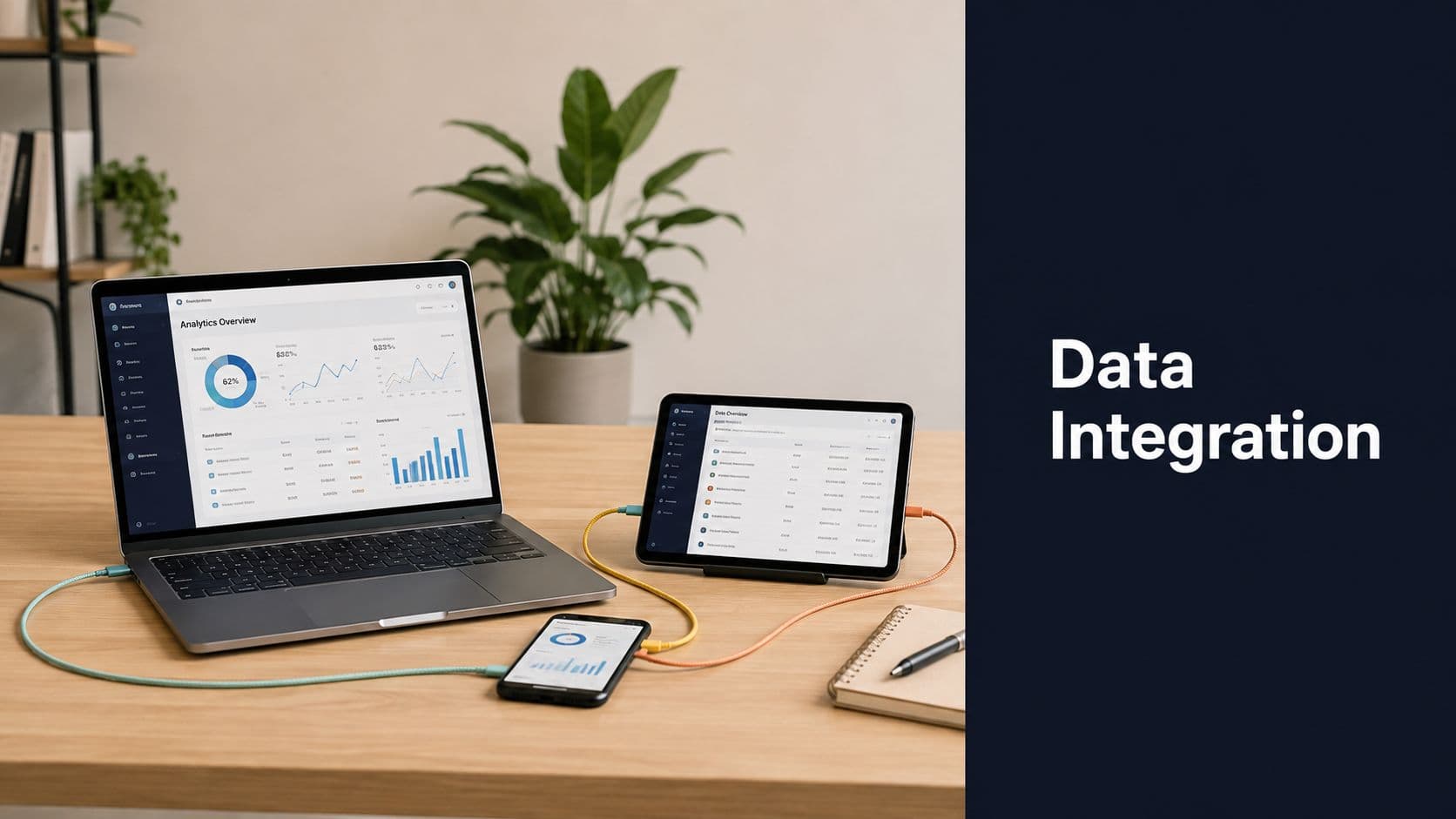
Multi-source data integration combines at least two distinct data sources into one unified dataset, giving product teams a more complete view of customer behavior. That unified view helps prevent isolated support, sales, and usage signals from distorting churn and expansion decisions.
A common SaaS warning sign looks familiar. Support reports a growing complaint about a workflow, sales hears prospects asking for a related capability, and product analytics show that existing customers barely use the feature involved. Each team sees a partial truth. The business still has to decide whether the issue threatens retention, represents an expansion opportunity, or is mostly noise.
Disconnected systems make that decision harder. A ticketing platform captures customer language, call recordings preserve commercial context, and behavioral logs reveal what users do. Multi-source data integration connects those signals so product teams can evaluate an issue against customer identity, usage, account value, and business outcome instead of treating every record as an isolated event.
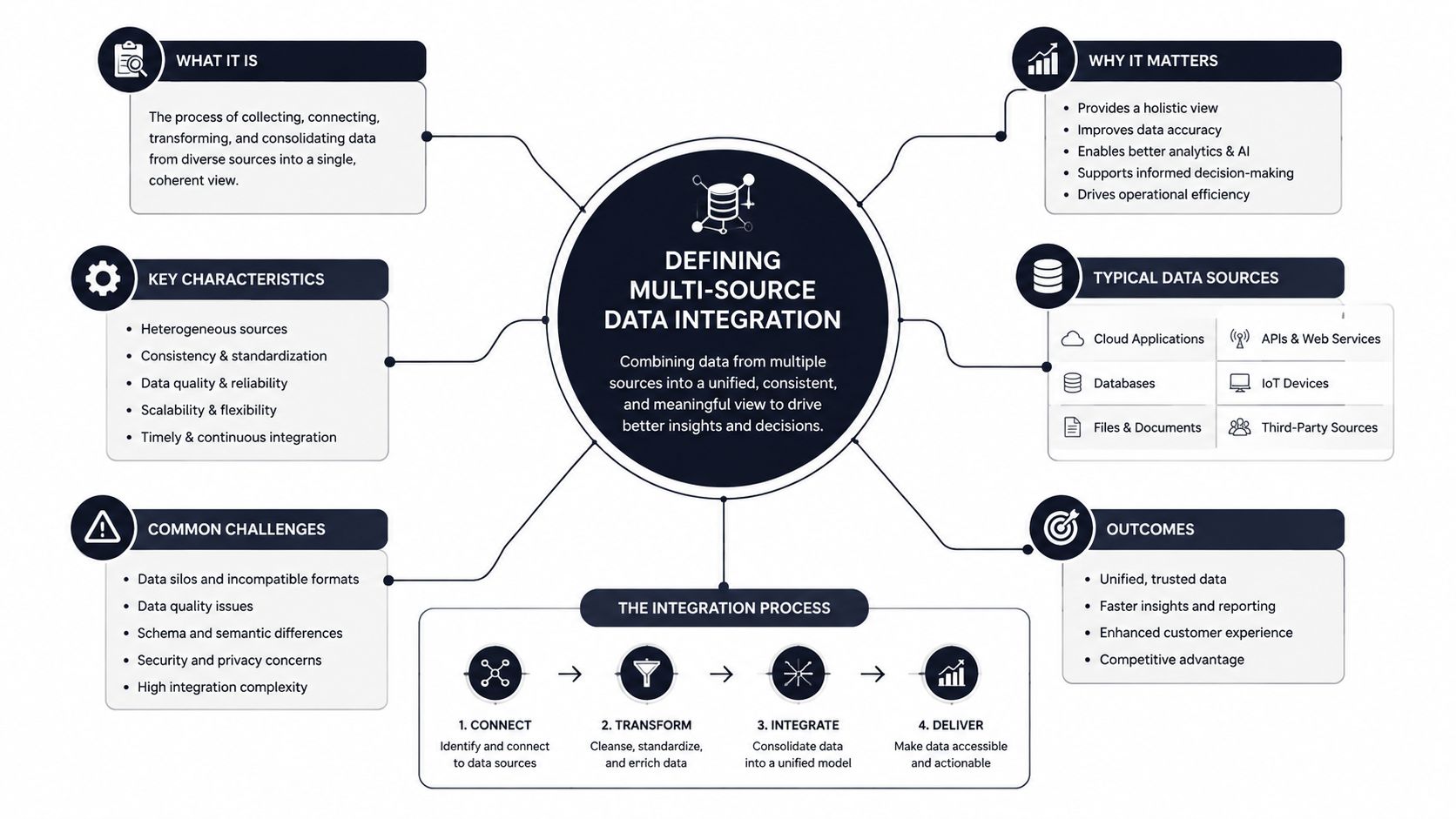
Defining Multi-Source Data Integration
The UNECE defines data integration as combining data from at least two different sources into a dataset, with the result always being an integrated dataset. Its guidance also connects integration to the Generic Statistical Business Process Model, meaning integration can happen throughout development, production, and dissemination, not only at the end of a pipeline. The UNECE discussion paper on data integration provides a useful baseline because it separates genuine integration from simple connectivity.
A connector can move records from Zendesk into a warehouse. A database link can let one system query another. Neither action, by itself, creates a coherent customer signal. Integration requires teams to align meaning, timing, identifiers, formats, and conflicting values so the resulting dataset can support a decision.
Collection is not integration
A single-source approach may be perfectly suitable for a narrow question. Product analytics can show feature adoption, while a CRM can show renewal status. The problem begins when a team treats one system as the complete account of customer health.
For product intelligence, a unified record might combine:
- Qualitative feedback: Support tickets, chat transcripts, and call notes describe friction in the customer's own language.
- Commercial context: CRM records connect requests to account ownership, renewal activity, and expansion conversations.
- Behavioral evidence: Usage metrics show whether the affected workflow is active, abandoned, or concentrated among valuable accounts.
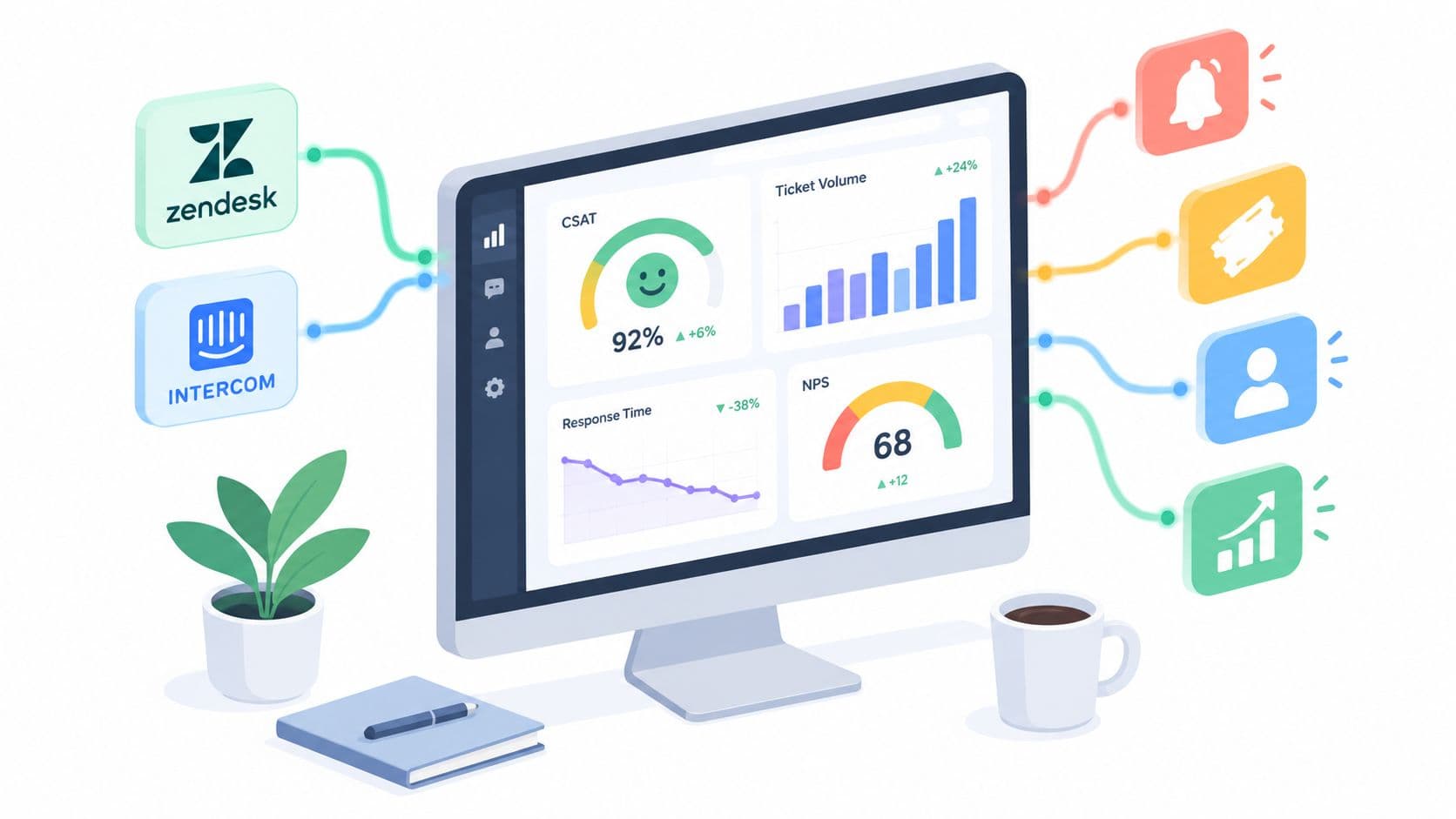
SigOS is one example of a product-intelligence workflow that connects feedback sources and analytics platforms, including Zendesk, Intercom, Mixpanel, and Amplitude, to combine these signals into a shared view. The practical benefit isn't the number of connectors. It's the ability to ask whether a repeated complaint correlates with declining usage, an open renewal risk, or an expansion conversation.
Practical rule: A unified dataset is only useful when every field has a defined meaning, owner, freshness expectation, and conflict policy.
The historical shift toward multi-source statistics reflects the same product problem. National statistical offices moved beyond single-source outputs because combining surveys, administrative records, and other big-data sources can produce more detailed and timely results, reduce respondent burden, and lower processing costs, as described in the UNECE-linked discussion paper. Product teams face a comparable choice: preserve siloed reports, or integrate enough evidence to understand what customers experience and do.
Common Integration Architectures and Patterns
Architecture determines where data is transformed, how much raw history is preserved, and who owns the logic that turns source records into usable product signals. The two patterns commonly compared are ETL, extract, transform, load, and ELT, extract, load, transform.
With ETL, the pipeline extracts records from systems such as Salesforce, Zendesk, and a product database, transforms them in an intermediate layer, then loads the curated output into a warehouse. This can enforce a clean structure before storage and may suit tightly controlled reporting environments. The cost is rigidity. When product leaders need a new interpretation of call topics or account health, engineers may have to modify transformation jobs before the data becomes available.
ELT loads source data first and transforms it inside the destination environment. That preserves raw records for later analysis and lets analysts or analytics engineers create new models without rebuilding ingestion. For product intelligence, ELT often works better when teams expect changing questions, because the original ticket, event, or account record remains available for reprocessing.
Choosing the pattern
| Decision factor | ETL | ELT |
|---|---|---|
| Transformation timing | Before warehouse loading | After loading |
| Raw-data retention | Often limited unless designed explicitly | Naturally supports raw landing layers |
| Change tolerance | More controlled, potentially slower to adapt | More flexible, with stronger warehouse dependency |
| Main risk | Business logic becomes embedded in pipeline code | Poorly governed raw data creates inconsistent models |
The choice isn't ideological. Sensitive data may require transformation or filtering before it reaches a shared environment. Conversely, hiding raw feedback too early can remove context that later helps resolve a churn signal. Teams should decide which fields require pre-load controls and which transformations belong in reusable downstream models.
The field has changed since ETL tools made multi-source extraction and standardization practical in the 1990s, a milestone described in this historical overview of data integration. The same source cites a 2019 market pulse survey in which companies drew from an average of over 400 data sources for BI and analytics, while more than 20% used 1,000 or more. That scale explains why point-to-point scripts become an operating problem rather than a temporary engineering shortcut.
For teams documenting dependencies and ownership visually, SigOS data architecture diagrams can help turn an abstract integration design into something product, engineering, and security stakeholders can review together. Modern architectures may include warehouses, lakehouses, APIs, event buses, and domain-owned data products. The durable principle is separation of concerns: connectors should retrieve data, transformation models should define meaning, and product metrics should expose business impact.
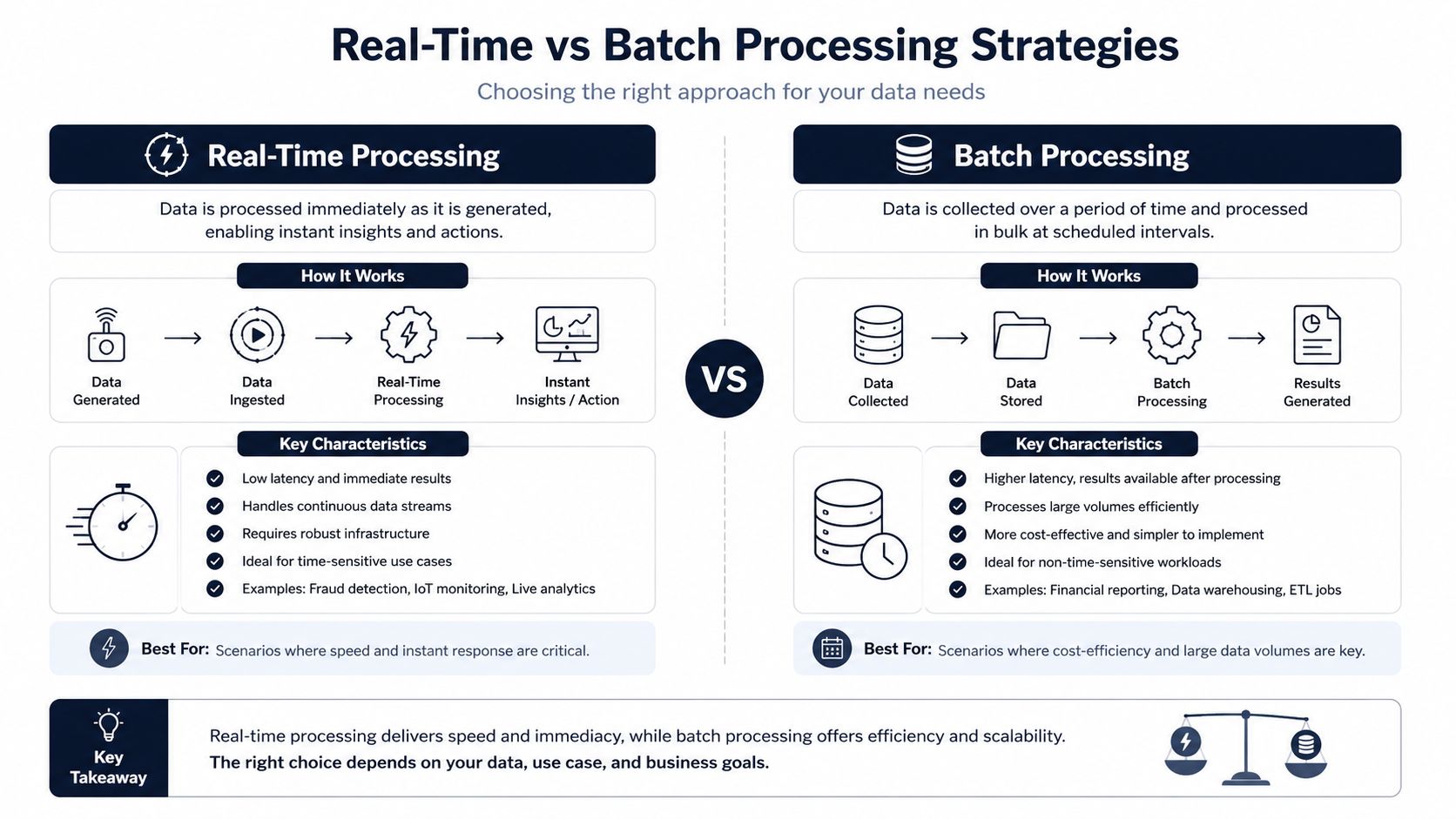
Real-Time vs Batch Processing Strategies
Product teams often overbuild latency. They stream every event because “real time” sounds valuable, then discover that most decisions happen in a weekly planning meeting. The right ingestion strategy depends on how quickly a change must influence an action.
Batch processing moves data on a schedule. It suits historical trend analysis, periodic usage summaries, roadmap reporting, and jobs where a small delay doesn't change the decision. A nightly aggregation of feature adoption can support planning without forcing the team to operate a complex event system.
Change Data Capture, or CDC, records inserts, updates, and deletes from a source database. It sits between full batch reloads and event streaming. CDC can be useful when account status, subscription state, or usage records need to arrive soon after a transaction changes, while the team still wants a structured record-change pipeline.
Streaming processes events continuously. It fits operational alerts, live workflow triggers, and situations where a product or success team must react while a customer is active. A sudden cluster of errors combined with a drop in usage could justify a near-immediate alert, but only if the business has a clear owner and response process.
Match latency to the decision
| Business need | Suitable approach | Why |
|---|---|---|
| Roadmap trend analysis | Batch | Historical completeness matters more than immediate arrival |
| Account-state changes | CDC | Record-level updates should flow without repeated full extracts |
| Churn-risk intervention | Streaming or CDC | Recent behavior may affect an active customer conversation |
| Executive reporting | Batch | Stable definitions and reconciliation matter more than event speed |
The difficult part is coordinating different clocks. Support tickets may arrive immediately, sales-call transcripts may be processed later, and usage events may be available continuously. A product signal should preserve event time, ingestion time, and source freshness so an analyst doesn't mistake delayed processing for customer behavior.
Real-time data analytics guidance from SigOS is relevant when teams are deciding whether immediacy changes the action they intend to take. If nobody can respond to an alert, streaming adds operational burden without adding product value.
A practical design often combines methods. Stream high-value behavioral events, use CDC for transactional systems, and batch slower qualitative processing or historical backfills. This hybrid model avoids forcing every source into one latency class.
The following video provides another visual explanation of the trade-offs between processing modes:
Key Challenges in Schema Mapping and Deduplication
Schema matching is necessary, but it isn't enough. Two systems may both contain a field called customer_id while using different identifier rules, scopes, or update schedules. A support platform may identify an organization by workspace, a CRM by account, and a product database by subscription or user.
MaDI-Bench frames end-to-end integration as a joint problem involving schema matching, value normalization, entity matching, and conflict resolution. Its benchmark defines 20 integration tasks across five domains and evaluates coverage, consistency, and correctness, rather than relying only on pairwise match accuracy. The MaDI-Bench benchmark is valuable because it mirrors what product teams discover after ingestion appears to work: aligned columns can still produce incomplete or contradictory customer entities.
The identity problem
Entity resolution determines whether records from different systems describe the same person, account, workspace, or product object. Deduplication isn't just deleting rows with similar names. It requires a hierarchy of evidence, such as stable IDs, verified domain relationships, email patterns, account mappings, timestamps, and source ownership.
A sensible pipeline should:
- Normalize values: Standardize casing, phone formats, country labels, plan names, and category vocabulary before matching.
- Block candidates: Compare records within plausible groups rather than attempting every possible pair.
- Score matches: Use thresholds that distinguish confident links from records requiring review.
- Resolve conflicts: Define which source wins for each field, or retain provenance when no source is authoritative.
- Measure entity quality: Track per-entity recall and per-entity-pair imprecision against ground truth where available.
The entity-resolution research linked in this study of large-scale ER evaluation emphasizes per-entity recall and per-entity-pair imprecision, while also showing why source latency affects integration cost and selection. A fast source can dominate a merged view even when a slower source contains more valuable or accurate context.
Data-quality warning: A pipeline that loads every source successfully can still be wrong at the customer level.
Migration planning exposes these risks early. Teams moving fragmented databases can use a founders database migration guide to think through inventory, mapping, validation, and cutover dependencies before they add product-intelligence logic. The same discipline applies when integrating SaaS sources that remain live after the first connection.
For product teams, the business consequence is direct. Duplicate accounts can inflate expansion opportunity, stale ownership can route a risk to the wrong person, and conflicting plan fields can corrupt churn analysis. Treat match quality and provenance as product requirements, not merely cleanup tasks. SigOS data quality guidance offers a useful reference for framing these issues around decision reliability.
Governance, Security, and Data Mesh Principles
More sources create more than technical complexity. They expand the number of owners, permissions, retention policies, definitions, and failure paths that a product team must manage. Industry coverage describes schema drift as normal, notes that teams commonly combine batch with near-real-time feeds, and treats catalogs, lineage, and rules-as-code as baseline capabilities. Domo's discussion of integrating data from multiple sources captures that operational reality.
A data catalog tells teams what exists and who owns it. Lineage shows how a churn metric was produced, including the source fields and transformations behind it. Rules-as-code makes validation and governance executable rather than leaving critical decisions in undocumented meeting notes.
Data mesh without governance theater
Data mesh principles treat data as a product and place ownership closer to the domain that understands it. Support may own ticket semantics, product analytics may own event definitions, and revenue operations may own account and contract fields. That distribution can improve context, but it doesn't eliminate the need for shared standards.
A workable model combines local ownership with central guardrails:
- Domain ownership: The team closest to a source defines its meaning, quality expectations, and change process.
- Common contracts: All domains publish identifier rules, freshness expectations, and field-level definitions.
- Discoverability: Catalogs and lineage let analysts find trusted datasets without reverse-engineering pipelines.
- Policy enforcement: Automated checks block or quarantine invalid records before they influence customer scoring.
- Access boundaries: Permissions should follow user roles and business purpose, especially when support conversations or call transcripts contain sensitive information.
Security needs to cover the entire path, from source authentication to storage, processing, dashboards, and downstream actions. Encrypt connections and stored data, minimize copied fields, restrict access by role, and log who accessed which customer context. A product manager doesn't need unrestricted access to every transcript just because the integration can technically provide it.
The proptech data integration strategy from BatchData is a useful adjacent resource because it highlights the importance of golden records, source quality, and reconciliation in a domain with fragmented records. Product intelligence requires the same restraint: a “golden customer” record should preserve source provenance and uncertainty rather than hiding disagreement behind a polished profile.
Governance principle: The safest integrated dataset isn't the one with the most fields. It's the one whose access, ownership, freshness, and meaning are visible.
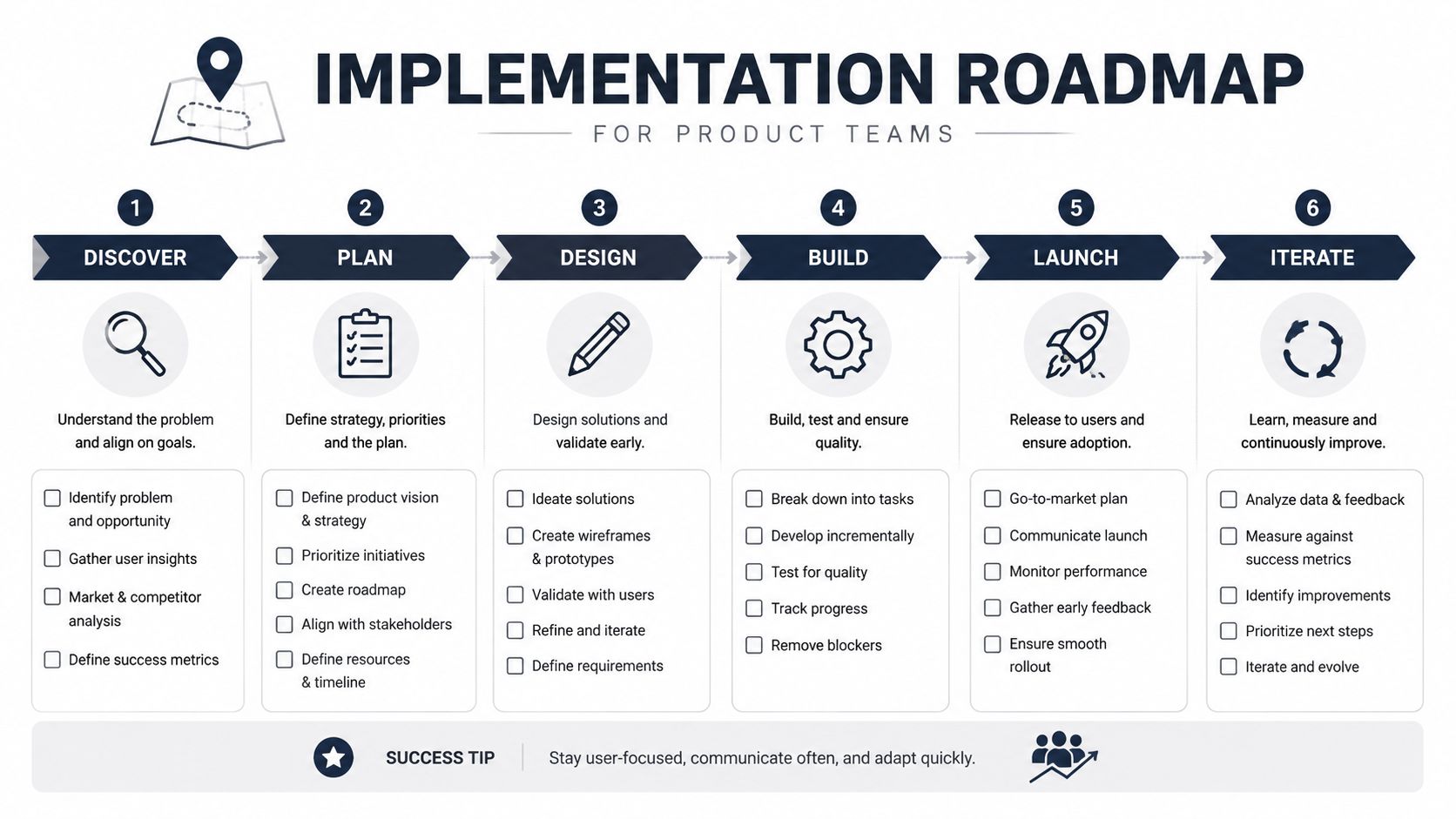
Implementation Roadmap for Product Teams
Start with one decision, not one connector. “Integrate all customer data” is too broad to govern and too vague to measure. A better starting point is a question such as, which recurring product issue is associated with renewal risk, or which feature request appears in active expansion conversations and real usage gaps?
Build the first trusted signal
Use a staged roadmap:
- Discover the decision: Choose a churn, adoption, support, or expansion question with a clear owner.
- Inventory the sources: List the systems involved, their identifiers, owners, refresh behavior, and sensitive fields.
- Define the canonical entities: Decide how the pipeline represents accounts, users, workspaces, subscriptions, tickets, and product events.
- Map and normalize: Document field meanings, value conversions, timestamps, and source precedence before writing transformations.
- Validate against reality: Sample merged records with support, sales, success, and product stakeholders. Test whether the result reflects what they know about actual accounts.
- Operationalize and iterate: Add monitoring, lineage, match-quality checks, and a process for schema changes before expanding source coverage.
A product team should be able to answer a few readiness questions without searching through old tickets or undocumented scripts:
- Ownership: Who approves changes to each source and metric?
- Identity: Can the team reliably connect an account across CRM, support, and product systems?
- Freshness: Which decisions require streaming, CDC, or batch delivery?
- Quality: How will the team detect duplicates, missing values, stale records, and conflicts?
- Security: Which roles can see raw feedback, account value, or behavioral detail?
- Outcome: What action changes when the integrated signal becomes available?
Don't begin with an AI summary layer that conceals weak entity matching. Establish the customer model and source contracts first, then measure whether integrated signals improve prioritization, intervention quality, or roadmap decisions. The best first release may be a narrow, auditable workflow rather than a company-wide customer data platform.
Conclusion and Future Outlook
Multi-source data integration becomes strategically useful when it connects evidence to a decision. A support ticket alone expresses frustration. A sales call alone expresses intent. A usage log alone shows behavior. Combined carefully, those records can reveal that a high-value account is struggling with a workflow, that the same problem is blocking expansion, or that a loud request has little behavioral support.
The integration itself doesn't guarantee better decisions. Poor normalization can multiply duplicates, delayed sources can make a current account look healthy, and conflicting ownership fields can send an urgent issue to the wrong team. Product leaders should judge an integrated system by the quality of its merged entities, the transparency of its lineage, and the action it enables.
The direction of the market points toward consolidation and operating durability. Industry coverage describes a shift away from proliferating point-to-point connectors toward more durable integration platforms, while discussions of AI readiness increasingly emphasize governance, observability, and trustworthy multimodal dataflows. The Data Integration and AI Readiness Report from Matillion reflects this focus on what separates organizations prepared for AI from those still struggling to make their data dependable.
AI readiness starts with evidence
AI systems can summarize fragmented feedback quickly, but speed doesn't correct a bad customer identity or an outdated field. Agents and models need governed access to source context, clear semantic relationships, and controls that expose uncertainty. More sources can improve a signal when they answer different parts of the same business question. They can also add noise when teams connect data merely because it exists.
The practical future is therefore not “integrate everything.” It's a product intelligence layer that selects meaningful sources, keeps provenance visible, routes each source through the right latency model, and measures downstream decision quality. Platform consolidation may reduce connector sprawl, while agentic AI and automation may reduce manual triage, but neither replaces ownership or validation.
A senior product team should leave integration with a living contract: what each signal means, where it comes from, how fresh it is, who can access it, and which decision depends on it. That contract turns fragmented systems into an operating capability rather than another warehouse project.
SigOS connects feedback and analytics sources into a product-intelligence workflow that helps teams relate customer language to usage behavior, churn signals, expansion opportunities, and revenue impact. Visit SigOS to see how your team can turn disconnected customer evidence into a more reliable product prioritization process.
Keep Reading
More insights from our blog
Ready to find your hidden revenue leaks?
Start analyzing your customer feedback and discover insights that drive revenue.
Start Free Trial →