The 12 Best Product Analytics Software Tools for SaaS in 2026
Discover the 12 best product analytics software platforms of 2026. Compare features, pricing, and use cases to find the right tool for your team.
Choosing the right product analytics software is a critical decision that directly impacts your ability to understand user behavior, drive adoption, and ultimately grow your business. Making the wrong choice can lead to months of wasted engineering effort, unreliable data, and a team that distrusts its own metrics. This guide is designed to prevent that outcome by providing a direct, no-nonsense evaluation of the top platforms available today.
We've done the heavy lifting to help you find the best product analytics software for your specific needs, whether you're a product manager at a growing SaaS company, a data analyst seeking deeper insights, or a CTO evaluating AI-driven solutions. Forget generic marketing copy and surface-level feature lists. Instead, this article delivers a practical breakdown of each tool's real-world strengths and weaknesses.
Inside, you'll find a detailed analysis of 12 leading platforms, including SigOS, Amplitude, Mixpanel, and Heap. For each tool, we provide:
- Concise pros and cons for a quick assessment.
- Ideal use-cases to match the software to your team's goals.
- Pricing pointers to help you understand the potential investment.
- Direct links and screenshots for a closer look.
This resource is structured to be scannable and actionable, allowing you to quickly compare options based on critical evaluation criteria like data accuracy, integration capabilities, and overall return on investment. Let's get straight to the analysis and find the platform that will give your team the clarity it needs to build better products.
1. SigOS
SigOS earns its top spot by fundamentally changing the product analytics game from a reactive, data-sifting exercise to a proactive, revenue-focused discipline. Instead of just tracking clicks and user flows, this AI-driven platform connects qualitative customer signals-like support tickets, chat logs, and sales calls-with quantitative product usage data. The result is a unified view that doesn't just show what users are doing, but explains why and quantifies the financial impact of their experience. This makes it an exceptional choice for B2B SaaS companies determined to align product development directly with business outcomes.
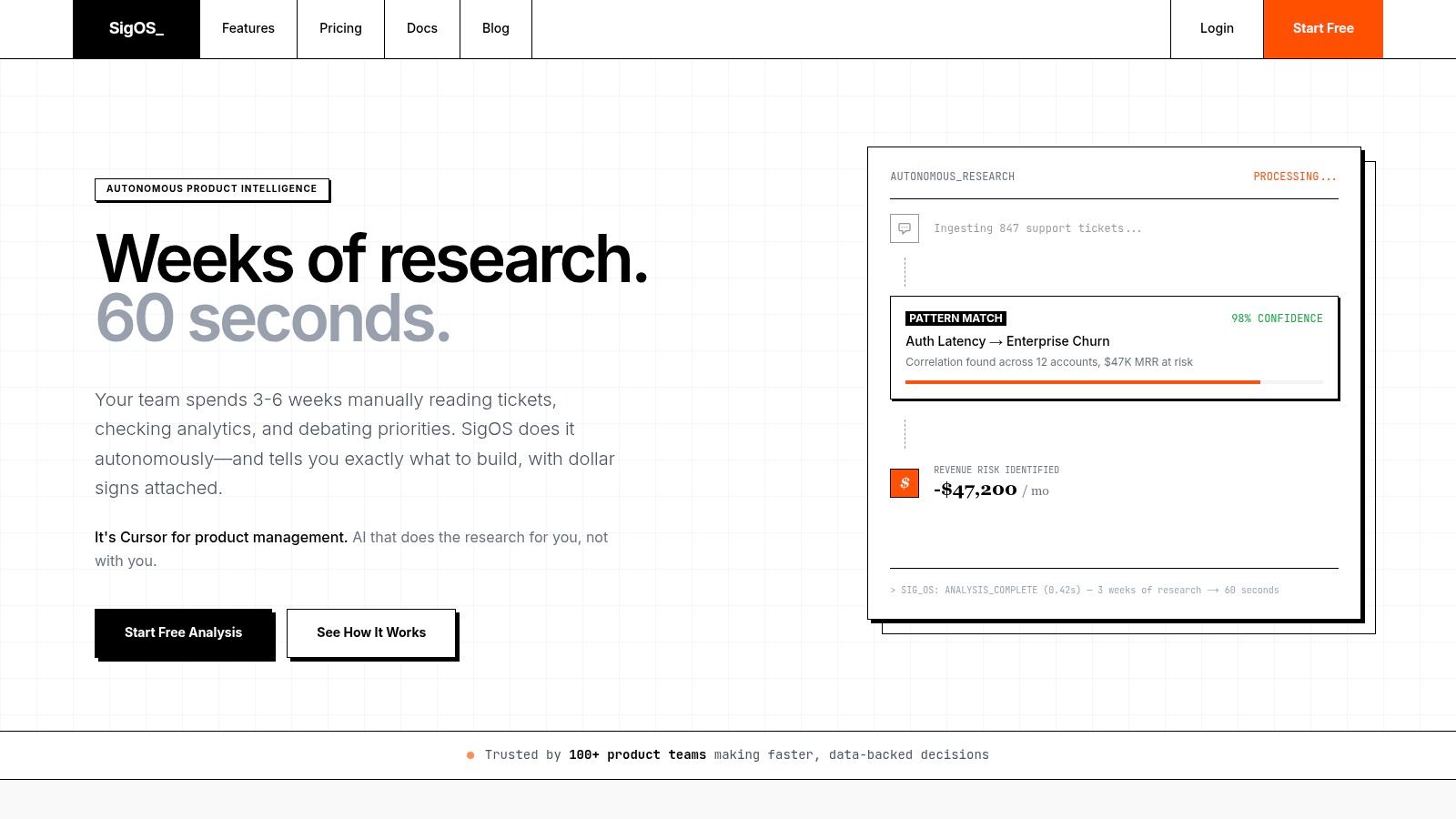
The core differentiator is its ability to translate raw feedback into a prioritized, revenue-driving work queue. For product managers, this means the daily dashboard automatically flags the top bugs costing the company real money or the specific feature requests holding up six-figure deals. The continuous behavioral analysis engine works around the clock, surfacing emergent churn risks and high-value expansion opportunities in real-time. This is not just another data visualization tool; it is an opinionated platform designed to guide decision-making.
Key Strengths & Use Cases
SigOS stands out for its direct workflow automation. Native integrations with tools like Zendesk, Intercom, Jira, and GitHub mean that when the AI identifies a critical issue, it can automatically generate a ticket complete with a calculated revenue-impact score. This closes the loop between insight and action, ensuring engineering resources are always focused on the highest-value work.
- Best For: SaaS product managers, customer success leaders, and growth teams who need to justify their roadmap with hard numbers. It's also a powerful asset for CTOs looking to connect engineering efforts directly to revenue preservation and growth.
- Implementation: Setup requires connecting multiple data sources, so its effectiveness is tied to the quality and completeness of your customer interaction and product usage data.
- Privacy Focus: A security-first approach includes encryption and a strict policy of never retraining models on customer data, addressing key compliance and data privacy concerns for enterprise clients.
Pricing and Access
SigOS does not list public pricing, which is common for platforms targeting mid-market and enterprise clients. Access requires scheduling a demo through their website to discuss specific needs and receive a custom quote. This sales-led approach ensures the solution is a good fit before purchase but means smaller teams may find it difficult to evaluate quickly.
Website: https://sigos.io
| Pros | Cons |
|---|---|
| Revenue-first prioritization directly quantifies the dollar impact of bugs and feature requests. | No public pricing requires engaging with the sales team for a demo and quote. |
| Fast, accurate analysis with 87% correlation accuracy and sub-minute processing for quick insights. | Initial setup requires integrating multiple data sources; value depends on data quality. |
| Seamless workflow automation creates tickets in Jira or Linear with revenue data attached. | Niche focus may be less suitable for teams needing traditional, broad-based event-tracking alone. |
| Strong privacy and security by design, with a policy never to retrain models on customer data. |
2. Amplitude
Amplitude has established itself as a front-runner by expanding from a pure product analytics tool into an integrated digital analytics platform. It combines event-based analysis with experimentation, feature flagging, and session replay, offering a consolidated solution for growth-focused teams. This all-in-one approach allows product managers to not only identify user behavior patterns but also to immediately test hypotheses and roll out features within the same environment, significantly shortening the feedback loop.
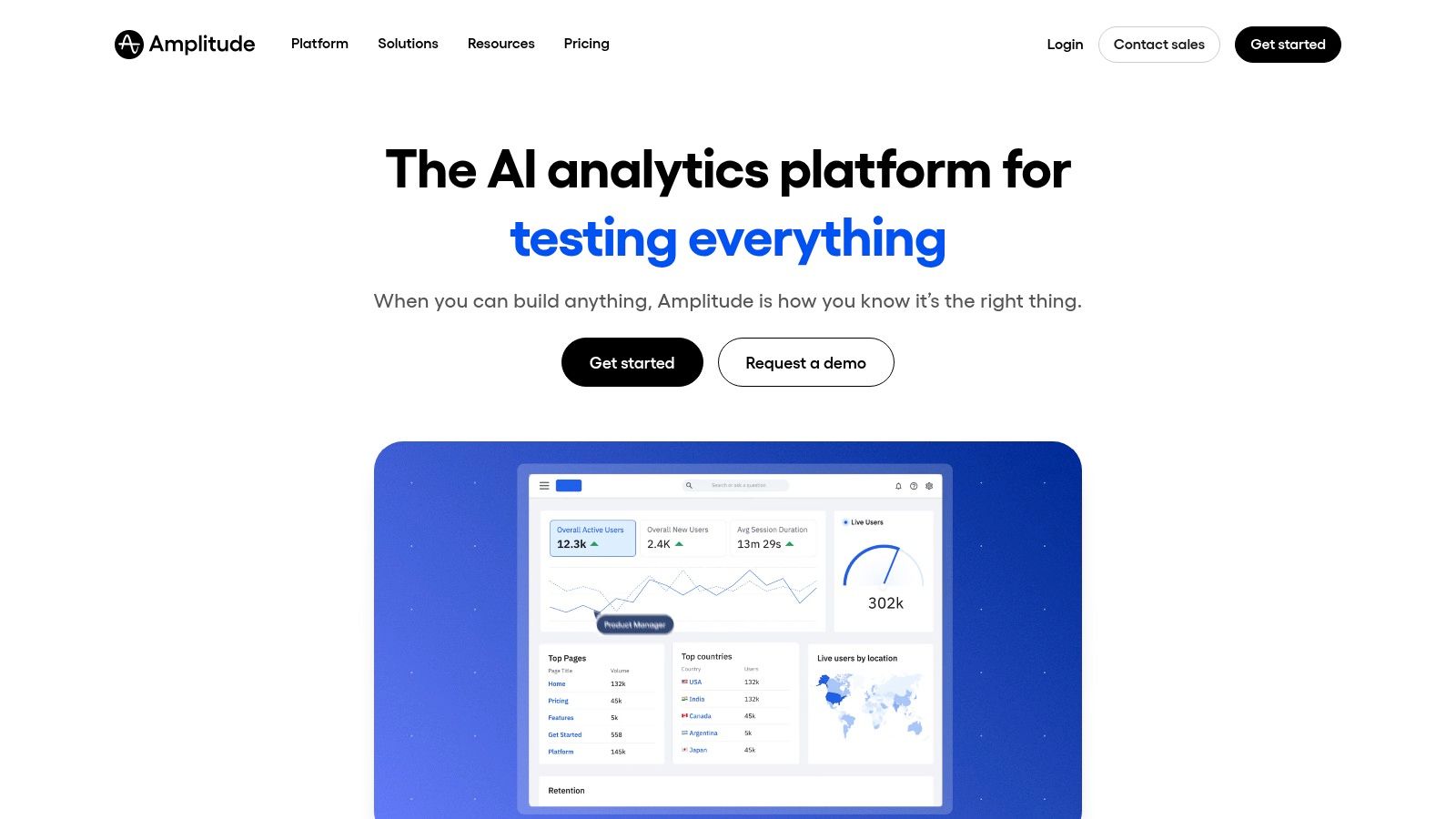
The platform is particularly effective for Product-Led Growth (PLG) companies, providing strong templates and clear user journey visualizations that help teams pinpoint friction and uncover opportunities for activation and retention. While its free plan is generous, the self-serve Plus plan's pricing is based on Monthly Tracked Users (MTUs), which can sometimes be less predictable than event-based models. For product teams looking to build a strong foundation, the principles of analytics for product managers are well-supported by Amplitude's feature set.
Key Evaluation
- Best For: Growth-stage SaaS companies and PLG teams needing a unified platform for analytics and experimentation.
- Pricing Model: Offers a free starter plan. Paid plans are based on MTUs, requiring sales contact for Growth/Enterprise tiers.
- Pros: Combines core analytics, A/B testing, and session replay in one interface; excellent onboarding and templates.
- Cons: MTU-based pricing can scale unpredictably; advanced data governance and experimentation features are gated behind higher-tier plans.
Website: https://www.amplitude.com
3. Mixpanel
Mixpanel has long been a favorite for its speed and self-serve, event-based analytics, empowering product teams to answer complex behavioral questions without writing SQL. Its core strength lies in its intuitive interface for building funnels, retention charts, and cohort analyses, which helps product managers quickly identify drop-off points and user trends. The platform is especially well-suited for both B2B and B2C SaaS companies that need fast, reliable answers about feature adoption and user engagement.
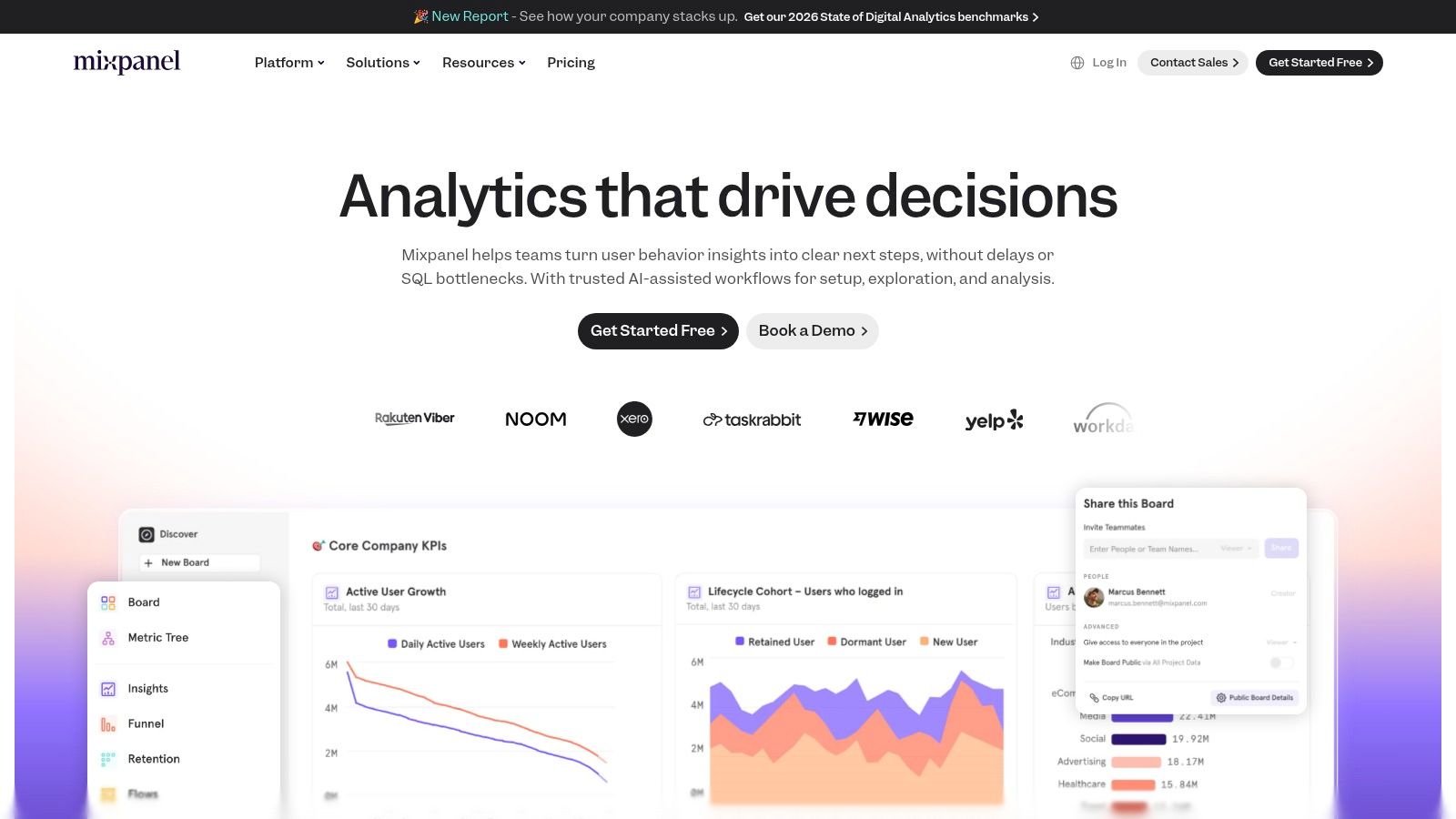
Recently, Mixpanel added Spark, an AI-powered query builder, and optional session replay to its toolkit, further reducing the barrier to entry for non-technical users. This focus on accessibility makes it a strong contender among the best product analytics software options for teams aiming for widespread data literacy. Its event-based pricing model is transparent, though teams should be mindful of tracking plans to avoid unexpected overages. Properly implemented, teams can use behavior analytics to drive meaningful product decisions with Mixpanel's powerful reporting.
Key Evaluation
- Best For: Product managers and teams in SaaS who need quick, self-serve insights without SQL dependency.
- Pricing Model: Offers a generous free plan. Paid plans are based on monthly event volume, with transparent pricing.
- Pros: Extremely fast and intuitive report building; transparent event-based pricing model; strong core analytics for funnels and retention.
- Cons: Event overages can become costly if instrumentation is not carefully planned; advanced data governance features are limited to the Enterprise tier.
Website: https://mixpanel.com
4. Heap (now part of Contentsquare)
Heap built its reputation on a powerful "autocapture" feature, which automatically tracks every user interaction-clicks, swipes, and form submissions-without requiring manual event tagging upfront. This approach provides a complete dataset from day one, enabling teams to perform retroactive analysis on behaviors they hadn't thought to track initially. Now part of the Contentsquare suite, its capabilities are being integrated into a broader digital experience analytics platform, combining quantitative data with qualitative insights like session replays and heatmaps.
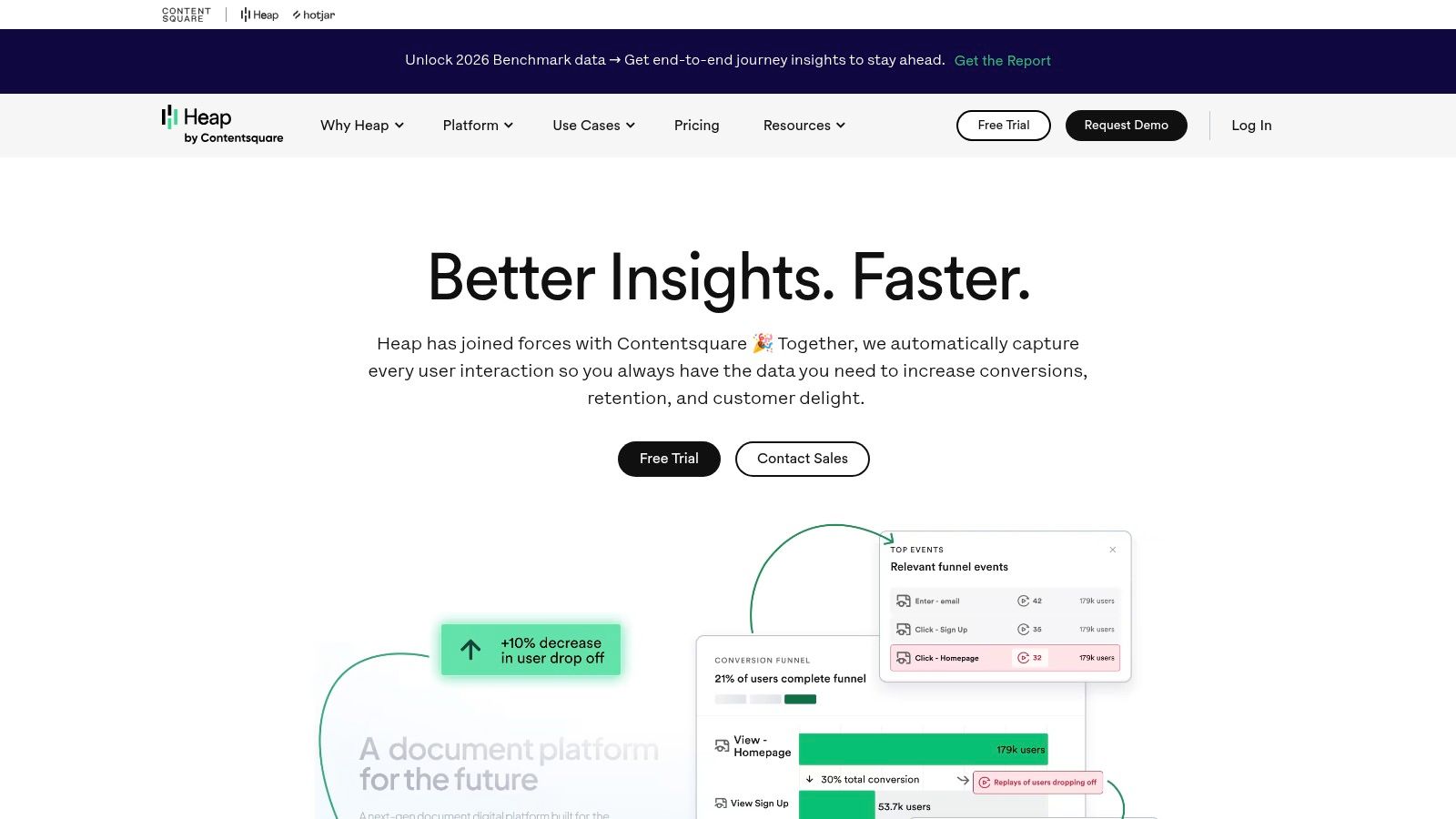
This platform excels for teams that need fast time-to-value and the flexibility to answer new questions without waiting for engineering resources to implement new tracking code. Its B2B-focused account analytics and engagement matrix are particularly useful for SaaS companies managing complex customer relationships. With Heap Connect, data can also be synced to a warehouse for deeper analysis, which is useful when conducting an advanced study like a detailed what is a cohort analysis investigation. The ongoing integration with Contentsquare means prospective users should evaluate how the product roadmap aligns with their long-term needs.
Key Evaluation
- Best For: Teams wanting immediate, comprehensive data without a heavy initial setup, especially in B2B SaaS.
- Pricing Model: Offers a free plan for up to 10k monthly sessions. Paid plans are quote-based and tied to session volume.
- Pros: Autocapture eliminates the need for upfront tagging, enabling retroactive analysis; strong account-level analytics for B2B.
- Cons: Session replay is an add-on for mid-tier plans; pricing can become expensive at scale and lacks transparency; the integration into Contentsquare may introduce platform changes.
Website: https://www.heap.io
5. PostHog
PostHog carves out a unique space in the product analytics market by combining an open-source foundation with a powerful, integrated suite of tools. It bundles product analytics, session replay, feature flags, and A/B testing into a single platform, making it a strong contender for developer-centric teams who value transparency and control. This all-in-one approach is particularly appealing to startups and scale-ups wanting to avoid the complexity and cost of stitching together multiple services.
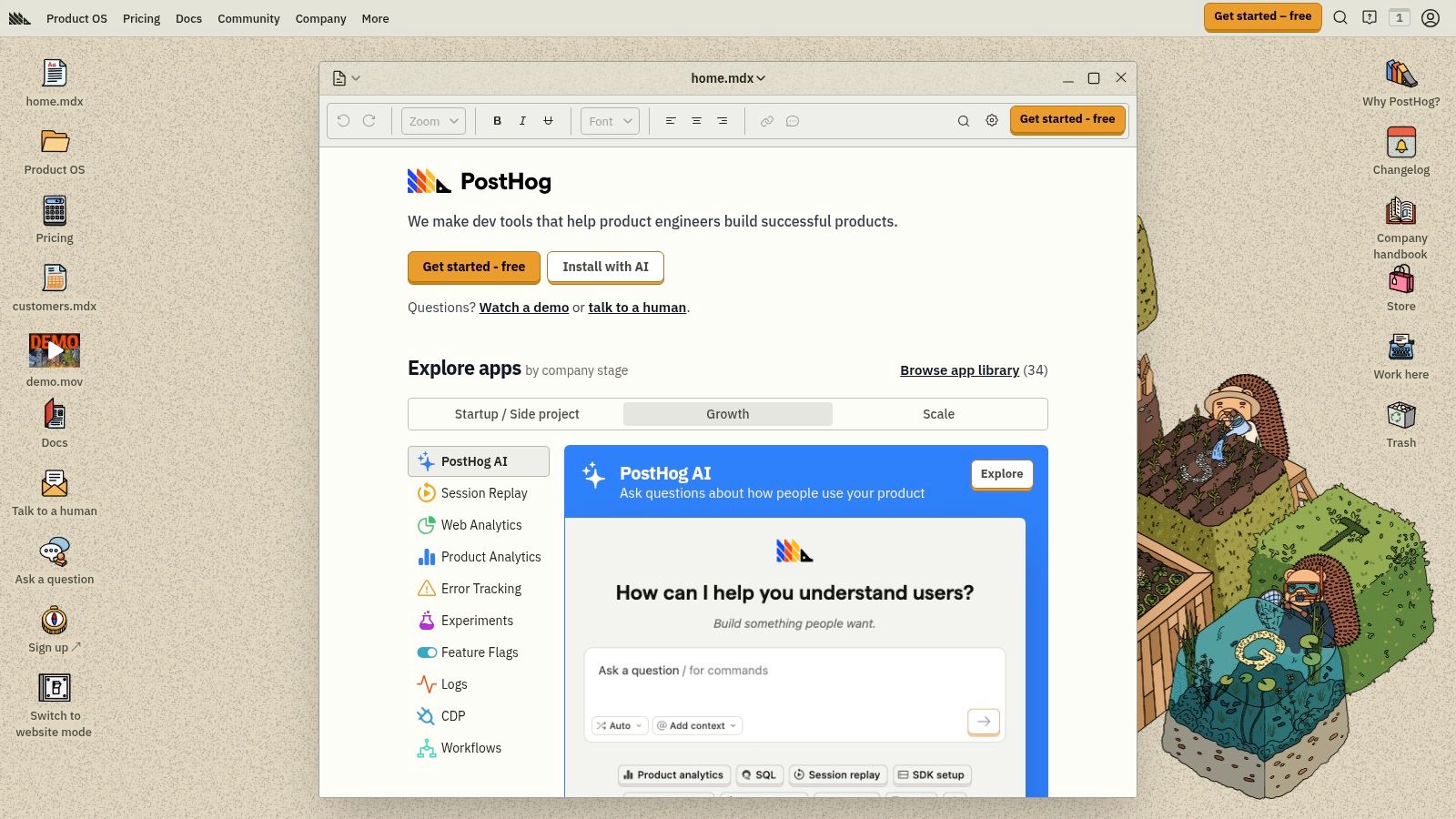
The platform’s major differentiator is its deployment flexibility; teams can use PostHog's cloud service or self-host the entire platform for maximum data control and privacy. Its pricing model is also a key draw, with generous free tiers for each product and transparent, usage-based pricing that scales predictably. For technical teams seeking one of the best product analytics software solutions that they can deeply integrate and manage themselves, PostHog presents a compelling, cost-effective alternative to closed-source competitors.
Key Evaluation
- Best For: Developer-led teams, startups, and companies that require data ownership via self-hosting or want an all-in-one tool with a generous free plan.
- Pricing Model: Offers a very generous free tier for each product. Paid plans are usage-based with transparent, per-event pricing that scales with use.
- Pros: Open-source with a self-hosting option for full data control; transparent, granular pricing is easy to start with and scale; strong developer ergonomics and API access.
- Cons: Requires thoughtful event governance to avoid noisy data and unexpected costs at high volumes; advanced support SLAs are gated behind higher-tier plans.
Website: https://posthog.com
6. Pendo
Pendo distinguishes itself by merging product analytics with in-app user engagement tools, creating a platform focused on both understanding and influencing user behavior. It's designed for teams who want to directly connect insights to action, offering features like in-app guides, surveys, and NPS feedback loops alongside core analytics. This dual capability makes it a strong choice for mid-market and enterprise companies where cross-functional alignment between product, marketing, and customer success teams is essential for driving adoption and onboarding.
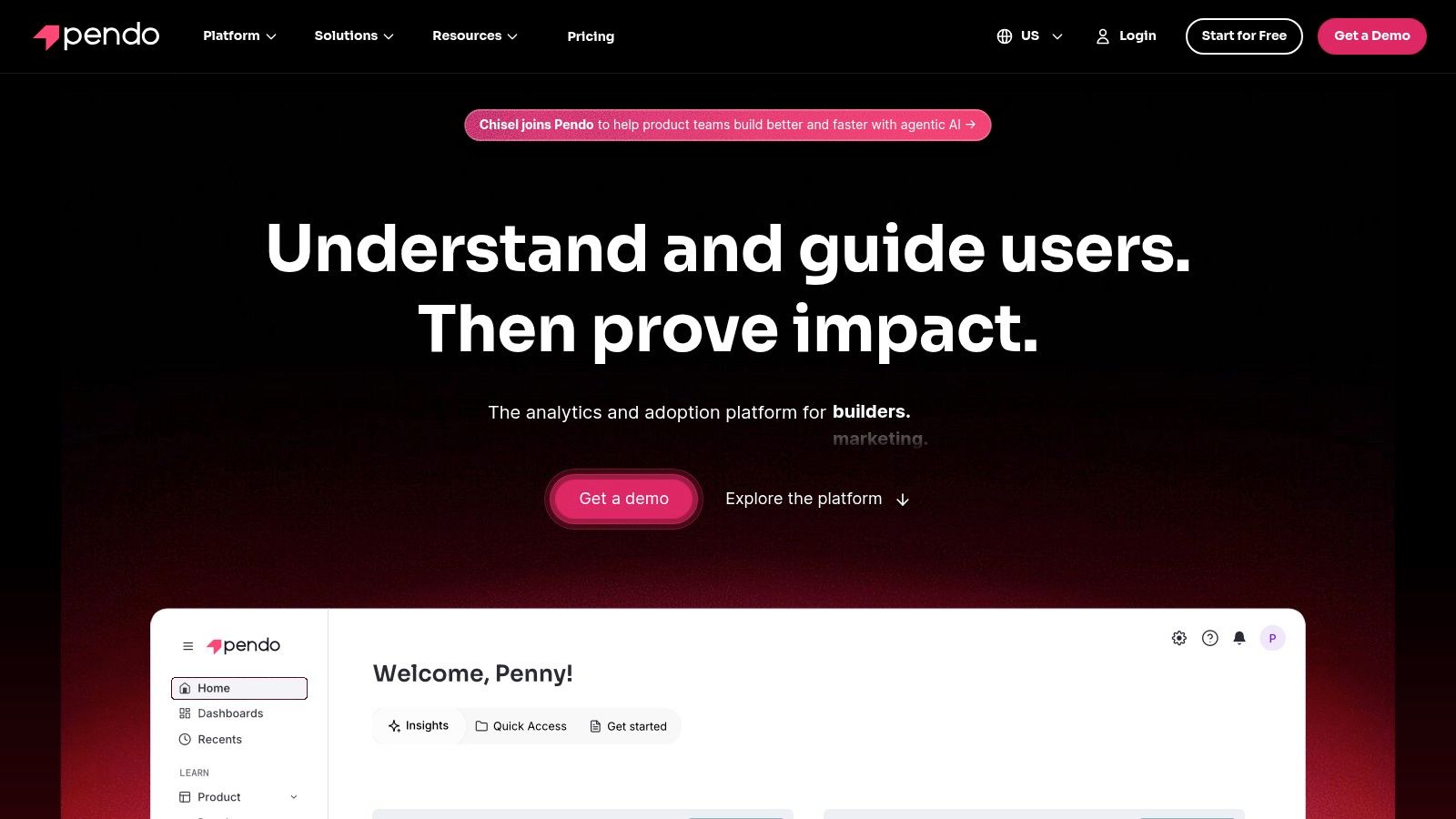
The platform’s strength lies in its ability to close the loop between data and communication. A product manager can identify a friction point in the user journey and immediately deploy a targeted guide or survey to that user segment without leaving Pendo. While its all-in-one approach is powerful, the pricing for paid tiers is sales-led and can become a significant investment as Monthly Active Users (MAUs) grow. The free plan is useful for initial validation but is capped at 500 MAUs, making it restrictive for products with an active user base looking for the best product analytics software.
Key Evaluation
- Best For: Enterprise and mid-market teams needing to align product analytics with customer success and onboarding initiatives.
- Pricing Model: Offers a limited free plan (up to 500 MAU). Paid plans require a custom quote from sales.
- Pros: Effectively combines analytics with in-product engagement tools; strong for improving user onboarding and collecting direct feedback.
- Cons: Paid plans can be expensive, especially at scale; the 500 MAU cap on the free plan limits its utility for growing products.
Website: https://www.pendo.io
7. Gainsight PX
Gainsight PX carves out a specific niche by merging product analytics with customer success workflows. It's designed for organizations, particularly B2B SaaS, that want to directly connect product usage data to customer health scores and retention efforts. The platform excels at providing account-level views, enabling product and customer success teams to collaborate on driving adoption, identifying at-risk accounts, and deploying in-app engagements like guides and surveys to influence user behavior. This makes it a powerful choice when analytics must inform proactive customer management.
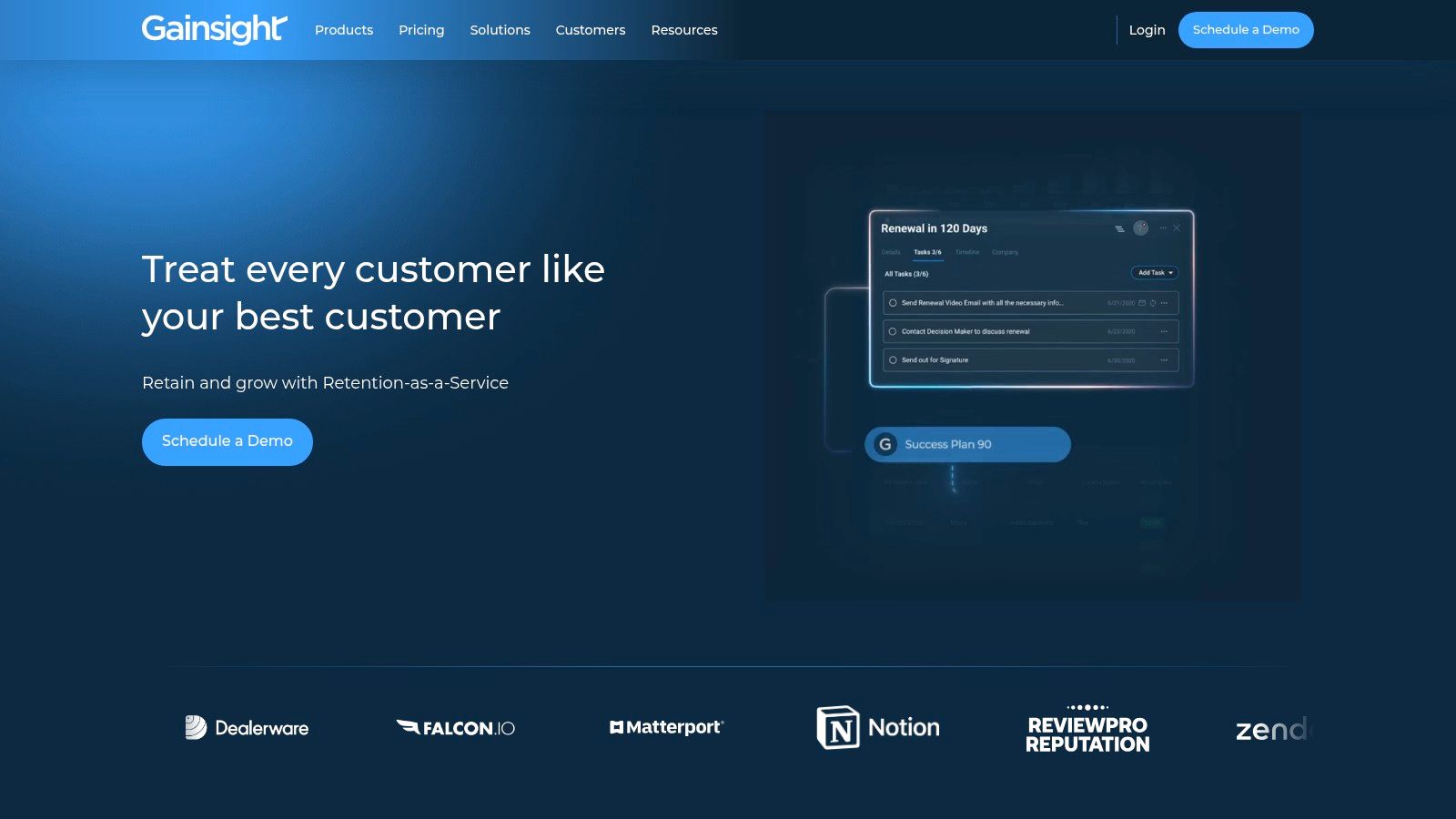
Unlike pure-play analytics tools, Gainsight PX’s strength is its integration into the broader Gainsight ecosystem, which includes customer success, customer experience, and renewal management. Its autocapture capabilities and path analysis are solid, but its primary differentiator is how it turns insights into action within CS playbooks. This makes it one of the best product analytics software options for companies where the product is the main driver of the overall customer relationship and long-term value.
Key Evaluation
- Best For: B2B SaaS companies where product adoption is tightly linked to customer health and retention, especially those already using the Gainsight ecosystem.
- Pricing Model: Quote-based only. Pricing is typically packaged for multi-product organizations and requires sales consultation.
- Pros: Deep alignment with Customer Success goals (health scores, adoption metrics); strong account-level analytics for B2B use cases; includes in-app engagement tools.
- Cons: The platform can feel heavy for teams needing only product analytics; quote-only pricing and implementation require significant stakeholder coordination.
Website: https://www.gainsight.com/product-experience
8. FullStory
FullStory carves out a unique position in the product analytics space by leading with high-fidelity session replay and then layering quantitative analysis on top. This approach flips the typical model, allowing product and support teams to first observe the "why" behind user friction through pixel-perfect recordings before digging into the "what" with funnels, conversion analysis, and journey mapping. This qualitative-first methodology is particularly effective for identifying and prioritizing UX bugs and rage clicks that quantitative tools alone might miss.
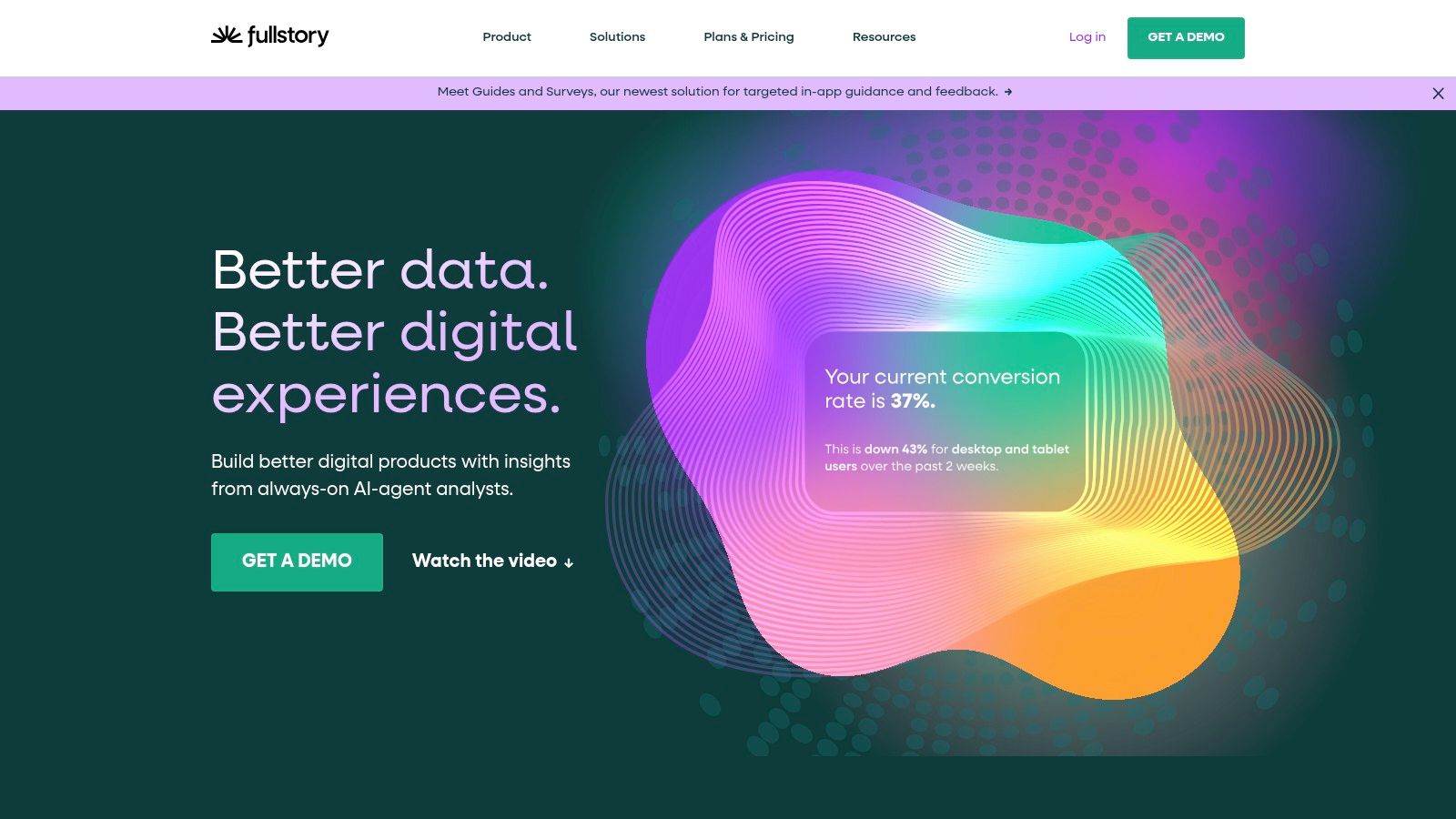
The platform excels at connecting individual user frustrations to broader, quantifiable business impacts. For instance, teams can instantly move from watching a user struggle in a replay to building a segment of all users who encountered the same CSS error and measuring the associated drop-off. Tools like FullStory offer robust session replay software, providing a powerful way to visualize and understand user journeys. While its free plan is generous with data retention, the sales-led pricing for higher volumes can become a significant investment as session counts grow.
Key Evaluation
- Best For: Customer support, UX researchers, and product teams prioritizing the reduction of user friction and bug resolution.
- Pricing Model: Offers a free plan with 1,000 sessions/month and three months of data retention. Paid plans are custom-quoted.
- Pros: Combines excellent qualitative and quantitative data in one tool; generous free plan retention helps early-stage teams.
- Cons: Replay-first approach can lead to data overload without proper governance; pricing can be costly as session volume scales.
Website: https://www.fullstory.com
9. Hotjar (by Contentsquare)
Hotjar is renowned for its qualitative, experience-focused toolset, making it an excellent starting point for teams looking to understand the "why" behind user actions. Traditionally known for heatmaps and session replays, it has expanded to include a dedicated Product Analytics module, funnels, and Voice of Customer (VoC) tools like surveys and feedback widgets. This combination provides a powerful, lightweight solution for UX designers, researchers, and product managers in SMBs who need to connect quantitative data with qualitative insights without a steep learning curve or heavy implementation.
The platform’s strength lies in its accessibility and rapid deployment. Non-analysts can quickly set up heatmaps or launch a survey to diagnose conversion issues or gather feedback on a new feature. Its modular approach allows teams to start with a free plan and add specific capabilities as needed, such as the "Observe" or "Ask" products. While its product analytics features are growing, organizations with complex data needs may find they eventually outgrow its capabilities and require a more specialized enterprise tool. For many, however, Hotjar is the perfect entry point into the world of product analytics software.
Key Evaluation
- Best For: UX and conversion-focused teams in SMBs and mid-market companies needing an approachable, all-in-one experience insights tool.
- Pricing Model: Offers a free plan with limits. Paid plans are modular (e.g., Observe, Ask, Engage), with the Growth plan starting around $49/month per module.
- Pros: Extremely fast to deploy with a user-friendly interface for non-technical users; flexible module-based pricing allows you to pay for only what you need.
- Cons: Data sampling occurs on lower-tier plans; pricing can become complex when scaling multiple modules; deep quantitative analysis capabilities may not match dedicated platforms.
Website: https://www.hotjar.com
10. LogRocket
LogRocket carves out a unique position by merging product analytics with developer-centric tools like pixel-perfect session replay, performance monitoring, and error tracking. This combination creates a powerful bridge between user experience issues and the underlying technical problems, allowing product, design, and engineering teams to collaborate on diagnostics. Instead of just seeing what users do, teams can see exactly how a bug or poor UX manifested on the user's screen, complete with console logs and network requests.
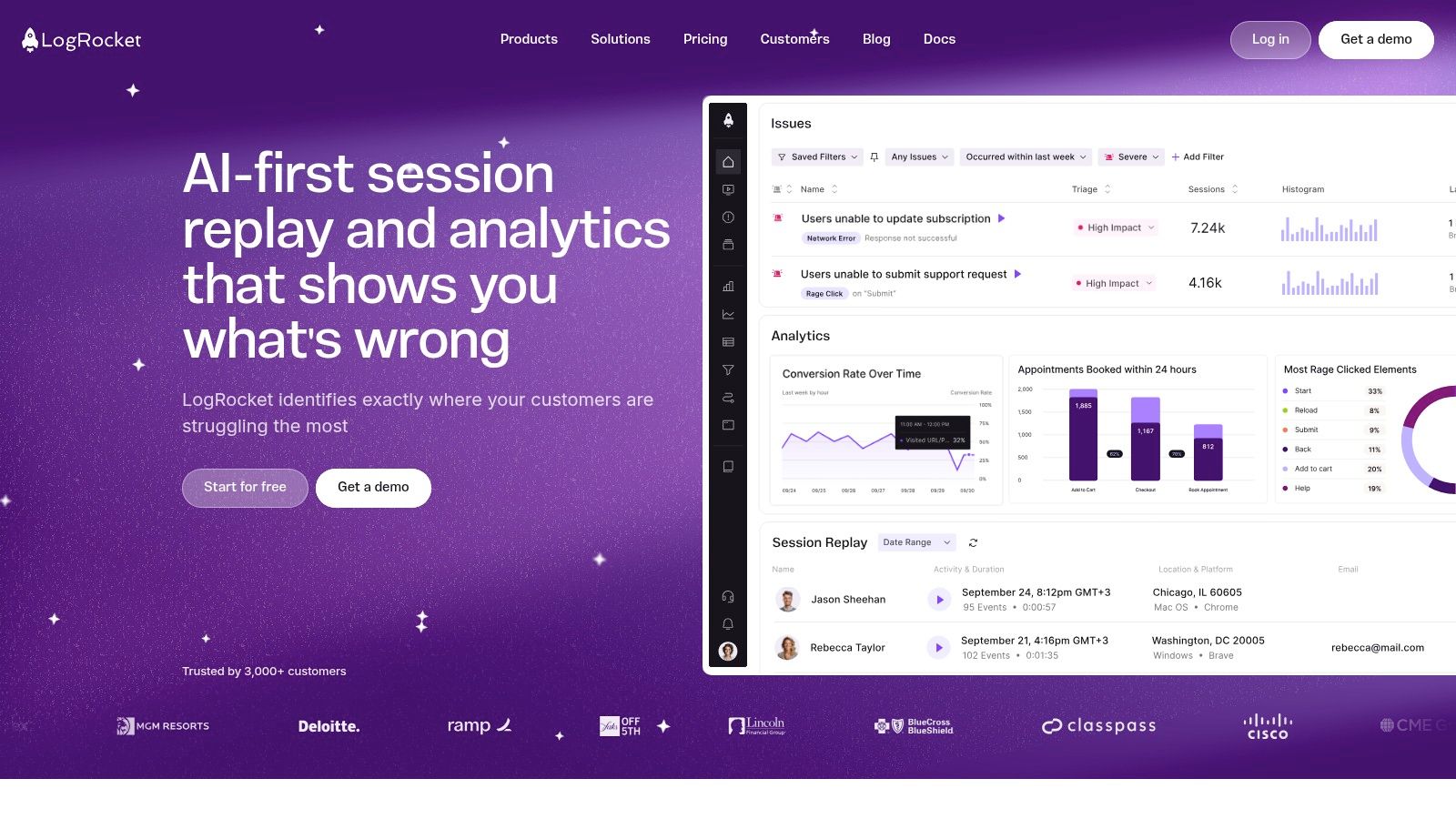
The platform’s strength is in closing the loop between a reported issue and its resolution. With AI-driven insights from its "Galileo" feature, it automatically surfaces user struggles, helping teams proactively identify friction points without waiting for support tickets. For companies prioritizing data privacy and control, LogRocket offers conditional recording rules and self-hosted options. This makes it a strong contender among the best product analytics software for teams that require a deep, technical understanding of the user journey to improve their product.
Key Evaluation
- Best For: Cross-functional teams (product, engineering, support) that need to connect user behavior with technical performance and errors.
- Pricing Model: Free plan available. Paid plans are based on sessions and offer transparent web pricing, with special offers for startups.
- Pros: Combines qualitative session replay with quantitative analytics and performance data; excellent for debugging and issue triage; AI-driven struggle detection surfaces problems automatically.
- Cons: Shorter data retention on lower-tier plans can be a limitation for long-term analysis; enterprise controls like SSO/SCIM often require higher-tier plans.
Website: https://logrocket.com
11. Snowplow Behavioral Data Platform (BDP)
Snowplow offers a different approach to product analytics by focusing on data ownership and infrastructure. Rather than a pre-built UI, it provides a behavioral data platform that collects and validates event data before loading it directly into your own data warehouse, such as Snowflake, BigQuery, or Redshift. This warehouse-native model grants data teams complete control over their data, eliminating vendor lock-in and allowing them to build custom analytics applications with tools like dbt and their preferred BI solution.
The platform is designed for organizations that want to treat behavioral data as a first-class asset. It provides broad SDK coverage, managed pipelines, and autogenerated data models that accelerate the path to insight. While it requires a significant upfront investment in analytics engineering resources compared to turnkey solutions, the payoff is a highly flexible, scalable, and cost-effective analytics stack. For teams searching for the best product analytics software that they can fully own and customize, Snowplow presents a powerful, infrastructure-first choice.
Key Evaluation
- Best For: Data-mature organizations with analytics engineering teams that need maximum control, data ownership, and integration flexibility.
- Pricing Model: Offers a free, self-hosted Community edition. Paid BDP Cloud and Private plans have custom pricing.
- Pros: Complete data ownership and transparency in your own warehouse; avoids UI lock-in and scales to massive volumes.
- Cons: Requires significant engineering and data modeling effort; longer time to initial value than all-in-one tools.
Website: https://www.snowplow.io
12. Smartlook (now part of Cisco)
Smartlook carves out its space in the product analytics market by leading with a strong, replay-first approach. It combines qualitative data from session recordings and heatmaps with quantitative analysis from funnels and event tracking, giving teams a direct view into user struggles and successes. Acquired by Cisco, it is positioned as a cost-effective solution for SMBs and mid-market companies that want to understand the "why" behind their metrics without a steep learning curve or complex implementation.
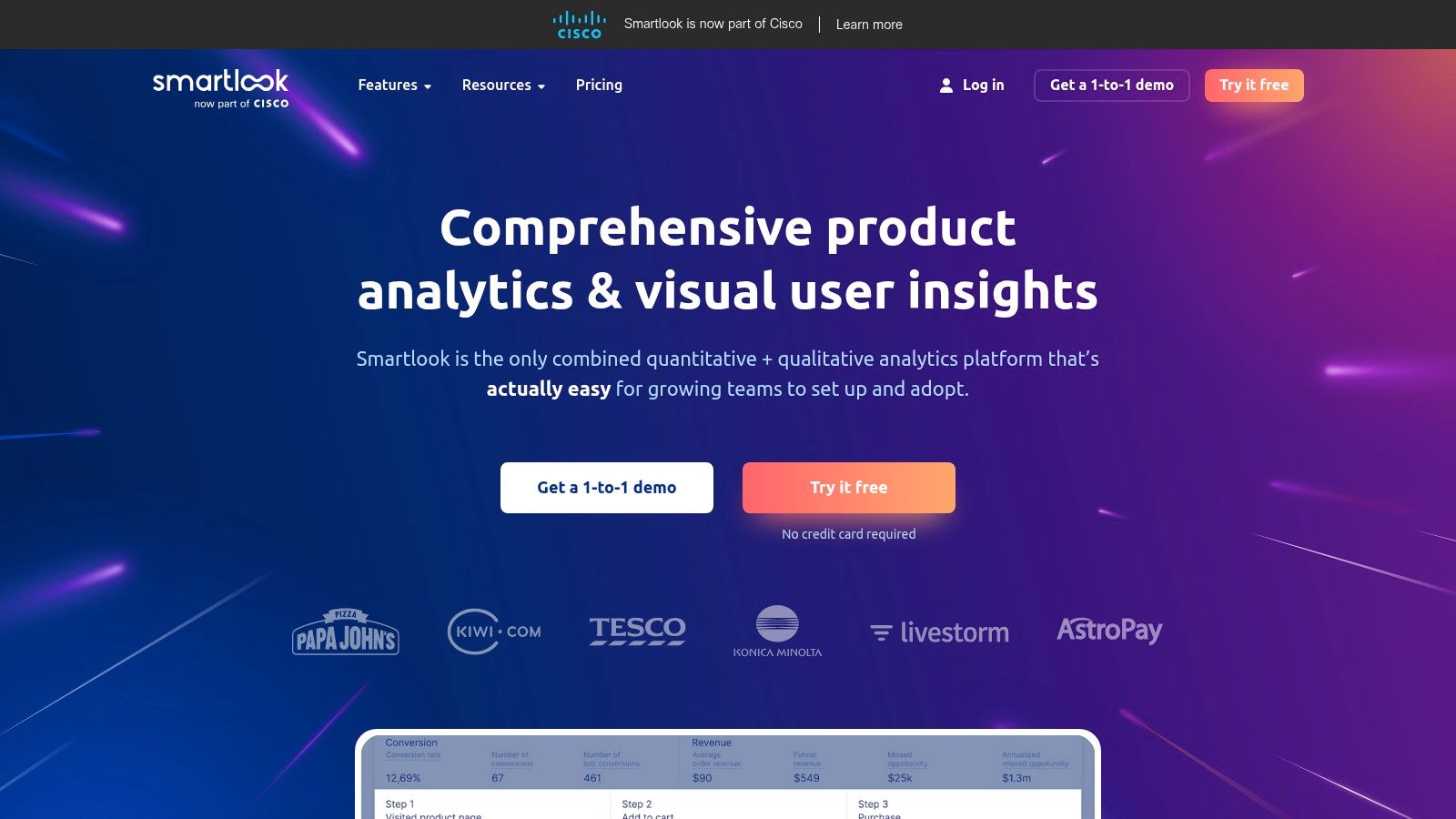
This tool is particularly useful for teams that prioritize fixing usability issues and optimizing conversion funnels by directly observing user behavior. Its simple UI and straightforward setup process make it an accessible entry point into product experience analytics. While it offers a free plan with a session allowance, the official website provides limited public pricing for its Pro and Enterprise tiers, which include features like anomaly detection. For many, Smartlook is a prime example of how combining session replay with core analytics creates a powerful, context-rich tool.
Key Evaluation
- Best For: SMB and mid-market teams needing a user-friendly, replay-first platform to diagnose usability issues and improve funnels.
- Pricing Model: Offers a free plan with a session limit. Pro and Enterprise plans require contact for a custom quote.
- Pros: Straightforward UI and quick onboarding; excellent combination of session replay and basic product analytics in one platform.
- Cons: Product analytics capabilities are not as deep as dedicated enterprise solutions; public pricing information is limited.
Website: https://www.smartlook.com
Top 12 Product Analytics Tools Comparison
| Product | Core features | Quality & Accuracy ★ | Pricing & Value 💰 | Target Audience 👥 | Unique selling points ✨ |
|---|---|---|---|---|---|
| SigOS 🏆 | AI product intelligence: ingest tickets/chats/calls/usage, revenue-impact scoring, automated integrations | ★★★★☆ (87% correlation, sub‑minute analysis) | 💰Quote / demo — ROI-focused | 👥PMs, Growth, CSMs, CTOs | ✨Revenue-first prioritization, 24/7 behavioral analysis, privacy-first models |
| Amplitude | Product analytics + experimentation, session replay, data governance | ★★★★☆ (robust templates & depth) | 💰MTU-based (Plus slider); sales-led for Growth/Ent | 👥PLG & growth teams | ✨Integrated analytics + experimentation in one platform |
| Mixpanel | Event analytics: funnels, retention, cohorts; Spark AI query builder | ★★★★☆ (fast insights, self-serve) | 💰Event-based pricing; free tier | 👥PMs & growth analysts | ✨Speed-to-insight for non‑SQL users; Spark AI |
| Heap (Contentsquare) | Autocapture, retroactive analysis, account analytics, replay add-ons | ★★★☆☆ (quick time-to-value) | 💰Mid/enterprise pricing; add-ons | 👥B2B product & analytics teams | ✨Autocapture + retroactive querying for fast TTV |
| PostHog | Analytics, session replay, feature flags; self-host + open-source | ★★★☆☆ (flexible, dev-centric) | 💰Generous free tier; usage-based scaling | 👥Dev teams & cost-conscious orgs | ✨Open-source + self-hosting for control and lower costs |
| Pendo | Analytics + in-app guides, surveys, NPS, session replay | ★★★☆☆ (adoption & onboarding focus) | 💰Free (500 MAU) then quote — can scale costly | 👥Mid-market & enterprise Product + CS | ✨In-product engagement tied to analytics |
| Gainsight PX | Autocapture, in-app guides, account analytics, CS integrations | ★★★☆☆ (CS-aligned insights) | 💰Quote-only (enterprise) | 👥Customer Success + Product in B2B | ✨Customer health + product adoption linkage |
| FullStory | High-fidelity session replay + quantitative analytics, AI add-ons | ★★★★☆ (excellent qualitative+quant) | 💰Free tier; sales-led at scale | 👥UX, Product & research teams | ✨Replay-first with AI summarization for friction analysis |
| Hotjar (Contentsquare) | Heatmaps, session replay, funnels, VoC, Product Analytics module | ★★★☆☆ (easy, approachable) | 💰Free / Growth from $49+/modular | 👥UX, CRO, SMB & mid-market teams | ✨Fast deploy, user-friendly mix of modules |
| LogRocket | Pixel-perfect replay + console/network logs, performance & error monitoring | ★★★★☆ (strong dev+UX triage) | 💰Transparent web pricing; startup offers | 👥Engineering, Product, Design | ✨Bridges UX issues to technical logs for faster triage |
| Snowplow BDP | Warehouse-native event pipelines, SDKs, dbt packages, high-volume scale | ★★★★☆ (full control & scalability) | 💰Custom (BDP Cloud/Private) or community edition | 👥Analytics/engineering teams | ✨Maximum data ownership; BI/warehouse native |
| Smartlook | Session replay, heatmaps, funnels, product analytics, anomaly reporting | ★★★☆☆ (cost-effective replay-first) | 💰Free tier; Pro/Enterprise tiers | 👥SMB & mid-market UX teams | ✨Simple onboarding, replay-first for conversion insights |
Final Thoughts
Choosing the right product analytics platform is a critical decision that directly impacts your ability to understand users, prioritize features, and drive sustainable growth. As we've explored, the market offers a diverse range of solutions, each with its own philosophy and strengths. From the event-based precision of Amplitude and Mixpanel to the autocapture convenience of Heap, and the open-source flexibility of PostHog, there is no single "best" tool for every company. The ideal choice depends entirely on your team's technical skill, data maturity, budget, and specific business questions.
The decision-making process should begin internally. Before you even start a free trial, your team needs to align on what you truly need to measure. Are you struggling with high-level conversion funnels, or do you need to debug complex, multi-step user journeys? Is your primary goal to reduce churn by understanding friction points, or is it to validate new feature ideas with A/B testing? Answering these questions first will prevent you from being swayed by impressive but irrelevant features.
Key Factors for Your Final Decision
As you narrow down your options from the twelve platforms we've covered, keep these core evaluation criteria at the forefront:
- Implementation and Maintenance: Autocapture tools like Heap or Smartlook offer a low initial barrier, but they can create data governance challenges down the line. Event-based tracking from tools like Amplitude, Mixpanel, or SigOS requires more upfront developer effort but yields cleaner, more intentional data. Consider your engineering resources not just for the initial setup, but for ongoing maintenance and instrumentation of new features.
- Team Composition and Skillset: Is your team composed of data scientists who are comfortable with SQL and building complex queries, or product managers who need a simple, visual interface? Tools like Pendo and Gainsight PX are built for less technical users, while Snowplow BDP offers the raw, granular data that a dedicated data team would prefer.
- Qualitative vs. Quantitative Needs: Do you just need to know what users are doing, or do you need to understand why? Many teams find immense value in combining quantitative data from a tool like Mixpanel with qualitative session recordings from FullStory or Hotjar. Platforms like SigOS are working to bridge this gap by connecting quantitative signals to their qualitative root causes automatically.
- Scalability and Cost: Your data volume will grow. Evaluate pricing models carefully. User-based pricing can become expensive quickly for B2C companies, while event-based pricing requires careful planning to avoid tracking superfluous actions. Make sure the platform's pricing tiers align with your anticipated growth over the next 18-24 months.
Putting Insights into Action
Ultimately, the best product analytics software is the one your team actually uses to make decisions. The goal isn't just to collect data, but to create a closed loop where user behavior insights inform product strategy, which in turn leads to a better user experience. This requires more than just a tool; it requires a cultural shift towards data-informed decision-making.
Furthermore, a complete product strategy extends beyond your own application's data. Understanding how your product is positioned in the wider market is just as important. This involves analyzing competitor strategies, features, and pricing models. For teams looking to build this external awareness, exploring the best competitor price tracking software tools can provide the market context needed to make your internal product insights even more powerful. By combining internal user data with external market intelligence, you create a more complete picture to guide your roadmap.
Embarking on this journey to find the right analytics partner is a major step toward building a truly user-centric product. The right platform will not just provide charts and dashboards; it will empower every member of your team to ask better questions and find clear answers, turning user behavior into your most valuable asset.
Ready to move beyond dashboards and get to the root cause of user behavior? SigOS uses AI to analyze your product data, automatically identifying the critical friction points and opportunities that drive your core metrics. Stop guessing and start knowing. Explore SigOS today to see how predictive analytics can transform your product strategy.

Ready to find your hidden revenue leaks?
Start analyzing your customer feedback and discover insights that drive revenue.
Start Free Trial →