Point of Parity: Boost SaaS Revenue & Reduce Churn
Discover what a point of parity is and its crucial role in SaaS. Explore types, measurement, and strategies to reduce churn and drive revenue effectively.

A lot of product teams are in the same trap right now. The roadmap is full of differentiated features, the demo looks sharp, and customers still stall, downgrade, or leave for a reason that feels embarrassingly basic.
It usually sounds like this: “We liked the vision, but we need SSO.” Or “Your analytics are stronger, but we can’t ship without the integration.” Or “The workflow is better, but the team expected real-time alerts.”
That’s the moment where point of parity stops being a marketing term and becomes a product strategy problem. The issue isn’t that your product lacks originality. It’s that buyers never got past the missing table stakes long enough to value what makes you special.
For SaaS teams, that changes how prioritization should work. You can’t treat parity features as boring backlog hygiene while pouring all strategic energy into shiny points of difference. In practice, parity is what gets you shortlisted, survives procurement, reduces avoidable churn, and creates the conditions for your differentiated features to matter.
The Hidden Cost of Being Different
A customer rarely says, “We churned because your strategic positioning was off.” They say they couldn’t do something they assumed any serious vendor would support.
That’s the hidden cost of being different in the wrong order. Teams spend months building a feature they believe will define the category, while a quiet group of customers keeps tripping over missing basics. Support sees it first. Sales hears it in objections. Customer success feels it in renewals. Product often notices last, after the account is already gone.

If you work on retention, you’ve probably seen versions of this already in your own SaaS churn benchmarks work. The visible reason for churn might be pricing, adoption, or “fit.” The underlying reason is often simpler. The product failed a minimum expectation test.
Where the mistake starts
Teams love points of difference because they’re easy to rally around. They make for better launches, stronger demos, and clearer internal narratives. “We’re the only platform that does X” is a far more exciting story than “We finally closed the gap on basic admin controls.”
But buyers evaluate in sequence. First they ask, “Can this tool do what any credible option should do?” Only after that do they ask, “What makes this one better?”
Practical rule: A feature can be strategically unexciting and still be revenue-critical if its absence keeps you out of consideration.
That’s what a point of parity is in practical terms. It’s not imitation for its own sake. It’s the set of expected capabilities that qualifies you to compete.
What it looks like inside a SaaS company
The pattern is usually easy to spot once you know where to look:
- Support sees repetitive friction: customers keep asking for the same “basic” capability.
- Sales loses avoidable deals: prospects like the product but stop at a procurement requirement.
- Success teams carry workarounds: account managers compensate manually for gaps that should be native.
- Product underestimates urgency: because the missing feature isn’t novel, it gets pushed behind roadmap bets with a bigger narrative.
That’s expensive. Not only because of churn, but because every missing parity feature weakens the commercial impact of everything else you built.
Understanding the Two Types of Parity
The easiest way to make point of parity useful is to split it into two buckets. Product teams usually need both, but they solve different problems.
Category parity
Category points of parity are the baseline expectations for your market. If you sell enterprise SaaS, buyers may expect permission controls, auditability, or SSO. If you sell product analytics, they expect dashboards, event visibility, and dependable core reporting.
These features don’t win the deal by themselves. They get you invited into the deal.
A simple analogy helps. Wi-Fi in a coffee shop is category parity. Nobody writes a glowing review because a café has Wi-Fi. But if it doesn’t, a large group of customers won’t even consider staying.
Competitive parity
Competitive points of parity are more targeted. They neutralize a specific rival’s advantage when that capability starts showing up repeatedly in deal cycles.
If one competitor keeps winning because they offer a Gantt view, a native Salesforce sync, or a stronger admin model, you may need that feature not because it defines the category, but because it removes a recurring objection.
That distinction matters in planning. Category parity keeps you credible. Competitive parity keeps a rival from boxing you out.
Why the idea still holds up
The language around POPs came into focus in a 2002 article by Kevin Lane Keller and co-authors, which argued that brands need points of parity alongside points of difference. A classic example involved Dove’s failed move into dishwashing liquid in the 1980s. Dove leaned on hand-softening benefits but didn’t establish enough confidence in the core cleaning performance buyers expected from the category. The result was disappointing sales, because the differentiator couldn’t compensate for the missing baseline expectation, as outlined in Neil Bendle’s discussion of points of parity and points of difference.
That old consumer example still maps cleanly to SaaS.
| Type | Core question | SaaS example |
|---|---|---|
| Category parity | Does this product meet the baseline for the market? | An enterprise tool needs SSO and admin controls |
| Competitive parity | Are we losing because one rival has a capability we don’t? | A project tool adds portfolio rollups to counter a specific competitor |
A strong product can fail for a very ordinary reason. It didn’t satisfy the buyer’s minimum standard for competence.
The operational takeaway is straightforward. Don’t throw all “missing features” into one bucket. Some are table stakes for the category. Others are blockers created by the competitive battlefield you’re selling into.
Why Parity Matters More Than Revenue Features
A familiar roadmap fight plays out in a lot of SaaS companies. Sales wants SSO, audit logs, and a better admin console because deals keep stalling. Product wants the new AI workflow because it looks like expansion revenue. Leadership often treats that as a choice between boring work and growth. In practice, the boring work is often what protects growth.

Parity features rarely win internal popularity contests. They also carry a different economic profile than headline features. A strong parity fix can raise activation, reduce late-stage objections, shorten security review, cut support load, and protect renewals at the same time. Very few “revenue features” do all five.
Revenue features underperform when parity gaps stay open
Teams usually model upside too narrowly. They assign pipeline or expansion potential to a differentiated feature, then treat parity work as defensive maintenance. That framing misses the true trade-off.
A missing baseline capability creates drag across the full customer lifecycle. New users hit setup friction. Admins question whether the product is ready for broader rollout. Champions spend political capital explaining workarounds. Customer success teams inherit preventable escalations. Expansion gets delayed because the account never reaches confident, repeatable usage.
That is why parity work often has better revenue impact than it gets credit for. It improves the conversion rate of value you already built.
The useful question is not, “Will this feature drive new revenue on its own?” The better question is, “How much revenue are we failing to realize because this gap keeps qualified accounts from adopting, expanding, or renewing?”
Qualification comes before preference
Differentiation helps after the buyer believes you meet the baseline. Before that, missing parity acts like a filter.
In enterprise SaaS, the filter is usually obvious. SSO, role-based permissions, audit history, APIs, data exports, procurement documentation, and integrations are common examples. In PLG products, the same pattern shows up earlier through stalled activation, abandoned setup, or teams that never invite additional users because one expected capability is missing. Product Led Growth (PLG) breaks down when the product experience lacks expected basics for the same reason.
A practical way to frame the trade-off:
- Parity protects qualification
- Differentiation drives preference after qualification
- Preference has little commercial value if buyers or users stop before trust is established
Product teams often get misled by visibility. A differentiated feature is easier to demo and easier to celebrate internally. A parity fix often looks ordinary in release notes while changing win rate, activation, and retention more materially.
The right parity work is measurable
The old marketing definition of point of parity is useful, but SaaS teams need an operating model, not just a concept. The better method is to quantify parity gaps through behavior and revenue correlation.
Start with product signals. Which missing capabilities correlate with stalled onboarding, low seat expansion, repeated admin friction, or accounts that require heavy manual support? Then connect those signals to commercial outcomes. Which gaps show up in churn notes, security reviews, lost deals, or delayed expansions?
Teams can do that with a warehouse and enough analyst time. They can also move faster by using behavior analytics to connect feature friction with revenue outcomes. The point is to stop debating parity work as opinion. Treat it as a measurable source of revenue leakage.
A parity feature becomes easier to prioritize when the evidence looks like this: accounts without this capability activate 20 days slower, require twice as many support touches, and expand at a lower rate than similar accounts that never encounter the gap. That is not “just matching competitors.” That is fixing a constraint on monetization.
Your differentiated story needs a credible base
Customers do not evaluate advanced capabilities in isolation. They evaluate them through trust. If the foundation feels incomplete, premium features read like decoration.
A short explainer helps frame that trade-off:
The strongest SaaS products handle this well. They do not confuse novelty with value. They make sure expected basics are solid enough that differentiated capabilities can influence the deal, the rollout, and the renewal.
Leadership test: If a feature removes repeated friction from evaluation, activation, or renewal, it belongs in the revenue conversation even if nobody wants to keynote it.
That is why parity deserves real budget and engineering capacity. It keeps revenue features from underperforming. Beyond that, it gives your moat something solid to stand on.
How to Diagnose Parity Gaps in Your Product
A team ships three headline features in a quarter, then loses two late-stage deals because procurement asked for SSO and the buyer assumed it was already there. That is how parity debt shows up in SaaS. It rarely looks dramatic inside the roadmap. It shows up in stalled evaluations, longer onboarding, extra support load, and expansions that never happen.
Teams usually notice parity gaps after the commercial hit lands. Churn notes pile up. Sales starts tagging the same competitor. Support keeps explaining the same workaround. By that point, the question is no longer whether the gap matters. The question is how much revenue has already been constrained.
Start with behavioral evidence, not feature wishlists
A useful parity review starts with expected behavior, not a competitor feature grid. The job is to find missing capabilities that buyers and users treat as baseline, then measure whether those gaps change what accounts do next.
A manual audit works best when it combines several inputs:
- Support tickets and chat logs: recurring complaints framed as “basic,” “expected,” or “must-have”
- Sales call notes: repeated objections that stop deals in late-stage evaluation
- Win-loss reviews: patterns in why buyers chose a competitor or delayed purchase
- Usage paths: moments where users stall, abandon setup, or fail to activate around the same gap
- Customer success escalations: workarounds your team keeps performing by hand
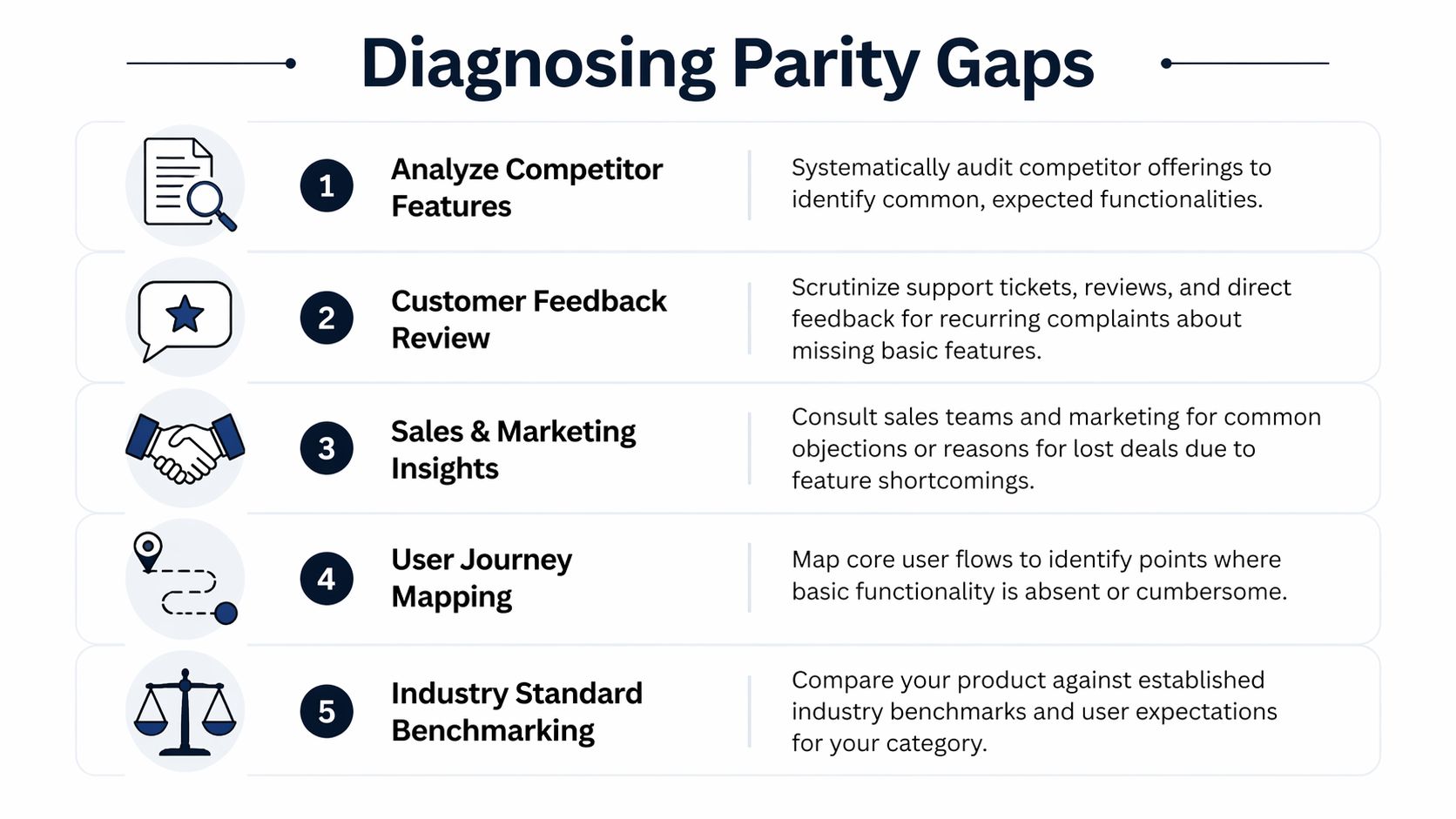
Teams that want a more structured format can borrow from these detailed competitor analysis reports, then layer in product behavior and customer evidence instead of stopping at a side-by-side feature matrix.
What to look for in the data
Strong parity signals tend to show up in three ways.
First, the same gap appears across systems. A missing integration surfaces in support tickets, then appears again in sales objections and lower trial progression for accounts with that requirement.
Second, customers describe the gap as obvious. They are not asking for a new strategic direction. They say, “we assumed you had this,” or “our security review requires it.”
Third, the impact is broad but uneven. Your best-fit power users may never mention the missing feature. Mid-market buyers, security reviewers, or implementation teams may block on it every time. That is exactly why parity work gets underfunded. The pain is distributed across the funnel, so no single team feels all of it.
When buyers frame something as expected, treat it as a parity candidate until the evidence says otherwise.
A practical manual audit
Without automation, keep the review cycle tight and commercial.
- Pull one quarter of feedback artifacts. Include support, chat, Gong notes, CRM loss reasons, and renewal risk notes.
- Tag expectation language. Mark phrases like “required,” “basic,” “standard,” “table stakes,” or “security needed.”
- Cluster by job to be done. Group by what the customer was trying to accomplish, not just the feature name.
- Check competitive mentions. Note where a rival repeatedly appears next to the same gap.
- Map the gap to a revenue event. Check whether it affects trial conversion, procurement, onboarding, expansion, or renewal.
The last step is the one teams skip. A parity gap matters more when you can quantify the pattern. Compare cohorts that hit the friction against similar accounts that do not. Look at activation time, sales cycle length, support touches, implementation delays, discounting pressure, and expansion rate. That turns a vague request into a product strategy decision.
If your team already uses event data in roadmap decisions, behavior analytics for product decisions adds the missing context. You can see whether users who encounter a known gap recover, ask for help, or abandon the workflow entirely.
Where AI changes the process
Manual audits are useful. They are also slow and inconsistent once volume grows. PMs, CS leaders, and sales managers all see part of the pattern, but parity decisions get distorted when each team works from its own sample.
A 2025 SaaS study found that many product managers struggle to prioritize points of parity amid noisy feedback, as cited in Velaris’ overview of points of parity. Platforms such as SigOS address that problem by scoring repeated expectation signals across systems, then linking those patterns to account outcomes like conversion, churn risk, and expansion delay.
That shift matters because parity should be measured like any other revenue constraint. AI helps teams examine large volumes of tickets, transcripts, and usage events fast enough to spot which “boring” gaps are suppressing growth.
| Signal source | What it reveals | Why it matters for parity |
|---|---|---|
| Support tickets | Repeated unmet expectations | Shows baseline friction early |
| Sales transcripts | Objections that block deals | Identifies qualification failures |
| Usage patterns | Drop-offs after key moments | Connects missing capability to behavior |
| Renewal notes | “Good product, but…” reasons | Exposes parity debt before churn grows |
The practical benefit is not automation by itself. It is better prioritization. Once a team can show that a missing admin control adds two weeks to security review, or that accounts without a needed integration activate later and expand less often, parity work stops looking defensive. It becomes one of the clearest ways to protect win rate and grow revenue.
Real-World SaaS Parity Plays and Lessons Learned
A familiar SaaS pattern looks like this. The demo goes well, buyers like the differentiated workflow, and the deal still stalls because one expected capability is missing. Product teams often label that as a competitive feature request. In practice, it is usually a parity gap with direct revenue impact.
The best teams treat those gaps as measurable commercial problems, not as bruises to product pride.
Teams and Zoom removed disqualifiers first
Microsoft Teams and Zoom are useful examples, even without over-claiming exact market-share or churn figures from weak secondary sources. Teams closed obvious collaboration gaps early, then used Microsoft's distribution, bundling, and enterprise buying relationships to grow quickly. Zoom responded to enterprise security expectations with stronger controls and clearer trust signals, which helped preserve momentum with larger customers.
The lesson is straightforward. Parity did not create the moat. Parity removed the objection that kept each company from using its real advantage.
That distinction matters in roadmap debates. A parity feature rarely wins because it is exciting. It wins because it stops sales, onboarding, security review, or renewal from getting stuck on something buyers already assume should exist.

What crowded categories teach you
In crowded software categories, buyers usually evaluate products in sequence. First they check for expected basics. Then they test workflow fit. Only after that do they spend time on differentiated value.
You can see that buying behavior in comparison content. Even a simple side-by-side like this Glinky Vs Fireflies.Ai comparison mirrors how evaluation works. Buyers confirm shared requirements first, then compare quality, usability, and fit.
Many product teams waste time arguing about whether a request is "strategic" while prospects are using it as a screening criterion.
A realistic mid-market parity play
Consider a workflow SaaS product selling into operations leaders. The product is faster to configure than larger competitors and handles complex process logic better than the category average. On paper, that should help it win.
Pipeline says otherwise.
Win-loss notes show repeated friction around one missing native integration. Support tickets mention workaround setup. Sales calls surface the objection late, after the champion is already sold. Expansion conversations slow down because adjacent teams will not adopt a product that does not connect cleanly to a system they use every day.
This is the part teams often miss. The integration is not just a feature gap. It creates revenue drag across the funnel.
Once the team ships it, the impact usually shows up in operational metrics before it shows up in launch headlines:
- Fewer late-stage objections in sales calls
- Faster activation because setup friction drops
- Less manual patching from customer success
- Better conversion on differentiated capabilities because buyers can finally evaluate the product on strengths instead of omissions
That is why parity work should be quantified. Platforms like SigOS help teams cluster repeated expectation signals across transcripts, tickets, and usage data, then correlate those patterns with outcomes like slower activation, lower conversion, or delayed expansion. The feature may look boring in a roadmap review. The revenue effect is not boring at all.
A useful discipline is to score parity candidates by objection frequency, affected ARR, and stage impact. If one missing control appears in 18 percent of lost enterprise deals and adds security-review delay to another 12 percent, that item deserves a very different conversation than "several prospects asked for it." Teams that need a simpler operating model can adapt a feature prioritization matrix for product roadmap decisions and add behavioral signal volume plus revenue correlation as explicit inputs.
The strongest parity features often become invisible after launch because buyers stop mentioning them. That silence is a good sign.
I have seen parity fixes outperform bigger roadmap bets for one simple reason. They remove the blocker that was preventing the rest of the product from getting fair consideration. In a crowded SaaS category, that is often the highest-return move on the board.
From Insight to Action A Prioritization Framework
Finding a point of parity gap is only half the job. The harder part is deciding when to prioritize it over a more differentiated feature that feels strategically bigger.
The cleanest answer is to score parity work by commercial consequence, not by novelty.
Use a three-part filter
When a parity candidate appears, evaluate it through three lenses:
| Filter | Question to ask | What a strong signal looks like |
|---|---|---|
| Revenue risk | Is this blocking new business or expansion? | Sales objections, stalled trials, delayed procurement |
| Churn exposure | Does the gap increase the chance of downgrade or loss? | Repeated renewal friction, customer workarounds, account escalations |
| Strategic necessity | Is this becoming expected in the category? | Buyers assume it exists before they ask about it |
This prevents a common mistake. Teams often compare parity work to innovation work as if they serve the same purpose. They don’t. One protects the base. The other extends it.
How to message parity without overselling it
Product marketing and sales shouldn’t try to position table stakes as category-defining breakthroughs. Buyers usually see through that. The better move is simple confirmation.
Say the thing clearly. Show that it works. Remove the objection. Then spend your real messaging energy on what makes the product better.
That applies internally too. Don’t force parity items to justify themselves with inflated storytelling. A feature can deserve priority because it keeps deals alive and reduces churn. That’s enough.
Reassessment has to be continuous
This is getting more important in AI-heavy SaaS, where buyer expectations are shifting quickly. A parity item today may not have existed on anyone’s checklist a year ago.
As of early 2026, Forrester reports that 55% of SaaS PMs miss emergent POPs like revenue-impact scoring on feedback, correlating to 23% higher churn, which is why quarterly reassessment matters more than occasional manual audits, as discussed in Northbeam’s review of parity and differentiation.
A practical operating rhythm looks like this:
- Quarterly review: reassess which buyer expectations have become standard
- Monthly signal scan: inspect support, sales, and usage data for new expectation clusters
- Roadmap checkpoint: reserve explicit capacity for parity debt
- GTM alignment: update sales enablement so parity answers are easy to confirm
- Prioritization discipline: use a repeatable model such as a feature prioritization matrix instead of arguing from opinion
Final operating principle: Build differentiation to win. Build parity so you’re allowed to compete.
The strongest SaaS products do both. They don’t romanticize copying competitors, but they also don’t confuse originality with strategy. They close the gaps that disqualify them, then invest where they can create a real moat.
If your team is drowning in feature requests and wants a clearer way to connect customer feedback to churn, expansion, and actual revenue impact, SigOS is built for that job. It helps product and growth teams turn support tickets, sales calls, chat transcripts, and usage signals into prioritized action, so you can spot point of parity gaps early and invest in the fixes that matter most.
Keep Reading
More insights from our blog

Ready to find your hidden revenue leaks?
Start analyzing your customer feedback and discover insights that drive revenue.
Start Free Trial →