Strategic Business Road Maps for SaaS Success
Build business road maps beyond feature lists. Guide for SaaS teams: use customer data to prioritize for revenue & retention. Learn more!
The roadmap meeting usually starts with confidence and ends with bargaining.
Sales wants the enterprise ask on the board because a prospect mentioned it twice. Support wants the top ten ticket themes fixed immediately. Engineering wants time for infrastructure work nobody else can see. Leadership asks for dates. Product opens a spreadsheet full of features, color codes a few rows, and calls it a plan.
That document is not a strategy. It is a record of unresolved arguments.
Most business road maps fail at this exact point. Teams treat the roadmap like a release calendar instead of a decision-making system. They lock in features before they have proven the problem is worth solving, then spend the next quarter explaining why priorities changed.
The bigger issue is not format. It is signal quality. Most roadmap guidance still centers on planning templates and timeline views, but it rarely shows teams how to connect decisions to live customer behavior that predicts revenue impact. As noted in this discussion of business mapping and insight gaps, that leaves a blind spot where teams build from gut feel instead of quantified behavior patterns tied to meaningful revenue outcomes.
A useful roadmap does something simpler and harder. It tells the company which problems matter most, why they matter now, and what evidence justifies the trade-off. In SaaS, that means bringing together support tickets, usage signals, sales friction, expansion opportunities, and churn patterns into one prioritization model.
When teams do this well, the roadmap stops being a feature wishlist. It becomes a business instrument. It gives the CRO a reason to believe product is helping revenue. It gives the CTO a stable frame for execution. It gives customer success a way to show that recurring pain is being addressed for the right accounts, not just the loudest ones.
The shift is uncomfortable because it removes a lot of familiar theater.
What usually breaks first
A feature-led roadmap tends to fail in predictable ways:
- Dates get overcommitted: Teams promise timing before they understand scope, dependencies, or customer value.
- The loudest request wins: A single large customer, a vocal exec, or a persuasive PM can distort the queue.
- Everything becomes urgent: Without a shared business frame, every request can sound critical.
- The roadmap turns stale fast: New data arrives, but the published plan becomes politically hard to change.
A roadmap should absorb new evidence without looking like chaos. If every new customer signal forces a public reset, the roadmap was too detailed to begin with.
The alternative is not to stop planning. It is to plan at the right altitude and feed that plan with real evidence. That is where outcome-based structure and revenue-linked signals start to outperform static feature lists.
Why Most Business Road Maps Fail Before They Start
The common mistake is simple. Teams confuse a roadmap with a build sheet.
A build sheet answers what engineering might ship. A roadmap should answer what the business is trying to change. Those are not the same thing. One is output. The other is direction.
The feature list trap
A feature-forward roadmap feels productive because it is concrete. It has names, dates, owners, maybe even mockups. Stakeholders can point at a row and ask for progress.
That visibility is deceptive. The more detailed the document becomes, the more fragile it gets. Teams commit to solutions too early, long before they know whether the underlying problem is widespread, expensive, or even still relevant by the time delivery starts.
This is why roadmap sessions so often become political. If the roadmap is a list of promised features, every stakeholder must fight to get their item locked in before capacity disappears.
Missing the live signal
The deeper failure is that most roadmap processes still do not integrate ongoing customer behavior into prioritization.
A support queue may show a recurring bug. Sales calls may reveal the same objection in late-stage deals. Usage data may show that a supposedly strategic workflow is barely adopted by high-value accounts. Yet those signals often sit in separate systems and never shape planning in a structured way.
The result is familiar. Product teams prioritize based on memory, confidence, anecdote, and internal momentum. They believe they are making reasoned trade-offs, but they often rank requests without seeing which issues correlate with churn risk, expansion potential, or blocked revenue.
What a better starting point looks like
A stronger roadmap starts with three questions:
- Which customer problems are happening repeatedly
- Which of those problems connect to retention, expansion, or deal progression
- Which initiatives deserve space on the roadmap because they can change those outcomes
That sequence matters. It prevents teams from jumping from request to solution without business context.
When a team gets this right, the roadmap becomes easier to defend. It also becomes easier to change. You are no longer saying, “We promised feature X for August.” You are saying, “We are investing in reducing a specific revenue-relevant problem, and this is the current best hypothesis for doing it.”
That is a much healthier kind of commitment.
Matching Your Roadmap to Your Mission
Not every roadmap should look the same.
One of the most common planning mistakes in SaaS is using a single document to satisfy every audience and every decision. Leadership wants strategy. Engineering wants sequencing. Growth wants experiments. Platform teams want architecture work represented accurately. A single roadmap format cannot do all of that well.
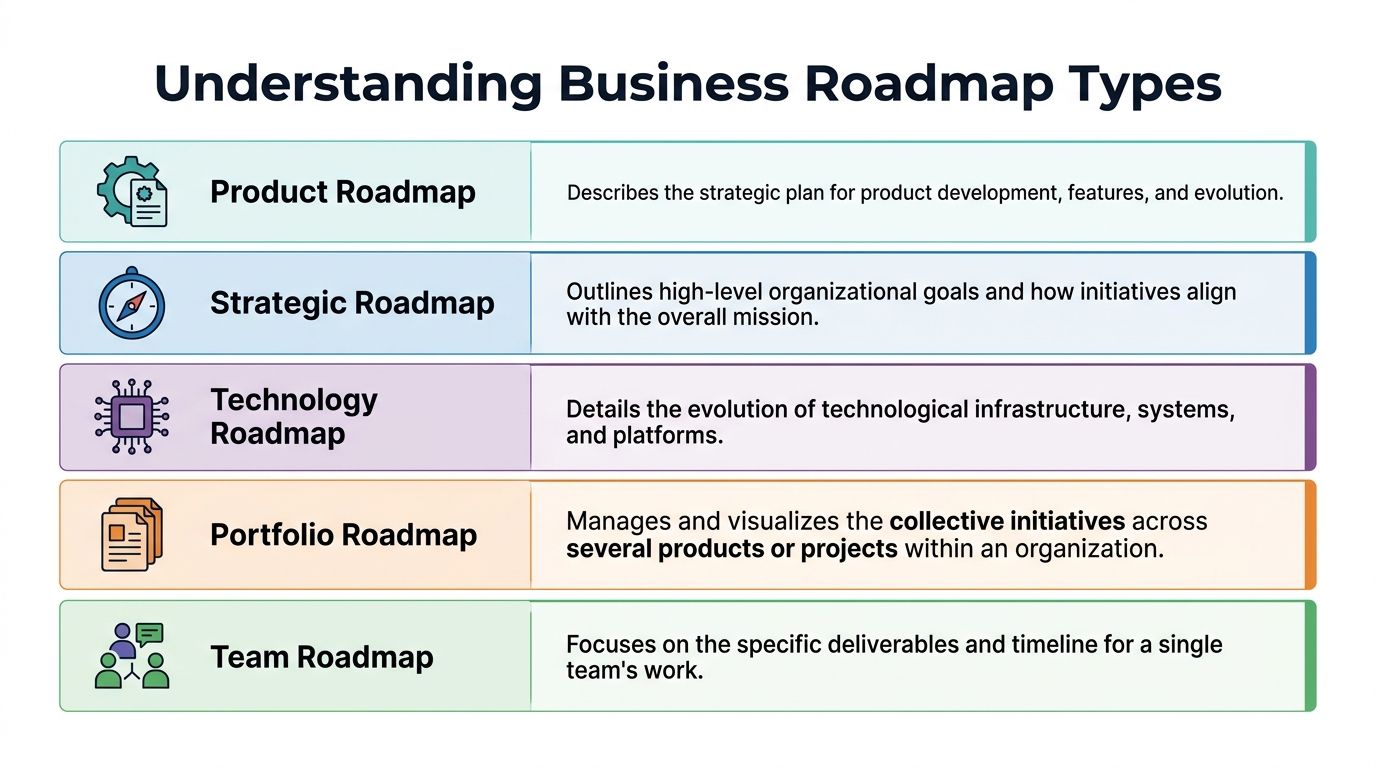
Five roadmap types and when they help
| Roadmap type | Best use | Primary audience | What belongs on it | What does not |
|---|---|---|---|---|
| Strategic roadmap | Company direction and market bets | Exec team, board, department heads | Business goals, market moves, major investment themes | Sprint detail, user stories |
| Product roadmap | Outcome-led product direction | Product, design, engineering, GTM leads | Problems to solve, initiative themes, expected business outcomes | Detailed feature checklists |
| Growth roadmap | Acquisition, retention, expansion learning | Growth, lifecycle, product, revenue teams | Experiments, funnel issues, onboarding or expansion themes | Deep platform architecture work |
| Technical roadmap | Reliability, architecture, debt, enablement | CTO, engineering leadership, platform teams | System work, migration themes, developer productivity initiatives | Broad commercial promises |
| Team roadmap | Local execution planning | Individual squads or functional teams | Near-term work bands, dependencies, owners | Company-wide strategy narratives |
Most companies need more than one. They do not need five disconnected versions of reality. They need linked views at different altitudes.
Use outcomes as the shared language
The unifying principle across roadmap types is outcome orientation.
When teams connect roadmap themes to business outcomes, they report up to 30 to 40 percent higher alignment with strategic goals and stronger product-business cohesion, according to this outcome-oriented roadmapping analysis. That matters because it gives every roadmap type a common backbone, even when the audiences differ.
A strategic roadmap might frame an outcome as improved retention in a key segment. A product roadmap might express the same outcome as reducing a repeated onboarding failure. A growth roadmap might support it through lifecycle experiments. A technical roadmap might include the instrumentation needed to measure it properly.
Same mission. Different lens.
A simple diagnostic
If your roadmap keeps creating confusion, ask what job it is trying to do.
- Entering a new market: Use a strategic roadmap first, then a product roadmap to support the move.
- Reducing churn from a repeated workflow failure: Use a product roadmap, backed by growth and support inputs.
- Cleaning up fragile systems that slow delivery: Use a technical roadmap that translates engineering work into business risk reduction.
- Coordinating one squad over the next cycle: Use a team roadmap, not the executive version.
A roadmap gets stronger when it is opinionated about audience. The moment one document tries to serve board reporting, engineering planning, launch sequencing, and customer commitments, it becomes weak at all of them.
For teams trying to connect business direction with technology choices, this guide on a business IT roadmap is a useful companion because it shows how strategy and execution can stay linked without collapsing into one document.
What to avoid
A few patterns almost always create trouble:
- One roadmap for everyone: It forces too much detail into strategic discussions and too little context into delivery planning.
- Feature buckets without business framing: Stakeholders see activity, not purpose.
- Roadmaps organized only by function: Customers experience problems across workflows, not org charts.
- Mission statements with no measurable consequence: Teams cannot tell whether a theme is working.
Strong business road maps are not just neat artifacts. They match the decision they need to support.
Most prioritization frameworks are useful until the room gets political.
RICE, MoSCoW, ICE, weighted scoring. All of them can help. All of them can also become performance art if the inputs are subjective. The problem is rarely the framework. The problem is that teams guess the impact, guess the confidence, and then argue over the math.

Start with a familiar model, then harden the inputs
A practical approach is to keep a simple prioritization method and upgrade the evidence behind it.
For SaaS teams, the two inputs that most need better grounding are:
- Impact: What business outcome could this initiative change if it works?
- Confidence: How strong is the evidence that solving this problem will matter for the right customers?
That means moving beyond broad statements like “customers are asking for it” or “sales needs this.” Those are signals, but they are incomplete.
The data stack that helps
The most useful prioritization inputs usually come from four places:
- Support systems such as Zendesk or Intercom, where recurring pain appears in plain language.
- Sales conversations where late-stage blockers and procurement objections show up.
- Product usage data that reveals where valuable accounts struggle, drop, or never adopt.
- Revenue context that tells you which segments, account types, or workflows matter most commercially.
On their own, these are just streams. True value comes from correlation.
A bug that appears often is not automatically roadmap-worthy. A bug that appears often in a cohort tied to churn risk is different. A feature request from one prospect is noise. The same request repeating across expansion conversations is a stronger candidate.
A practical scoring method
Use a short worksheet before adding any initiative to the roadmap.
| Question | What to look for | Weak answer | Strong answer |
|---|---|---|---|
| What problem are we solving | Repeated customer behavior or friction | “People want this” | Specific workflow failure or repeated objection |
| Who is affected | Segment, account type, or lifecycle stage | “Many users” | Clear customer group with business relevance |
| What business outcome could change | Retention, expansion, conversion, deal progression | “It feels important” | A named business outcome |
| How strong is the evidence | Cross-source consistency | Single anecdote | Pattern seen across tickets, calls, and usage |
| What is the current best action | Initiative band, not detailed feature scope | Full spec too early | Focused hypothesis and next step |
Teams should also tighten up how they synthesize raw inputs here. If you want a practical way to turn data into decisions, it helps to think less about dashboard volume and more about which evidence changes a priority call.
What data-driven prioritization looks like in practice
A healthy weekly review sounds like this:
- Support flags a recurring failure in a billing workflow.
- Sales notes that the same issue is creating friction in renewal conversations.
- Usage data shows affected accounts abandoning the workflow after the same step.
- Product frames the issue as a retention-risk hypothesis, not a pre-committed feature.
- Engineering joins early to assess likely solution paths without locking implementation detail.
At that point, the item has earned serious consideration. Not because it is loud, but because it is economically legible.
One option for teams that want this signal stitched together automatically is SigOS, which analyzes support tickets, chat transcripts, sales calls, and usage metrics to surface patterns tied to churn, expansion, and revenue impact, then pushes prioritized issues into tools like Jira and Linear with impact context attached.
Separate evidence from solutioning
Many teams still slip here.
They finally collect enough evidence to justify action, then immediately jump into a fully specified feature. That reintroduces the same old problem. They are now overcommitted to one solution before discovery has done its job.
Keep the roadmap item at the initiative level. Put the detailed options in discovery and backlog work.
The strongest prioritization habit is not better scoring. It is the discipline to say, “We have enough evidence to invest in the problem, but not enough certainty to lock the full solution.”
If your team wants a more explicit structure for comparing candidate initiatives, this post on how to build a feature prioritization matrix is a useful model for creating a repeatable decision rubric.
What fails in practice
A few habits consistently weaken prioritization:
- Treating volume as value: More tickets do not always mean more business impact.
- Scoring in isolation: Product should not assign impact scores without support, sales, and engineering input.
- Using account names for undue influence: Big logos can distort prioritization if the underlying pattern is not broad enough.
- Hiding uncertainty: If confidence is low, say so. Low-confidence bets can still be valid. They just need tighter review.
The goal is not to remove judgment. The goal is to make judgment evidence-backed and easier to challenge.
A roadmap can be well prioritized and still fail because it is hard to read.
The classic symptom is a dense quarterly slide full of feature names, delivery dates, and dependency arrows. It may look rigorous. In practice, it invites the wrong conversation. Stakeholders stop asking whether the plan is strategically sound and start asking whether item seven will slip by two weeks.
Use a Now Next Later structure
For most SaaS companies, Now, Next, Later is a better communication format than a rigid date-based roadmap.
It forces a more honest level of precision. Teams signal sequencing without pretending they can forecast every delivery detail months in advance. It also keeps the roadmap strategic. The emphasis stays on what the business is trying to change and what problems are getting investment.
A useful product roadmap entry usually includes:
- Theme or initiative name
- The customer or business problem
- Expected outcome
- Owning team
- Key dependencies or risks
That is enough for a roadmap. It is not enough for execution, which is exactly the point.
Keep three layers distinct
Roman Pichler’s model is one of the clearest ways to prevent roadmap sprawl. He recommends a three-layered planning stack made up of a strategy layer, a roadmap layer, and a backlog layer. Organizations using this layered model report 20 to 30 percent higher delivery predictability when they limit detailed commitments to the backlog rather than the roadmap, as outlined in Pichler’s guidance on roadmap mistakes and planning structure.
Here is what that looks like in practice:
| Layer | Purpose | Typical horizon | Level of detail |
|---|---|---|---|
| Strategy | Defines direction and business goals | Annual or multi-quarter | High |
| Roadmap | Shows outcome-focused initiatives | Quarterly | Medium |
| Backlog | Holds epics, stories, specs, acceptance criteria | Near-term | Detailed |
Teams get into trouble when they blend these layers together. A roadmap turns into a spec document. A backlog turns into a strategy memo. Nobody knows which artifact to trust.
What the artifact should say
A strong roadmap presentation should help each audience answer a different question:
- Executives: Why are these initiatives worth the investment?
- Engineering leaders: How stable are the priorities and where are the major constraints?
- Go-to-market teams: What should we prepare for, and what should we not overpromise?
- Customer-facing teams: Which customer problems are getting attention, and what is still under evaluation?
If you want another strong reference for roadmap communication choices, Aakash Gupta’s Product Manager's Guide to a Killer Product Roadmap is worth reviewing for examples of how roadmap formats shape stakeholder interpretation.
A short walkthrough can also help teams align on what “good” looks like before they redesign their templates.
Common design mistakes
A roadmap usually loses clarity for one of three reasons:
- Too much granularity: Detailed epics belong in Jira, Linear, or another backlog system.
- False date precision: Quarter-level sequencing is often honest enough. Exact dates too early create mistrust later.
- No problem statement: If stakeholders only see solution labels, they cannot understand the trade-off.
If a stakeholder can read your roadmap and immediately ask for delivery dates on every line item, the artifact is probably still too tactical.
Good business road maps do not just show work. They shape the conversation around intent, evidence, and trade-offs.
A roadmap earns alignment only when people can see their priorities reflected in its logic.
That does not mean every stakeholder gets what they want. It means each group understands why the chosen initiatives matter, what trade-offs were made, and how success will be judged. When teams skip this translation step, even a strong roadmap gets treated as product’s private opinion.
Speak in the stakeholder’s language
Different leaders do not disagree because they are difficult. They disagree because they are carrying different risk.
The CRO worries about blocked deals and expansion friction. The CTO worries about operational stability, delivery credibility, and technical drag. Customer success worries about recurring account pain. Marketing wants launch confidence and market narrative. Finance wants clearer justification for resource allocation.
Your job is to frame the same roadmap theme in terms each group can act on.
- For revenue leaders: Explain which customer problem is affecting retention, renewals, or expansion conversations.
- For engineering leaders: Show whether the initiative creates focus or adds fragmented work.
- For support and success: Tie the initiative to repeated customer pain, not isolated complaints.
- For executives: Focus on why this is a better use of time and capital than the alternatives.
Move from qualitative support to quantified stakes
Roadmaps often fail in executive settings because they stay too abstract.
The useful insight from mapping and spatial intelligence is not the map itself. It is the way a visual model helps leaders allocate time and capital based on evidence. As described in Esri’s discussion of how smart maps changed business decision-making, that kind of visibility helps executives make decisions on a more fact-based basis. Product roadmaps need the same quality. They should communicate why an initiative matters, not just that it exists.
That means replacing statements like “customers asked for this” with language such as:
- This issue appears across multiple customer-facing channels.
- The problem affects a commercially important workflow.
- The team believes addressing it will improve a named business outcome.
- The confidence level is high, medium, or low based on current evidence.
You do not need every discussion to include a spreadsheet. You do need every initiative to carry a clear consequence.
A practical buy-in routine
Alignment improves when roadmap conversations happen in a fixed rhythm, not only during quarterly planning.
A workable cadence looks like this:
- Pre-read distributed early: Share the proposed themes, evidence, and open questions before the meeting.
- Decision meeting focused on trade-offs: Use meeting time to debate priorities, not to reveal them for the first time.
- Audience-specific follow-up: Tailor the same roadmap into different narratives for execs, engineering, and customer-facing teams.
- Ongoing evidence updates: If the data changes, explain whether the theme remains the same or the hypothesis needs to shift.
This keeps the roadmap from turning into a one-time reveal that creates surprise and defensiveness.
Handle objections without losing the plot
Three objections come up repeatedly.
“A major prospect needs this now.” Treat it seriously, but ask whether the request reveals a broader pattern or a one-account accommodation. Both can matter. They should not be mistaken for the same kind of roadmap item.
“Engineering needs stability, not another moving target.” That is fair. Stability comes from keeping roadmap themes steady while allowing backlog choices to adapt as evidence improves.
“We cannot prove the exact return yet.” Also fair. Early-stage product decisions often involve uncertainty. The right response is not fake precision. It is a transparent confidence level and a clear review point.
Buy-in comes from credible reasoning, not from pretending uncertainty has disappeared.
Make accountability visible
Cross-functional alignment gets stronger when every roadmap theme has three visible anchors:
- An owner
- A business outcome
- A review date
That changes the conversation. The roadmap is no longer a static communication artifact. It becomes a shared contract about what the company is trying to learn or improve.
Teams rarely resist roadmaps because they dislike planning. They resist roadmaps because too many of them feel disconnected from reality, heavy on promises, and light on evidence. Fix that, and alignment gets much easier.
The final failure mode is operational, not strategic.
A team builds a thoughtful roadmap, gets approval, and then lets it drift away from daily work. Jira fills with tickets that no longer map cleanly to roadmap themes. Support keeps collecting patterns that never reach planning. Monthly reviews become status recaps instead of learning loops. The roadmap still exists, but it has stopped governing decisions.

Turn the roadmap into an operating rhythm
A roadmap stays useful when it sits inside a regular cadence.
A practical pattern is:
- Weekly: Review fresh customer signals, backlog shifts, and delivery risks.
- Monthly: Check whether roadmap themes still reflect the strongest business problems.
- Quarterly: Reset themes, retire weak bets, and introduce new initiatives where evidence justifies it.
The monthly checkpoint is especially important. It is where product, engineering, support, success, and revenue leaders test whether the roadmap still reflects live conditions instead of last quarter’s assumptions.
Connect insight tools to delivery tools
Execution improves when the handoff between signal and work is lightweight.
For example, support patterns might begin in Zendesk. Conversation themes might come from Gong or a call note system. Usage analysis might live in a product analytics tool. Delivery happens in Jira, Linear, or GitHub. If these systems never connect, someone must manually translate evidence into work, and that translation often strips away context.
The better model is simple:
| Stage | What happens | Output |
|---|---|---|
| Signal capture | Gather recurring customer friction and behavior data | Candidate problems |
| Pattern review | Validate frequency, business relevance, and confidence | Prioritized themes |
| Delivery handoff | Create backlog items tied to roadmap initiatives | Executable work with context |
| Outcome review | Compare completed work against intended business effect | Keep, adjust, or retire initiative |
Teams often need better reporting discipline. A roadmap should not just feed execution. It should also feed learning. For teams building that reporting layer, this guide on metrics and reporting is a helpful reference for structuring performance visibility around decisions, not vanity dashboards.
Measure the roadmap itself
Many teams measure delivery but not roadmap quality.
That is a missed opportunity. You want to know whether the roadmap is generating focused work and useful outcomes, not just whether tickets are moving.
A healthy operational review asks questions like:
- Did this initiative produce the intended business effect?
- Did we discover the original hypothesis was wrong?
- Did the team have to absorb too much unplanned work?
- Were customer-facing functions able to explain the initiative clearly?
- Did new evidence change the backlog while preserving roadmap stability?
Notice what is absent here. There is no obsession with whether every original idea survived untouched. A good roadmap is not one that never changes. It is one that changes for disciplined reasons.
Keep the artifact light and the reviews sharp
The fastest way to suffocate a roadmap is to overload it with operational debris.
Do not stuff it with every dependency note, bug ID, or implementation nuance. Keep the roadmap readable. Let execution tools handle the detail. Then use reviews to ask better questions, not to perform administrative updates.
A strong monthly review usually includes:
- Theme health: Is the business problem still important?
- Evidence refresh: Did support, sales, or usage data strengthen or weaken the case?
- Backlog fit: Are current stories still the best path under the roadmap theme?
- Decision log: What changed, and why?
Operational discipline is what turns a roadmap from a quarterly presentation into a durable management system.
What mature teams do differently
Teams that run roadmaps well tend to share a few habits:
- They review assumptions, not just progress
- They preserve separation between roadmap and backlog
- They let fresh evidence reprioritize backlog work without destabilizing company direction
- They document why decisions changed so trust does not erode
Business road maps become far more than planning artifacts in this context. They become a repeatable way to turn customer evidence into coordinated action.
If your team is drowning in tickets, feature requests, and anecdotal roadmap debates, SigOS is worth evaluating as part of your operating stack. It helps product and revenue teams analyze support conversations, sales calls, and usage signals together so roadmap decisions can be tied to churn, expansion, and revenue impact instead of opinion alone.
Keep Reading
More insights from our blog
Ready to find your hidden revenue leaks?
Start analyzing your customer feedback and discover insights that drive revenue.
Start Free Trial →