A Career in Product Management Your 2026 Guide
Explore a career in product management with our complete 2026 guide. Learn about salaries, skills, interview tips, and how to break into this high-growth field.
You’re probably here because you can already ship work, influence people, and solve messy problems, but you want a role with greater impact. You want to shape what gets built, not just execute what someone else decided. That instinct is often what pulls people toward a career in product management.
It’s a good instinct. Product management sits at the intersection of customer pain, business value, engineering reality, and market timing. It’s one of the few roles where you’re expected to care about all four at once.
It’s also a role that’s changing fast. The PM who relied on instinct, stakeholder volume, and a tidy quarterly roadmap is getting replaced by someone who can read signals across data, behavior, support, and AI-assisted product intelligence. In 2026, the job is still about judgment. But the best PMs now make that judgment with a much better instrument panel.
What a Product Manager Actually Does
A lot of capable people misunderstand the role because the title sounds broader than it is. A product manager is not the CEO of the product, and they’re not a project manager with a shinier title.
The simplest explanation is this. A PM owns the why and the what. The team around them helps deliver the how.
The conductor analogy still works
Think of a PM as the conductor of an orchestra. The conductor doesn’t play the violin, write every note, or sell tickets at the door. They make sure each section comes in at the right time, follows the same interpretation, and produces something coherent for the audience.
That’s what product managers do with engineering, design, data, marketing, support, and sales.
A PM usually isn’t the deepest expert in every function. They don’t need to be. They need to make sure the right problem is being solved, the trade-offs are explicit, and the team is aligned on what matters now versus later.
What the job looks like in practice
On a real team, that often means:
- Finding the problem: Talking to customers, reading support themes, reviewing usage patterns, and understanding where users get stuck.
- Deciding what matters: Weighing customer demand against revenue impact, technical complexity, strategic fit, and timing.
- Creating clarity: Writing requirements, defining success, making priorities visible, and keeping teams pointed at the same outcome.
- Protecting focus: Saying no to distractions, resisting vanity features, and preventing the roadmap from turning into a list of opinions.
Practical rule: If you can’t explain why a feature should exist in one or two plain sentences, you’re not ready to prioritize it.
What PMs are not paid to do
Aspiring PMs often think the role is about ideas. It isn’t. Teams are full of ideas already.
You’re paid for judgment. Which problem is worth solving. Which customer segment matters most. Which release should slip and which cannot. Which signal is real and which one is noise.
That’s why strong PMs look more strategic than they sound. They ask sharper questions, frame trade-offs better, and keep the team anchored to outcomes instead of activity.
The Product Management Career Ladder and Specializations
A lot of aspiring PMs assume the ladder is linear. It rarely is.
I have seen strong PMs move from growth into platform, from core product into AI, or from B2C into regulated sectors because the scope got more interesting and the learning curve stayed steep. Titles matter, but scope matters more. At each step, the central question is simple: how much ambiguity can you handle, how many trade-offs sit on your desk, and how directly do your decisions shape business results?
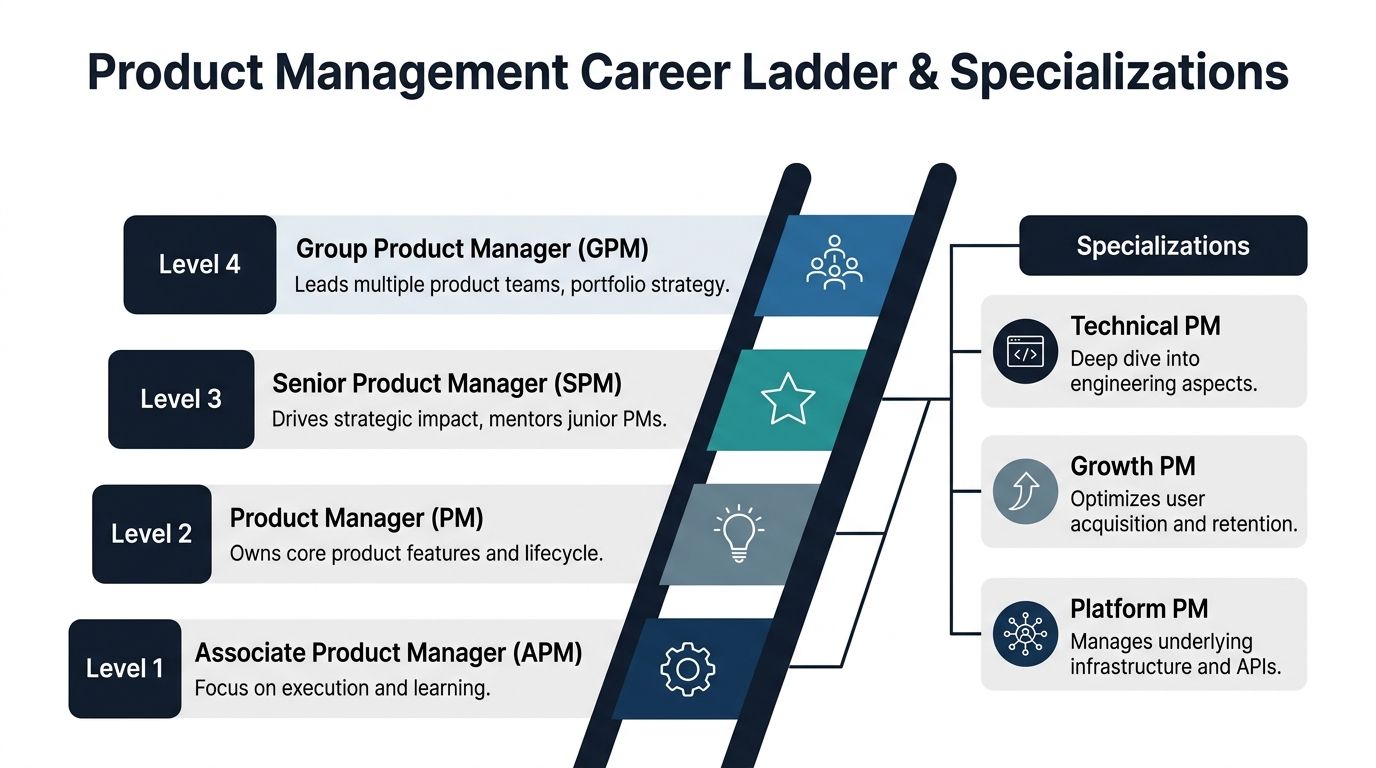
The ladder from APM to product leadership
The ladder usually looks familiar across companies, but the work changes faster than the titles suggest.
| Level | What usually changes |
|---|---|
| Associate Product Manager | Learns the craft, supports discovery and delivery, manages smaller scopes |
| Product Manager | Owns a product area or meaningful feature set end to end |
| Senior Product Manager | Handles more ambiguity, drives cross-team initiatives, mentors newer PMs |
| Group Product Manager | Leads multiple PMs or teams, manages portfolio-level decisions |
| Director and above | Sets broader strategy, builds product org capability, aligns company bets |
Early in your career, the work is close to the team. You are learning how to define problems clearly, work with design and engineering, and keep delivery tied to user value. By the time you reach senior PM, you are expected to make sharper calls with incomplete evidence. You are no longer judged only on execution quality. You are judged on whether you picked the right problems, sequenced them well, and avoided wasting team capacity on low-return work.
Group PM is where many people realize the job has changed again. You are managing product managers, product areas, or both. Compensation often reflects that broader scope. Levels.fyi salary data for Group Product Manager roles shows total compensation in major markets can range from roughly 156,000 to 244,000 depending on company and location. Seniority also stacks up in this field. Zippia’s product manager career profile reports that 32% of product managers have more than 10 years of experience.
That tracks with what happens on the job. Portfolio choices get harder than feature choices. Resourcing one team often means slowing another. An AI initiative may look strategic, but if the data foundation is weak or instrumentation is broken, the team will build demos instead of durable value.
Specializations change the shape of the job
A PM title only tells you so much. The operating model under that title changes the day-to-day work.
- Technical Product ManagerBest fit for people who like APIs, systems design, data models, infrastructure constraints, and engineering-heavy prioritization. The trade-off is that customer value can feel more indirect, so you need discipline in connecting platform work to business outcomes.
- Growth Product ManagerFocuses on acquisition, activation, retention, and monetization. This path rewards experimentation discipline and comfort with metrics. It also punishes shallow analysis. PMs in growth need strong product analytics habits, which is why learning product analytics for product managers pays off early.
- Platform Product ManagerBuilds capabilities for internal teams, developers, or partners. The user may be internal, but the product work is still real. Prioritization gets harder because success depends on adoption across teams, not just shipping a capability.
- AI Product ManagerThe AI Product Manager role is changing fastest. AI PMs are dealing with model behavior, retrieval quality, latency, prompt design, trust, safety, and workflow redesign. The hard part is not adding AI to a roadmap. The hard part is deciding where AI improves an experience enough to justify the new failure modes.
That last specialization matters for career growth. Companies now expect PMs to work with data, instrumentation, and product intelligence instead of waiting for weekly summaries from other teams. Tools such as SigOS are part of that shift because they help PMs inspect user behavior, spot friction earlier, and make better calls faster. For an ambitious PM, that changes the career curve. The people who can combine product judgment with data fluency and AI literacy are moving into higher-scope roles faster than generalists who still treat analytics as someone else’s job.
How to choose a path
Choose based on the problems you want to own for the next several years.
If you like messy user behavior, funnels, and rapid experiments, growth can be a strong fit. If you enjoy architecture, dependencies, and long-horizon system decisions, technical or platform work will probably keep you engaged longer. If you want to work near the sharp edge of product change, AI product is worth serious attention, especially if you are willing to build judgment around data quality, product intelligence, and model trade-offs instead of treating AI like a feature category.
Industry context matters too. A consumer PM, a platform PM, and a PM in a regulated business can all have the same title and completely different constraints. If you want to understand how the role changes in a compliance-heavy market, this overview of the Fintech Product Manager role is a useful reference.
Core Skills Every Successful Product Manager Needs
The PM skill set gets described too vaguely. “Be strategic.” “Communicate well.” “Understand users.” None of that helps if you’re trying to become good at the job.
In practice, strong PMs combine hard skills that help them inspect reality with soft skills that help them move people.
Hard skills that stop bad decisions
The market has moved past the PM who only reads dashboard summaries prepared by someone else. If you work on software, especially SaaS, you need to be comfortable with data and systems.
Data pipeline comprehension and SQL proficiency matter because they let you investigate product behavior directly instead of waiting for a cleaned-up narrative. According to Statsig’s perspective on technical product management skills and tools, TPMs who can directly query datasets and understand system architecture can reduce feature misprioritization by 30% to 40% by connecting engineering feasibility with business ROI.
That sounds technical, but the practical version is simple.
A PM notices feature adoption slipping. A weak PM asks for anecdotes. A strong PM checks event definitions, traces where drop-off starts, confirms whether instrumentation changed, and compares what users say with what they do.
Three hard skills matter most:
- Analytics fluency: You should be able to read funnels, cohorts, retention patterns, and usage trends without turning every question into a data-team request.
- Technical literacy: You don’t need to code full-time, but you do need to understand APIs, dependencies, data flow, and why some requests are cheap while others are architecture work.
- Prioritization discipline: A backlog is a set of economic choices. It is not a parking lot for opinions.
If you want a practical view of how PMs use analytics to make those calls, this guide on analytics for product managers is worth reading.
Soft skills that make the work real
The PM role breaks down when someone has good ideas but can’t align people around them.
Consider a common scenario. Sales says a prospect needs Feature A. Support says current users are angry about Bug B. Engineering says both requests compete for the same resources. Design thinks the root issue is onboarding confusion. No dashboard solves that for you.
Soft skills matter in these situations:
- Stakeholder management: You need to hear each function clearly without letting the loudest voice run the roadmap.
- Customer empathy: Not performative empathy. Actual curiosity about the job the customer is trying to get done.
- Decision communication: Teams don’t just need the decision. They need the reasoning, the trade-offs, and the conditions under which it would change.
The fastest way to lose trust as a PM is to sound certain before you’ve done the work to understand the problem.
The combination is what counts
PMs fail when they over-index on one side.
A highly analytical PM can still lose influence if they can’t tailor the message for engineers, executives, and GTM leaders. A charismatic PM can still waste quarters if they can’t separate pattern from noise.
The best product managers do both. They inspect the evidence, then turn it into a story the organization can act on.
Building Your Skills and Breaking Into the Field
Many candidates try to break into product management backward. They collect certificates, memorize frameworks, and hope a hiring manager will infer product judgment from effort.
That rarely works.
What gets you hired is evidence that you already think like a PM. Not perfectly. Just clearly enough that someone can trust you with a small product surface area.
Build proof before you have the title
You do not need formal PM authority to practice PM work.
You can create a portfolio that demonstrates product thinking with assets like:
- A product teardown: Pick a product you use often. Diagnose where the experience breaks down, identify the target user, and propose a tighter solution.
- A feature proposal: Write a short spec for one change. Include the user problem, expected behavior, trade-offs, and how you’d measure success.
- A side project: Launch something small. Even a simple internal tool or niche utility teaches prioritization, scoping, and feedback handling.
- A support-driven analysis: If you work in support, success, or sales, synthesize recurring customer pain into a product memo.
Hiring managers are not looking for polished theater. They want to see whether you can observe a problem, define it clearly, and make a reasonable recommendation.
Your current role is probably closer than you think
Some of the strongest PMs I’ve worked with came from adjacent functions because they already understood one critical piece of the system.
A few examples:
| Starting role | Transferable strength |
|---|---|
| Engineering | Technical trade-offs, feasibility, system thinking |
| Customer support | Deep exposure to user pain and workflow friction |
| Marketing | Positioning, audience understanding, launch discipline |
| Sales engineering or solutions | Objection handling, buyer context, implementation realities |
The mistake is thinking you need to hide your previous specialty. Usually you need to translate it.
An engineer moving into PM should not present as “I want less coding.” They should present as “I’ve learned where technical constraints shape product decisions, and I want to own those decisions earlier.”
A support lead should not say “I know the product well.” They should say “I can identify patterns in customer pain, separate edge cases from strategic issues, and turn that into prioritization input.”
Optics matter more than people admit
Career progress in product is often limited by perception, not raw capability. Many PMs do solid work and still get labeled “execution-focused” because they communicate at the wrong altitude.
That problem has been studied more directly than most PM career advice admits. According to ProdPad’s discussion of product manager career path and optics, 62% of stalled PMs in 2025 cite poor stakeholder alignment over skill deficits.
That tracks with what happens inside companies. Smart PMs often lose momentum because they explain their work as a task list instead of a strategic narrative.
How to present yourself like a PM
Use these rules when you’re trying to enter the field:
- Lead with the problem, not the task“Customers dropped during onboarding” is stronger than “I redesigned the onboarding flow.”
- Name the trade-offPMs get trusted when they can explain what they chose not to do and why.
- Show prioritization judgmentIf everything in your story sounds equally important, you’re not demonstrating product thinking.
- Practice decision writingA tight one-pager beats a vague deck.
If you want to sharpen the judgment behind those stories, this article on backlog prioritization techniques gives a useful lens for turning competing requests into defensible choices.
Your portfolio should answer one question. If we gave you a real product problem next month, would you know how to start?
The Modern PM Toolkit and the Rise of Product Intelligence
The PM toolkit used to be easier to describe. Jira for tracking. Figma for design collaboration. Analytics platforms for funnels and retention. Docs for specs. Spreadsheets for prioritization.
That stack still matters. But it no longer covers the full job.
Modern PMs operate in an environment where product signals arrive from too many places at once. Support tickets, call transcripts, CRM notes, feature requests, user behavior, experiment results, NPS comments, churn feedback, community posts. The bottleneck isn’t access to information. It’s deciding what deserves action.
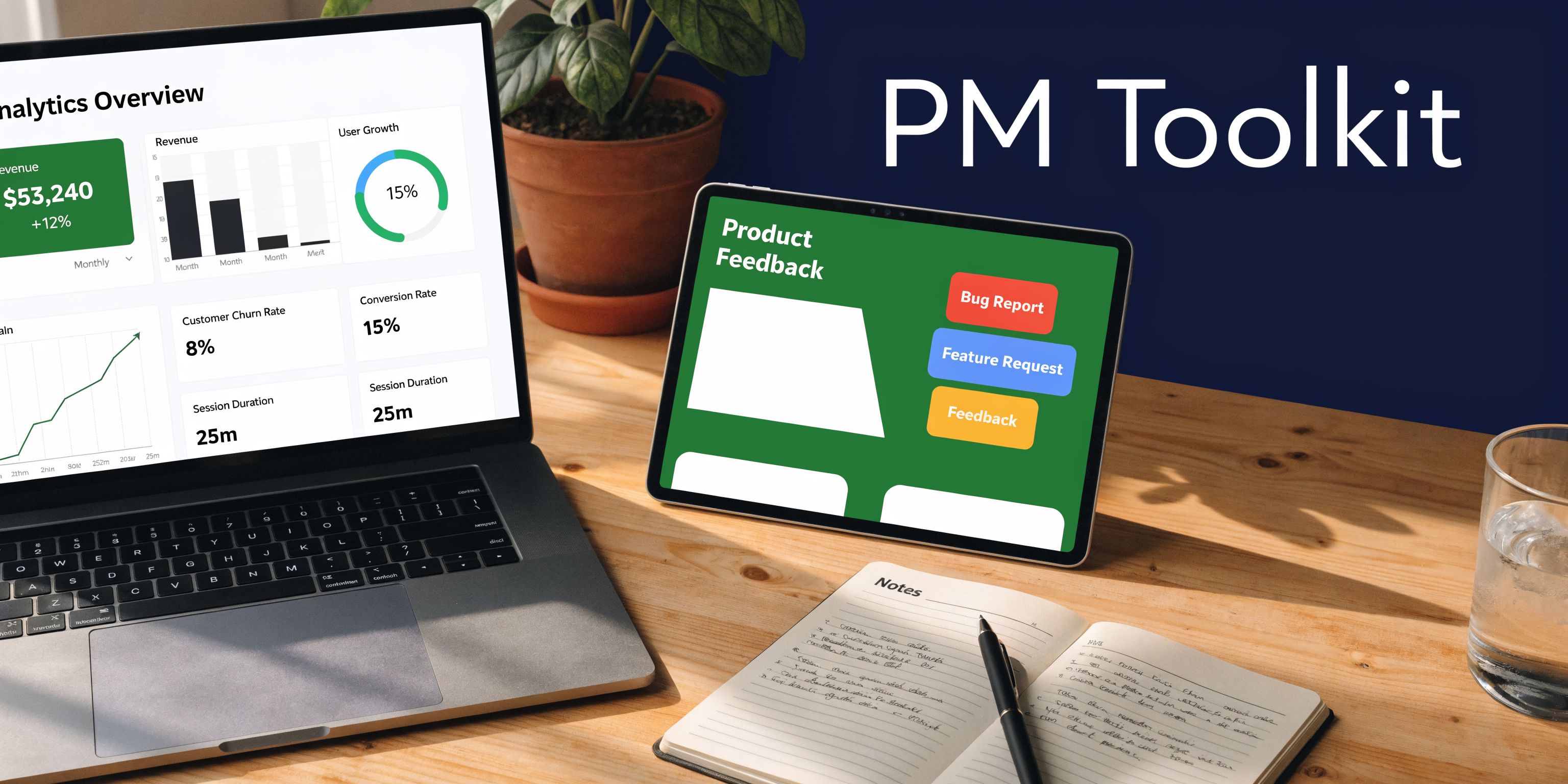
The old toolkit still has a place
A capable PM still needs to be comfortable moving across tools like:
- Jira or Linear for delivery coordination
- Figma for reviewing flows and collaborating with design
- Amplitude, Mixpanel, or similar analytics tools for behavior analysis
- Docs and wikis for requirements, decision logs, and product rationale
- Interview and feedback tools for collecting qualitative insight
None of that is optional. A PM who can’t work inside these systems will struggle to build credibility.
But there’s a limit to what this stack does well. Most of it is still fragmented. One tool tells you what users clicked. Another tells you what they complained about. Another tells you what the sales team promised. The PM is left doing manual synthesis.
Why product intelligence has become a real career advantage
This is the shift that matters most for the next wave of PMs.
AI-driven product intelligence tools are becoming part of the operating layer for product teams because they help answer a question PMs have struggled with for years. Which feedback matters?
The old way was familiar and flawed. A customer escalates loudly. Sales pushes for a feature tied to a big account. Support forwards recurring complaints. Product tries to sort signal from noise using spreadsheets, instinct, and internal influence.
That approach breaks under scale.
The better approach combines qualitative and behavioral inputs. Instead of treating every request as equal, product intelligence helps teams identify patterns tied to churn risk, expansion potential, workflow friction, and revenue impact. That changes prioritization from opinion management into evidence-backed judgment.
If you want a broader scan of what’s entering the PM workflow, this roundup of Top 12 AI Tools for Product Managers in 2026 is a practical starting point.
What this means for your career
The PMs who rise faster in the next few years won’t just be “good with AI.” That phrase is too vague.
They’ll be the ones who can:
- Translate AI outputs into product decisions
- Question weak signals instead of blindly trusting summaries
- Connect customer language with behavioral evidence
- Use automation to speed up discovery without outsourcing judgment
For a useful perspective on that shift in day-to-day product work, this guide to AI for product development shows where these tools fit into actual decision-making.
The modern toolkit is no longer just a set of execution tools. It’s becoming a decision environment. PMs who learn to operate in that environment will have a real edge.
A Day in the Life of a Product Manager
At 8:12 a.m., a PM sees three things before coffee is finished. A usage drop in a key workflow. A Slack message from support about a frustrated enterprise account. A note from engineering that a dependency changed overnight and may affect the release plan.

That sequence is normal. Product management is a decision job built around interruption. The work is not just strategy, and it is not just delivery. It is deciding what matters, fast enough to keep teams moving, without letting urgency replace judgment.
Morning work that sets direction
A B2B SaaS PM usually starts by checking what changed since yesterday. That includes product usage, customer escalations, release health, and notes from other time zones. In stronger teams, that review is grounded in live signals rather than a pile of opinions. AI-assisted analytics and product intelligence tools now make it easier to spot unusual behavior, trace friction to a workflow, and separate one loud request from a broader pattern.
Then the calendar starts filling in the blanks.
Stand-up with engineering is rarely about status. The useful part is hearing where scope is drifting, where technical constraints are changing, and where a small implementation detail creates a very different customer experience. Good PMs catch that early.
A customer call might come next. Sometimes the proposed solution is right and the messaging is wrong. Sometimes the opposite is true. Sometimes the customer asks for a feature when the underlying problem is reporting, permissions, or rollout complexity. In these situations, product judgment gets tested in public.
Industry research has shown that PM time is split between defining the product and getting it delivered. That rings true in practice. The role keeps pulling you between discovery and execution, often within the same hour.
Midday is where alignment gets tested
By midday, the work shifts from problem definition to coordination. A PM may be in a release planning session with design, then a go-to-market review with sales and marketing, then a quick check-in with support on what customers are struggling to understand.
These meetings can look administrative from the outside. They are not. Weak launches usually start in these situations.
A good PM keeps pressing on a few practical questions:
- Who will change behavior because of this release
- What customer problem does it solve right now
- What trade-off did we accept to ship it
- Where will users get confused
- What should sales avoid promising
I spent years watching teams lose weeks to preventable misalignment. The pattern was consistent. Engineering built what was asked. Marketing positioned what sounded strongest. Sales filled in the gaps. Support absorbed the consequences. A strong PM reduces that gap before launch, not after.
The PM job often feels like translation. You turn technical constraints, customer friction, and business priorities into decisions other teams can act on.
Afternoon is usually reserved for real product work
The highest-value PM hours are often the least visible. Writing a clear product brief. Tightening success metrics before a launch. Reviewing experiment results. Reworking a roadmap call after new evidence shows the original plan was wrong.
This is also where the PM role has changed fastest. Five years ago, many PMs relied on stakeholder input, survey summaries, and a handful of dashboard cuts. Now the better teams work from a richer stream of evidence. Session patterns, support themes, win-loss notes, and AI-assisted analysis all feed the same decisions. Tools like SigOS fit here. They help PMs connect customer language with behavioral data quickly enough to influence prioritization while it still matters.
This video gives a useful external view of how people describe the role in practice.
Some afternoons get blown up by an incident review, an executive update, or a design debate that should have been resolved earlier. That is part of the job. Very few days stay clean from start to finish.
What separates strong PMs is not a perfectly organized calendar. It is the ability to keep decision quality high while context-switching, to know when to go deeper, and to use modern product intelligence well enough that choices are based on evidence instead of volume or politics.
Nailing the Product Manager Resume and Interview
A PM resume fails for one of two reasons. It reads like a task list, or it sounds strategic without proving anything.
Hiring managers want evidence that you can make decisions under ambiguity and create outcomes through other people. Your resume and interview both need to show that.
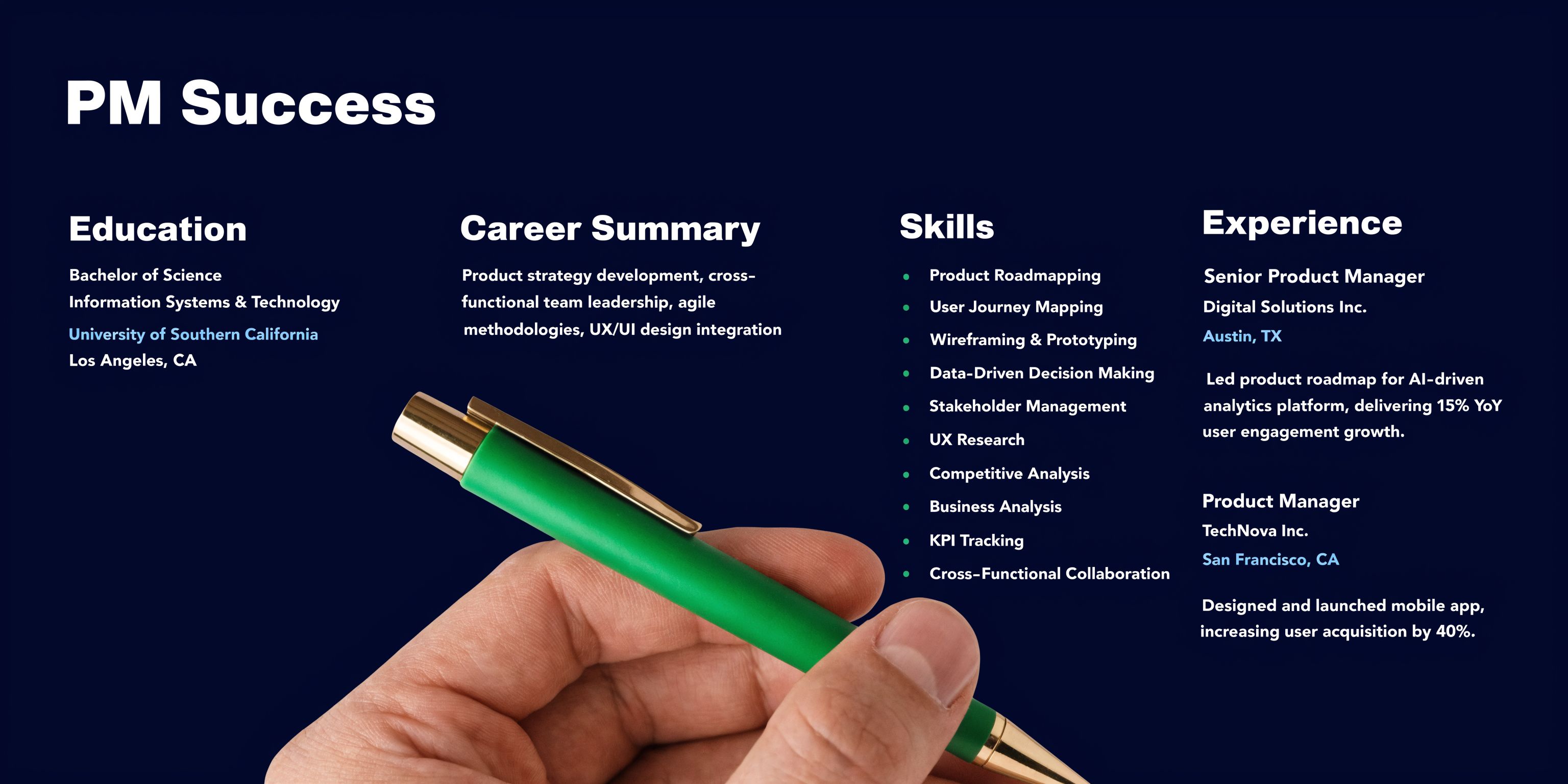
What a PM resume should actually say
Weak bullet:
- Managed backlog and coordinated with engineering
Better bullet:
- Prioritized onboarding fixes based on customer friction and engineering constraints, then partnered with design and engineering to improve activation flow
The stronger version shows judgment, not just activity.
Here’s the pattern that works best:
| Resume element | What to emphasize |
|---|---|
| Scope | Product area, user segment, or business problem you owned |
| Decision | What you prioritized, changed, launched, or cut |
| Reasoning | Why that choice mattered |
| Outcome | Business, customer, or operational impact |
If you don’t have official PM titles yet, that’s fine. Use your adjacent work. Product interviews care more about how you think than whether your previous title looked perfect.
How to handle common interview questions
PM interviews usually come in three forms.
Behavioral interviews
Use a tight narrative. Situation, problem, decision, outcome, reflection.
Don’t just say what happened. Say how you chose between competing options.
A good answer includes:
- Context: What was changing or broken
- Trade-off: What made the choice hard
- Action: How you aligned people and moved forward
- Learning: What you’d do differently next time
Product design questions
You’ll hear prompts like “How would you improve this product?”
Don’t rush to features. Slow down.
Start with:
- Who is the user
- What job are they trying to do
- Where does the current experience fail
- Which problem is most worth solving first
That structure shows you can reason before ideating.
Analytical or estimation questions
These are less about getting the exact answer and more about staying structured. State your assumptions. Break the problem down. Show your logic.
Strong PM candidates don’t perform certainty. They expose their reasoning so the interviewer can trust how they think.
The biggest interview mistake
Candidates often try to sound polished instead of useful.
Useful wins. If a decision was messy, say it was messy. If stakeholder alignment was the hard part, say that. If you changed your mind after new evidence, that helps you, not hurts you.
Interviewers are usually trying to answer one quiet question. Would this person make good decisions when the inputs are incomplete and the room is tense?
Help them say yes.
Salary Expectations and Market Trends for 2026
Product management remains one of the more attractive paths in tech because demand, compensation, and strategic relevance are all still strong.
The demand side is clear. Product manager job postings have seen a 30% annual increase, according to Noble Desktop’s product manager job outlook. That same source reports a global average salary of $110,916.
The upside becomes even more visible in specialized roles. For 2026, **AI Product Managers are projected to earn between ****130,000 and **200,000, also based on the Noble Desktop summary of market data. That aligns with what many teams are signaling already. PMs who can work comfortably across AI capability, data interpretation, and business prioritization are becoming more valuable.
What the market is rewarding
The most impactful PMs in the next cycle will usually have some combination of these traits:
- Data literacy: They can inspect behavior instead of relying only on summaries.
- Technical fluency: They understand architecture enough to make realistic trade-offs.
- AI readiness: They know where AI changes product workflows and where it doesn’t.
- Decision communication: They can align executives, engineers, and GTM teams around one priority.
What this means for your next move
A career in product management is still one of the better bets for people who want strategic work without giving up proximity to customers and execution.
But the bar is changing. Generalist instinct alone won’t carry the same weight it used to. The market is moving toward PMs who can blend product judgment with analytics, technical context, and AI-assisted decision support.
That’s good news if you’re willing to build those muscles now. The field still rewards people who can learn fast, think clearly, and make better calls than the average team under pressure.
If you’re building that muscle and want a sharper way to connect customer feedback to churn, expansion, and revenue impact, take a look at SigOS. It gives product teams a clearer view of which issues matter, so prioritization gets driven by evidence instead of noise.
Keep Reading
More insights from our blog

Ready to find your hidden revenue leaks?
Start analyzing your customer feedback and discover insights that drive revenue.
Start Free Trial →