customer acquisition and customer retention: SaaS growth
Unlock customer acquisition and customer retention with proven SaaS tactics to grow, reduce churn, and maximize ROI.

Every business dreams of growth, but that growth really comes down to two core activities: bringing new customers in the door and making sure the ones you already have stick around. These two concepts, customer acquisition and customer retention, are the fundamental pillars of a healthy company.
Think of acquisition as the gas pedal—it's how you accelerate and find new markets. Retention, on the other hand, is the powerful flywheel that keeps your business spinning, generating momentum and driving long-term profit.
The Two Engines of SaaS Growth

For a SaaS business, the path to sustainable growth isn't about picking one engine over the other. It’s about learning to run both in perfect harmony.
Going all-in on acquisition without a solid retention plan is like trying to fill a leaky bucket. You can pour water in all day, but you're working furiously just to stand still. It's expensive and, ultimately, a losing battle.
This dynamic is what separates fragile companies from resilient ones. Sure, aggressive marketing campaigns can juice your top-line numbers for a quarter, but it’s your loyal, long-term customers who provide the predictable revenue that actually funds your roadmap and fuels real profitability.
Acquisition vs Retention at a Glance
At their core, acquisition and retention serve very different purposes. They operate on different timelines, come with vastly different costs, and require their own unique playbooks. Getting a handle on these differences is the first step to building a truly balanced growth strategy.
The table below breaks down the key distinctions.
| Aspect | Customer Acquisition | Customer Retention |
|---|---|---|
| Primary Goal | Attract new prospects and convert them into first-time paying customers. | Nurture existing customers to build loyalty and drive repeat business. |
| Relative Cost | High. It can cost 5 to 25 times more to land a new customer than to keep a current one. | Low. The focus is on delivering value, not on expensive ad campaigns. |
| ROI Timeline | Often long-term. You have to recoup the initial cost of acquisition over time. | Immediate and compounding. Retained customers provide ongoing value from day one. |
| Key Strategies | SEO, content marketing, paid ads, social media campaigns, and sales outreach. | Great onboarding, proactive support, loyalty programs, and community building. |
Understanding these differences helps clarify where to invest your time and money. While both are critical, they are not interchangeable.
Why This Balance Is Non-Negotiable
A truly healthy SaaS business doesn't just grow—it compounds. And that compounding effect is where retention becomes your superpower.
Consider this: a mere 5% increase in customer retention can boost your profits by anywhere from 25% to 95%. How? Because happy, loyal customers do more than just pay their subscription fees. They upgrade their plans, expand their usage, and become your best salespeople by referring new business. All of that happens at a fraction of the cost of finding a new customer from scratch.
Ultimately, mastering both customer acquisition and customer retention means you have a deep understanding of the entire customer journey. You know what it takes to get someone to sign up, but more importantly, you know what makes them stay for the long haul. This is foundational to calculating key metrics, and you can learn more about how this impacts the lifetime value of a customer in our SaaS guide.
When you see them as two interconnected engines, you can finally build a growth machine that isn't just fast, but also incredibly efficient and built to last.
Calculating the True ROI of Your Growth Efforts
To really figure out where to put your money—acquisition or retention—you have to get beyond gut feelings and look at the hard numbers. Measuring the Return on Investment (ROI) for both isn't just a bean-counting exercise; it's how you check the pulse of your SaaS business and see if it's built to last.
Think about it like flying a plane. You wouldn't just stare out the cockpit window and hope for the best. You need your altimeter, your fuel gauge, and your airspeed indicator to know you're on the right track. For a SaaS business, key metrics like Customer Acquisition Cost (CAC) and Customer Lifetime Value (LTV) are your most important gauges.
The Acquisition Gauge: Customer Acquisition Cost
Customer Acquisition Cost (CAC) is simply what it costs you, on average, to land a single new paying customer. It’s a straightforward but incredibly powerful number that tells you how much you're spending to press the growth "gas pedal."
To figure it out, just add up all your sales and marketing expenses for a given period and divide that by the number of new customers you brought in during that same timeframe.
CAC Formula: (Total Sales & Marketing Costs) / (Number of New Customers Acquired) = CAC
This isn't just ad spend. It includes everything from content creation and software subscriptions to the salaries of your marketing and sales teams. A high CAC isn't necessarily a red flag, but it absolutely has to be justified by the value that customer brings in over the long haul.
The Retention Engine: Customer Lifetime Value
On the flip side, you have Customer Lifetime Value (LTV). This metric is the total revenue you can realistically expect to earn from a single customer over the entire time they stay with you. LTV is the ultimate report card on your retention efforts.
Calculating LTV can get a little more complicated, but a common starting point is:
LTV Formula: (Average Revenue Per Account) x (Customer Lifetime) = LTV
A healthy LTV tells you that customers are sticking around because you're consistently delivering value. This is where the magic of retention really happens. Research consistently shows that a mere 5% increase in customer retention can drive profits up by an astounding 25% to 95%. It makes sense when you remember that acquiring a new customer costs about five times more than keeping an existing one—a reality that has pushed 94% of sales leaders to focus on balancing both.
The Ultimate Health Check: The LTV to CAC Ratio
Neither CAC nor LTV gives you the full picture on its own. The real "aha!" moment comes when you put them together. The LTV:CAC ratio is arguably the most critical metric for any SaaS business. It answers one simple but vital question: are we making more money from our customers than we're spending to get them?
Let's walk through a quick example.
Fictional Company: "ProjectFlow SaaS"
- Monthly Marketing & Sales Spend: $20,000
- New Customers Acquired in a Month: 40
- Average Revenue Per Account (ARPA): $100/month
- Average Customer Lifetime: 36 months
Step 1: Calculate CAC 20,000 / 40 new customers = 500 CAC
Step 2: Calculate LTV 100 ARPA x 36 months = 3,600 LTV
Step 3: Find the LTV:CAC Ratio 3,600 LTV / 500 CAC = 7.2:1 Ratio
In this scenario, ProjectFlow is absolutely crushing it. Their 7.2:1 ratio proves their acquisition and retention strategies are working together beautifully. But if that ratio dipped below 1:1, it would be a blaring alarm bell—they'd be losing money on every new signup, signaling it's time to fix the leaks in the bucket before trying to pour more water in.
To get a better feel for the ROI of specific tactics, you can dig into things like strategies to achieve significant ROI with retargeting. Once you get comfortable with these calculations, you can stop guessing and start making sharp, data-driven decisions that build a much more resilient business.
Frameworks for Prioritizing Your Spend and Effort
Knowing your LTV:CAC ratio is a bit like knowing your car's fuel efficiency—it tells you how healthy your growth engine is. But it doesn't tell you where to drive next. To make smart calls on where to invest your next dollar, you need a framework that matches your spending to where your company is on its growth journey.
The right balance between customer acquisition and customer retention isn't a fixed target. It's constantly shifting as your business matures. What works for a scrappy startup with a dozen customers is worlds away from the strategy an established market leader needs.
The Growth Stage Matrix
A straightforward way to approach this is with the Growth Stage Matrix. It breaks down your priorities based on whether you're a startup, a scale-up, or a mature enterprise. Each stage has a clear primary focus that should guide how you allocate your resources.
- Startup Stage (Pre-Product-Market Fit): Right now, your entire world revolves around acquisition. You have to get people through the door to prove your concept and find that first passionate group of customers. The split here is heavily skewed, maybe 80% on acquisition and 20% on retention. The retention work you do is mostly about learning why those early believers stick around.
- Scale-Up Stage (Post-Product-Market Fit): You’ve found a repeatable way to bring in new customers. Fantastic. Now, things start to even out, shifting to a 50-50 balance between acquisition and retention. You're still bringing in new business aggressively, but you’re also building the systems to keep churn low and drive up LTV.
- Mature Stage (Market Leadership): Once you're an established player, growth naturally slows, and your market might start feeling crowded. This is when your priorities flip dramatically toward keeping and expanding the customers you have. The focus becomes something like 30% acquisition and 70% retention. Your biggest growth opportunities now come from upselling existing accounts and making sure no one leaves.
Using Product Intelligence to Guide Your Focus
Knowing when to shift your focus is one thing; knowing how is another entirely. This is where product intelligence—digging into the behavioral signals inside your product—becomes your compass. Instead of just going with your gut, you can use real data to see what actions separate your raving fans from the users who churn.
By analyzing the in-app behaviors of your best, most successful customers, you can pinpoint "power user" actions. These are the specific features they engage with or milestones they hit that have a strong correlation with high retention and LTV.
Imagine a project management tool discovers that users who create and share three projects within their first week have a 90% retention rate after a year. That’s not just a cool stat; it's a game-changing insight. This "aha!" moment becomes the North Star for both your acquisition and retention strategies.
Turning Behavioral Insights into Action
Once you’ve identified these critical behavioral signals, you can re-engineer the entire customer journey to steer new users toward them. This creates a powerful feedback loop where what you learn from retention directly sharpens your acquisition strategy.
You can put this intelligence to work in a few key ways:
- Refine Onboarding: Redesign your onboarding flow to get new users to complete those "power user" actions as fast and frictionlessly as possible.
- Target Marketing: Tweak your ad copy and marketing messages to attract prospects who look like they’re already primed to perform these valuable behaviors.
- Proactive Customer Success: Create alerts that notify your success team when a new user isn't hitting those key milestones, giving them a chance to jump in and help.
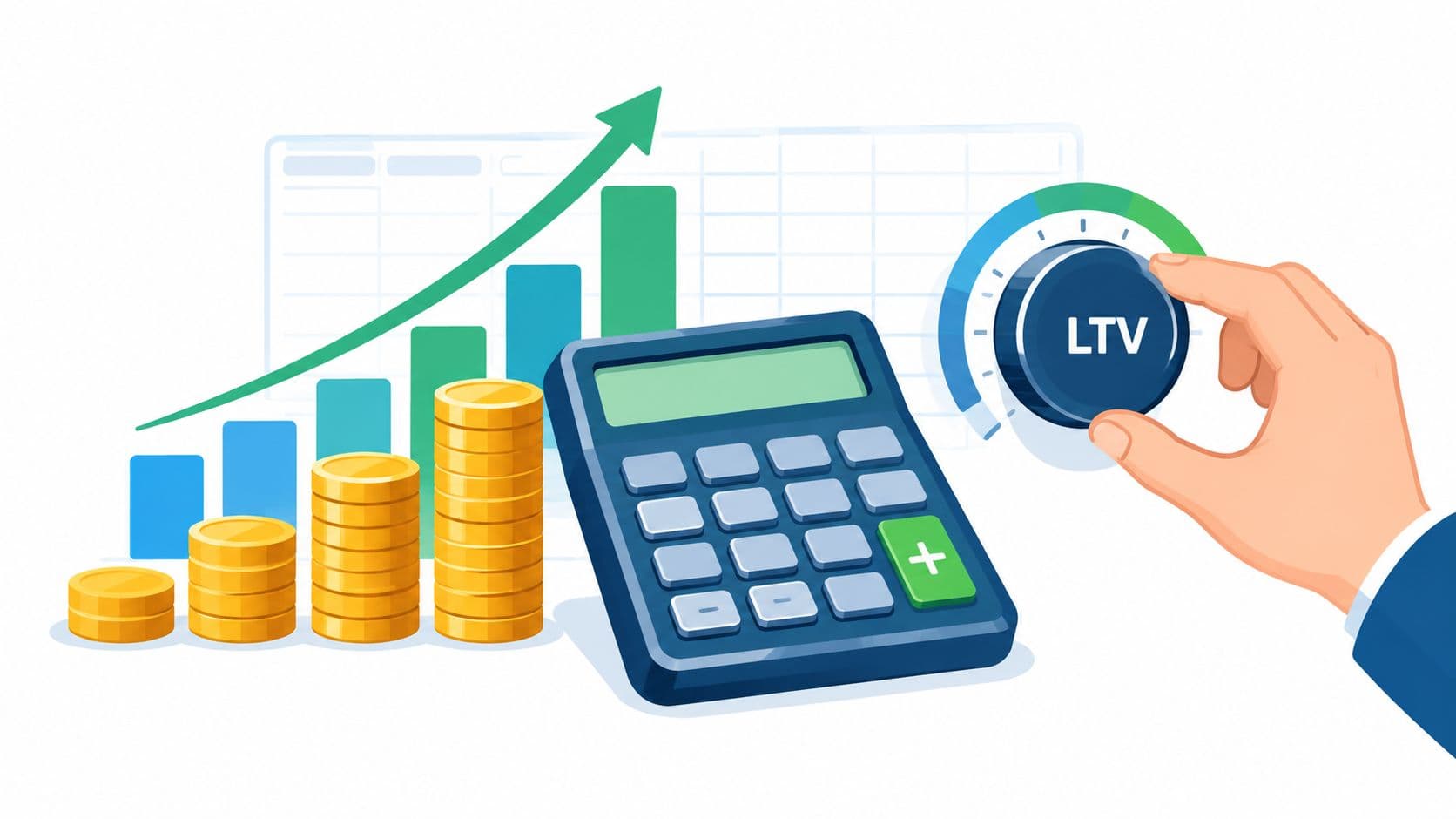
This diagram shows the classic health ratio for a SaaS business, with Lifetime Value (LTV) stacked against Customer Acquisition Cost (CAC) to give you the all-important LTV:CAC metric.
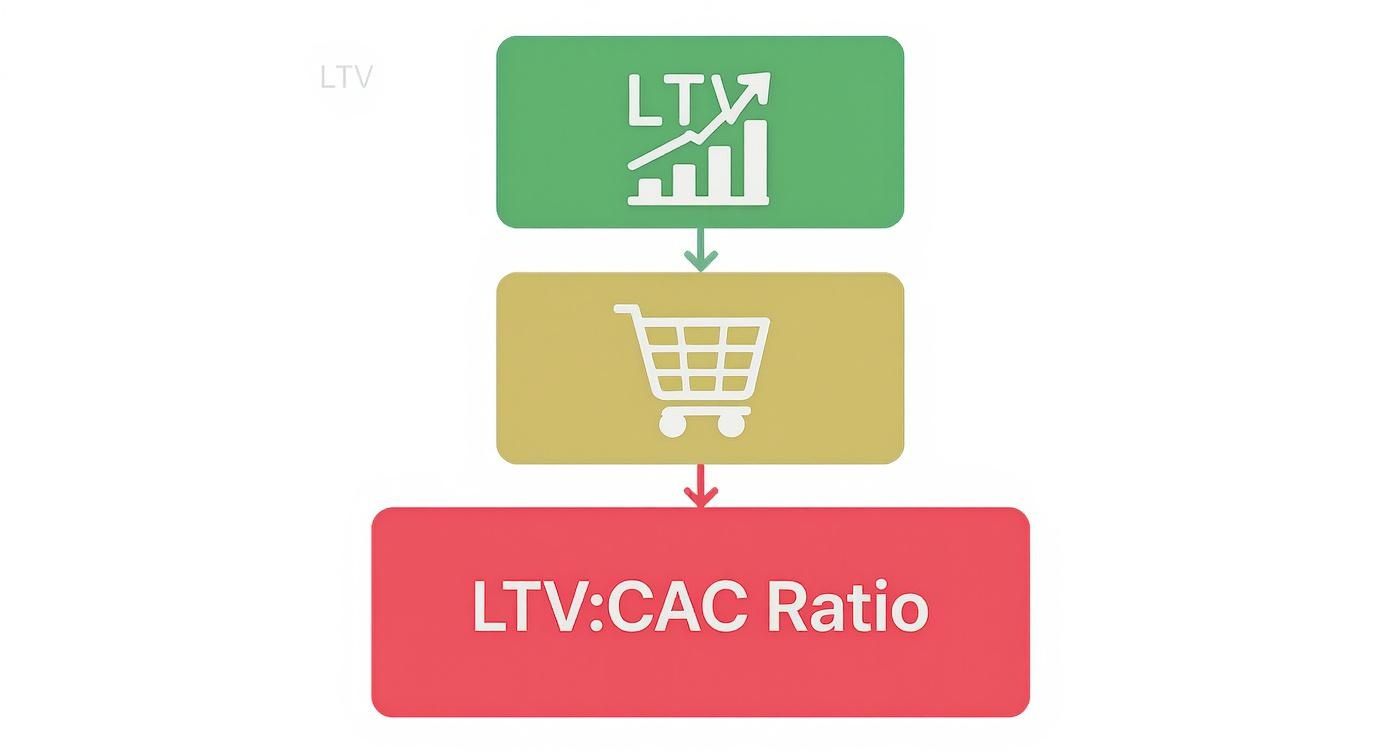
At the end of the day, a healthy business generates way more value from a customer over their lifetime than it costs to get them in the door. By using behavioral data to continuously improve this ratio, you stop just spending money on growth and start strategically investing in profitable, long-lasting customer relationships.
Actionable Strategies for Winning New Customers
Knowing your numbers is one thing, but growth only kicks in when you turn that knowledge into action. A truly effective customer acquisition strategy isn’t just one brilliant tactic; it’s a well-oiled machine with several engines running in harmony. For any SaaS company, the goal is to build a predictable, repeatable system for bringing in new business.
Let's break down three of the most powerful pillars for modern customer acquisition: building an audience with inbound marketing, paying for laser-focused reach with performance marketing, and amplifying your footprint through smart partnerships. Each one plays a distinct role, but together, they create a steady, scalable flow of new customers.
Build Your Audience with Inbound Marketing
Inbound marketing is the long game. It’s all about attracting customers by creating genuinely valuable content and experiences that solve their problems, rather than just shouting at them with ads. By doing this consistently, you pull people into your orbit and establish your brand as a trusted authority they can rely on.
Think of it as becoming the go-to resource in your niche. When a potential customer has a question, your blog is the first place they find the answer. This is an incredibly powerful approach in the SaaS world, where buyers spend a ton of time researching solutions before they ever think about making a purchase.
Here’s a mini-playbook to get you started:
- Hunt for High-Intent Keywords: Fire up your favorite SEO tool and look for long-tail keywords—those specific, multi-word phrases your ideal customers are typing into Google. Think "how to reduce customer churn for a SaaS" instead of a generic term like "customer churn." These queries are a huge signal that someone is actively looking for a solution.
- Create Pillar Content: Go deep on a broad topic by creating a massive, comprehensive guide. This not only shows off your expertise but also acts as a central hub you can link to from all your smaller, more specific blog posts.
- Promote and Distribute Relentlessly: Writing amazing content is only half the job. You have to get it in front of people. Share it across social media, in your email newsletters, and in the online communities where your audience actually hangs out.
Drive Immediate Growth with Performance Marketing
While inbound marketing builds momentum slowly over time, performance marketing is like hitting the gas pedal for instant results. This is all about paid advertising channels where you only pay for a specific action, like a click or a sign-up. It's a direct line to getting your product in front of a highly targeted audience, right at the moment they need it most.
The secret to winning at performance marketing is an obsessive focus on your unit economics. You absolutely have to keep your Customer Acquisition Cost (CAC) well below your Customer Lifetime Value (LTV). This means you’re constantly testing, tweaking, and digging into the data to squeeze every drop of value out of your ad spend.
Here are a few steps to put this into practice:
- Start with Search Ads: Launch campaigns on Google Ads targeting those high-intent keywords you found earlier. These users are literally raising their hands and telling you they need a solution like yours, making them the lowest-hanging fruit.
- Lean into Social Retargeting: Use platforms like LinkedIn or Facebook to run ads targeting people who have already visited your website but didn’t convert. A gentle reminder can be just the thing to bring them back.
- Obsess Over Landing Pages: Make sure the page a user lands on after clicking your ad delivers exactly what the ad promised. A crystal-clear call-to-action and a dead-simple signup process are non-negotiable.
Expand Your Reach Through Partnerships
Why go through the pain of building an audience from scratch when you can tap into one that already exists? Partnership ecosystems let you break into new markets by teaming up with other companies who serve a similar customer but aren't direct competitors. This can be one of the most cost-effective customer acquisition and customer retention strategies out there.
These partnerships can be as simple as a co-hosted webinar or as complex as a deep technical integration where your products work together seamlessly. A brilliant integration can even become a core feature that drives both acquisition and retention. Many fast-growing companies have built their entire strategy around a product-led growth motion, where the product itself is the main engine for acquiring new users.
For instance, a project management tool could team up with a time-tracking app. By integrating their software, they create more value for both sets of customers and can cross-promote to each other's user bases. It's a classic win-win that fuels growth for everyone involved.
Proven Playbooks for Reducing Customer Churn

While winning new business always feels like a victory, the quiet, ongoing work of keeping customers is where sustainable growth is really forged. Customer retention isn't something that just happens; it's an active process. It requires structured playbooks designed to proactively fight churn before it ever gets a chance to take root.
Hoping customers stick around is a classic "leaky bucket" strategy. Instead, smart companies build systems to consistently deliver value, spot risks early, and listen intently to their users. These efforts are the bedrock of balancing customer acquisition and customer retention for long-term health.
Let's walk through three proven playbooks that will help you keep your hard-won customers engaged, loyal, and always seeing the value in what you offer.
Create a Frictionless Onboarding Experience
A new user's first few interactions with your product are make-or-break moments. A confusing or overwhelming onboarding experience is a one-way ticket to churn. The absolute goal here is to guide users to their "aha!" moment—that instant where they truly get your product's value—as fast as possible.
Think of it as the difference between giving someone a guided tour and just handing them a complex map. A great onboarding flow doesn't just show off features; it pushes users to complete meaningful actions that solve their immediate problems.
To get this right, you should:
- Personalize the first run: Use a simple welcome survey to ask about a user's role or goals. Then, use that information to tailor their initial experience and highlight the features most relevant to them.
- Implement interactive walkthroughs: Guide users step-by-step through a critical setup task or a core workflow. Make sure they achieve a small win in their very first session.
- Celebrate early milestones: When users complete key actions, acknowledge their progress with positive in-app messages. This reinforces good habits and builds momentum.
Implement Proactive Customer Success Programs
Waiting for an unhappy customer to complain is a losing game. A modern approach to retention means being proactive, using data to identify at-risk accounts long before they even think about canceling. This is where customer health scores become absolutely invaluable.
A health score is a metric that rolls up various data points—like product usage, support ticket volume, and survey responses—to predict the likelihood of churn.
By monitoring these scores, your customer success team can shift from a reactive, fire-fighting mode to a proactive, consultative one. They can reach out to offer help, provide training, or share best practices with accounts whose engagement is slipping.
Poor communication is a silent killer of customer relationships. It's shocking, but poor follow-up is responsible for 41% of lost accounts, making it the single largest preventable reason for churn. To fight this, 83% of sales leaders now kick off renewal talks early, and 73% of organizations use shared CRM tools to keep teams aligned.
Build a Powerful Customer Feedback Loop
Your customers are the ultimate source of truth about your product's strengths and weaknesses. Building a systematic way to collect, analyze, and act on their feedback is a cornerstone of any solid retention strategy. It closes the loop between what users are asking for and what your team is building.
An effective feedback loop isn't just a suggestion box; it's an integrated system that connects customer input directly to your product roadmap. This ensures you're not just building features, but building the right features that solve real problems and deepen loyalty. For more actionable ideas, you can learn how to reduce customer churn with targeted strategies.
This system should include:
- Multiple collection channels: Use a mix of in-app surveys (like NPS), support ticket analysis, and direct conversations to gather feedback from different touchpoints.
- Centralized analysis: Funnel all that feedback into a single platform to spot recurring themes and prioritize issues based on their impact on revenue or churn.
- Visible action: When you release a feature or a fix based on customer feedback, announce it. This shows users you’re listening and that their input has a real impact.
For a detailed breakdown of how to combat churn effectively and retain your valuable customers, explore these 10 SaaS retention strategies to stop churn.
Frequently Asked Questions
When you're in the trenches of growing a business, the theory behind customer acquisition and customer retention gives way to hard questions. Let's tackle some of the most common ones that come up.
What’s a Good LTV:CAC Ratio for a SaaS Business?
The gold standard for a healthy SaaS business is an LTV to CAC ratio of 3:1 or higher. In plain English, that means for every dollar you spend to land a new customer, you should be making at least three dollars back over their lifetime.
If your ratio dips below 1:1, you're officially in the red zone—you’re losing money on every single customer you sign. On the flip side, a sky-high ratio like 5:1 might sound great, but it could be a sign you’re not investing enough in growth and are leaving market share on the table.
Keep in mind, this isn't a one-size-fits-all rule. Your ideal ratio depends on your industry, funding, and business model. An early-stage, VC-backed startup might stomach a lower ratio for a while to grab a foothold in the market.
But if you're bootstrapping? You need to keep that ratio healthy right from the start to stay profitable and keep the lights on.
How Can a Small Team Improve Customer Retention?
When you’re a small team, you can't be everywhere at once. The key to improving customer retention is to lean into automation and smart prioritization.
Your first move should be to build a killer automated onboarding experience. This is your single best opportunity to make a great first impression and get users to that "aha!" moment without you having to hold their hand.
Here are a few practical ideas:
- Use in-app guides and tooltips that walk new users through the most important first steps.
- Set up an automated email series to share helpful tips and nudge them toward key features during their first couple of weeks.
- Build a self-serve knowledge base or a solid FAQ section so users can find answers on their own, which takes a huge load off your support team.
Beyond that, you have to be ruthless about where you spend your time. Segment your customers to figure out who your most valuable accounts are and give them your proactive attention. Even something as simple as a Net Promoter Score (NPS) survey can give you a ton of feedback at scale, without needing a big team to manage it.
Should I Focus on Acquisition or Retention First?
This is the classic chicken-or-the-egg question for startups. The answer really comes down to what stage you're at.
If you’re just starting out with few or no customers, your world revolves around customer acquisition. You can't retain customers you don't have, right? Your job at this stage is to prove there's a real demand for what you've built, test your marketing channels, and find your product-market fit.
But that doesn't mean you ignore retention. From the moment you land your first users, you need to watch them like a hawk.
- Get as much feedback as you possibly can.
- Figure out why the happy ones are sticking around.
- Dig into why the others are leaving.
Once you’ve built a small, stable customer base and can prove you’re not losing them as fast as you get them, you’ve earned the right to pour more fuel on the acquisition fire. It's not a switch you flip overnight; it's a gradual shift as your business grows up.
What Are the Common Mistakes in Balancing Acquisition and Retention?
One of the biggest blunders is the "leaky bucket" problem. This is when a company spends a fortune on acquisition (filling the bucket with water) while completely ignoring a high churn rate (the giant holes in the bottom). It's a surefire way to burn through cash with nothing to show for it but stagnant growth.
Another common mistake is treating acquisition and retention teams like they live on different planets. The marketing team’s job isn't "done" when a user signs up. If they're bringing in customers who are a terrible fit, they’re just handing a problem to the retention team. The best companies make sure everyone is aligned—marketing is on the hook for acquiring customers who actually have the potential to succeed long-term.
Finally, a lot of businesses simply don't measure the right things. They get obsessed with vanity metrics like total sign-ups instead of the numbers that actually move the needle, like user activation rates or the all-important LTV:CAC ratio.
Without the right data, you're flying blind. You won't know where your strategy is broken or how to fix it, making it impossible to strike a healthy balance between customer acquisition and customer retention.
Ready to turn customer feedback into your biggest growth driver? SigOS uses AI-driven product intelligence to analyze behavioral signals from support tickets, sales calls, and usage data. We identify the patterns that predict churn and highlight the opportunities that drive revenue, so you can build a product your customers will never want to leave. Discover how SigOS can help you prioritize with confidence.
Keep Reading
More insights from our blog
Ready to find your hidden revenue leaks?
Start analyzing your customer feedback and discover insights that drive revenue.
Start Free Trial →