Resource Allocation Optimization: A SaaS Playbook
A practical guide to resource allocation optimization for SaaS product teams. Learn to prioritize work by revenue impact, reduce churn, and measure ROI.

Monday starts with three Slack messages that all sound urgent. Sales wants a feature to close a deal. Support has a cluster of tickets from frustrated customers. Engineering wants time for platform work because the current architecture is slowing every release. Everyone is right, and your team still can't do all of it.
That's the actual resource allocation problem in SaaS. It rarely looks like a spreadsheet issue. It looks like competing claims on the same engineering week, with revenue, churn, product quality, and team morale all pulling in different directions.
Teams often claim to prioritize by impact. In practice, they prioritize by volume, politics, or recency. The loudest internal stakeholder gets attention. The biggest customer gets a shortcut. The oldest infrastructure pain gets deferred one more sprint. Over time, the roadmap turns into a trail of local optimizations instead of a portfolio of deliberate bets.
The fix isn't a prettier planning ritual. It's resource allocation optimization tied directly to business outcomes. If a bug is driving churn, quantify that. If a feature opens expansion conversations, quantify that. If platform work reduces delivery drag across multiple roadmap items, force it into the same decision system instead of treating it as “important but hard to justify.”
Your Team Is Drowning in Priorities
A familiar scene plays out in fast-growing SaaS companies. A strategic prospect asks for a missing workflow before signing. Customer Success brings evidence that a broken onboarding path is frustrating paying accounts. Engineering points out that the release train is unstable, so every new commitment carries hidden delivery risk. Product gets stuck in the middle, asked to turn all of it into one coherent plan.
The mistake is treating these requests as if they belong in separate conversations. They don't. They all compete for the same finite pool of engineers, designers, analysts, and implementation support. When teams split them into separate queues, they lose the ability to compare one week of work on retention against one week of work on expansion.
Why instinct breaks first
When teams don't have a shared value model, they reach for proxies. Customer passion. Executive pressure. Sales confidence. Severity labels. None of those are useless, but none of them are enough.
A 2024 Gartner finding summarized here reported that 71% of successful SaaS companies allocate resources based on customer behavior analytics rather than subjective feedback, and those companies saw a 26% higher revenue expansion rate and 19% lower churn. That result matches what many product leaders learn the hard way. Opinion creates motion. Behavior creates signal.
For many teams, better backlog prioritization techniques transform from a PM hygiene topic into a revenue discipline. The question isn't “which item feels important?” It's “which item changes customer behavior in a way the business cares about?”
Practical rule: If two requests are competing for the same sprint, compare them on retained revenue, expansion potential, delivery risk, and confidence. Don't compare them on who asked loudest.
What a better operating model looks like
A revenue-first model changes the language inside roadmap meetings.
Instead of saying:
- High impact bug
- Important enterprise feature
- Needed technical debt
Say:
- This issue appears tied to churn risk in a specific customer segment
- This feature could unblock expansion conversations in accounts already showing demand
- This platform work increases our ability to ship high-value work with less delay
That shift matters because engineering time is expensive and irreversible. Once a sprint is gone, you don't get it back. Every team already understands that in theory. Very few teams make it visible in planning.
The companies that get this right don't win because they forecast perfectly. They win because they force each decision into the same frame. Revenue impact. Retention impact. Confidence in the signal. Cost to deliver. Trade-offs become explicit, which is the only way to make them defendable.
Define Value Beyond Vague Impact Scores
A roadmap review gets expensive fast when one leader says a request is "high impact," another calls it "strategic," and nobody can explain what either term means in dollars, renewals, or expansion. Teams do not stall because they lack opinions. They stall because they are using different definitions of value.
The fix is to define value in business terms before scoring anything. For SaaS teams, that usually means four questions. Does this work reduce churn risk in a visible customer segment? Does it help expansion revenue already in motion? Does it solve a broad pattern instead of a one-off escalation? Does it support a deliberate company bet that leadership is willing to fund?
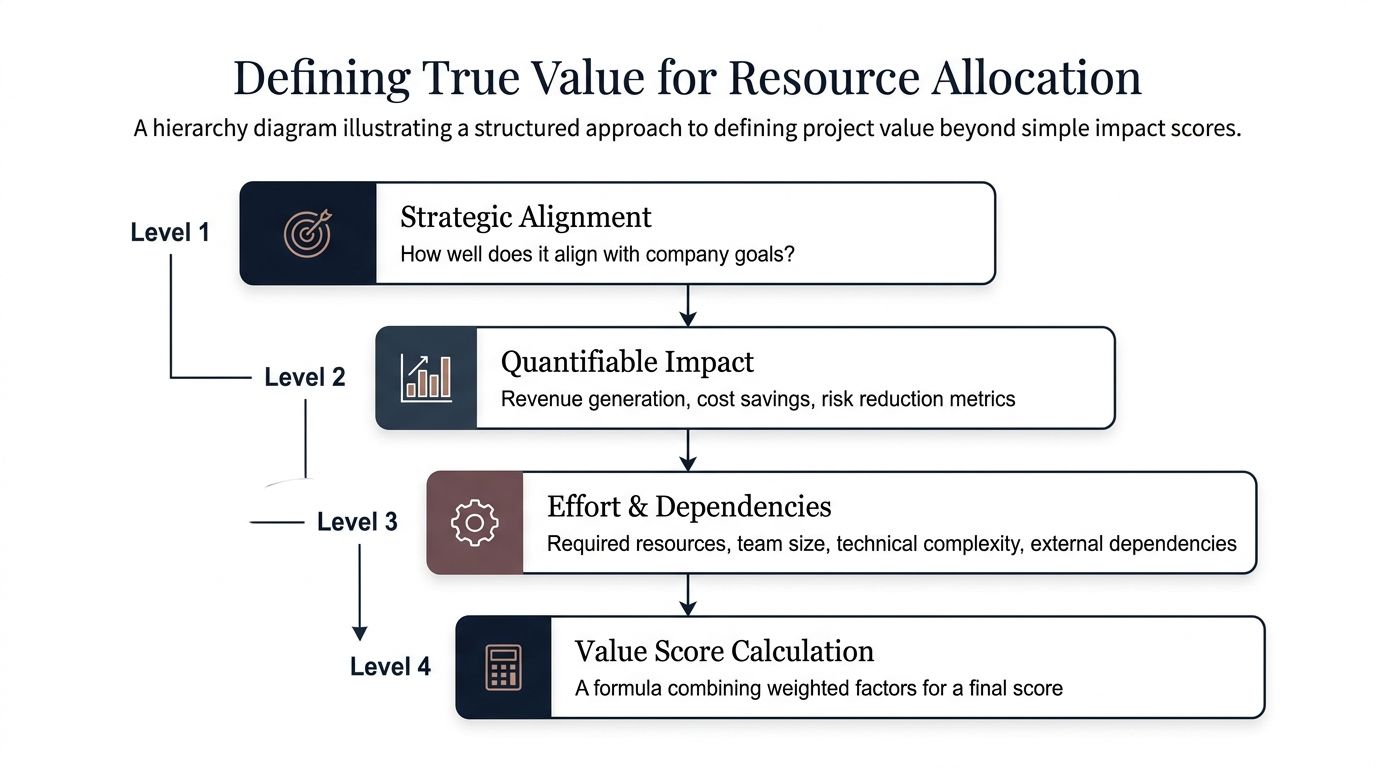
Build one value language across teams
The hard part is not writing the categories. The hard part is getting Product, Sales, Success, and Engineering to describe the same issue the same way.
If Sales logs "missing audit logs" as a deal blocker, Support logs it as a compliance request, and Product logs it as a reporting enhancement, the portfolio gets distorted. The work looks like three separate problems. In reality, it may be one revenue issue with a clear buyer, a clear use case, and a clear commercial path. A product roadmap development process only holds up when the intake language is consistent enough to compare unlike work on the same scale.
Use a short set of value inputs for every initiative:
- Churn signalLook for declining usage, repeated friction, renewal objections, executive escalations, or downgrade behavior in affected accounts.
- Expansion pathCheck whether the request is tied to larger seat counts, plan upgrades, enterprise security reviews, or active upsell conversations.
- Pattern strengthSeparate isolated requests from recurring evidence across a segment, plan tier, or customer lifecycle stage.
- Strategic fitName company bets directly. If the work matters because it supports enterprise readiness, international expansion, or AI-driven differentiation, say so plainly.
Turn requests into evidence
A feature request becomes useful when the intake captures the commercial context around it.
"We need audit logs" is weak. It gives the team no basis for comparison.
A stronger intake says which accounts asked for it, what renewal or expansion event it is tied to, how often the pattern appears, what workaround the customer is using today, and what happens commercially if the team does nothing for two quarters. That level of discipline keeps loud requests from beating valuable ones.
I have seen teams overfund enterprise asks because the account value is large, then discover the feature had no real adoption path beyond one procurement cycle. I have also seen a smaller workflow fix save multiple mid-market renewals because it removed friction that Success had been flagging for months. The lesson is simple. Account size alone is a poor proxy for value.
A useful side effect is better visibility beyond the roadmap. Teams trying to improve discoverability often apply the same discipline in marketing. That is part of why operators studying Algomizer's AI visibility strategy focus on measurable signals instead of broad importance labels.
Work without a revenue path, retention signal, or strategic role can still deserve time. It just needs to compete honestly against work that has one.
Define effort in business terms
Effort should not stop at story points.
A request that looks attractive on paper may pull in platform work, security review, migration risk, post-launch support load, and coordination across three teams. That cost matters because the actual trade-off is not feature A versus feature B. It is feature A versus every other revenue-bearing use of the same capacity.
The teams that handle this well estimate effort with business friction included:
- Cross-team coordination cost
- Dependency risk
- Operational overhead after launch
- Confidence in the expected outcome
- Opportunity cost against current roadmap commitments
That gives leadership a cleaner definition of value. It is not "impact." It is expected commercial upside adjusted for breadth, confidence, and delivery cost. That standard makes roadmap debates shorter, and the trade-offs easier to defend when revenue goals get tight.
Score and Prioritize Work with a Revenue First Lens
Once value is defined clearly, prioritization gets less emotional. Not easy, but cleaner. The job is to score unlike work in one system: bugs, features, platform investments, integrations, and workflow improvements.
A generic framework like RICE can help, but SaaS teams usually need a more direct lens. Revenue and retention should sit at the top of the stack, not as a side note.
Use a weighted model that reflects the business
A practical revenue-first model usually includes five inputs:
- Churn reduction potential
- Expansion revenue potential
- Strategic alignment
- Confidence in the signal
- Effort and dependency cost
The weighting depends on company stage. A mature platform under renewal pressure may weight churn reduction highest. A company pushing into enterprise may place more weight on expansion and strategic fit. The important part is consistency. If the weighting changes every planning cycle based on who's in the room, the model is decorative.
A strong side benefit is operational efficiency. The PMI study summarized by Planisware found that organizations using optimized resource allocation practices reduced project delays by 47%, cut resource waste by 32%, and achieved an average 18% increase in ROI on project investments.
A simple scoring table you can actually use
Here's a lightweight template that keeps teams out of endless argument:
| Initiative | Predicted Churn Reduction ($/mo) | Predicted Expansion Revenue ($/mo) | Effort (person-weeks) | Weighted Score |
|---|---|---|---|---|
| Onboarding bug fix | ||||
| Enterprise permissions feature | ||||
| Billing reconciliation cleanup | ||||
| Search performance improvement |
The point of the table isn't false precision. It's forcing every initiative through the same gate. If one item has strong churn logic but low expansion upside, that becomes visible. If another has large upside but weak confidence and heavy effort, that becomes visible too.
How to calculate the score
Many teams use a formula along these lines:
- Value score = weighted churn impact + weighted expansion impact + weighted strategic alignment
- Priority score = value score × confidence, then adjusted downward for effort and dependencies
Keep the scale simple. What matters is whether your team can explain why an item ranked above another.
For work related to acquisition or product discovery, it can help to borrow measurement thinking from adjacent disciplines. A useful example is Algomizer's AI visibility strategy, which is valuable because it frames prioritization around observed visibility outcomes instead of abstract content effort. That same mindset works inside product planning. Start with the business result you need, then allocate resources backward from it.
For roadmap communication, this also makes discussions with executives much easier. A product roadmap development process is more credible when roadmap items can be tied to retained revenue, expansion movement, and delivery cost rather than broad claims of importance.
The best prioritization models don't eliminate disagreement. They make disagreement explicit, measurable, and shorter.
One hard trade-off most teams avoid
Tech debt should not live outside the scoring system. If it slows releases, increases defect rates, or blocks high-value roadmap work, it has business value. Score it that way.
What doesn't work is giving technical work a permanent “special lane” while forcing revenue-facing work to justify itself in detail. The opposite is also broken. If every engineering foundation item gets deferred because the near-term revenue path is less obvious, the roadmap starts to tax itself. Delivery slows, rework increases, and the next quarter's “capacity issue” becomes self-inflicted.
The answer isn't to pretend all work is identical. It's to compare all work in one investment model.
Build Automated Feedback Loops and Workflows
A prioritization framework dies quickly if it depends on heroic manual upkeep. Product ops updates one spreadsheet. Support exports a CSV on Fridays. Sales insights live in call notes. Engineering triages what it can see. Three weeks later, the roadmap still reflects old conditions.
That's why resource allocation optimization has to be operational, not ceremonial.
Connect the systems that already hold the signal
The biggest practical problem is visibility. Rypple reports that organizations waste approximately 12% of their total resources due to inefficient allocation, driven by limited real-time visibility and static annual planning. In SaaS, that waste often hides in disconnected tools: Zendesk, Intercom, Jira, Linear, HubSpot, Gong, GitHub, and your data warehouse all contain fragments of the truth.
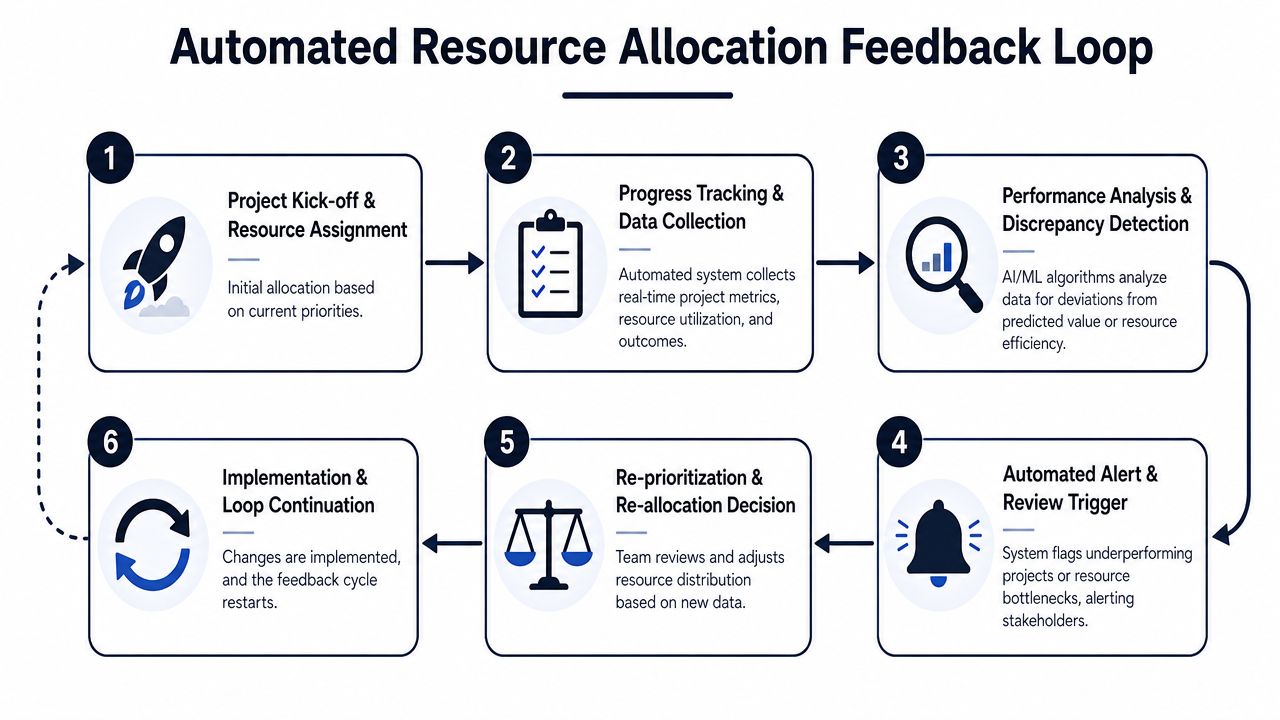
A workable operating loop looks like this:
- Capture behavior: Pull ticket themes, product usage changes, sales objections, and implementation friction into one analysis layer.
- Classify consistently: Tag issues using one shared taxonomy so Product, Support, and Success aren't describing the same problem three different ways.
- Score automatically: Estimate likely retention or expansion relevance before a PM manually reviews the queue.
- Create tasks in delivery tools: Push validated issues into Jira or Linear with context attached.
- Review in a standing cadence: Use a weekly capacity review to re-rank open work against current signals.
- Close the loop after shipping: Feed post-release outcomes back into the model.
What good automation actually does
Automation should reduce lag, not remove judgment. The point isn't to let a model run the roadmap. The point is to ensure the team sees real changes before they become expensive.
Good triggers are narrow and practical:
- A support pattern spikes among accounts in renewal windows
- Sales calls repeatedly flag the same missing capability in enterprise deals
- Usage drops after a known product friction point
- Engineering reports recurring defects clustered around the same workflow
Here's a useful overview of how continuous review changes planning behavior:
Once those triggers exist, assign ownership clearly. Support shouldn't own prioritization. Engineering shouldn't own revenue interpretation. Product shouldn't manually chase every data source. Each team contributes signal, and one operating process turns that signal into ranked work.
Replace annual planning with rolling allocation
Static annual planning breaks fast in SaaS because customer behavior changes faster than the plan. Teams need rolling reallocation. That doesn't mean chaos. It means a structured check-in rhythm.
A healthy cadence usually includes:
- Weekly tactical review for newly surfaced issues and capacity shifts
- Monthly portfolio review for larger resource moves
- Quarterly weighting review to see if the scoring model still matches company goals
If your highest-priority work only changes during quarterly planning, your system is optimized for internal comfort, not market reality.
Many teams discover that the roadmap problem wasn't prioritization alone. It was workflow design. The company had the signal. It just arrived too late, in the wrong format, through too many disconnected channels.
Measure True ROI and Run Optimization Experiments
Predicted value is useful. Actual value is what earns trust. If your team can't trace shipped work back to retention, expansion, or operational improvement, your scoring model will become political again.
That's why resource allocation optimization should be treated like a product system. It needs inputs, outputs, instrumentation, and iteration.
Measure outcomes after release
Many teams stop at launch. They shipped the feature, closed the ticket cluster, or completed the integration, then moved on. That leaves a major blind spot. You never learn whether the original resource decision was right.
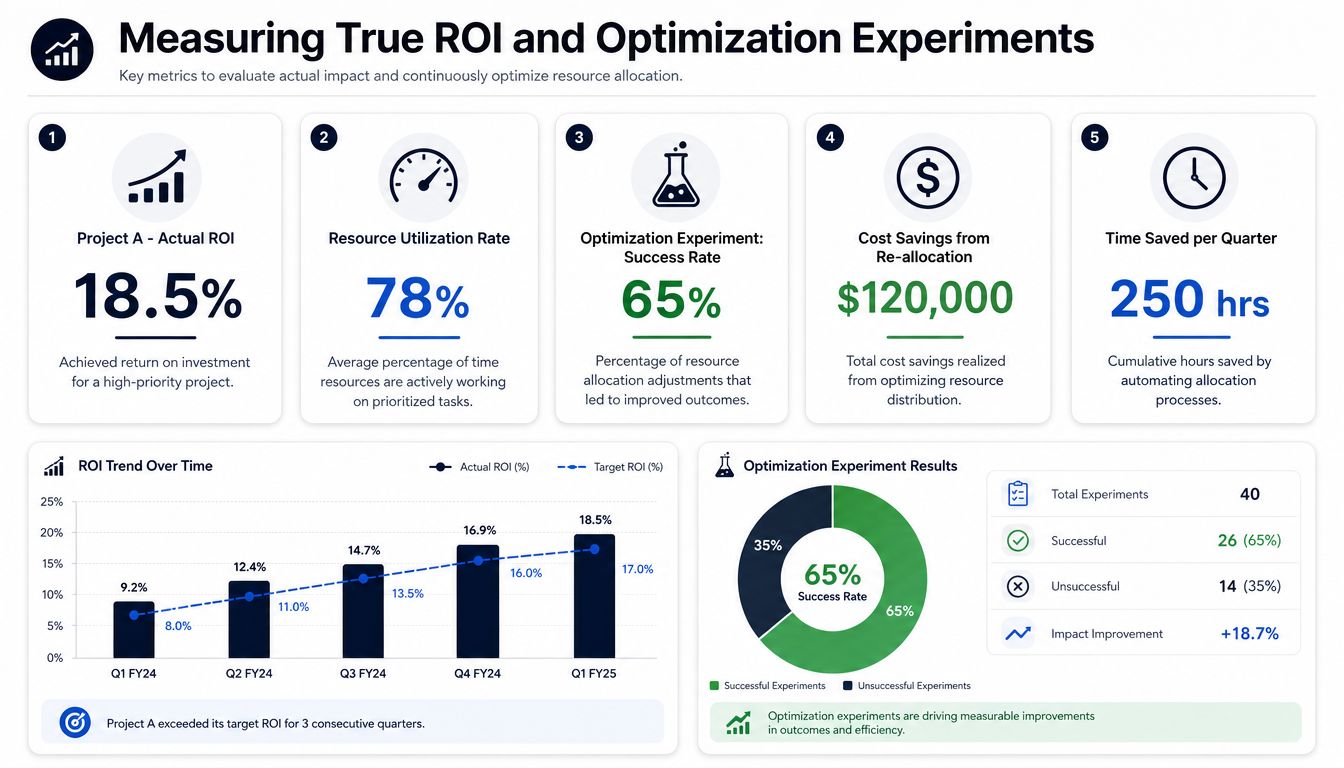
A cleaner post-release review asks:
- Did the targeted customer behavior change
- Did the issue volume drop
- Did expansion conversations accelerate
- Did at-risk accounts stabilize
- Did the operational burden on Support or Success decrease
The hardest part is usually not analytics tooling. It's decision framing. Research discussed in this practitioner summary of stakeholder conflict in allocation models notes a major gap in translating qualitative stakeholder conflict into quantifiable decision variables, and cites evidence that 65% of resource allocation failures stem from unresolved stakeholder priorities rather than technical algorithm flaws. That tracks with what happens after launch too. If stakeholders weren't aligned on what success meant before development started, they won't agree on whether the investment paid off.
Run small experiments before committing big capacity
You don't need a perfect causal model for every roadmap item. You do need disciplined experiments where possible.
Use:
- Phased rollouts when risk is moderate and customer segmentation is clear
- Pilot programs for enterprise workflows that need close observation
- Pre and post comparisons for operational improvements such as support load or task completion friction
- Hypothesis-based release reviews so the team can compare predicted value against actual movement
For teams building this muscle, a practical reference is Cometly's measurement insights, not because product planning is the same as marketing attribution, but because the underlying discipline is similar. Clear definitions, clean event mapping, and agreement on which metrics count prevent endless retroactive storytelling.
If your team needs a repeatable decision habit, use a lightweight hypothesis testing approach for roadmap bets. The structure matters more than the tooling. State the expected business outcome, define the evidence you'll look for, and decide ahead of time what would count as validation or failure.
Teams get better at prioritization when they review misses without blame. A wrong prediction is useful data. An unexamined prediction becomes roadmap folklore.
Tune the model, don't defend it
Mature teams separate themselves. They don't treat their scoring formula as a sacred artifact. They tune it.
If the team keeps overvaluing strategic requests with weak customer pull, lower that weight or require stronger evidence. If platform investments repeatedly produce downstream delivery benefits that weren't captured, improve how that value gets represented. If churn-related fixes are consistently under-scored because the signals arrive too late, change your intake process.
Resource allocation optimization is never finished. Customer behavior changes. Market pressure changes. Team composition changes. The model should adapt with them.
Avoid These Common Resource Allocation Pitfalls
Roadmap failures usually start earlier than teams think. A quarter begins with ten high-priority requests, three strategic bets, two customer escalations, and a hiring plan that assumes no one quits, gets sick, or spends a week untangling a production issue. The plan looks efficient on paper. Then reality shows up, and the team starts missing dates, splitting focus, and shipping work that does not move churn or expansion.
Chasing full utilization
Teams break when leaders treat 100% allocation as the goal.
A SaaS team needs room for defect triage, enterprise escalations, sales support, and the uncertainty that comes with software delivery. Fill every hour, and the first surprise forces a trade-off nobody made explicitly. Deadlines slip, specialists become bottlenecks, and high-value work gets delayed by low-value interruptions.
A better operating rule:
- Hold buffer capacity on purpose
- Protect specialist time from fragmented requests
- Plan for unplanned work instead of pretending it is rare
I have seen this pattern repeatedly. Teams that look “fully utilized” often produce less revenue impact because they spend the quarter in reactive mode.
Ignoring the cost of context switching
A roadmap can be logical in a planning doc and still fail in execution. The usual culprit is scattered ownership. One engineer is helping with onboarding improvements, a pricing experiment, two customer-specific fixes, and an infrastructure cleanup. Every item seems reasonable on its own. Together, they create drag.
Watch for these signs:
- Engineers bouncing across too many domains in one cycle
- PMs carrying too many active stories for different stakeholders
- Customer issues staying open because ownership keeps changing
Concentration wins. Fewer active bets, tighter sequencing, and clear ownership usually create more shipped value than a long list of partially staffed initiatives.
Letting the model become a black box
A scoring framework loses credibility when only Product Ops or senior leadership can explain it. The team will assume politics still decides the roadmap, even if the math is sound.
Make the model inspectable. Show the inputs, the weighting logic, the confidence level, and why a lower-ranked item did not make the cut. That transparency matters more in a revenue-first system because the trade-offs are sharper. If churn prevention lost to an expansion feature, or vice versa, people should be able to see the reasoning.
A prioritization model works better when teams can challenge the assumptions without questioning the fairness of the process.
Failing to communicate reallocation decisions
Reallocation is where trust often breaks. Sales still thinks a customer commitment stands. Success assumes a retention fix is in progress. Engineering sees priorities change but does not hear the revenue logic behind the move.
Communicate four things every time resources shift:
- What moved
- Why it moved
- What evidence triggered the change
- What business trade-off the company accepted
That last point matters most. Resource allocation is never just a staffing exercise. It is a revenue decision. If a team pauses a broad platform project to fix a churn driver in the onboarding flow, say that clearly. If expansion work takes precedence because a packaging change can lift account growth this quarter, say that clearly too.
SigOS helps product and growth teams turn messy customer feedback into ranked, revenue-aware priorities. If you want a faster way to connect support tickets, sales calls, usage signals, and issue tracking into one decision system, take a look at SigOS.
Keep Reading
More insights from our blog


Ready to find your hidden revenue leaks?
Start analyzing your customer feedback and discover insights that drive revenue.
Start Free Trial →