Customer Data Security: A Practical SaaS Guide
Master customer data security with practical controls, threat models, and AI workflow strategies designed for modern SaaS product and growth teams.
In 2025, the United States recorded 3,322 publicly reported data compromises, the highest count on record and about 5% higher than in 2024. The average cost of a data breach reached 4.99 million globally in 2026, while the U.S. average reached ****11.5 million, according to Security Affairs' data breach coverage. Those figures make one point clear: customer data security is a revenue protection discipline, not a box on an IT compliance checklist.
SaaS companies face a particularly difficult version of the problem. Support tickets, chat transcripts, sales calls, product telemetry, account histories, and AI-generated summaries all contain customer information. If those data flows aren't designed deliberately, every new integration can create another copy, another permission boundary, and another place where sensitive records can remain exposed.
The Financial and Operational Reality of Customer Data Security
A breach creates more than a security incident. It can interrupt product operations, trigger customer communications, consume engineering capacity, delay sales, and force leaders to explain why data moved through systems nobody had fully inventoried. The financial impact includes direct response costs, but the commercial impact can last longer because enterprise buyers often reassess a vendor's ability to protect confidential information.
The exposure window matters just as much as the initial intrusion. In the 2026 reporting cycle covered by Security Affairs, the average breach lifecycle was 247 days, including 183 days to identify the breach and 64 days to contain it. A customer record can therefore remain accessible while teams continue to operate normally, ship features, and synchronize data into connected systems.
Customer data is part of the product surface
Product teams often classify security as infrastructure work owned by the platform or IT group. That division breaks down when the product itself decides what to collect, where to store it, which vendors receive it, and how long it remains available.
A support workflow may send a ticket to a help desk, enrich it with account data, summarize it with an AI service, create an issue in an engineering tracker, and notify a collaboration channel. Each step may be useful. Together, they form a distributed data pipeline that can become a shadow data store.
The same pattern appears in behavioral telemetry. Usage events may start as harmless product signals, then become linked to identifiable accounts, support histories, contract details, or payment records. Security decisions made during schema design and integration setup determine whether that information stays constrained or spreads across systems.
Practical rule: Treat every destination that receives customer information as part of the product's security boundary, even if another company operates it.
The cost of collecting everything
Over-collection creates two kinds of liability. First, it increases the amount of information an attacker can access if one system or credential is compromised. Second, it makes retention, deletion, consent, and vendor-governance obligations harder to execute consistently.
More data can improve an AI workflow's context, but more context isn't automatically better intelligence. Raw transcripts may contain names, contact details, account identifiers, payment references, health information, or confidential business details that the model doesn't need to answer a product question. Sending all of it to every downstream tool expands risk without necessarily improving the decision.
A stronger design starts with the business question. If the goal is to identify recurring product complaints, a sanitized issue category and relevant product metadata may be enough. If the goal is churn analysis, the system may need account-level usage trends, but not unrestricted access to every conversation.
Customer data security therefore requires product managers to ask a harder question than “Can this integration access the data?” They should ask, “What is the minimum data this workflow needs, for how long, and who can retrieve its output?”
Navigating Threat Models and Compliance Obligations
The GDPR moved customer data security into the center of European business operations. The regulation was approved by the European Parliament in 2016 and took effect on May 25, 2018, establishing personal-data protection as a core legal obligation across EU member states. Its influence extends beyond Europe because companies serving EU customers have had to rethink collection, consent, retention, and incident response, as described in coverage of customer data and GDPR enforcement.
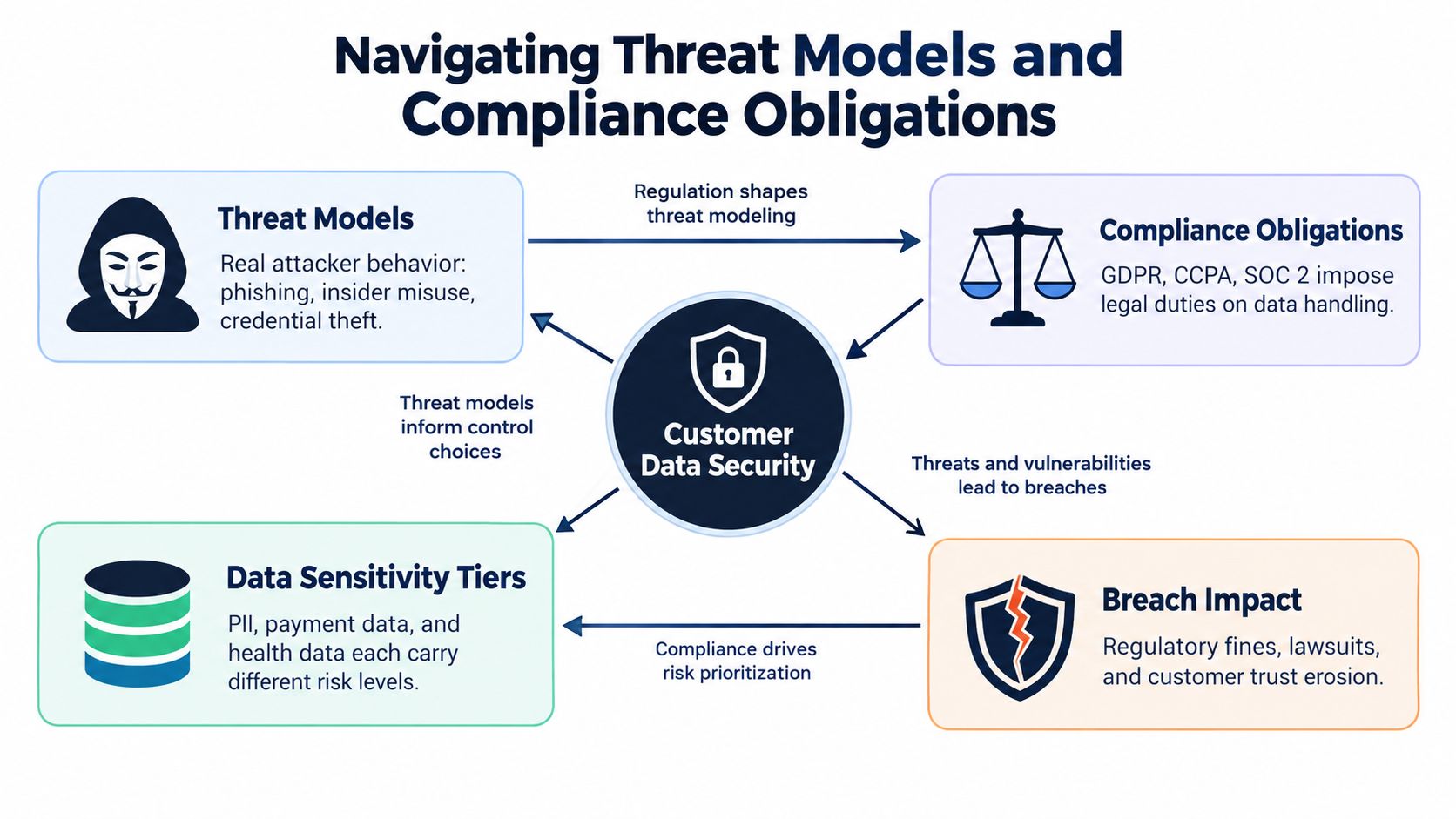
Compliance defines what a company is allowed to collect, retain, share, and use. A threat model defines how that information could be misused, stolen, altered, or exposed. SaaS leaders need both. A privacy policy can't compensate for a stolen administrator credential, and strong authentication can't justify retaining data the business no longer needs.
Map obligations to attacker paths
Start with the data lifecycle rather than a list of regulations. Document how information enters the platform, how it is transformed, where it travels, who can access it, and when it is deleted. Then identify the abuse paths associated with every stage.
A practical threat model should examine:
- Compromised identities: Could a stolen employee or customer credential retrieve records beyond the user's role?
- Over-permissioned integrations: Can a support tool or AI connector read an entire workspace when it only needs selected fields?
- Human error: Could an employee export, paste, or forward sensitive content into an unapproved destination?
- Software vulnerabilities: Could an exploited application weakness expose stored records or service credentials?
- Third-party failure: What happens if a vendor changes its retention, training-use, subprocesser, or access policies?
The Palo Alto Networks analysis of breach threat factors reports that 74% of breaches involve the human element and 83% involve external actors. That combination should change how product teams prioritize controls. The realistic adversary is often not an exotic attacker bypassing every defense. It's a stolen identity, a misused privilege, a deceptive message, or a connected service with more access than it needs.
Use sensitivity tiers to make decisions
Not every field deserves identical treatment. Personal identifiers, payment data, health information, authentication material, internal notes, and aggregated product signals carry different consequences if exposed. Create clear sensitivity tiers and attach rules to each tier for access, encryption, logging, export, retention, and vendor sharing.
This makes compliance operational. Data minimization becomes a schema and workflow decision. Breach notification planning becomes an inventory and classification exercise. Vendor review becomes a question of which fields cross the boundary, rather than a vague assessment of whether a provider appears trustworthy.
When physical media or retired devices enter the process, teams also need a verifiable disposal method. Guidance on NIST compliant sanitization can help organizations evaluate how data-bearing equipment should be handled before reuse or recycling. The principle is the same as digital minimization: information that no longer serves a business purpose shouldn't remain recoverable.
For a useful distinction between the legal and technical sides of the problem, see data privacy versus data security. Privacy establishes appropriate use and governance. Security protects the information and systems that support that use.
Building Technical and Organizational Security Controls
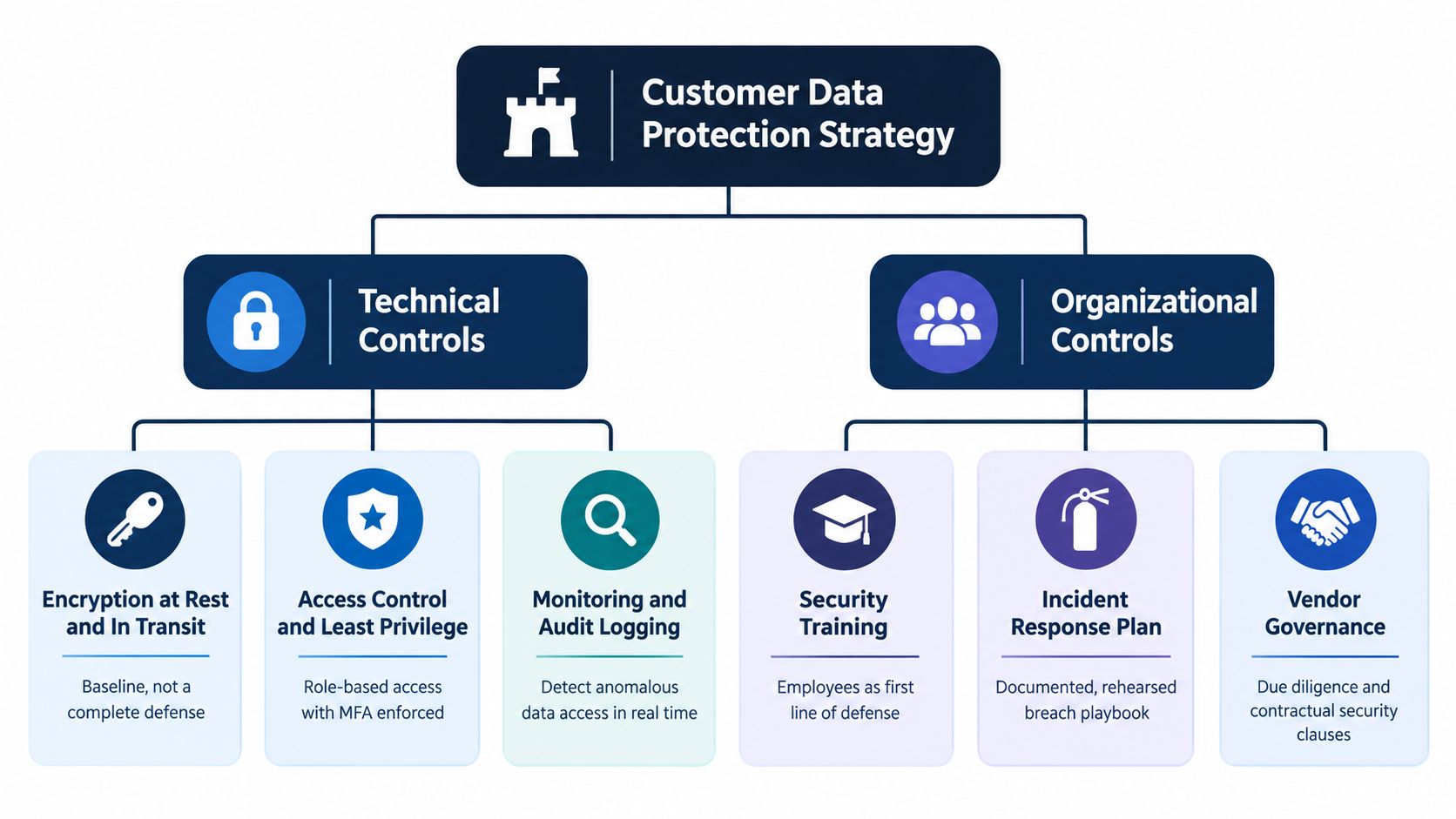
Encryption is necessary, but it isn't a complete customer data security strategy. Industry guidance for CRM and customer-data systems treats encryption in transit and at rest, single sign-on, multi-factor authentication, and role-based access as baseline controls. The reason is simple: encryption protects stored or transmitted data, while identity and authorization controls determine who can reach it in the first place.
A well-designed SaaS system assumes that credentials, integrations, and internal accounts can eventually be misused. It limits what each identity can do, records the action, and gives operators a way to revoke access quickly.
Build the technical boundary
Use encryption at rest for cloud storage and databases, and verify approved cryptographic protocols for transport during vendor assessment. Don't treat a vendor's statement that it “uses encryption” as sufficient evidence. Ask which data is encrypted, where keys are managed, which protocols are supported, and whether backups and temporary processing locations follow the same policy.
Then put identity controls around the encrypted data:
- Centralize authentication: Use SSO for workforce access so departures, role changes, and account disablement don't depend on manual updates across many tools.
- Require MFA: Enforce MFA for all privileged accounts and for any workflow that can export, delete, or alter sensitive customer data.
- Apply least privilege: Give users and service accounts only the fields, records, actions, and environments required for their work.
- Separate sensitive fields: Restrict identifiers and payment data independently from ordinary product metadata, rather than granting access to an entire record by default.
- Log meaningful events: Record access, exports, permission changes, administrative actions, and integration activity in a form that investigators can search.
Role-based access control is a useful starting point, but static roles can still be too broad. A support agent may need access to one active case, not every account in a customer database. A data analyst may need aggregated trends, not raw transcripts. Where practical, use context, case scope, environment, and time to narrow permissions further.
The API security best practices guide provides additional context for protecting the interfaces that connect these services. APIs deserve the same design attention as user-facing screens because integrations often bypass the assumptions built into the main application experience.
Make the organization part of the control system
Technology can't correct unclear ownership. Assign a data owner for each sensitive dataset, an engineering owner for each integration, and an incident lead who can make decisions during an exposure. Require teams to document why a workflow needs access and what happens when that need ends.
Periodic authorization reviews should compare actual usage with assigned permissions. Remove stale accounts, unused service connections, and broad grants that were created for a temporary launch. Review changes as well as additions, because a safe integration can become risky after a new endpoint or data field is introduced.
Training should use the workflows employees operate. Support personnel need practice recognizing credential theft and handling sensitive tickets. Product managers need to understand vendor data-use terms. Engineers need to know which logs, test fixtures, and debugging exports may contain customer information.
Strong cryptography can't save a system that gives every connected service unrestricted access.
An incident response plan completes the structure. It should identify who can disable an integration, revoke tokens, preserve evidence, communicate with customers, assess affected data, and coordinate legal review. Rehearse the plan with realistic scenarios, including an AI vendor compromise and a support account takeover.
Securing AI Workflows and Managing Third-Party Vendors
AI-enabled customer experience workflows create a new security boundary after ingestion. A ticket, call transcript, or usage event may be copied into a vector store, prompt log, model provider, analytics warehouse, evaluation dataset, or automation history. Teams that secure only the primary database can miss the places where sensitive content is reproduced.
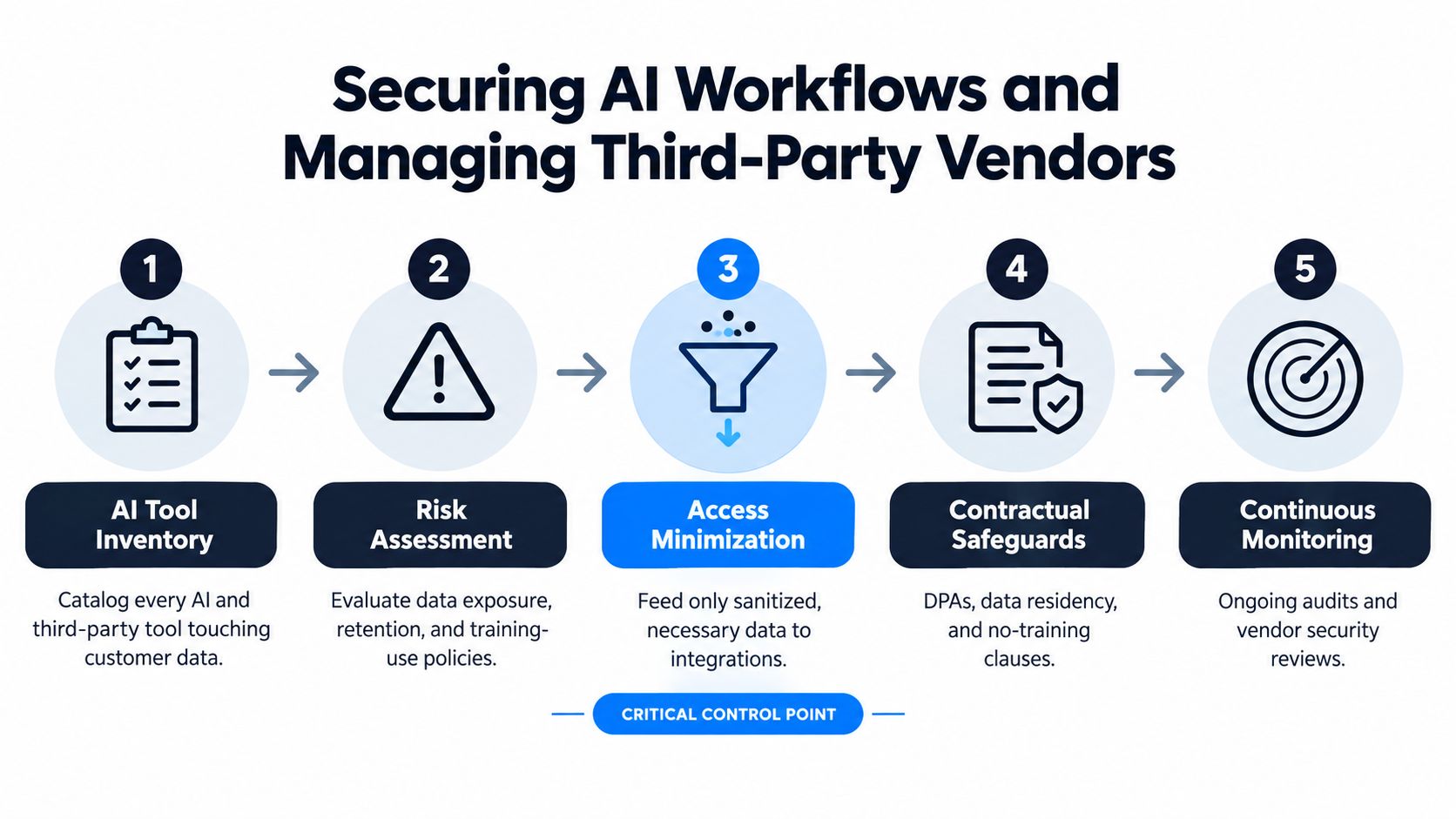
The answer isn't to ban AI. It's to design the workflow around data minimization, explicit trust boundaries, and observable movement. Start by cataloging every AI and third-party tool that touches customer data, including experiments created by individual teams. An integration that isn't on the inventory can't be reviewed, constrained, or retired.
Put the critical control before the vendor
The most effective intervention usually happens before data leaves your system. Sanitize and reduce the payload before an external model or automation service receives it. Replace direct identifiers with stable internal references when the workflow doesn't need names or contact details. Remove irrelevant transcript sections, redact payment information, and send structured attributes instead of unrestricted raw text where possible.
A five-stage review works well:
- Inventory the tools: Include model providers, transcription services, ticket enrichment tools, analytics destinations, and automation platforms.
- Assess exposure: Check retention, subprocessors, training use, data residency, administrator access, breach notification, and deletion behavior.
- Minimize the payload: Define the exact fields and records the workflow requires. Block everything else at the integration layer.
- Contract for the intended use: Use data-processing agreements and explicit terms covering confidentiality, secondary use, deletion, access, and security obligations.
- Monitor continuously: Review permissions, destinations, configuration changes, unusual exports, and vendor disclosures rather than treating approval as permanent.
The CX security and privacy guidance for 2026 highlights the governance risks created by AI-driven customer experience tooling and cloud contact centers. The practical concern is not just whether a model is secure. It's whether the company knows where customer data goes after ingestion and whether each copy follows the same rules.
Challenge the assumption that more tooling means more safety
Security teams often respond to complex data flows by adding another monitoring product, gateway, or scanning layer. Those controls can help, but they don't remove unnecessary copies or excessive permissions. A smaller data footprint can reduce the blast radius more directly than a larger perimeter.
Vendor review should be specific. Ask whether prompts and outputs are retained, whether customer content is used to train shared models, how deletion requests propagate, which subprocessors can access the data, and whether administrators can retrieve content. Require evidence for encryption claims and verify the protocols used for transport and storage.
For teams evaluating the broader implications of information security integrity in 2026, the useful lens is operational trust. A vendor isn't safe because it has a polished security page. It's safer when its controls match your data classification, access model, retention policy, and incident-response requirements.
A strong contract still doesn't replace architecture. If the vendor receives less sensitive information, retains it for less time, and has no standing access to your core systems, a vendor-side incident has fewer ways to become a customer-wide crisis.
Implementation Patterns and Metrics for Product Teams
Security work fails when it arrives as a manual approval queue at the end of product development. Product teams can move faster by placing data-handling decisions inside existing discovery, design, development, and release workflows.
During discovery, require a short data-impact record for every feature that collects, links, exports, or sends customer information to a third party. The record should identify the fields involved, their sensitivity tier, the purpose of processing, retention needs, access roles, and deletion behavior. During development, automate checks for secrets, unauthorized destinations, unapproved fields, and overly broad integration scopes.
A release should pause when a feature changes the data boundary, not whenever someone adds an ordinary interface. That distinction keeps security review focused on meaningful risk.
Track decisions instead of appearances
Security scorecards often reward activity that doesn't reduce exposure. A high volume of training completions or a long list of policies can look impressive while stale permissions remain active. Product leaders should track whether the system becomes easier to understand, harder to misuse, and faster to recover.
| Metric Category | Vanity Metric Avoid | Actionable Metric Track |
|---|---|---|
| Identity | Number of users enrolled in an identity platform | Time to revoke access after a role change or departure |
| Integrations | Number of connected tools | Percentage of integrations with named owners, scoped permissions, and documented data fields |
| Permissions | Number of completed access reviews | Age and remediation status of excessive or unused grants |
| Data handling | Number of published privacy documents | Coverage of data flows with classification, purpose, retention, and deletion rules |
| Detection | Number of alerts generated | Time from anomalous access to investigation and containment |
| Vendor governance | Number of vendor questionnaires completed | Current evidence for retention, subprocessors, training use, encryption, and incident obligations |
| Recovery | Number of response exercises scheduled | Time required to disable a compromised integration and identify affected records |
The breach lifecycle data cited by Security Affairs makes response speed a practical product concern. If identification and containment take a long time on average, teams should invest in telemetry that identifies unusual exports, privilege changes, service-to-service access, and sudden retrieval of sensitive fields.
Make metrics operational
Assign an owner and review cadence to every metric. A metric without a decision rule becomes reporting theater. For example, an integration permission review should specify who can approve continued access, what evidence is required, and when the connection gets disabled if the owner doesn't respond.
Use small, repeatable controls rather than a large annual exercise. A pull request can trigger a data-flow review. An onboarding workflow can require SSO and MFA. A vendor renewal can require confirmation of retention and secondary-use terms. An incident drill can test whether the team can revoke access without waiting for a single administrator.
The best metrics expose friction and risk at the same time. If engineers can't determine which fields an integration receives, fix the architecture and documentation. If support leaders can't identify who accessed a ticket, improve logging before adding another dashboard.
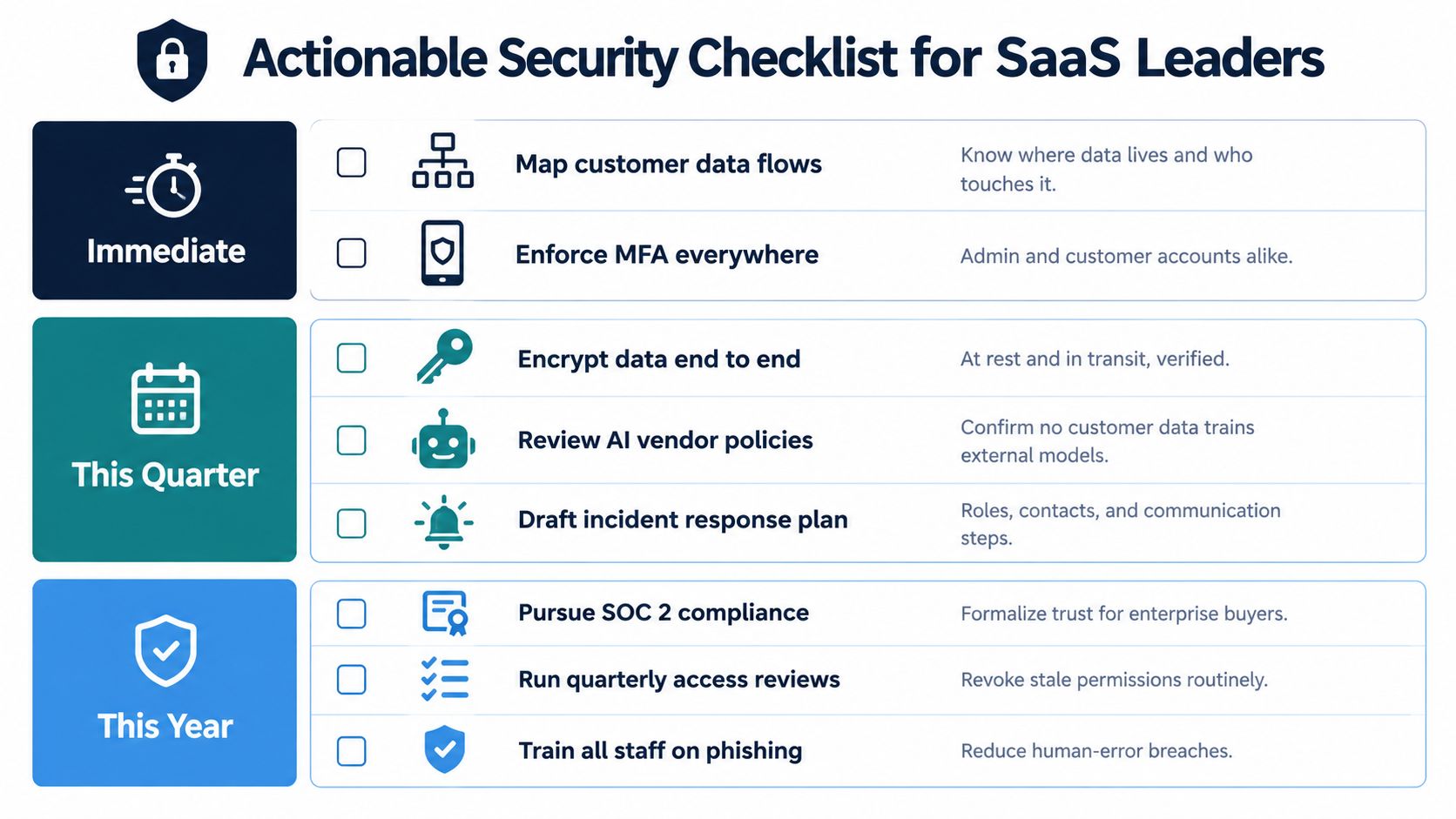
Actionable Security Checklist for SaaS Leaders
Leaders don't need to solve every security problem at once, but they do need to sequence the work by blast-radius reduction. The first priority is to stop unauthorized access paths. The second is to reduce unnecessary data movement. The third is to make detection, response, and governance repeatable.
Use the checklist below in a product and security review. Assign each item to a named owner, record the evidence, and set a clear remediation date.
Immediate actions
- Map customer data flows: Document where support tickets, chat transcripts, sales calls, behavioral telemetry, and AI outputs enter, move, transform, and remain stored.
- Enforce MFA: Require MFA for administrators, support personnel, integration owners, and other privileged users. Extend strong authentication to customer accounts where the product risk warrants it.
- Audit active integrations: List every connected service, its owner, scopes, credentials, destinations, and last confirmed business need.
- Remove obvious excess: Disable unused accounts, stale tokens, abandoned test connections, and exports that no longer serve an active workflow.
These actions create visibility quickly. They also expose a common weakness: companies often know which systems they purchased but not which systems currently receive customer data.
This quarter
- Separate sensitive fields: Keep identifiers, payment details, and other high-risk values behind narrower roles and workflows.
- Verify encryption: Confirm encryption at rest and in transit for primary systems, backups, logs, temporary stores, and vendor connections.
- Constrain AI inputs: Replace raw records with minimized, sanitized payloads wherever the model doesn't require full context.
- Review vendor terms: Check data retention, secondary use, training policies, subprocessors, deletion, residency, access, and incident obligations.
- Draft the response playbook: Name the people who can revoke access, disable integrations, investigate records, coordinate communications, and involve legal counsel.
A retention policy should be specific enough to guide deletion, not merely state that data is kept “as long as necessary.” The data retention policy best practices guide offers a useful framework for connecting business purpose, storage duration, access, and disposal.
This year
- Run recurring access reviews: Compare assigned permissions with actual job needs and remove grants that have no current owner or purpose.
- Test vendor resilience: Reassess providers after major product, policy, ownership, or subprocesser changes.
- Rehearse breach response: Test credential theft, over-permissioned integration access, accidental disclosure, and AI workflow exposure.
- Train staff on phishing: Use role-specific scenarios for support, sales, engineering, finance, and leadership rather than generic awareness material.
- Measure containment: Track whether the team can identify affected records and shut down a compromised pathway without reconstructing the entire environment manually.
The checklist should evolve as the product evolves. A new AI feature, support integration, analytics destination, or customer export can change the threat model even when the core application hasn't changed.
Prioritizing Security in Product Intelligence Platforms
Product intelligence systems sit close to the most revealing customer information. They combine what customers say with what customers do, then use those signals to guide roadmap, retention, and growth decisions. That makes security architecture part of the product's value, not an administrative layer added after the analysis is complete.
The defensible design is selective ingestion. A platform should support encrypted data pathways, least-privilege access, masking of sensitive fields, auditability, and clear limits on how customer information is used. It should also avoid retraining models on customer-specific information when that use isn't necessary for the customer's stated purpose.
This approach creates a useful trade-off. Teams may need to spend more time defining schemas, redaction rules, permissions, and vendor boundaries before activating an insight workflow. In return, they gain a smaller exposure surface and a clearer answer when customers ask where their data goes.
Security-first product intelligence also improves commercial conversations. Enterprise buyers want useful analysis without handing over unrestricted access to confidential support histories, call transcripts, and usage records. A platform that can demonstrate controlled data movement, transparent retention, and auditable access gives product and revenue teams a stronger basis for earning that trust.
The practical standard is simple: use customer data to answer a defined business question, keep the scope narrow, protect every pathway, and delete what no longer has a purpose. That discipline lets SaaS teams pursue AI-assisted customer insight without turning every new workflow into an unmanaged liability.
SigOS offers AI-driven product intelligence that analyzes support tickets, chat transcripts, sales calls, and usage metrics to identify patterns connected to churn, expansion, and revenue impact. Visit SigOS to evaluate how its security-focused data handling can support customer insight workflows while keeping privacy and access controls central to the design.



Ready to find your hidden revenue leaks?
Start analyzing your customer feedback and discover insights that drive revenue.
Start Free Trial →