Data Privacy vs Data Security: Key Differences
Explore data privacy vs data security in this practical guide covering definitions, controls, regulations, and best practices for product teams building AI
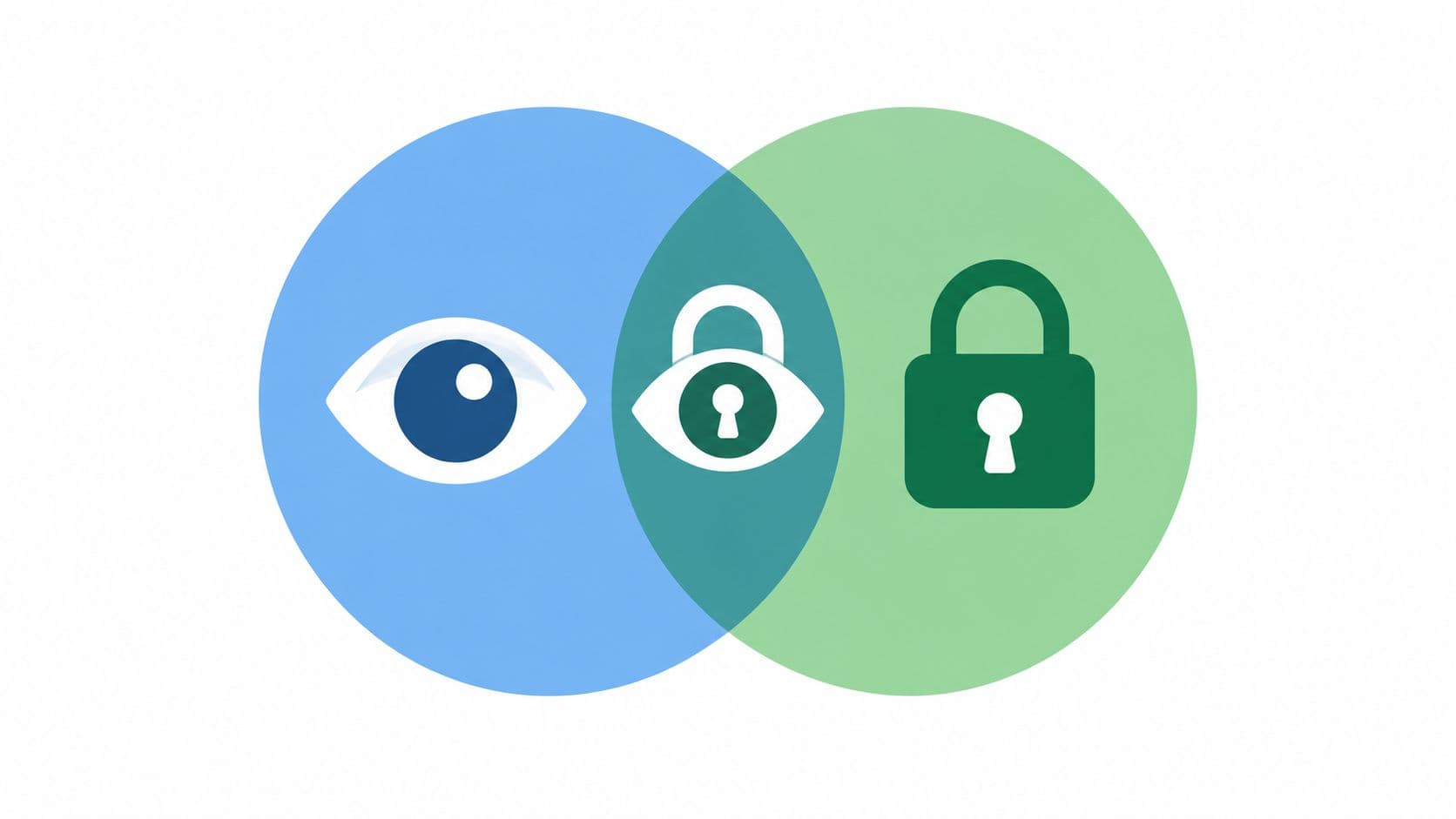
Your AI feature passed security review, shipped to customers, and ran smoothly for two quarters. Then an enterprise customer's privacy team asked a simple question: What happens to the personal information inside prompt logs after the model responds? The product team had encryption, access controls, and monitoring. It still lacked a clear purpose, retention schedule, and deletion path.
That situation captures the difference between data privacy vs data security. Privacy determines whether you should collect and use the data, for what purpose, and under which conditions. Security protects the data and systems from unauthorized access, alteration, theft, and disruption. SaaS teams need both, especially when AI creates new paths through which customer information can move.
Why Product Teams Keep Confusing Privacy With Security
Privacy audits often expose decisions that security reviews never examined. An engineering team may confirm that prompt logs are encrypted, access is restricted, and suspicious activity is monitored. A privacy review can still find that the product collects more personal information than it needs, uses it for an undeclared purpose, or keeps it without a defensible retention rule.

Two lenses on the same data
Security asks, “How do we stop the wrong party from accessing or changing this data?” Privacy asks, “Should we collect, use, share, or retain this data in the first place?”
The overlap creates confusion. Both teams discuss personal information, access logs, vendors, and data flows. Both may review identity controls and incident procedures. A SOC 2 report can provide useful evidence about an organization's controls, but it shouldn't be treated as proof that every product decision satisfies privacy obligations.
The distinction matters because secure processing can still be unlawful or unexpected. A company might protect a full archive of customer conversations perfectly while having no valid reason to use those conversations for model training. Conversely, a well-designed consent flow won't protect data if an attacker can bypass authorization.
Why AI makes the confusion expensive
AI features make data movement harder to trace. A single user interaction may pass through the application, telemetry system, logging service, moderation layer, model provider, vector database, and support tooling. Each component can introduce a different privacy question and a different security failure mode.
Use this operating rule:
- Privacy defines the permitted data journey.
- Security protects every stop on that journey.
- Product architecture must enforce both.
Practical rule: A security review can approve the protection of a data flow. It can't, by itself, approve the reason for that flow.
Teams that separate these lenses early avoid late-stage rework. Teams that combine them into one generic “data protection” checkbox usually discover gaps when an enterprise buyer, regulator, or customer request forces them to map the system in detail.
What Each Discipline Actually Means
Data privacy governs the lawful, fair, and transparent handling of personal information. It covers what a company collects, why it collects it, who may use it, whom it may share it with, how long it keeps it, and how people can exercise their rights.
The practical privacy questions are specific:
- Does the feature need this field?
- Has the user received a clear explanation?
- Is there a valid legal basis for processing?
- Can the person withdraw permission or request deletion?
- Does the proposed AI use match the original purpose?
A useful introduction to these principles is this guide to understanding data privacy, but product teams shouldn't leave the answers inside legal documentation. The product specification, event schema, retention configuration, and user interface should all reflect them.
Data security protects information and systems from unauthorized access, alteration, theft, loss, and disruption. It applies to personal data, but its scope is broader. A company must secure source code, credentials, infrastructure, operational records, and proprietary data even when those assets don't identify an individual.
Security focuses on confidentiality, integrity, and availability. It asks whether an authenticated user has the right permissions, whether a service can be tampered with, whether secrets are protected, and whether the system can recover from an incident.
Different goals, different owners
Privacy optimizes for appropriate use and limited exposure. Security optimizes for resilience against threats. Those goals often support each other, but they aren't interchangeable.
Privacy work reaches into product design, consent flows, data inventories, retention rules, vendor agreements, data subject rights, and model-training decisions. Security work reaches into infrastructure, application security, identity, endpoint protection, monitoring, vulnerability management, and incident response.
Ownership usually differs too. Product and legal teams often define the purpose and user experience. A data protection officer may govern the privacy program. Engineering implements system behavior. Security or a CISO function leads threat modeling, defensive controls, and response.
The same dataset sits in the middle, which explains the confusion. The answer isn't to merge the disciplines into one vague responsibility. It's to make each team answer its own question before the feature ships.
Controls Side by Side and Where They Overlap
Product teams shouldn't start with a new compliance platform. They should map the controls already present and identify which question each control answers.
Privacy controls govern permission, purpose, scope, and lifecycle. Security controls govern protection, detection, and recovery. The shared zone contains the evidence and architectural decisions that make both programs credible.
Privacy vs Security Controls Where Each Side Takes the Lead
| Control Area | Privacy Focus | Security Focus | Shared Responsibility |
|---|---|---|---|
| Data collection | Minimize fields and document purpose | Validate ingestion paths and protect endpoints | Approve the schema before production |
| Consent and permissions | Capture, explain, and honor user choices | Enforce authorization technically | Connect consent state to access and processing |
| Retention | Define how long data is needed and when it must be deleted | Protect stored data during its lifecycle | Automate expiration and verify deletion |
| Access | Limit use to authorized purposes and roles | Enforce IAM, MFA, and least privilege | Review access logs and investigate anomalies |
| Data transformation | Use minimization, masking, or pseudonymization to reduce exposure | Protect transformation services and keys | Prevent raw identifiers from spreading |
| Vendors | Review processing terms and downstream use | Assess security posture and technical safeguards | Approve processors and monitor changes |
| AI pipelines | Govern training eligibility, prompts, outputs, and model use | Isolate tenants, secure APIs, and monitor inference | Trace data lineage from input to model |
| Incidents | Assess affected people, obligations, and communications | Contain, investigate, and remediate the attack | Maintain one coordinated response process |
The overlap is where failures hide
Access logs illustrate the shared responsibility. Privacy teams need evidence that data was used for an appropriate purpose. Security teams need evidence of unauthorized access or unusual behavior. One logging system can support both, but only if it captures enough context to connect a user, role, tenant, resource, action, and purpose.
Pseudonymization offers another example. Replacing direct identifiers can reduce privacy exposure and shrink the security blast radius. It doesn't eliminate risk, however. The re-identification key needs separate access controls, stronger monitoring, and a clear business justification.
Vendor reviews also span both disciplines. Privacy examines data-processing terms, permitted purposes, retention, subprocessors, and deletion commitments. Security examines encryption, access management, incident response, vulnerability handling, and service isolation. A contract that addresses only one side leaves the product exposed.
For API-heavy products, teams should pair these controls with API security best practices. The most frequently missed AI gaps are training-data lineage, prompt logging rules, output retention, model-provider terms, and tenant isolation during inference. Treat those as architecture requirements, not documentation tasks.
GDPR and the Regulations That Linked Them
A SaaS team can give an authorized user fast access and still create a privacy failure. GDPR makes that tradeoff operational: it applies from the reason for processing through access, retention, and deletion. The regulation took effect on May 25, 2018, and covers organizations worldwide that process EU residents' data. Its maximum penalty can reach €20 million or 4% of global revenue, whichever is higher (Legit's data privacy and security statistics).
GDPR's privacy principles require lawfulness, purpose limitation, data minimization, accuracy, and storage limitation. Its security obligations require appropriate safeguards. Product teams must connect both disciplines to each data flow. Documenting a valid purpose does not justify broad permissions, and strong encryption does not make an unnecessary collection practice acceptable.
Enforcement has made that distinction expensive. Cumulative GDPR fines surpassed €7.1 billion since 2018, with roughly €1.2 billion issued in 2025, according to GDPR enforcement data from the European Data Protection Board. By early 2025, 144 countries had data and consumer privacy laws covering about 6.3 billion people, or 79% of the world population, based on UNCTAD's global data protection and privacy legislation data.
Major Privacy Regulations Compared
| Regulation | Region | Max Fine | Key Requirement for Product Teams |
|---|---|---|---|
| GDPR | European Union and organizations processing EU residents' data | €20 million or 4% of global revenue, whichever is higher | Map lawful purpose, user rights, retention, and safeguards to each data flow |
| CCPA and CPRA | California | Varies by violation and enforcement context | Provide transparency and support applicable access, deletion, and opt-out rights |
| LGPD | Brazil | Varies under Brazilian enforcement rules | Govern personal-data processing, rights, and security across the data lifecycle |
| PIPL | China | Varies under Chinese enforcement rules | Address consent, processing purposes, and applicable localization or transfer obligations |
Treat these laws as one operating system with jurisdiction-specific settings, not as separate checklists. Maintain an inventory covering data, purpose, recipients, retention, and technical controls. Then apply local requirements for rights, transfers, notices, and enforcement. Teams can review Technovation LLC compliance expertise alongside advice from counsel who understands the markets where the product operates.
AI features need a separate design review. Training, automated decisions, explainability, and high-risk uses can create obligations beyond ordinary application processing. Add legal basis, data lineage, model-use boundaries, and deletion behavior to feature reviews before launch. A practical data governance guide for product and data teams can help turn those decisions into repeatable controls.
Real Scenarios in AI Product Development
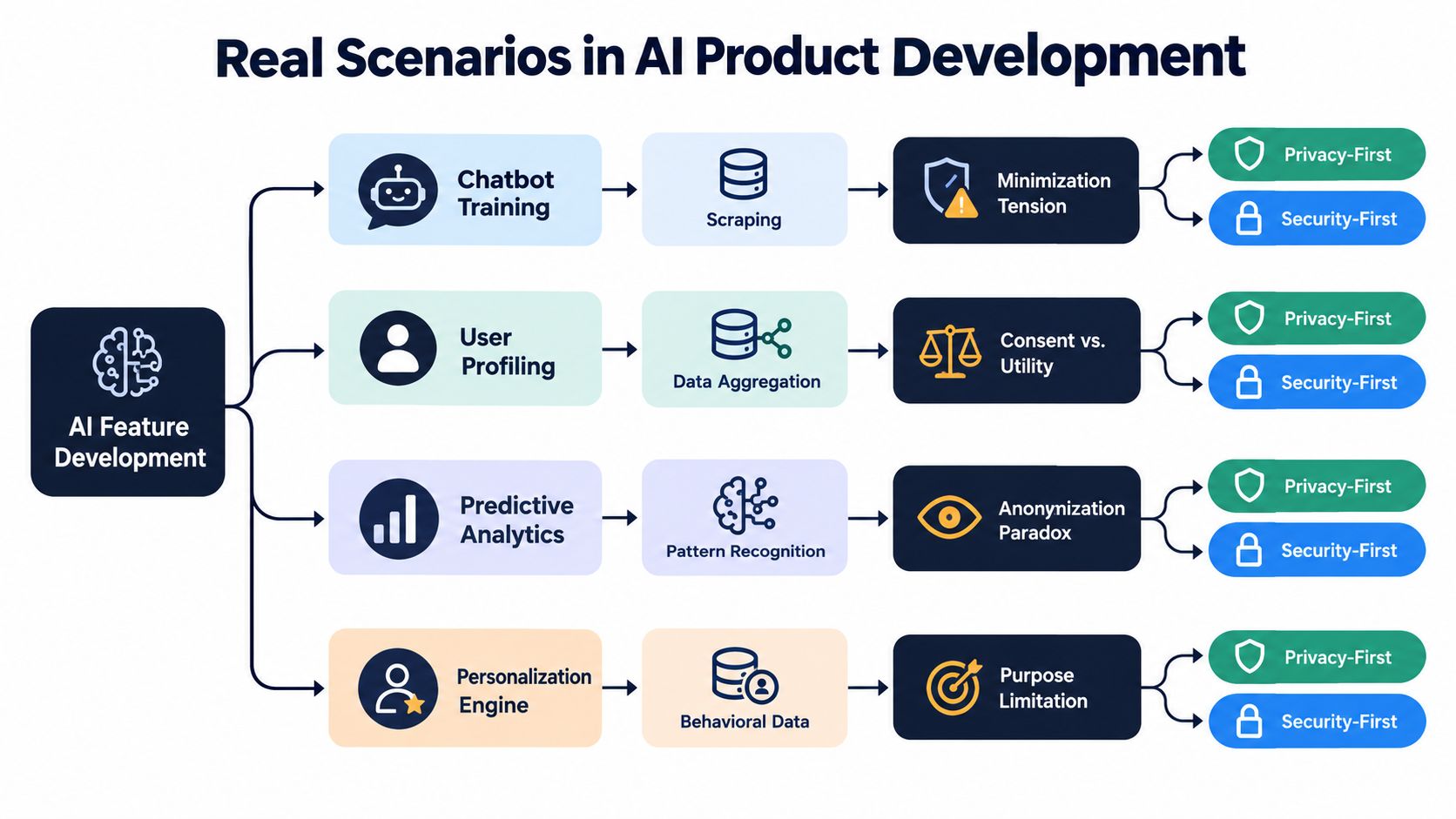
AI systems expose the difference between privacy intent and security execution. A team can minimize data before training and still leak it through logs. It can secure a vector database and still retain documents for a purpose the customer never accepted.
Training a support chatbot
A product team wants to fine-tune a chatbot on support tickets. The privacy decision comes first: are those tickets eligible for training, and did the customer understand that use? The team should define a lawful purpose, remove unnecessary identifiers, exclude sensitive categories where appropriate, and set a deletion path for training copies.
Security then protects the approved dataset. Restrict access to the training workspace, encrypt files and credentials, isolate environments, and log exports. Neither control replaces the other. An encrypted dataset can still violate the customer's expectations, while a lawful training purpose can still fail through a stolen artifact.
Runtime inference with personal prompts
A user submits a prompt containing personal information. Privacy controls should define whether prompt content is retained, whether it may be used for service improvement, and how the user can request deletion. The security layer must enforce tenant isolation, protect data in transit and at rest, restrict administrative access, and prevent prompt content from entering broad telemetry.
Prompt logging deserves an explicit policy. “We log for debugging” isn't a sufficient design decision. Specify which fields are recorded, redact sensitive content where possible, limit retention, and separate operational telemetry from content needed to deliver the feature.
RAG and customer document embeddings
Retrieval-augmented generation introduces a less visible privacy boundary. A customer document may be transformed into an embedding, but that transformation doesn't automatically remove its sensitivity or eliminate the possibility of inference.
Privacy teams should define which documents may enter retrieval, how long embeddings remain, and how deletion requests propagate through indexes and backups. Security teams should protect the embedding store, enforce document-level permissions, isolate tenants, and monitor retrieval behavior. The system must also prevent a user from retrieving information merely because semantic similarity found it.
Multi-tenant vector databases
A misconfigured filter can cause one customer's documents to appear in another customer's search results. Privacy sees an unauthorized disclosure and a failure of purpose and access boundaries. Security sees an authorization defect and an isolation failure.
The fix requires both disciplines. Product and privacy owners define the tenant boundary and acceptable use. Engineering enforces resource-level authorization. Security tests cross-tenant access, reviews database configuration, monitors suspicious queries, and includes the retrieval layer in threat models.
Who Owns What Inside a SaaS Team
Responsibility fails when everyone is accountable in theory and nobody owns the decision in practice. Product, engineering, security, legal, and the DPO need distinct responsibilities, with a joint gate for any new personal-data flow.
Privacy and Security Ownership Matrix RACI
| Activity | Product | Engineering | Security | Legal | DPO |
|---|---|---|---|---|---|
| Define feature purpose and collected fields | A/R | C | C | C | C |
| Design consent and preference experience | A/R | C | I | C | C |
| Implement encryption and access controls | C | A/R | C | I | I |
| Conduct threat modeling and penetration testing | C | C | A/R | I | I |
| Define retention and deletion behavior | A | R | C | C | C |
| Review legal basis and contracts | C | I | I | A/R | C |
| Complete a DPIA where required | C | C | C | R | A |
| Respond to incidents | C | R | A/R | C | C |
| Handle data subject requests | C | R | C | C | A/R |
| Approve a new production data flow | A/R | R | C | C | C |
Product managers own feature-level decisions. They should be able to explain every collected field, the product outcome it supports, the user notice, and the deletion behavior. If the product manager can't answer those questions, the feature isn't ready.
Engineering owns implementation. That includes encryption in transit and at rest, access enforcement, secure coding, infrastructure hardening, tenant isolation, and reliable deletion mechanisms. Engineering shouldn't be expected to infer legal purpose from a ticket.
Security owns threat modeling, vulnerability management, penetration testing, detection, and response. Security should challenge assumptions about trust boundaries, service accounts, model providers, and administrative access.
Legal interprets applicable regulations, negotiates processing clauses, and reviews legal basis and DPIA requirements. The DPO, where required, governs the privacy program, supports regulator communication, and coordinates independent oversight.
Privacy isn't a legal handoff. Security isn't an engineering handoff. Both are product launch responsibilities.
Create a joint privacy-security review gate before production. Require the team to attach a data-flow diagram, field inventory, purpose, retention rule, processor list, threat model, access design, and deletion test. That gate catches problems while the architecture is still flexible.
Recommended Practices Beyond Checklists
Encryption is necessary, but it's also the easiest answer to give. More encryption doesn't make an unnecessarily collected dataset appropriate, and it won't fix a model trained on identifiable conversations without a clear purpose.
Design for minimum necessary data
Start with purpose limitation. Reject new fields unless the team can connect them to a documented product outcome. Separate prompt content from telemetry, avoid copying raw conversations into debugging systems, and make retention windows reflect the value the data still provides rather than the capacity of the storage budget.
Consent should be visible in the product experience. Use plain-language explanations, granular choices for optional AI features, accessible preference controls, and a reliable way to withdraw permission. A privacy notice can't compensate for a confusing interface.
Make AI boundaries explicit
Give customers a clear data sheet that explains what enters the model, what gets logged, whether data is used for training, which providers process it, and how deletion works. Add model-card disclosures for material limitations and intended use. Build opt-outs into training and retraining pipelines instead of promising that a future manual process will remove data.
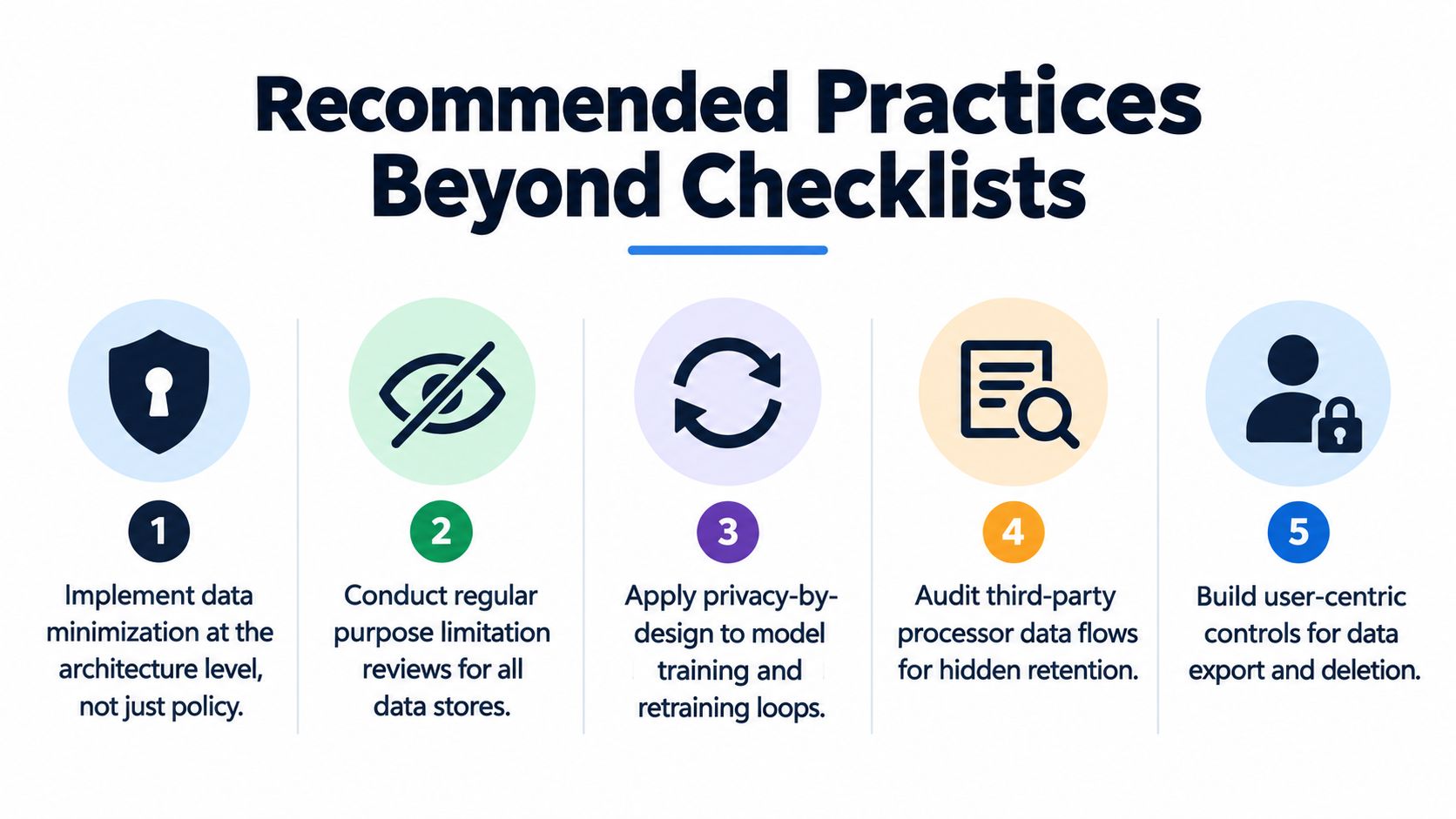
Treat deletion as a tested product capability. A request should reach primary stores, caches, indexes, derived datasets, and applicable backups according to the organization's documented process. Security controls protect the operation, while privacy requirements determine its scope and timing.
A Pragmatic Next Step for Your Stack
Stop debating frameworks and audit one shipped feature. Choose a customer-data flow that reaches from collection through processors, storage, inference, analytics, and deletion. For two weeks, document every step and assign each gap to a named owner.
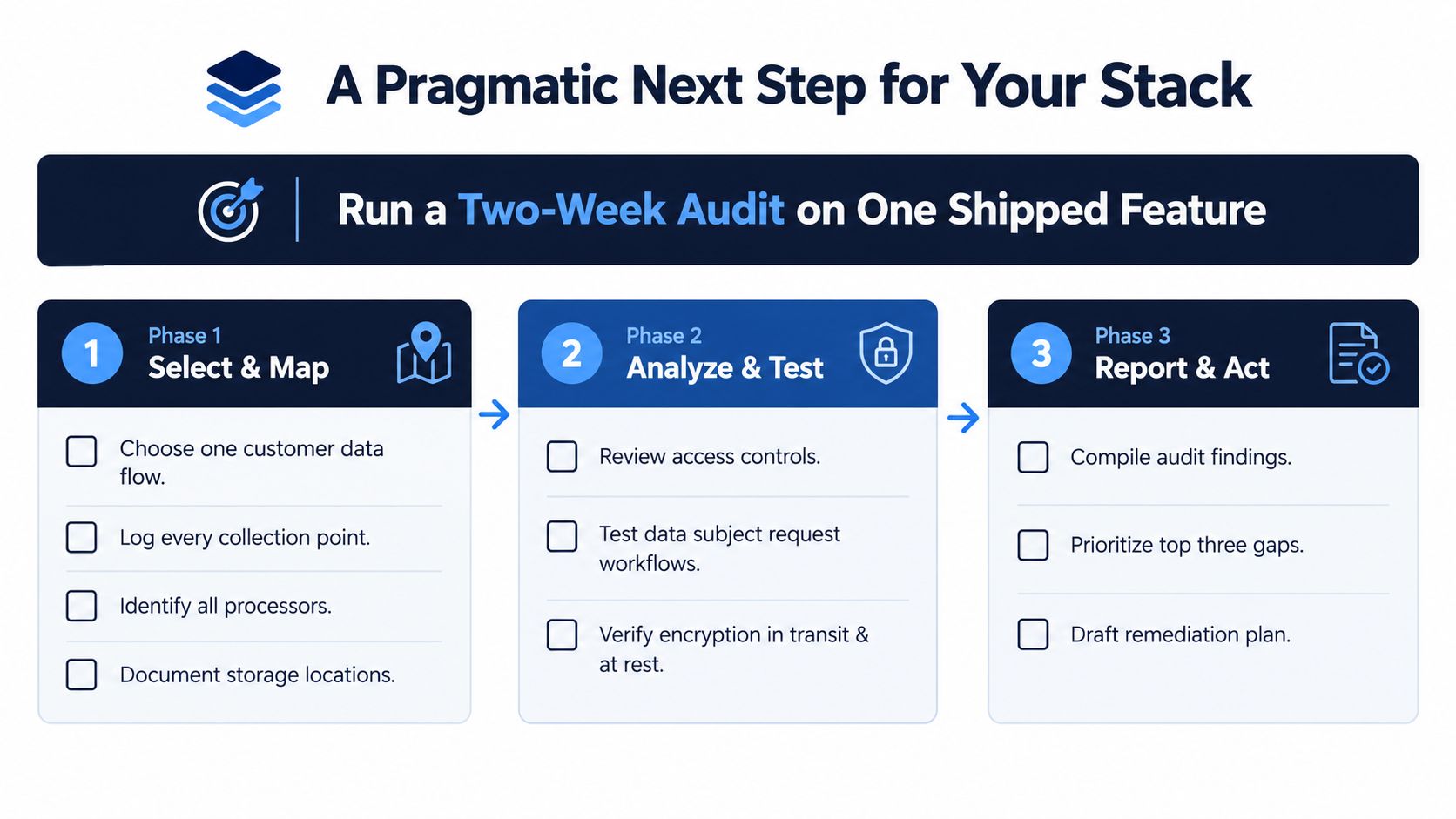
Use this sequence:
- Select and map: Choose one feature, list collection points, identify processors, document storage, and trace every model that consumes the data.
- Analyze and test: Review permissions, test data subject request workflows, verify encryption, inspect retention, and attempt cross-tenant access.
- Report and act: Prioritize the top gaps, assign owners, and ship a concrete remediation such as tighter retention, clearer consent, or scoped role-based access.
A compliance tool can organize evidence, but it won't decide whether a field belongs in the product. Teams evaluating SOC 2 software platforms should use them to support control management, not to replace product judgment. For teams that need to turn customer conversations and usage signals into prioritized product decisions, SigOS can analyze support tickets, chat transcripts, sales calls, and usage metrics while its stated approach keeps models from being retrained on customer data.
In the next 30 days, ship one visible privacy improvement and prove it with a test. That small change does more for trust than another policy document no one uses.
Use SigOS to connect customer feedback and product-usage signals with the privacy decisions behind your AI roadmap. Visit SigOS to identify the highest-impact product issues while keeping customer-data handling aligned with clear retention, access, and model-use boundaries.
Ready to find your hidden revenue leaks?
Start analyzing your customer feedback and discover insights that drive revenue.
Start Free Trial →