10 Data Retention Policy Best Practices
Discover 10 data retention policy best practices for SaaS. Learn to manage data, ensure compliance with GDPR/CCPA, and reduce risk with our expert guide.

A customer asks for deletion after ending their contract. Support still has old tickets in Zendesk. Product has years of usage events in the warehouse. Sales call recordings sit in a separate platform. Engineering kept verbose logs during an incident six months ago and never trimmed them. Now legal, security, and product are all trying to answer the same question. What do we have, why are we keeping it, and who owns the decision?
That moment exposes whether retention is real or just policy paper.
In SaaS, over-retention creates three problems at once. Storage costs drift up because old data keeps accumulating across apps, backups, and analytics systems. Risk grows because every unnecessary record expands the blast radius of a breach or access mistake. Data quality slips because old, duplicated, and low-value records pollute reporting, search, and model training. Teams building AI features feel this quickly. Better retention improves model inputs by removing stale records and preserving the data that still reflects how customers use the product. SigOS depends on that distinction when turning support tickets, chat transcripts, sales calls, and usage metrics into usable product intelligence.
I have seen teams defend broad retention with a familiar argument. Keep everything now, decide later. That sounds safe until the bill arrives, a regulator asks for your schedule, or an enterprise customer pushes on deletion terms in the DPA. It also breaks down operationally. Engineers spend longer querying noisy datasets. Analysts debate which history is trustworthy. Security teams inherit systems full of data nobody can justify.
A good retention policy fixes more than compliance posture. It helps SaaS teams decide which data earns long-term value and which data should expire on schedule. Support tickets may justify a longer window for dispute handling and trend analysis. Raw usage events often lose value faster once they have been aggregated. Call recordings may help coaching for a limited period, then shift from useful asset to avoidable liability. The point is not to keep less data by default. The point is to keep the right data for the right reason.
That discipline also builds trust. Customers notice when a vendor can explain retention in plain language, execute deletions reliably, and limit access as data ages. Internally, the same discipline improves system hygiene and AI output quality. Poor retention and poor data quality usually travel together. Teams dealing with duplicated records, stale logs, and inconsistent historical exports often run into the same problems covered in these common SaaS data quality issues.
Retention works best when product, engineering, security, and compliance treat it as an operating decision tied to real systems and real use cases. That is where cost control, privacy, defensible compliance, and better AI performance start to line up.
1. Define Clear Data Classification and Retention Schedules
A retention policy usually breaks at the first hard question from engineering or legal: what exactly are we keeping, and why does this dataset deserve that long? If the answer changes by team, system, or sprint, the policy is already weak.
Start with a shared classification model tied to real SaaS data, not abstract labels that nobody uses in practice. Product, engineering, support, security, and compliance should all be able to map the same categories to the systems they own. In a typical SaaS stack, that means separating support tickets from ticket attachments, raw usage events from aggregated product analytics, customer chat transcripts from internal Slack discussions, billing records from marketing leads, and audit logs from general application logs.
The reason is simple. Different data types create different cost, privacy, and operational trade-offs. Raw event streams can explode storage spend and pollute analytics if they stay around too long in full fidelity. Call recordings and attachments often hold the most sensitive customer data, so keeping them longer than needed raises risk fast. Support tickets may justify a longer window because they help with dispute resolution, trend analysis, and model training for support automation. The right schedule protects the business and keeps high-value data available long enough to be useful.
Build schedules around purpose, value, and end-of-life action
Each category needs three decisions documented in plain language:
- Purpose: Why the business keeps it
- Retention period: How long the original form should remain accessible
- Disposition: Whether it gets deleted, anonymized, aggregated, or archived at the end
That last point matters more than teams expect. “Retain for 12 months” is incomplete if nobody defines what happens on day 366.
A practical schedule often looks like this:
- Support tickets: Keep long enough for support history, dispute handling, and product feedback analysis. Review whether closed tickets can shift to a lower-cost archive before final deletion.
- Usage metrics: Keep raw events for short-term debugging and feature analysis, then roll older data into aggregates for trend reporting, forecasting, or AI features such as SigOS.
- Chat transcripts: Classify customer conversations separately from internal collaboration. They carry different legal, privacy, and business risks.
- Attachments and call recordings: Assign their own retention rules. They often contain screenshots, IDs, payment details, or health information that never belonged in a general “support data” bucket.
- Audit logs: Retain based on security, investigation, and control requirements, not the same schedule used for product telemetry or customer content.
This is also where data retention becomes a product quality issue, not just a compliance task. Teams that keep noisy, duplicated, stale records too long usually see the same SaaS data quality issues that distort analytics and AI output. Better classification improves deletion decisions, storage discipline, dashboard accuracy, and model performance.
Practical rule: If the owner of a data category cannot explain its business or legal purpose in one sentence, do not give it an open-ended retention period.
Treat free-text and file-based content with extra care. Structured fields in a ticketing platform are easier to classify, search, and govern. Attachments, transcripts, and exported CSVs are where retention programs often lose control because sensitive data hides inside them and copies spread across systems. I have seen teams set a clean policy for the primary app while ignoring exports in BI tools, shared drives, and vendor platforms. The schedule looked complete on paper and failed in practice.
Good classification also helps teams make better economic decisions. Not all data deserves premium storage, broad access, or long retention in identifiable form. Some records should stay hot because teams use them every day. Some should be aggregated after 30 or 90 days. Some should disappear as soon as the operational purpose ends. That discipline lowers storage costs, improves signal quality for analytics and AI, and gives customers a clearer answer when they ask how their data is handled.
2. Implement Automated Data Purging and Lifecycle Management
Manual deletion sounds manageable until your product hits scale. Then one missed export, one forgotten backup bucket, or one stale integration breaks the whole policy. The strongest guidance on enforcement points in the same direction: automate retention rules, automate deletion or anonymization workflows, support legal holds, and run scheduled audits to verify removal occurred, as described in Forcepoint's retention best practices overview.
Here's the operating reality. If an engineer, support manager, or analyst has to remember to delete data by hand, it won't happen consistently.

A better pattern is lifecycle management at ingestion. Apply tags when data lands. Route it to the right storage tier. Attach an expiration rule. Trigger archive, anonymization, or deletion automatically. Keep an audit record. If a legal hold applies, pause expiration without changing the underlying policy.
What good automation looks like
For SaaS teams, the first wins usually come from high-volume, lower-risk systems:
- Application logs: Expire aggressively unless a control framework or incident-response requirement says otherwise.
- Transient analytics exports: Delete after processing rather than treating scratch storage as permanent storage.
- Ticket attachments: Archive or purge separately from the ticket record if the attachment no longer serves the original purpose.
- Sandbox and test data: Remove on a fixed schedule, especially if production-like data ever leaks in.
Soft delete can be useful, but don't let it become fake deletion. A temporary recovery window is reasonable. An endless "deleted" state that still leaves data broadly accessible isn't.
Teams using AWS S3 Lifecycle Policies already know the pattern. A bucket can transition data between classes and remove objects according to rule-based timing. The lesson isn't about one vendor feature. It's that lifecycle rules beat memory every time.
Later in the rollout, train teams with a short explainer or walkthrough like this:
The hardest part isn't the delete job itself. It's building confidence that deletion won't break reporting, restoreability, or customer operations. Pilot on one data class, verify downstream dependencies, then expand.
3. Establish Data Retention by Use Case and Business Value
One-size-fits-all retention rules usually come from fear. Fear of deleting something useful. Fear of failing an audit. Fear of needing old data later. So teams choose the lazy compromise and keep everything. That doesn't protect the business. It creates a bigger attack surface and a noisier data estate.
The better question is: what job does this data still do?
A support ticket from a current enterprise account may still help your product, customer success, and renewal teams. A years-old stream of raw click events may have little value in raw form, but still matter as summarized trend data. A sales call transcript might support account history for some period, while extracted product objections and themes remain useful longer in de-identified form.
Match retention to the workload
SaaS companies adopt a strategic approach. Your retention timelines should reflect analytical usefulness, customer obligations, and revenue relevance.
For a platform like SigOS, that often means separating raw from derived data:
- Raw support conversations: High context, high sensitivity, usually shorter useful life.
- Normalized issue clusters: Lower sensitivity, strong long-term product value.
- Usage events: Valuable for pattern detection in active windows, less valuable as raw exhaust over time.
- Revenue-linked feature signals: Worth preserving in aggregated or de-identified form because they guide roadmap choices.
That approach also supports better AI performance. Models trained on bloated historical data often inherit stale naming conventions, obsolete workflows, and irrelevant edge cases. Curated retention keeps the model anchored to current product reality. In practice, that means preserving the signal and letting old noise expire.
Keep detailed data only while detail changes decisions. After that, preserve summary, trend, or aggregate value instead.
You don't need perfect certainty to do this. You need documented reasoning. Product can explain analytical value. Finance can explain contractual or reporting needs. Legal and privacy can explain deletion pressure. Engineering can confirm what the system can enforce safely. That shared rationale is stronger than generic "maybe we'll need it someday."
4. Create Privacy-First Anonymization and De-identification Protocols
Deletion isn't the only end state. Sometimes the right move is to keep the insight and remove the identity.
That's especially useful for SaaS teams holding product feedback, support conversations, and behavioral data that remain analytically valuable after direct identifiers are stripped out. Product leaders still want trend lines. Data scientists still want issue patterns. Growth teams still want feature adoption analysis. None of that always requires retaining names, emails, phone numbers, account contacts, or free-text identifiers.
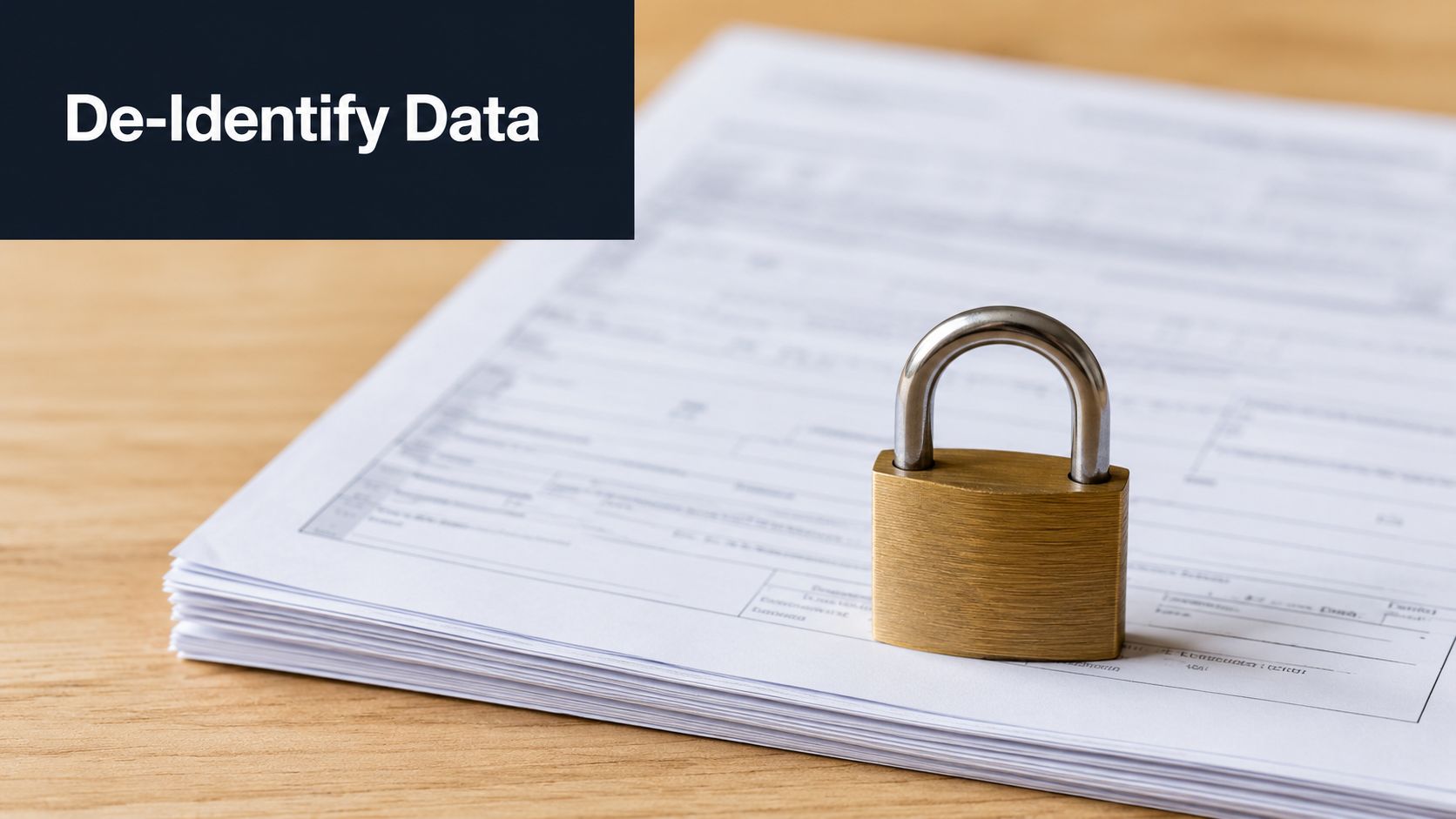
The nuance matters here. De-identification is not a cosmetic masking pass. If a transcript still includes rare company names, employee titles, URLs, or contract references, your "anonymous" dataset may still be easy to re-identify. That risk gets worse in unstructured data.
Preserve value without preserving exposure
Use a layered approach:
- Remove direct identifiers: Names, emails, phone numbers, account IDs, exact addresses.
- Generalize quasi-identifiers: Replace specific values with broader groupings when exactness isn't needed.
- Separate keys from analytics stores: If tokenization is necessary, keep re-linking keys under tighter controls than the analysis environment.
- Test for reversibility: Security and privacy teams should try to re-identify samples before approving the method.
Retention and customer trust directly connect. If your privacy notice says you minimize stored personal data, your architecture should make that true. Support organizations can retain issue categories and resolution patterns without exposing every historic conversation forever. Product teams can preserve adoption and friction insights without dragging forward old personal data that no longer serves the original purpose.
I've seen teams make one common mistake here. They assume archive equals lower risk. It doesn't. Archived personal data is still personal data. If you want long-term analytical use, de-identify before the archive handoff, not after.
5. Implement Tiered Storage Architecture with Graduated Access Controls
Retention isn't just a question of how long. It's also where the data lives during that period and who can still touch it.
Too many SaaS teams keep everything in hot storage because it feels operationally simple. That's expensive, but the bigger problem is access. When old data stays in the same environment as active production data, people query it casually, export it unnecessarily, and widen the blast radius if credentials are compromised.
A better design moves data through hot, warm, and cold tiers based on age, use frequency, and sensitivity. Recent support tickets might remain in active systems for agents and customer success. Older closed records can shift to archive storage with narrower access. Historical usage data may move from row-level event stores to summarized analytical tables.
Access should cool as data cools
Storage tiering works best when access controls tighten at each stage:
- Hot data: Available to operational teams who need it for service delivery.
- Warm data: Limited to analytics, compliance, or incident-response use cases.
- Cold data: Restricted access, retrieval workflow, stronger approvals, and clearer logging.
This is also an architecture discipline problem. If your system diagrams don't show where data moves after its active life, the retention policy will drift from reality. Teams documenting that lifecycle should treat retention states as part of the platform design, not a side note in compliance docs. Good data architecture diagrams make retention boundaries visible to engineers, auditors, and product owners.
A SaaS example is straightforward. Keep current quarter usage data in fast-access systems for product monitoring. Move older detailed events to cheaper archive storage. Keep only curated summaries in the warehouse used for routine dashboards. When someone needs archived detail, require a retrieval workflow instead of leaving it permanently one click away.
That design also helps with recovery planning. Backup and archive aren't the same thing, but both become easier to manage when older data is already segmented, less duplicated, and governed by purpose rather than habit.
6. Establish Legal Hold and Exception Management Processes
A common failure shows up the first time counsel asks for a preservation order after the retention engine is already deleting records on schedule. If the product team has no precise way to pause deletion for a defined set of data, the company is forced into a bad choice. Freeze too much and storage costs climb, search quality drops, and AI training sets fill up with stale or sensitive records. Freeze too little and you create legal exposure.
Legal holds and retention exceptions need separate workflows because they answer different questions. A legal hold exists because litigation, an investigation, or a regulatory matter requires preservation. An exception exists because the business has a time-bound reason to keep data longer than the standard rule. If teams collapse those into one bucket, "temporary" retention has a way of becoming permanent.
Keep both processes narrow, documented, and easy to audit.
A workable model includes a centralized register for holds and exceptions, system-level controls that pause deletion only for in-scope records, named approvers, and review dates that force renewal or release. That sounds procedural, but it has direct technical consequences. Engineering needs record-level or tenant-level hold flags, deletion jobs that check those flags before purge, and clear logic for what happens to derived data such as search indexes, embeddings, analytics tables, and backups.
The scope question matters more than teams expect. In SaaS systems, a hold might apply to support tickets for one enterprise account, audit trails tied to a billing dispute, or product usage logs for a specific workspace during an abuse investigation. It usually should not freeze every ticket, every event stream, or every customer attachment in the platform.
Use a simple decision standard:
- Legal hold: Required by counsel, compliance, or an external authority. Preserve specific records tied to a defined matter.
- Retention exception: Approved business need, such as a customer contract term, fraud review, or unresolved security incident. Set an expiry date at approval.
- Standard retention: Default rule for everything else. No informal side deals.
This discipline protects more than compliance posture. It also keeps data stores cleaner. Support teams can still search current tickets without wading through years of preserved matter data. ML teams can keep training corpora focused on relevant, policy-approved records instead of automatically inheriting every preserved artifact. Product and security leaders should track hold volume, age, and release rates as part of their retention reporting and policy metrics, because exceptions that never expire are usually process debt in disguise.
One more practical point. A hold is not just a database setting. It has to cover exports, downstream warehouses, object storage, and any workflow that copies data into another system. If your retention engine can pause and resume with precision across those paths, you reduce legal risk without turning the whole platform into an archive.
7. Implement Comprehensive Audit Logging and Retention Transparency
A customer asks why six-month-old support attachments still appeared in an export after your stated deletion window passed. If the team has to piece together answers from app logs, warehouse queries, and backup tickets, the retention policy is not doing its job. SaaS companies need a clean chain of evidence that shows what rule applied, what system enforced it, and what happened when the record reached end of life.
This matters for more than audit readiness. Good retention logging reduces support friction, speeds up incident response, and gives product teams a cleaner view of which data sets are still valid for analytics or AI training. If SigOS or another model is learning from support conversations, usage events, or account metadata, stale or policy-violating records will hurt model quality and raise risk at the same time.

Retention logging should cover the full record lifecycle, not just admin access. Capture policy changes, schedule overrides, deletions, archive transitions, legal hold actions, restore events, and bulk exports. Include enough context to answer practical questions later: which data category was affected, which rule version applied, which service executed the action, and whether the action succeeded, failed, or was skipped.
Make those logs hard to alter. In practice, that usually means centralized collection, limited write access, clear retention for the logs themselves, and alerts for failed deletion jobs or unexpected restores. Security teams need that trail during investigations. Compliance teams need it when a customer asks for proof. Engineering teams need it when a lifecycle job stopped running unnoticed two releases ago.
Tell customers what you retain
Transparency outside the company matters just as much. Your privacy notice, DPA language, trust center answers, and sales security questionnaires should describe actual system behavior. If you retain support tickets for 24 months, aggregate usage metrics for longer, and raw event logs for a shorter window, say that clearly. Customers usually accept different schedules when the business reason is specific and the enforcement looks credible.
A small reporting layer makes this easier. Track expired records processed, deletion failures, exception volume, systems not yet under policy control, and restore tests that touched expired data. Teams that already use disciplined retention reporting and policy metrics should apply the same operating cadence here, because visibility is what turns a written standard into a control.
Useful artifacts include:
- A data map: What data types you collect, where they live, and which teams use them.
- Policy-to-system mapping: Which platform, service, or job enforces each schedule.
- Deletion evidence: Logs, job records, or certificates that show records were deleted or archived on time.
- Restore test results: Proof that expired data does not reappear after backup recovery.
- Customer-facing retention summaries: Plain-language answers for common SaaS data types such as support transcripts, billing records, product telemetry, and uploaded files.
Trust comes from consistency. When the policy, the logs, and the customer explanation all match, retention stops looking like a compliance checkbox and starts working like a real product capability.
8. Define Clear Roles, Responsibilities, and Decision Authority
Retention drifts when everyone has partial ownership and nobody has final authority. Legal knows obligations. Product knows value. Engineering knows technical limits. Security knows exposure. Support knows what sits inside customer conversations. Without a clear decision model, the loudest stakeholder wins.
That usually means one of two bad outcomes. Either legal pushes for long retention everywhere because it feels safer, or engineering pushes for aggressive deletion without understanding contractual and customer commitments.
Assign owners by data domain
The cleanest operating model uses named owners for each major data domain and a cross-functional review path for changes. Billing data may sit with finance operations. Support conversations may sit with support leadership plus privacy review. Product analytics may sit with product operations or data engineering. Security and legal should review, but they shouldn't be the only people making category-level business decisions.
A practical governance setup includes:
- Policy owner: Maintains the master retention standard.
- Data steward: Owns retention decisions for a specific data domain.
- System owner: Implements controls in the platform where the data lives.
- Approver for exceptions: Reviews requests to extend or pause normal schedules.
- Audit contact: Produces evidence when customers, auditors, or regulators ask.
This doesn't need to become bureaucracy theater. A monthly governance review often works better than endless ad hoc escalations. The key is clarity. Who can approve a longer retention window for sales call recordings? Who signs off before a warehouse table is purged? Who verifies that backups respect the same rule? Put names next to those decisions.
Where teams struggle, I usually find one hidden issue. The retention policy is written in legal language, but enforcement lives in engineering tickets. If your engineers can't translate policy into fields, tags, jobs, and access rules, decision authority still isn't operational.
9. Conduct Regular Impact Assessments and Retention Policy Reviews
A SaaS team ships a new chatbot, routes customer conversations into the warehouse for analytics, then starts using those transcripts to tune an internal AI assistant. Six months later, the original 30-day retention rule still exists in the policy doc, but three copied datasets, a backup snapshot, and a vendor export are keeping the same data far longer. That gap is why retention reviews matter.
Set a review cadence that matches change velocity. Annual review is the floor. Quarterly usually fits better for teams adding new integrations, entering regulated markets, or feeding product data into AI systems. The point is not to polish the policy text. The point is to test whether real system behavior still matches legal commitments, customer expectations, storage budgets, and model-quality goals.
A good review starts with changed conditions.
- New systems and vendors: Support platforms, session replay tools, CDPs, data warehouses, and AI services often create duplicate copies with different deletion behavior.
- New data use: Usage metrics collected for reliability may later get pulled into churn scoring or feature adoption models. That changes both value and risk.
- Deletion side effects: Broken dashboards, missing audit evidence, and failed restores show where retention rules were never mapped to downstream dependencies.
- Over-retention: Old ticket attachments, stale feature-flag logs, and unused event tables raise storage cost and expand breach scope without adding business value.
Use this review to force trade-off decisions into the open. Keeping support tickets longer may help train a better assistant for customer operations. It also increases privacy exposure if those tickets contain free text, screenshots, or health and payment details. Keeping raw product events for years may help with long-range trend analysis. It can also bloat the warehouse and degrade signal quality for systems like SigOS if irrelevant or outdated records overwhelm the current patterns you want the model to learn from.
Review live records, not just diagrams and schedules. Pull samples from the systems that matter: Zendesk tickets, call recordings, Stripe exports, warehouse tables, S3 buckets, Snowflake stages, backups, and model training datasets. Check whether timestamps, purge jobs, anonymization rules, and legal hold flags work the way the policy says they do. I have seen teams pass a policy review on paper while retaining deleted customer data in derived analytics tables for another year.
Include product, engineering, data, security, privacy, and the operator responsible for backups or disaster recovery. Business continuity often drives hidden retention drift. Teams keep old snapshots because recovery feels safer with more history, even when the actual recovery objective only requires a much shorter window. That is a governance problem, not a storage problem. Teams that need a clearer framework for those decisions should spend time mastering GRC concepts.
One practical output helps more than a long meeting deck: a review register with four fields for each finding. What changed. What risk or cost it created. What decision was made. Who owns remediation. That format gives engineering a usable backlog and gives compliance a record they can defend during audits or customer reviews.
10. Integrate Data Retention with Privacy by Design and DPA Compliance
The strongest retention programs don't start with cleanup. They start with product design.
If a new feature collects broad free-text input, exports raw customer conversations into multiple tools, and creates no deletion path, your policy is already behind. Engineering will spend months retrofitting controls that should have existed from day one. Privacy by design fixes that by forcing retention decisions into schema design, feature requirements, vendor selection, and system architecture.
Make shorter retention the default
Recent guidance on retention consistently returns to the same principle. Keep data only as long as needed, but define the legal or business purpose behind each timeline, document it, and test deletion, restore, and audit trails regularly, especially for unstructured data. BigID's overview of data retention and over-retention risk captures that tension well. Delete too little and you raise risk, search burden, and cost. Delete too aggressively and you can break audits, eDiscovery, or recovery.
For SaaS builders, privacy by design usually means:
- Collect less upfront: If the feature doesn't require a field, don't store it.
- Set expiration at creation: New tables, buckets, and message streams should ship with a retention rule.
- Map customer promises to system behavior: Your DPA, privacy notice, and enterprise commitments must match actual technical controls.
- Design for deletion across replicas and backups: If erasure only works in the primary app database, it isn't finished.
This is also where governance connects to broader compliance maturity. Teams that need a stronger operating foundation should understand the basics of mastering GRC concepts because retention doesn't stand alone. It sits inside your wider governance, risk, and compliance model.
A final product lesson matters for AI-enabled SaaS. Cleaner, time-bounded, purpose-aligned data produces better downstream analysis. Not because "less data is always better," but because better-governed data is easier to trust, easier to explain, and easier to use without violating customer expectations.
Top 10 Data Retention Policy Best Practices Comparison
| Item | Implementation Complexity 🔄 | Resource Requirements ⚡ | Expected Outcomes 📊 | Ideal Use Cases 💡 | Key Advantages ⭐ |
|---|---|---|---|---|---|
| Define Clear Data Classification and Retention Schedules | Medium 🔄, policy, mapping effort | Moderate ⚡, governance, tagging tools | Organized datasets, compliance, lower storage 📊 ⭐⭐⭐ | Structured orgs needing consistent data labeling (SigOS: tickets, metrics) | Improves compliance, security, faster analysis ⭐⭐⭐ |
| Implement Automated Data Purging and Lifecycle Management | High 🔄, infra + workflows | High ⚡, engineers, automation, monitoring | Consistent enforcement, storage savings, audit trails 📊 ⭐⭐⭐⭐ | High-volume streams where manual deletion is impractical (SigOS daily ingest) | Eliminates manual error, ensures policy consistency ⭐⭐⭐⭐ |
| Establish Data Retention by Use Case and Business Value | High 🔄, cross-functional scoring, dynamic rules | Moderate ⚡, analytics, governance time | Optimized retention, better model training, cost alignment 📊 ⭐⭐⭐⭐ | AI-driven platforms needing targeted historical data | Maximizes analytical value per cost, supports data science ⭐⭐⭐ |
| Create Privacy-First Anonymization and De-identification Protocols | High 🔄, PII detection, differential privacy | High ⚡, privacy tooling, specialist expertise | Extended safe retention, reduced breach risk, shareable insights 📊 ⭐⭐⭐⭐ | Privacy-sensitive datasets; sharing analytics without PII (SigOS behavioral patterns) | Lowers privacy risk, enables safe analytics at scale ⭐⭐⭐⭐ |
| Implement Tiered Storage Architecture with Graduated Access Controls | Medium 🔄, lifecycle policies & migration | Moderate ⚡, multi-tier storage, automation | Major cost savings, faster queries on hot data, secure archives 📊 ⭐⭐⭐⭐ | Large datasets with varying access frequency (hot/warm/cold) | Cost optimization, performance, stronger access controls ⭐⭐⭐⭐ |
| Establish Legal Hold and Exception Management Processes | Medium 🔄, legal workflows, overrides | Moderate ⚡, coordination, audit trails | Preserves evidence during disputes, controlled exceptions 📊 ⭐⭐⭐ | Organizations exposed to litigation or regulatory probes | Ensures legal compliance and documented approvals ⭐⭐⭐ |
| Implement Comprehensive Audit Logging and Retention Transparency | Medium 🔄, logging design & retention | Moderate ⚡, storage, SIEM, analyst time | Forensics, regulator evidence, deterrence of misuse 📊 ⭐⭐⭐⭐ | Regulated environments requiring traceability | Enables incident investigation and compliance reporting ⭐⭐⭐⭐ |
| Define Clear Roles, Responsibilities, and Decision Authority | Low-Medium 🔄, governance setup, RACI | Low ⚡, meetings, documentation | Consistent decisions, accountability, fewer conflicts 📊 ⭐⭐⭐ | Teams lacking centralized data governance | Clear accountability and faster approvals ⭐⭐⭐ |
| Conduct Regular Impact Assessments and Retention Policy Reviews | Medium 🔄, recurring audits & PIAs | Moderate ⚡, cross-team time, analysis | Updated policies, gap identification, cost/value alignment 📊 ⭐⭐⭐ | Rapidly changing business, tech, or regulatory contexts | Continuous improvement and risk detection ⭐⭐⭐ |
| Integrate Data Retention with Privacy-by-Design and DPA Compliance | High 🔄, product design changes, CI/CD checks | Moderate-High ⚡, product, legal, engineering effort | Built-in compliance, minimal collection, stronger customer trust 📊 ⭐⭐⭐⭐ | New products or privacy-first platforms (SigOS enterprise customers) | Reduces long-term risk, simplifies compliance, builds trust ⭐⭐⭐⭐ |
From Policy to Practice: Your Implementation Checklist
A data retention policy becomes real only when it changes how systems behave. That's the gap most SaaS companies still need to close. They have policy text, privacy language, and scattered admin settings, but not a working operating model that product, engineering, security, and legal can all trust.
The fastest way to make progress is to stop treating retention as a giant companywide transformation. Start narrower. Pick one data category with clear business value and clear risk. Support tickets are often a good candidate. They contain customer context, they flow across multiple systems, and they usually expose the exact problems that exist everywhere else: unclear ownership, copied exports, attachments with sensitive data, analytics reuse, and no consistent end-of-life process.
Build a cross-functional team around that first category. Legal or privacy should define the minimum constraints. Product should explain how long the data remains useful. Engineering should map where it lives and how deletion or archiving can be enforced. Security should define evidence and control expectations. Customer-facing teams should confirm what must remain accessible for service delivery. Once those decisions are written down, implement the technical workflow and test it in production conditions.
Keep the scope practical. Inventory the category. Classify the fields. Set a purpose-based schedule. Decide whether end-of-life means deletion, anonymization, or archival. Apply automation. Add legal hold handling. Log every action that matters. Then verify the result with sample data, restore testing, and exception review. That sequence works far better than trying to publish a perfect enterprise retention matrix before any system enforces it.
The next step is expansion, not reinvention. Move to another category such as chat transcripts, usage metrics, audit logs, or sales recordings. Reuse the same governance pattern, but expect different trade-offs. Support data often carries more free-text risk. Usage metrics usually create volume pressure. Recordings create storage and privacy pressure. Backups create recoverability pressure. Your policy should stay consistent in principle while changing in implementation.
Done well, data retention policy best practices improve more than compliance posture. They lower storage waste, tighten access, reduce discovery burden, and make AI and analytics outputs more reliable because the underlying data estate is cleaner and more intentional. That matters for platforms like SigOS. Product intelligence is only as good as the data pipeline behind it. If your systems preserve useful signal, remove expired noise, and document every retention decision, you create the conditions for faster prioritization, stronger customer trust, and safer analytics at scale.
The most effective teams don't ask whether retention is a legal project or a product project. They run it like an operational discipline. That's what turns policy into an advantage.
If your team is trying to turn support tickets, chat transcripts, sales calls, and usage data into product decisions without creating retention chaos, SigOS can help. It helps SaaS teams identify the highest-value patterns across customer data while staying disciplined about what data should remain active, what should be summarized, and what should age out of the workflow.
Keep Reading
More insights from our blog
Ready to find your hidden revenue leaks?
Start analyzing your customer feedback and discover insights that drive revenue.
Start Free Trial →