Unlocking Revenue with Customer Feedback Services
Discover how modern customer feedback services turn insights into profit. Learn to choose, implement, and measure the ROI of your feedback strategy.

Ignoring customer feedback is like trying to navigate a ship blindfolded. You can stare at your instruments all day, but you're deaf to the crew shouting warnings about the iceberg dead ahead. The financial cost of those unheard warnings is staggering, driven by silent churn and problems that fester just below the surface.
This is where effective customer feedback services come in. They act as your sonar, revealing what's really happening with your customers and helping you turn those signals into profitable decisions.
Why Ignoring Customer Feedback Costs You Money
There's a massive, expensive chasm between how companies think they're doing on customer experience (CX) and how customers actually feel. This isn't just a difference of opinion—it's a direct threat to your revenue.

This perception gap is glaring. While 66% of brands believe their CX is getting better, only a tiny 17% of consumers agree. The problem is compounded by internal inaction; even when companies collect tons of feedback, 30-40% of departments do absolutely nothing with it. They’re sitting on a goldmine of data while revenue quietly leaks out the door.
The High Price of Inaction
In today’s market, 89% of businesses compete primarily on customer experience, a factor that now outweighs both product features and price. When the competition is this fierce, doing nothing is a massive liability. The stakes are incredibly high, especially when you realize that 52% of consumers will walk away from a brand after just one bad experience.
Losing a customer isn't a one-time event. It’s a compounding loss that erases future revenue, kills potential referrals, and tarnishes your brand's reputation. Every ignored complaint or dismissed feature request adds another drop to the bucket of silent, steady churn.
The real danger is in the feedback you don't get. For every one customer who takes the time to complain, dozens of others just leave without saying a word. These "silent churners" are the direct result of a feedback loop that's broken somewhere between listening and acting.
Moving Beyond Outdated Methods
Traditional methods like annual surveys are like using last year's map to navigate a storm. They might tell you where you were months ago, but they offer zero guidance on the immediate threats that cause customers to leave right now.
To protect your business from the financial fallout of customer churn, you have to get ahead of the problem with things like proactive churn marketing strategies. This is where modern customer feedback services provide the real-time sonar you need. They help you:
- Find silent frustration: Dig into support tickets and chat logs to spot subtle issues before they become reasons to leave.
- Prioritize profitable actions: Connect specific feedback directly to revenue, so you can focus development on what actually moves the needle.
- Prevent revenue loss: Convert qualitative signals from all your customer conversations into quantifiable, predictive insights.
Ultimately, the goal isn't just to gather more data. It’s to build a responsive system that translates your customers' voices into real, measurable business outcomes—protecting your bottom line and setting you up for sustainable growth.
Choosing the Right Type of Customer Feedback Service
Not all customer feedback services are the same. Picking the right one is a bit like outfitting a kitchen—what you need depends entirely on whether you're just boiling an egg or running a Michelin-star restaurant. Let's walk through the options so you can find the perfect fit for your business.
Think of it in three tiers. At the most basic level, you have tools that just gather the raw ingredients. As you grow, you need a system to organize those ingredients. Finally, the most sophisticated platforms act like a master chef, turning what you've gathered into insights that actually drive your business forward.
Tier 1: Collection Tools
The first type of service is all about data collection. These tools are your ingredient gatherers. They excel at one specific job: capturing feedback from a single point in the customer journey.
You’ve probably seen or used these before:
- Survey tools like SurveyMonkey or Typeform for building and sending questionnaires.
- In-app feedback widgets that let users leave a quick rating or comment.
- Review management platforms that pull in reviews from sites like G2 or Capterra.
These tools are perfect for startups or teams just starting to listen to their customers. They're affordable, easy to set up, and give you a direct line to user sentiment. The big downside? They create data silos. The feedback from a survey lives in one place, your support tickets in another, making it nearly impossible to see the big picture without a ton of manual copy-pasting.
Tier 2: Management Hubs
Once you start collecting feedback from multiple sources, you'll quickly realize you need a central pantry to store and organize it all. This is where management hubs come into play. These platforms act as a central repository, pulling data from your various collection tools into one unified space.
These services help you tag, categorize, and track feedback over time. A product manager can log in and see a clean list of all feature requests, sorted and filtered. It's a huge step up from messy spreadsheets and scattered documents, giving you a much more organized view of what your customers are saying.
But even with a hub, your team still does the heavy lifting. Someone has to read every single piece of feedback, tag it correctly, and then try to decide what’s truly important. The data is organized, but it’s still just a static list—it tells you what customers said, but not why it matters or how it connects to your bottom line.
Tier 3: Intelligence Platforms
The most advanced services are intelligence platforms. If collection tools are your ingredient gatherers, these are the AI-powered master chefs. They don't just collect and organize; they analyze everything, create recipes (insights), and predict which initiatives will have the biggest impact on the business.
An intelligence platform like SigOS goes way beyond just collecting comments. It connects feedback directly to business outcomes, automatically pinpointing which bugs are causing churn and which feature requests are tied to your most valuable deals. It answers the ultimate question: "Of the hundreds of things we could build, what should we build next to grow revenue?"
These platforms ingest unstructured data from all your sources—support tickets, sales calls, chat logs, surveys, and more. Then, using AI, they do two critical things:
- Signal Identification: They automatically group related feedback to spot emerging trends without anyone having to manually tag a thing.
- Revenue Correlation: They connect those trends to your financial data. Instead of just seeing "15 people asked for a new integration," you see "This integration is blocking $200k in ARR." This turns qualitative noise into a clear, prioritized action plan.
For any business focused on growth, reducing churn, and finding expansion opportunities, an intelligence platform is a game-changer. It closes the loop between what customers say and what your teams build. To see how this works in practice, you can explore the functions of a modern customer feedback analysis tool.
Comparison of Customer Feedback Service Tiers
To make the choice clearer, here’s a side-by-side look at how these three tiers stack up. Each level offers more sophisticated capabilities, moving from simple data gathering to strategic, revenue-focused insights.
| Service Type | Primary Function | Key Data Sources | Typical Output | Business Impact |
|---|---|---|---|---|
| Collection Tool | Gathers feedback from a single channel. | Surveys, in-app widgets, review sites. | Raw, siloed data lists (e.g., a list of survey responses). | Basic customer sentiment; good for early-stage understanding. |
| Management Hub | Centralizes feedback from multiple sources. | Collection tools, support tickets, CRM. | Tagged and categorized lists of feedback. | Organized view of requests; better internal visibility. |
| Intelligence Platform | Analyzes feedback and connects it to revenue. | All sources (calls, emails, chats, CRM). | Prioritized action plan with revenue impact data. | Data-driven decisions; direct link between product and revenue growth. |
Ultimately, the right service depends on where your company is today. If you're just starting out, collection tools are a great first step. If you're drowning in disorganized data, a management hub can bring order to the chaos. But if you need to connect feedback to revenue and make truly data-driven decisions, an intelligence platform is the only way forward.
How Customer Feedback Directly Impacts Revenue
It's easy to think of customer feedback as a "nice to have," but let's be clear: it's a direct line to your bottom line. A smart feedback strategy isn't a theoretical exercise; it shows up in your P&L statement by improving customer retention, driving expansion revenue, and sharpening your product-market fit.
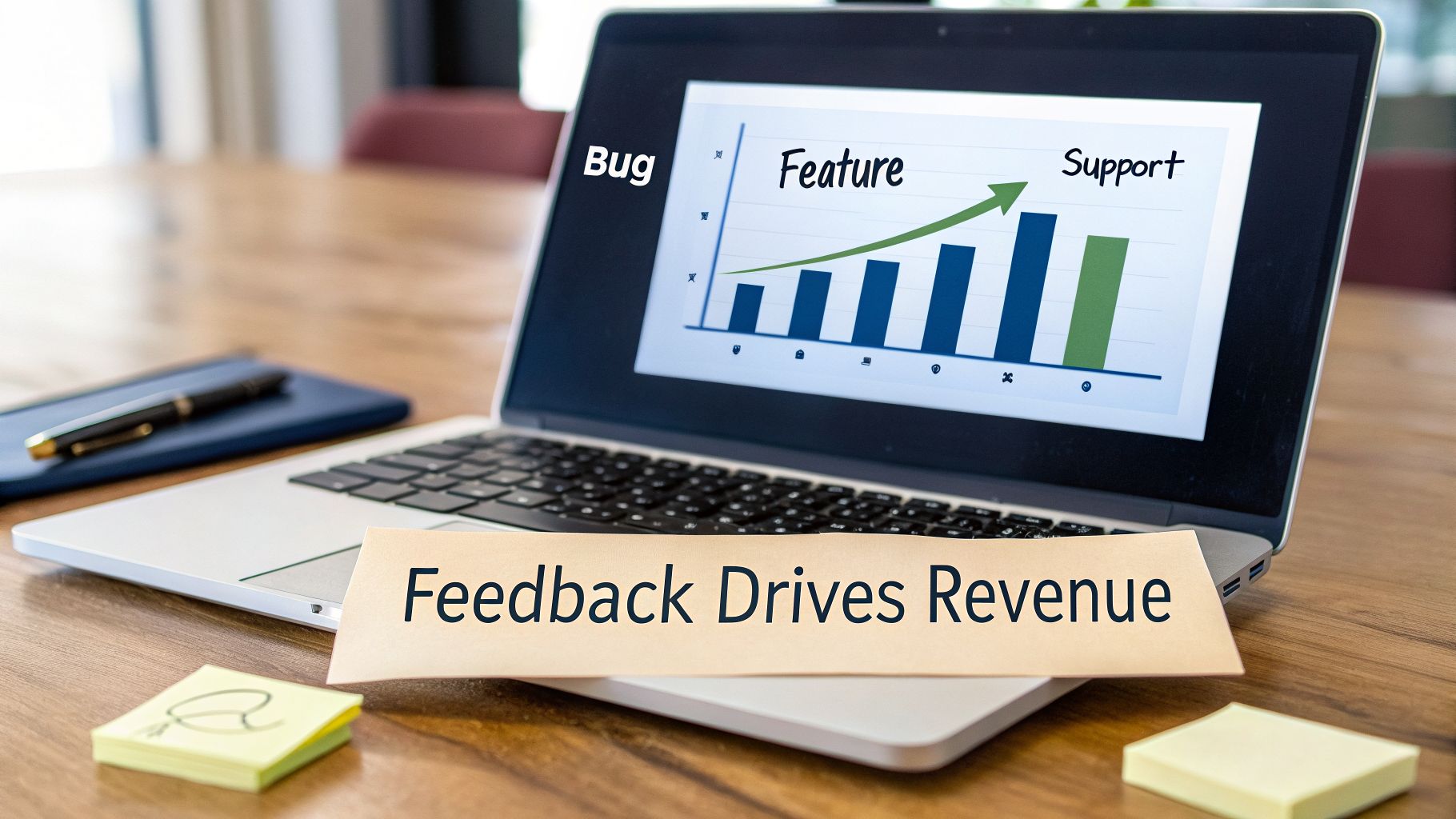
The numbers are staggering. By 2026, poor customer experiences are expected to cost businesses a mind-blowing $3.7 trillion every year. That’s how much money gets left on the table when feedback is ignored.
Even more concerning? A shocking 56% of consumers who have a bad time with a product just walk away without a word. They don't complain; they just churn. For SaaS businesses, the contrast is stark: companies that get serious about feedback analysis grow their revenue up to 80% faster than their peers. You can find more eye-opening data in Nextiva's research on customer service trends.
Reduce Churn by Catching Silent Killers
Most customers don’t leave because of one big, dramatic failure. They leave because of a slow burn—a death by a thousand paper cuts. These are the "silent killers": the annoying little bugs, the confusing parts of your interface, and the daily frictions that slowly convince them your product just isn't worth it.
Think of effective customer feedback services as your early-warning system. By digging into support tickets, chat logs, and user behavior data, you start to see the patterns in what look like isolated complaints.
Imagine you notice a dozen customers have filed tickets over the last three months about the same non-critical bug. On their own, each ticket seems minor. But what if an AI platform connects that bug to a combined $100,000 in annual recurring revenue (ARR) at risk? Suddenly, that "minor" bug becomes a priority fix that prevents a major churn event.
This is where you see the real ROI. It's not just about listening; it's about quantifying risk and stopping revenue from walking out the door.
Accelerate Expansion Revenue
Not all feedback is created equal, especially when it comes to feature requests. Your backlog is probably overflowing with ideas, but a powerful feedback system helps you zero in on the requests tied to high-value contracts and upsell opportunities.
Your sales and customer success teams hear it all the time: "We'd upgrade our contract if you just had this one feature." A modern feedback platform doesn't let that valuable insight get lost in a spreadsheet. It captures the request and attaches a dollar value to it.
For instance, a product manager can look at their dashboard and see a crystal-clear priority list:
- Feature A: Requested by 50 small accounts.
- Feature B: Requested by 3 enterprise prospects, currently blocking $300,000 in potential new ARR.
With that kind of clarity, your roadmap transforms from a popularity contest into a revenue-generating machine. You can be confident your engineering team is building the exact features that unlock the biggest deals. If you want to dive deeper into this, see our guide on how to analyse customer feedback for business impact.
Improve Product-Market Fit
At the end of the day, a continuous stream of analyzed feedback is your best defense against building a product no one wants. It keeps your team honest, grounding your decisions in real-world user needs instead of internal assumptions.
When you align your roadmap with what customers are actually trying to achieve, you build a "stickier" product that’s harder for them to leave. You're not just guessing what they need; you're solving their proven, daily problems. This deepens loyalty, increases customer lifetime value, and builds a competitive advantage that’s incredibly difficult for anyone else to copy.
Finding the Signal in the Noise with AI
Let's be honest. The hardest part of customer feedback isn't getting more of it—it's the feeling of being buried alive by it. Trying to manually sift through thousands of support tickets, sales call transcripts, and survey responses is a losing battle. It’s like panning for gold with a teaspoon; you know the valuable nuggets are in there somewhere, but you’re exhausted, and you’re definitely missing the most important ones.
This is where AI-powered customer feedback services step in and completely change your approach. Forget manual labor. These platforms act like industrial-grade machinery, connecting to all your data sources and automatically turning that chaotic flood of feedback into clear, actionable insights.
The Power of Automated Signal Identification
The first job of a smart platform is Signal Identification. It doesn't just scan for keywords; it actually understands the context, sentiment, and intent behind the customer's words. By analyzing the language across all your feedback channels, the AI automatically groups related issues together, spotting emerging trends weeks or even months before a human could.
For example, imagine you get a few hundred support tickets in a given week. An AI platform might flag that 15 tickets, all from different customers and worded differently, are actually talking about the same problem—a "slow login process" or a "payment page that keeps freezing." It automatically bundles these into a single, high-priority issue, complete with the original user quotes.
Suddenly, you’re not looking at a mountain of disconnected comments anymore. You’re looking at a clean, organized list of themes that show you exactly what needs attention. To dig deeper into how this works, our guide on customer voice analysis explains the process in more detail.
Tying Feedback Directly to Revenue
Spotting trends is a great start, but it's only half the story. The real breakthrough happens with Revenue Correlation. This is where the platform connects the what (the feedback trend) with the so what (how much money it's costing you).
By integrating with your CRM and billing systems, the AI can quantify the business impact of each problem it finds. Instead of bringing a list of complaints to your next product meeting, you can bring a prioritized dashboard that speaks the language of the leadership team.
This completely shifts the conversation. A vague problem like "some users are frustrated with the API" becomes a concrete business case: "This API bug is affecting 12 of our enterprise accounts, putting $450,000 in ARR at risk of churn."
This data-driven approach takes the guesswork and office politics out of building your roadmap. You no longer have to debate what to work on next. The platform gives you a clear, daily list of the most expensive problems to fix and the most valuable opportunities to chase.
Demystifying AI in Practical Terms
"AI" can sound like a buzzword, but its application here is incredibly down-to-earth. It’s about taking all the messy, unstructured data your company already has and turning it into something you can make decisions with.
Think about all the different kinds of feedback you collect:
- Support Tickets: Packed with details on bugs and points of friction.
- Sales Calls: Full of insights on what features are blocking new deals.
- Chat Logs: A goldmine of real-time reactions to your product.
- Surveys & Reviews: Direct input on customer satisfaction and overall sentiment.
An AI platform can process all of it. For audio feedback from calls, powerful interview transcription software can convert those conversations into text, making them fully analyzable. The AI then ingests that text, identifies the core themes, and links them back to revenue.
The result is a continuous, automated loop. New feedback comes in, the AI analyzes it, and your team gets a clear, prioritized action plan that will directly impact the bottom line. It's the difference between trying to navigate with a map and a compass versus using a GPS that shows you the fastest, most profitable route to your destination.
How to Measure the ROI of Your Feedback Program
Trying to measure the real impact of your customer feedback services can sometimes feel like chasing a ghost. But it's absolutely one of the most important things you can do to prove their worth. To get real buy-in from leadership, you have to move past vanity metrics like "number of surveys sent." Instead, you need to connect feedback directly to dollars and cents.
The trick is to start focusing on the numbers that actually matter to the business. It’s about translating what customers are saying into a quantifiable story that resonates with your finance, product, and executive teams.
Think of it like this: you have all this raw, messy data coming in from everywhere. Modern AI-driven platforms act as a powerful processor, turning that noise into a clear, actionable signal.
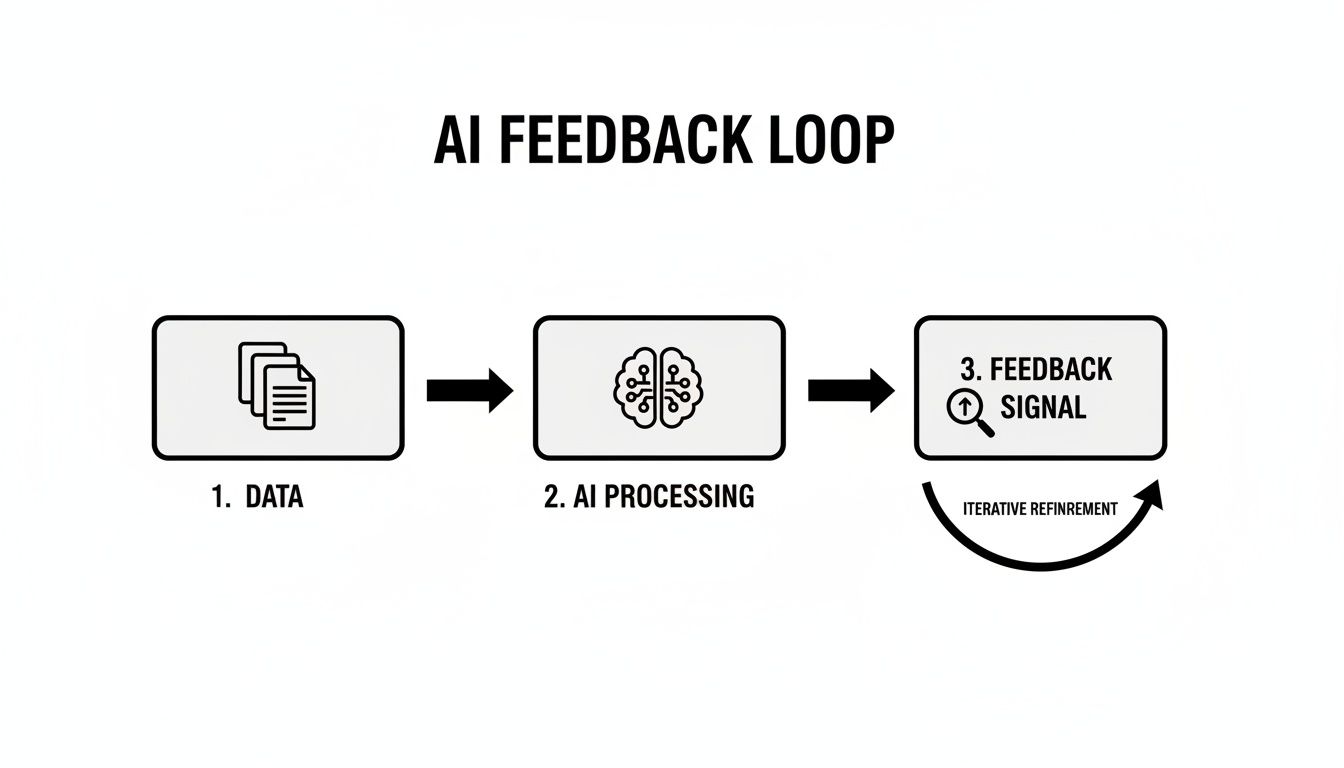
This process is what transforms scattered complaints into a prioritized list of opportunities, showing you exactly where to focus your efforts for the biggest impact.
Key Metrics That Prove Business Impact
To build a business case that no one can argue with, you need to ground your ROI calculations in metrics that directly reflect the financial health of your company. Here are four of the most powerful KPIs to start tracking.
- Churn Reduction Rate: This is a big one. It measures how successful you are at stopping customers from walking away. When you find and fix the problems that are causing frustration, you're actively protecting your recurring revenue. A great way to track this is to monitor the churn rate for a group of customers who were affected by a bug you fixed. If you solve an issue impacting 100 users and only two leave that quarter instead of the usual ten, that's a tangible win.
- Expansion Revenue from New Features: How many upsells or bigger contracts did you land after launching a feature that customers were asking for? This directly connects product development to revenue growth. When a feature request comes up during a sales or renewal call, tag it in your CRM along with the potential deal value. Once the feature goes live, you can credit that closed deal directly to your team's responsiveness.
- Reduction in Support Ticket Volume: Seeing a drop in support tickets for a specific issue after you’ve shipped a fix is a clear signal of success. It means a better user experience and a more efficient support team. Simply measure the ticket volume for a problem before and after you implement the solution. A 40% decrease in related tickets is a hard number that proves you've saved your agents' time and eliminated a major point of friction for customers.
- Customer Lifetime Value (CLV) Uplift: This metric shows the long-term payoff. A better experience encourages customers to stick around longer and spend more over their entire relationship with you. To see this in action, compare the average CLV of customers whose feedback you've acted on against those you haven't. An increase in CLV for the group you helped proves the lasting financial benefit of listening and responding.
Tying ROI to Real-World Scenarios
This is where things get really interesting. The true power of modern feedback tools is their ability to connect vague complaints to very specific financial risks. Instead of just knowing "users are frustrated," you can see exactly how much that frustration might cost you.
For example, an AI platform like SigOS might analyze your support tickets and notice a pattern of complaints about a buggy integration. It then cross-references this with your CRM and billing data, discovering the issue is affecting 20 of your enterprise customers—posing a $50,000/month churn risk.
Suddenly, the conversation changes. It’s no longer about "some users are unhappy." It’s about a critical business decision: "We need to fix this now to prevent losing $600,000 in ARR."
The ROI is no longer a fuzzy concept. It becomes the direct, measurable value of the revenue you just saved. That's a story every executive wants to hear.
Integrating Feedback Services into Your Daily Workflow
Let's be honest—the thought of adding another piece of software can feel like a headache. But the best customer feedback services aren't designed to disrupt your team's rhythm; they're meant to plug right into the tools you already use every day.
The whole point is to create a "closed-loop" system. This isn't just about looking at insights on a dashboard. It’s about building an automated bridge where feedback automatically triggers the right actions in the right places, from your support desk to your project management tools.
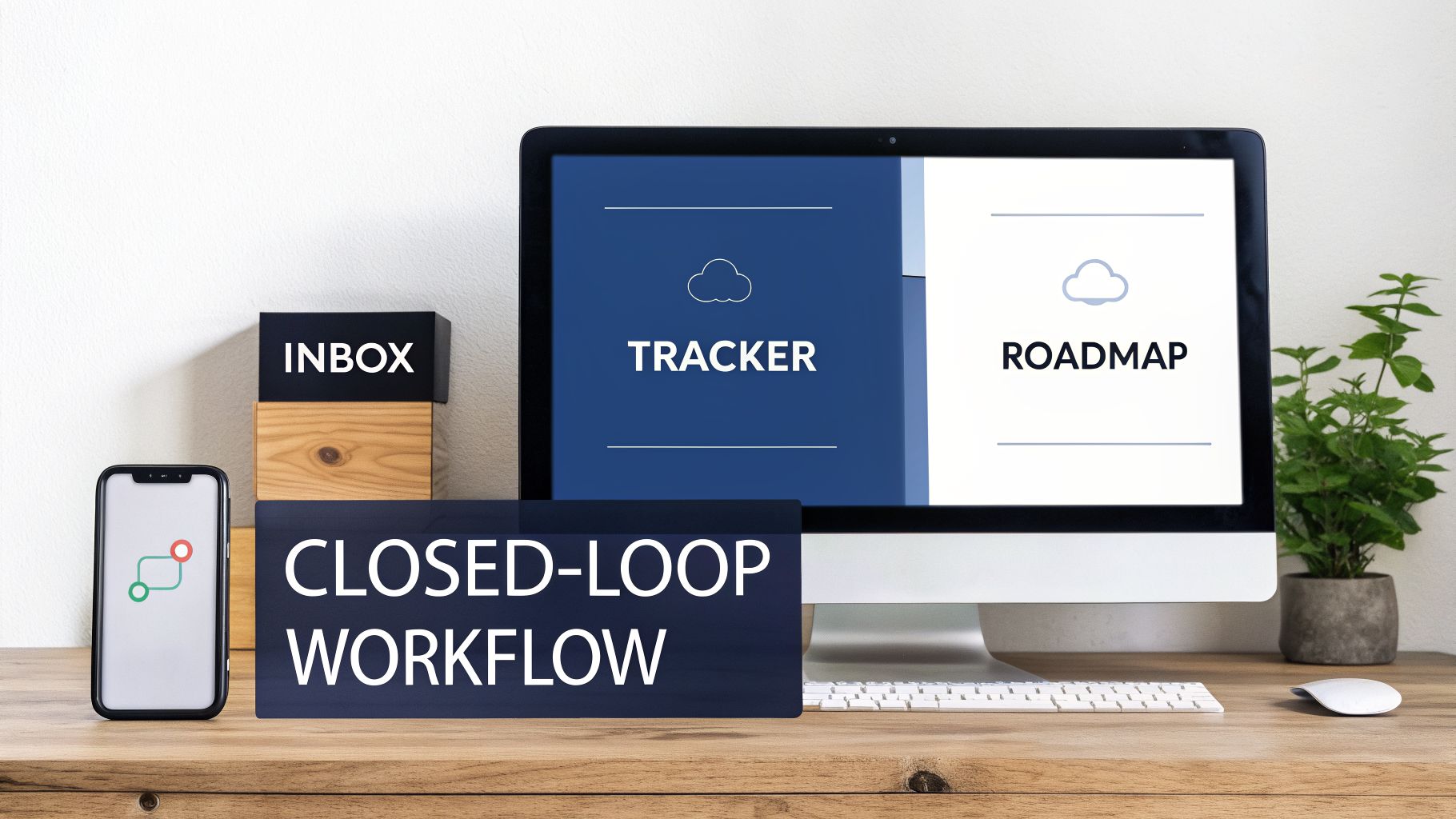
Think of it as moving from a reactive "fire-fighting" mode to a proactive, strategic one. It's a shift that's quickly becoming the new standard—in fact, 72% of CX leaders already believe AI will handle all proactive customer outreach in the near future.
Building Your Automated Feedback Engine
Creating this kind of automated workflow is surprisingly straightforward. It's really just a three-step process designed to get the right information to the right person without anyone having to manually copy and paste data between systems.
Here’s how you can set it up:
- Connect Your Data Sources: First, you simply link the platform to all the places where your feedback lives. This could be your Zendesk support tickets, conversations in Intercom, notes in your CRM, or even transcripts from customer calls. This funnels everything into one unified stream for analysis.
- Configure Automated Issue Creation: This is where the real power kicks in. You can set up rules to automatically create a Jira ticket or a Linear issue when a specific feedback pattern emerges. For example, if an issue is tied to a significant amount of revenue, a ticket can be instantly generated, pre-filled with all the necessary context—customer quotes, impact data, and the calculated revenue at risk.
- Set Up Real-Time Stakeholder Alerts: Finally, you make sure the key decision-makers are always in the loop. You could set up a Slack alert to ping your Head of Product the moment a feature request is linked to a six-figure deal. High-value insights and opportunities simply can't fall through the cracks.
By integrating your feedback this way, you’re not just passively collecting data. You're building an active, revenue-aware system that ensures the most critical customer needs are addressed immediately, stopping problems before they grow and seizing opportunities before they're gone.
Frequently Asked Questions
When you're exploring modern customer feedback services, a few common questions always come up. This is especially true for product, support, and engineering leaders who are already juggling heavy workloads. Let's tackle the big ones head-on.
My Team Is Already Overwhelmed. Won’t This Just Add More Noise?
That's a completely fair question, and it's rooted in how older, simpler feedback tools used to work. They often just created another inbox for your team to manage. But modern, AI-driven platforms are built to solve that exact problem—they're noise-cancellers, not amplifiers.
Instead of just dumping raw feedback on your plate, these systems automatically analyze, group, and prioritize everything for you. The goal isn't to give your team more to read. It's to deliver a short, focused list of the top issues and opportunities that are directly tied to revenue. It turns a firehose of feedback into a clear, actionable signal.
An intelligent feedback platform doesn't create more work; it creates focus. It tells you exactly what to fix or build next to make the biggest impact, turning overwhelming noise into a prioritized action plan.
How Can You Accurately Calculate the Revenue Impact of Feedback?
This is where connecting the dots between different systems becomes so powerful. The platform pulls together data that your teams are already generating but that live in separate silos. For example, it might spot a pattern of complaints in support tickets and cross-reference it with churn data from your billing system.
It can also link a specific feature request mentioned on multiple sales calls to the total deal value of those opportunities in your CRM. By tying qualitative feedback to hard numbers, the platform puts a dollar value on what used to be subjective. You go from a vague complaint to a clear business case, like: "This specific bug is affecting 30 customers with a combined ARR of $250,000." Suddenly, prioritization becomes a lot more obvious.
Is It Difficult to Integrate an AI Feedback Platform?
Not at all. The best platforms are designed for quick and painless setup. They come with native, one-click integrations for the tools your teams already live in, like Zendesk, Jira, Intercom, and GitHub.
The process is usually as simple as logging in and authorizing the connection. From there, the platform does its work quietly in the background, analyzing data without needing constant attention. The whole point is to automate the flow of information so critical insights surface right where your team works, making it a natural part of their daily routine.
Stop drowning in feedback and start surfacing revenue. SigOS uses AI to connect customer feedback to your bottom line, giving you a prioritized action plan every day. Discover the insights you're missing at Sigos.io.
Keep Reading
More insights from our blog

Ready to find your hidden revenue leaks?
Start analyzing your customer feedback and discover insights that drive revenue.
Start Free Trial →