Customer Sentiment Analysis: Link to Churn & Revenue
Go beyond scores with customer sentiment analysis. This 2026 guide covers data, models, and linking sentiment to churn & revenue.
Your team probably already has more customer feedback than it can use.
Support tickets pile up in Zendesk. Sales calls are recorded and forgotten. Chat transcripts sit in Intercom. Product managers skim a few comments, customer success escalates the loudest accounts, and leadership asks the same question every quarter: what is driving churn, expansion, and product demand?
That's the gap customer sentiment analysis is supposed to close. In practice, a lot of teams stop too early. They classify messages as positive, negative, or neutral, put the score on a dashboard, and call it insight. It isn't. A sentiment score without business context is only a cleaner version of noise.
The useful version of customer sentiment analysis does something harder. It identifies what customers feel about specific parts of the experience, ties those signals to account value and behavior, and turns them into prioritization decisions. That's when “customers are frustrated” becomes “login instability is putting renewals at risk in this segment” or “positive sentiment around onboarding is showing up in expansion conversations.”
Beyond the Buzzword What Is Customer Sentiment Analysis
A common situation looks like this: the support lead says customers are upset about reliability, the product team thinks pricing confusion is the bigger issue, and sales says the main blocker is missing enterprise features. Everyone has evidence. No one has a complete picture.
Customer sentiment analysis exists to solve that problem at scale.
In practical terms, it uses NLP and AI to classify customer language as positive, negative, or neutral across feedback sources like tickets, chats, reviews, emails, and other interactions. What changed over the last decade is not the basic idea. It's the volume of digital customer data and the ability to score every message automatically. AWS describes the core task that way, and that shift turned sentiment analysis from a manual research exercise into an operational signal teams can use every day through AWS's overview of sentiment analysis.
That distinction matters. Manual review works for a handful of interviews. It breaks when thousands of customer messages arrive each week.
What it is in business terms
The wrong way to think about customer sentiment analysis is “software that tells me if a comment is happy or angry.”
The better definition is this:
- A signal layer for customer operations that reads unstructured feedback at scale
- An early warning system for product friction, service failures, and churn risk
- A prioritization input that helps teams decide what deserves engineering, support, and customer success attention
Practical rule: If your sentiment output doesn't change backlog priorities, account outreach, or retention work, you don't have a sentiment program. You have labeled text.
What sentiment analysis is not
It isn't mind reading. It won't replace product judgment. It won't magically resolve conflicting stakeholder opinions. And it won't tell you the economic value of a problem unless you connect the signal to account data, usage, and outcomes.
That's where most programs stall. They answer whether feedback is negative. They don't answer whether the negative feedback matters.
The Data Sources Where Customer Sentiment Hides
Many teams often start in the wrong place. They think about social mentions first because they're public and easy to imagine. For B2B SaaS and product-led companies, the higher-signal data usually lives inside your own systems.
Treat sentiment work like a detective case. One clue rarely closes it. A pattern across sources does.
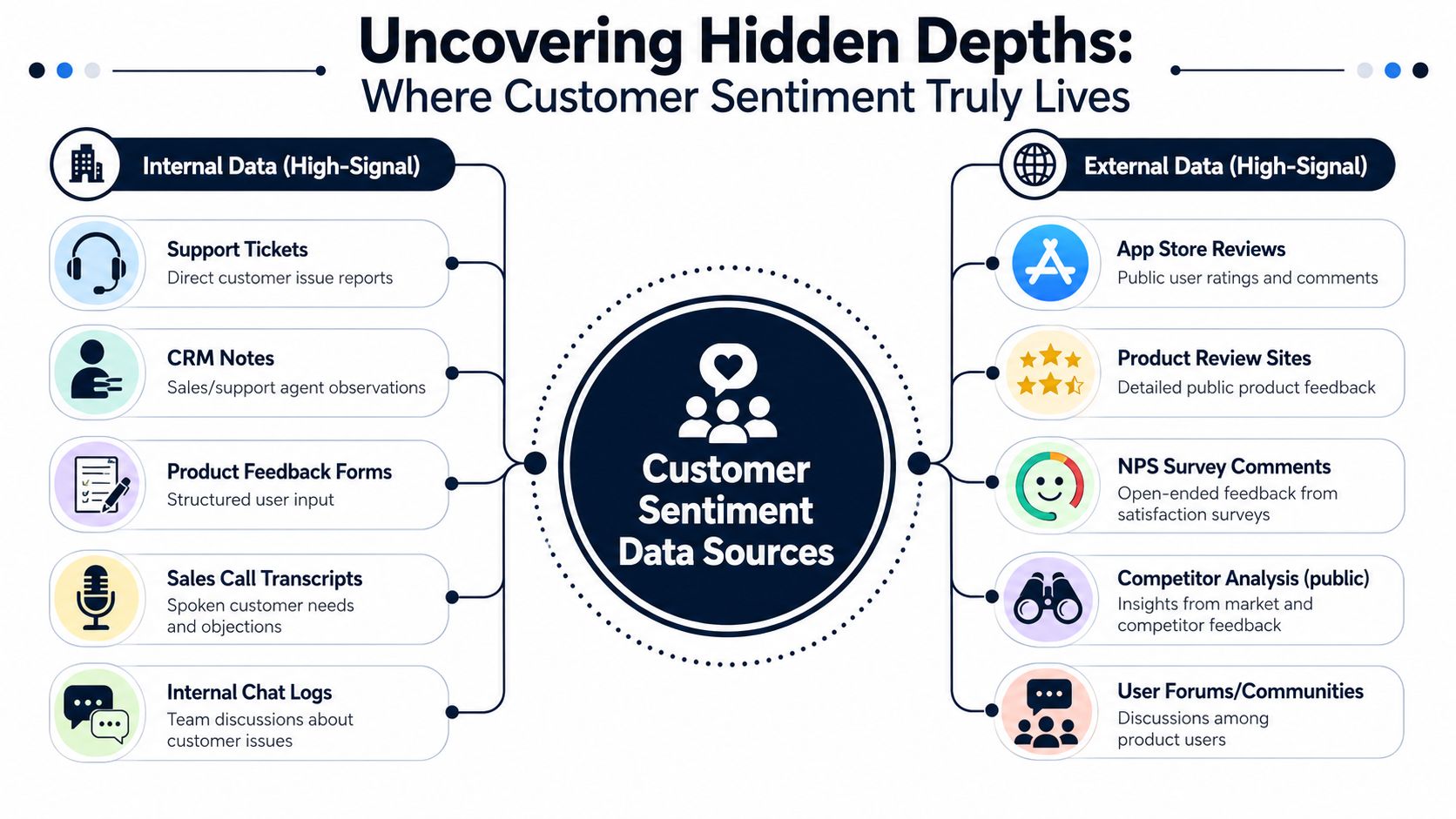
Internal systems usually hold the strongest evidence
If you want sentiment that impacts revenue, start where customers reveal friction in context.
- Support tickets carry explicit problem statements. They often include urgency, repeat failure patterns, and the exact language customers use when something blocks work.
- Chat transcripts expose raw emotion faster than formal surveys do. People tend to be less polished in chat, which makes frustration easier to detect.
- Sales call transcripts surface objections before the deal closes. That matters because negative sentiment here often points to product gaps, trust issues, or adoption concerns that affect pipeline quality.
- CRM notes capture what account executives and customer success managers hear when a customer is evaluating renewal, expansion, or alternatives.
- Product feedback forms and NPS comments give structured entry points, but the open text is where the actionable detail lives.
A good primer from MyMentions' insights on sentiment analysis is useful here because it broadens the lens beyond simple text labeling and pushes toward operational use.
Behavioral data changes the meaning of sentiment
Text tells you what customers say. Product behavior tells you whether they're adapting, struggling, or disengaging.
That's why product intelligence teams should pair language signals with:
| Signal type | What it tells you |
|---|---|
| Usage trend | Whether frustration is followed by reduced engagement |
| Feature adoption | Which product areas are associated with positive or negative reactions |
| Support recurrence | Whether an issue is isolated or repeating |
| Renewal timing | Whether the sentiment spike is happening near commercial risk |
| Account value | Whether the same issue affects strategic customers or long-tail accounts |
A complaint from a trial user and the same complaint from a major renewal account shouldn't carry the same weight.
External sources still matter
Public review sites, app store reviews, communities, and forums can reveal perception gaps your internal systems miss. They're especially useful when customers won't escalate directly but will describe the experience publicly.
Still, internal feedback usually gives you better operating detail. It has account context, product history, and downstream business outcomes attached.
If you're building the taxonomy for all this input, SigOS's guide to analyze customer feedback is a useful reference for thinking about clustering, categorization, and signal extraction across mixed channels.
One channel tells you what happened. Multiple channels tell you whether it's a one-off complaint or a business problem.
How Sentiment Modeling Actually Works
A lot of sentiment tooling gets treated like magic. It isn't. The models follow a progression, and each step changes what kind of business decision you can support.
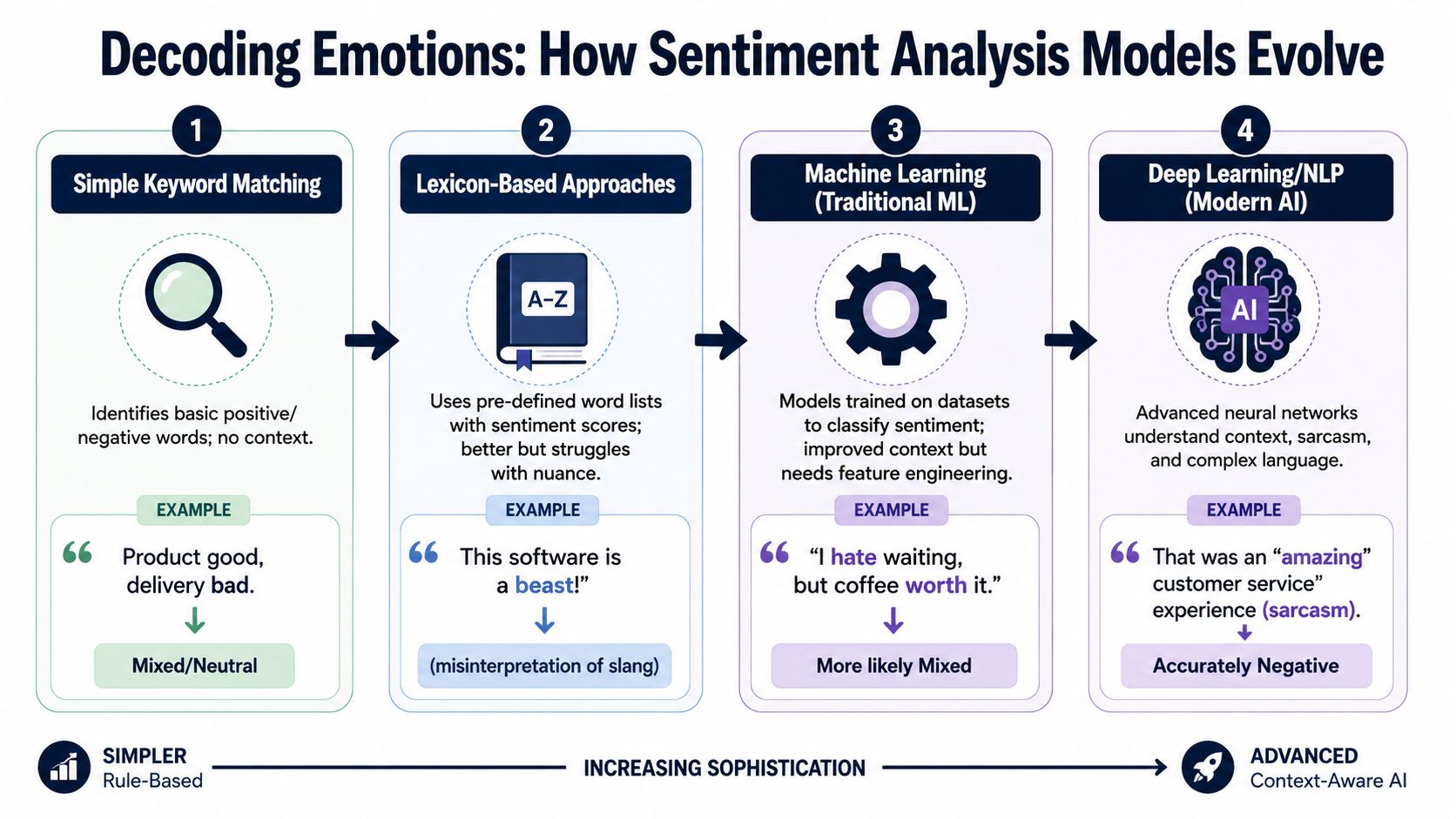
Basic approaches break fast
The earliest layer is keyword or lexicon-based scoring. If a message contains words like “great,” it trends positive. If it contains “broken” or “slow,” it trends negative.
That approach is fast, cheap, and brittle.
It fails on mixed statements, domain language, and sarcasm. “The migration was painful but support saved the rollout” contains both risk and recovery. “This feature is sick” may be praise in one context and criticism in another. Keyword systems often flatten all of that into something misleading.
Traditional machine learning classification improved this by training on examples rather than hard-coded word lists. That gets you better overall document classification into positive, negative, or neutral. For general reporting, it can be enough.
For product intelligence, it still misses the point.
Document-level sentiment is too coarse
A product team doesn't need to know that a conversation was “mixed.” It needs to know what inside the conversation drove the sentiment.
Take a simple line: “The UI is beautiful but the API is slow.”
A coarse model may classify the whole message as neutral or mixed. That's not useful for prioritization. Design doesn't need fixing. API performance might.
This is why Aspect-Based Sentiment Analysis, or ABSA, matters. Instead of scoring the entire message once, ABSA maps sentiment to the specific aspect mentioned, such as onboarding, search, pricing, support responsiveness, API stability, or billing.
According to the verified benchmark provided, ABSA increases correlation accuracy with revenue metrics by 25-30% compared to coarse-grained models because it isolates the actual driver of dissatisfaction. The same verified data also notes that reviews containing high-intensity negative emotions have a 4.2x higher probability of customer churn within 30 days.
That's the jump from text analytics to business instrumentation.
Why aspect-level output changes backlog decisions
ABSA matters because customers rarely talk in one-dimensional sentences. They bundle praise, criticism, feature requests, urgency, and context into the same interaction.
A useful model should separate:
- Aspect such as onboarding flow, invoice accuracy, admin permissions, or mobile sync
- Polarity such as positive, negative, or neutral
- Intensity such as mild disappointment versus clear anger
- Context such as whether this came from a new user, power user, evaluator, or renewal-risk account
Operator's view: “Negative sentiment increased” is a reporting statement. “Negative sentiment tied to login reliability increased among high-value accounts” is something a product and CS team can act on.
Input quality sets the ceiling
Sentiment modeling is only as good as the text it receives. If your call transcripts are weak, your sentiment labels will be weak too. If product area tagging is inconsistent, aspect-level analysis won't be trustworthy.
That's why teams working with voice data should spend time to evaluate transcription quality before they over-interpret sentiment trends from call recordings. Bad transcripts don't just create noise. They can push attention toward the wrong issue cluster.
What works in practice
The strongest production setups usually share a few traits:
- They train around domain language. SaaS vocabulary, implementation jargon, and customer-specific terms matter.
- They score at the aspect level, not only the conversation level.
- They detect intensity, not just polarity.
- They allow review and correction. Product ops, support ops, or analysts should be able to inspect outputs and refine taxonomies.
What doesn't work is stopping at “overall sentiment by week” and assuming that tells you what to build.
Turning Sentiment into Actionable Product Intelligence
The sentiment score is not the deliverable. It's the trigger.
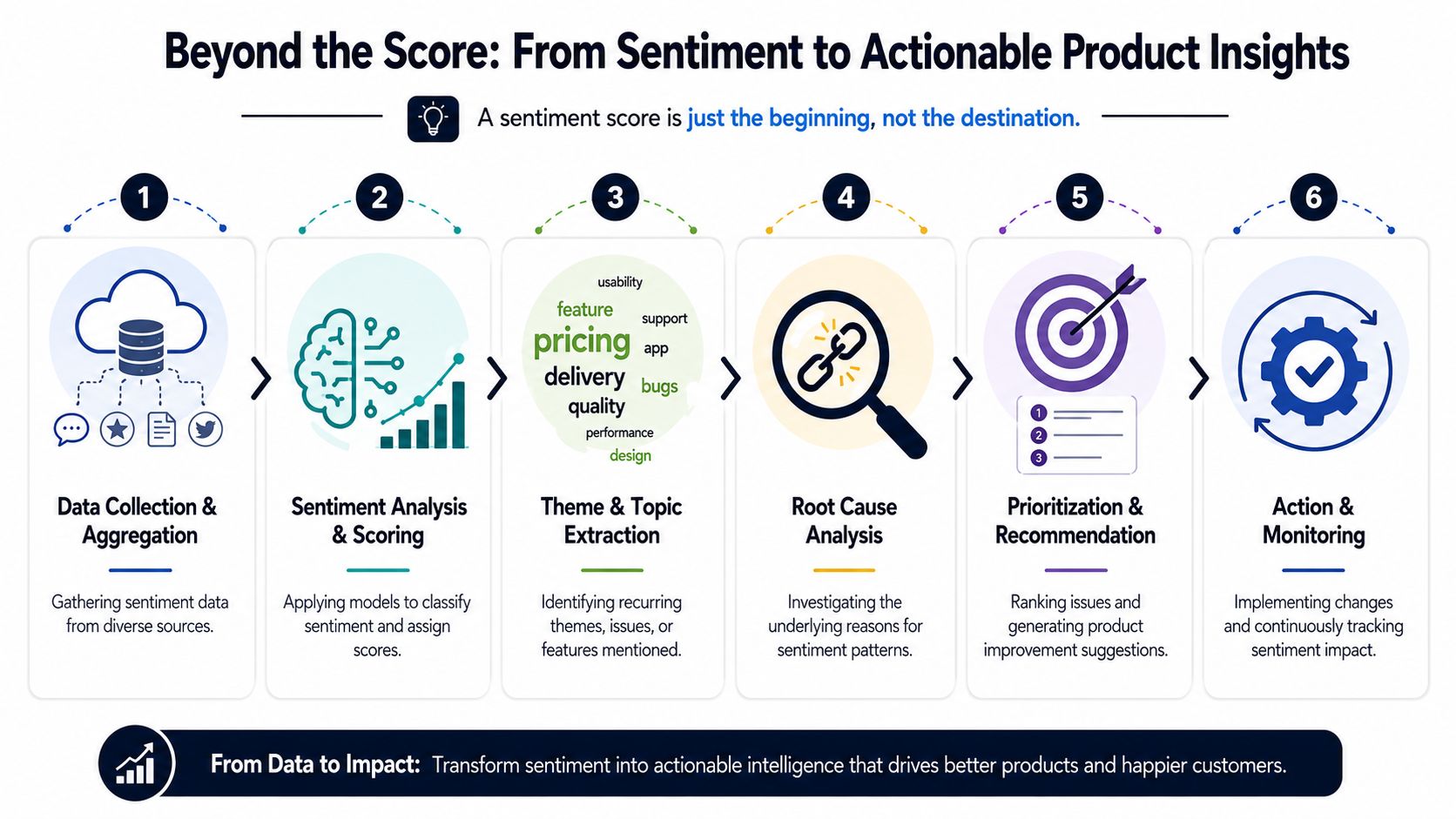
Teams often get stuck because they ask the model to do the whole job. It can't. It can detect emotion and categorize text, but prioritization requires a second layer: issue grouping, business context, and operational follow-through.
A useful explanation of the workflow looks like this:
The operational sequence that actually matters
A mature program usually follows this chain:
- Collect the raw feedback from tickets, chats, call transcripts, CRM notes, and surveys.
- Apply sentiment and aspect tagging so each item carries structured emotional meaning.
- Cluster similar issues so “can't log in,” “SSO failure,” and “auth timeout” roll into the same problem family.
- Enrich with account context like segment, plan type, ARR, seat count, renewal date, and usage trend.
- Route the result to the right team. Engineering for defects, customer success for retention risk, product for recurring friction, sales for expansion signals.
This is the key point many teams miss: sentiment only becomes actionable when it's paired with issue clustering and impact analysis. That's also the guidance in Unwrap's customer sentiment analysis write-up, which notes that sentiment scores alone aren't enough for prioritization and should be enriched with B2B context like ARR, renewal date, and seat count.
Move from loudest voice to highest impact
A sentiment program should reduce political prioritization.
Instead of reacting to whichever account manager escalates the most forcefully, teams can rank issues by a combination of:
- Negative sentiment concentration
- Volume of similar reports
- Account value
- Renewal proximity
- Usage decline or stalled adoption
- Expansion relevance
That changes the conversation in planning meetings. The debate shifts from “this customer is upset” to “this issue is appearing across the same revenue-critical segment.”
Tooling should fit the workflow
The stack can vary. Some teams use a BI layer plus custom NLP pipelines. Others rely on support analytics tools, call intelligence platforms, and feedback platforms stitched together.
One practical option in this category is SigOS, which ingests support tickets, chat transcripts, sales calls, and usage metrics to surface patterns tied to churn, expansion, and revenue impact. That kind of setup is useful when the main problem isn't collecting feedback, but ranking it against business outcomes.
The real win is not cleaner reporting. It's getting engineering, success, and revenue teams to work from the same evidence.
Dashboards and KPIs That Drive Decisions
Most sentiment dashboards are built for presentation, not action.
They show total positive versus negative feedback, maybe a trend line, and often a word cloud that looks impressive but doesn't help anyone decide what to do next. A good dashboard should help a VP of Product, Head of Support, or revenue leader answer three questions fast: where sentiment is changing, what is causing it, and which accounts or segments are exposed.
The metrics worth putting on screen
Zendesk's guidance is useful here because it ties customer sentiment to retention and revenue, and notes that two-thirds of consumers who believe a business cares about their emotions are more likely to spend more in its discussion of customer sentiment and analytics. It also notes that sentiment is often normalized on a -1 to +1 scale or similar, which makes trend reporting easier.
That doesn't mean your main KPI should be one giant average. It means the score should sit next to business metrics that give it meaning.
A practical dashboard usually includes:
- Sentiment trend by product area so you can see whether billing, onboarding, permissions, or reliability is moving in the wrong direction
- Top negative drivers ranked by issue cluster, not by raw keywords
- Sentiment by segment such as SMB, mid-market, and enterprise
- Sentiment by lifecycle stage including trial, onboarding, steady-state use, and renewal window
- Support volume plus sentiment so leaders can distinguish between noisy categories and truly painful ones
- Expansion and churn watchlist showing accounts with worsening sentiment tied to important product aspects
What leaders should review weekly
A weekly operating view works better than a static monthly report.
| Dashboard view | Why it matters |
|---|---|
| Aspect sentiment over time | Shows whether a product area is improving or degrading |
| Negative theme leaderboard | Highlights root causes, not just emotional totals |
| Account risk panel | Helps CS focus on customers with both negative language and business exposure |
| Segment comparison | Prevents enterprise problems from being hidden inside blended averages |
If your company also runs commerce flows or self-serve experiences, some of the thinking in how teams improve Shopify customer satisfaction is relevant because it pushes metrics closer to operational decisions instead of generic satisfaction reporting.
The dashboard should also predict
The strongest sentiment dashboards aren't retrospective. They support prediction.
That means linking sentiment views to churn modeling, account health, and renewal planning. If negative aspect sentiment climbs in the same product area that precedes contraction, the dashboard should make that visible before the quarter closes. A useful framework for that connection is predictive churn modeling, where sentiment becomes one input in a broader risk model rather than a standalone score.
Best Practices for a Trustworthy Sentiment Program
A sentiment program only helps if people trust it.
That trust doesn't come from saying the model is “AI-powered.” It comes from clear data handling, honest expectations about accuracy, and a workflow that knows where automation stops.
Bias and privacy need design choices, not policy slides
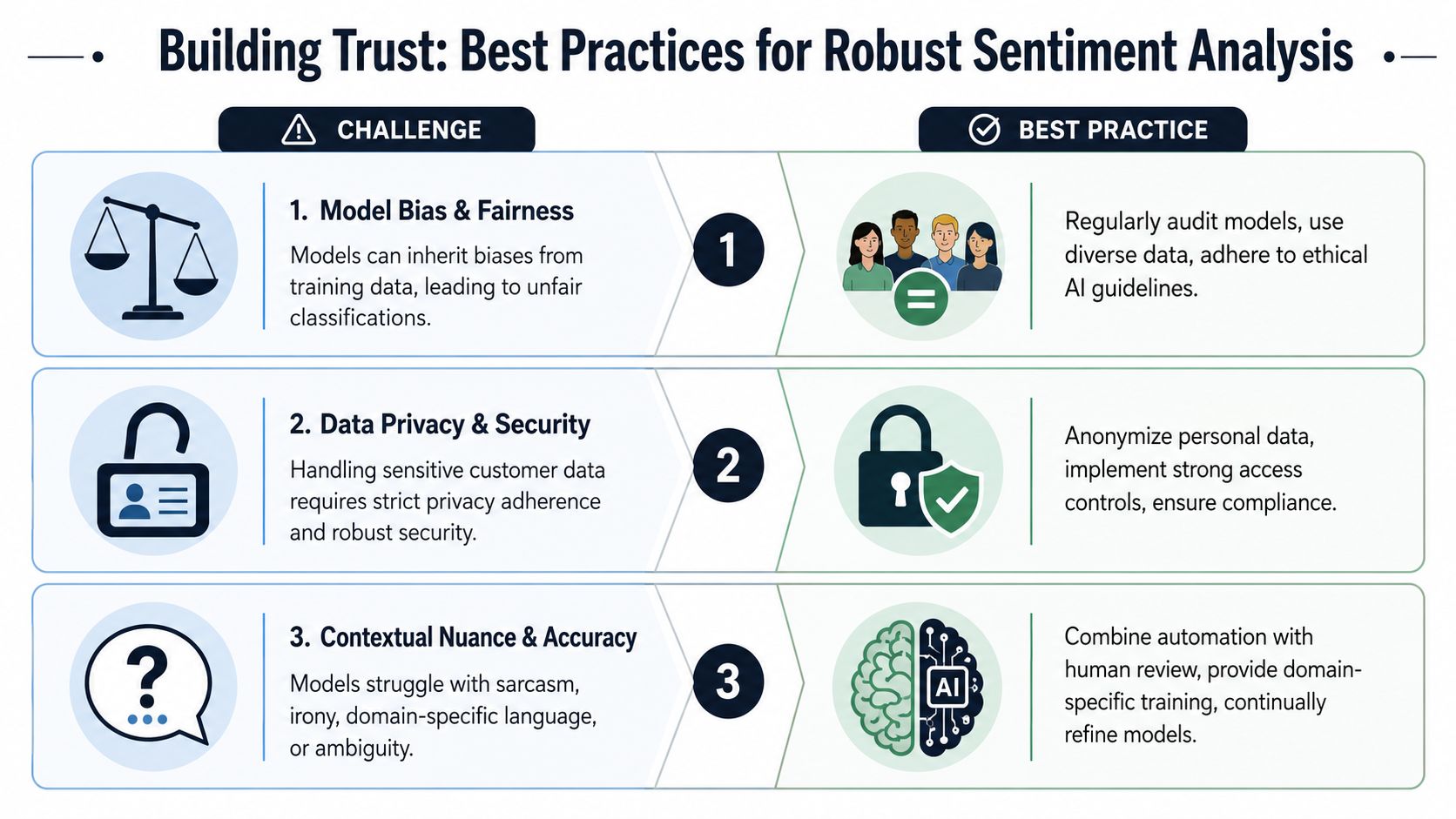
Sentiment systems can inherit bias from training data. They can overreact to certain language patterns, underperform on domain-specific phrasing, or misread customers whose tone doesn't fit the dominant examples in the training set.
Privacy is just as important. Support tickets, CRM notes, and call transcripts often contain sensitive customer and employee information. If your team can't explain who has access, how data is protected, and whether customer data is used to retrain models, adoption will stall for good reason.
A few guardrails are essential:
- Minimize sensitive exposure by anonymizing fields that aren't needed for analysis.
- Limit access by role so broad transcript access doesn't become the default.
- Audit classification drift when the product, market, or support language changes.
- Document model behavior so stakeholders know what the system can and can't do.
Accuracy needs the right target
Many teams ask the wrong question: “Is the model accurate?”
Accurate for what?
A model can be good enough for triage and still not be good enough for executive reporting. It can be useful for detecting broad frustration trends while still needing human review on nuanced enterprise calls. Don't hold every workflow to the same threshold.
The more useful questions are:
- Where does the model perform reliably?
- Which message types generate false confidence?
- What decisions are safe to automate, and which require review?
Working rule: Automate detection first. Automate judgment later, if ever.
Human review is not a fallback
It's part of the design.
Practitioner guidance from Helply's B2B SaaS customer sentiment analysis article is clear on this point: real customer conversations often contain mixed or ambiguous sentiment, including sarcasm, and hybrid workflows with automated classification plus human review work better for flagged edge cases.
That aligns with how strong teams operate. They let the model do the broad reading across thousands of interactions, then route edge cases to people who understand customer history, product nuance, and commercial stakes.
Where humans should stay in the loop
Human review is especially important for:
- Sarcasm and indirect language
- Multi-intent conversations where a customer praises one area and threatens to churn over another
- Strategic accounts where one misread interaction can distort a major decision
- Taxonomy refinement when new product areas or issue categories emerge
The goal isn't to replace analysts, support ops, or product ops. It's to stop wasting their time on the easy reads so they can focus on ambiguous, high-stakes interpretation.
Implementing Sentiment Analysis and Measuring ROI
Don't start with every channel, every team, and a giant dashboard initiative. Start with one high-value workflow where customer language and revenue risk already intersect.
For many SaaS companies, that's support tickets. The data is available, the pain is current, and the downstream actions are obvious. Sales call transcripts can be another strong starting point if your company is trying to understand deal risk, objections, or expansion demand.
A rollout that avoids the usual mess
A practical implementation path looks like this:
- Pick one source with clear ownership. Support is often easiest because ticket routing and issue management already exist.
- Define a limited taxonomy. Don't launch with dozens of categories. Start with a manageable set of product areas and issue types.
- Connect sentiment to business fields. Add segment, plan, renewal timing, and account value before you build polished reports.
- Create one response path. Negative sentiment without a workflow is dead output. Decide who acts on what.
- Review false positives weekly. Early calibration matters more than dashboard aesthetics.
Measure ROI where finance and product both care
The strongest business case comes from showing that the program changed decisions and outcomes, not just visibility.
Track questions like:
- Are high-risk accounts being identified earlier?
- Did the team reprioritize fixes based on clustered sentiment plus account value?
- Are customer success managers intervening sooner on renewal risk?
- Are product teams spending less time sorting anecdotal feedback by hand?
- Did expansion signals become easier to spot in customer language?
ROI usually shows up in three places: retention, better resource allocation, and faster identification of revenue opportunities. You don't need a grand transformation story on day one. You need evidence that a previously hidden pattern led to a better action.
If you need a starting point for tooling and workflow design, SigOS's customer feedback analysis tool guide is a practical reference for getting from raw feedback files to structured issue and sentiment analysis.
Customer sentiment analysis becomes valuable when it stops being a reporting layer and starts acting like revenue intelligence. That's the standard to hold it to.
If your team is sitting on tickets, chats, call transcripts, and product signals but still struggling to connect feedback to churn and expansion, SigOS is built for that problem. It helps product and growth teams identify which issues are tied to real revenue risk, cluster feedback into actionable themes, and prioritize work based on business impact rather than whoever shouts loudest.
Keep Reading
More insights from our blog
Ready to find your hidden revenue leaks?
Start analyzing your customer feedback and discover insights that drive revenue.
Start Free Trial →