Data Privacy Compliance: A Practical Guide for SaaS Teams
Learn what data privacy compliance means, the regulations you must follow, and a practical playbook for SaaS product and growth teams to stay compliant in 2026.

The privacy review usually starts too late. A product manager ships a new survey, a support lead adds a fresh tagging field, or a vendor changes a data flow, and the first real question comes from a customer asking for deletion, access, or proof that the data was handled correctly. At that point, data privacy compliance stops being legal wallpaper and becomes an operational problem across product, growth, support, analytics, and engineering.
That's the practical reality for most SaaS teams. The hard part isn't knowing that privacy matters, it's deciding which controls must be global by default and which need to be localized by market without breaking product velocity. The teams that handle this well treat privacy as a design constraint, not a quarterly cleanup task.
The Moment Privacy Compliance Becomes a Product Problem
A common failure pattern shows up the same way in different companies. A customer success manager exports a support transcript into a spreadsheet, a growth marketer connects a new campaign tool, or legal asks for a deletion workflow and engineering discovers that personal data is scattered across half a dozen systems with no clean way to trace it. By then, the problem is no longer theoretical, it's a production gap that affects how the company answers customers and regulators.
The bigger shift is that privacy work doesn't sit in one department. It touches what product chooses to collect, what analytics stores, what support can see, what sales forwards to prospects, and what engineers can re-identify later. That's why teams that treat it as an annual review usually end up with mismatched defaults, stale vendor lists, and deletion requests that require manual heroics.
Practical rule: if a feature creates, moves, or enriches personal data, privacy is part of the feature, not a post-launch audit item.
The regulatory backdrop makes that operational view unavoidable. By 2025, 172 countries had data protection laws, representing 79% of all nations worldwide, and 20 U.S. states had privacy laws in force by January 2026, which means most SaaS products are already operating inside a multi-jurisdiction map, even before you think about enterprise contracts or sector rules. In other words, the question isn't whether you need a program. It's whether your product can execute one.
If you're a product, growth, or customer success leader, the useful outcome from this guide is simple. You should be able to look at a roadmap item, a dashboard, or a support workflow and say which privacy controls are essential, which ones vary by market, and what evidence you need when a customer asks for proof.
What Data Privacy Compliance Actually Means
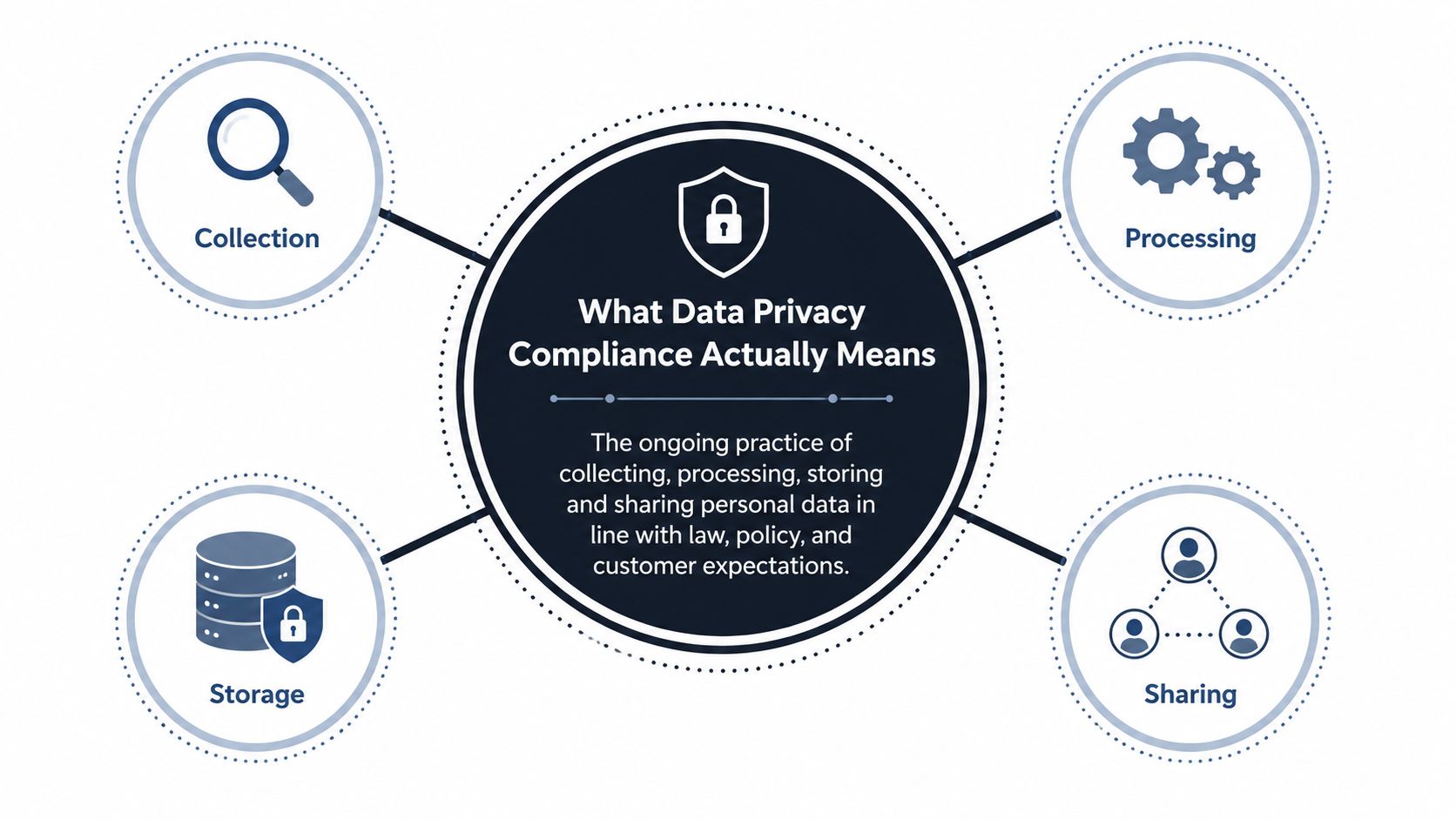
Data privacy compliance is the ongoing practice of collecting, processing, storing, and sharing personal data in line with law, internal policy, and customer expectations. That definition matters because it's broader than “don't leak data.” It includes the reasons you collect data in the first place, how long you keep it, who can see it, and whether the same data gets reused for a different purpose later.
The easiest way to explain it to a non-legal colleague is this, privacy decides what you may do with data, security decides how well you protect it. You need both, but they solve different problems. A system can be strongly encrypted and still fail privacy expectations if it collects data it doesn't need or repurposes it without a lawful basis.
The principles that show up everywhere
A good mental model is a hotel. The front desk needs a guest register to run the stay, but that doesn't mean the hotel can sell the list to advertisers or keep it forever once the stay is over. That's the tension at the heart of privacy compliance, the data is useful for a defined purpose, and the purpose sets the boundary.
The core principles are consistent across modern regimes:
- Lawfulness and transparency. Tell people what you're doing and have a valid basis for doing it.
- Purpose limitation. Use the data for the reason you said you'd use it.
- Data minimization. Collect only what you need.
- Accuracy. Keep records current enough to avoid bad decisions.
- Storage limitation. Don't keep personal data forever.
- Integrity and confidentiality. Protect the data from improper access or use.
- Accountability. Be able to prove the above with records and controls.
That last point is where many teams stumble. A policy that lives in a folder isn't accountability. Accountability means product decisions, system behavior, and vendor contracts all point in the same direction.
Privacy compliance also now spans almost every market a SaaS company might enter. By 2025, 172 countries had data protection laws, representing 79% of all nations worldwide, and one source reported privacy frameworks across 179 of 240 jurisdictions covering about 80% of the world's population. That spread matters because product defaults have to be defensible across regions, not just in the place where the company is headquartered.
The Major Regulations You Need to Map
SaaS teams don't need to memorize every article of every law. They need to know where the laws overlap, where they diverge, and which product settings can stay global. The overlapping controls are familiar, consent or notice for some processing, security safeguards, access and deletion rights, breach handling, and vendor governance. The differences show up in how each regime defines personal data, how it handles inferred data, and how much freedom you have to reuse operational telemetry.
A clean way to think about it is this, standardize the control, localize the rulebook. Your intake forms, access control model, logging architecture, and deletion workflows should usually be global. Your consent language, retention periods, and some market-specific disclosures may need to vary by jurisdiction.
| Obligation | GDPR | CCPA/CPRA + US states | India DPDP | LGPD |
|---|---|---|---|---|
| Notice and transparency | Required | Required | Required | Required |
| Consent or another lawful basis | Core concept | Often opt-out or notice-based, depending on use | Important for certain processing models | Required in several cases |
| Access and deletion requests | Expected | Expected | Expected | Expected |
| Security safeguards | Required | Required | Required | Required |
| Vendor and processor controls | Required | Required | Required | Required |
| Data minimization and retention limits | Strongly emphasized | Present in practice | Strongly emphasized | Strongly emphasized |
That table is useful only if it changes behavior. If a control can't be enforced consistently in product, it's not really a control, it's a document. The team should be able to point to one place where the rule is implemented and then describe the market-specific differences on top of it.
The most practical advice I give teams is to map by workflow, not by law. Track how marketing captures leads, how support stores transcripts, how product analytics ingests events, and how customer success exports reports. Once you map the workflow, the legal obligations become easier to assign because you're no longer talking about abstract categories.
For teams that need a breach-readiness reference while they map obligations, a useful starting point is how to handle a data breach, especially if you're comparing notification paths across jurisdictions. Use it as a process guide, not as a substitute for your own counsel or local requirements.
The key trade-off is simple. A broad global baseline keeps engineering sane. Excessive local branching, by contrast, creates data sprawl, inconsistent retention, and support teams that can't explain why one market behaves differently from another.
The Core Building Blocks of a Compliance Program
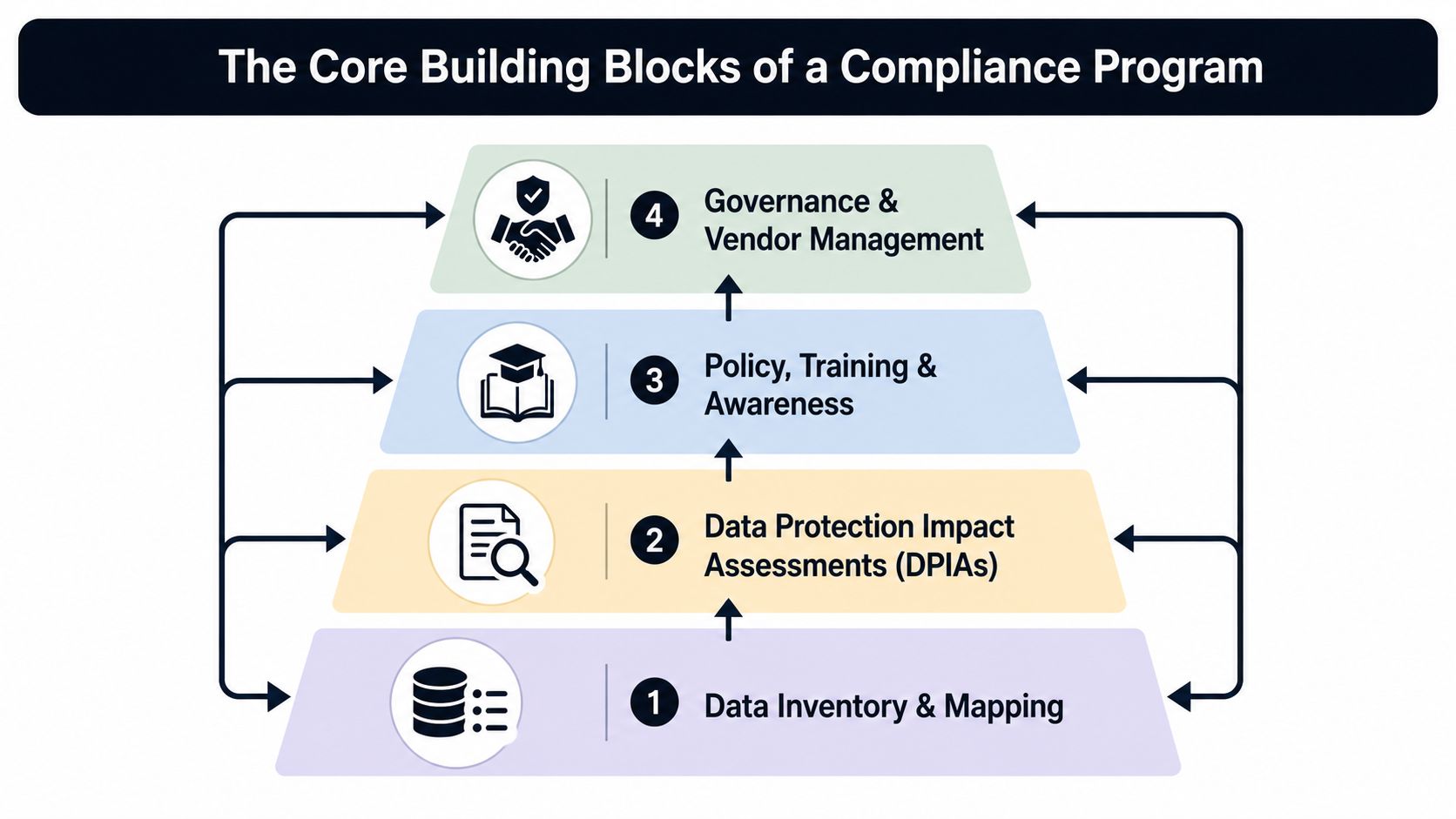
A real privacy program is load-bearing. If one piece is missing, the whole structure gets shakier, especially when a customer exercises rights or a vendor changes behavior. The building blocks are not separate projects, they're connected layers that keep data flows understandable and defensible.
Start with inventory, then make it enforceable
Data inventory and mapping come first because you can't govern what you can't see. Every serious program needs to know where personal data enters, where it moves, who can touch it, and which systems store re-linkable identifiers. If that sounds boring, that's because it is, until a DSAR lands or an auditor asks for evidence.
DPIAs and risk assessments are the next layer because they force a design conversation before launch. They're where product teams decide whether the feature can achieve the same outcome with less data, less retention, or narrower access. A good DPIA doesn't block shipping, it clarifies the conditions under which shipping is safe.
Operational insight: if your privacy review only happens after design freeze, it's already too late to change the data architecture cheaply.
Put control where the data actually lives
Access control and identity governance need to be precise. UK GDPR guidance says measures must ensure only authorized people can access, alter, disclose, or delete personal data, and systems must remain restorable after technical incidents, while India's DPDP implementation guidance gives teams a concrete logging benchmark of at least one year for system and processing logs. That combination points to the same operational need, centralize immutable audit logs, monitor privileged activity, and make sure backups and restores work.
Vendor management, incident response, and periodic audits complete the chain. The vendor side matters because one unreviewed tool can expand your data surface. Incident response matters because privacy obligations don't pause during an outage. Audits matter because controls drift when the business moves faster than the documentation.
If you're trying to visualize the plumbing, a good internal reference is data architecture diagrams. The point isn't the diagram itself, it's forcing the team to agree on where the data lives, who owns it, and which systems are allowed to re-use it.
The operational failure mode is usually the same. Teams keep each element in a separate spreadsheet, separate tool, or separate meeting cadence. The compliant teams connect them into one system, so inventory informs access, access informs logging, logging informs incident response, and vendor decisions feed back into the map.
Embedding Privacy by Design in Product and Growth Workflows
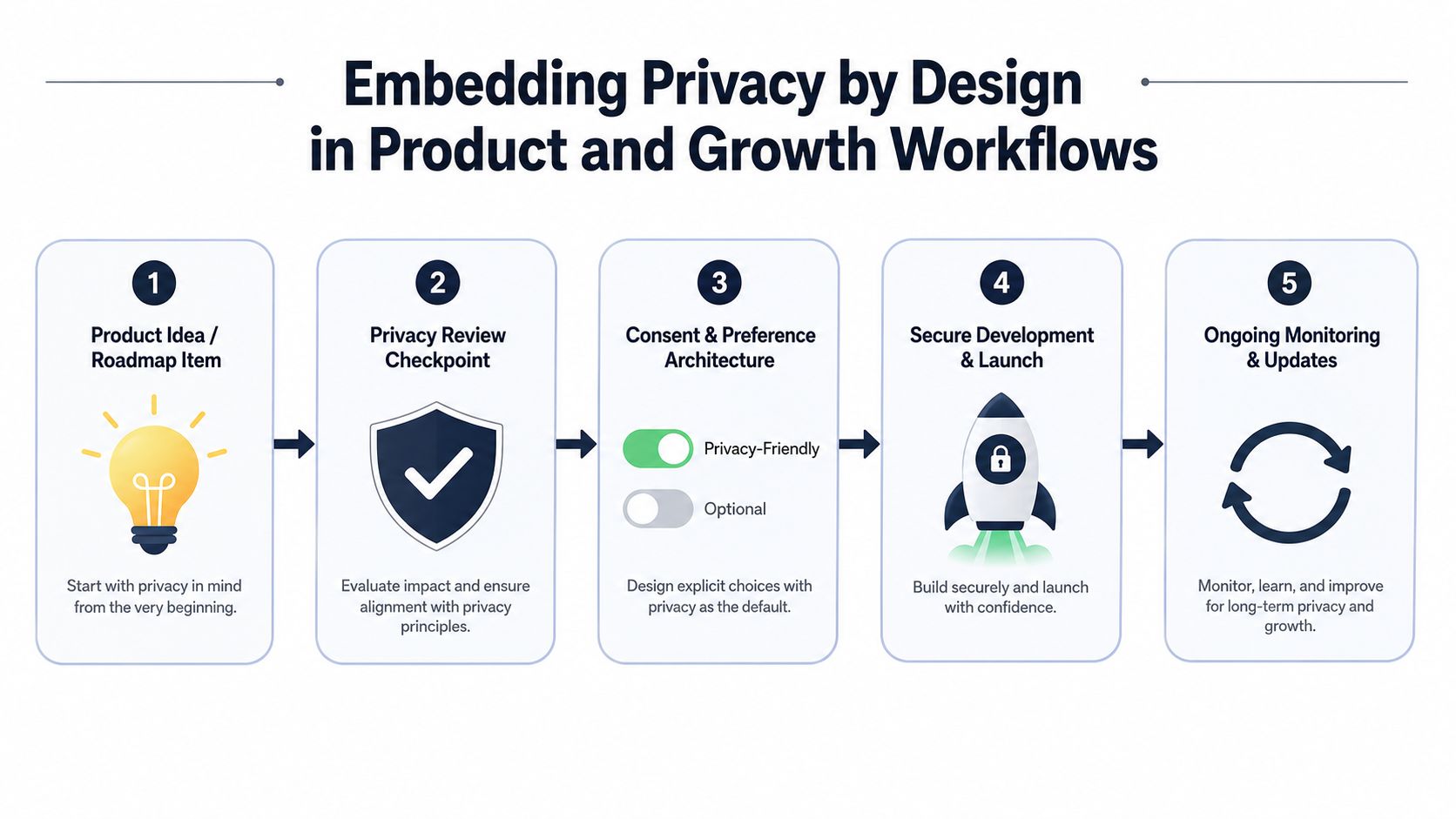
Privacy by design only works when it changes day-to-day product behavior. That means every roadmap item gets a privacy checkpoint, every new data use gets a documented purpose, and every team knows which defaults are strictest across the markets you serve. If you wait until launch review, you end up redesigning event schemas, consent logic, and deletion logic under pressure.
The best pattern is to treat privacy like product requirements. A PM should be able to state the data needed for the feature, the lawful basis or other justification, the retention period, and the deletion path before engineering starts. That keeps the discussion concrete and prevents the familiar “we'll clean it up later” trap.
The habits that survive real shipping pressure
Privacy-by-design guidance requires systems to embed measures such as pseudonymization and minimization across the product lifecycle, and personal data should be erased once the original purpose is exhausted rather than retained indefinitely, as described in GDPR Article 25 guidance on privacy by design. That changes how you build consent and preference architecture too. The safe default is the strictest applicable market, then loosen only where you've explicitly verified the local rule allows it.
A useful checklist for product and growth teams looks like this:
- Privacy review on every roadmap item. No feature ships without a data purpose, retention rule, and deletion path.
- Consent and preference defaults. Start with the most restrictive setting that still supports the product outcome.
- DSAR and erasure flows. Build them so support can use them without filing an engineering ticket.
- Telemetry gating. Prevent new event types from leaking identifiers into analytics unless they're approved.
- Vendor terms that match the product. Don't let contracts promise one thing while integrations do another.
A small example shows why this matters. If you add a CSAT survey to checkout, product usually sees a quick feedback loop. Privacy sees a new collection point, a new retention decision, and potentially a new vendor, which means the survey design has to answer whether the response is tied to an order, whether it's needed for service improvement, and how fast it should be deleted.
If you need a tighter way to write those requirements, how to write a PRD is a useful internal framing document. The best PRDs I've seen make privacy explicit enough that engineering doesn't have to guess.
The teams that get this right don't treat privacy as friction. They turn it into a release habit, one that protects both the customer and the product roadmap.
AI Telemetry, Product Intelligence and Privacy Compliance
AI-driven product intelligence can absolutely fit inside a privacy program, but only if the controls are designed into the pipeline. The hard question isn't whether telemetry is useful. It's whether the system can prove that the same data isn't being reused beyond the original purpose, especially when product analytics, churn prediction, and support automation all touch the same event stream.
That's where field-level classification matters. If the ingestion layer can identify names, emails, ticket text, and account identifiers before analysis, then the platform can tokenize or strip what it doesn't need and keep the rest bounded by purpose. Retention should follow the underlying customer record, not a generic analytics rule, and inferred signals should be deleted when their business purpose ends.
Practical rule: pseudonymized doesn't automatically mean non-personal. If a team can re-link the signal to a person or account, it still needs a governance story.
SigOS is a useful example of the kind of control an AI product intelligence platform should be able to articulate. Its security-first encryption and design note that models are never retrained on customer data, which is a concrete expression of purpose limitation and data minimization in an AI workflow, not just a privacy claim on a marketing page. That matters because retraining, if it isn't tightly governed, is exactly where product telemetry tends to drift into new purposes.
For teams evaluating vendors, govern AI workflows with NanoPIM is a relevant comparison point for how AI governance gets documented in practice. Use it to compare policy coverage, deletion handling, and how the vendor describes downstream reuse of customer data.
A good vendor review should ask a few direct questions. What gets classified at ingestion, what gets tokenized, what's retained, who can re-identify, and under what lawful basis the platform supports each downstream use. If the vendor can't answer those cleanly, the risk isn't just security, it's that your analytics stack becomes a shadow processing system.
For a product-specific view of AI use cases, AI for product development is worth pairing with your privacy review so the business value and the data path are discussed together. That's the standard I'd use before letting any AI telemetry tool sit between customer conversations and roadmap decisions.
Common Pitfalls and Early Warning Signs
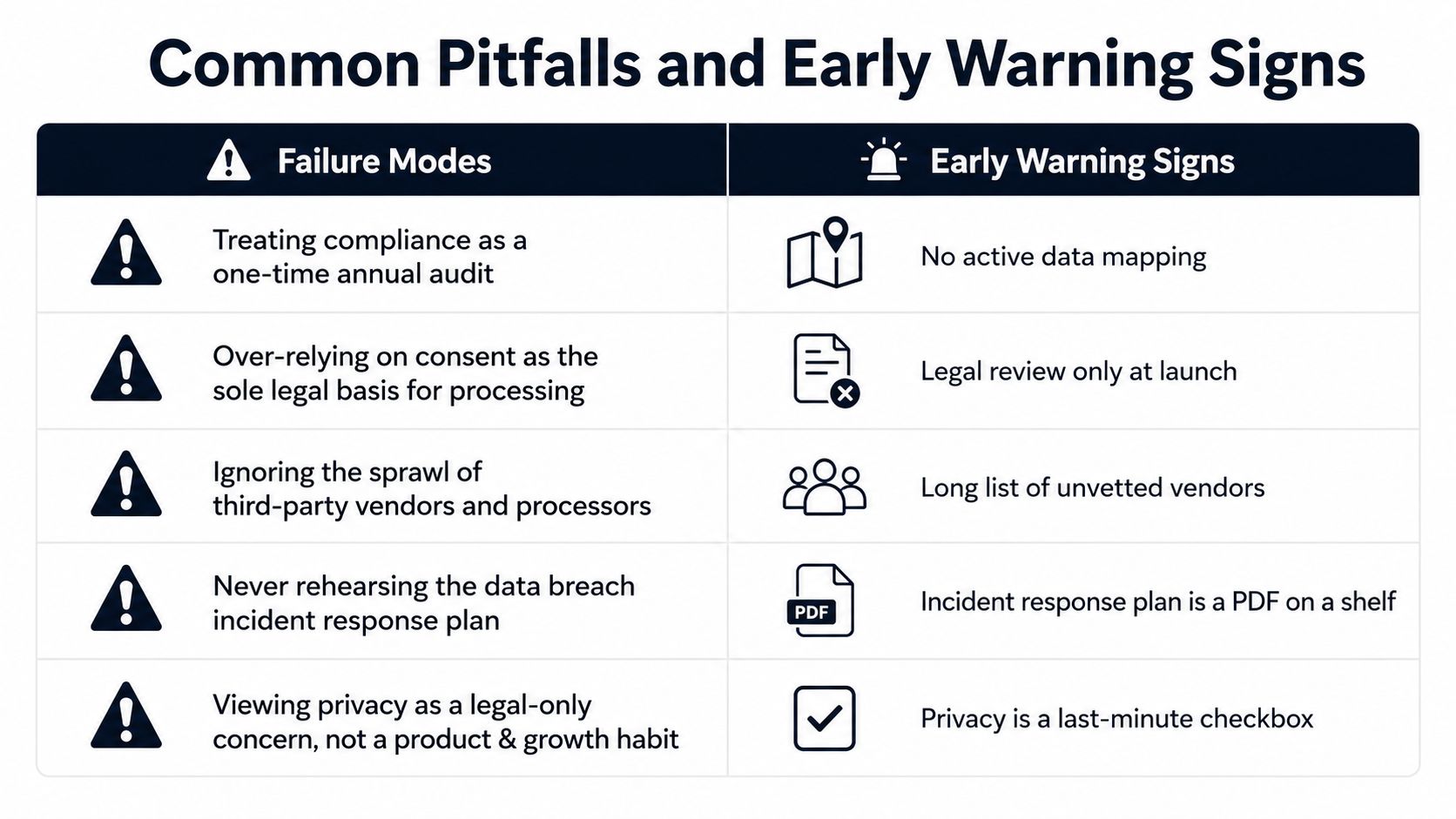
Most privacy programs don't fail in dramatic fashion. They fail through drift, one extra vendor here, one unreconciled dashboard there, one undocumented export that someone assumes is harmless. The warning signs show up in product and support workflows long before a regulator or enterprise buyer notices.
What to look for before the damage compounds
A few patterns keep repeating:
- Treating compliance as an annual audit. The warning sign is that nobody can show an updated data map, and launch reviews are the only privacy checkpoint.
- Over-relying on consent. The warning sign is that every lawful basis conversation turns into “just add a checkbox,” even when the use case isn't really optional.
- Ignoring vendor sprawl. The warning sign is a long list of tools that were never reviewed, especially in marketing and customer success.
- Never rehearsing incident response. The warning sign is a PDF plan that nobody has walked through in a real simulation.
- Treating privacy as a legal-only concern. The warning sign is that product and growth teams learn about privacy requirements after implementation decisions are already made.
The financial stakes are real enough to force discipline. Cumulative GDPR fines across Europe have passed €7.1 billion, with €1.2 billion issued in 2025 alone, according to the enforcement data linked earlier, which is a strong reminder that paperwork without operating controls is a bad bet. But the larger cost is usually internal. Teams waste time untangling systems they should have designed cleanly from the start.
A useful self-check is to open your analytics stack and ask who can see customer identifiers, which vendors have fresh approval, and whether support can execute an erasure request without engineering help. If the answer depends on one person's memory, the program is still fragile.
A Practical 90 Day Starter Plan
The fastest way to make progress is to stop trying to solve everything at once. A ninety-day plan works when it prioritizes the highest-risk data flows, then turns those flows into repeatable controls that the business can maintain.
Weeks 1 and 2 should focus on inventory and risk. Map the top three surfaces where personal data enters or spreads, usually product analytics, support tooling, and customer operations. Then identify the highest-risk fields, the highest-risk vendors, and the workflows most likely to break if a deletion request arrives.
Weeks 3 through 6 should fix the defaults. Tighten consent and preference architecture, gate telemetry so new event types don't leak identifiers by accident, and restrict access on sensitive systems to the people who need it. This is also where you standardize retention rules so they're enforced at the storage layer instead of being left to memory.
Weeks 7 through 10 should operationalize response and review. Build DSAR and erasure flows that support can run, rehearse breach response, and audit your vendor list against the data they can touch. UK GDPR guidance requires that only authorized people can access, alter, disclose, or delete personal data, and India's DPDP implementation guidance adds a concrete benchmark of retaining system and processing logs for at least one year, giving product teams two clear targets for the access-control and logging portion of the plan.
Weeks 11 and 12 should publish a simple internal policy and define the leading indicators that tell you whether the program is working:
- DSAR fulfillment time. Are requests getting resolved without ad hoc engineering work?
- Vendor coverage. Do current DPAs and reviews match the tools in use?
- Unmapped event types. Are new telemetry events showing up before they're approved?
- Rehearsed incident response time. Has the team practiced, or just read the plan?
The payoff is practical. Lower breach risk matters, but so does smoother enterprise sales and a cleaner story for customers who increasingly ask for privacy evidence during procurement. When product, growth, and engineering can show how data is collected, used, retained, and deleted, privacy stops being a blocker and starts becoming part of the product's credibility.
If you want product intelligence that respects privacy by design while still surfacing customer signals your team can act on, take a look at SigOS. It's built to help SaaS teams prioritize feedback, surface churn and expansion patterns, and keep analytics aligned with purpose limitation and data minimization.
Keep Reading
More insights from our blog

Ready to find your hidden revenue leaks?
Start analyzing your customer feedback and discover insights that drive revenue.
Start Free Trial →