Types of Feedback: A PM's Guide to Revenue Impact
SaaS PMs, learn types of feedback & a framework to collect, validate, and prioritize it by revenue impact.
Every SaaS team says it listens to customers. Many of these teams are collecting fragments.
Sales drops a Slack message about a prospect who “needs this feature to sign.” Support forwards a cluster of tickets that all sound urgent. Customer success flags an account that suddenly feels shaky. Product analytics show a step in the workflow where users stall, but nobody can explain why. The backlog grows, confidence drops, and roadmap meetings turn into a contest between the loudest anecdote and the newest chart.
That's the main problem behind most discussions of types of feedback. It isn't that teams lack categories. It's that they lack a way to connect feedback to business outcomes.
Beyond the Suggestion Box Overload
Most articles on types of feedback stop too early. They sort feedback by tone, source, or delivery style, then call the job done. That may help a manager run a better one-on-one, but it doesn't help a product team decide whether to fix onboarding friction, build a requested integration, or rework a broken workflow that's pushing accounts toward cancellation.
Research on workplace and 360-degree feedback shows the same pattern. Feedback is often categorized as evaluative, appreciative, coaching, or corrective, but that framing still leaves product and revenue teams with the hard question unanswered: what business risk does this signal predict? Cameron Conaway's analysis of feedback frameworks makes that gap clear. Effective feedback is useful when it is goal-referenced, tangible, and actionable.
Why lists of feedback types fall short
A feature request by itself is not a roadmap item.
A complaint by itself is not a churn signal.
A drop in survey sentiment by itself is not a reason to pivot a quarter of engineering capacity.
Teams get into trouble when they treat every piece of feedback as equal. It isn't. Some feedback reveals a minor annoyance. Some reveals a blocked activation path. Some points to an expansion opportunity. Some is just noise wearing the costume of urgency.
Practical rule: If a feedback system can't help you answer “What revenue, churn, or expansion risk does this predict?”, it's still a suggestion box.
That's why the useful shift isn't from “collect less feedback” to “collect more feedback.” It's from listening to translating.
The operating question that changes prioritization
Strong teams don't ask only, “What are customers saying?”
They ask:
- Who is saying it? A trial user, power user, admin, champion, or detractor.
- Where did it show up? Survey, support queue, sales call, product analytics, review site.
- What behavior supports it? Drop-off, repeat workaround, failed task, reduced usage, stalled adoption.
- What account exposure sits behind it? Renewal risk, expansion path, deal friction, support cost.
Once you start working this way, feedback stops being a pile of disconnected inputs. It becomes a set of signals with uneven economic value.
That's the difference between a backlog shaped by anecdotes and a roadmap shaped by evidence.
The Signal Spectrum Direct Indirect and Inferred
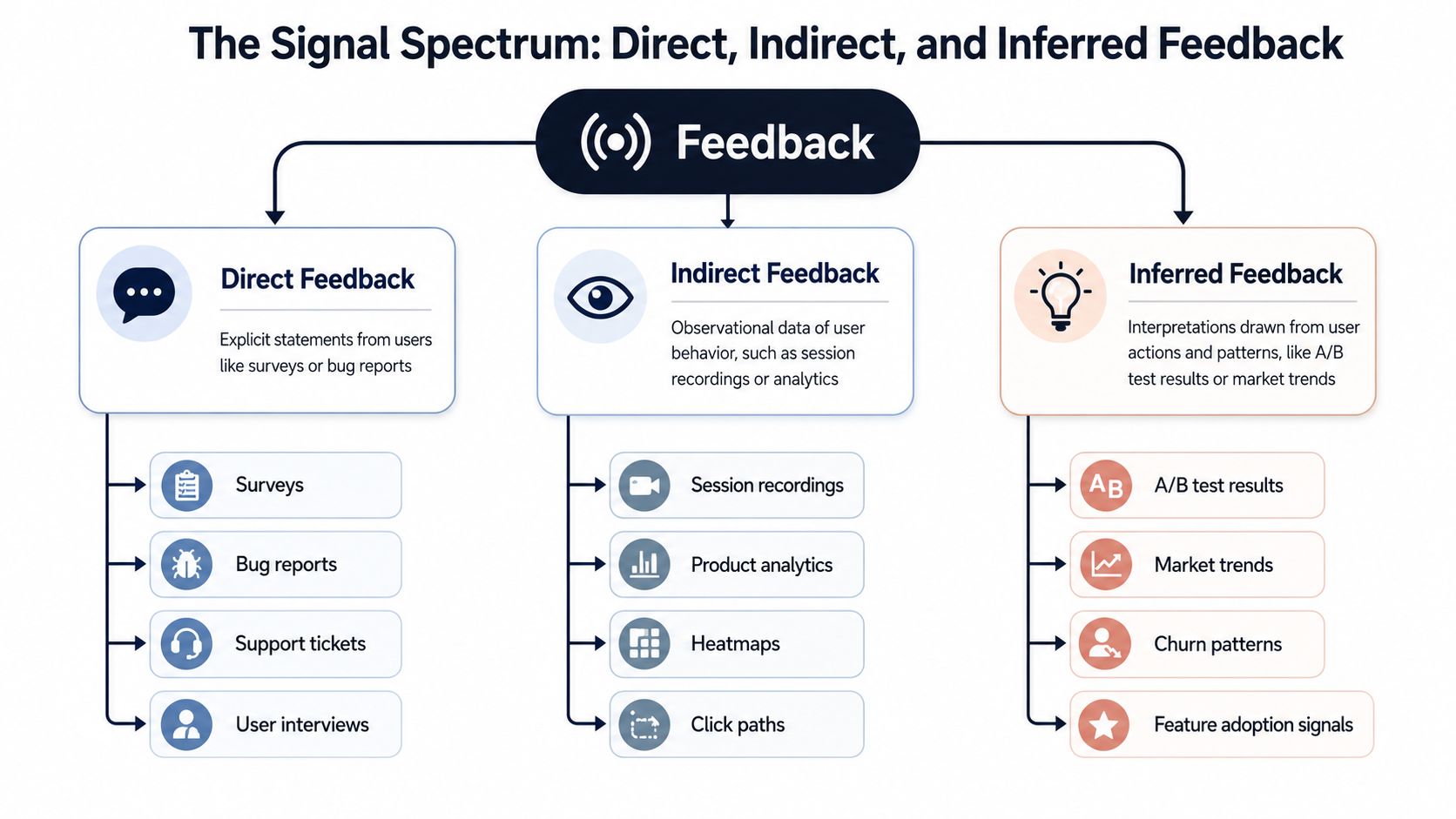
The cleanest way to think about types of feedback is as a signal spectrum. Start with source, then look at format.
Three signal families
Direct feedback is explicit. The customer tells you something in a survey, review, interview, or formal complaint.
Indirect feedback comes from interactions around the product. Support tickets, social posts, and success conversations often reveal pain points without following a neat research script.
Inferred feedback comes from behavior. Heatmaps, session replays, usage patterns, and drop-off data show what users do, even when they never explain it.
That separation matters because each stream answers a different question. This breakdown of customer feedback analysis methods puts it well: direct and indirect feedback often capture why users acted, while inferred feedback captures what they did.
Structured and unstructured matter too
The second lens is format.
Structured feedback is easy to sort and compare. Think ratings, form fields, categorical tags, and closed-ended responses.
Unstructured feedback carries nuance but needs work. That includes ticket text, call transcripts, interview notes, reviews, and open comments. Teams usually turn that into usable signal through sentiment scoring, thematic coding, and frequency analysis.
A useful mental model is clinical diagnosis.
- Direct feedback is the patient describing symptoms.
- Indirect feedback is the clinician noticing observable context.
- Inferred feedback is the lab result or scan.
No competent doctor would rely on only one of those. Product teams shouldn't either.
A customer saying “the setup is confusing” matters. A session replay showing repeated backtracking matters. Seeing both in the same segment is where prioritization gets sharp.
Why combination beats purity
Single-source systems create false confidence.
If you rely only on surveys, you'll overvalue articulate respondents. If you rely only on support tickets, you'll overweight acute pain from vocal users. If you rely only on analytics, you'll see friction without understanding motivation.
The job is not to pick the best feedback type. The job is to combine the right ones.
A strong feedback system usually does three things at once:
- Captures stated intent through direct input.
- Observes operational friction through indirect channels.
- Measures actual behavior through inferred signals.
That's the point where “types of feedback” become operational, not academic.
Decoding Your Key Feedback Channels
The raw materials are often already present. The issue is that channels are treated as silos instead of a portfolio of signal types.
A support team sees ticket volume. Sales sees objection notes. Product sees dashboards. Success hears risk in renewal calls. Marketing catches public reviews. Each function thinks it owns “customer feedback,” and nobody combines the views.
That fragmentation is expensive because customer feedback is incomplete. Medallia's overview of direct, indirect, structured, and unstructured feedback notes that only 1 in 26 customers will tell a business about a negative experience. What reaches your systems is only a partial and biased sample.
Feedback Channel Signal Guide
| Feedback Channel | Signal Type | Primary Use Case | Key Question Answered |
|---|---|---|---|
| NPS or CSAT responses | Direct, structured with unstructured comments | Measure sentiment and identify common reasons behind it | How do customers say they feel? |
| Support tickets | Indirect, mostly unstructured | Spot repeated pain, bug clusters, usability breakdowns | What is hurting active users right now? |
| Feature request boards | Direct, unstructured or lightly structured | Track stated demand and recurring requests | What do users think they need? |
| Sales call notes | Indirect, unstructured | Understand deal blockers and missing capabilities | What is stopping a purchase? |
| Churn interviews or cancellation forms | Direct, structured and unstructured | Diagnose exit reasons and patterns by segment | Why are customers leaving? |
| Social mentions and reviews | Indirect, unstructured | Catch public sentiment and unmanaged reputation issues | What do users say when you are not in the room? |
| Product analytics | Inferred, structured | Detect drop-off, adoption gaps, and workflow friction | Where does behavior suggest a problem? |
| Session replays or heatmaps | Inferred, unstructured observational data | Validate task confusion and UI friction | What are users trying to do but failing to complete? |
What each channel gets wrong
Every channel has a bias. Mature teams plan around that instead of pretending objectivity.
- Surveys favor the responsive minority. They're useful for controlled measurement, but they can flatten complex problems into neat scores.
- Support tickets overrepresent urgent pain. They're excellent for severity detection, weak for silent frustration.
- Sales notes distort toward pre-sale priorities. Prospects describe what they think they need to buy, not always what will create durable product value.
- Feature request boards reward repetition. A frequently requested item may still have low commercial value.
- Usage data misses intent. It shows hesitation, abandonment, and repetition, but not motivation.
That's why teams investing in enhancing business operations with data usually centralize collection before they centralize decision-making. You can't prioritize well if each team stores feedback in its own language and tool.
A better way to read the channels you already have
If you want a practical starting point, audit your current channels against four questions:
- Coverage: Which user moments does this channel see?
- Bias: Who is likely to appear here, and who is invisible?
- Economic link: Can this channel be tied to deals, renewals, expansion, or support cost?
- Validation path: What second source can confirm or challenge it?
For teams tightening their collection process, this practical guide on how to collect feedback from customers is a useful reference because it forces discipline around channel design rather than just volume.
When product leaders start seeing channels this way, the chaos becomes easier to manage. You stop asking, “Which feedback inbox should I trust?” and start asking, “What does this channel know, and what can it never know by itself?”
From Raw Input to Validated Insight
Categorizing feedback is only the first pass. The harder job is deciding whether a signal is credible enough to influence roadmap or retention work.
Many teams fail to prioritize effectively. They collect diligently, tag aggressively, and still prioritize badly because they don't distinguish between expressed opinion and validated insight.
Papershift's guidance on feedback quality makes the key point plainly: vague opinions, secondhand commentary, and input misaligned with agreed goals should be ignored or downgraded unless tied to concrete observations. It also stresses that effective feedback is specific, contextual, and dialogue-based.
Use triangulation, not intuition
A simple operating rule works well in practice:
- One signal is a report
- Two signals are a clue
- Three aligned signals are a pattern
If a sales rep says a prospect needs SSO, that is not yet market truth. It becomes stronger when you also see repeated enterprise objections and onboarding friction around access management. It becomes roadmap-grade when those patterns cluster in accounts that matter commercially.
A validation checklist that actually works
Run incoming feedback through this filter before it gets priority:
- SpecificityCan someone point to the exact workflow, screen, event, or outcome involved?
- ContextWhich segment is affected? New users, admins, enterprise buyers, inactive accounts, expansion candidates?
- Observed behaviorIs there evidence in usage, replay, support logs, or lifecycle events?
- RepeatabilityDoes the same issue appear across accounts, channels, or time periods?
- Business relevanceCan the problem plausibly affect retention, expansion, win rate, activation, or service cost?
Low-signal feedback often sounds confident but lacks an anchor. “Customers hate this” is weak. “Admins abandon setup after permissions mapping and then open tickets asking for manual workarounds” is useful.
Turning text into something decision-ready
Most valuable feedback arrives as messy language. Ticket text, Gong transcripts, interview notes, and survey comments need interpretation before anyone should prioritize them.
That's where a disciplined workflow matters:
- Code themes across open-text responses
- Group duplicate issues with shared language and context
- Separate symptom from root cause
- Map each theme to the user journey and account segment
If your team needs a working primer, this guide to qualitative data analysis is helpful for turning open-ended comments into themes you can compare consistently. Once your raw input is cleaned up, this customer feedback analysis workflow is a useful next step for converting those patterns into product decisions.
Validation is where feedback stops being democratic and starts becoming useful. Not every voice should carry the same weight. Evidence should.
Prioritizing Feedback with a Financial Lens
Roadmaps break when teams use request volume as the main ranking system.
The most requested item is not always the most valuable item. Sometimes a heavily requested feature matters to a small, noisy cohort. Sometimes a less visible workflow issue subtly damages activation, renewals, and support efficiency across important accounts.
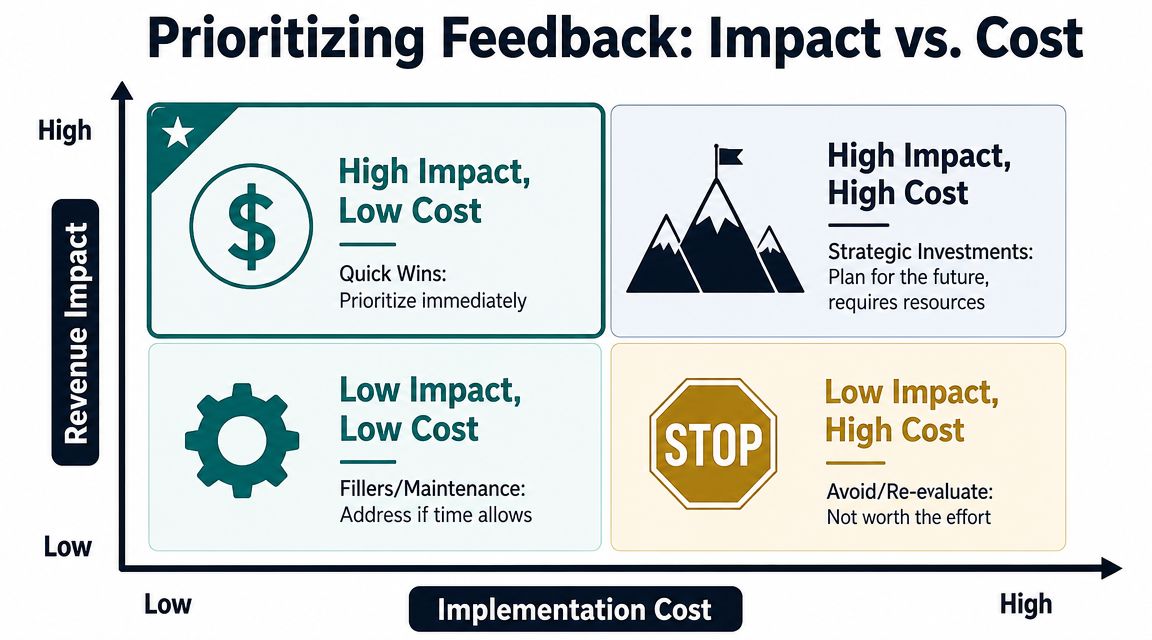
Financial prioritization fixes that by asking a better question: if we act on this signal, what business outcome are we likely to protect or improve?
Start with the right feedback cadence
Not all feedback supports the same kind of decision.
UXtweak's distinction between solicited, unsolicited, and continuous feedback is useful here because each one supports a different inference path:
- Solicited feedback works best for controlled measurement.
- Unsolicited feedback is richer for pain-point discovery.
- Continuous feedback is strongest for trend detection over time.
That matters because prioritization needs all three. Controlled input tells you whether sentiment is moving. Unsolicited input surfaces issues you didn't think to ask about. Continuous monitoring tells you whether a problem is episodic or systemic.
A practical scoring model for product teams
You don't need a complex finance model. You need a consistent one. A simple scoring approach works:
Reach
How many meaningful accounts or users does this issue touch?
Don't count raw mentions only. Count exposed segments. A problem affecting admins in your largest customer tier may matter more than a broad annoyance among free users.
Revenue impact
What kind of money is tied to this signal?
Use categories if exact dollars aren't available:
- Retention risk
- Expansion enablement
- New business blocker
- Support cost reduction
A bug tied to renewal risk should score differently from a cosmetic request. A requested integration tied to live deals should score differently from a “nice to have” workflow tweak.
Confidence
How strong is the evidence?
Raise confidence when multiple signal types agree. Lower it when the input is anecdotal, secondhand, or hard to reproduce.
Effort
What will implementation actually cost in engineering, design, QA, migration risk, and opportunity cost?
Cheap work with high impact usually moves first. Expensive work with strategic importance needs explicit sponsorship.
What good prioritization sounds like
Weak roadmap argument:
- “Several customers asked for this.”
Stronger roadmap argument:
- “This issue appears in support, sales objections, and usage drop-off among high-value admin workflows.”
Best roadmap argument:
- “This problem affects a commercially important segment, shows up across multiple feedback types, and has a clear path to reducing churn or achieving expansion.”
For teams that need a reusable framework, this feature prioritization matrix is a practical way to structure the decision instead of debating each item from scratch.
Build a scorecard that stakeholders respect
A useful scorecard often includes:
| Dimension | What to capture |
|---|---|
| Signal source | Direct, indirect, inferred |
| Evidence quality | Anecdotal, triangulated, repeat pattern |
| Affected segment | Trial, SMB, mid-market, enterprise, admin, end user |
| Business risk | Churn, expansion, new business, support burden |
| Cost to solve | Low, medium, high |
| Recommended action | Fix now, research further, defer, reject |
This is also the point where tooling matters. Teams can do this in Airtable, Linear, Jira, Notion, or a warehouse-backed workflow. Some teams also use platforms such as SigOS to ingest support tickets, sales calls, chat logs, and usage data into one view so feedback patterns can be ranked by revenue and churn exposure rather than by whoever escalated them most recently.
That shift changes stakeholder conversations. Product is no longer defending opinions. Product is presenting a business case.
Building Your Continuous Feedback Engine
A good feedback review meeting is useful. A continuous feedback engine is harder to replace.
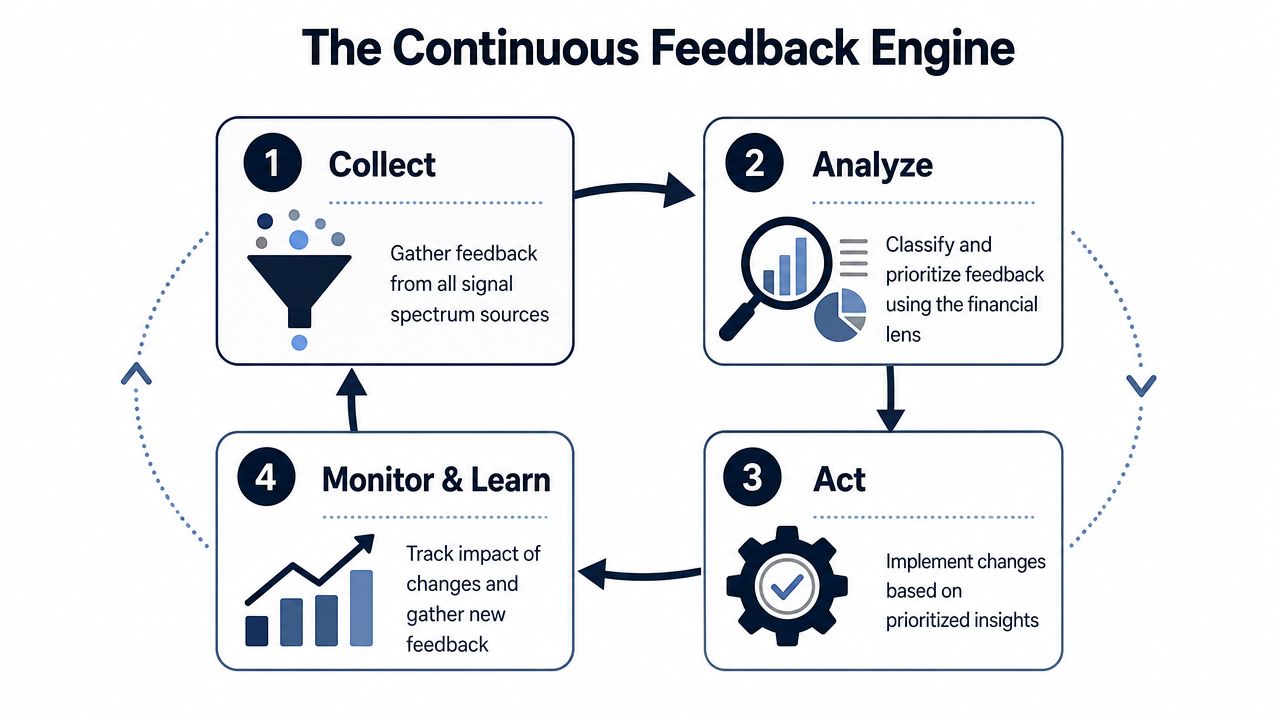
The difference is operational rhythm. Strong teams don't wait for quarterly synthesis to notice churn signals, adoption failures, or deal blockers. They create a loop that keeps collecting, validating, acting, and learning.
What the engine needs to include
A working system usually has four layers.
Collection
Pull from all major signal sources, not just the channels product owns directly.
That includes support systems like Zendesk and Intercom, sales call transcripts, CRM notes, survey tools, review sites, and product telemetry. If one team has to manually forward “important” feedback to another, the system is already leaking.
Analysis
Classify by signal type, segment, theme, severity, and economic relevance.
Teams separate duplicate requests from distinct problems, and they map themes to retention, expansion, or acquisition outcomes.
Action
Route validated issues into execution tools with enough context to matter.
A Jira ticket that says “customers confused” is useless. A ticket that includes segment, workflow, observed behavior, repeated quotes, and account exposure is actionable.
Monitoring and learning
Measure what changed after release.
Did support contacts drop for that issue? Did activation improve in the affected journey? Did the sales objection rate change? Did at-risk accounts stabilize? Without this loop, teams collect feedback but never improve their judgment.
The feedback engine isn't complete when you ship the fix. It's complete when you confirm whether the fix changed customer behavior or business risk.
Cross-functional habits matter more than dashboards
The best systems are not owned by product alone.
Support should tag operational pain in a way product can reuse. Sales should log objections in a consistent format. Success should document renewal risk with concrete examples, not only sentiment. Revenue teams that already invest in sales coaching to drive revenue usually adapt faster here because they are already used to turning messy call input into repeatable patterns and actions.
The operating habits are straightforward:
- Use one shared taxonomy for themes and segments.
- Require evidence with escalations so low-signal opinions don't flood planning.
- Review patterns on a cadence instead of reacting only to escalations.
- Close the loop with customers when feedback leads to meaningful change.
That last step matters more than many teams admit. Closing the loop improves trust internally and externally. It also sharpens future input because customers learn that specificity gets action.
If your team is still juggling support tickets, survey comments, sales notes, and product data in separate places, SigOS gives you a way to unify those feedback types into one product intelligence workflow. It helps teams identify which patterns are tied to churn risk, expansion potential, and revenue impact so prioritization can move beyond anecdote.
Keep Reading
More insights from our blog
Ready to find your hidden revenue leaks?
Start analyzing your customer feedback and discover insights that drive revenue.
Start Free Trial →