Unlock SaaS Growth with Market Research Panels
Market research panels offer actionable insights for SaaS growth. Reduce churn and make smarter decisions with powerful panel data.

It feels like we're drowning in data, yet getting straight answers about your product has never been more difficult. This is where market research panels come in—think of them as your secret weapon, a pre-vetted focus group you can access on-demand. For SaaS teams, they offer a direct line to specific, motivated audiences who are ready to help you validate your most critical assumptions.
Why Market Research Panels Are a SaaS Secret Weapon

If you’ve ever sent a survey to your entire customer list, you already know the pain of low response rates and the collective groan of "survey fatigue." You're not alone. Over the last ten years, average survey response rates have tanked, with many email surveys barely hitting a 10-30% completion rate. Market research panels offer a smarter way forward.
Instead of trying to build an audience from scratch every single time you need feedback, panels give you a ready-made pool of participants. These individuals are already recruited and deeply profiled, so you can skip the slow, frustrating work of cold outreach and get answers in days, not weeks.
Moving Beyond "What" to "Why"
Behavioral analytics platforms like SigOS are brilliant at showing you what your users are doing. You can easily spot where they drop off, which features they ignore, and which segments are about to churn. But this quantitative data almost always leaves you with the biggest question of all: Why?
This is where the real magic happens—when you pair product intelligence with insights from a market research panel.
A market research panel lets you take the behavioral patterns you see in your analytics and immediately ask the right people the right questions. It’s the bridge between user behavior and user intent, turning numbers on a dashboard into actionable stories.
Imagine your SigOS data reveals that users who ignore a new dashboard widget are 40% more likely to churn. Instead of just guessing what's wrong, you can launch a targeted survey to a panel of users who fit that exact profile.
You can ask them directly:
- Was the widget confusing to use?
- Did they not understand its value?
- Was it simply irrelevant to their job?
The Agile Advantage for SaaS Teams
In the world of software development, speed and confidence are everything. Burning a whole development cycle on a feature no one wants is an expensive mistake. Panels provide the rapid feedback loop needed to de-risk your product roadmap and build with conviction.
For product teams, this translates to tangible benefits:
- Faster Validation: Test new feature concepts, pricing ideas, or UI mockups in a matter of days.
- Higher Confidence: Base your roadmap decisions on direct feedback from your target audience, not just internal speculation.
- Reduced Risk: Kill bad ideas before they consume resources and double down on the solutions customers confirm they'll pay for.
By connecting the "what" from your behavioral data with the "why" from panel insights, you create a powerful cycle of continuous improvement. You stop making educated guesses and start making decisions backed by real-world evidence. While panels are a potent tool on their own, understanding broader market research strategies gives your team a more complete toolkit, ensuring your product roadmap is a strategic plan for growth, not just a list of features.
Choosing the Right Type of Research Panel
So, you need answers. You've got a burning question about your product, your market, or your customers, and you know you need to talk to real people. That’s where a research panel comes in. But picking the right one can feel like a minefield.
It’s crucial to understand that not all panels are the same. The one you choose will fundamentally shape the answers you get. Think of it this way: asking your loyal customers about a new feature is completely different from asking your competitor's users why they didn't choose you. Let's dig into the three main flavors of research panels so you can find the right fit for your questions.
Proprietary Panels: Your Private Community
Imagine having your own dedicated group of customers and prospects, ready to give you feedback on a moment's notice. That’s a proprietary panel. It’s a community you build and nurture yourself, creating an incredible asset for your business.
Think of it as your own personal advisory board. These panels are fantastic for:
- Following users over time: Want to see how a new feature lands with your power users over six months? A proprietary panel is perfect for this kind of longitudinal tracking.
- Getting deep, contextual feedback: These are your people. They already know your brand and your product, so their feedback is grounded in real-world experience.
- Rapid-fire iteration: You can quickly show them mockups, test new copy, and get feedback on prototypes, dramatically speeding up your development cycle.
The beauty is the relevance. The insights are coming from the very people you’re trying to serve. The catch? It takes real effort. You have to invest time and resources into recruiting, managing, and keeping your panel members engaged and happy. It's a commitment.
Recruited Panels: Accessing Niche Audiences
What if your question is about a market you haven't even entered yet? Or you need to talk to a very specific, hard-to-find group of people? This is where recruited panels shine. These are run by specialized firms that have done the legwork to build massive databases of people from all walks of life.
This is your go-to when you need to reach outside your own bubble. For example, if you need to survey “neurosurgeons who use a specific type of medical device” or “CFOs at Fortune 500 companies,” a recruited panel is often the only way to find them. They're built for precision targeting.
The huge plus here is access. These vendors can connect you with almost anyone, from architects and IT managers to farmers and frequent flyers. The trade-off is cost. You’re paying for their expertise and their network, and prices are typically set on a "per-complete" basis, meaning you pay for each qualified person who finishes your survey.
Online/DIY Panels: Speed and Affordability
Sometimes, you just need a quick answer. You don't need a perfectly representative sample of a niche B2B audience; you just need a directional gut check, and you need it now. Welcome to the world of Online/DIY (Do-It-Yourself) panels.
These platforms are built for speed and simplicity. They offer self-service access to large pools of general population respondents. This is the perfect tool when you need to:
- Test a few different headlines for a landing page.
- See which of three logo concepts resonates most.
- Quickly settle a heated internal debate with a dose of outside opinion.
You can often get hundreds of responses in less than 48 hours for a relatively low cost. The limitation is the targeting. While you can usually filter by basic demographics, you won't get the highly specific profiles available through a specialized recruited panel. It’s a trade-off between speed and specificity.
To make the choice a little clearer, let’s compare these three panel types side-by-side.
Choosing Your Panel Type: Proprietary vs. Recruited vs. DIY
This table compares the three main types of market research panels to help you decide which is best suited for your research objectives, budget, and timeline.
| Panel Type | Best For | Pros | Cons |
|---|---|---|---|
| Proprietary Panel | Continuous feedback from your own users and longitudinal studies. | High relevance, deep context, strong relationships. | High effort to build and maintain, risk of bias. |
| Recruited Panel | Reaching niche B2B audiences and competitor customers. | Unmatched access to specific profiles, high-quality vetting. | Higher cost, less brand context among participants. |
| Online/DIY Panel | Quick pulse checks, fast turnaround, and general population surveys. | Speed, affordability, ease of use through self-service platforms. | Limited targeting for niche audiences, less depth. |
Ultimately, there's no single "best" panel—only the one that’s best for the job at hand. In fact, many savvy product teams use a hybrid strategy. They rely on their proprietary panel for the day-to-day work of iterative design and turn to recruited or DIY panels when they need to look beyond their own walls for a fresh perspective or a quick read on the market.
How Panels Ensure High-Quality Data

When you're making big decisions about your product, you have to be able to trust your data. A top-tier market research panel isn’t just a glorified email list; it’s a living, breathing community built on a foundation of rigorous quality control. This process begins long before you even think about launching a survey.
Think of it like being a scout for a professional sports team. You wouldn’t just sign anyone who says they can play. You’d vet their history, watch their game tape, and run them through drills. Panel providers do the same thing, using a smart mix of strategies to find and retain people who will give you thoughtful, honest answers.
Building and Maintaining a Healthy Panel
Everything starts with recruitment. Panel companies cast a wide net, pulling in participants from all corners of the internet to build a diverse and representative group.
You'll see them use a few common methods:
- Web Intercepts: Pop-ups on niche websites that invite users with specific interests or demographics to join.
- Partnerships: Working with online magazines, loyalty programs, or large communities to tap into their pre-vetted audiences.
- Referral Programs: Letting their best, most trusted panelists invite friends and colleagues, creating a network effect of quality.
But getting someone to sign up is just the beginning. The real work is in the upkeep. Panel providers are constantly monitoring how people respond, how often they participate, and whether their answers are consistent. This involves regularly “scrubbing” the panel—weeding out people who are unresponsive or provide junk data to keep the community and the insights fresh.
A well-maintained panel is a living asset. The goal is to cultivate a community of thoughtful participants, not just a database of email addresses. This commitment to quality is what separates a reliable panel from a simple list.
This hands-on management means that when you’re ready to field a study, you’re not just shouting into the void. You're tapping into a group of people who are ready and willing to give you the feedback you need. It’s this foundational work that prevents you from basing a critical roadmap decision on bad data. To dig deeper into this, check out our guide on navigating common data quality issues.
Filtering Out the Noise at the Source
Even with a great panel, you’re going to run into some less-than-perfect responses. You have people trying to game the system for incentives and others who are just mindlessly clicking through. That’s where automated and manual checks act as your first line of defense.
Reputable panel providers use a whole toolkit to spot and filter out bad responses on the fly. These systems are designed to catch the usual suspects:
- “Speeders”: People who finish a 10-minute survey in 90 seconds. Their responses are almost certainly useless and get flagged immediately.
- “Straight-liners”: Respondents who select the same answer for every single question in a matrix (like choosing "C" all the way down) without even reading.
- Fraudulent Responders: Bots or people using fake profiles to crank through as many paid surveys as possible.
To catch these issues, surveys are often peppered with clever traps. Attention checks (like a question that says, "Please select 'Strongly Agree' to show you're paying attention") and "red herring" questions with obvious answers are simple but effective ways to see who's actually engaged.
Today's panels are also getting smarter, using AI-powered tools to spot unusual response patterns and logical inconsistencies that a human might miss. By weeding out this junk data at the source, panel companies deliver a clean dataset you can actually use. This gives you the confidence to turn insights into action.
Understanding the True Cost of Panel Research
Alright, let's get down to brass tacks. You see the value in panel research, but now you're wondering, "What's this actually going to cost me?" It's a fair question. While panels offer incredible insights, they aren't free. Understanding how providers price their services is the key to setting a realistic budget.
The most common way you'll be charged is through a model called Cost Per Interview (CPI), sometimes known as cost per complete. It's pretty straightforward: you pay a set fee for each individual who finishes your survey from start to finish and passes all your quality checks. But don't let that simplicity fool you—several factors can make that CPI number swing wildly.
Deconstructing the Cost Per Interview
Think of finding your audience as a supply and demand problem. The single biggest driver of your cost is how hard it is to find the people you need.
If you're casting a wide net for a general consumer opinion, the supply of panelists is huge, and the cost is relatively low. But if you need to find a very specific, needle-in-a-haystack group, you can expect to pay a premium.
Here's a rough idea of how that plays out:
- General Audience: A quick survey targeting a broad slice of U.S. consumers might run you **2 to **8 per complete.
- Niche B2C: Need to talk to "first-time homebuyers aged 25-35 who own a dog"? The price goes up.
- Specialized B2B: If you're trying to reach "VPs of Engineering at Series B fintechs," get ready for a significant jump. These experts are rare and their time is valuable, so costs can easily hit $150 or more per complete.
Other variables also come into play. A longer survey means a higher CPI, as you're compensating panelists for more of their time. The same goes for studies with complex screening questions. You also have to consider the incidence rate—that’s the percentage of the general population that actually qualifies for your study. If your incidence rate is low, the panel company has to screen tons of people just to find one qualified respondent, and that extra work gets factored into your price.
Navigating the Legal and Ethical Landscape
Beyond the budget, there's a legal and ethical landscape you absolutely cannot ignore. Good research is built on a foundation of trust, and that trust is enshrined in data privacy laws. Getting this wrong can lead to crippling fines and, worse, a complete loss of your company's credibility.
Protecting participant data isn't just a legal requirement; it's an ethical imperative. When you conduct research, you enter into a contract of trust with each participant, and upholding that trust is paramount to getting honest, high-quality insights.
Your research must be fully compliant with major regulations, including:
- GDPR (General Data Protection Regulation): This governs data privacy for anyone in the European Union.
- CCPA (California Consumer Privacy Act): This gives California residents specific rights over their personal information.
In practice, this means ensuring all data is properly anonymized, panelists give informed consent about how their data will be used, and you have clear, transparent privacy policies. Any reputable panel provider will be an expert here and can guide you, but at the end of the day, the responsibility for compliance rests on your shoulders.
Because panelists are already on board with the research process, they provide a remarkably efficient way to gather insights globally. It's not uncommon to see acceptance rates hit 75% in North America and even 90% in the APAC region for some studies. This kind of efficiency, which you can read more about in these findings from Drive Research, is exactly why product intelligence platforms like SigOS rely on panels. They can continuously track shifts in customer sentiment and connect them directly to revenue—all without the headaches of cold outreach.
Designing Panel Studies That Deliver Clear Insights
Even the best market research panel can’t give you good answers to bad questions. It’s a classic case of "garbage in, garbage out." The insights you get are a direct reflection of the care you put into designing your study. This might feel like an art, but it really starts with one very specific, practical step.
Every solid study is built on a single, focused objective tied to a real business problem. The biggest mistake we see is trying to boil the ocean by asking about everything at once. A goal like "get feedback on the new UI" is a recipe for vague, unusable responses.
Get specific. A much stronger objective sounds like this: "Determine if our new dashboard widget is confusing to first-time users, which we suspect is contributing to the 40% churn risk we're seeing in our analytics." This clarity becomes your North Star, guiding every question you write and ensuring the results are something you can actually act on.
Crafting Questions That Elicit Truth
With a clear objective in hand, the next hurdle is writing questions that don’t accidentally lead your participants. The way you word a question can completely change the answers you get, so neutrality and clarity are non-negotiable. Even tiny tweaks can introduce bias.
For example, a leading question subtly pushes a panelist toward the answer you want to hear:
- Before (Leading): "How much do you love our new, innovative dashboard feature?"
- After (Neutral): "How would you describe your experience using the new dashboard feature?"
The first version presumes a positive experience, cornering the respondent. The second one opens the door for honest feedback, good or bad. To keep your study on the right track from the beginning, a good research planning template can provide the structure you need to organize your goals and questions.
Another common pitfall is using an unbalanced scale, which skews your results from the start.
- Before (Unbalanced): "How satisfied are you with our support? Very Satisfied, Satisfied, Somewhat Satisfied."
- After (Balanced): "How satisfied are you with our support? Very Satisfied, Satisfied, Neutral, Dissatisfied, Very Dissatisfied."
The balanced version gives you a far more honest picture by offering an equal number of positive and negative choices, along with a true neutral option.
Choosing the Right Question Format
The format of your questions matters just as much as the wording. Different question types are tools for different jobs, and knowing when to use each one will make your studies significantly more powerful.
Question Types and Their Best Use Cases:
- Multiple Choice (Single Select): Your go-to for straightforward, "either/or" answers. Think: "Which of these devices do you use most often for work?"
- Multiple Choice (Multi-Select): Perfect for understanding which options apply from a list. For example: "Which of the following features have you used in the last month? (Select all that apply)."
- Likert Scale: The industry standard for measuring sentiment or agreement on a spectrum, like your classic "Strongly Agree to Strongly Disagree" scales.
- Open-Ended Questions: These are gold for uncovering the "why" behind a rating or choice. Use them strategically—they take more effort to answer and analyze. A great place for one is at the end: "Is there anything else you'd like to share about your experience?"
Think of your study like a real conversation. You wouldn't just pepper someone with yes/no questions. You’d mix it up to keep them engaged. Do the same here to get rich quantitative data and the qualitative stories behind it.
Finally, always design for mobile-first. A huge number of panelists will be taking your survey on their phone. That means you need short questions, no giant walls of text, and buttons or scales that are easy to tap on a small screen. A clunky mobile experience is the fastest way to get rushed, low-quality answers and a high drop-off rate. When you nail your objective and design your questions with care, your investment in a research panel will pay off with insights you can confidently use.
Connecting Panel Data with Your Product Intelligence
Your product intelligence platform tells you what users are doing. A market research panel can tell you why. The magic happens when you bring these two together. By combining hard numbers with human stories, you create a feedback loop that shifts your product strategy from just reacting to problems to actively building what customers want.
Let's say your product intelligence tool, like SigOS, flags a worrying trend: a specific user segment has a 35% higher churn risk after a recent update. Your analytics show you the problem—the what—but they're silent on the user’s actual frustration. That’s your cue to bring in a panel.
The What-Why-How Model in Action
I find the easiest way to think about this is with a simple "What-Why-How" model. It’s a straightforward path that takes you from spotting a problem in your data to validating a solution, ensuring your team’s precious development time is spent on things that will actually make a difference.
Let’s walk through it with our churn risk example:
- WHAT (The Problem): Your analytics clearly show that trial users who don't invite a teammate in their first three days are much more likely to cancel. You’ve found a critical drop-off point in the user journey.
- WHY (The Reason): Now, you go to your market research panel. You find people who match this exact profile—trial users who bailed—and you just ask them. Was the invite feature hard to find? Did they not see the point? Was it broken?
- HOW (The Fix): The feedback is overwhelming: the "invite" button is buried in a settings menu no one ever visits. Your team designs a new onboarding tooltip to make it impossible to miss. But before you push it live, you show a mockup to that same panel to get a gut check. Is the new design actually better?
This What-Why-How cycle bridges the gap between what people do and what they think. It’s how you stop guessing and start building with confidence, because you know you’re treating the root cause of an issue, not just the symptom.
From Reactive Fixes to Proactive Strategy
This connection between analytics and panel insights isn't just for putting out fires; it’s for finding opportunities. When you continuously watch user behavior and layer in feedback from real people, you start making decisions proactively. You get ahead of churn before it becomes a crisis and uncover feature ideas that customers are genuinely excited about.
Getting those valuable insights all starts with designing a solid study.
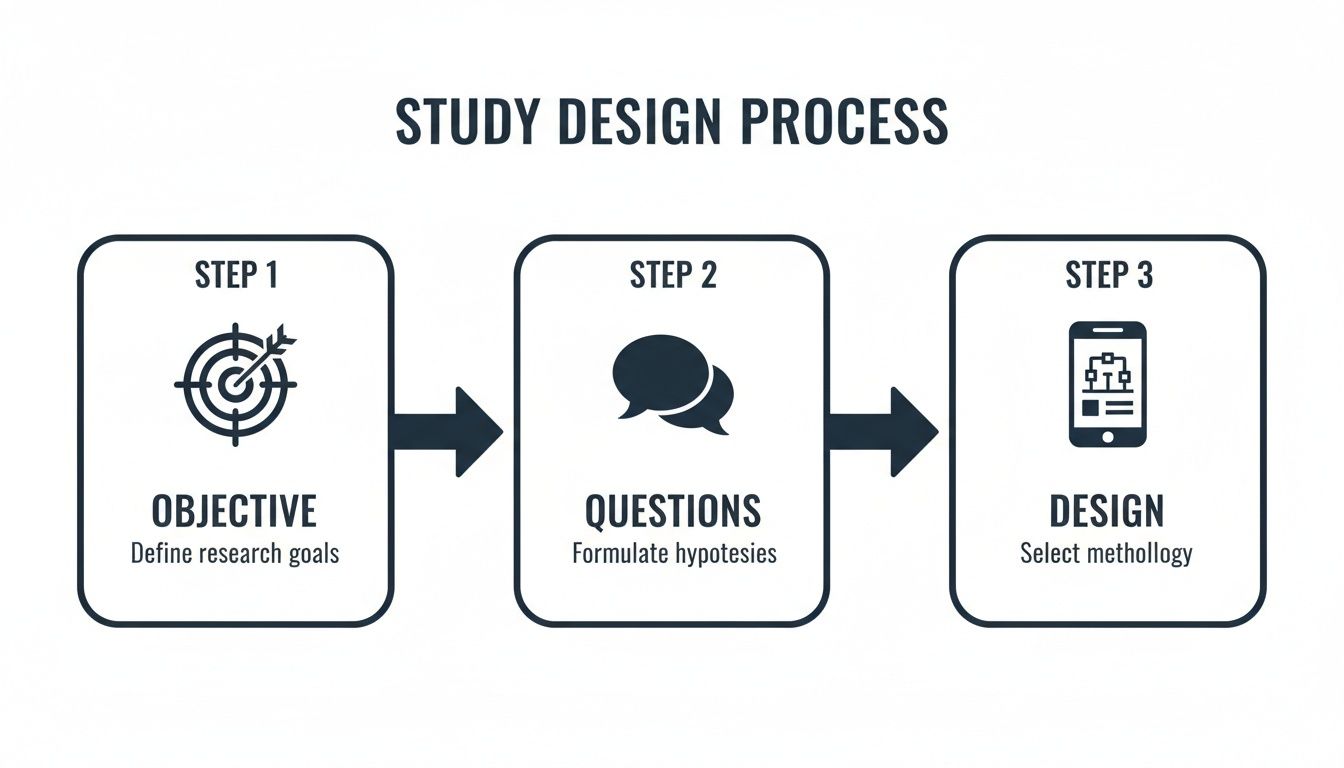
This process—starting with a sharp objective, crafting the right questions, and designing a clean study—is the bedrock of getting answers you can trust from your panel.
By weaving qualitative feedback directly into your product analysis, you build a much richer, more complete picture of the user experience. Combining both quantitative and qualitative data is what separates a good analysis from a great one. To get a feel for how to pull it all together, this sample of a data analysis report shows how you can present these blended findings.
Ultimately, this approach helps your team move from constantly fighting fires to strategically building a product that customers not only love but are happy to pay for.
Common Questions About Market Research Panels
Even after you're sold on the idea, jumping into your first panel study can feel a little daunting. Let's tackle some of the most common questions that pop up for product managers, founders, and marketers diving in for the first time.
How Fast Can I Actually Get Results?
The speed is often what surprises people most. You’re not waiting weeks for responses to trickle in.
For a general consumer survey, you can expect to see hundreds of completed responses within 24 to 48 hours. It's incredibly fast. If you’re targeting a very specific, hard-to-reach professional audience, it might take a bit longer—think a few days to a week—as the panel provider carefully screens and finds just the right people for your study.
What's This Going to Cost Me?
The honest answer? It depends entirely on who you need to talk to. Think of it like supply and demand.
A quick pulse survey sent to a broad, general audience can be very affordable, often costing just **2 to **8 per response. But if you need to get inside the head of a "VP of Engineering at a Series B fintech," that's a different story. The cost for that hyper-specific, high-value professional can climb to $150 or more per complete response, simply because their time is scarce and their insights are incredibly valuable.
Can I Really Trust the Data?
This is the big one. Reputable panel companies live and die by their data quality, and they invest a ton of resources into keeping it clean. They use a multi-layered approach to filter out apathetic or fraudulent participants.
Some of their common tactics include:
- Attention Checks: Simple questions designed to catch anyone who isn't reading carefully.
- Speeding Filters: Automatically flagging respondents who blaze through a 15-minute survey in three minutes.
- Redundancy Checks: Looking for contradictory answers to similar questions asked at different points in the survey.
No system is foolproof, of course. But these quality checks are incredibly effective at weeding out bad data. Most providers guarantee a certain level of quality and will even replace shoddy responses for free, so you can be confident in the dataset you're analyzing.
Once you have that data, you need the right tools to make sense of it all. Choosing the right survey data analysis software is crucial for connecting panel insights with your other business intelligence.
At SigOS, we’re all about bridging the gap between the what of your product analytics and the why of your customer research. We help you find the signal in the noise, turning behavioral data into a clear, prioritized product roadmap. Learn how SigOS can help you build what matters.
Keep Reading
More insights from our blog
Ready to find your hidden revenue leaks?
Start analyzing your customer feedback and discover insights that drive revenue.
Start Free Trial →