Mastering the 7 Phases of Product Development
Discover the essential phases of product development from idea to launch. Our guide breaks down each stage to help you build products that drive real growth.

Getting a product from a simple idea to a market success isn't magic; it's a journey. Think of the phases of product development as your roadmap—a proven blueprint that guides your team from a rough concept to a tangible solution that truly helps your customers. This structure is what separates the products that thrive from those that just fade away.
Your Blueprint for Turning Ideas Into Impact
Let's be honest: most new products fail. A staggering 95% of them never find their footing, and it's rarely because the initial idea was bad. The real culprit is usually a lack of process. Jumping straight into building without a plan is like trying to build a house without blueprints—it’s a recipe for wasted time, money, and effort.
The goal here is to methodically move from high uncertainty to high confidence. Each phase in the development lifecycle is a critical checkpoint. It forces you to pause, ask the tough questions, and validate your assumptions before you pour more resources into the project. This isn't about slowing down; it's about being smart and de-risking your investment every step of the way.
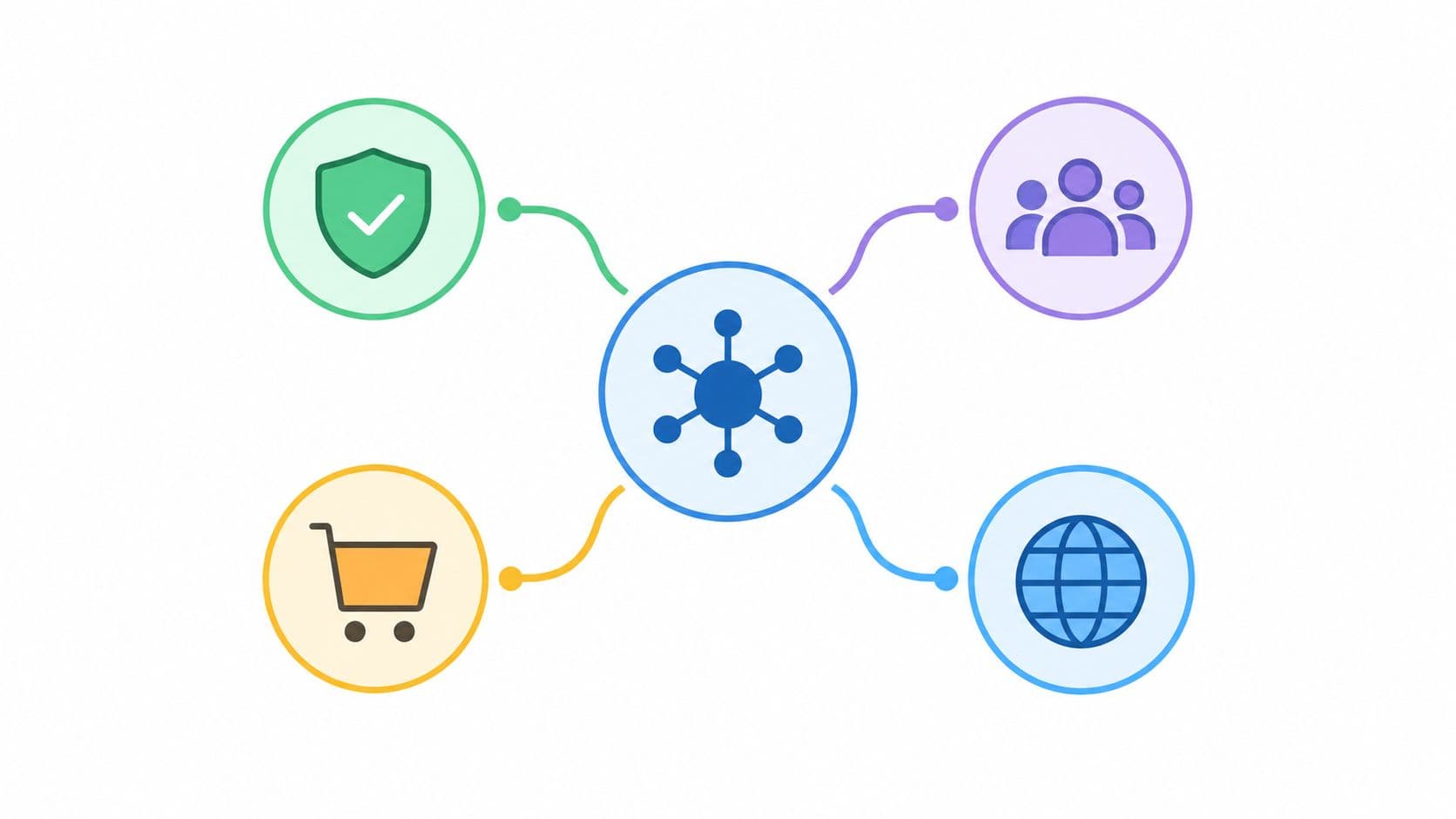
This map shows exactly how that flow works—from a raw idea, through a structured process, all the way to measurable impact.
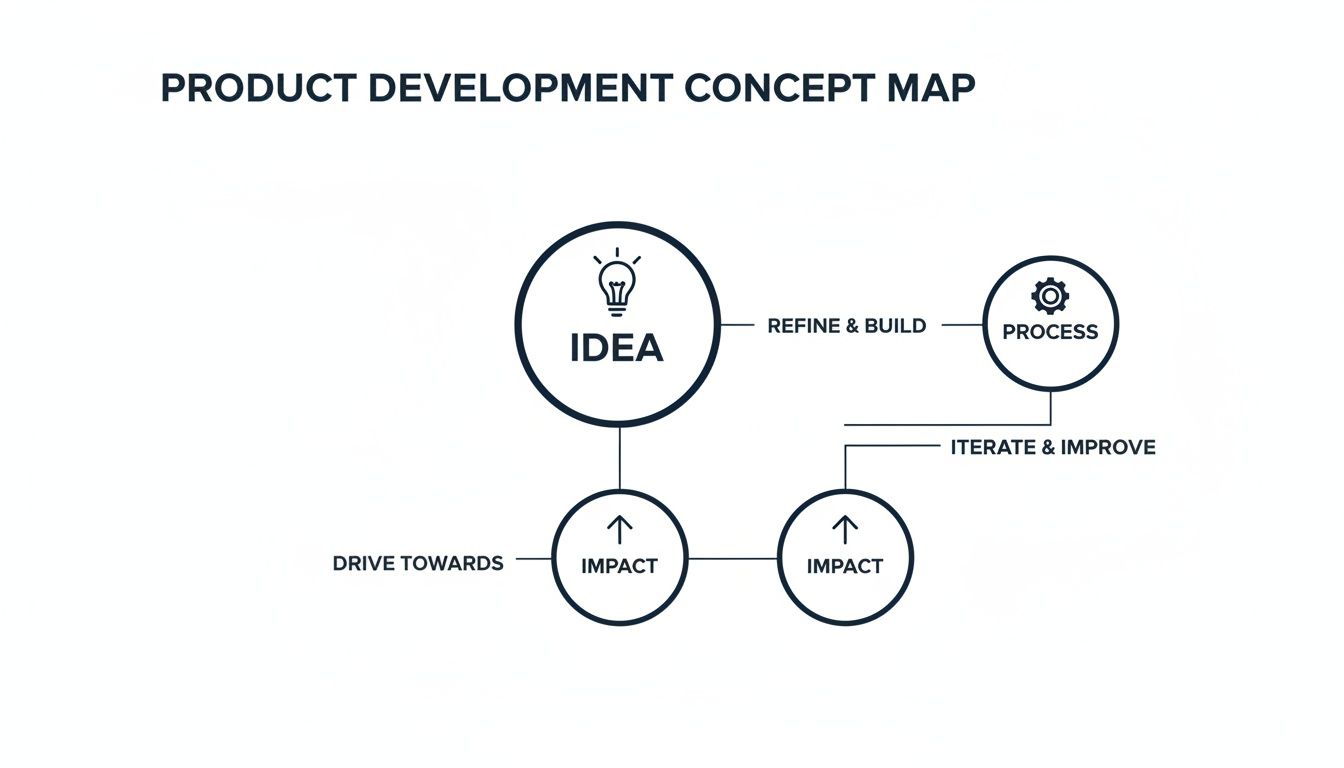
As you can see, a brilliant idea is just the starting line. It's the repeatable process that actually unlocks its value.
Why a Phased Approach Matters
Working through product development methodically brings a sense of order to what can often feel like a creative, chaotic process. It gives you predictability and control when you need it most.
Here’s why breaking the journey into distinct phases is so powerful:
- It cuts down your risk. You can test—and kill—ideas that don't have legs early on, before you’ve spent a fortune building them.
- It gets everyone on the same page. When engineering, design, and marketing all follow the same roadmap, they work toward the same goals. No more silos.
- It keeps you focused. Each phase has a clear objective, which helps you fight off the dreaded "feature creep" and avoid getting lost in the weeds.
- It makes things predictable. You get much better at forecasting timelines and budgets, which makes the whole project easier to manage.
This structured process is your key to de-risking decisions, aligning your team, and ensuring you build solutions that solve real customer problems and create measurable business value.
To get a complete picture, it’s helpful to understand all the connected product development lifecycle stages. Following a clear new product development roadmap transforms innovation from a guessing game into a repeatable science.
Let's dive into the seven core phases and see how each step builds on the last.
The 7 Phases of Product Development at a Glance
To kick things off, here's a quick overview of the entire journey. This table breaks down each of the seven phases we'll be exploring, showing you the main goal for each and the big question you need to answer before moving on.
| Phase | Primary Goal | Key Question to Answer |
|---|---|---|
| 1. Discovery | Identify and understand a genuine customer problem. | What's the core problem we're trying to solve, and for whom? |
| 2. Ideation | Generate a wide range of potential solutions. | What are all the possible ways we could solve this problem? |
| 3. Validation | Test the most promising ideas with real users. | Is this solution desirable, feasible, and viable for our business? |
| 4. Build | Develop and engineer the market-ready product. | How do we build a high-quality, scalable version of our validated solution? |
| 5. Launch | Release the product and acquire early adopters. | How do we successfully introduce our product to the market? |
| 6. Growth | Scale user acquisition and optimize the product. | How do we accelerate adoption and achieve product-market fit? |
| 7. Maintenance | Ensure long-term stability and user satisfaction. | How do we support our existing users and keep the product healthy? |
Think of this table as your cheat sheet. Each of these phases is a critical building block, and understanding their purpose is the first step toward mastering the entire product development lifecycle.
Validating Your Idea Before You Build
This is the make-or-break stage. It’s where brilliant products get the green light and costly mistakes are put to rest before they drain your budget. In the validation phase, we stop dreaming about what we could build and start proving why we should build it. This is all about turning assumptions into cold, hard evidence.
The best place to start? Look for problems, not solutions. Your most valuable insights are often hiding in plain sight—buried in customer support tickets, sales call notes, and live chat logs. These are the raw, unfiltered voices of your customers detailing their biggest headaches and unmet needs.
This isn't just about tallying up feature requests. It's about spotting the recurring themes and pain points that signal a real market opportunity.
From Raw Feedback to Quantifiable Insights
Let's be real: no one has time to manually sift through thousands of customer conversations. That's where the right tools come in. By analyzing all that qualitative feedback from every customer touchpoint, you can automatically pull the high-impact ideas out of the noise.
For instance, a platform like SigOS can plug directly into your support and sales tools. It can pinpoint which issues are mentioned most often alongside churn threats or expansion opportunities. Suddenly, subjective feedback becomes a solid business case, all before a single line of code is written.
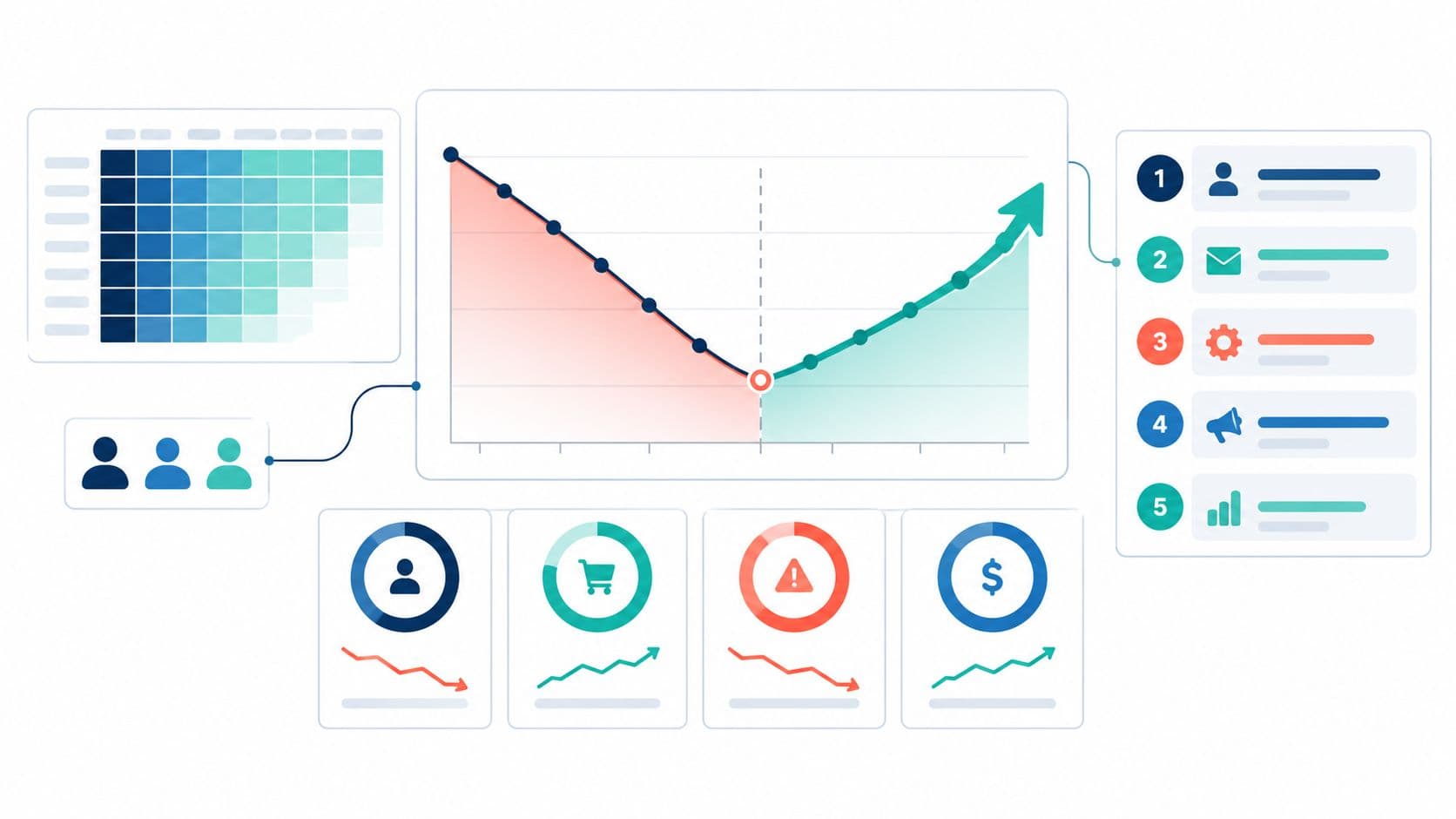
Here’s a quick look at how SigOS can flag critical issues tied to user sentiment, giving you a crystal-clear signal on where to focus.
This kind of data visualization instantly tells you which problems are causing the most pain, so you know exactly where to dig deeper.
The Critical Filter of Market Validation
Once you’ve got a promising, data-backed idea, it's time for market validation. Think of this as the final filter that separates a potential hit from a guaranteed flop. Skipping this step is a huge reason why up to 95% of new products fail—they’re often just solutions looking for a problem. On the flip side, companies that invest in proper interviews, surveys, and competitive analysis are 62% more likely to succeed because they confirm demand before spending big.
This process usually involves a few key activities:
- Deep User Interviews: Get past the simple "Would you buy this?" Instead, ask open-ended questions to truly understand their current workflow, their biggest frustrations, and what they're doing right now to solve the problem.
- Competitive Analysis: Who else is already trying to solve this? What do they do well, and where are they dropping the ball? Find the gaps you can fill.
- Hypothesis Testing: Create clear, testable statements about your target user, their problem, and your proposed solution. Our guide offers a great framework on how to do hypothesis testing to get results you can trust.
The goal of validation isn't to prove your idea is brilliant. It's to find all the reasons it might fail, and to do it as quickly and cheaply as possible. Every invalidated assumption is a crisis averted.
By methodically testing your riskiest assumptions, you build a foundation of evidence. Before you commit serious resources, learn how to validate a business idea to make sure people actually want what you're planning to build. This disciplined approach means that when you finally decide to move forward, you aren’t just gambling—you’re making a calculated investment based on real data and confirmed user needs.
Phase 3: Build & Validate with Prototypes and MVPs
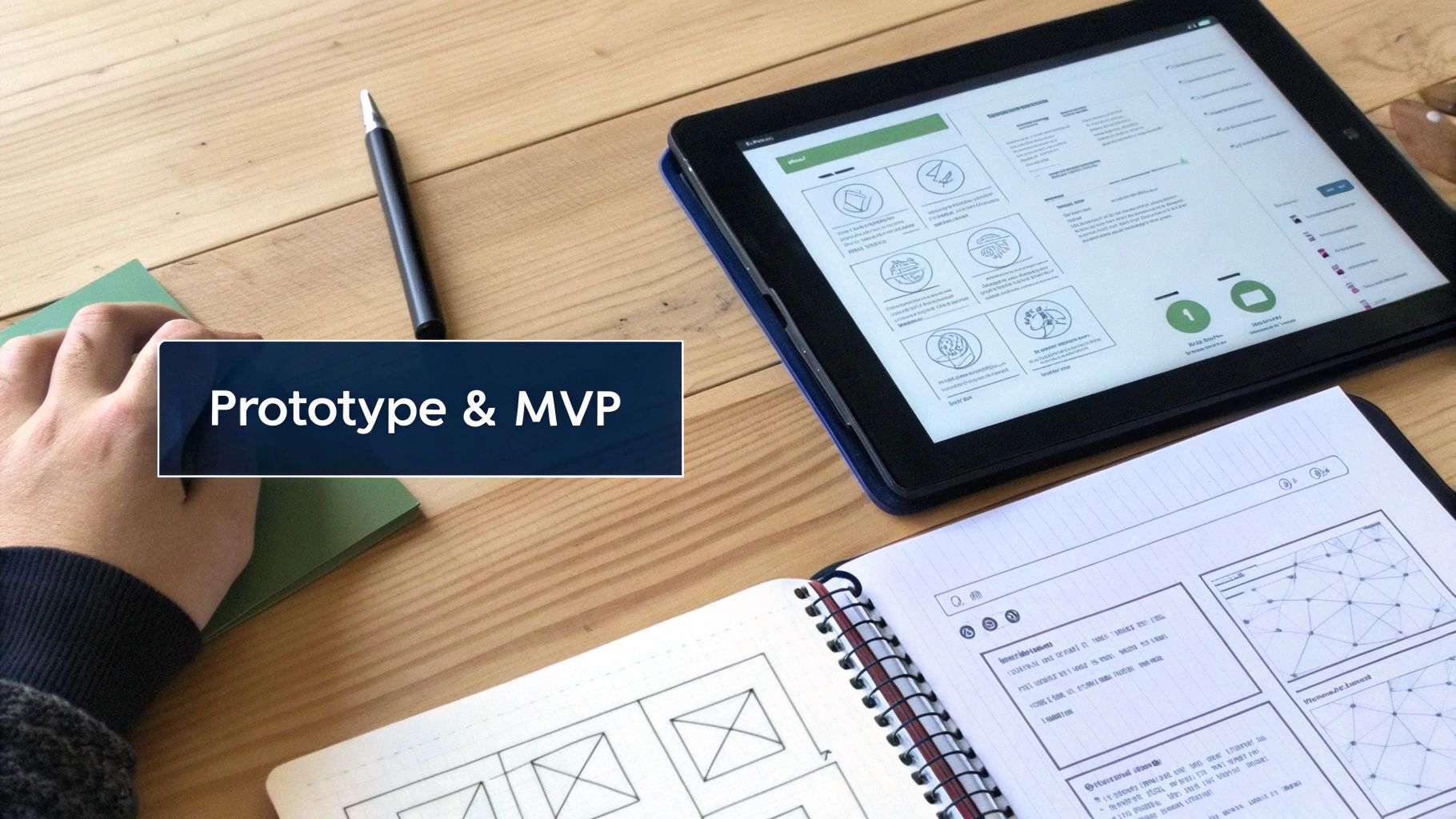
Once you've confirmed a real market need exists, it's time to start making your solution tangible. This is the stage where abstract ideas finally begin to take shape, becoming something your users can see, touch, and react to. We kick things off with prototyping, which is all about learning as much as you can, as quickly and cheaply as possible.
Think of a prototype as a conversation starter. Instead of just telling someone your idea, you're showing them. These can be anything from simple, hand-drawn sketches on a notepad to high-fidelity, interactive mockups built in Figma that feel almost like the real thing. The point isn't perfection; it's to test your core assumptions about the user experience before writing a single line of code.

Does the navigation feel natural? Is the workflow confusing? Answering these fundamental questions with a simple prototype will save you countless engineering hours and headaches down the road.
From Prototype to the First Real Build
The feedback you gather from prototyping is the fuel for the next critical step: building the Minimum Viable Product (MVP). It's a common misconception that an MVP is just a buggy, stripped-down version of your final product. It's not.
An MVP is the smallest, most focused version of your product that delivers the core value to a very specific group of early adopters.
The key word here is "viable." Your MVP has to genuinely solve a real problem for its first users—well enough that they're willing to actually use it. You're aiming to deliver a complete, functional slice of the product, not a broad set of half-finished features.
For example, if you're building a new project management tool, your MVP might only include the ability to create a task, assign it to someone, and set a due date. That's it. All the fancy stuff—like Gantt charts, complex reporting, and third-party integrations—can wait. You first need to prove people will use your core loop before you invest in building out the rest.
Using Data to Decide What Goes into Your MVP
Figuring out what makes the cut for an MVP is one of the hardest parts of product management. This is where you have to move past gut feelings or who has the loudest opinion in the room and start relying on hard data.
In today's market, speed is everything. Research shows that 62% of teams feel pressure from consumers to deliver faster, and 65% are accelerating development just to get ahead of competitors. With the average product development timeline stretching to 22 months and the design/prototyping phase alone eating up 3-4 months, there's no room for wasted effort.
This is exactly where a product intelligence platform like SigOS gives you a serious edge. By analyzing your customer feedback, it can pinpoint which bug fixes or feature requests are directly tied to churn risk or new revenue. Suddenly, prioritization isn't a subjective debate; it's an objective, data-backed financial decision.
For example, SigOS can integrate directly with tools like Jira, automatically attaching real-dollar impact scores to each development ticket.
This kind of clarity is a game-changer. It helps product managers show that fixing a specific bug isn't just a technical task—it's an action that could directly save $28.3k in potential churn. This focus ensures your initial build is laser-focused on delivering the highest ROI and reducing risk.
To learn more about structuring these requirements effectively, take a look at our guide on how to write a Product Requirements Document (PRD). By building a lean, focused MVP that’s backed by quantifiable data, you're not just launching a product; you're laying a solid foundation for sustainable growth.
4. Launch: Showtime
After all the late nights, endless meetings, and countless lines of code, the moment of truth has arrived. Your product is ready for the world. But launching isn't just about flipping a switch and hoping for the best. It's a calculated, strategic debut where you finally start acquiring those all-important first users.
Think of it like a grand opening for a restaurant. You’ve perfected the menu (the MVP), but now you need to get people in the door and make sure they have a great experience. This is where your marketing, sales, and support teams really shine. They need to be fully equipped and trained to make your product's debut a massive success.
This internal alignment is critical. If your support team is fumbling with questions about new features or your sales reps can't clearly explain the value, even the most brilliant product will fall flat.
Measuring What Matters from Day One
The second your product goes live, your attention needs to pivot immediately to the data. Gut feelings are useless here. You need hard numbers to tell you if the launch is working, and you need them from the very start.
Here are the key metrics that truly matter:
- Adoption Rate: This is all about how quickly new users are actually using your product or a specific new feature. If this number is sluggish, it could be a red flag that your marketing message is off or your onboarding is confusing.
- Time-to-Value (TTV): How long does it take for a new user to have that "aha!" moment where they experience the core benefit? The faster you can get them there, the higher the chance they'll stick around for the long haul.
- User Engagement: Are people just signing up and leaving, or are they coming back? Tracking Daily Active Users (DAU) and Monthly Active Users (MAU) gives you a clear picture of how sticky your product really is.
Expert Tip: Don't get distracted by vanity metrics like total sign-ups. It's easy to celebrate a big number, but it doesn't mean anything if those users aren't activated and retained. Those are the numbers that prove your product is actually solving a problem.
Monitoring these KPIs gives you an immediate health check on your product and its potential for real, sustainable growth.
The table below breaks down the key metrics you should have on your dashboard from the moment you launch.
Launch Phase Key Performance Indicators (KPIs)
| Metric | What It Measures | Why It's Important |
|---|---|---|
| User Adoption Rate | The percentage of new users who start using the product or a key feature within a specific timeframe. | A slow adoption rate can signal issues with marketing messaging, onboarding friction, or a lack of perceived value. |
| Time-to-Value (TTV) | The average time it takes for a new user to realize the product's core benefit or "aha!" moment. | A shorter TTV is directly correlated with higher user retention. The faster they see the value, the more likely they are to stay. |
| Activation Rate | The percentage of sign-ups that complete a critical action, indicating they've become an "active" user. | This separates genuinely engaged users from passive sign-ups, providing a much clearer picture of initial traction. |
| Customer Acquisition Cost (CAC) | The total cost of sales and marketing to acquire a single new customer. | Keeping an eye on CAC ensures your launch marketing is efficient and not burning through cash without a return. |
| DAU/MAU Ratio | The ratio of daily active users to monthly active users, often used as a measure of "stickiness." | A higher ratio indicates that users are forming a habit around your product, which is a strong predictor of long-term success. |
These metrics aren't just numbers on a screen; they are the vital signs of your product's health in its most vulnerable early days.
Reacting to Post-Launch Feedback in Real Time
No matter how thoroughly you've tested, your first real users will uncover problems you never saw coming. It’s inevitable. How you handle that first wave of feedback can set the tone for your product's entire lifecycle.
The old way of doing things—waiting for support tickets to pile up—is purely reactive. You’re always playing catch-up.
A much smarter approach is to be proactive. This is where a platform like SigOS becomes invaluable. It can monitor customer feedback channels in real time—from support chats to social media mentions—and instantly alert you to emerging issues. This gives your team the power to spot a recurring bug or a point of friction hours, or even days, before it spirals into a crisis.
By catching these signals early, you can deploy a quick hotfix, update your help docs, or send a targeted message to affected users. This not only protects the user experience but also shows your earliest, most important customers that you're listening. That kind of responsiveness is how you build an incredibly loyal user base right from the start.
5. Driving Sustainable Growth and Product Health
So, you've launched. The launch party was great, the initial feedback is rolling in, and the team is breathing a sigh of relief. But the work isn't over—far from it. This is where the real journey begins, shifting from a one-time release to the long-term, sustainable success of your product.
This stage breaks down into two crucial, ongoing phases: Growth and Maintenance.

Making this transition requires a real change in mindset. You're moving from a builder to a gardener. Your job is now to nurture a living product, continuously optimizing every part of the user experience to attract new customers, get them to that "aha!" moment, and, most importantly, keep them coming back.
Fostering Growth Through Optimization
The Growth phase is all about learning and iterating—fast. The goal is to get a deep, almost intuitive understanding of how people use your product and then use those insights to make it stickier and more valuable. This is where data-driven experimentation becomes your best friend.
A few common strategies you'll see here are:
- A/B Testing: You'll test different versions of a feature, a new onboarding flow, or even something as small as a button's color to see what performs best against your key metrics.
- User Segmentation: You'll slice and dice your user base to see how different groups behave. This helps you spot opportunities for more personalized experiences or targeted improvements.
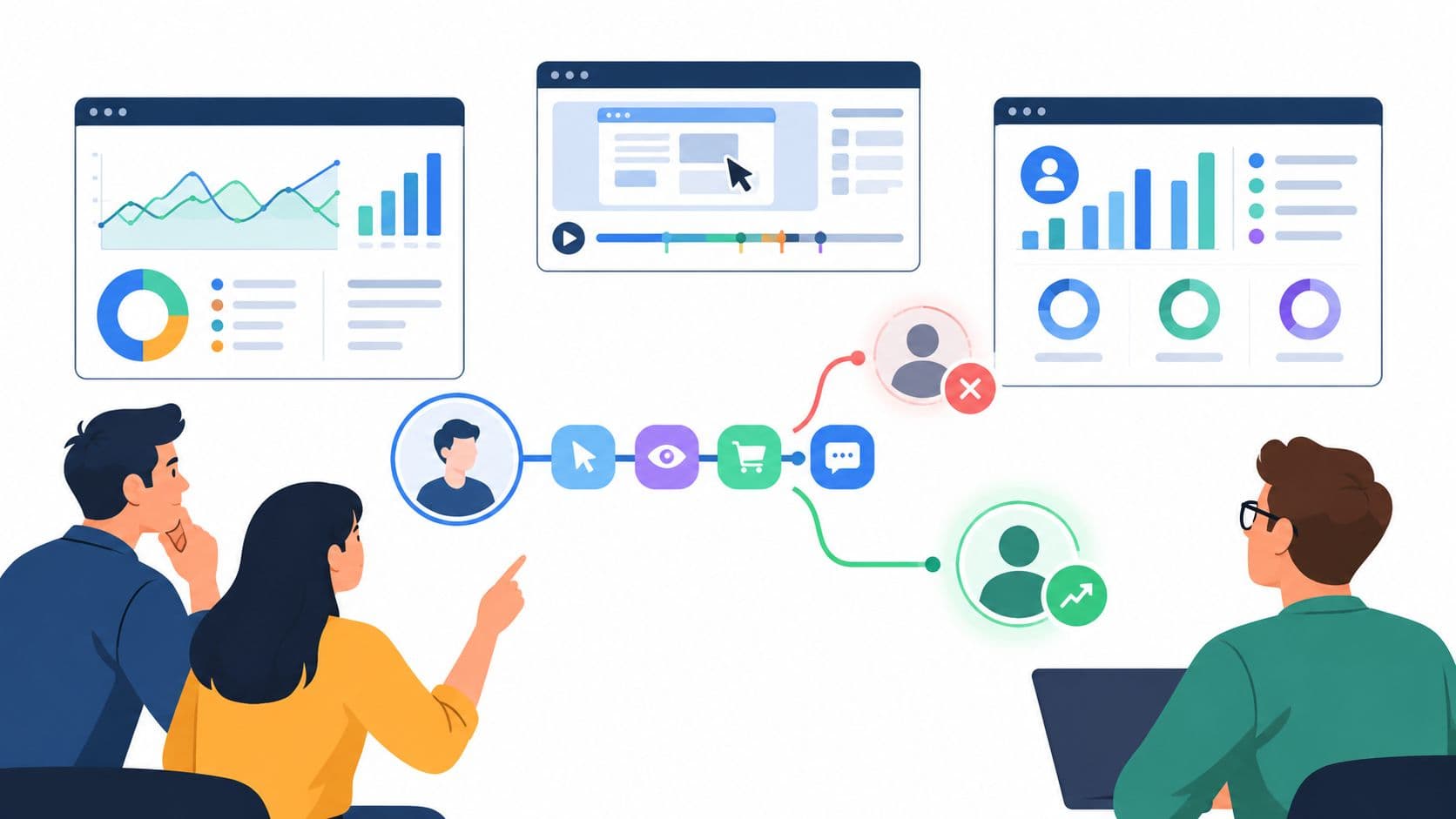
- Behavioral Data Analysis: It's time to dig into the nitty-gritty of user navigation. Where are people getting stuck? What paths lead them to the highest-value features?
This is where your metrics shift. While high conversion rates are great, they only tell part of the story. True growth is measured by things like churn and retention. The ratio of Daily Active Users (DAU) to Monthly Active Users (MAU) is a classic for a reason—it’s an early warning system for flagging engagement drop-offs. You can find more details about how lifecycle metrics define product success on contentsquare.com.
A growth mindset isn't just about pouring more users into the top of the funnel. It's about making your product so indispensable that your current users can't imagine their life without it. Retention is the most powerful growth engine you have.
This constant cycle of learning and tweaking is what separates a good product from a great one. It’s the small, continuous improvements that stack up over time, creating an experience that's tough to beat.
Maintaining Product Health and Stability
Running right alongside your growth efforts is the equally important Maintenance phase. Think of it like keeping the engine of your car perfectly tuned while you're racing down the highway. This means proactively managing technical debt—the hidden cost of taking shortcuts now instead of using a better, more sustainable approach.
It also means squashing bugs and optimizing performance to keep the product stable, secure, and fast as more and more people start using it. Neglecting maintenance is a recipe for disaster. It leads to a slow, buggy product that frustrates users and eventually sends them looking for alternatives, no matter how many cool new features you release.
The real challenge is balancing priorities. With only so many engineering hours in a day, how do you choose between fixing a gnarly bug and building that next big growth feature?
Prioritizing Your Backlog with Revenue Impact
This is where gut feelings and loud opinions can really derail a product team. A bug that seems minor to an engineer might be a complete showstopper for a segment of your highest-paying customers. This is exactly where a continuous intelligence platform like SigOS becomes invaluable.
Instead of just looking at the technical severity of a bug, SigOS quantifies the actual dollar value of ongoing issues. By connecting the dots between support tickets, chat logs, and user data, it can pinpoint which problems are directly tied to churn risk or lost revenue opportunities.
For instance, SigOS can provide real-time alerts when it detects patterns that signal a high risk of customer churn, showing you exactly who is affected and how much revenue is on the line.

This completely changes the conversation around backlog prioritization. You’re no longer just arguing about technical details; you're having a strategic discussion rooted in business impact. This ensures that both your growth and maintenance efforts are always focused on what matters most: the company's financial health.
Common Mistakes to Avoid in Your Product Journey
Navigating the product development lifecycle is as much about dodging bullets as it is about hitting targets. Even the sharpest teams can get tripped up by a few common, costly mistakes. Knowing what these traps look like is the first step to making sure you don't fall into them.
One of the most classic blunders is building a solution in search of a problem. A team gets so excited about a cool idea that they jump straight into building it, completely bypassing the crucial discovery and validation work we just talked about. The result? They launch a beautiful product that nobody actually needs.
Then there's the infamous feature creep. This is what happens when the scope of an MVP keeps expanding, one "small" addition at a time. The desire to please everyone turns a lean, focused product into a bloated, delayed mess that doesn’t do anything particularly well.
Ignoring Qualitative Feedback for Vanity Metrics
It's tempting to get dazzled by big, flashy numbers. Think total downloads or daily sign-ups. But these are often just vanity metrics—they look great on a dashboard but tell you very little about real user engagement or whether you're actually solving a problem.
A successful launch isn’t just about getting users; it’s about getting the right users and making their lives better. The real gold is often buried in qualitative feedback—the messy, human stuff found in support tickets, user interviews, and in-app chat logs. That's where customers tell you exactly what’s frustrating them, in their own words.
Grounding your decisions in objective, revenue-centric data rather than assumptions is the ultimate strategy for avoiding these common traps. It transforms subjective feedback into a quantifiable business case.
This is exactly where a tool like SigOS becomes a game-changer. It takes all that unstructured feedback and automatically quantifies which issues are creating real churn risk or holding up potential expansion deals. Suddenly, your team can prioritize what to build next based on direct revenue impact, not just on which metric looks the prettiest.
Letting Poor Communication Derail Progress
Finally, nothing sinks a product faster than a breakdown in communication between teams. When engineering, marketing, and support are all operating in their own little worlds, the entire process grinds to a halt.
This misalignment shows up in a few painful ways:
- Marketing promotes features that aren't ready. This sets false expectations with new users and immediately erodes trust.
- Support teams get blindsided by a launch. They have no idea how to answer questions about new functionality, leading to frustrated customers and an overwhelmed team.
- Engineering doesn't understand the "why." Without crucial context from customer-facing teams, developers can't make smart decisions when they hit technical roadblocks.
Building a great product demands constant, transparent communication. When you get every team aligned around the same goals and the same data, you create a resilient process that can handle the inevitable bumps in the road.
A Few Common Questions About Product Development
As teams navigate the twists and turns of building a product, a few key questions always seem to pop up. Getting these answers straight is less about textbook definitions and more about aligning your team and sharpening your strategy. Let's dig into some of the most common ones.
A big point of confusion is often the difference between the product development lifecycle and a methodology like Agile. It’s simple when you think about it this way: the lifecycle is the "what," and your framework is the "how."
The lifecycle gives you the big picture—the strategic roadmap from the first glimmer of an idea all the way to maintaining a mature product. Agile, on the other hand, is how your team gets the work done within those stages. It’s the tactical, boots-on-the-ground approach focused on short cycles, collaboration, and adapting on the fly. They're two sides of the same coin.
How Long Should Each Phase Take?
This is the million-dollar question, and the honest answer is: it depends. There’s no universal timeline. A simple mobile app might fly through the early stages, while a complex enterprise platform will naturally take much longer. Your team's size and the market you're jumping into also play a huge role.
That said, for a pretty standard B2B SaaS product, you could use these as a loose guide:
- Discovery & Validation: 4-8 weeks
- Prototyping & MVP Build: 3-6 months
- Launch & Initial Growth: 3-6 months
But here’s the most important part: don’t get fixated on the calendar. The real goal is to nail the objective of each phase. Rushing through validation just to hit a deadline is how you end up building a beautiful solution to a problem nobody actually has.
How Can a Small Team Implement These Phases?
It's a total myth that a structured product process is just for big companies with deep pockets. In fact, these principles are arguably more critical for small teams where every single hour and dollar has to count. The trick isn't to skip stages, but to scale them to fit your reality.
Here’s how smaller teams can make it work:
- Go for lean validation. You don't need to commission a massive market study. A dozen deep-dive interviews with potential customers can give you more gold than you know what to do with.
- Build a truly minimal MVP. Get ruthless with your feature list. Your first launch should be about testing one core hypothesis with the absolute smallest thing you can build.
- Lean on smart tools. Find software that can automate the grunt work, like analyzing customer feedback. This frees up your small team to focus on the high-impact thinking that only humans can do.
When it comes down to it, having a clear process helps small teams punch way above their weight. It makes sure every ounce of effort is aimed squarely at solving a real, validated customer problem.
By turning qualitative feedback into actionable, revenue-driving insights, SigOS helps product teams cut churn, find expansion opportunities, and build features that customers are actually asking for. Learn more at https://sigos.io.
Keep Reading
More insights from our blog
Ready to find your hidden revenue leaks?
Start analyzing your customer feedback and discover insights that drive revenue.
Start Free Trial →