Choosing Your Product Strategy Framework
Discover the right product strategy framework for your team. Compare popular models like OKRs, RICE, and JTBD to build a roadmap that drives growth.
So, what exactly is a product strategy framework?
Think of it as the bridge between your grand vision and your team's day-to-day work. It’s a structured approach that takes a high-level goal—like "become the market leader"—and breaks it down into a concrete, actionable plan. It's the GPS for your product journey, giving you the turn-by-turn directions needed to build things that solve real problems while hitting your business targets.
A good framework ensures every decision, from a minor UI tweak to a major feature release, is deliberate and backed by data.
Why Your SaaS Needs a Product Strategy Framework

Trying to navigate the SaaS world without a map is a recipe for disaster. A product strategy framework is what pulls you out of reactive "firefighting mode" and into proactive, intentional building. It gives you a repeatable system for making those tough trade-off decisions and prioritizing work based on evidence, not just the loudest voice in the room.
But this isn't just about creating another document that sits in a folder. It's about creating a shared language for the entire company. When engineering, marketing, and sales all get the "why" behind the roadmap, true alignment clicks into place. Suddenly, everyone can see how their daily tasks connect to the big picture, which builds a powerful sense of ownership.
The Cost of Navigating Without a Map
Teams without a framework almost always fall into the same traps. They end up chasing competitor features, building for a single demanding customer, or designing elegant solutions for problems nobody actually has. These missteps don’t just waste time; they burn cash and lead to a disjointed product that never finds its footing.
The numbers are pretty sobering. Unclear company strategies are to blame for a massive 23% of all product development investment failures around the globe.
To avoid becoming a statistic, 66% of businesses now make sure their company strategy is directly linked to product development. This keeps the vision and execution in lockstep, making it easier to pivot based on real market data and user feedback.
Core Benefits of Adopting a Framework
When you finally put a solid framework in place, the benefits ripple out far beyond the product team. It brings clarity and focus to the chaos, empowering everyone to make smarter decisions, faster.
Here are the key advantages you can expect:
- Smarter Prioritization: You get an objective lens for evaluating new ideas, making sure you’re always working on what delivers the most value to both customers and the business.
- Real Team Alignment: When everyone is working from the same playbook, cross-functional collaboration just works. It’s smoother, more efficient, and a lot less frustrating.
- Deep Customer Focus: The framework forces you to anchor every decision in validated user needs. The result? You build products people genuinely love and are happy to pay for.
- Massively Reduced Risk: A structured process helps you spot and squash risks early on, preventing expensive mistakes and dramatically improving your odds of long-term success.
Ultimately, a product strategy framework is the scaffolding that supports sustainable growth. It’s what ensures your team isn't just building features, but building the right features that solve the right problems for the right customers. If you want to dive deeper, you can explore our complete guide to building a winning product strategy. It’s the foundational step that turns an ambitious vision into a market-defining product.
The Core Components of an Effective Framework
No matter what you call it, every solid product strategy framework rests on the same foundational pillars. These are the non-negotiables that work together to guide an ambitious idea from a brainstorm session into a product that actually succeeds. They give you a complete, 360-degree view of your market, your goals, and your plan of attack. Without them, a "strategy" is just a wish list.
Think of it like building a house. The product vision is the architectural blueprint—it shows everyone what you're trying to create. The other components are the foundation, the support beams, and the wiring. Each one is absolutely essential to end up with something stable, functional, and valuable.
Vision and Market Understanding
It all starts with two things: a crystal-clear vision and a genuine understanding of your customers. Your product vision is your North Star. It defines the ultimate "why" behind your product and the long-term impact you want to have. It answers the most important question of all: "Why does this product need to exist?" A great vision is aspirational but still grounded, giving the team a meaningful problem to rally behind.
Paired with that vision is a deep customer and market understanding. This has to go way beyond running a few surveys. We're talking about digging into real signals from support tickets, sales call transcripts, and user behavior data. For instance, a platform like SigOS can spot patterns showing that 15% of support requests are all about the same missing integration, putting a hard number on a customer pain point.
Goals and Prioritization
Once you know where you're going, you can set measurable goals to get there. These aren't fuzzy objectives. They are specific, outcome-driven targets that directly connect what your product team is doing to the success of the business.
A solid product strategy framework aligns product vision with business goals through four major elements: market analysis, a well-defined product roadmap, thorough competitive analysis, and an effective go-to-market strategy. This structure is vital, as 66% of businesses now integrate their overall strategy directly into product development. You can discover more about this strategic alignment and its impact.
This is where a disciplined prioritization system becomes your best friend. It gives you an objective way to decide what to build next, moving you past guesswork or just listening to the loudest voice in the room. Smart teams use tools like a feature prioritization matrix to score potential initiatives against factors like customer impact and development effort. It’s how you make sure your resources are always aimed at the highest-value work.
Roadmapping and Iteration
Finally, the strategy comes to life in your product roadmap. But modern roadmaps aren't just a list of features with dates slapped on them. They focus on outcomes over outputs, communicating the customer problems you intend to solve. This keeps the team focused on delivering real value and gives you the flexibility to adapt as you learn.
And that brings us to the last piece: a real commitment to measurement and iteration. A strategy should never be a static document you write once and file away. By constantly tracking your key performance indicators (KPIs), you can measure progress, check if your assumptions were right, and adjust to new information. This feedback loop is what keeps your strategy relevant and ensures your product evolves right alongside your customers.
Comparing Popular Product Strategy Frameworks
Once you’ve got the basics down, the real work begins: picking the right tool for the job. The world of product strategy is swimming in acronyms, but don't get overwhelmed. Think of these frameworks less like a rigid instruction manual and more like a versatile toolkit. Each one gives you a different lens to view your challenges, make decisions, and track your progress.
Choosing a framework isn't a one-size-fits-all decision; it completely depends on the problem you’re trying to solve. Are you trying to get the entire company rowing in the same direction toward a massive goal? Or do you just need a cold, hard, mathematical way to wrangle an overflowing backlog?
Let's break down some of the most popular options to see how they stack up.
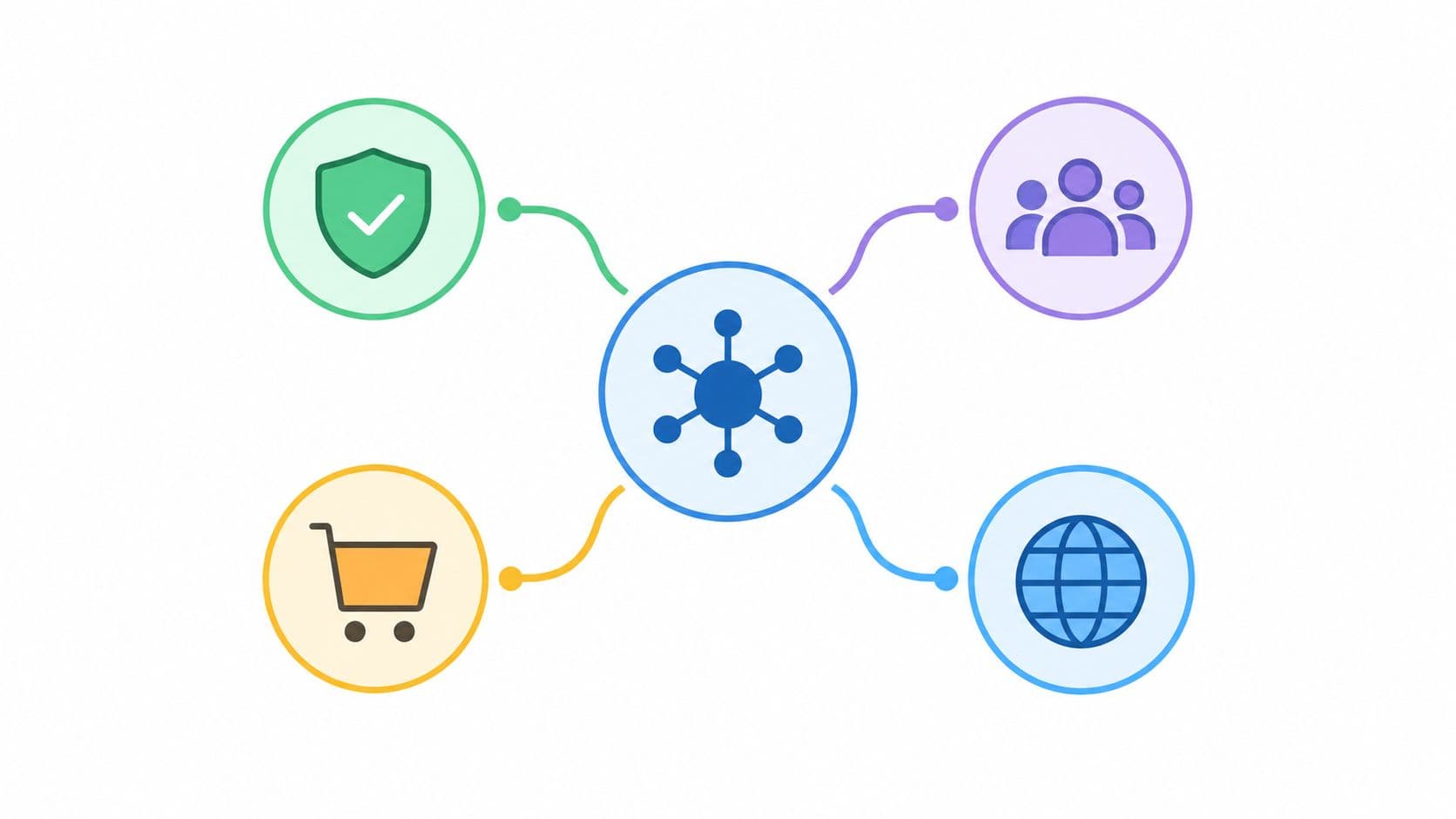
The diagram below shows the foundational pillars that every good framework is built on—things like vision, market analysis, execution via a roadmap, and, of course, measurement. It's a great reminder of the core elements you should always be thinking about.
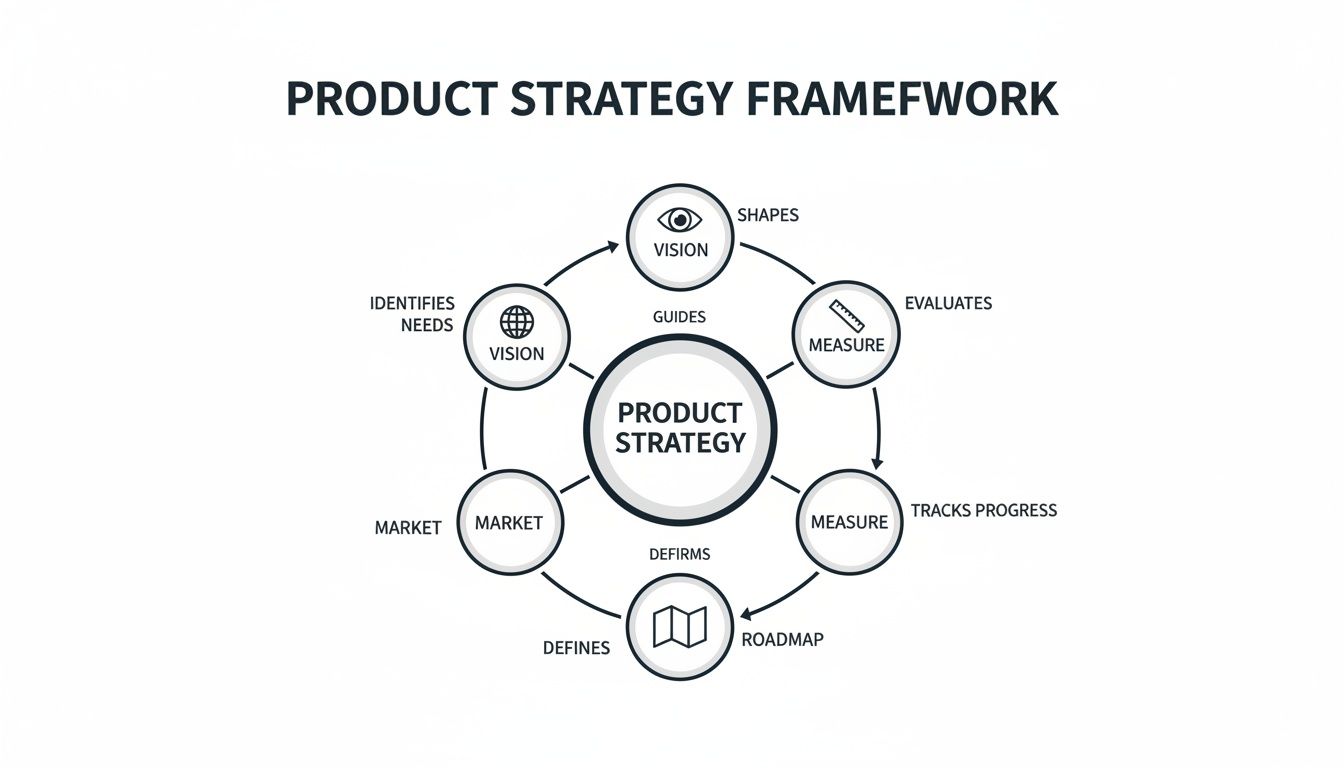
No matter which specific framework you land on, it has to connect your big-picture vision to the realities on the ground. It needs to guide your roadmap and give you a clear way to know if you're actually winning.
H3: OKRs for Goal Alignment
You've probably heard of Objectives and Key Results (OKRs). It’s the goal-setting framework that helped Google become, well, Google. It’s all about aligning the entire organization around a set of ambitious, measurable goals. You start with a high-level Objective (what you want to achieve) and then define a few Key Results (how you’ll know you’ve achieved it).
- Best For: Teams that need a direct line of sight between their day-to-day work and the company's top-level strategy. It's fantastic for creating focus and transparency, especially in larger organizations.
- Example: Your Objective might be to "Launch a world-class onboarding experience." Your Key Results could be things like "Improve user activation rate from 40% to 60%" and "Reduce support tickets during a user's first week by 30%."
The real magic of OKRs is how they cascade. Everyone, from the CEO down to an intern, can see exactly how their work ladders up to the bigger picture.
H3: RICE for Ruthless Prioritization
The RICE scoring model is a purely quantitative method for deciding what to build next. It’s designed for one thing: ruthless prioritization. It forces you to evaluate every idea against four factors: Reach, Impact, Confidence, and Effort. By running each initiative through this formula, you get a data-informed list of what to tackle first.
One of the biggest headaches for any product team is trying to manage conflicting stakeholder demands. A framework like RICE is the antidote. It replaces subjective arguments with an objective system, so you can evaluate every request using the same clear criteria.
This method is a lifesaver for teams that are drowning in feature requests and need a logical system to find the signal in the noise. It shifts the conversation from "who is shouting the loudest?" to "what will actually move the needle?"
H3: JTBD for Deep Customer Insight
Jobs to be Done (JTBD) is different. It’s less of a prioritization framework and more of a mindset for getting to the heart of customer motivation. The core idea is that customers don't just "buy" products; they "hire" them to get a specific "job" done in their lives. This forces you to look past demographics and focus on the user's underlying goal.
- Best For: Perfect for early-stage product discovery, finding new market opportunities, and genuine innovation. It helps you uncover the why behind what your users are doing.
- Example: The classic example is the drill. People don't buy a drill because they want to own a drill. They buy a drill because they want a quarter-inch hole in their wall. The "job" is the hole, not the tool itself.
By focusing on that desired outcome, JTBD helps you design solutions that solve the real, deep-seated problem. It's how you build something that people will not only use but will happily "hire" again and again.
H3: At-a-Glance Framework Comparison
To make it easier to see how these popular frameworks fit together, here's a quick reference table. Think of this as your cheat sheet for matching the right framework to your current challenge.
| Framework | Primary Focus | Best For | Example Metric |
|---|---|---|---|
| OKRs | Goal Alignment & Transparency | Aligning large teams on ambitious, company-wide goals. | Increase user activation from 40% to 60%. |
| RICE | Quantitative Prioritization | Objectively scoring and ranking a backlog of features or ideas. | A calculated RICE score (e.g., 2.5) for a feature. |
| JTBD | Customer Motivation | Uncovering unmet needs and driving product innovation. | Time to achieve the desired outcome (the "job"). |
| HEART | User Experience Measurement | Evaluating and improving the quality of the user experience. | Task success rate or user satisfaction (NPS/CSAT). |
| Opportunity Solution Tree | Structured Ideation | Visualizing and exploring potential solutions to a desired outcome. | Number of viable experiments run per quarter. |
This table isn't exhaustive, of course. Many teams end up blending elements from different frameworks to create a system that works for them. The key is to understand what each tool is designed for so you can use it effectively.
How to Choose and Adapt the Right Framework
Picking a product strategy framework isn't about finding the "best" one. It's about finding the one that your team will actually understand, buy into, and use day in and day out. The goal is to get out of the land of theory and into a practical system that feels like it was made just for your business.
There’s no magic bullet here. The right choice hinges entirely on your company stage, how mature your product is, and the culture you've built. A tiny startup hunting for product-market fit has completely different strategic needs than a massive enterprise SaaS platform juggling a dozen product lines. That's why the first step is always diagnosing your biggest problem.
Ask the Right Diagnostic Questions
Before you jump on the latest framework bandwagon, get your team in a room and figure out what you’re really trying to solve. Gaining that clarity first can save you from adopting a complicated system when a simple checklist would have done the job.
Start by asking a few honest questions:
- What’s our single biggest strategic headache right now? Is it a lack of alignment across the company? Are you drowning in ideas and unable to prioritize? Or do you just not understand your customers deeply enough? Your answer will point you in the right direction.
- How mature is our product? A product in its early days needs a discovery-focused framework like Jobs to be Done (JTBD) to test its core value. A mature product, on the other hand, might need a system like RICE to triage a constant flood of feature requests.
- How comfortable is our team with data? A quantitative framework like RICE only works if your team is used to making data-driven arguments. If you run more on qualitative insights and user feedback, something like an Opportunity Solution Tree is probably a much better fit.
Answering these questions gives you a clear starting point. If everyone agrees the main goal is to get the whole company rowing in the same direction, OKRs are a no-brainer. If the team is constantly debating the potential impact of 50 different feature ideas, the RICE model gives you the objective scoring you need to move forward.
Blending Frameworks for Real-World Results
Here's a secret: the best teams almost never stick to a single framework by the book. The real magic happens when you create a hybrid model, cherry-picking the best parts of different systems to build a process that works for you.
The most successful product teams don't just adopt a framework; they adapt it. They might use the customer-centric principles of JTBD for initial discovery, then switch to a RICE model to prioritize the resulting ideas for their roadmap.
This creates a powerful, end-to-end strategic process. Imagine using JTBD interviews to uncover a high-value customer "job," then framing an OKR around solving it, and finally using RICE to score the specific features that will get you there. This blend gives you both the deep customer insight you need and the disciplined plan to act on it.
The key is to stay flexible. The system you build should grow with your company. What works for a team of 10 will absolutely need to be tweaked when you hit a team of 100. Revisit your process every few quarters and don't be afraid to change what isn't working.
Putting Your Framework Into Action
A product strategy framework is only as good as its execution. You can pick the perfect model, but the real work starts when you weave it into your team's daily routines. It has to become a living, breathing guide for every decision, not just a document that collects dust.
Success hinges on getting genuine buy-in from your stakeholders. This goes way beyond a simple presentation. Leaders in sales, marketing, and engineering need to grasp not just what the framework is, but why it's the key to making smarter, more consistent choices for the business.
Fuel Your Framework With Quantified Intelligence
The best strategies run on quantified customer intelligence, not gut feelings. This is where you have to get specific about your data inputs. Vague feedback like "customers want more integrations" doesn't help anyone.
But what if you could turn that into something concrete? An intelligence platform like SigOS can surface the hard numbers, showing that "15% of at-risk accounts have requested a specific integration in the last 30 days." Now that's an insight you can plug directly into a RICE score or use to validate an OKR. It gives your framework the fuel it needs to work.
This data-driven approach is a massive shift. Today, 66% of businesses are aligning their company-wide goals directly with their development cycles. This helps them sidestep the 23% failure rate that comes from having a gap between strategy and execution. It’s a huge leap from the mere 13% of companies still stuck on rigid, annual roadmaps.
For SaaS revenue teams, this means turning customer chatter into numbers that predict behavior. In fact, by analyzing usage metrics and sales calls, you can predict churn with up to 87% accuracy.
A Practical Implementation Checklist
Rolling out your new framework needs a disciplined, step-by-step process. This is how you make sure the strategy is actually applied, from the high-level roadmap all the way down to a single feature launch.
Here’s a simple process to get you started:
- Communicate the "Why": Kick things off with a workshop. Don't just explain the framework; focus on the problems it solves, like confused priorities or teams pulling in different directions. Get everyone invested.
- Define Your Data Sources: Map out exactly where your inputs will come from. This might be a mix of support tickets, CRM data, NPS surveys, and product analytics. Be specific.
- Integrate Into Your Workflow: This is critical. Connect the framework to the tools your team already uses, like Jira or Linear. Every new initiative or epic should have fields for your framework's criteria (e.g., RICE scores).
- Schedule Regular Reviews: A strategy isn't static. Set a recurring quarterly meeting to review your priorities against fresh data and market changes. Stay agile.
When you're ready to move from planning to launch, a detailed product launch checklist can be a lifesaver, ensuring no critical steps are missed. This systematic approach is what turns a good idea into a system that drives real value and gets the entire team pointed in the same direction. To see how strategy directly shapes execution, check out our guide on product roadmap development.
Common Mistakes to Avoid
Look, even the best product strategy framework on paper can completely fall apart in the real world. You can have the perfect system chosen, but a few common slip-ups will stop you dead in your tracks.
One of the biggest traps I see teams fall into is "analysis paralysis." This is where everyone gets so bogged down in debating the exact prioritization scores—is this a '3' for impact or a '2'?—that nothing actually gets decided. The whole point of a framework is to speed up decisions, not get you stuck in an endless loop of debate.
Another classic mistake is the "set it and forget it" approach. Your strategy isn't a dusty document you create once a year and then shove in a drawer. It's a living, breathing guide. If you're not revisiting it regularly, it becomes useless fast.
Relying Only on the Numbers
This one is subtle but critical. It’s so easy to treat the numbers from a framework like RICE as gospel. But quantitative scores, as helpful as they are, don't tell the whole story. They show you what might be a priority, but they almost never explain why.
The best product teams I've worked with have mastered the art of blending the hard numbers with human insight. A feature might score low on paper but be a non-negotiable for a key enterprise customer—a nuance the numbers alone will never capture.
The way to dodge these bullets is to think of your framework as a conversation starter, not a rigid set of rules. It’s there to guide your thinking and force tough conversations, but there always has to be room for strategic judgment and context.
After all, one of the cardinal sins of product management is building something for a market that doesn't exist. A good framework, used correctly, helps you validate product ideas fast so you know you’re solving real problems for people who will actually pay you for it.
Frequently Asked Questions
Even the best-laid plans run into real-world questions. When it comes to putting a product strategy framework into practice, a few common queries always pop up. Let's tackle them head-on.
How Often Should We Review Our Product Strategy?
Your core product vision—that north star you're steering towards—should be pretty stable. But the strategic path you take to get there? That needs to be more agile.
For most SaaS teams, a quarterly review hits the sweet spot. It's frequent enough to react to new market signals or a competitor's surprise move, but not so often that it throws your development team into a constant state of whiplash.
Think of the framework as your guide for the day-to-day decisions within that quarter, keeping everyone aligned and moving in the right direction.
Product Strategy Versus Product Roadmap
It's easy to get these two mixed up, but they play very different roles. Imagine you're planning a big road trip from New York to Los Angeles.
- Your Strategy is the guiding philosophy: "We're going to win by taking the most direct route, driving a reliable car, and only stopping for essentials to make it there in record time."
- Your Framework is the system you use to make trade-offs: How do you decide between a cheap motel (saves money) and one closer to the highway (saves time)? A framework like RICE would help you score those options.
- Your Roadmap is the turn-by-turn plan: "Day 1: Drive to Chicago. Day 2: Head through Omaha. Day 3: Push on to Denver." It’s the tangible output, the visual plan of what you're building and when.
The strategy informs the roadmap, and the framework is the tool you use to make the tough calls that shape it.
How to Handle Conflicting Priorities
This is exactly where a good framework proves its worth. It stops decisions from being made based on who has the loudest voice or the most urgent-sounding request.
When the sales team is pushing for a specific feature to land a big new logo, and the support team is flagging a bug that's about to cause a major customer to churn, you have a classic standoff. A framework takes the emotion and subjectivity out of it. It forces you to run both requests through the same objective filter.
You move the conversation away from opinions and toward impact. By using data to estimate the potential revenue of that new deal versus the cost of losing an existing customer, the right choice often becomes surprisingly clear.
One of the costliest mistakes a team can make is pouring resources into features nobody actually wants. A solid framework helps you validate product ideas fast, ensuring that every sprint is dedicated to solving real problems for real customers.
SigOS transforms messy customer feedback into clear, revenue-tied priorities. Our AI-driven platform analyzes support tickets, sales calls, and usage data to show you exactly which features will drive expansion and which bugs are causing churn. Stop guessing and start building what matters. Discover how to quantify your product decisions today.
Keep Reading
More insights from our blog
Ready to find your hidden revenue leaks?
Start analyzing your customer feedback and discover insights that drive revenue.
Start Free Trial →