Ultimate Guide to reducing customer churn for SaaS teams
Learn proven strategies for reducing customer churn with actionable steps to diagnose churn signals, boost retention, and build lasting loyalty.

Reducing customer churn is all about plugging the leaks in your revenue bucket before they completely drain your growth. It’s a process of figuring out why customers are leaving and, more importantly, getting ahead of the problem with strategies that improve their experience, show them your product's value, and build real loyalty.
The good news? Most churn is preventable. It almost always leaves a trail of breadcrumbs long before a customer actually clicks "cancel."
Understanding the True Cost of Customer Churn
Customer churn isn't just another metric on a dashboard; it’s a silent killer of growth. Imagine your business is a bucket you're constantly trying to fill with new customers. If that bucket is riddled with holes (churn), you have to work harder and harder just to keep the water level from dropping, let alone fill it to the top. This is exactly why a growth strategy focused only on acquisition is doomed to fail.
The key is to shift your mindset. Stop seeing churn as an unavoidable cost of doing business and start treating it like a puzzle you can solve. With the right approach, you can learn to read the signals your customers are sending and build a proactive plan to keep them around.
The Staggering Financial Impact of Churn
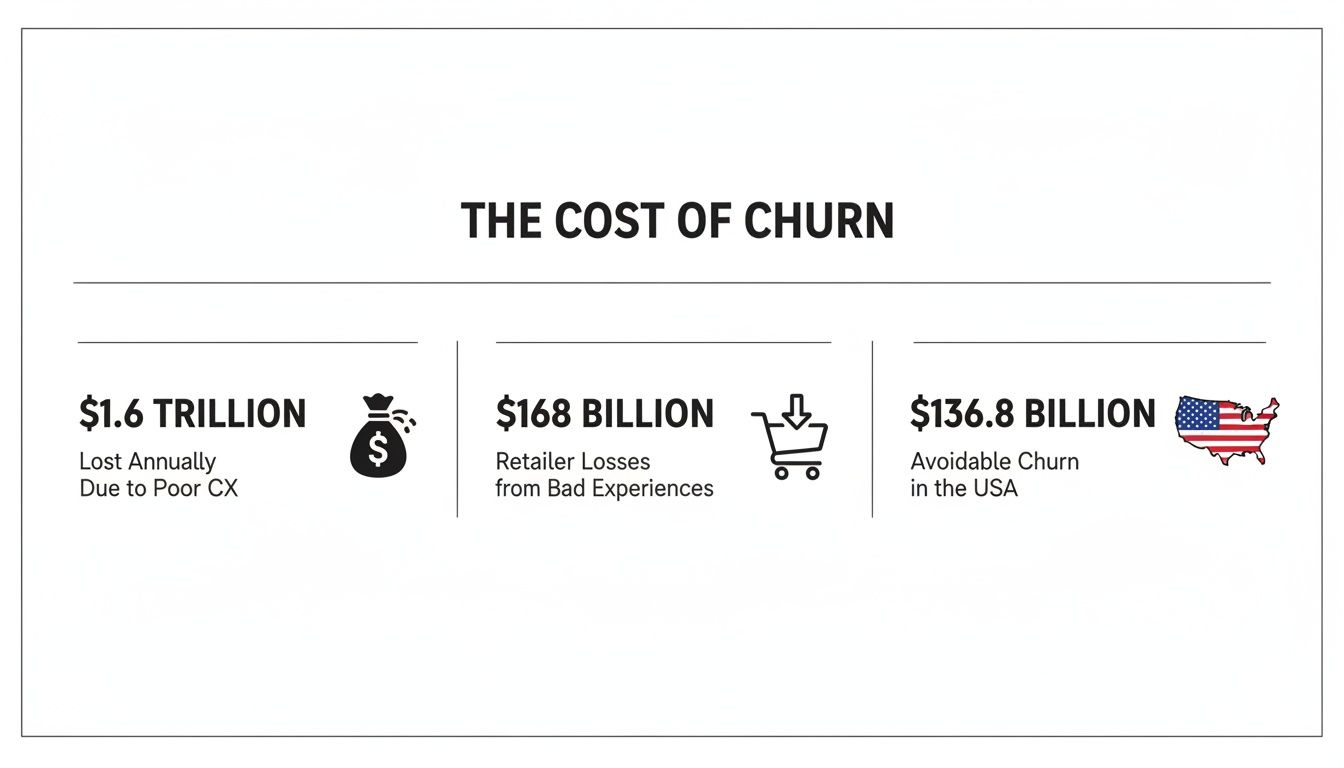
The financial hit from customer churn is one of the biggest hurdles businesses face today. The numbers are almost hard to believe. Globally, companies lose a staggering 1.6 trillion every single year because customers walk away. In the US alone, businesses are bleeding ****136.8 billion annually from churn that could have been prevented.
This infographic really puts those massive losses into perspective.
These aren't minor expenses we're talking about. Churn is a direct threat to your profitability and long-term stability.
It’s easy to dismiss a small monthly churn rate, but the corrosive effect over a year is massive. A seemingly tiny leak can sink the whole ship if left unattended.
Here’s a quick look at how a small monthly churn rate can snowball into a huge annual loss of your customer base.
How Monthly Churn Compounds into Annual Customer Loss
| Monthly Churn Rate | Equivalent Annual Customer Loss |
|---|---|
| 1% | 11.4% |
| 2% | 21.5% |
| 3% | 30.6% |
| 5% | 46.0% |
| 8% | 65.0% |
As you can see, even a "good" churn rate of 1-2% a month means you're losing between a tenth and a fifth of your customers every year. That’s a serious headwind for any growth plan.
Why Retention Is Your Strongest Growth Lever
While the cost of losing customers is steep, the payoff for keeping them is even better. Happy, long-term customers are the foundation of any sustainable business. Here’s why:
- It’s Cheaper: Bringing in a new customer can cost five times more than holding onto an existing one. Putting your effort into retention just makes good financial sense.
- They Spend More: A small 5% bump in customer retention can increase your profits by anywhere from 25% to 95%. Loyal customers buy more, upgrade more often, and aren't as sensitive to price changes.
- Predictable Revenue: A solid base of retained customers gives you a reliable, recurring revenue stream. This makes everything from forecasting to strategic planning easier and is directly tied to a higher SaaS customer lifetime value.
By shifting from reactive problem-solving to proactive value creation, you transform churn from a liability into a strategic advantage. This is how you build a resilient, high-growth SaaS business.
Diagnosing the Real Reasons Customers Leave
Before you can fix your churn problem, you have to play detective. Customers rarely give you the real reason they’re leaving. Vague excuses like "budget cuts" or "changing priorities" are usually just polite ways of avoiding a difficult conversation. They're symptoms, not the root cause. To actually fix the leak, you have to trace it back to the source.

Think of it like being a doctor. You wouldn't prescribe a treatment just because a patient says they "feel unwell." You’d run tests and ask targeted questions to figure out what’s really going on. Your job is to look past the surface-level cancellation reasons and uncover the specific, actionable gaps in your customer experience.
The best way to get to the bottom of it is through a comprehensive behavioral churn analysis. This process goes way beyond exit surveys to examine how your users' actions—or lack thereof—tell the true story.
The Three Controllable Churn Drivers
While every business is different, the root causes of churn often fall into just a few predictable buckets. The good news? Research shows that over half of all churn is preventable and can be traced back to a handful of operational failures. These aren't mysterious forces; they are specific moments where the customer journey simply breaks down.
Data reveals that a whopping 53% of churn stems from just three controllable factors. A clunky onboarding process is responsible for 23%, a lack of ongoing relationship-building causes another 16%, and poor customer service drives away the final 14%.
This is fantastic news, really. It means that by focusing your efforts on these three core areas, you can tackle the majority of issues that push customers out the door.
Problem One: A Confusing Onboarding Process
The first 90 days are everything. If users don't get a quick, meaningful win—that "aha!" moment—they'll struggle to see any long-term value in your product. A confusing, complicated, or unguided onboarding experience is the fastest way to lose a customer who was once genuinely excited to sign up.
This is where the promise of your marketing meets the cold reality of your product.
A customer's initial experience sets the tone for the entire relationship. If they feel confused or abandoned during onboarding, they will assume that's the level of support they can expect moving forward, making churn a near certainty.
Friction at this stage usually looks something like this:
- Unclear Next Steps: Users log in for the first time, look around, and have no idea what to do to get value.
- Information Overload: The product throws every single feature at them at once, leading to analysis paralysis.
- Lack of Proactive Guidance: There are no in-app tours, checklists, or welcome emails to guide them toward that first taste of success.
Problem Two: A Lack of Ongoing Relationship Building
Once a customer is successfully onboarded, many companies make a fatal mistake: they go silent. They stop communicating unless there’s a problem to solve or a bill to pay. This purely transactional approach makes customers feel like a line item on a spreadsheet, not a valued partner.
Without consistent engagement, your product slowly fades into the background. Customers forget why they signed up, they miss out on new features that could solve their problems, and eventually, they just drift away. Proactively building that relationship is absolutely essential for keeping churn down in the long run.
A proactive strategy is all about consistent, value-added communication. This isn't about spamming their inbox with marketing fluff. It’s about helping them get more out of the product they're already paying for. When you better understand how to analyze customer feedback, you can tailor this communication to what they actually need.
Problem Three: Reactive Customer Service
The final major churn driver is a customer service model that only reacts to problems instead of preventing them. By the time a customer has to reach out for help, they're already feeling friction. If that support experience is slow, unhelpful, or requires multiple follow-ups, it just deepens their frustration and erodes their trust.
Poor service is a churn accelerant. A single bad support interaction can undo months of goodwill. This is especially true when customers feel like they aren't being heard or that their feedback is just going into a black hole. Modern support isn't about closing tickets—it's about making customers feel understood and valued.
Turning Customer Data into Actionable Insights

Knowing your churn rate is like knowing your bucket has a leak. It’s a start, but it doesn’t help you patch the hole. To do that, you need to understand why it's leaking. That’s the difference between knowing a crime happened and having the fingerprints and motive needed to actually solve it. This is where modern product intelligence becomes your best detective.
Let's be honest, your business is probably drowning in raw data—usage logs, support tickets, survey responses, feature requests, you name it. Each piece is a potential clue, but trying to connect them all manually is a recipe for disaster.
This is exactly why you need to move beyond basic dashboards. A product intelligence platform acts as a translator, turning that chaotic stream of information into a clear, prioritized roadmap for reducing customer churn.
Uncovering the Hidden Churn Signals
Customers almost never send a formal announcement before they churn. Instead, they leave a trail of breadcrumbs—subtle churn signals that show they’re slowly disengaging. Think of them as the early tremors before an earthquake; they’re your warning that something big and bad is on the horizon.
Trying to spot these tremors by hand is like trying to hear a single whisper in a packed stadium. It's just not going to happen. AI-driven platforms, on the other hand, can sift through millions of data points to spot these patterns in a heartbeat.
Some of the most common churn signals include:
- Decreased Product Usage: A steady drop-off in logins or time spent in your app is one of the oldest and most reliable predictors of churn.
- Neglecting Core Features: If a customer stops using the key features that deliver your product's core value, it’s a massive red flag. They're no longer seeing the ROI.
- A Spike in Support Tickets: A sudden flood of bug reports or help requests, especially from a long-time power user, often points to mounting frustration.
- Changes in Support Language: AI can analyze sentiment, flagging when a customer's tone shifts from constructive to negative, impatient, or downright angry.
These signals give you the "why" behind the numbers, giving you a fighting chance to step in before it’s too late.
Connecting What Customers Do with What They Say
The real magic happens when you bring two very different types of data together: what people do and what people say.
- Quantitative Data (The "What"): This is the hard evidence—login frequency, feature adoption rates, clicks, and session times. It tells you exactly how people are using your product.
- Qualitative Data (The "Why"): This is the human context—the feedback buried in support tickets, survey comments, sales call notes, and reviews. It explains why they behave the way they do.
A platform like SigOS is built to bridge this gap. It won’t just tell you a customer’s usage has dropped (quantitative). It can instantly correlate that drop with a recent support ticket where they complained about a critical bug (qualitative), immediately pointing to the root cause of their disengagement.
This kind of analysis allows you to finally quantify qualitative feedback, tying specific complaints and feature requests directly to revenue at risk.
Without this connection, you're flying blind. You might sink thousands of dollars into building a new feature everyone says they want, only to see it have zero impact on retention because the real problem was a persistent bug annoying your highest-value customers.
From Insight to Proactive Action
Once you have these unified insights, your whole retention strategy can shift from reactive to proactive. Instead of waiting for the cancellation email to land in your inbox, you can take specific, data-backed steps to prevent it from ever being sent.
Imagine a product intelligence tool flags an account with a declining health score. You dig in and see their usage of a key reporting feature has flatlined. The system also surfaces a support chat from two weeks ago where they called the feature "confusing."
Suddenly, you have a playbook.
- Reach Out Intelligently: Your customer success manager can email them, not with a generic "Just checking in!" but with something targeted: "I noticed you haven't used the reporting feature lately. We just published a new guide that simplifies the process—mind if I walk you through it?"
- Fix the Real Problem: The product manager sees this isn't an isolated incident and creates a high-priority ticket to improve the feature's usability for everyone.
- Prevent Future Churn: The system learns that a drop-off in this specific feature is a strong churn predictor, so it can flag other at-risk accounts much earlier next time.
This is how you scale retention. You build an automated, insight-driven workflow that creates a product customers can't imagine leaving.
Getting Ahead of Churn with Proactive Retention Strategies

Alright, you’ve dug into the data and have a good idea of why customers are leaving. Now comes the real work: shifting from simply analyzing churn to actively preventing it.
Reactive "save" attempts are a losing game. The real win comes from a proactive playbook that tackles problems long before a customer even thinks about canceling. The best retention strategies aren't about last-ditch offers; they're about weaving value and loyalty into the entire customer experience, from day one.
This isn't just one team's job. It requires a coordinated push focused on three critical areas: nailing the onboarding experience, keeping customers engaged for the long haul, and turning your support team into a retention powerhouse. Each one directly counters the common reasons customers churn, creating a powerful defense against attrition.
Redesigning Your Onboarding for an Instant "Aha!" Moment
A customer's first few interactions with your product are make-or-break. If their onboarding is confusing or fails to deliver on your marketing promises, they'll check out mentally (and physically) before they ever discover that "aha!" moment.
Your goal isn't to show them every single feature. It's to guide them to their first quick win.
- Create a "First Win" Checklist: Guide new users through the 3-5 absolute must-do steps to get their first taste of success. This builds immediate momentum and proves your product's value right out of the gate.
- Personalize the Path: Use what you know about a customer's role or industry to tailor their onboarding. An e-commerce manager has different priorities than a finance director, so their starting points should reflect that.
- Offer a Human Touch: Don't wait for them to hit a wall. An automated email with a helpful tip triggered by their behavior, or even a quick, optional onboarding call, can make all the difference.
A thoughtful onboarding process turns a fresh signup into an activated user who sees the value and sticks around.
Building Proactive Customer Engagement Programs
The biggest mistake companies make after onboarding is going quiet. Reaching out only when the renewal is due makes the relationship feel purely transactional, and customers feel like a number on a spreadsheet.
Proactive engagement keeps the conversation going and constantly reminds them why they chose you in the first place. For a deep dive into building these relationships, it’s worth exploring various proactive churn marketing strategies that focus on early warning signs and intervention.
The best retention programs don't just react to disengagement. They create a steady stream of value that embeds the product into a user's daily workflow, making it indispensable.
A solid engagement program isn't random; it's strategic.
- Lifecycle-Based Communication: The messages you send should match where the customer is in their journey. A 90-day-old user might be ready for an advanced features webinar, while a customer celebrating their one-year anniversary could benefit from a personalized business review.
- Celebrate Their Wins: Acknowledge customer milestones. A simple automated message like, "Congrats on creating your 100th report!" makes users feel seen and reinforces the value they're getting.
- Share What's New and What's Next: Keep users in the loop with product updates and best-practice guides. It shows you’re committed to their success and constantly improving the tool they rely on.
Turning Customer Service into a Retention Engine
Great customer service isn't just a nice-to-have anymore; it's a core retention strategy. Your support team is on the front lines, where a single frustrating interaction can undo months of goodwill. The goal is to shift their mindset from just closing tickets to proactively solving problems and building trust.
The impact here is huge and directly measurable. Think about it: research shows that 56% of consumers have walked away from a company simply because of a bad service experience. On the flip side, when you solve an issue on the first try, you can reduce churn by as much as 67%. This proves that fast, empathetic support is one of the most powerful retention tools you have.
To transform your support team into a retention machine, you need a clear game plan.
Here's a quick summary of high-impact tactics that can really move the needle on your retention efforts.
High-Impact Tactics for Reducing Customer Churn
| Tactic | Primary Goal | Key Success Metric |
|---|---|---|
| First-Contact Resolution | Solve the customer's issue in a single interaction without transfers or escalations. | First-Contact Resolution (FCR) Rate |
| Proactive Support Outreach | Use data to identify struggling users and offer help before they ask for it. | Reduction in inbound support tickets from at-risk accounts. |
| Closing the Feedback Loop | Follow up with customers after an issue is resolved to ensure they are satisfied and share how their feedback is being used. | Customer Satisfaction (CSAT) Score |
By focusing on these proactive strategies across onboarding, engagement, and support, you’re not just plugging leaks. You’re building a framework that turns satisfied customers into your most loyal advocates.
Building a Modern Churn Reduction Workflow
Knowing the theories behind churn reduction is one thing. Actually putting them into a scalable, repeatable process is a whole different ballgame. This is where modern tools and automated workflows come in, turning a chaotic flood of customer feedback into a focused, revenue-driven roadmap. The goal isn't just to analyze data manually; it's to build a system that does the heavy lifting for you.
To make this feel real, let's walk through a day in the life of a product manager who’s using a product intelligence platform. This isn't about piling more work onto your plate. It's about making the work you already do smarter and a lot more impactful.
Starting the Day with Revenue-Focused Priorities
Imagine starting your morning not with a panic-inducing inbox, but with a clear, prioritized dashboard. Instead of digging through dozens of support tickets and scattered feature requests, you see a concise list of the most critical issues hitting your customers, already sorted by revenue impact.
This is the magic of an AI-driven system. It connects the dots between what customers are saying (qualitative feedback) and what they're doing (behavioral data).
- Top Churn Drivers: The dashboard flags a bug in the reporting module that's frustrating three high-value enterprise accounts. Together, they represent $250,000 in annual recurring revenue. Ouch.
- Key Expansion Opportunities: It also highlights a feature request for a new integration. This has come up in sales calls with multiple late-stage prospects, representing a potential $150,000 in new business.
- Emerging Patterns: A real-time alert shows a small but growing number of users on your mid-tier plan are suddenly hitting a wall with a specific workflow. This could be a small onboarding snag that, if ignored, could snowball into a major problem.
By quantifying the dollar value of every bug, complaint, and feature request, you can instantly see where your development resources will have the greatest financial impact. This shifts your roadmap from being opinion-based to being data-driven.
Turning Insights into Action in Minutes
With these priorities crystal clear, the next step is to act. A modern workflow automates the tedious, manual parts of this process. Right from the dashboard, the product manager can take immediate, integrated actions.
For that high-impact reporting bug, they click a button to create a development ticket in a tool like Jira or Linear. The ticket is automatically pre-populated with all the context an engineer needs:
- Linked Customer Evidence: It includes direct links to the exact support tickets, chat transcripts, and customer call snippets where the issue was reported.
- Revenue at Risk: The ticket is tagged with the $250,000 ARR from the affected accounts, giving engineers instant clarity on its business priority.
- Behavioral Context: It also pulls in usage data showing a sharp nosedive in feature adoption among these accounts right after the bug appeared.
This whole process takes less than five minutes. The engineering team now has a complete picture—the problem, its urgency, and the specific customers it affects. This cuts out the endless back-and-forth that so often slows development to a crawl. The foundation of this kind of automated intelligence comes from knowing how to build a predictive churn model.
A Real-World Intervention Example
Later that day, the system sends an alert. It’s correlated a recent spike in bug reports about API timeouts with a sudden drop in product usage from a high-value account that renewed just two months ago. Their "customer health score" has plummeted.
This is a classic churn signal that would be nearly impossible to spot manually in real-time.
Armed with this specific insight, the customer success manager can intervene proactively and effectively. They don’t send a generic "just checking in" email. Instead, they reach out with a targeted message that gets straight to the point:
"Hi Alex, we've identified an API performance issue that may be impacting your team's workflow. Our engineers are deploying a fix tonight, and I'll notify you the moment it's live."
This simple action transforms a potentially churn-inducing frustration into a trust-building moment. The customer feels heard and valued because you found their problem before they even had to complain. This is how an automated workflow doesn't just reduce customer churn—it protects revenue and strengthens relationships at scale.
The End Game: Turning Churn into Your Growth Engine
We've covered a lot of ground, from digging into the real "why" behind customer churn to setting up proactive, automated retention plays. If there's one thing to take away, it's this: real, sustainable growth isn't about frantically pouring more leads into the top of the funnel. It's about obsessing over the customers you've already earned.
When you make that mental shift, churn stops being a frustrating cost you have to swallow. Instead, it becomes your single biggest opportunity for strategic growth.
This isn't just about a new tactic or a piece of software; it's a commitment to embedding retention into the very fabric of your company. You have to listen intently, act decisively on the data you gather, and treat every single customer touchpoint—from the first login to a support ticket—as a chance to reinforce your value.
The most resilient businesses don't see retention as a defensive tactic to plug a leaky bucket. They see it as their primary growth engine. It's the best long-term investment you can possibly make.
By adopting a proactive, data-informed mindset, you get out of the reactive, fire-fighting mode that drains so many teams. You start building an army of loyal customers who not only drive predictable revenue but also become your most passionate advocates.
There's no better way to protect your bottom line and build a business that can weather any storm. The work starts now. Make retention your most powerful lever for growth.
Common Questions We Hear About Churn
If you're leading a SaaS team, you've probably wrestled with these questions about customer churn. It's a topic that comes up constantly because getting it right is fundamental to protecting your revenue. Let's walk through some of the most common questions and get you some clear, practical answers.
What’s a Good Churn Rate for a SaaS Company?
The honest answer is: it depends. A "good" churn rate isn't a one-size-fits-all number; it's all about who you sell to and how mature your business is.
For early-stage companies selling to SMBs, a monthly churn of 3-5% might be perfectly normal. But if you're an established business serving large enterprise accounts, you should be aiming for less than 1%.
The number itself isn't the whole story, though. What really matters is the trend. Is your churn rate going down over time? That’s the real goal. It's also critical to look beyond just the customer count (logo churn) and focus on revenue churn (MRR churn). Losing one huge account can sting a lot more than losing ten tiny ones.
How Can We Predict Which Customers Are About to Churn?
Predicting churn is all about spotting the warning signs before it's too late. Think of it as looking for digital breadcrumbs that customers leave when they're starting to drift away.
These signals are often behavioral. You might see a noticeable drop in how often they log in, fewer active users on their team, or they stop using the core features that once made your product sticky. A sudden flood of support tickets can also be a red flag.
Don't forget the qualitative clues, either. Negative feedback in a survey or a frustrated tone in a support chat can be just as telling as any usage metric.
This is where AI-powered product intelligence really shines. These platforms sift through all this data automatically, spotting subtle patterns that are invisible to the human eye. By correlating current behaviors with past churn events, they can flag at-risk customers early, giving your team a crucial heads-up to step in and help.
What's the Difference Between Voluntary and Involuntary Churn?
It’s essential to know why a customer leaves, and it usually falls into one of two buckets.
- Voluntary Churn: This is the one that keeps founders up at night. The customer actively chooses to cancel their subscription. It could be because they’re unhappy with the product, a competitor wooed them away, or they had a bad support experience.
- Involuntary Churn: This is churn by accident. It’s almost always caused by a failed payment—an expired credit card, a bank decline, or some other processing hiccup. The customer didn't mean to leave.
Tackling voluntary churn demands a deep look at your product, onboarding, and customer service. But you can often solve involuntary churn with simple, tactical fixes. Think automated payment reminders, in-app alerts for expiring cards, and offering more ways to pay. It's the low-hanging fruit of churn reduction.
Ready to turn messy customer feedback into a clear, revenue-focused roadmap? With SigOS, you can automatically see which bugs and feature requests are actually costing you money. It helps you prioritize your development work around what will truly keep customers happy and subscribed.
Keep Reading
More insights from our blog
Ready to find your hidden revenue leaks?
Start analyzing your customer feedback and discover insights that drive revenue.
Start Free Trial →