7 SaaS Sample User Journey Maps to Drive Growth in 2026
Explore 7 detailed SaaS sample user journey examples. Learn how to map behavioral signals to drive retention, prioritize features, and increase revenue.

In the competitive SaaS landscape, understanding what users truly want is the difference between market leadership and obsolescence. Traditional user journey maps are often static, based on assumptions and qualitative interviews. They offer a good starting point, but often lack the dynamic, real-time data needed to drive meaningful action. For a foundational understanding, exploring a comprehensive practical guide to user journey mapping can be incredibly useful.
But what if you could see the hidden signals in user behavior that directly correlate with revenue? This article moves beyond theory, presenting seven actionable sample user journey maps designed for key SaaS personas. We'll break down how to identify critical touchpoints, behavioral signals, and the key metrics that matter, transforming reactive problem-solving into a proactive growth engine.
This is not just about mapping paths; it's about connecting user actions to business results. We will explore how platforms like SigOS use AI-driven intelligence to quantify the dollar value of bugs and feature requests, enabling teams to prioritize what truly impacts churn and expansion. Get ready to build journeys that don't just guide users, but actively drive measurable business outcomes.
1. The Reactive Support Manager Discovering Revenue Impact
This sample user journey maps the transformation of a support leader from a reactive, ticket-focused manager to a proactive, revenue-centric strategist. Traditionally, support teams are measured by metrics like response time and ticket volume, often disconnected from broader business outcomes. This journey begins when the manager realizes their team is a cost center, unable to prioritize issues based on their financial impact.
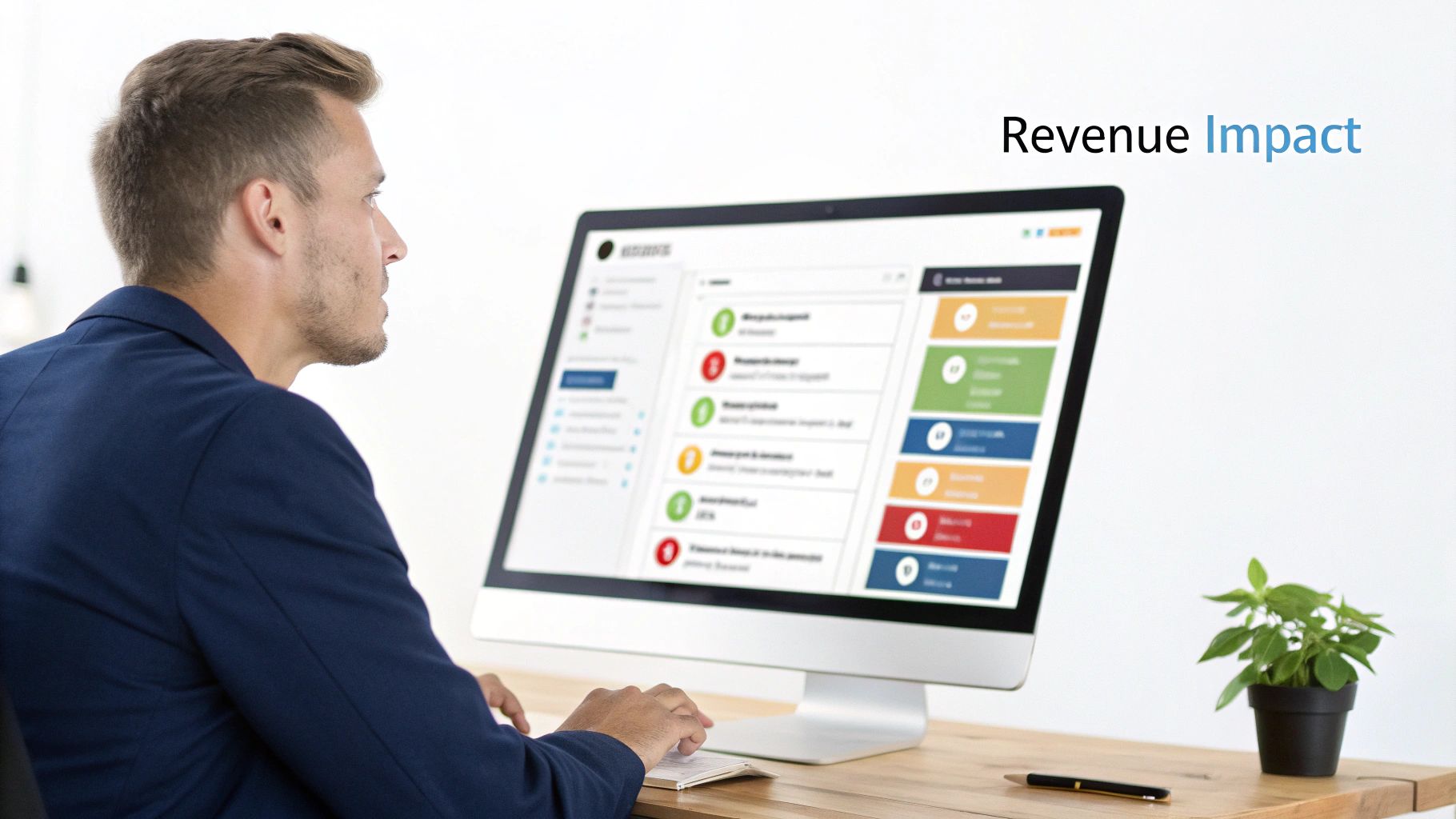
The shift occurs when they adopt a system like SigOS, which connects support tickets to customer health and revenue data. Instead of seeing a flood of undifferentiated tickets, the manager now sees a prioritized list where each issue is scored by its potential to cause churn. This visibility allows them to escalate high-impact problems to product and engineering teams with hard data, turning support into a critical source of product intelligence and revenue protection.
Strategic Analysis and Application
This journey is crucial for SaaS companies aiming to align their support operations with business growth. By quantifying the financial consequences of bugs and usability issues, support managers can justify resource allocation, influence the product roadmap, and demonstrate their department's value beyond simple ticket resolution.
Key Insight: Connecting support activity to revenue data transforms a support team from a reactive cost center into a proactive revenue-retention engine. This strategic shift empowers support leaders to advocate for product improvements with data-backed business cases.
For example, a support manager might discover that a seemingly minor bug in the onboarding flow is correlated with 15% of all new-user churn. Armed with this insight, they can present a clear business case to the product team, elevating the issue from a low-priority bug to a critical growth blocker.
Actionable Takeaways
To implement this user journey in your organization, follow these steps:
- Initial Audit: In your first week using a tool like SigOS, identify the top five churn-correlated support issues. This provides an immediate, high-impact starting point.
- Establish a Cadence: Create a weekly or bi-weekly meeting with product leadership to share these data-driven insights. This ritual ensures support’s findings consistently inform product priorities.
- Contextualize Priorities: Use the revenue impact data in support team training. Helping agents understand the financial context of tickets empowers them to escalate and handle issues more effectively.
- Report on Success: Export reports demonstrating support-driven revenue protection and share them in executive presentations to showcase the team's direct contribution to the bottom line.
2. The Data-Driven Product Manager Validating Feature Prioritization
This sample user journey details how product managers can shift from subjective, opinion-based roadmapping to a process driven by behavioral intelligence and revenue data. Product leaders often face the challenge of prioritizing features based on anecdotal feedback or internal politics. This journey begins when a product manager seeks a definitive way to validate feature requests against actual customer needs and their direct financial impact.
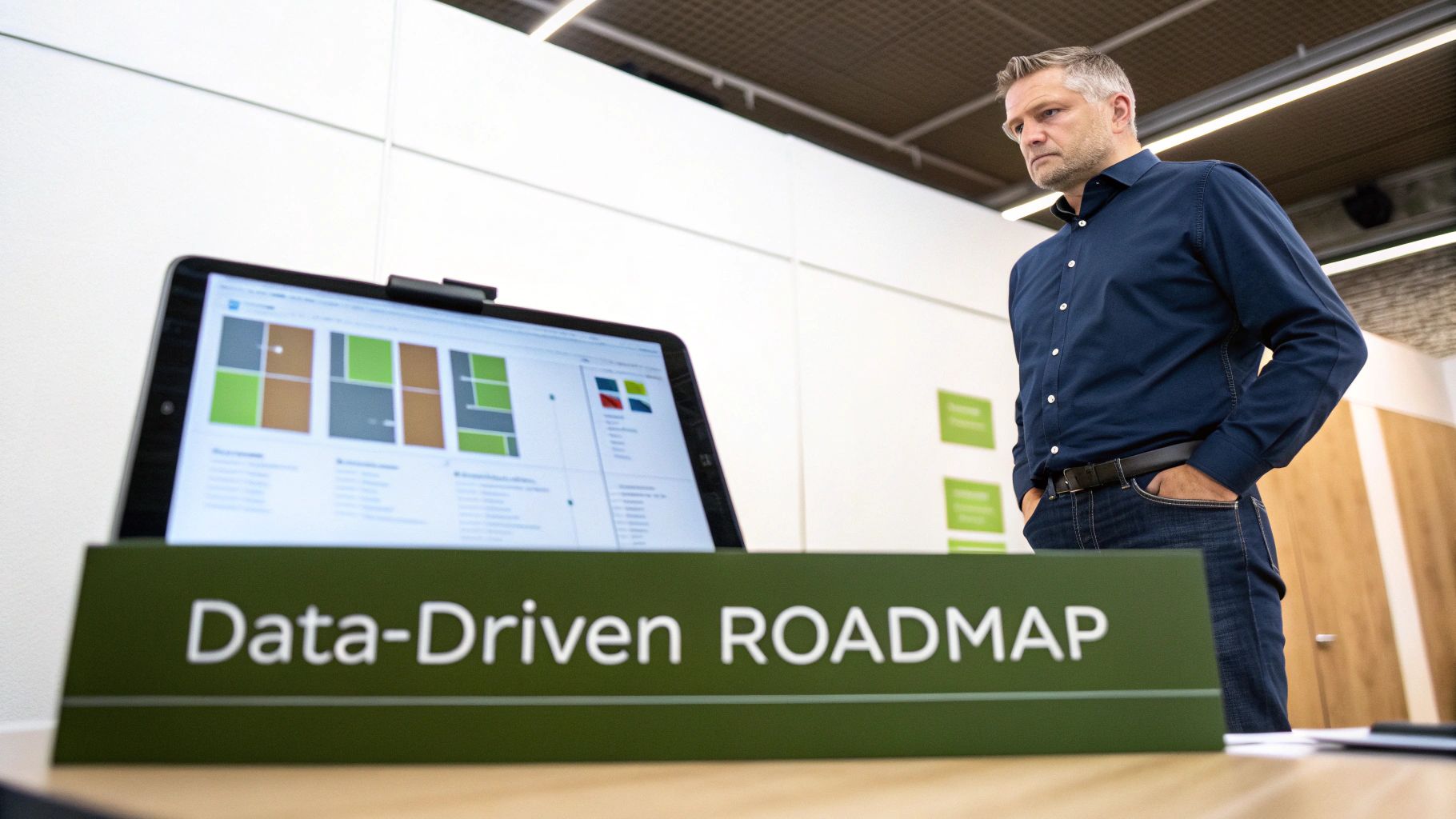
The transformation happens when they use a system like SigOS to analyze which feature requests correlate with expansion opportunities versus churn risk. Instead of guessing which features will move the needle, the PM’s morning dashboard becomes a source of truth. They can clearly see which missing functionalities are blocking new deals or causing existing customers to leave, enabling precise, data-backed prioritization.
Strategic Analysis and Application
This journey is essential for product-led growth companies that need to ensure their development resources are focused on the highest-impact initiatives. By connecting feature requests to revenue, product managers can de-risk their roadmap and build a strong business case for every decision. This approach transforms product management from an art into a science.
Key Insight: Linking customer feature requests to behavioral signals and revenue data allows product teams to prioritize development based on quantifiable business outcomes, not just qualitative feedback. This turns the product roadmap into a strategic tool for driving growth and retention.
For instance, a B2B SaaS product manager might discover that requests for API batch operations have come from eight high-value prospect companies, representing a potential $2.4M in new ARR. Conversely, they might find that the absence of a key integration correlates with 22% of churn in their mid-market segment. Properly framed examples of user stories can then be built around this data.
Actionable Takeaways
To implement this user journey in your product organization, follow these steps:
- Build a Cadence: Establish a weekly feature prioritization review meeting centered around insights from your SigOS dashboard.
- Create Decision Frameworks: Combine revenue impact data with your long-term strategic vision to create a balanced and defensible prioritization model.
- Align with Sales: Share SigOS patterns showing expansion opportunities with sales teams to help them validate and close deals based on upcoming features.
- Track and Build Trust: Monitor the correlation accuracy of AI-driven recommendations over time to build confidence across the product and engineering teams.
3. The Growth Leader Identifying Expansion Triggers and Upsell Moments
This sample user journey details how a growth leader shifts from generic upsell campaigns to a data-driven expansion strategy. Traditionally, growth teams rely on broad signals like company size or contract renewal dates to time their upsell pitches. This journey begins when a leader realizes these methods are inefficient and miss crucial behavioral cues indicating a customer is ready to expand.
The transformation occurs when they leverage a platform like SigOS to analyze deep usage patterns and feature requests. Instead of guessing, the leader can now identify specific behaviors that strongly correlate with expansion revenue. They discover which features unlock high-value deals and what usage patterns signal that a customer is outgrowing their current plan. This allows them to coordinate with sales on perfectly timed outreach and guide product teams on prioritizing features that directly fuel growth.
Strategic Analysis and Application
This journey is vital for SaaS businesses focused on maximizing customer lifetime value and net revenue retention (NRR). By pinpointing precise expansion triggers, growth leaders can create highly effective, targeted sales plays and customer success motions. This data-driven approach ensures that sales efforts are focused on accounts with the highest propensity to upgrade, increasing efficiency and conversion rates.
Key Insight: Analyzing granular user behavior to find expansion triggers transforms a growth strategy from reactive and generalized to proactive and personalized. This alignment between customer needs and sales outreach creates a smoother, more successful upsell experience.
For example, a product analytics company might discover through SigOS that customers who enable real-time collaboration features have a 3.2x higher expansion rate. Or, a growth team might find that 12 enterprise prospects have explicitly requested advanced permission management, representing a $4M expansion opportunity. This insight moves the feature from the backlog to a top priority.
Actionable Takeaways
To replicate this user journey within your growth team, follow these steps:
- Initial Audit: In the first week, identify the top three user behaviors that correlate with historical account expansions. These are your initial high-probability triggers.
- Establish a Cadence: Create weekly expansion opportunity briefs for sales leadership, highlighting accounts that have recently displayed these trigger behaviors.
- Develop Playbooks: Build specific sales and customer success playbooks around your top expansion triggers. For instance, create a dedicated outreach sequence for when a team hits 90% of its user seat limit.
- Align Incentives: Connect the patterns discovered in SigOS to sales compensation. Rewarding reps for acting on these data-driven signals ensures strong alignment and execution.
4. The Churn-Prevention Customer Success Leader Acting on Early Warnings
This sample user journey details how a Customer Success (CS) leader transitions from reactive account management to proactive, data-driven churn prevention. Many CS teams operate in a "firefighting" mode, only engaging with customers when an issue is escalated or a renewal is at risk. This journey begins when a CS leader realizes they lack the early warning signals needed to identify and save at-risk accounts before they disengage.

The transformation occurs by implementing a system like SigOS, which provides real-time alerts based on behavioral data, support ticket patterns, and feature adoption gaps. Instead of waiting for a customer to complain, the CS leader receives notifications when an account exhibits behaviors that predict churn. For example, they might discover that customers who fail to use a specific high-value feature within 60 days of onboarding churn at a rate 3.8 times higher than the baseline.
Strategic Analysis and Application
This journey is vital for any subscription-based business where customer retention is paramount. By leveraging predictive analytics, CS leaders can prioritize their team's efforts on accounts that need immediate attention, armed with specific context about why the customer is at risk. This proactive approach not only prevents revenue loss but also strengthens customer relationships and provides invaluable feedback to the product team about friction points in the user experience.
Key Insight: Proactive churn prevention is driven by identifying leading indicators of risk, not lagging indicators like cancellation requests. Early-warning systems empower CS teams to intervene with targeted, helpful actions that address root causes before they become irreversible.
A CS leader could use an alert from a platform like SigOS to schedule a proactive check-in with a customer who has stopped using a key reporting feature. Rather than a generic "how are things going?" call, the CSM can offer specific training on that feature, uncover a previously unreported bug, or identify a new use case, effectively re-engaging the customer and mitigating the churn risk.
Actionable Takeaways
To implement this user journey in your CS organization, follow these steps:
- Establish Alert SLAs: Define clear service-level agreements for how quickly CSMs must respond to high-risk churn alerts, ensuring timely intervention.
- Build Churn Playbooks: Develop standardized playbooks for the top 3-5 churn patterns identified by your system. This equips your team with consistent, effective responses for common risk scenarios.
- Measure Intervention Impact: Correlate CS activities triggered by alerts with actual retention rates to measure the effectiveness of your playbooks and refine your strategy. You can learn more about how the best predictive analytics software makes this possible.
- Close the Product Feedback Loop: Share insights on churn patterns with the product team to help them address and eliminate the root causes of customer friction.
5. The Technical CTO Translating Customer Behavior into Engineering Priorities
This sample user journey details how technical leaders can bridge the gap between customer behavior and engineering priorities. Traditionally, CTOs and engineering managers rely on product management to translate customer needs into technical specifications. This journey begins when a CTO realizes their team's roadmap is driven by qualitative feedback and feature requests, lacking a direct, data-backed link to business outcomes like revenue retention and expansion.

The transformation happens when they integrate a platform like SigOS to correlate technical performance issues with financial metrics. Instead of just tracking error rates or system latency, the CTO can now see which API limitations, database query inefficiencies, or integration gaps directly cause churn or block expansion revenue. This empowers engineering to prioritize work that not only improves the product's technical foundation but also delivers measurable business impact.
Strategic Analysis and Application
This journey is essential for technology-led companies where the line between product performance and business success is razor-thin. By translating user behavior into quantifiable engineering priorities, CTOs can allocate resources more effectively, justify technical debt repayment with clear ROI, and ensure the engineering team is a direct driver of growth.
Key Insight: Connecting technical performance data to customer revenue transforms engineering from a feature-delivery function into a strategic business partner. This allows CTOs to build a business case for infrastructure improvements, architectural changes, and bug fixes based on their direct financial impact.
For instance, a CTO might discover that consistent API rate-limit errors are correlated with an 18% failure rate for expansion deals in the enterprise segment. This insight elevates a "technical issue" into a critical revenue blocker, justifying the immediate allocation of senior engineering resources to redesign the API's scaling architecture.
Actionable Takeaways
To implement this user journey in your organization, follow these steps:
- Initial Audit: In your first week, use a tool like SigOS to identify technical events (e.g., API errors, slow page loads) most correlated with failed payments or contract downgrades.
- Establish a Cadence: Create a weekly engineering prioritization review where you use revenue impact data to stack-rank the backlog. This shifts conversations from "what's urgent" to "what's valuable."
- Contextualize Priorities: Develop a scoring framework that combines revenue impact with factors like technical debt. This helps balance immediate business needs with long-term platform health.
- Report on Success: Track the reduction in churn or increase in expansion revenue tied to specific engineering initiatives. Use these reports to justify headcount requests and demonstrate the team's ROI to leadership.
6. The Data Analyst Discovering Hidden Customer Behavior Patterns
This sample user journey follows a data analyst transitioning from manual, time-intensive report building to automated, AI-driven pattern discovery. Traditionally, an analyst might spend weeks running complex queries and joining disparate data sources to find correlations between user actions and business outcomes. Their work, while valuable, is often reactive and constrained by the hypotheses they can test manually.
The journey shifts when the analyst adopts a system like SigOS, which automates the discovery of hidden patterns across support tickets, usage data, and chat logs in real-time. Instead of searching for answers, the analyst is presented with statistically significant correlations, such as discovering that users who have three or more support tickets in their first 30 days churn at a 4.1x higher rate. This frees them to focus on validating, contextualizing, and communicating these high-value insights to stakeholders.
Strategic Analysis and Application
This journey is critical for data-driven organizations that want to move from hindsight to foresight. By automating the grunt work of pattern discovery, analysts can operate more strategically, uncovering unexpected opportunities and risks that manual analysis would miss. For data analysts aiming to truly understand how users interact with a product and uncover hidden customer behavior patterns, leveraging tools like efficient session replay software is crucial.
Key Insight: Automating pattern discovery transforms a data analyst's role from a reactive report-builder to a proactive strategic advisor. They become the bridge between raw data patterns and actionable business strategy, accelerating the company’s ability to respond to customer needs.
For instance, an analyst using SigOS might find an unexpected correlation between low usage of a specific API endpoint and higher enterprise expansion rates. This counterintuitive insight could lead the product team to investigate whether that API is overly complex, prompting a simplification that ultimately drives more revenue.
Actionable Takeaways
To empower your data analysts through this journey, follow these steps:
- Establish a Cadence: Set up a weekly meeting where analysts present newly discovered patterns from SigOS to product and customer success teams for validation and brainstorming.
- Automate Communication: Build dashboards that automatically surface the top patterns identified by the system, making insights accessible to non-technical stakeholders.
- Document and Prioritize: Create a clear process for documenting patterns, distinguishing between those that are merely informational and those that require immediate action. Learn more about the principles of AI-driven pattern recognition.
- Collaborate for Validation: Encourage analysts to work directly with support teams to add qualitative context to quantitative patterns, ensuring the insights are accurate and meaningful.
7. The Executive Leader Connecting Customer Behavior to Revenue and Strategic Decisions
This sample user journey details how C-level executives and board members shift from relying on siloed departmental reports to using unified behavioral intelligence for strategic decision-making. Executives often struggle to connect product performance, customer feedback, and support tickets directly to financial outcomes like ARR and retention. This journey begins when they can no longer accept lagging indicators and need a real-time, consolidated view of how customer behavior impacts revenue.
The transformation happens when they adopt a system like SigOS, which provides executive-level dashboards translating complex customer signals into clear business metrics. Instead of reviewing separate reports from sales, support, and product, they see a single source of truth showing how specific bugs, feature gaps, and usability issues correlate with churn risk and revenue leakage. This clarity empowers them to make confident, data-backed decisions on resource allocation and company priorities.
Strategic Analysis and Application
This journey is vital for leadership teams aiming to foster a data-driven culture and align the entire organization around customer-centric growth. By connecting product and customer experience directly to financial performance, executives can communicate progress to investors with confidence and set priorities that have a measurable impact on the bottom line. This approach eliminates guesswork and internal politics from the strategic planning process.
Key Insight: Translating low-level customer behaviors into high-level financial metrics gives executives the strategic clarity needed to steer the company. It transforms resource allocation from a debate based on opinions into a decision based on quantifiable revenue impact.
For instance, an executive team might discover through a SigOS dashboard that three specific bug clusters are responsible for $2.1M in annual revenue leakage. This insight allows them to justify an immediate, all-hands engineering response, a decision that would be difficult to make based on anecdotal support tickets alone.
Actionable Takeaways
To implement this user journey in your organization, follow these steps:
- Build Executive Briefings: In your first month, create a recurring executive briefing focused on the top three revenue-impact insights from SigOS. This establishes a new, data-driven rhythm for strategic discussions.
- Inform Investor Updates: Incorporate SigOS data into board meetings and investor updates to demonstrate a deep understanding of product-market fit and revenue drivers. Showcase how product improvements directly reduce churn.
- Connect to OKRs: Create company-level Objectives and Key Results (OKRs) directly tied to SigOS metrics, such as reducing churn correlated with specific feature gaps or increasing expansion revenue from high-engagement cohorts.
- Track Revenue Retention: Use dashboards to track quarter-over-quarter improvements in net revenue retention (NRR) that are directly attributable to data-informed product prioritization.
7-Role User Journey Comparison
| Persona | 🔄 Implementation complexity | ⚡ Resources & efficiency | 📊 Expected outcomes | 💡 Ideal use cases | ⭐ Key advantages |
|---|---|---|---|---|---|
| The Reactive Support Manager Discovering Revenue Impact | Medium — Zendesk integration and historical ticket mapping | Moderate resources; streamlines triage and prioritization | Quantified revenue impact of tickets, faster escalation of high‑impact issues | High‑volume support teams needing revenue visibility | Quantifies business cost of issues; enables data‑driven escalations |
| The Data‑Driven Product Manager Validating Feature Prioritization | Medium‑High — integrates with Linear/Jira and behavioral signals | Moderate‑High; reduces wasted dev effort and clarifies backlog | Revenue‑aligned roadmap, fewer low‑impact builds, identified expansion opportunities | PMs resolving roadmap debates and proving feature ROI | Validates feature requests with revenue signals; identifies six‑figure opportunities |
| The Growth Leader Identifying Expansion Triggers and Upsell Moments | Medium — requires sales and usage data integration | High coordination across sales/product; improves upsell timing and efficiency | Predictable expansion pipeline, early identification of upsell triggers | Growth teams aiming to scale upsell and account expansion | Enables proactive outreach; reveals high‑LTV behavioral triggers |
| The Churn‑Prevention Customer Success Leader Acting on Early Warnings | Medium — predictive scoring and real‑time alerting setup | Moderate; requires SLAs and fast CS response to be effective | Weeks‑ahead churn warnings, targeted interventions, reduced retention losses | CS teams focused on preventing churn in at‑risk cohorts | Provides advance warning and action recommendations; allocates CS resources effectively |
| The Technical CTO Translating Customer Behavior into Engineering Priorities | Medium‑High — GitHub/Linear + technical pattern correlation | Moderate‑High; demands engineering buy‑in but speeds prioritization | Engineering roadmap aligned to revenue impact; less political prioritization | CTOs justifying technical work with business metrics | Quantifies technical ROI; surfaces revenue‑impacting technical debt |
| The Data Analyst Discovering Hidden Customer Behavior Patterns | Low‑Medium — automated multi‑source pattern discovery | Low ongoing effort; cuts manual analysis time by ~70–80% | Rapid discovery of actionable correlations, faster hypothesis validation | Analytics teams needing fast, repeatable pattern detection | Automates discovery at scale; surfaces non‑obvious correlations for stakeholders |
| The Executive Leader Connecting Customer Behavior to Revenue and Strategic Decisions | Medium — cross‑team data aggregation and executive dashboards | Moderate; centralizes metrics for faster strategic decisions | Evidence‑based resource allocation, investor‑ready revenue narratives | C‑suite and boards needing quantified impact to set priorities | Aligns org around revenue metrics; quantifies ARR impact of product decisions |
Unlocking Your Revenue Potential, One Journey at a Time
Throughout this article, we’ve dissected seven distinct yet interconnected sample user journey narratives. From the Support Manager uncovering revenue impact to the CTO translating customer behavior into engineering priorities, each example illuminates a fundamental truth: your users are constantly communicating their needs, frustrations, and desires through their actions. The challenge has always been to listen at scale, filter the noise, and act decisively on the right signals.
The models we explored move beyond generic personas and into the realm of dynamic, data-driven journey mapping. They demonstrate that understanding a sample user journey is not a one-time exercise but a continuous process of observation, analysis, and action. By shifting from reactive problem-solving to proactive engagement, you transform every interaction into an opportunity for growth and retention.
From Signals to Strategy: Key Takeaways
The core lesson from these journeys is the power of translating behavioral signals into tangible business outcomes. Whether it's identifying an upsell trigger for a growth leader or an early churn warning for a customer success manager, the methodology remains consistent.
- Connect Behavior to Revenue: The most impactful journeys are those that directly link user actions to financial metrics. Don't just track feature usage; measure how that usage correlates with contract renewals, expansion revenue, or reduced support costs.
- Embrace Proactive Intervention: Waiting for a customer to file a support ticket or complain on social media is a losing game. The goal is to identify the behavioral precursors to these events and intervene before dissatisfaction sets in.
- Democratize Customer Insights: True alignment happens when Product, Engineering, Support, and Growth teams all operate from the same behavioral data. A unified platform for these insights ensures everyone is solving the right customer problems, not just the loudest ones.
Your Actionable Next Steps
Mastering the art of journey analysis is a powerful competitive advantage. It ensures your roadmap is not built on assumptions but on the quantifiable needs of your customer base. The ultimate value lies in creating a self-reinforcing loop: you identify a critical journey, optimize it based on behavioral data, measure the revenue impact, and reinvest those gains into the next high-value opportunity.
Start small but think big. Choose one critical sample user journey from your own business, such as new user onboarding or the path to a key feature's "aha!" moment. Begin mapping the touchpoints, identifying the positive and negative behavioral signals, and considering what automated triggers could improve the outcome. This single, focused effort can provide the momentum and proof needed to scale this approach across your entire organization, turning customer behavior into your most valuable strategic asset.
Ready to move from theory to action? The journey examples in this article highlight the need for a system that can automatically surface critical behavioral signals. SigOS is the intelligence layer that connects customer behavior to revenue, allowing you to build and automate the proactive workflows we've discussed. See how you can transform your customer data into predictable growth by exploring SigOS today.
Keep Reading
More insights from our blog

Ready to find your hidden revenue leaks?
Start analyzing your customer feedback and discover insights that drive revenue.
Start Free Trial →