Best Software for Customer Engagement in 2026
Explore 2026's best software for customer engagement. Our guide reviews top platforms, must-have features, and how to prove the ROI of your tech stack.
Customer engagement software is a class of tools built to help you manage, understand, and improve every single interaction a customer has with your business. Think of it as going beyond basic customer service—it’s about proactively building relationships that foster real loyalty.
Why Customer Engagement Software Is No Longer Optional
It's tempting to see these tools as just another expense, but that’s a dangerously outdated view. The right customer engagement software is the operational hub of a modern SaaS business. It’s the connective tissue linking your product, support, and sales teams, getting everyone focused on the same thing: understanding and serving your customers.
This is the real difference between just getting by and truly growing. Without this kind of software, you’re constantly on the defensive, scrambling to put out fires and solve problems only after they’ve happened. With it, you get to play offense by anticipating needs and creating value before a small issue becomes a big one.
Moving From Reactive Support to Proactive Value
Think back to the old way of doing things. Companies had their Customer Relationship Management (CRM) systems, which were basically glorified digital address books. They were great for storing contact info and tracking sales deals, but that's where their usefulness ended. They could tell you who your customers were, but they offered zero insight into why they were sticking around—or why they were leaving.
In 2026, that’s simply not enough. Success now depends on having a much deeper, data-driven understanding of the customer journey. This move from basic CRMs to intelligent engagement platforms is all about one thing: reducing churn.
The goal isn't just to close a support ticket anymore. It's to understand what caused that ticket, get that insight to the product team, and make sure ten more customers don't run into the same problem next month.
Connecting Your Teams for Unified Growth
That’s where the magic really happens—when your tools are integrated and the data flows freely. Silos between departments crumble, and you start to see a complete, 360-degree picture of the customer experience.
- Product Teams get clear, quantified feedback on which features to prioritize or fix.
- Support Teams can resolve issues on the first try because they have the full context of a user's history and in-app behavior.
- Sales & Success Teams can spot at-risk accounts before they churn and identify perfect opportunities for expansion.
This unified approach delivers real, measurable results. For example, recent data from global company surveys shows that 47% of businesses using CRM systems see significant improvements in customer service efficiency. These integrated platforms don't just add features; they make your entire team more effective. You can dig into the complete findings on CRM statistics to see just how much they can boost performance.
Ultimately, bringing on modern customer engagement software isn't about buying another tool. It's a fundamental shift in how your business works. You're turning a series of disconnected interactions into a clear, actionable strategy for keeping customers happy and growing your revenue.
When you start looking into customer engagement software, it's easy to get lost. There’s a sea of tools out there, and every vendor seems to promise the world. The best way to cut through the noise is to think of these platforms in four main categories, or pillars.
Each pillar has a specific job, but they all work together to create a solid foundation for how you interact with your customers. It's less about finding one "magic" tool and more about building a tech stack where each part plays its role.
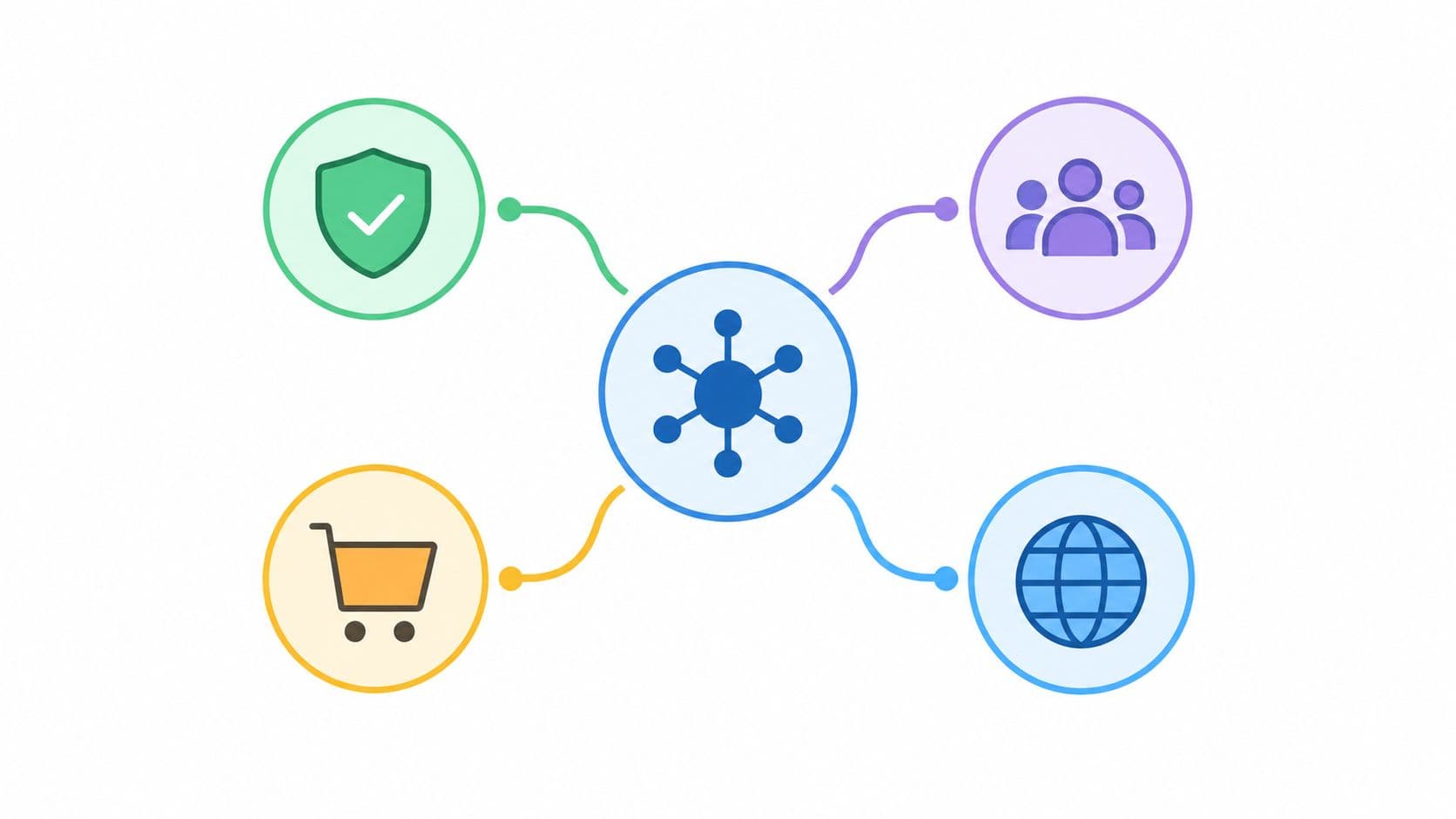
This map shows how these different software functions link up to improve your product, streamline support, and ultimately, drive sales.
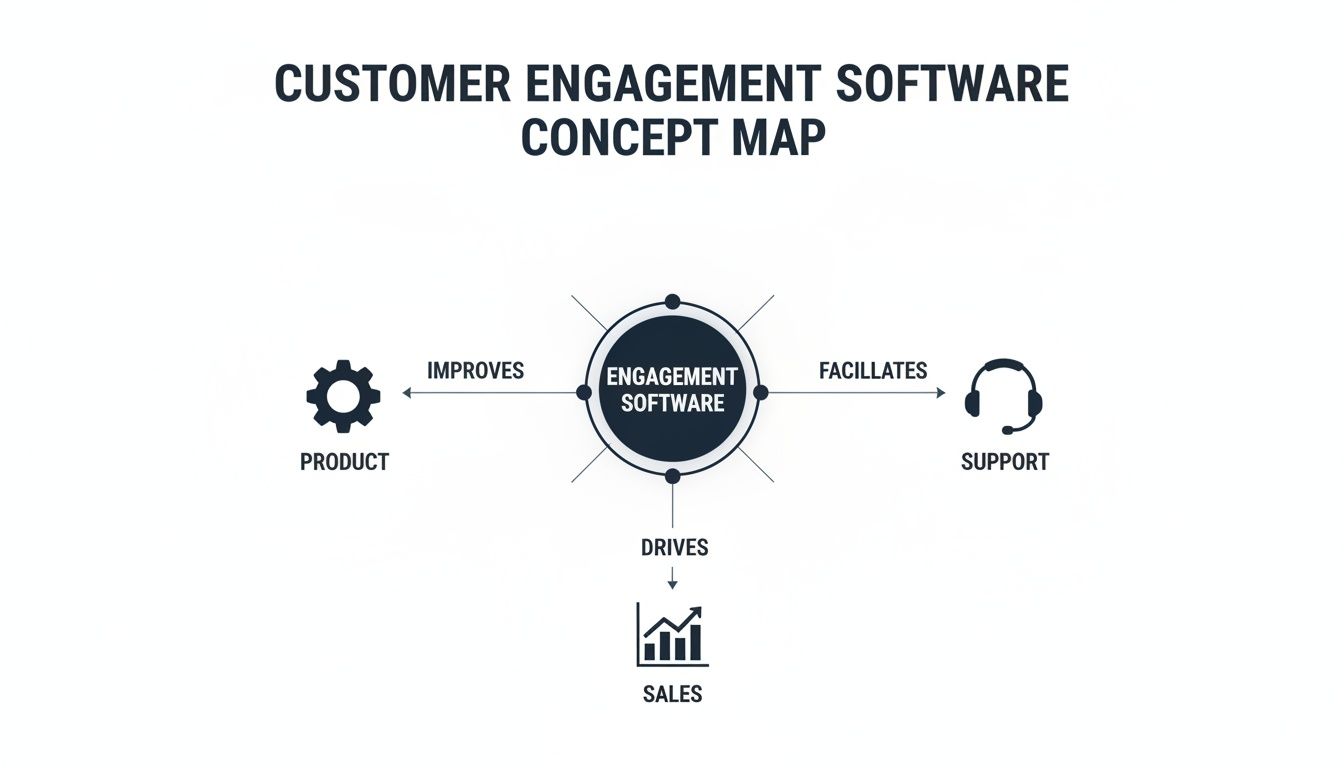
As you can see, a central hub connects everything. This ensures the insights you gain in one part of the business actually inform what you do in another.
1. Communication Platforms: The Ears and Mouth
First up are the communication platforms. These are your direct lines to your customers—the tools that handle all the two-way conversations happening across live chat, email, social media, and more.
Think of platforms like Intercom or Zendesk. Their main purpose is to make sure every customer message gets heard, sent to the right person, and answered quickly. They’re the front line. When someone pops open that chat widget in your app with a question, a communication platform is what’s powering that conversation.
These tools are crucial for providing good, timely support. For a deeper look at building this kind of unified experience, this omnichannel contact center success guide is a great resource.
2. Analytics Platforms: The Brain
If communication tools are for listening and talking, analytics platforms are for understanding. This is the brain of your customer operations. These systems crunch massive amounts of behavioral data to show you what your users are actually doing inside your product.
Tools like Amplitude or Mixpanel track every click, every feature used, and every path a user takes. They help you answer the big questions:
- Which features do people love most?
- Where are new users getting stuck during onboarding?
- What actions typically lead to someone upgrading their plan?
By spotting these patterns, analytics platforms transform raw user activity into hard numbers, giving you a clear, quantitative view of user behavior at scale.
3. CRM Platforms: The Memory
A Customer Relationship Management (CRM) platform is your company's collective memory. It’s the central database that holds the entire history of your relationship with every single customer.
CRMs like Salesforce or HubSpot are designed to be the single source of truth for customer data. They store everything from contact info and deal stages to communication logs and contract values.
This historical context is priceless. Imagine a high-value customer sends in a support ticket. Your CRM is what tells the agent that this isn't just any user—it's a key account that's been with you for five years. It gives your team the background they need to handle every interaction with the right priority and context.
4. Product Intelligence Platforms: The Signal Finder
The final pillar is Product Intelligence. While the other platforms are busy collecting data, these tools are all about connecting that data to your bottom line. They are the "signal finders" that sift through all the noise to tell you what actually matters.
Product intelligence platforms, like our own SigOS, are built to answer the "so what?" question. They take qualitative feedback from support tickets and sales calls, combine it with quantitative data from your analytics tools, and use AI to find the patterns that directly impact revenue.
For example, a product intelligence tool can analyze thousands of support conversations and discover that a certain bug isn't just a minor issue. It's the very reason 15% of new users give up during onboarding, which has a direct, measurable impact on your churn rate. This kind of software bridges the gap between customer feedback and a revenue-driven product roadmap, making your entire engagement stack smarter and more effective.
Comparing Features Across Engagement Software Types
To make it even clearer, here’s a breakdown of how the core features map to each software category. This will help you see at a glance which type of tool solves which specific problem.
| Feature | Communication Platforms | Analytics Platforms | CRM Platforms | Product Intelligence |
|---|---|---|---|---|
| Live Chat & Bots | Core Feature | Not Included | Basic/Add-On | Integrates Data From |
| Support Ticketing | Core Feature | Not Included | Core Feature | Integrates Data From |
| Behavioral Tracking | Limited | Core Feature | Limited | Integrates Data From |
| User Segmentation | Basic | Advanced | Advanced | Advanced (Revenue-Based) |
| Contact Database | Limited | Not Included | Core Feature | Integrates Data From |
| Feedback Analysis | Manual | Not Included | Manual | Core Feature (AI-Powered) |
| Revenue Correlation | Not Included | Manual | Manual | Core Feature |
| Roadmap Prioritization | Not Included | Indirect | Indirect | Direct (Impact-Based) |
As the table shows, each platform type has a clear focus. Communication and CRM tools manage direct interactions and relationships, Analytics tools quantify behavior, and Product Intelligence connects all that data to business outcomes. A truly effective strategy uses a combination of these to cover all the bases.
Critical Features Your SaaS Team Needs in 2026
When you're shopping for software for customer engagement, it’s easy to get distracted by flashy demos and long feature lists. But the real value isn't in the brand name—it's in the specific tools your team gets to use every day. As we move through 2026, a few key features have solidified their spot as absolute must-haves for any SaaS company that's serious about growth.
These aren't just nice additions; they're the core functions that separate platforms that merely track customers from those that genuinely understand them. Let's dig into what you should be looking for to turn simple interactions into a real competitive edge.
Omnichannel Communication and AI Chatbots
Your customers are everywhere, and your conversations with them shouldn't be scattered. That's the simple idea behind omnichannel communication. It pulls every interaction—whether it’s from live chat, email, a social media DM, or a phone call—into a single, unified view. No more piecing together disjointed conversations from five different systems just to understand one customer's history.
AI chatbots are the perfect complement here. Think of them as your 24/7 front line, instantly handling common questions and freeing up your human agents. This lets your team focus their energy on the complex, nuanced problems where their expertise truly makes a difference.
Advanced User Segmentation
Sending a generic message to your entire user base is like shouting into a crowded room and hoping the right person hears you. It just doesn't work. True engagement is built on relevance, which is why advanced user segmentation is so important.
Your platform needs to let you slice and dice your user base into meaningful groups based on what they do, not just who they are. For example, you should be able to create segments like:
- Behavioral Data: Users who’ve used Feature X more than 10 times this month.
- Subscription Data: All customers on your Enterprise plan.
- Lifecycle Stage: Users who signed up in the last 30 days but haven't finished onboarding.
This is the engine that drives personalization. It lets you send the right message to the right people at the right time, whether it's for marketing, support, or proactive outreach.
Behavioral Analytics and AI-Driven Personalization
While segmentation puts users into buckets, behavioral analytics shows you exactly what they're doing inside your product. It’s like getting a heatmap of every user's journey, revealing which features they love and where they're getting stuck. For product teams, this insight is pure gold.
Pairing these analytics with AI is where things get really interesting. AI can spot patterns in user behavior that a human would never catch, allowing you to predict what a user might do next. And this isn't just a futuristic concept—it's happening now. A recent study found that a striking 87% of organizations using AI-driven personalization report measurable boosts in customer engagement. As data from Adobe shows, AI is what turns a generic user experience into one that feels like it was built just for them.
Automated Feedback Tagging
Customer feedback is one of your most valuable assets, but it's usually a chaotic mess scattered across support tickets, survey responses, and call logs. The old way of manually sifting through it all in a spreadsheet is a slow, painful process that rarely keeps up.
Automated feedback tagging is the feature that ends spreadsheet chaos. It uses AI to automatically read and categorize incoming feedback, instantly quantifying bug reports, feature requests, and general sentiment.
Imagine your product manager instantly seeing that "Bug XYZ" was mentioned in 200 support tickets this month, with most coming from your highest-paying customers. That's the kind of clarity that transforms product development. It replaces guesswork with data, creating a direct line from your support queue to your development backlog. This is easily one of the most impactful features in modern software for customer engagement.
How to Measure the ROI of Your Engagement Software
Deciding to invest in software for customer engagement is a big step. But justifying that investment can't come down to gut feelings or a few positive anecdotes. To keep your budget secure and prove the tool’s worth, you have to tie its use directly to financial results.
It's all about moving past fuzzy metrics like "more engagement" and focusing on the numbers that matter to the bottom line. You need to draw a straight, undeniable line from what the software does to how it makes the business money. That's the only way to answer the C-suite’s real question: "What return are we getting on this?"
Moving Beyond Vanity Metrics
It's easy to fall into the trap of measuring activity instead of impact. Sure, tracking the number of emails sent or support tickets closed is useful for managing your team's workload. But those numbers don't tell you if your customers are actually sticking around longer or are happier with your product.
To measure real ROI, you have to go deeper. The trick is to zero in on a few high-impact KPIs that are direct indicators of customer health and business growth. These are the metrics that show whether your engagement efforts are actually paying off.
Look at metrics like:
- Customer Lifetime Value (CLV): This is the ultimate measure—the total revenue a customer will bring in over time. Smarter engagement should make this number go up.
- Churn Rate: The percentage of customers who leave. Bringing this number down is one of the fastest and most powerful ways to demonstrate ROI.
- Net Promoter Score (NPS): A direct pulse on customer loyalty. While it feels "soft," a rising NPS is often a leading indicator of future growth, while a falling one can predict churn.
- Feature Adoption Rate: Are people using the features you're building? High adoption of your stickiest features is a strong sign of a healthy, long-term customer.
Connecting Software to Financial Impact
Tracking these KPIs is a great start, but the real magic happens when you can attribute changes in those numbers directly to your software for customer engagement. This is where the gap between activity and outcome often lies, and it's where a product intelligence platform proves its worth by bridging customer feedback with hard financial data.
Think about this real-world scenario: Your support team uses a platform to manage bug reports. A product intelligence tool can sift through those tickets and flag a specific bug that keeps getting reported by your high-value enterprise customers.
By connecting that bug to the actual customer accounts it's impacting, the platform can calculate a precise "revenue at risk" figure. Suddenly, an "annoying bug" becomes a $25,000 per month problem. That’s a number that gets a development team’s immediate attention.
Once the fix is shipped, you can track the churn rate for that specific group of customers. Seeing a measurable drop provides concrete proof of ROI. You can walk into a meeting and say, "Fixing this one issue, which our engagement stack helped us find and prioritize, saved us $25,000 per month in at-risk revenue."
This is the kind of data-driven story that gives growth and analytics teams the evidence they need to justify their tools. If you’re ready to build your own business case, a good return on investment template is the perfect place to start. It gives you a framework for turning abstract benefits into a financial argument no one can ignore.
Turning Customer Feedback into Revenue with SigOS
Every modern tech stack is a data-generating machine. Your communication tools, CRMs, and analytics platforms are constantly pumping out a river of qualitative information—all the "noise" from support tickets, chat logs, sales calls, and survey responses. While this feedback is gold, it's usually unstructured and, frankly, overwhelming. This is where a product intelligence platform like SigOS comes in.
Think of SigOS as the smart layer that sits on top of your existing software for customer engagement. Its entire job is to be the "signal finder" that cuts through the noise. It uses AI to analyze all that unstructured feedback and, more importantly, automatically calculates its real-world impact on revenue.
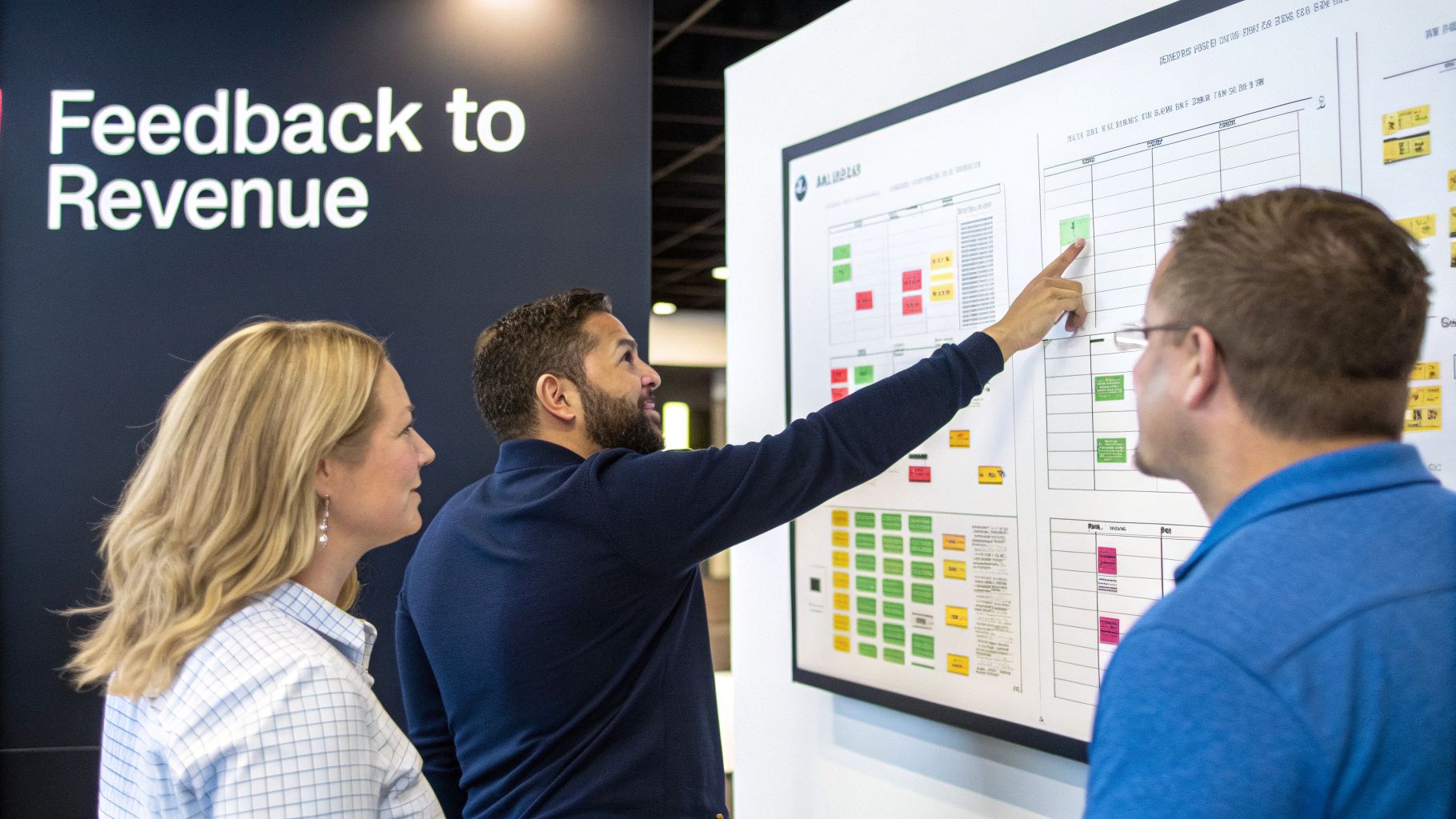
This screenshot isn't a mock-up; it's a real SigOS dashboard showing exactly how the platform pinpoints specific issues and ties them directly to monthly recurring revenue (MRR) at risk. Suddenly, that endless list of tickets becomes a prioritized action plan based on what actually moves the needle financially.
Connecting Feedback to Financial Outcomes
The biggest headache with qualitative feedback is that it’s all words and no numbers. A product manager might hear that "some users are frustrated with the export feature," but what does that really mean for the business? Is that complaint more important than the five other feature requests that landed on their desk this week?
SigOS provides the answer by connecting that feedback directly to your financial data. By integrating with the tools you already use, like Zendesk, Jira, and Salesforce, it creates a single, unified view. Vague complaints are transformed into specific, actionable business cases.
- Example 1: Identifying Costly Bugs. SigOS can sift through incoming support tickets and cross-reference them with your customer subscription data. It might find a specific bug that’s overwhelmingly affecting your highest-value customers. The platform then puts a number on it, letting you report, "This bug is putting $20,000/month in potential churn at risk."
- Example 2: Unlocking New Deals. In the same way, SigOS can scan sales call transcripts and notes from your CRM. It might flag that three different enterprise prospects have all mentioned needing the same security feature. This insight empowers your sales team to say, "Building this feature could help us close a $150,000 enterprise deal."
This approach gets your team away from relying on anecdotal evidence and lets them make decisions based on hard financial data.
From Manual Analysis to an Automated Roadmap
Without an intelligence layer, product teams are stuck spending countless hours manually triaging feedback. They’re stuck building complicated spreadsheets, reading through thousands of tickets, and trying to spot trends through sheer force of will. It’s a process that's not just slow and full of errors—it's impossible to scale.
SigOS automates this entire workflow. It’s like having an AI-powered analyst working 24/7 to analyze, categorize, and prioritize every piece of feedback that flows into your system.
SigOS transforms raw, unstructured feedback from tools like Intercom and Zendesk into a prioritized, revenue-driven development roadmap. It eliminates the need for manual analysis, freeing your product team to focus on building what matters most.
By integrating directly with development tools like Jira and Linear, SigOS can automatically generate tickets for the highest-impact issues. These tickets arrive pre-filled with all the crucial context: the number of affected customers, the associated revenue, and links back to the original feedback. For teams wanting to build a much more efficient product development cycle, you can learn how to analyze customer feedback with AI to tighten up your processes.
This creates a perfect, seamless loop:
- A customer reports an issue in a support chat.
- SigOS ingests the conversation and identifies it as a critical bug affecting a high-value segment.
- The platform calculates the potential revenue impact.
- An issue is automatically created in the engineering team's backlog, prioritized by its financial importance.
This automated, data-driven approach ensures your development resources are always focused on the work that will have the biggest positive impact on your company's bottom line. It turns your software for customer engagement from a simple set of tools into a powerful engine for revenue growth.
Your 2026 Vendor Evaluation Checklist
Let’s be honest: choosing the right customer engagement software can feel overwhelming. You’re bombarded with marketing hype and flashy demos, making it tough to see which platform is a genuine fit and which is just a collection of features you’ll never use.
To cut through the noise, you need a game plan. This checklist is your team’s secret weapon. It’s designed to help everyone—from your CTO worried about security to your product managers focused on workflow—ask the right questions. The goal is to find a true partner, not just a vendor, that aligns with your tech stack, growth ambitions, and security standards for 2026 and beyond.
Integration and Workflow Compatibility
Your new tool has to fit into your team's daily life. If it doesn't play well with the systems you already rely on, it’s not a solution; it’s a problem. A platform that creates yet another data silo is a massive step backward, no matter how cool its features look.
Get straight to the point with these questions:
- Do you have native, two-way integrations with our core tools like Jira, Slack, and Salesforce?
- How much of a technical lift is required to set up and maintain these connections?
- Can your platform pull in data from our communication channels and our behavioral analytics tools?
A tool that plugs seamlessly into your existing stack starts adding value from day one. Otherwise, it's just another island of information your team has to swim to.
Data Security and Compliance
You're about to trust a vendor with your customer data—one of your most critical assets. This is where you can't afford to be shy. Vague promises about security aren't good enough; you need concrete proof.
How is our customer data used, encrypted, and stored? This isn't just a technical question—it's a fundamental test of whether a vendor can be trusted with your most valuable asset.
Drill down on the non-negotiables:
- What are your specific data encryption policies, both for data at rest and in transit?
- Do you retrain your AI models on our company’s or our customers’ data?
- Can you provide documentation for your SOC 2 and GDPR compliance?
If a vendor gets cagey when you ask about security, that’s a huge red flag. A company that takes security seriously will be proud to show you how they do it.
Scalability and Future-Proofing
The platform you pick today has to grow with you. A system that works fine for a startup with ten thousand users will crumble under the weight of a million. You need to know how it will perform when your user base and data volumes explode.
Challenge them to think about your future:
- How does performance change as we scale from 10,000 to 1,000,000 monthly active users?
- What does your product roadmap look like for the next 18-24 months?
- How does the system handle analyzing large volumes of historical data without slowing down?
The right partner solves today’s problems while being ready for tomorrow’s. For a deeper look at the evaluation process, our guide on choosing a customer feedback analysis tool offers even more criteria to help you make a confident decision.
Frequently Asked Questions
It’s completely normal to have questions when you’re looking at customer engagement software. Let's tackle some of the most common ones we hear from teams so you can make a smart, confident choice.
What Is the Real Difference Between CRM and Customer Engagement Software?
This is a frequent point of confusion, but the distinction is pretty important. Think of a traditional CRM, like Salesforce, as your company's filing cabinet for sales. It’s a system of record that’s brilliant at storing contact information, tracking deals, and managing sales pipelines.
Customer engagement software, on the other hand, is about the conversation itself. It’s the platform you use for the actual back-and-forth across the entire customer journey—from marketing and support chats to gathering product feedback. It’s the engine for the experience, not just the record of the contact.
How Can a Small SaaS Startup Afford to Start?
You absolutely don't need a huge, expensive suite right out of the gate. The smart move is to start small and focused. Pick up a free or low-cost live chat and help desk tool. Your first goal might be as simple as cutting down your response times.
The trick is to choose those starter tools with solid integration capabilities. That way, you can easily plug in an intelligence layer like SigOS later. It will analyze the data from the tools you already use to show your small team exactly where to focus for the biggest impact on revenue. It’s all about maximizing your ROI from day one.
How Long Does Implementation Take to See Results?
That really depends on what you’re setting up. A simple live chat widget can be up and running in a few hours. A full-blown CRM migration, however, could take months of planning and work.
With an AI intelligence platform like SigOS, the initial connection is surprisingly fast—often just minutes to link your data sources via API. You can start seeing your first insights within hours as it crunches your historical data. As for tangible results, like seeing churn drop after you act on a specific product insight, you could see that within the first quarter as the platform helps guide your team's priorities.
If you have more questions, this resource on common FAQs is also a great place to look for answers.
Ready to stop guessing and start knowing what your customers really want? SigOS uses AI to analyze all your customer feedback, shows you its financial impact, and gives your product team a clear, prioritized roadmap. See how we turn noise into revenue at https://sigos.io.
Keep Reading
More insights from our blog
Ready to find your hidden revenue leaks?
Start analyzing your customer feedback and discover insights that drive revenue.
Start Free Trial →