The 12 Best Software for Tracking Customers in 2026
Discover the top software for tracking customers. We compare 12 tools for sales, support, and product teams to help you reduce churn and drive growth.

Understanding what your customers do, say, and need is the bedrock of sustainable growth. But as your business scales, relying on manual notes, disconnected spreadsheets, and gut feelings becomes impossible. You start missing critical churn signals, overlooking expansion opportunities, and building features no one asked for. The right software for tracking customers doesn't just store data; it connects conversations to actions, links behavior to revenue, and turns raw feedback into a prioritized, actionable roadmap.
This guide moves beyond generic feature lists to provide a deep, comparative analysis of the 12 best platforms available today. We'll dissect each tool by its core strengths, practical use cases for product, growth, and support teams, and its honest limitations. Inside, you will find:
- Detailed Breakdowns: An in-depth look at platforms like SigOS, Salesforce, Mixpanel, and Gainsight.
- Use-Case Scenarios: Clear examples of how different teams can use each tool to solve specific problems.
- Direct Comparisons: We evaluate key areas like behavioral tracking, feedback management, churn prediction, and integration capabilities.
Whether you need a simple CRM to organize contacts, an enterprise-grade customer success platform to manage high-value accounts, or an AI-driven intelligence engine to find the signal in the noise, this resource will help you make an informed decision. Each review includes screenshots and direct links, so you can quickly explore the options that best fit your team's specific requirements. This is your definitive resource for choosing the software for tracking customers that will actively help you build a better product and retain more users.
1. SigOS
SigOS presents a distinct approach to customer tracking by shifting the focus from manual data interpretation to autonomous, AI-driven product intelligence. Instead of merely collecting customer data, the platform is engineered to ingest, analyze, and convert disparate signals into a prioritized, revenue-backed product roadmap. It connects qualitative feedback from sources like Zendesk, Intercom, and sales calls with quantitative behavioral and billing data from tools like Segment, Mixpanel, and Stripe.
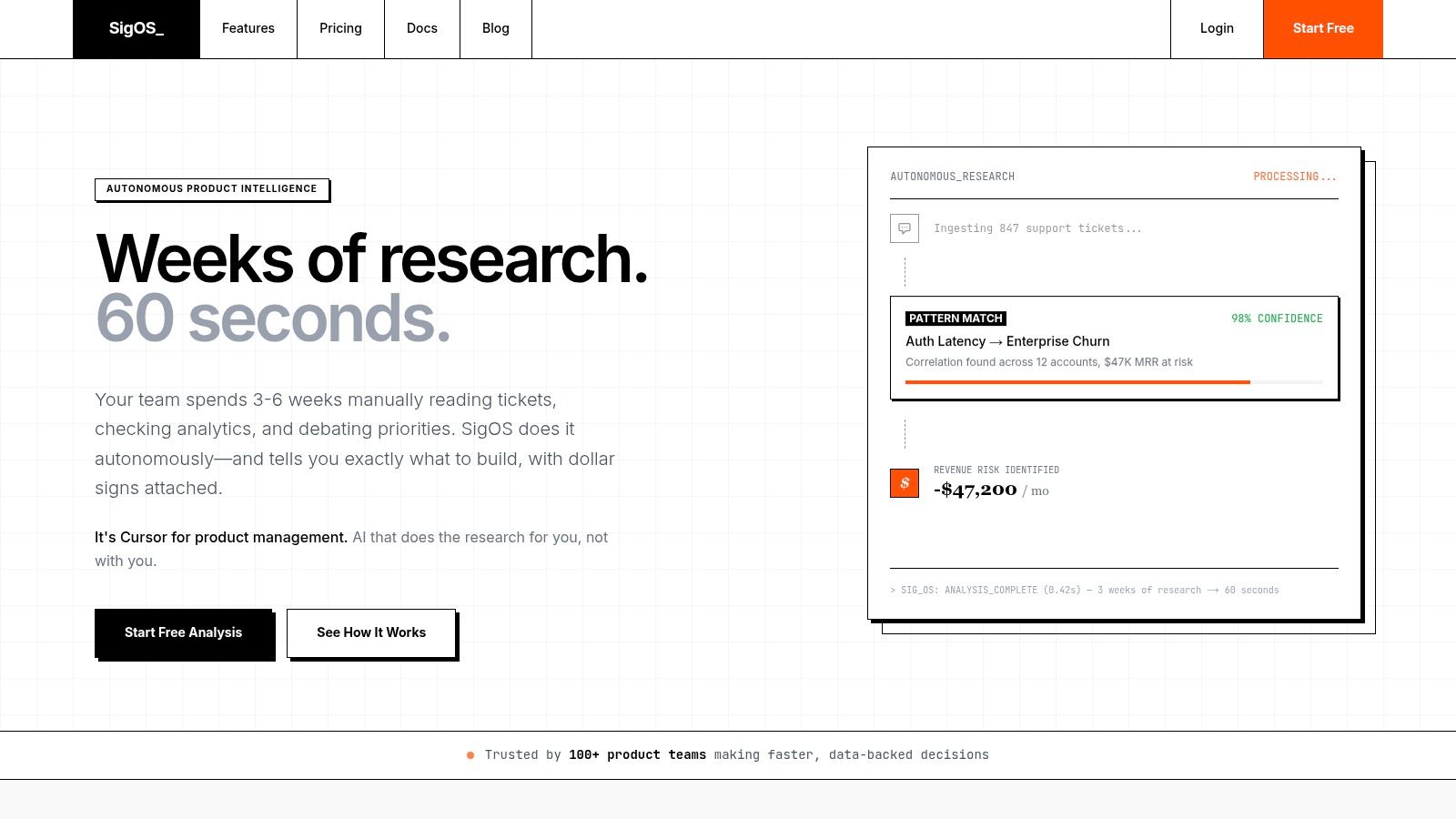
This four-layer intelligence model (qualitative, quantitative, revenue, and shipping) allows SigOS to surface critical insights with direct financial implications. For instance, it can identify a bug mentioned in support tickets, correlate it with a specific user cohort exhibiting churn behavior, calculate the associated revenue at risk, and present the finding as a high-priority issue. Case studies on its site report concrete outcomes like identifying a $47K/mo authentication bug and helping another company reduce churn from 23% to 8% through targeted fixes. This makes it a powerful piece of software for tracking customers not just for engagement, but for direct revenue impact.
Key Strengths and Use Cases
- Autonomous Prioritization: The platform's primary function is to eliminate the manual work of sifting through feedback. Product teams can use it to instantly generate a roadmap where features and bug fixes are ranked by their predicted impact on revenue and churn, replacing gut-feel decisions with data-backed priorities.
- Proactive Churn and Expansion Alerts: Growth and customer success teams can configure real-time alerts. SigOS actively monitors for emergent patterns, notifying teams of high-value accounts showing churn risk or customers whose usage patterns indicate a strong upsell opportunity.
- Workflow Integration: With native connectors to Jira, Linear, and GitHub, a product manager can convert an AI-surfaced insight into a developer ticket with one click. The ticket arrives pre-populated with qualitative evidence, quantitative data, and its calculated revenue-impact score. If you're looking to expand your knowledge, SigOS provides resources that explain how to use behavior analytics to inform these decisions.
Practical Considerations
While pricing is not publicly listed and requires a sales inquiry, SigOS offers a free initial analysis to demonstrate its value. The platform's effectiveness is directly tied to the volume and quality of a company's data; organizations with substantial feedback channels and clear revenue signals will derive the most benefit. Its security-first posture, which includes a policy against retraining models on customer data, makes it a suitable option for privacy-conscious teams.
| Feature | Description |
|---|---|
| Analysis Type | Autonomous, AI-driven correlation of qualitative and quantitative data. |
| Core Value | Converts feedback into a revenue-prioritized product roadmap. |
| Key Integrations | Zendesk, Intercom, Jira, Linear, Segment, Mixpanel, Stripe, Salesforce. |
| Primary Use Case | Product and engineering prioritization based on revenue impact. |
| Pricing | Not public; tailored plans. Free initial analysis available. |
| Best For | Scaling SaaS companies with significant customer feedback and revenue data. |
Website: https://sigos.io
2. Salesforce Sales Cloud
Salesforce Sales Cloud is one of the most established and powerful platforms for tracking customers, particularly within complex B2B sales cycles. It operates as a full-featured Customer Relationship Management (CRM) system, moving beyond simple contact lists to provide a 360-degree view of every lead, account, and opportunity. Teams use it to meticulously log interactions, manage sales pipelines, and forecast revenue with high precision.
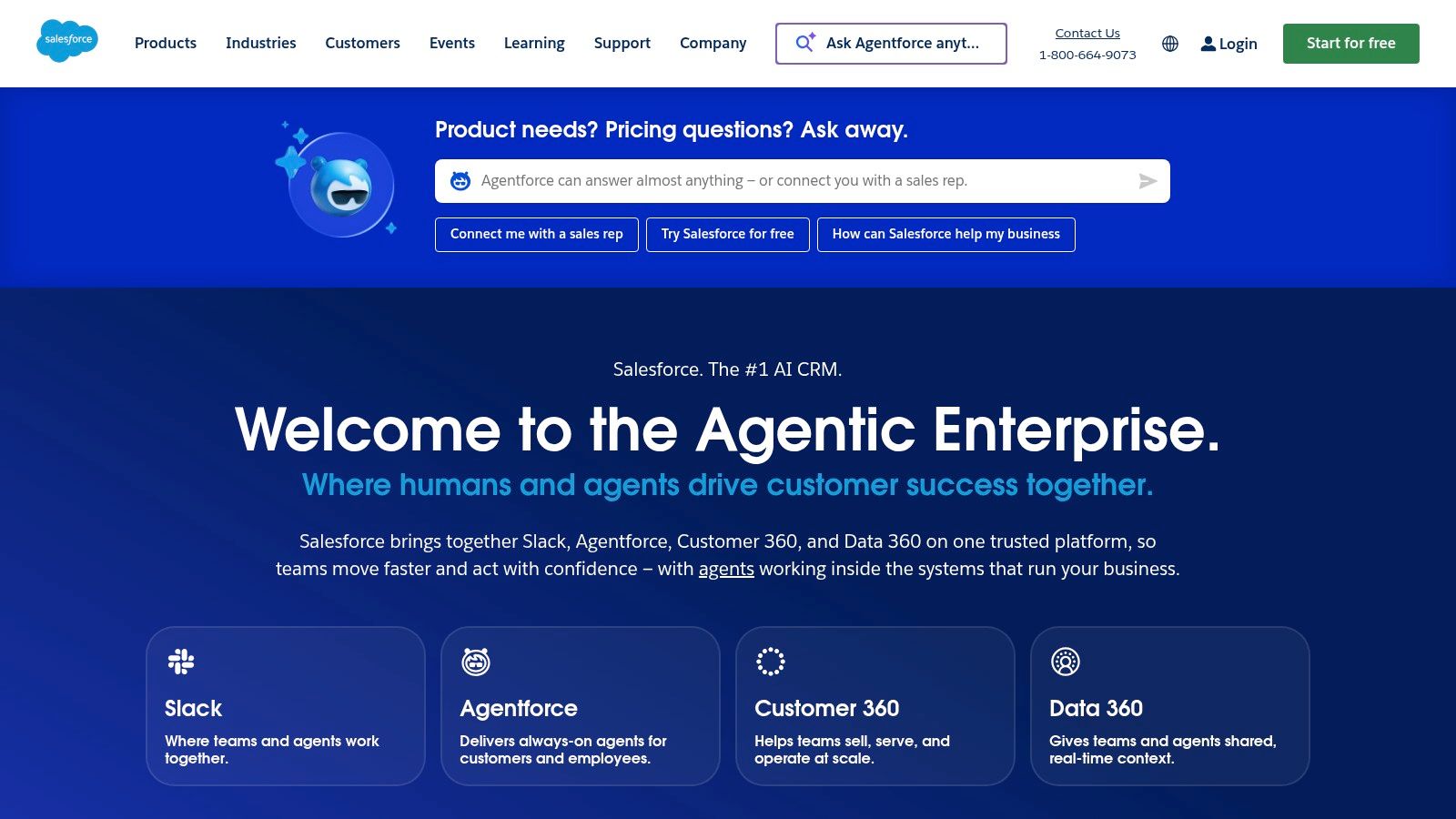
What sets Salesforce apart is its immense customizability and the vast AppExchange ecosystem. It's not just a tool; it's a platform you build upon. A growth team can integrate it with marketing automation software, while a support team can connect it to their help desk system, ensuring all customer data resides in one central record. This single source of truth prevents data silos and gives every department consistent insight into the customer journey.
Key Features & Use Cases
- Lead & Opportunity Management: Sales teams can track a lead from initial contact through to a closed deal, managing every stage, activity, and communication along the way.
- Pipeline and Forecast Management: Leaders get a real-time, accurate view of the sales pipeline, enabling reliable revenue forecasting and resource planning.
- Deep Customization: Admins can create custom objects, fields, and automation rules (workflows) to match the platform to their exact business processes.
- Integration Hub: The AppExchange allows you to connect Salesforce to thousands of other business applications, from accounting software to e-signature tools.
Limitations & Implementation
The primary challenge with Salesforce is its complexity. Initial setup and ongoing administration often require a dedicated specialist or consultant. Its power is also its weakness; without careful planning, the system can become cluttered and difficult for end-users to navigate. Furthermore, the total cost of ownership can escalate quickly with essential add-ons and user licenses.
Website: https://www.salesforce.com Pricing: Plans start at 25/user/month (billed annually) for the "Starter" tier and scale up to 500/user/month for advanced, unlimited editions. Many features require higher-tier plans or separate add-on purchases.
3. HubSpot CRM / Customer Platform
HubSpot’s Customer Platform is renowned for its ease of adoption, making it a top choice for startups and SMBs that need effective software for tracking customers without a steep learning curve. It provides a unified CRM that natively integrates marketing, sales, and service tools into a single, cohesive system. This approach gives teams a central view of all interactions, from email opens and form submissions to support tickets and sales calls.
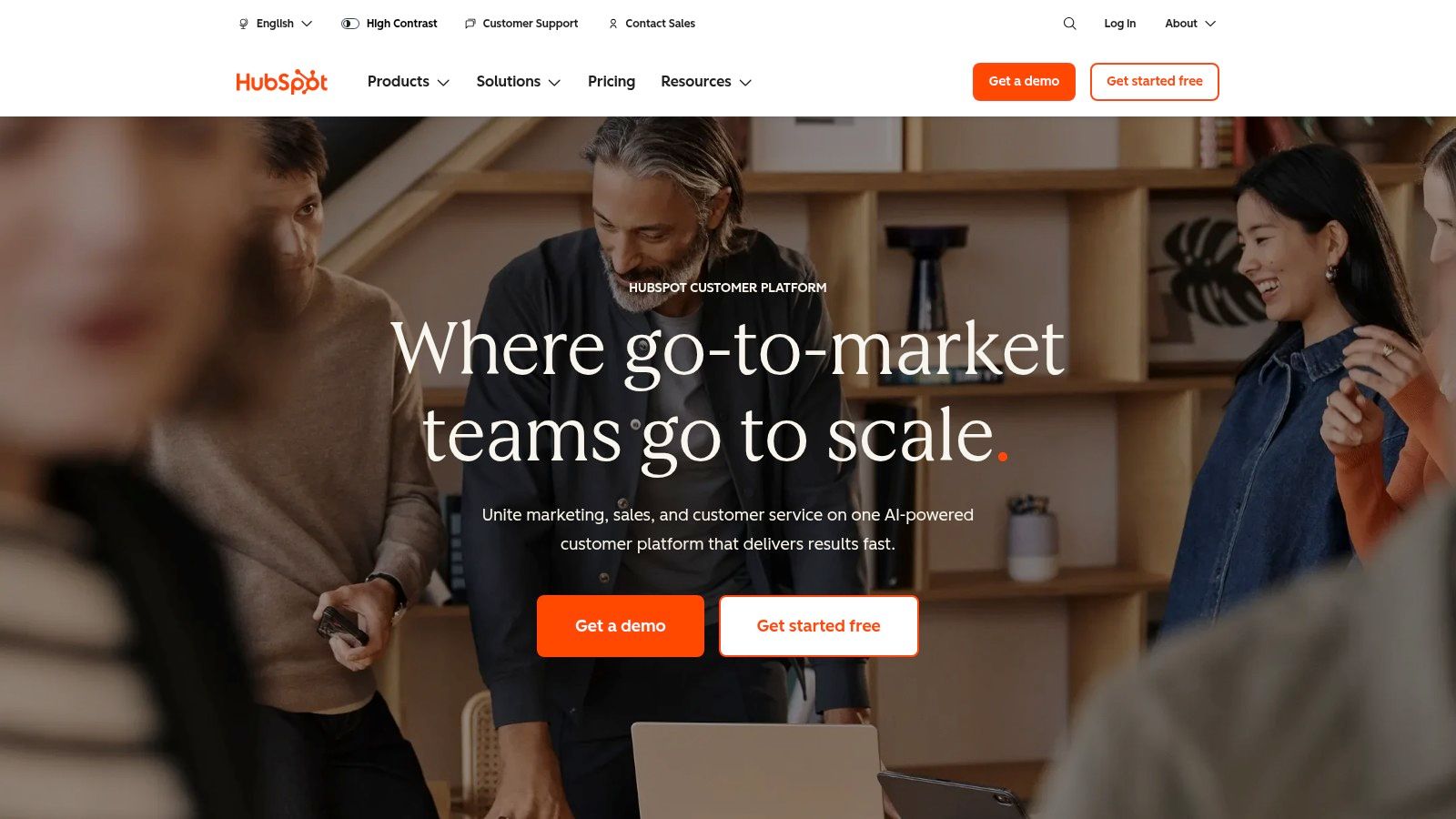
What makes HubSpot stand out is its immediate time-to-value. Teams can set up live chat, a shared inbox, and basic deal pipelines in hours, not weeks. The platform is designed for growth, allowing businesses to start with a free or low-cost CRM and then add more powerful "Hubs" (Marketing, Sales, Service) as their needs expand. This modularity ensures that all customer data remains connected, which is critical for understanding the SaaS customer lifetime value as you scale.
Key Features & Use Cases
- Contact, Deal, & Activity Tracking: A centralized database logs every email, call, meeting, and note, providing a complete historical record for every contact.
- Shared Inbox & Live Chat: Support and sales teams can manage customer conversations from one place, ensuring faster response times and collaborative resolutions.
- Native Marketing & Sales Cohesion: Users can build landing pages, send marketing emails, and track deal progress all within the same platform, eliminating data sync issues.
- AI Assistance: Higher tiers include AI features for summarizing conversations, generating content, and assisting agents, which helps improve team efficiency.
Limitations & Implementation
The primary drawback of HubSpot is its pricing model. While the entry-level tools are free or affordable, costs can increase significantly as you add more contacts, seats, or upgrade to professional-tier Hubs for advanced automation and governance features. The all-in-one nature can also be a limitation for companies that prefer a best-of-breed approach with specialized tools.
Website: https://www.hubspot.com Pricing: Offers a free tier with basic tools. Paid plans for the Customer Platform start at $30/seat/month (billed annually) and scale up with additional Hubs and features.
4. Zendesk Suite
Zendesk Suite is a cornerstone in the customer support world, offering a powerful platform for tracking every customer interaction across multiple channels. It consolidates conversations from email, chat, messaging, and voice into a single, unified ticketing system. This approach gives support teams a complete historical context for every customer, ensuring they can provide informed and efficient service without having to piece together information from different sources.
What makes Zendesk a leader is its scalability and mature ecosystem. A small startup can begin with the essentials and grow into advanced features like AI-powered agents and workforce management tools. Its extensive marketplace allows teams to connect Zendesk with other business-critical applications, from CRMs to project management tools. This creates a centralized hub for all customer-facing activity, which is essential for any business serious about software for tracking customers. While Zendesk Suite offers comprehensive tools, exploring Zendesk alternatives can help businesses find the perfect fit for their specific needs.
Key Features & Use Cases
- Omnichannel Ticketing: Consolidates all customer requests into a unified agent workspace, providing a full conversation history regardless of the channel used.
- Help Center & Knowledge Base: Enables teams to build a self-service support portal, allowing customers to find answers independently and reducing ticket volume.
- AI Agents & Copilot: Automates responses to common questions with AI bots and assists human agents with context and suggestions to resolve issues faster.
- Extensive Marketplace: Integrates with hundreds of other apps, allowing teams to connect support data with sales, engineering, and marketing platforms.
Limitations & Implementation
The main challenge with Zendesk is that its best value is often locked behind higher-tier plans and annual commitments. While powerful, achieving deep customization to match specific internal workflows can require dedicated administrator expertise and a significant setup investment. For new teams, navigating the full suite of features and admin settings can present a steep learning curve without proper onboarding and training.
Website: https://www.zendesk.com Pricing: Plans start at 55/agent/month (billed annually) for the "Suite Team" tier. More advanced features like AI capabilities and workforce management are included in higher tiers, which scale to 115/agent/month and beyond.
5. Intercom
Intercom is a conversational relationship platform designed to foster customer connections through its powerful in-app messenger and support suite. It excels at tracking customers by capturing live conversations, user behavior, and support history directly within a unified inbox. This approach allows support, sales, and marketing teams to engage with users contextually, whether for resolving issues, offering proactive help, or announcing new features.
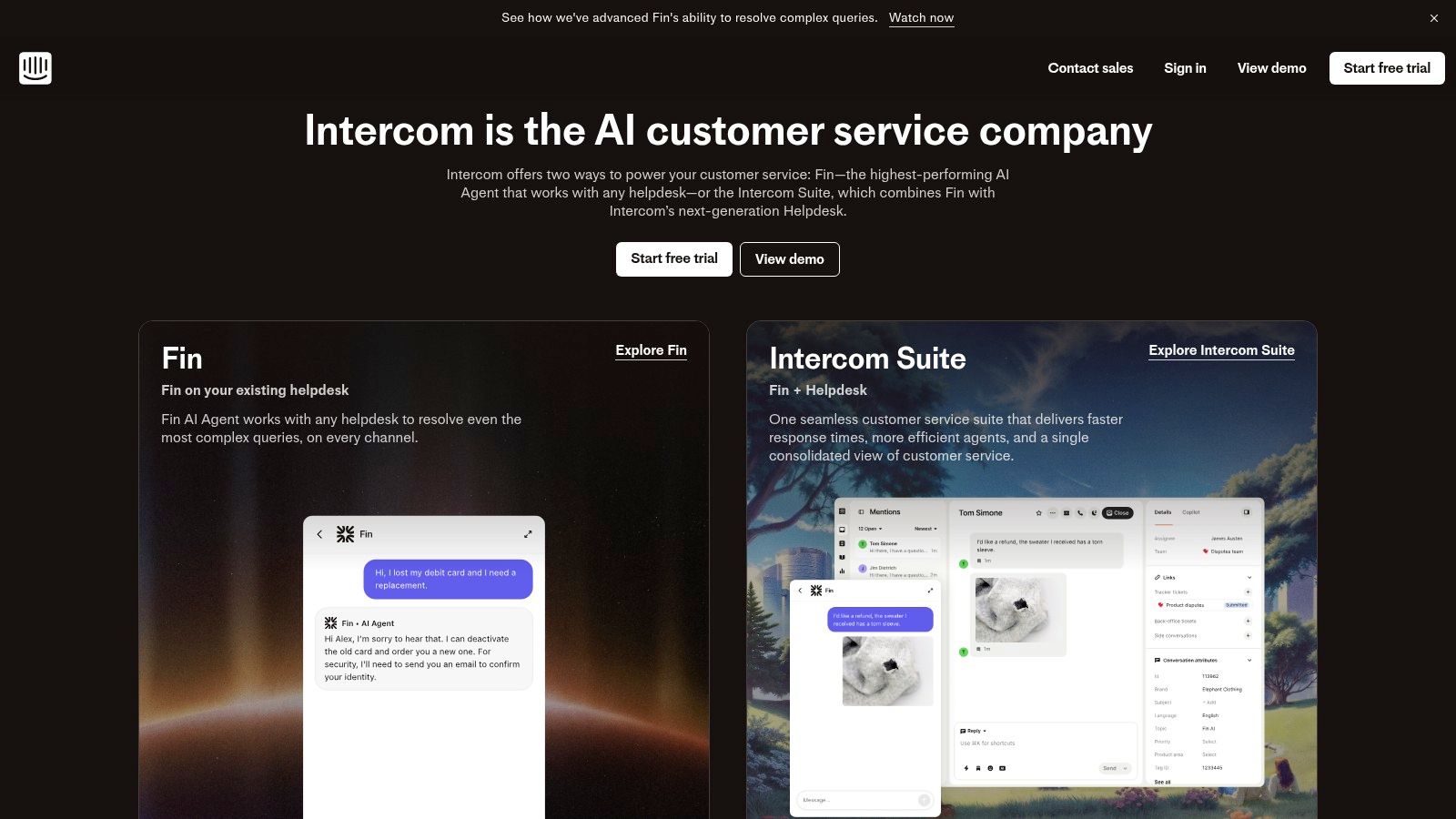
What makes Intercom distinct is its focus on in-product communication as the primary channel for customer interaction. Instead of relying solely on email or phone, teams can build automated product tours, send targeted outbound messages based on user actions, and deploy AI chatbots to handle common queries. This creates a seamless experience where support and engagement feel like a natural part of using the software, not an external process.
Key Features & Use Cases
- Unified Inbox & Messenger: Teams can manage conversations from the website, in-app messenger, email, and social media from one central location.
- Proactive Support: Trigger automated tours, surveys, and messages based on user behavior, helping onboard new users or guide them through complex features.
- Fin AI Agent: An AI-powered chatbot that can answer questions and resolve support tickets, with a unique per-resolution pricing model.
- Integrated Help Center: Build and manage a knowledge base that is accessible to both customers and the AI agent for faster, more accurate answers.
Limitations & Implementation
Intercom's primary strength in real-time messaging can also be a challenge; it requires a team ready to manage live conversations. The pricing model can become costly, especially for larger teams or those who heavily use add-ons like the Fin AI Agent, where costs are tied to successful resolutions. While powerful, achieving a high degree of automation and proactive support requires a thoughtful setup and ongoing optimization of its rules and campaigns.
Website: https://www.intercom.com Pricing: Plans start at $39/seat/month for basic support. Advanced functionality, proactive messaging, and the Fin AI Agent are available in higher-tier plans or as add-ons with separate pricing structures, including per-resolution fees for AI.
6. Gainsight CS
Gainsight CS is a dedicated customer success platform designed for post-sales teams to manage the entire customer lifecycle. Instead of a general-purpose CRM, it provides a specialized operating system for tracking customer health, driving adoption, and managing renewals and expansions. It's particularly dominant in large B2B SaaS organizations where retaining and growing complex accounts is the primary business driver.
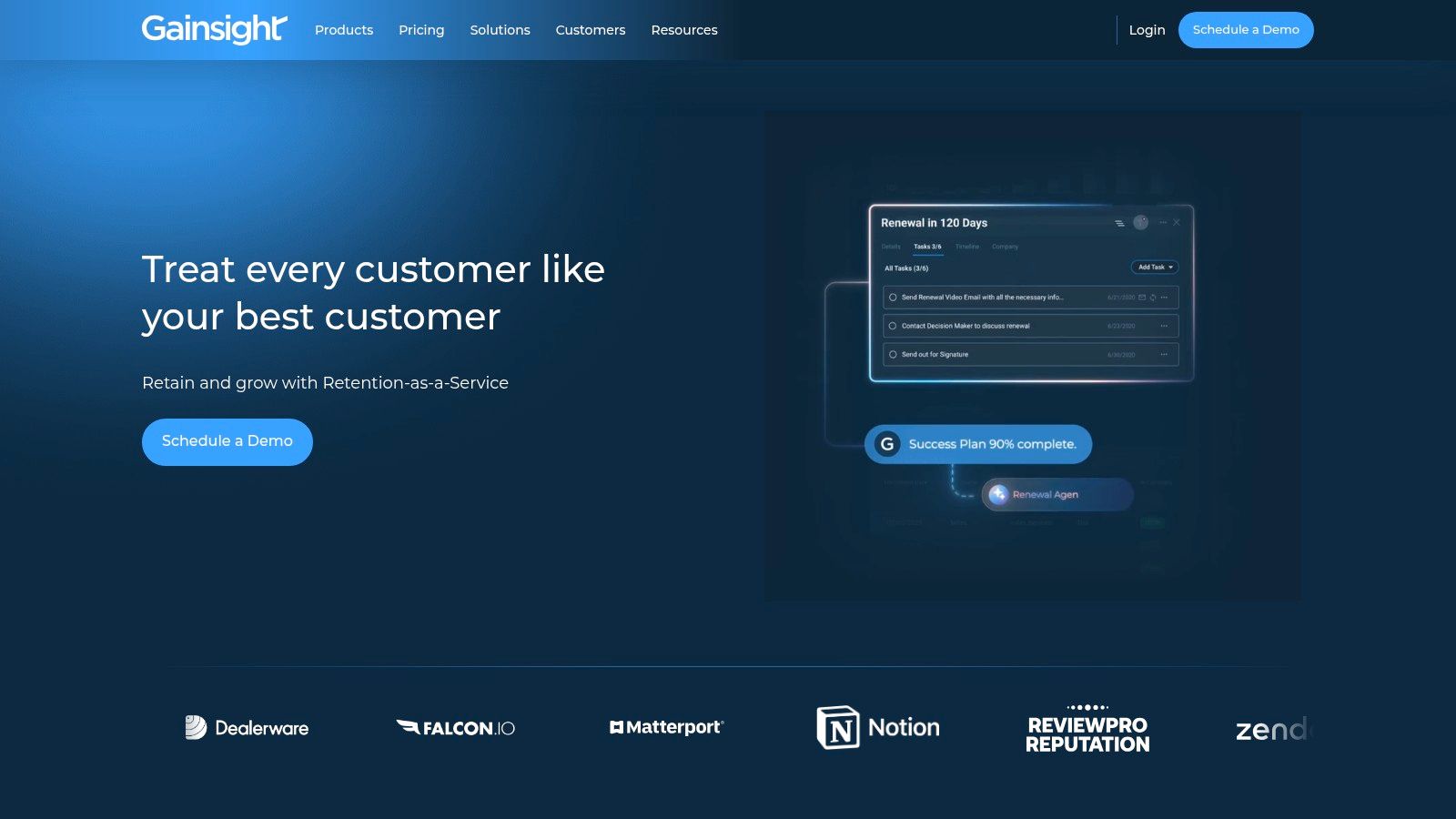
The platform's core strength lies in its ability to combine qualitative and quantitative data into a single, actionable view of the customer. It ingests usage data, support tickets, survey responses, and CSM notes to create dynamic health scores. This allows customer success managers (CSMs) to proactively identify at-risk accounts and trigger automated playbooks to guide them back to health, making it a powerful tool for any team focused on Net Revenue Retention (NRR).
Key Features & Use Cases
- Customer 360 and Health Scorecards: Consolidate all customer data into a single view and create configurable health scores to predict churn or identify expansion opportunities.
- Playbooks and Success Plans: Standardize the CS team's response to key events, like low adoption or an upcoming renewal, with automated and manual task workflows.
- Renewal and Expansion Forecasting: Gives CS leaders a clear view of the renewal pipeline and helps CSMs identify and manage upsell or cross-sell opportunities.
- Surveys and Sponsor Tracking: Collect customer feedback directly within the platform and track key relationships to ensure executive alignment and mitigate sponsor departure risks.
Limitations & Implementation
Gainsight's power is best suited for mature customer success organizations. The implementation process is resource-intensive and requires careful planning to configure health scores, data integrations, and playbooks correctly. For smaller teams or companies without a dedicated CS function, the platform can be overly complex and expensive. Its focus is strictly on post-sales, so it must be integrated with a CRM like Salesforce for a complete customer view.
Website: https://www.gainsight.com Pricing: Pricing is custom and not publicly listed. It is enterprise-grade software that requires a direct sales consultation and is typically priced based on the number of managed accounts and specific product needs.
7. Totango
Totango is a modular customer success platform built to help businesses proactively manage customer health and drive adoption. Unlike monolithic CRMs, it’s designed specifically for customer success teams to orchestrate the entire post-sale journey, from onboarding to renewal and expansion. It serves as a central hub for tracking customer health scores, managing tasks, and executing automated engagement campaigns based on user behavior.
What makes Totango distinct is its flexible, composable architecture and unique licensing model. Teams can start with specific modules, called SuccessBLOCs, for immediate needs like onboarding or health tracking, and add more as their program matures. The Unison AI engine works in the background to analyze customer data, identify trends, and surface risks or opportunities, giving CSMs actionable intelligence. This focus on modularity and AI-driven insights makes it a powerful tool for scaling customer success operations.
Key Features & Use Cases
- Customer Health Tracking: Create dynamic, multi-dimensional health scores based on product usage, support tickets, survey responses, and more.
- SuccessBLOCs & Playbooks: Utilize pre-built or custom templates to manage lifecycle stages like onboarding, adoption campaigns, and renewal processes.
- Flexible Seat Types: Provide "Practitioner" licenses for CSMs, while offering more affordable "Contributor" and "Viewer" seats for sales, support, and leadership to access customer data.
- Unison AI Engine: Automatically surfaces key insights about customer behavior, account sentiment, and potential churn risks without manual analysis.
Limitations & Implementation
The platform's main drawback for small teams is its opaque pricing, which requires engaging with the sales team for a custom quote. While powerful, configuring complex health scores and automated playbooks can demand dedicated customer success operations resources to set up and maintain effectively. Without proper data governance, the information flowing into Totango can become inconsistent, reducing the accuracy of its health scores and AI-driven recommendations.
Website: https://www.totango.com Pricing: Pricing is not publicly listed and is customized based on the number of accounts, users, and chosen modules. A free plan is available for small teams getting started with basic customer tracking.
8. ChurnZero
ChurnZero is a dedicated customer success platform designed specifically to help B2B SaaS companies reduce churn and expand revenue. Instead of being a general-purpose CRM, it focuses entirely on the post-sale customer lifecycle, making it an excellent piece of software for tracking customers after they sign up. The platform synthesizes data from multiple sources to create dynamic customer health scores, alerting teams to risks and opportunities in real-time.
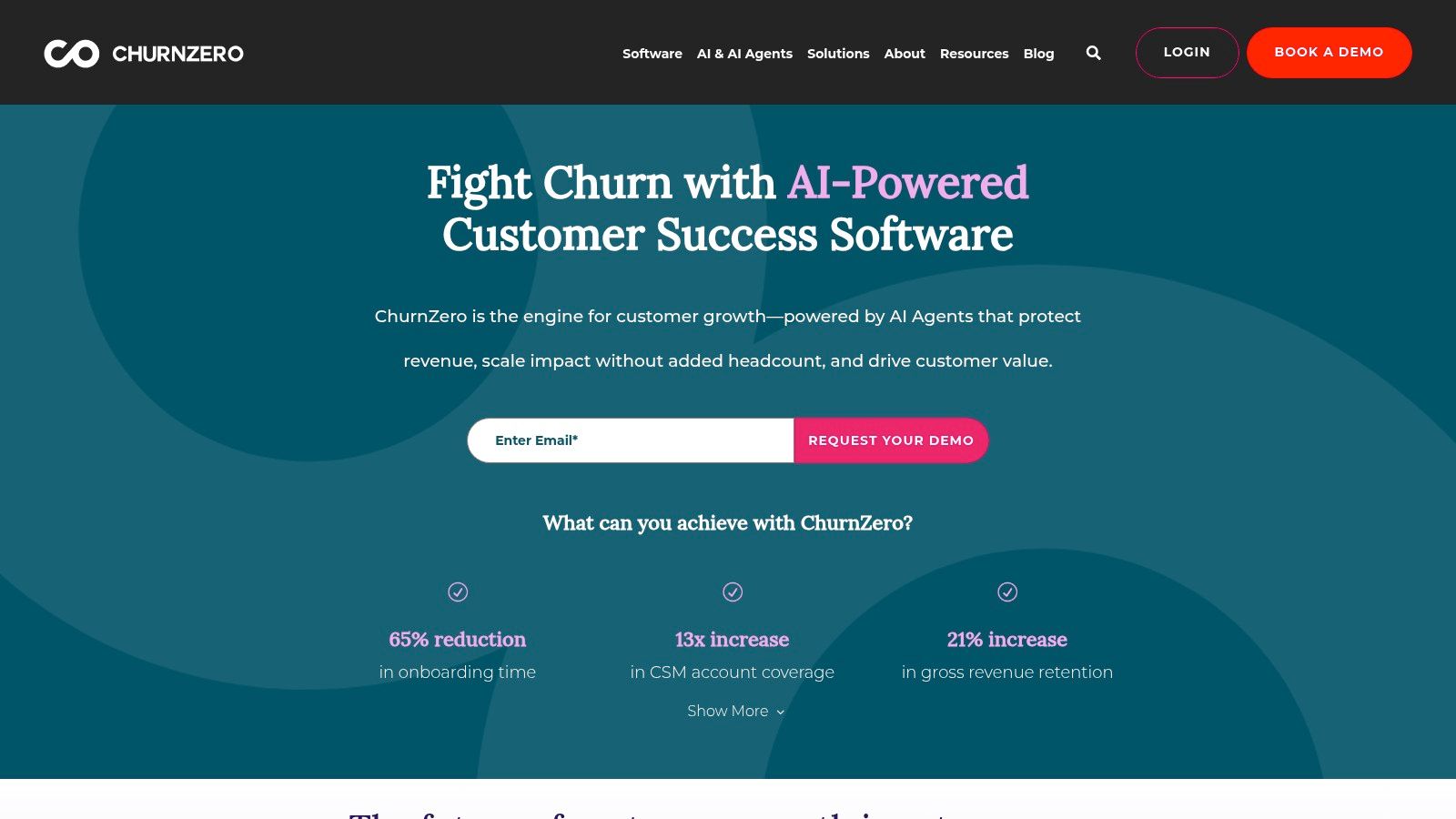
The platform's main strength is its action-oriented design. It doesn't just show you data; it equips customer success managers (CSMs) with the tools to act on it. Through automated playbooks, personalized communication features, and in-app guidance, teams can proactively engage at-risk accounts or identify prime candidates for upsells. This focus on operationalizing customer success makes it a powerful tool for retention-focused teams.
Key Features & Use Cases
- Customer Health Scoring: Aggregates product usage, support tickets, and other signals into a customizable score to instantly identify at-risk accounts.
- Automated Playbooks: CSMs can build and trigger automated sequences of tasks and communications based on customer behavior or health score changes.
- Customer Journeys: Visually map out and manage key stages of the customer lifecycle, from onboarding to renewal, ensuring consistent engagement.
- In-App Communications: Engage users directly within your product with announcements, guides, and surveys without needing engineering resources.
Limitations & Implementation
The primary consideration with ChurnZero is its specialized nature. It's not a sales CRM, and it may have feature overlap with product analytics tools a company is already using. The implementation requires careful integration with your CRM and product data sources to be effective. Its pricing is also customized, which can make it a significant investment, especially for teams needing advanced professional services for setup and enablement.
Website: https://churnzero.com Pricing: Pricing is not publicly listed and is provided on a custom-quote basis, often requiring a discovery call to determine the scope and needs. This approach is common for enterprise-focused customer success platforms.
9. Vitally
Vitally is a modern customer success platform designed specifically for B2B SaaS companies that need to scale their post-sales operations. Unlike traditional CRMs, it focuses entirely on the customer lifecycle after the sale, providing tools for health tracking, automated playbooks, and team collaboration. This specialized focus makes it a powerful piece of software for tracking customers and proactively managing their health to prevent churn.
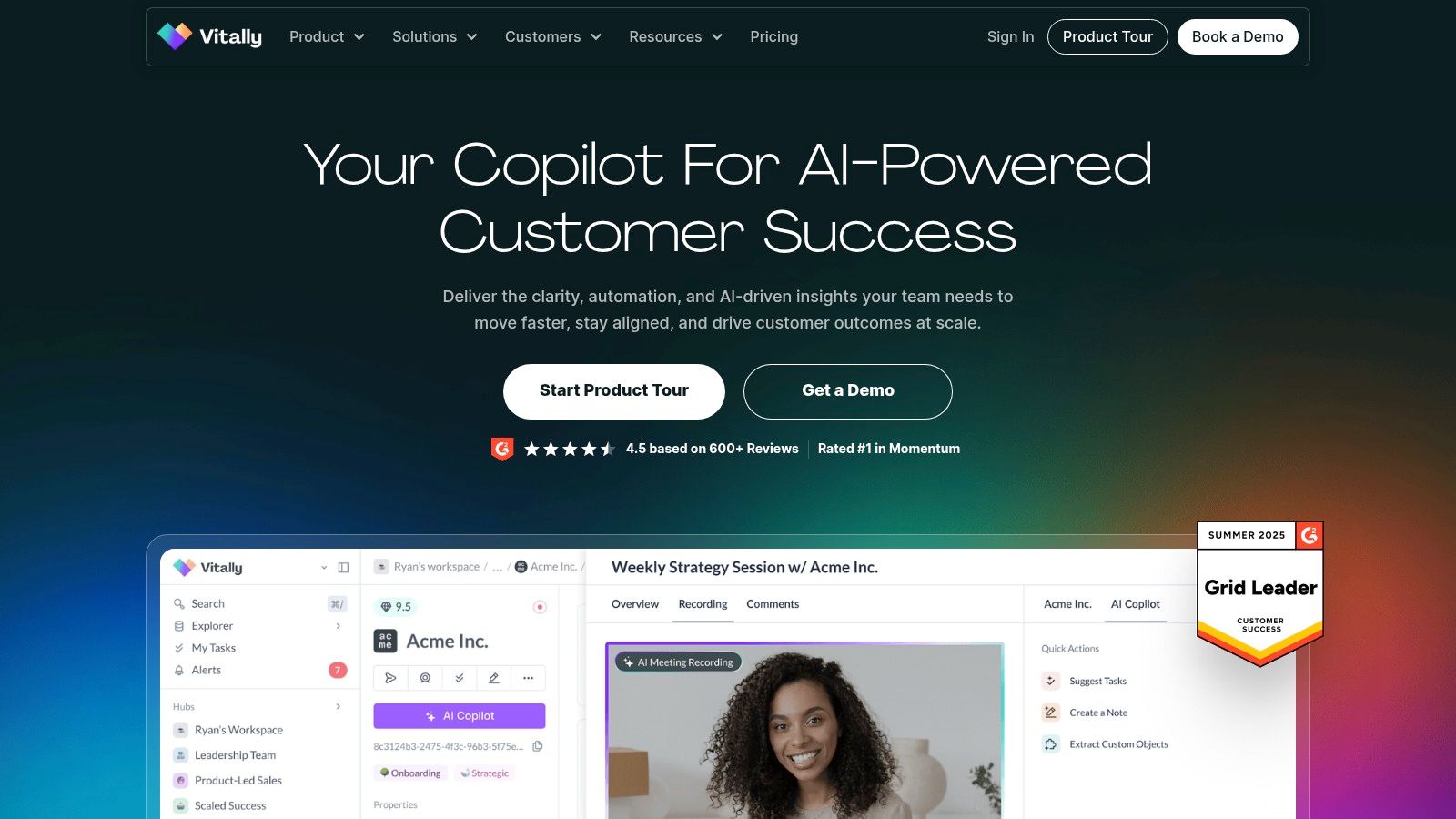
What makes Vitally stand out is its emphasis on operational efficiency and cross-functional visibility. The platform includes unlimited free "observer" seats, allowing product, sales, and leadership teams to access customer data without extra cost. Its AI-powered features, like conversation summaries and automated action items, help customer success managers (CSMs) focus on strategic work rather than manual data entry. The strong bidirectional sync with systems like Salesforce ensures that customer health data is accessible across the entire go-to-market team.
Key Features & Use Cases
- Vitally AI: An integrated copilot that can summarize customer conversations, answer questions about accounts, and draft follow-up actions.
- Customer Health Scores: Teams can configure dynamic, weighted health scores based on product usage, support tickets, and survey feedback to identify at-risk accounts.
- Automation & Playbooks: Automate tasks and workflows based on lifecycle events, such as triggering an onboarding project for new customers or an intervention playbook for low health scores.
- Rich Integrations: Offers deep, bidirectional syncs with key tools like Salesforce, HubSpot, and Segment to create a unified customer view.
Limitations & Implementation
The main drawback is the lack of public pricing, which requires engaging with their sales team for a custom quote. While powerful, its integration ecosystem is smaller than that of older, more established platforms, which could be a consideration for companies with very specific tech stacks. Implementation is relatively fast, but maximizing its automation capabilities requires a clear strategy for defining customer lifecycle stages and health metrics upfront.
Website: https://www.vitally.io Pricing: Pricing is not publicly listed and is available upon request through a demo. The inclusion of unlimited observer seats is a key part of its value proposition.
10. Mixpanel
Mixpanel is a powerful, self-serve product analytics platform designed for tracking how users interact with websites and mobile applications. Instead of focusing on sales pipelines, it provides deep insight into user behavior, making it an essential tool for product, growth, and marketing teams. This software for tracking customers helps answer critical questions like which features drive retention, where users drop off in conversion funnels, and how different user segments behave over time.
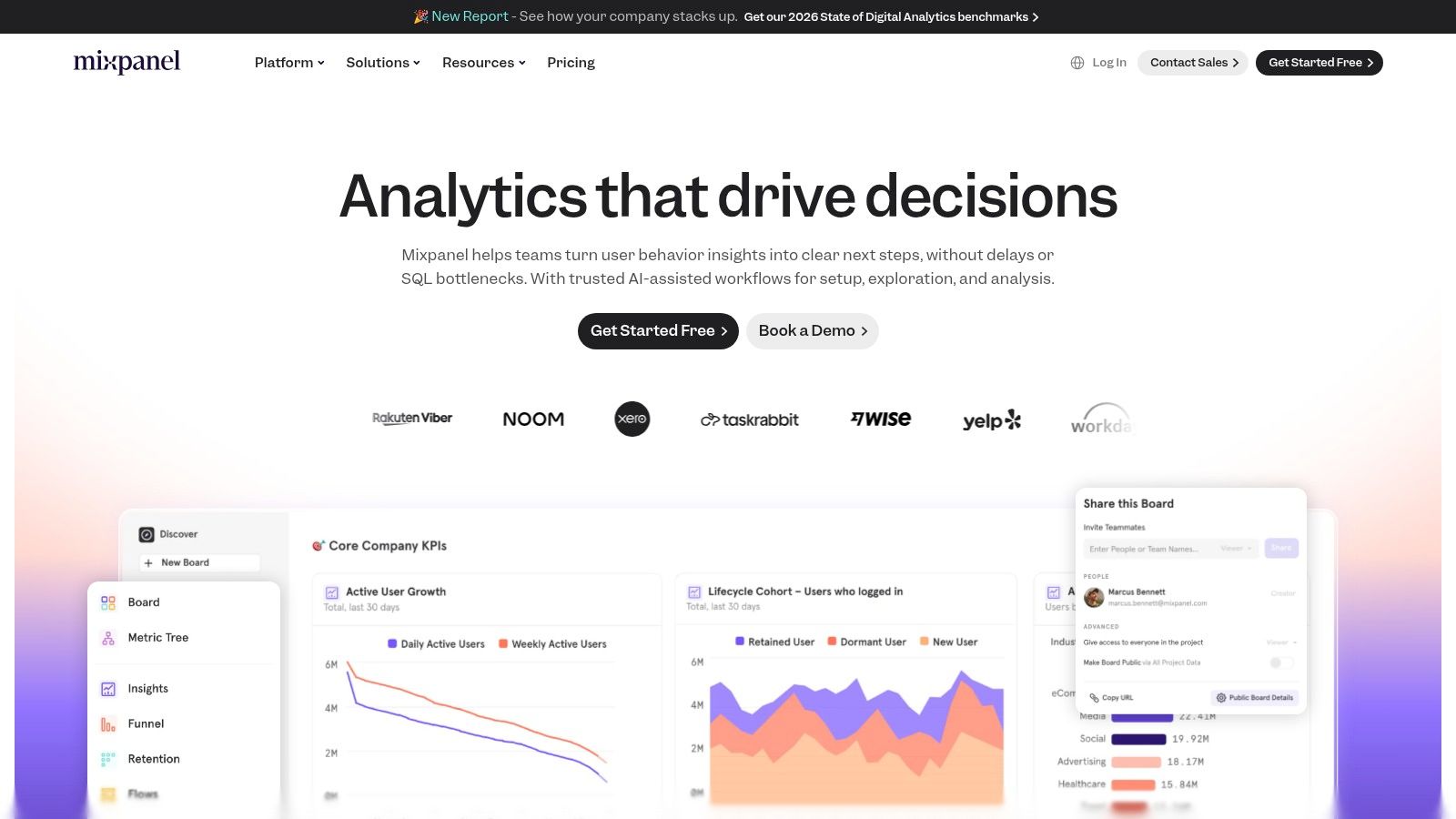
What makes Mixpanel a standout choice is its speed and user-friendly interface, which empowers non-technical team members to build complex reports without writing SQL. It operates on an event-based model, where every user action, from a button click to a page view, is tracked as a distinct event. This granular data allows teams to construct detailed funnels, analyze user flows, and build cohorts to understand product adoption and engagement with high precision.
Key Features & Use Cases
- Funnels & Flows Analysis: Product managers can visualize the exact paths users take to convert or drop off, identifying friction points in the user journey.
- Retention & Cohort Analysis: Teams can group users by signup date or behavior to measure how product changes impact long-term engagement.
- Interactive Dashboards: Build and share dashboards with key product metrics, providing a single source of truth for team performance and user activity.
- AI-Powered Insights: The Spark AI feature allows users to ask questions in plain language and get instant data visualizations and answers.
Limitations & Implementation
The main challenge with Mixpanel is its event-based pricing, which can become expensive for high-traffic applications if not managed carefully. Teams must be deliberate about which events to track to avoid unexpected cost spikes. While excellent for product analytics, it is not a CRM; deep account-level or sales-cycle tracking requires integrating it with other systems like Salesforce or HubSpot.
Website: https://mixpanel.com Pricing: Offers a generous free plan for up to 20M monthly events. Paid plans start at $20/month for the "Growth" tier with usage-based pricing that scales with event volume. Enterprise plans offer advanced features and security.
11. Amplitude Analytics
Amplitude Analytics is a leading product intelligence platform that provides deep insights into how users interact with a digital product. It moves beyond simple page views to focus on behavioral analytics, helping teams understand what actions lead to retention, conversion, and growth. This makes it an essential piece of software for tracking customers' in-app behavior and journey, rather than just their sales or support history.
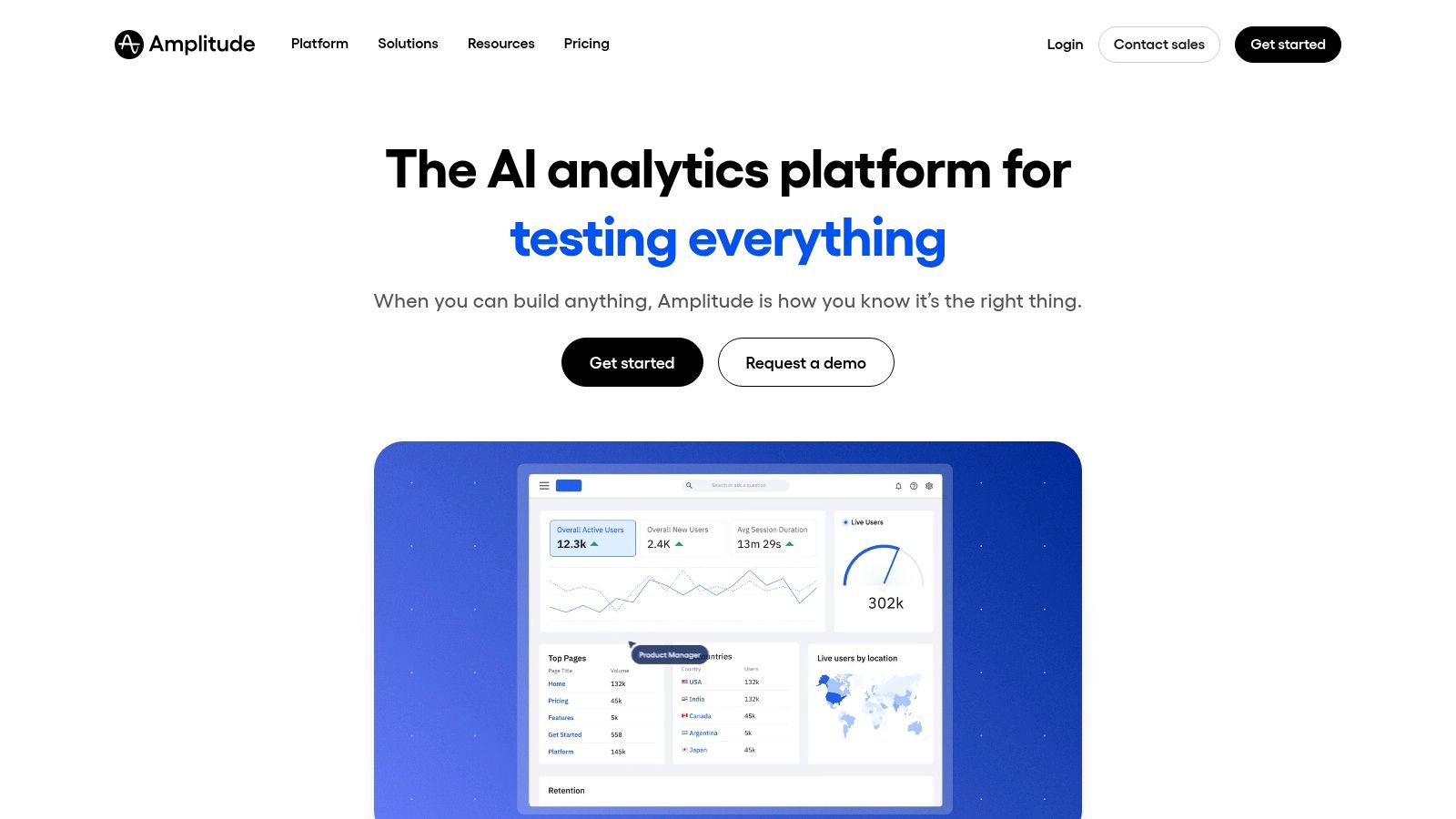
What makes Amplitude stand out is its integrated suite of tools that combines analytics with action. Product teams can not only discover insights through behavioral cohorts and funnel analysis but also act on them immediately using built-in feature flags and A/B testing. This creates a tight loop of hypothesis, experimentation, and analysis, all within a single environment, shortening the time it takes to build features that customers actually use.
Key Features & Use Cases
- Behavioral Analytics & Cohorts: Group users based on the specific actions they take (or don't take) to understand what drives engagement and retention.
- Feature Flags & Experimentation: Roll out new features to specific customer segments and run A/B tests to validate their impact on key metrics before a full launch.
- Session Replay: Watch user sessions to identify friction points and bugs, providing qualitative context to quantitative data.
- Data Warehouse Integration: Offers warehouse-native options and streaming syncs, allowing teams to run analyses directly on their own data infrastructure.
Limitations & Implementation
The primary consideration with Amplitude is its pricing model, which is based on Monthly Tracked Users (MTUs). This requires active management to control costs, especially for products with large, low-engagement user bases. While the core analytics are powerful, accessing the full suite of tools like Experimentation and advanced data governance often requires upgrading to more expensive Growth or Enterprise plans, which may be a barrier for smaller teams.
Website: https://www.amplitude.com Pricing: A generous free "Starter" plan is available. Paid plans begin with the "Plus" tier, designed for small teams, with custom pricing for "Growth" and "Enterprise" tiers that include more advanced features and higher MTU limits.
12. Pendo
Pendo is a product experience platform that closes the loop between understanding user behavior and influencing it. It goes beyond simple observation by pairing robust product analytics with tools for in-app communication, making it an excellent software for tracking customers and guiding them toward valuable features. This dual capability allows product teams to not only see where users are struggling but to immediately deploy a tooltip, guide, or survey to help them succeed.
What makes Pendo a popular choice is its retroactive analytics. Once the Pendo snippet is installed, it begins collecting data on every click and page view, so teams can create reports on features they hadn't previously tagged. This eliminates the need for developer intervention every time a new question arises about user activity. The platform serves as a central hub for product usage data, user feedback, and in-app messaging, connecting product insights directly to user engagement.
Key Features & Use Cases
- Product Analytics: Track feature adoption, user retention, and customer journeys with codeless, retroactive event tagging.
- In-app Guides: Launch onboarding tours, feature announcements, and tooltips to drive adoption and provide contextual support without writing code.
- Feedback & NPS: Collect qualitative feedback and measure customer loyalty with integrated Net Promoter Score (NPS) and other in-app surveys.
- Session Replay: Watch recordings of user sessions to understand the context behind analytics data and identify points of friction.
Limitations & Implementation
The main challenge with Pendo is that its most powerful features, like advanced feedback tools and robust governance, are often gated behind higher-tier plans with opaque pricing. While the free tier is excellent for startups, scaling teams may find the jump in cost significant. Additionally, without strong internal processes for managing guide creation and analytics, the platform can become cluttered with outdated content and inconsistent reports.
Website: https://www.pendo.io Pricing: A generous free plan is available for up to 500 monthly active users. Paid plans require contacting sales for a custom quote, which is based on usage and feature set.
Top 12 Customer Tracking Software Comparison
| Product | Core features (✨) | UX / Quality (★) | Value / ROI (💰) | Target audience (👥) |
|---|---|---|---|---|
| 🏆 SigOS | ✨ Autonomous AI product intelligence; ticket/chat/call + usage + billing integrations; revenue-impact scores | ★★★★★ — sub‑min analysis; 87% churn‑corr. | 💰 Prioritizes dev work by $ impact; free first analysis; proven recoveries | 👥 Scaling SaaS product, growth & CS teams |
| Salesforce Sales Cloud | ✨ Full CRM, forecasting, AppExchange & APIs | ★★★★☆ — powerful but complex | 💰 Enterprise pricing; high TCO with customizations | 👥 Large B2B sales orgs & enterprises |
| HubSpot CRM / Customer Platform | ✨ Unified CRM + native marketing/service hubs | ★★★★ — very quick setup, intuitive | 💰 Freemium → paid Hubs; good SMB ROI | 👥 Startups, SMBs, midmarket teams |
| Zendesk Suite | ✨ Omnichannel ticketing, AI agents, marketplace | ★★★★ — mature support tooling | 💰 Mid→high; best value with annual plans | 👥 Support ops from startups to enterprise |
| Intercom | ✨ In-app Messenger, Fin AI, proactive messaging | ★★★★ — excellent in-product UX | 💰 Per-resolution AI costs; modular pricing | 👥 SaaS product teams needing in-app engagement |
| Gainsight CS | ✨ Customer 360, playbooks, renewal forecasting | ★★★★ — deep CS operating model | 💰 Custom enterprise pricing; implementation cost | 👥 Large, complex B2B CS organizations |
| Totango | ✨ Modular CS, Unison AI, flexible seat types | ★★★★ — flexible & collaborative | 💰 Custom pricing; scalable licensing | 👥 CS teams seeking modular/enterprise fit |
| ChurnZero | ✨ Health scoring, playbooks, CS-specific AI | ★★★★ — focused on retention workflows | 💰 Custom pricing; may require services | 👥 Teams prioritizing churn reduction & expansion |
| Vitally | ✨ AI copilot, automation, unlimited observers | ★★★★ — fast operationalization | 💰 Quote-based; observer-friendly licensing | 👥 Scaling CS teams & cross-functional GTM |
| Mixpanel | ✨ Funnels, cohorts, retention, generous free tier | ★★★★ — self-serve analytics for PMs | 💰 Usage-based Growth pricing; free up to 1M events | 👥 PMs, analysts, product teams |
| Amplitude Analytics | ✨ Behavioral analytics + flags & experiments | ★★★★ — integrated analytics & experiments | 💰 MTU-based pricing; clear Plus entry | 👥 Product teams needing analytics + experimentation |
| Pendo | ✨ Analytics + in-app guides, NPS & session replay | ★★★★ — combines insights with guidance | 💰 Free small MAU tier → custom enterprise | 👥 Product teams focused on adoption & in-app UX |
Choosing the Right System to Translate Customer Signals Into Growth
Selecting the right software for tracking customers is less about finding a single "best" tool and more about assembling a strategic technology stack that mirrors your company's stage, team structure, and primary goals. The dozen platforms we've explored serve distinct, though sometimes overlapping, purposes, and understanding these differences is the first step toward making a well-informed decision.
For a startup just beginning its journey, a unified platform like HubSpot CRM or Zendesk Suite can provide immediate, accessible value. These systems consolidate sales, support, and marketing data into one place, offering a foundational view of the customer journey without the complexity of managing multiple specialized tools. They are excellent for establishing core processes and getting a basic handle on customer interactions.
As your organization matures, the need for specialized insight deepens. This is where dedicated tools for specific functions become critical. Product teams at scale will find the deep behavioral analytics of Mixpanel or Amplitude essential for optimizing features and user flows. Similarly, customer success teams managing complex, high-value accounts require the health scoring, playbook automation, and workflow management offered by platforms like Gainsight, ChurnZero, or Vitally. These tools are built to proactively manage relationships and prevent churn at a scale that all-in-one CRMs simply cannot handle.
Identifying Your Core Challenge: Data Collection vs. Data Interpretation
The central question every team must answer is: Is our primary challenge collecting customer data, or is it interpreting the data we already have?
- If you lack basic visibility, your priority should be establishing a system of record. Salesforce remains the gold standard for enterprise sales data, while Intercom excels at capturing real-time communication signals.
- If you have data but struggle with analysis, the next step is to add a layer of intelligence. This often involves segmenting users in a product analytics tool or building health scores in a customer success platform. Many companies also find that, to truly understand customer perceptions and drive growth, leveraging dedicated customer sentiment analysis tools can be invaluable for decoding the qualitative feedback hidden in surveys, support tickets, and reviews.
The Final Frontier: Connecting Actions to Revenue
Yet, even with a robust stack of CRMs, support suites, and analytics platforms, a significant gap often remains. Teams are frequently overwhelmed by a deluge of dashboards, behavioral events, and qualitative feedback. The critical disconnect is the inability to quickly and reliably connect specific user behaviors and product issues directly to their revenue impact. Answering "What should we build next?" becomes a time-consuming exercise of manual data correlation and internal debate.
This is precisely the problem that next-generation, AI-driven product intelligence platforms like SigOS are designed to solve. Instead of just providing more charts and data points, SigOS moves beyond simple tracking to autonomous analysis and prioritization. It ingests data from all your existing sources, identifies the most impactful friction points and opportunities, and quantifies their direct effect on revenue and churn. The output isn't another dashboard to monitor; it's a clear, prioritized list of actions for your engineering and product teams.
Your journey to find the right software for tracking customers should ultimately lead you to a system that doesn't just show you what’s happening but tells you what to do about it. Evaluate your current tools and workflows. If your biggest pain point is the manual effort required to find the actionable, revenue-driving signals within your sea of data, it’s time to look beyond traditional tracking and toward automated intelligence.
Ready to stop guessing and start prioritizing with AI? SigOS connects all your customer data to pinpoint the exact product improvements that will grow your revenue and reduce churn. See how our product intelligence platform can give your team a clear, data-backed roadmap by visiting SigOS today.
Keep Reading
More insights from our blog
Ready to find your hidden revenue leaks?
Start analyzing your customer feedback and discover insights that drive revenue.
Start Free Trial →