Boost SaaS Performance with Ai Driven Insights
Learn how ai driven insights can reduce churn, prioritize features, and prove revenue impact for SaaS teams. Your 2026 practical guide.
Your backlog probably has the same problem as everyone else's. Support has one view of customer pain. Sales has another. Customer success logs renewal risk in a spreadsheet. Product gets feature requests in Slack, Jira, Gong, Intercom, Zendesk, and email. Everyone says they're data-driven, but when roadmap decisions happen, the loudest anecdote still wins.
That's where AI driven insights become useful. Not as a novelty layer on top of dashboards, but as a way to turn messy qualitative input into ranked, revenue-tied priorities. For SaaS teams, that changes the job. Feedback stops being a pile of context to manually sort through and starts becoming evidence you can act on. Its value isn't that AI finds themes. It's that it helps teams connect those themes to churn risk, expansion potential, and product work that moves the business.
Beyond the Buzzword What Are AI-Driven Insights
Many teams already have plenty of data. The problem is that the data that matters most is often unstructured. Customers don't file feedback in neat categories. They complain in call transcripts, mention blockers in onboarding meetings, describe workarounds in support tickets, and hint at deal risk in CRM notes.
AI-driven insights are what you get when systems process that messy input at scale and turn it into something operational. According to Grand View Research's AI market analysis, the global Artificial Intelligence market was valued at 390.91 billion in 2025 and is projected to reach ****3,497.26 billion by 2033, expanding at a 30.6% CAGR. That level of investment exists because companies are moving AI from experimentation into core business infrastructure.

What counts as an insight
A data point is “25 customers mentioned export issues.”
An insight is “enterprise accounts mentioning export latency also show reduced usage in reporting workflows, and those accounts are appearing in renewal-risk conversations.”
That difference matters. Product teams don't need more tagged comments. They need a defensible reason to act.
What SaaS teams should look for
Useful AI driven insights usually have three traits:
- Business context attached: The signal is tied to churn, expansion, activation, retention, or deal movement.
- Customer evidence behind it: You can trace the conclusion back to tickets, transcripts, usage patterns, or account behavior.
- A clear action path: Fix the bug, change onboarding, update packaging, retrain support, or prioritize a feature.
Practical rule: If an insight can't change a roadmap decision, save a renewal, or help close a deal, it's probably just better-organized noise.
Why the shift matters
The old model treats feedback review as a research project. Someone pulls samples, reads notes, creates tags, and presents a summary two weeks later. By then, the account may already be gone or the sales opportunity may have stalled.
The better model treats feedback as an operating signal. AI helps product, growth, and success teams see which customer problems deserve immediate attention because they affect revenue, not because they generated the most internal chatter.
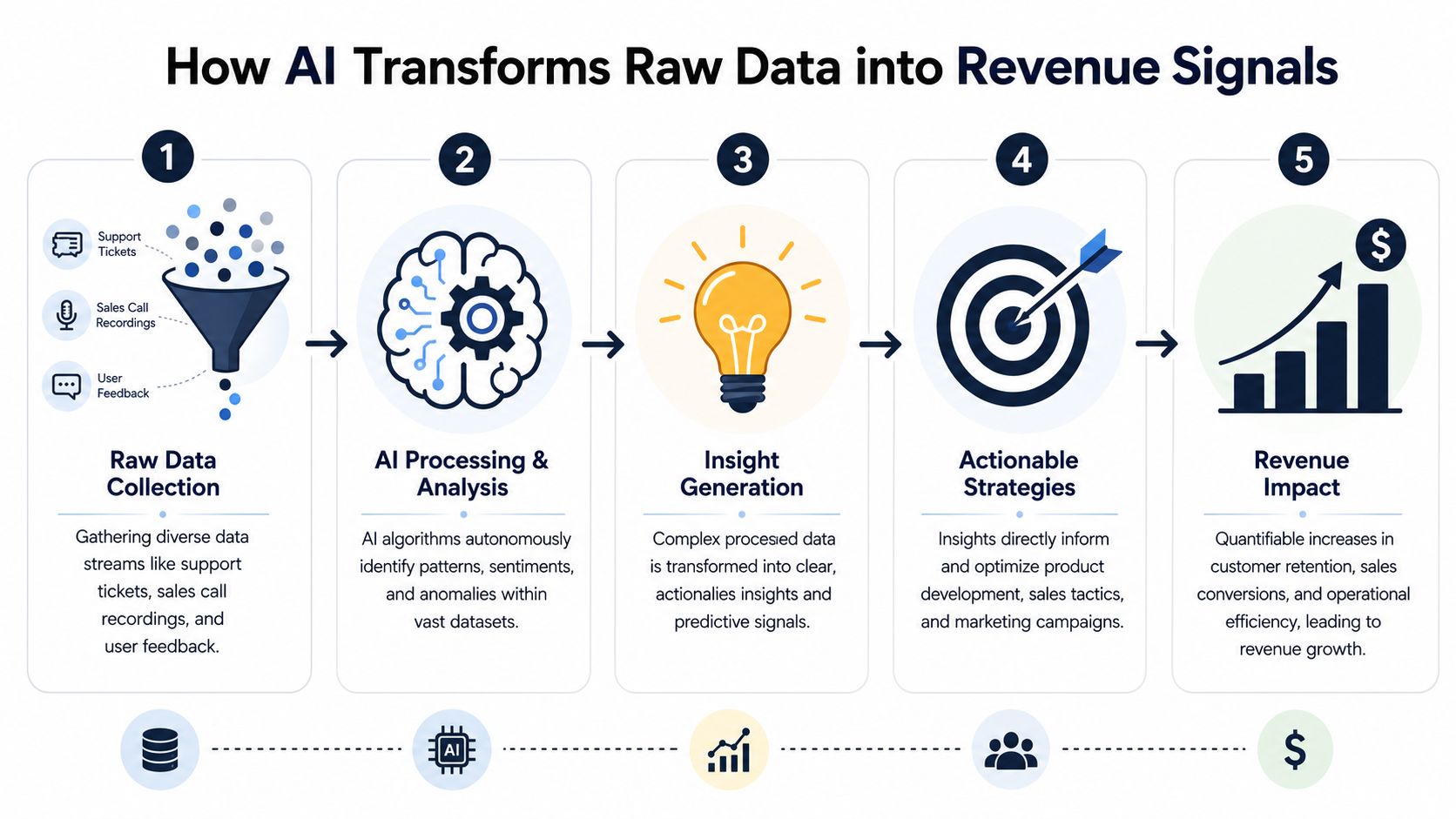
How AI Transforms Raw Data into Revenue Signals
An AI insights engine works like a strong product analyst with unlimited time and perfect memory. It reads the ticket support received last night, the sales call from two weeks ago, the bug report from engineering, and the usage drop from analytics. Then it asks the hard question people often skip: are these events related?
Start with ingestion, not intelligence
If the system only sees one channel, it will produce shallow conclusions. The useful setup pulls from places like Zendesk, Intercom, Jira, CRM notes, call transcripts, survey responses, and product analytics.
That matters because the signal rarely lives in one source. A customer may complain about reporting in support, then stop using the reporting module, then ask for concessions at renewal. If those systems are disconnected, nobody sees the full picture.
Then let NLP structure the mess
Language is where most SaaS teams lose time. Human reviewers can read a few dozen tickets well. They can't reliably synthesize thousands of comments across channels every week.
According to Supermicro's explanation of AI-driven insights, the process integrates Machine Learning, Natural Language Processing, and predictive analytics to handle large volumes of structured and unstructured data, using clustering and pattern recognition to forecast outcomes based on historical correlations.
In practice, NLP helps identify:
- Intent: Is the customer asking for help, threatening to leave, or requesting a missing capability?
- Urgency: Is this an annoyance, a blocker, or a trigger for escalation?
- Topic consistency: Are different customers describing the same root issue with different language?
Correlation is where revenue signal appears
This is the part many teams miss. Categorization alone doesn't justify prioritization. You need a link between the qualitative theme and an account outcome.
A good model looks for patterns such as:
- A theme appears repeatedly in customer conversations.
- The same accounts show a change in product behavior.
- Those accounts also surface in expansion, downgrade, or renewal workflows.
At that point, you're no longer looking at “feedback volume.” You're looking at a probable business consequence.
Think like a detective, not a dashboard builder. One clue is interesting. Several clues tied to the same account behavior become a case.
The final output should be operational
The best systems don't stop at analysis. They surface a ranked recommendation. For example:
| Signal detected | Likely implication | Team action |
|---|---|---|
| Repeated complaints about onboarding confusion | Activation risk | Revise setup flow and enablement content |
| Rising mentions of billing friction in a segment | Churn risk | Review pricing communication and support workflows |
| Feature request appearing in late-stage sales calls | Expansion opportunity | Validate packaging and roadmap timing |
That's the standard to hold AI driven insights to. If the output still requires three meetings to interpret, the pipeline may be technically impressive but operationally weak.
Concrete Use Cases for SaaS Growth Teams
The fastest way to tell whether AI driven insights are working is to ask a blunt question. Did they change what the team shipped, fixed, or escalated this week?
For SaaS growth teams, the answer usually shows up in three places: churn prevention, feature prioritization, and revenue impact scoring.
Churn mitigation before the cancellation arrives
A common failure mode is waiting for explicit churn language. By the time a customer says they're evaluating alternatives, the damage is usually done.
The earlier signal is often softer. Support tickets start mentioning confusion around invoices. CSM notes reflect frustration from finance stakeholders. Usage from admin users drops. The account hasn't filed a cancellation notice, but the relationship is already under stress.
Real-time alerting is essential. As described in Acceldata's overview of AI-powered business decisions, insight systems can use real-time visualization and automated alerts when thresholds are breached, enabling immediate prescriptive actions.
A practical response might look like this:
- Support flags the pattern: Billing-related tickets rise in one account segment.
- Product checks behavior: Those same accounts use the invoicing workflow less often.
- Success intervenes: The team reaches out with clarification, training, or account-specific remediation before renewal pressure builds.
That's much better than treating every complaint as equal and much better than reacting after legal or procurement enters the thread.
Feature prioritization that isn't driven by volume alone
The most requested feature isn't always the most valuable one. Some requests come from low-fit accounts. Others come from vocal users who won't expand no matter what you ship.
Better prioritization comes from weighting demand by account quality and commercial relevance. If a feature request repeatedly appears in late-stage enterprise sales conversations, expansion reviews, and onboarding friction for high-value customers, it deserves more attention than a cosmetic request with broad but shallow demand.
Teams trying to build this discipline often pair AI-based synthesis with process work like tighter product review loops and clearer evidence standards. A useful example is this guide to AI for product development workflows, which focuses on connecting feedback analysis to actual roadmap execution.
The right feature doesn't just have demand. It has consequences when absent.
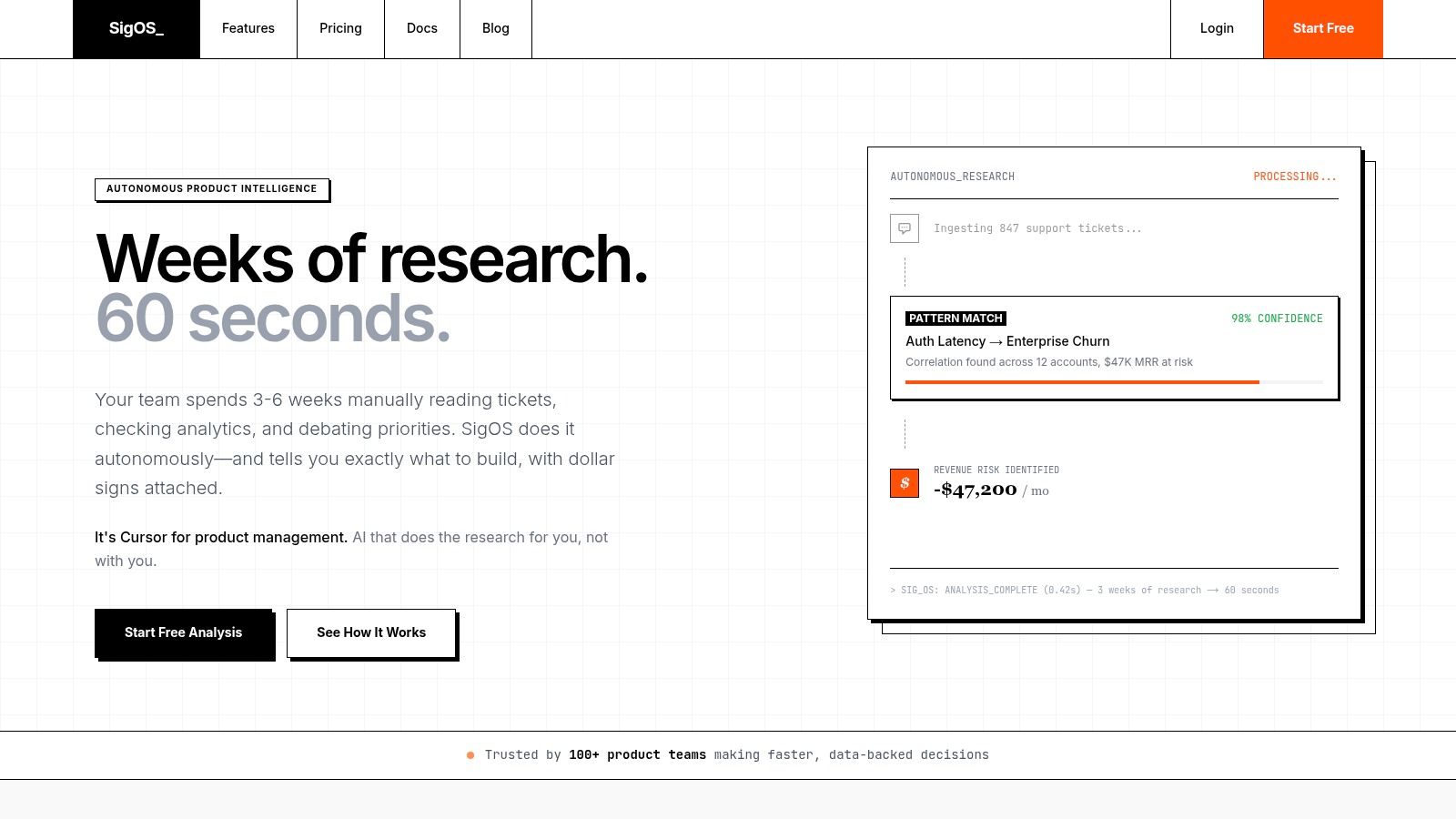
A platform such as SigOS can help by ingesting support tickets, call transcripts, chat logs, and usage data, then surfacing patterns tied to churn, expansion, and revenue impact so product teams can compare requests on business value instead of anecdotal urgency.
Revenue impact scoring for bugs and requests
At this stage, teams usually level up. Instead of asking, “How many customers reported this?” they ask, “What revenue is exposed if this remains unresolved?”
A bug affecting a narrow workflow may still be far more important than a commonly mentioned annoyance if it blocks a renewal, delays procurement, or slows adoption in strategic accounts. The same goes for requests. Some drive sales momentum. Others foster goodwill.
Here's a short walkthrough of how teams are starting to operationalize that shift:
Once teams start assigning commercial weight to product issues, roadmap discussions get cleaner. Engineering sees why a defect matters. Sales stops lobbying through anecdotes. Product can defend a decision with evidence tied to retention and growth.
Implementing an AI Insights Engine
Teams often don't need a massive transformation program to get started. They need a cleaner operating model. The implementation usually fails for simple reasons: disconnected systems, vague goals, or no owner for acting on the output.
Connect the systems that already hold the truth
Start with the systems your teams already use every day. For most SaaS companies, that means support, CRM, call recordings, product analytics, and issue tracking.
A practical first pass includes:
- Customer conversation tools: Zendesk, Intercom, Gong, email, or chat systems.
- Commercial systems: Salesforce, HubSpot, renewal notes, and opportunity records.
- Delivery systems: Jira, Linear, GitHub, and release history.
- Behavioral systems: Feature usage, activation events, and account-level product activity.
If you skip any one of those categories, your insights will skew. Customer language without usage data creates guesswork. Usage data without customer language creates false confidence.
Define outcomes before you tune models
Teams often ask the system to “find patterns.” That's too vague to be useful. The better question is, “What decisions should this improve?”
Good starting objectives are concrete:
- Reduce resolution time for bugs that threaten renewals.
- Surface feature requests tied to expansion conversations.
- Detect churn signals earlier in onboarding or support.
- Route high-risk issues into Jira or Linear with enough context to act.
If your team needs help operationalizing that data layer, this walkthrough on self-serve analytics for product teams is a useful companion because it focuses on making insight consumption easier across functions, not just analysts.
Build the workflow, not just the dashboard
A dashboard alone doesn't change anything. Someone must own review cadence, escalation rules, and downstream actions.
That usually means setting simple rules such as:
- Product reviews the top revenue-exposed issues every week.
- Success gets alerts for churn-related patterns in named accounts.
- Engineering receives enriched tickets with customer evidence attached.
- Sales can reference validated product signals in deal strategy.
Here's the operational difference in plain terms:
| Aspect | Traditional Method | AI-Driven Insights |
|---|---|---|
| Evidence gathering | Manual review of tickets, calls, and notes | Automated synthesis across sources |
| Speed | Slow, periodic, and backlog-driven | Continuous and near real-time |
| Prioritization basis | Volume, intuition, stakeholder pressure | Correlated customer and business signals |
| Bias risk | High, because reviewers sample selectively | Lower, if data sources and review rules are broad |
| Output quality | Summaries that still need interpretation | Ranked issues tied to likely business impact |
| Team workflow | Separate handoffs across departments | Shared visibility across product, growth, and success |
If implementation feels hard, simplify the question. What decision should become easier next Monday because this system exists?
Governance Privacy and Building Trust
A team won't act on AI-driven output if they don't trust how the system handles customer data or how it reached a conclusion. That skepticism is healthy. In practice, trust comes from boring things done well: access controls, anonymization, clear usage boundaries, and reviewable evidence.
Privacy has to be designed into the workflow
Customer feedback often includes sensitive details. Sales calls may mention pricing, procurement, headcount plans, or internal incidents. Support tickets can contain account-specific operational information. If an AI tool ingests that data without clear guardrails, teams will hesitate to connect the systems that make the product useful in the first place.
The baseline should include encrypted data handling, role-based access, and explicit boundaries around model behavior. Teams evaluating vendors should also look closely at retention policies and whether proprietary customer data is used to retrain models. That's one reason these insights on AI data guardrails are worth reading. They give a practical checklist for evaluating whether an AI workflow protects sensitive business data instead of just claiming to.
Bias isn't a side issue
Trust also breaks when the system consistently misreads certain customers, segments, or communication styles. According to California Health Care Foundation guidance on equitable AI implementation, avoiding bias requires data inputs that reflect a wide variety of demographic variables, including race, ethnicity, language, gender, and location, and it requires involving people with lived experience from the start.
That guidance maps surprisingly well to SaaS product work. If your input data overrepresents one customer segment, one geography, or one type of user behavior, the model can steer teams toward misleading priorities.
A few practical safeguards help:
- Review source coverage: Make sure the system isn't over-weighting one team's data, such as only support or only sales.
- Audit representative input: Check whether different customer types are present in enough volume to avoid one-sided conclusions.
- Keep humans in the loop: Product, success, and support should review outputs that drive major roadmap or account decisions.
Reliable AI doesn't remove judgment. It gives teams a stronger starting point for judgment.
Transparency matters more than polish
The best insight systems don't just hand back a score. They show the evidence trail. Which conversations drove the pattern? Which accounts are affected? Which behaviors changed?
That traceability is what lets teams challenge bad conclusions, verify good ones, and build confidence over time. Without it, even an accurate model will struggle to influence high-stakes product or revenue decisions.
Measuring Success and Calculating ROI
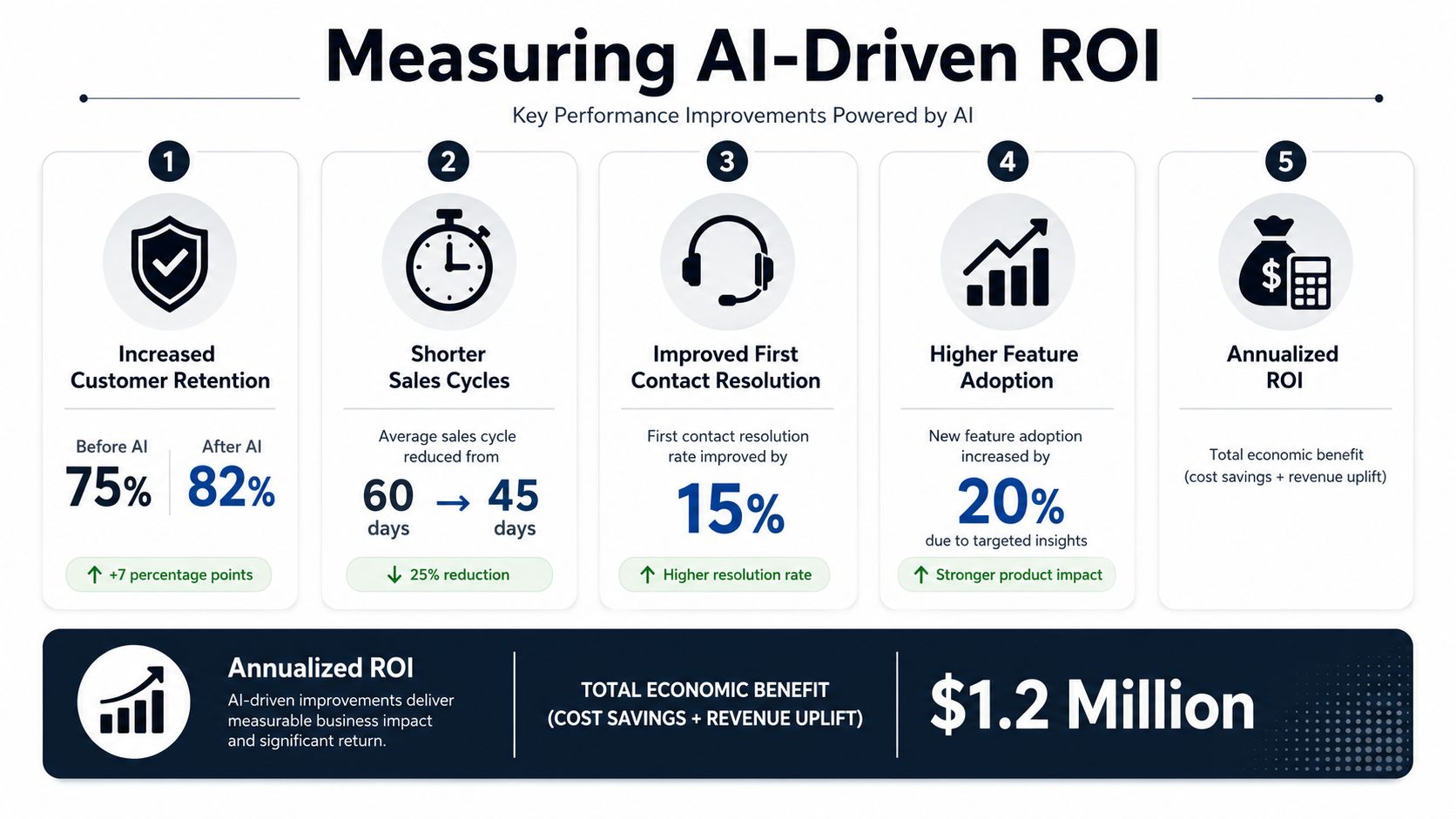
An AI insights program earns budget when it changes business outcomes that leadership already cares about. If you measure it like a generic analytics project, it will look vague. If you measure it like a retention and expansion system, the value becomes easier to explain.
According to Forbes Advisor's AI statistics roundup, AI technology is estimated to generate $15.7 trillion in revenue by 2030, and 78% of organizations reported AI usage in 2024, up from 55% the previous year. That macro trend matters, but your internal case still needs local proof.
Measure the outcomes that change financial performance
Start with metrics that reflect retained or realized revenue rather than generic engagement.
Useful categories include:
- Retention protection: Which at-risk accounts were identified earlier, and what product or success action followed?
- Expansion enablement: Which feature gaps or requests showed up in expansion or late-stage sales conversations?
- Faster issue response: Did revenue-impacting bugs get triaged and resolved faster because the team had clearer evidence?
- Feature adoption quality: Did teams improve rollout decisions because they understood why customers were or weren't using a capability?
This is also where operational efficiency matters. If your pipeline processes large amounts of qualitative input, formatting and token discipline can affect cost. For teams working through ingestion and summarization workflows, this article on how Markdown saves AI API costs is a useful tactical read because it connects content structure to model spend.
A simple ROI model that executives will understand
Keep the formula plain:
ROI = value of churn saved + expansion revenue influenced + operational time recovered - platform and implementation cost
You don't need perfect precision to make this useful. You need consistency. If the team can show that the platform repeatedly surfaced issues connected to renewals, deal progression, or adoption blockers, leadership can evaluate it as a revenue support system instead of a research expense.
A practical scorecard might include:
| ROI component | What to track |
|---|---|
| Churn saved | Accounts where early signals triggered intervention |
| Expansion influenced | Opportunities where insight-backed feature work helped unblock growth |
| Product efficiency | Reduction in low-value roadmap work caused by anecdotal requests |
| Support and success leverage | Less manual review time and faster escalation on meaningful issues |
For teams that need a structured way to document the business case, this ROI template for AI initiatives can help standardize assumptions across product, finance, and leadership.
The strongest ROI story isn't “AI saved time.” It's “AI changed which work we prioritized, and that protected or created revenue.”
If your current process still treats customer feedback as an inbox to manage, you're underusing one of the richest signals in the business. AI driven insights become valuable when they rank what matters, tie it to commercial outcomes, and help teams act while there's still time to change the result.
If you're evaluating ways to turn support tickets, sales calls, and usage data into revenue-tied product priorities, SigOS is one option to review. It's built for teams that want to connect qualitative feedback with churn risk, expansion signals, and issue prioritization inside the tools they already use.
Keep Reading
More insights from our blog
Ready to find your hidden revenue leaks?
Start analyzing your customer feedback and discover insights that drive revenue.
Start Free Trial →