A Guide to AI for Customer Insights and Revenue Growth
Turn customer feedback into revenue. This guide shows you how to leverage AI for customer insights, linking data to tangible business growth and ROI.
If you feel like you're drowning in customer feedback, you're not alone. The real challenge isn't just managing the volume—it's about turning that qualitative chaos from support tickets, sales calls, and social media into clear, revenue-driving actions.
That’s where AI for customer insights comes in. Think of it as a financial translator for everything your customers are trying to tell you.
From Customer Noise to Revenue Signal

Your teams are sitting on a goldmine of information. Every support ticket, call transcript, and social media comment holds a piece of a much larger puzzle about your business. The problem? All those pieces are scattered, unstructured, and often seem to contradict each other.
This creates what we call “customer noise”—an overwhelming mix of bug reports, feature ideas, complaints, and praise. Trying to sort through this manually is more than just a time sink; it's practically impossible to do at scale. Inevitably, crucial insights get buried, and high-impact opportunities are missed.
Finding the Signal in the Chaos
This is where a modern AI platform completely changes the game. It acts like a sophisticated filter, automatically sifting through all that unstructured data to separate the distracting noise from the valuable revenue signals. It finds the patterns, themes, and connections that a person could easily miss.
An AI system can connect dots that seem totally unrelated to reveal their collective business impact. For instance, it can show you how:
- A "minor" bug that keeps getting reported is actually a major churn risk among your highest-value customers.
- A simple feature request, mentioned in just a few sales calls, represents a six-figure expansion opportunity.
- A handful of frustrated comments on social media point to a critical flaw in your new user onboarding flow that’s killing activation rates.
By quantifying the financial impact of qualitative feedback, AI elevates the "voice of the customer" from a collection of anecdotes into a core strategic asset.
This allows your product, success, and growth teams to finally stop guessing. Instead of relying on gut feelings, they can prioritize work based on a concrete, data-backed understanding of what truly matters to customers and the bottom line. It bridges the gap between what customers are saying and what the business should do next, ensuring you're always focused on solving the problems with the biggest impact.
How AI Uncovers Hidden Customer Intelligence
You don't need a data science degree to understand how AI finds customer insights. Just think of it as a superhuman team of analysts, working 24/7 to make sense of the mountains of data your customers create. It sifts through everything, from support tickets to product usage logs, to build a picture of your customer that’s both deep and actionable.
Let’s break down how this actually works. AI uses a few core techniques that build on each other to turn raw data into real business intelligence.
First up is Natural Language Processing (NLP). This is how we teach computers to read and, more importantly, to understand context and intent. It’s the difference between just seeing words on a page and grasping the frustration in a bug report or the excitement in a feature request.
With NLP, AI can finally tackle the huge volumes of unstructured text we all have—call transcripts, survey free-text, social media comments, you name it. It sorts this chaotic stream of feedback into an organized, searchable library of customer sentiment.
Core AI Techniques for Customer Insights
To better understand these technologies, here's a quick breakdown of the main AI methods, what they do, and the kind of insights they produce.
| AI Technique | Primary Function | Example Insight Generated |
|---|---|---|
| Natural Language Processing (NLP) | Understands and categorizes human language from text and speech. | "15% of support tickets this month mention 'confusing UI,' with 80% of those coming from new users." |
| Behavioral Analysis | Connects language-based feedback to actual user actions within the product. | "Users who complain about the 'confusing UI' are twice as likely to churn in their first 30 days." |
| Pattern Detection | Identifies subtle, non-obvious correlations across multiple datasets. | "The 'confusing UI' complaint is most common among enterprise users on Chrome browsers after 3 PM on Fridays." |
These techniques don't work in isolation. They form a chain of analysis that gets more powerful at each step, moving from what customers say to what they do, and finally to why it's happening.
Linking Words to Actions with Behavioral Analysis
Knowing what customers say is just one piece of the puzzle. The real breakthrough comes when you connect their words to their actions. This is where behavioral analysis steps in, linking the themes from NLP to what users are actually doing (or not doing) in your product.
For example, an AI platform like SigOS might use NLP to spot a surge in tickets about a "confusing reporting dashboard." Behavioral analysis then takes over, checking that theme against usage data. It might find that users who complain about the dashboard have a 50% higher drop-off rate in their first week. Suddenly, a vague complaint is a quantifiable churn risk.
An insight is not just knowing that customers are frustrated with a feature. A true insight is knowing that this frustration is causing your highest-paying accounts to abandon the platform, costing you predictable revenue.
This is the connection that turns feedback into a financial data point. It gives teams the evidence they need to stop just logging complaints and start fixing the problems that directly impact the bottom line.
Finding Patterns Humans Can't See
The final piece is pattern detection. While people are good at spotting trends we're looking for, AI is brilliant at finding hidden correlations we'd never even think to check. It can scan thousands of variables at once to uncover subtle but crucial connections.
These are the kinds of patterns AI can surface:
- Pinpointing bugs that only affect users on a specific browser version who are also on your premium plan.
- Highlighting feature requests that consistently came up in sales calls for deals you ultimately lost.
- Noticing a small dip in engagement with a key feature right after a minor UI update was pushed live.
Think about how much unstructured data exists in video testimonials or product review vlogs. You can learn how to AI summarize YouTube video content to extract key themes and sentiment at scale, revealing what customers really think. By weaving together NLP, behavioral analysis, and pattern detection, AI gives you a complete view of your customers that’s simply impossible to get manually.
Fueling the AI Engine with High-Value Data
Your AI is only ever going to be as smart as the data it learns from. Think of it this way: a brilliant detective can't solve a case without clues. To get those game-changing AI for customer insights, you need to feed your system high-quality, relevant information.
But where do you find these crucial clues? They’re often buried in plain sight, hidden within the day-to-day conversations and interactions you’re already having with customers. The trick is knowing which sources contain the real intelligence.
The Most Valuable Data Sources
Not all data tells you the same story. Some sources are a direct pipeline into your customers' worlds, revealing their biggest frustrations, what triggers a purchase, and what they secretly wish your product could do.
Let's look at the sources that pack the most punch.
- Support Tickets (Zendesk, Intercom): This is ground zero for customer friction. Every single ticket is a direct report card on a bug, a confusing workflow, or a process that just isn't working. An AI can comb through thousands of these reports in minutes, spotting trends before they blow up.
- Sales Call Transcripts (Gong, Chorus): These conversations are a goldmine. They hold the unfiltered truth about why you win some deals and lose others. AI can analyze these transcripts to pinpoint common objections, identify feature gaps that kill deals, and flag every time a competitor's name comes up.
- Product Usage Data: This is where the rubber meets the road. It shows you what customers actually do, not just what they say they do. You can see which features they love, which ones they completely ignore, and exactly where they get stuck. It’s undeniable proof of user behavior.
This is how an AI system conceptually takes all that raw language and data and turns it into something you can actually use.
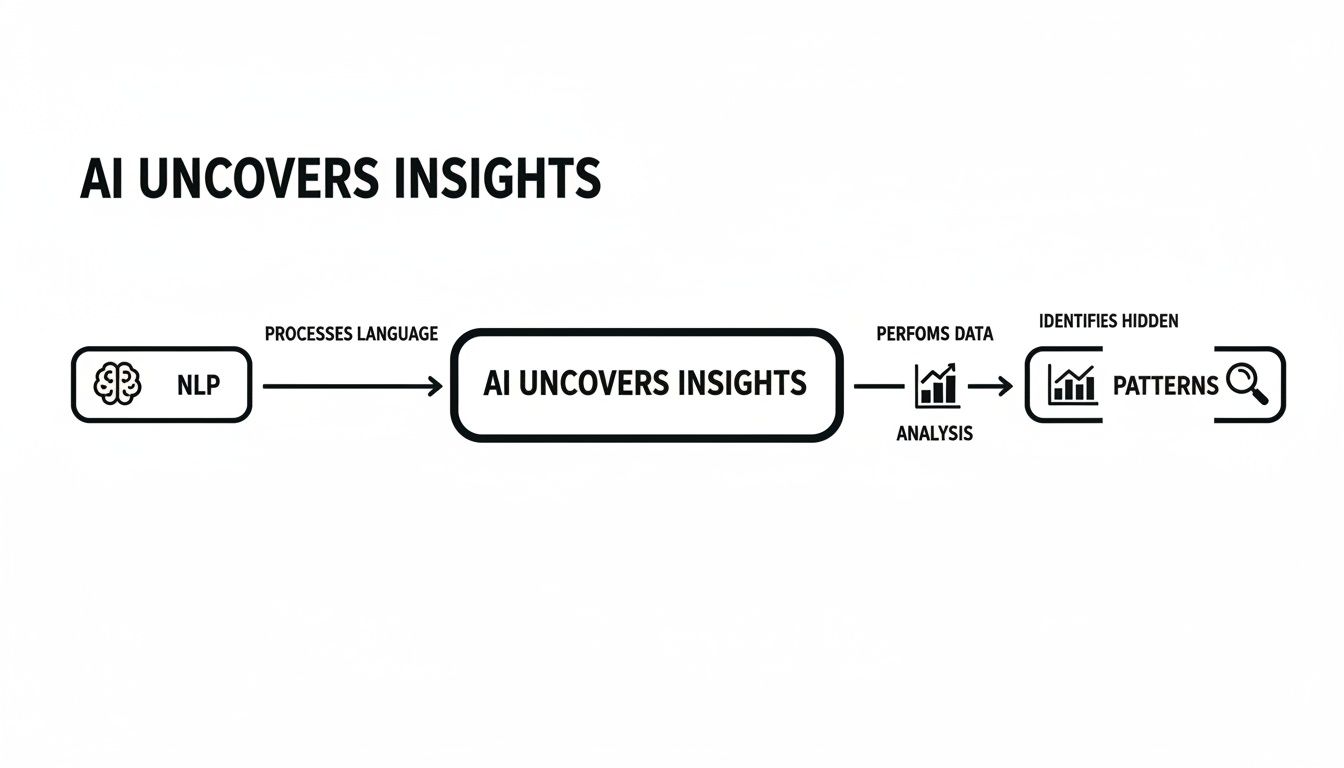
The flowchart shows how AI applies Natural Language Processing (NLP) and pattern detection to systematically pull out the important signals from the noise of customer feedback.
Creating a Holistic Data Ecosystem
The real breakthroughs happen when you start weaving these different data sources together. An AI platform looking only at support tickets will miss the critical context from sales calls. By connecting multiple sources, you build a complete picture—a 360-degree view of the entire customer experience.
Think about it: customer support stops being just a reactive cost center and becomes a source of incredible predictive insight. In 2025, North America alone held a 35.10% share of the global conversational AI market, worth USD 5.19 billion. By 2026, that's projected to climb to USD 6.24 billion. That growth is happening because AI can dissect customer interactions to forecast churn or spot expansion opportunities, as detailed in this conversational AI market analysis.
For a SaaS product manager, this means an AI can digest all your Zendesk and Intercom data overnight and produce a dashboard that quantifies exactly how much revenue a specific bug is costing you.
A Key Insight: Genuine AI-driven insight isn't about analyzing one data stream in a silo. It’s about orchestrating multiple streams to tell the complete story and create a closed loop where a discovery in one area automatically drives action in another.
A platform like SigOS, for example, connects these dots for you. It might spot a recurring complaint on sales calls in Gong and, at the same time, see a corresponding dip in feature usage from your product analytics.
It doesn’t just flag the issue. It creates an automated task in a tool like Jira or Linear, complete with a dollar value attached, like "200k Churn Risk" or "****50k Expansion Blocker." This gives product teams the power to prioritize their work based not on who shouts the loudest, but on what will actually move the needle for the business.
Of course, these insights are only reliable if your data is clean and accurate. You can learn more by reading our guide on common data quality issues and their solutions.
Real-World Use Cases That Drive Revenue

Theory is great, but what really matters is how AI-driven insights actually make a difference to the bottom line. This is where the magic happens—when abstract data gets turned into real-world actions that generate revenue or, just as importantly, protect it.
Let's move past the jargon and look at a few stories from the trenches. These aren't just hypotheticals; they’re examples of how connecting the dots between support tickets, sales calls, and user behavior creates a straight line from customer feedback to financial impact.
Protecting Revenue by Catching Hidden Bugs
Picture a mid-sized SaaS company. Things are going well. Then, an AI platform flags a new trend: a small but growing number of support tickets are trickling in about a seemingly minor bug. On its own, it’s just another low-priority item for the engineering backlog.
But the AI sees the bigger picture. It instantly cross-references the affected users with the company’s CRM and finds a terrifying correlation. It turns out 90% of the users reporting this "minor" bug are from the company's highest-value enterprise accounts—the ones responsible for millions in annual recurring revenue (ARR).
A platform like SigOS doesn't just spot the bug; it quantifies the financial risk. It fires off a high-priority alert to the Head of Product and the Customer Success lead, complete with a revenue-at-risk score.
Instead of waiting for an account manager to notice a trend or for a customer to threaten to churn, the team gets a proactive warning. A fix is fast-tracked, and a potential multimillion-dollar churn crisis is averted before it even begins.
This is what modern, proactive risk management looks like. You're no longer waiting for customers to scream. You're using AI to hear the whispers from your most important clients and act before they have a reason to get loud. Understanding these patterns is a key first step in building a robust strategy for predicting and reducing customer churn.
Unlocking Expansion Deals from Sales Conversations
Here’s another all-too-common scenario. A sales team is hitting a wall with several promising expansion deals. They keep stalling out, but the feedback logged in the CRM is vague—prospects are saying the product is "just not quite there yet."
This is the perfect problem for AI-powered conversation analysis. The system plugs into their call recordings from Gong and Chorus, using NLP to sift through hours of conversations for recurring themes. Before long, it finds the pattern: in six different stalled deals, prospects from the logistics industry all asked about a specific "route optimization" feature.
No single salesperson saw this as a trend. It was just a one-off request in their minds. But the AI, with its bird's-eye view, identified a major blind spot.
The platform automatically creates a Jira ticket, tags it as a ‘$500k Expansion Opportunity,’ and assigns it to the product team. The ticket even includes direct links to the moments in the call transcripts where the feature was discussed. The product manager now has a rock-solid business case, the feature gets prioritized, and sales can re-engage with a clear roadmap, ultimately closing the deals.
Improving Activation by Fixing Onboarding Friction
A product team is pulling their hair out over a stubbornly low new user activation rate. They’ve tried everything—rewriting help docs, tweaking onboarding emails—but the needle won't budge. They know there’s a friction point somewhere in the onboarding flow, but they just can't see it.
By connecting user behavior data with support tickets in an AI insights platform, they finally get their answer. The AI analyzes session recordings and flags a massive drop-off at one specific step in the setup wizard. At the same time, it analyzes support tickets and finds a cluster of conversations where new users all say they got "confused" or "stuck" at that exact same point.
The AI brings it all together in one clear insight: the third step of the wizard is an activation killer. The UI copy is ambiguous, and users have no idea what to do. Armed with this specific, data-backed evidence, the team redesigns that single screen. The result? A 15% increase in new user activation within a week.
This also highlights how AI can be applied at the very top of the funnel. For example, many businesses now use AI-powered lead generation chatbots to engage and qualify potential customers around the clock.
Measuring the ROI of Your AI Insights
So, you’re investing in an AI platform for customer insights. That’s a big move. But how do you prove to your CFO that it’s actually paying off? The truth is, executives don't care about vanity metrics like the number of insights your new tool generates. They care about business results.
The key is to connect the dots directly from an AI-driven finding to a tangible, bottom-line impact. It’s about creating a financial scorecard for your customer intelligence efforts. This approach changes the conversation from, "we found a critical bug," to, "we prevented $50,000 in potential churn by fixing this bug." That’s a language everyone in the C-suite understands.
KPIs for Product Teams
For product managers, the value of AI really boils down to two things: speed and revenue. Before, figuring out the root cause of a customer complaint could mean weeks of sifting through data manually. Now, you can shrink that entire process into a few hours, or even minutes.
Here are two essential KPIs to get you started:
- Reduction in Time-to-Insight: How long does it take your team to go from a mountain of raw feedback (like 1,000 support tickets) to a prioritized, actionable insight? If that process used to take two weeks of a PM's time and now it takes one day, you’ve just unlocked a massive efficiency gain.
- Correlation of Shipped Features to Revenue: This is where it gets exciting. When you ship a new feature based on an AI-identified opportunity, you can track its direct impact. For example, if an insight is tagged as a '$300k Expansion Opportunity' and it leads to a new feature, you can measure how many of those expansion deals closed after the feature was released. It's all about mastering the art of revenue attribution for new product features.
KPIs for Customer Success Teams
For Customer Success, the name of the game is retention. These teams are on the front lines every day, and AI acts as a powerful early-warning system. It allows them to stop reacting to churn and start proactively preventing it.
The most crucial metric here is the Reduction in Churn Attributed to Product Gaps. By using AI to flag customers who have reported issues that are known churn drivers, your CS team can intervene. They can offer a workaround, share a roadmap update, or just provide some personal attention—all before the customer even starts looking at your competitors.
KPIs for Sales and Marketing Teams
It’s no surprise that sales and marketing teams are jumping on AI. One recent report shows 42% of them already use generative AI for customer insights, and that number climbs to 55% in tech companies. This is part of a much bigger trend, with some forecasts predicting AI could add $15.7 trillion to the global economy by 2030, mostly through productivity boosts and better personalization. You can explore this comprehensive AI market research to see the full picture.
For these teams, measuring the return looks like this:
- Increased Deal Velocity: Imagine AI uncovers a common objection from your sales call transcripts. Your enablement team can immediately build a battle card to address it head-on. The next step is to measure the time it takes to close deals before and after the team has this new resource.
- Higher Win Rates: By analyzing patterns in lost deals, AI can pinpoint the exact feature gaps that cause you to lose to competitors. Once the product team acts on this intel and closes the gap, you can measure whether win rates for similar deals improve over the next quarter.
Your Roadmap for Putting AI-Driven Insights into Action
Getting started with AI for customer insights isn't about flipping a switch and overhauling your entire company overnight. In fact, that's a recipe for failure. The smartest companies approach this deliberately, focusing on small, quick wins to build momentum and prove the value.
Think of it less like a giant leap of faith and more like building a staircase, one solid step at a time. This four-phase roadmap is designed to get you there by introducing AI in a controlled way, demonstrating its worth early, and setting your teams up for success without causing chaos.
Phase 1: Figure Out What Data You Actually Have
Before an AI can spot any trends, you have to know what you’re working with. The first real step is an honest audit of where all your customer feedback and behavioral data currently lives. It’s usually scattered across more systems than you think.
Start by mapping out your key sources:
- Qualitative Feedback: Where do you keep support tickets from tools like Zendesk or Intercom? What about sales call notes from Gong or survey responses?
- Behavioral Data: How are you tracking product usage, user click paths, and other in-app events?
- Outcome Data: Where are your core business metrics, like revenue and churn? This is typically in your CRM or a dedicated billing platform.
Once you have this map, you can focus on consolidation. The goal isn't to dump everything into a single database—it's to make sure your AI platform can securely plug into each source. Don't skip this step. Remember the old saying: garbage in, garbage out. Powerful insights demand clean, accessible data.
Phase 2: Define What "Success" Looks Like
With your data landscape mapped out, you need to decide what you're trying to accomplish. So many companies adopt new tech with a vague goal of "finding insights," which makes it impossible to know if you've actually succeeded. Your objectives have to be tied to real business outcomes.
Don't just aim to "understand customers better." Get specific. A great goal sounds more like, "Reduce churn from customers complaining about our confusing navigation by 10% in the next six months" or "Find three new expansion revenue opportunities worth at least $100k each."
This clarity gives your entire project a purpose. It ensures your teams are using the AI to solve an actual problem, not just play with a shiny new toy. This is also how you'll eventually measure your return on investment.
Phase 3: Start Small with a Pilot Program
Now it’s time to get your hands dirty, but start small. Fight the temptation to roll out a new AI platform to everyone at once. Instead, launch a pilot program with a single, highly-motivated team—your product managers or a specific customer success group are often perfect candidates.
The point of a pilot is to prove the concept quickly and iron out any wrinkles in a low-risk setting. Pick a team that's drowning in "customer noise" and has a clear objective from Phase 2. As they start using a tool like SigOS to connect unstructured feedback directly to revenue impact, they'll become your biggest advocates. Their success stories are what will build the business case for a company-wide rollout.
Phase 4: Scale and Weave It into Your Workflow
Once your pilot program delivers a clear ROI, you're ready to scale. This means giving more teams access and, more importantly, integrating the AI insights platform into your company's daily routines.
For example, you can set up automations in SigOS that instantly create tickets in your engineering team's Jira or Linear backlog, complete with the revenue data attached to the issue. This is also when you'll want to formalize your security and privacy protocols, making sure all data handling is compliant with regulations like GDPR and CCPA.
When you reach this stage, the insights are no longer a separate report—they become part of the natural rhythm of your business, informing decisions across product, sales, and marketing every single day.
Your Questions About AI for Customer Insights, Answered
If you're exploring AI for customer insights, you've probably got a few questions. That's a good thing. Let's tackle some of the most common ones we hear from leaders just like you.
How Is This Different from Our Standard Analytics Dashboards?
This is a fantastic question. Your traditional analytics tools are excellent at telling you what is happening. They show you the numbers—website clicks, feature adoption rates, churn percentages. But they almost always stop short of explaining why.
AI-driven insights pick up where those dashboards leave off. By digging into unstructured data like support chats, call transcripts, and survey responses, the AI connects the quantitative "what" to the qualitative "why." For instance, your analytics might flag a sudden drop in usage for a popular feature. The AI can sift through thousands of recent support tickets to discover customers are all saying the same thing: a recent update made the user interface confusing. It finds the human story behind the data points.
Is This AI Going to Make My Product and Research Teams Redundant?
Not a chance. In fact, it’s going to make them more powerful. Think of this AI as a tireless research assistant, not a replacement for your team's expertise. It automates the soul-crushing work of manually reading feedback, tagging themes, and trying to spot patterns across thousands of data points.
The AI is brilliant at finding the signal in the noise. But it’s your people—your product managers, researchers, and strategists—who provide the crucial context, creativity, and decision-making. The goal is to supercharge your experts, not replace them.
This frees up your team to do what they do best: thinking strategically, understanding the nuances of customer problems, and innovating. The AI provides the evidence, and your team provides the genius.
What if Our Customer Data Is a Complete Mess?
Welcome to the club! This is probably the single most common concern we hear, and it's completely valid. Most companies have data scattered everywhere—support tickets in Zendesk, sales calls in Gong, reviews on G2, and product data in Mixpanel. It’s rarely neat and tidy.
The good news is that modern AI insight platforms are built for this exact scenario. They’re designed from the ground up to connect to dozens of different systems and are exceptionally good at cleaning, organizing, and making sense of messy, unstructured data. The initial setup is about connecting the pipes, but once that's done, the platform does the heavy lifting of turning that chaos into a clean, unified source of truth.
Ready to stop guessing and start knowing what your customers really want? SigOS uses AI to analyze your support tickets, sales calls, and product usage data to give you a clear, revenue-focused roadmap. See how SigOS turns feedback into financial impact.
Keep Reading
More insights from our blog

Ready to find your hidden revenue leaks?
Start analyzing your customer feedback and discover insights that drive revenue.
Start Free Trial →