Amplitude vs Mixpanel A SaaS Team's Practical 2026 Guide
Choosing between Amplitude vs Mixpanel? This guide compares core features, AI, pricing, and use cases to help SaaS teams find the right product analytics tool.
Choosing between Amplitude vs Mixpanel often comes down to a simple question of focus. Are you trying to understand the deep, winding journey of a B2B customer, or do you need to quickly track millions of discrete actions in a fast-paced B2C app?
Amplitude is really built for the former, offering powerful, user-centric behavioral analysis that's a great fit for mature products. On the other hand, Mixpanel shines with its efficient, event-based model, making it ideal for high-volume, self-serve SaaS and mobile apps. Your choice depends entirely on whether your priority is complex user journey analysis or raw event-tracking speed.

The 2026 Product Analytics Showdown
For any SaaS product or growth team, picking the right analytics platform is a foundational decision. It dictates how you see, interpret, and ultimately act on user behavior. The Amplitude vs. Mixpanel debate isn't just a feature-for-feature race; it's about finding the tool that aligns with your business reality.
So, where do you sit? Do you need to map the long, intricate path of a handful of high-value enterprise accounts? Or are you trying to make sense of millions of rapid-fire clicks from a massive user base? This guide is designed to give you a practical framework for making that call, moving beyond the spec sheets to get to the core of what matters for your team.
Amplitude vs Mixpanel at a Glance
To get started, let's lay out the fundamental differences. This table gives you a quick snapshot to help orient your thinking and see which platform might be a more natural fit for your current needs and future ambitions.
| Criterion | Amplitude | Mixpanel |
|---|---|---|
| Primary Data Model | User-centric, focused on user properties and timelines. | Event-centric, focused on tracking discrete actions. |
| Ideal Use Case | Complex B2B SaaS, mature products, in-depth journey analysis. | B2C apps, self-serve SaaS, high-volume event tracking. |
| Pricing Structure | Based on Monthly Tracked Users (MTUs). | Based on event volume. |
| Key Strength | Deep behavioral cohorting and AI-powered journey insights. | Speed, user-friendly interface, and cost-effective at scale. |
This high-level view helps frame the decision, but the core distinction is really about the questions you're trying to answer.
The fundamental choice is this: Amplitude is built to answer why specific user segments behave a certain way over time, while Mixpanel is optimized to tell you what actions are happening at scale across your entire user base.
Of course, both tools excel at quantitative data, telling you the "what" and "how many." But they can't tell you the "why" behind the numbers. That's where you need to layer in qualitative feedback. To truly understand the full story, we've found that pairing product analytics with other tools is key. Our guide on top-tier customer insights platforms explains how to connect those dots, turning raw user data into a revenue-driven product roadmap. This approach helps you prioritize the work that will actually move the needle.
Comparing Core Analytics and Data Models

The biggest difference between Amplitude vs Mixpanel isn't a flashy feature—it’s how they think about your data from the ground up. The way each platform organizes user information directly impacts the questions you can ask and, more importantly, the answers you can get. This is a foundational choice that will shape your analytics strategy for years to come.
Amplitude is built on a user-centric data model. Essentially, it creates a detailed biography for every person who interacts with your product. The main character in this story is the Monthly Tracked User (MTU), and every action is just another entry in their personal timeline. This model is all about understanding the "who" behind the "what."
Mixpanel, on the other hand, champions an event-centric model. Here, the event itself is the star of the show—a button click, a purchase, or a video play. While these events are always tied back to a user, the entire system is optimized to count and analyze massive volumes of actions with incredible speed.
Amplitude's User-Centric Approach
Because Amplitude’s world revolves around the user, it’s a natural fit for B2B SaaS companies or any business focused on high-value, long-term customer relationships. Its data model is specifically designed to answer complex behavioral questions that unfold over time.
For instance, a product manager at a project management tool might need to know: "Of the users who signed up in Q1 and used our 'Task Dependencies' feature within 30 days, how does their long-term retention and upgrade rate compare to those who ignored it?"
With its user-first model, Amplitude is purpose-built to untangle these multi-layered behavioral questions. It preserves the historical state of user properties with each event, allowing you to analyze how changes in a user's status (like moving from a "Free" to "Pro" plan) impacted their subsequent behavior.
This approach makes it the go-to tool for:
- Deep Cohort Analysis: Grouping users by shared behaviors and attributes to see how their journey evolves over months or even years.
- Long-Term Retention Studies: Figuring out what really makes your power users stick around.
- Complex User Journey Mapping: Visualizing the messy, non-linear paths users actually take before they convert or churn.
Diving deep into user behavior is essential for building a great product. For teams ready to build this capability, you can find best practices for setting up self-serve analytics in our detailed guide.
Mixpanel's Event-Centric Powerhouse
Mixpanel’s event-centric architecture is all about speed and scale. This makes it a favorite for B2C apps, e-commerce stores, and gaming companies where you're dealing with huge numbers of users and actions. When your main job is to measure the immediate impact of something across millions of data points, Mixpanel really shines. It's built to count things extremely well.
Imagine you're a growth marketer for a mobile shopping app. You just launched a 24-hour flash sale and need answers fast: "In the first hour, how many users viewed the sale banner, added an item to their cart, and actually checked out?"
Mixpanel is optimized to process this kind of high-volume, event-based query with lightning speed. The platform is less concerned with the intricate life story of a single user and more focused on the collective volume of specific actions happening right now.
This makes Mixpanel the perfect choice for:
- High-Volume Event Tracking: Analyzing millions or billions of events from a massive user base without getting a huge bill tied to user counts.
- Campaign Performance Measurement: Getting a quick, clear read on the reach and conversion of marketing efforts.
- A/B Test Analysis: Simply counting which version of a feature got more clicks or drove more sign-ups.
Ultimately, your choice of data model comes down to the questions that drive your business. If your success depends on understanding the nuanced, long-term journey of each user, Amplitude’s model offers a much richer context. But if your world is all about tracking high-volume interactions and conversions at scale, Mixpanel's event-focused model is far more efficient and cost-effective.
How AI is Shaping the Analytics Race

The Amplitude vs Mixpanel conversation is no longer just about who has better funnels or cohort reports. The real battleground has shifted to AI, where both platforms are racing to deliver automated insights faster. For product and growth leaders, understanding each tool's AI philosophy is critical to future-proofing your analytics stack.
Amplitude is making a big, aggressive bet here. They are weaving artificial intelligence directly into the fabric of their platform. The idea is to shift the burden of analysis from you to the machine, automatically surfacing the "why" behind your data so your team doesn't have to spend hours digging for it.
For anyone building products today, getting a handle on AI's practical role is a must. Our guide on using AI for product development offers a good primer on how these technologies are fundamentally changing the game.
Amplitude's Proactive AI Engine
Amplitude's standout AI features are designed to close the gap between collecting data and making a decision. The two main pillars here are AI-Generated Insights and Predictive Audiences. Together, they aim to turn Amplitude from a reactive tool into a proactive analytical partner.
Think of AI-Generated Insights as a data analyst that never sleeps. It constantly monitors your key metrics for significant changes—like a sudden drop in engagement or a spike in churn. When it finds an anomaly, it doesn't just send a vague alert. It pinpoints the specific user behaviors or properties that are most likely causing the change.
This gets to the heart of their philosophy: Instead of a PM starting with a hypothesis and spending hours validating it, Amplitude's AI brings a data-backed hypothesis directly to the PM, complete with the initial evidence.
For instance, Amplitude's AI is already achieving up to 87% correlation in its predictive accuracy. It can flag that a 15% churn uptick is strongly tied to users who stopped using a certain feature. For a busy product team, that cuts the analysis time from a few hours down to just a few minutes.
Mixpanel's Hands-On Approach
Mixpanel, on the other hand, comes from a tradition of empowering the user. Its strength has always been in providing a lightning-fast, clean interface for analysts and PMs to explore data and test their own hypotheses manually. While Mixpanel is certainly investing in AI, its core identity is still centered on this hands-on, user-driven exploration.
This is a fantastic approach for teams with strong data literacy who want to stay in the driver's seat of their investigations. The trade-off, of course, is that the burden of discovery rests almost entirely on the user.
Let's walk through a real-world scenario:
- The Problem: A SaaS company sees a 10% drop in weekly active users for one of its key features.
- With Amplitude: The AI-Generated Insights feature would automatically flag this drop. It might quickly surface a correlated insight like, "Users on the new mobile OS version are 3x more likely to have stopped using this feature compared to last week." The product team immediately has a concrete, actionable lead.
- With Mixpanel: The product manager would first have to spot the drop on a dashboard. From there, they would start a manual investigation, slicing and dicing the data by device, OS, plan type, and other properties to hunt for the cause. It's a thorough process, but it can easily take several hours.
Future-Readiness and Strategic Advantage
This difference in AI strategy is a massive factor in the Amplitude vs Mixpanel decision. Amplitude is gambling that automated insight discovery will become the new standard, giving teams a serious competitive edge. It’s a trend worth watching, and learning about how SaaS companies are using AI to improve their products gives you a broader view of this shift.
For growth teams, Amplitude's Predictive Audiences feature adds another layer of advantage. It uses machine learning to build audiences of users who are likely to churn, upgrade, or take another key action. This lets marketers get ahead of the curve with proactive campaigns, rather than just reacting to what has already happened.
While you can achieve similar workflows in Mixpanel using third-party integrations, Amplitude's native predictive capability is built-in and feels much more seamless.
Calculating the True Cost and ROI
I’ve seen too many teams get this wrong. You look at the sticker price of an analytics tool and think you've found a deal, only to get hit with a massive bill six months later. When it comes to Amplitude vs. Mixpanel, simply comparing introductory plans is a recipe for disaster.
The real story is in how they price. It's a fundamental difference that will dramatically change your Total Cost of Ownership (TCO) depending on how your product works. Amplitude bills you based on Monthly Tracked Users (MTUs), while Mixpanel charges for event volume. Let’s break down what that actually means for your budget.
Amplitude’s MTU-Based Model
Amplitude’s user-based pricing is a natural fit for many B2B SaaS companies. In that world, your user count is often manageable, but each user is incredibly valuable. Paying per user feels right when your main goal is understanding and retaining a specific set of high-value accounts over the long haul.
But this model can get scary, fast, for B2C or freemium products. If your growth strategy relies on attracting millions of users who might not be highly active, your Amplitude bill can explode. You're essentially paying a premium for every single person who signs up, even if they barely do anything.
A mid-market B2B company with a few thousand high-LTV users will find Amplitude's costs predictable. A new social media app that gets a sudden surge of sign-ups after a viral video, on the other hand, is in for some serious "bill shock."
Mixpanel’s Event-Based Advantage
Mixpanel's event-based approach often provides a much more predictable, and frankly, affordable path for startups and products that generate a lot of user actions. You pay for what you track, not how many people you track. This is a game-changer for businesses with a huge, low-frequency user base or for those that need to track a ton of interactions per session.
Take a freemium mobile game, for example. It might have millions of monthly users, but the product team really only cares about a few key events like "Level Complete" or "In-App Purchase." With Mixpanel, the massive user count is irrelevant to the bill; the budget is focused on tracking the actions that directly impact monetization.
For products where user volume vastly outpaces deep engagement—like many consumer apps, content platforms, and freemium tools—Mixpanel’s event-based pricing provides a crucial financial safety net. It decouples your analytics cost from your top-of-funnel user growth.
This is especially helpful for early-stage companies trying to manage their burn rate. Mixpanel's Growth plan starts at a very accessible 20-24 per month, scaling up to around ****450 for 5 million events and 1,200 for 10 million. In contrast, Amplitude's Plus tier starts at ****49 for just 1,000 MTUs and ramps up quickly. For most event-heavy products, Mixpanel can easily be 30-50% more affordable. You can dig deeper into how these platforms stack up across different industries with this in-depth technology overview on w3techs.com.
Comparing Scenarios and Projecting ROI
To really see the difference, let’s run the numbers against a few common scenarios:
- Early-Stage Freemium App:
- Scenario: You hit 100,000 monthly users, but each person only generates a handful of important events.
- Winner: Mixpanel. The cost for 100,000 MTUs on Amplitude would be unsustainable. Mixpanel lets you track your core funnel cheaply, even with a massive free user base.
- Mid-Market B2B SaaS:
- Scenario: You have 5,000 high-value users, and you need to track their every move to understand complex workflows and improve retention.
- Winner: Amplitude. Here, the cost per user is easily justified by the high lifetime value of each account. The focus is on deep behavioral analysis for retention and expansion, which is Amplitude's bread and butter.
- Large-Scale B2C Product:
- Scenario: You’re managing 2 million monthly users with a moderate number of events per user.
- Winner: Mixpanel. Paying for 2 million MTUs on Amplitude would likely cost a fortune. Mixpanel's event-based pricing provides a far more scalable and predictable cost structure as you grow.
In the end, ROI isn't just about finding the cheapest tool. It's about what you get for your money. If Amplitude's powerful behavioral analysis helps your B2B company reduce enterprise churn by just 5%, its higher price tag pays for itself many times over. On the flip side, if Mixpanel allows your growth team to experiment and scale acquisition channels for a fraction of the cost, that’s a clear and immediate win.
A Decision Framework for Choosing Your Tool
We've pulled apart the features, pricing, and data models in the Amplitude vs Mixpanel debate. Now comes the most important part: deciding which one is actually right for your business.
The truth is, there’s no single “best” platform. The right choice comes down to matching a tool’s strengths to your team's specific needs, your budget, and how mature your product is. This framework is designed to help you cut through the noise and make a choice with confidence.
It all hinges on a few core questions. Are you a scrappy startup that needs to move fast and keep costs low? Or are you a larger company trying to understand incredibly complex user journeys? Is your product a B2C app with millions of users, or a B2B platform with high-value, long-term contracts?
Situational Recommendations by Business Profile
I find it helps to frame the decision around three common business profiles. See which one sounds the most like your organization for a clear, directional recommendation.
1. The Early-Stage Startup
For startups where speed, a simple UI, and predictable costs are everything, Mixpanel is often the better starting point. Its generous free tier and event-based pricing mean you can track your core user flows without worrying about a massive bill if you suddenly get a spike in sign-ups.
The learning curve is also much gentler. This lets small teams, where founders and marketers are doing everything, get real insights fast without needing a dedicated data analyst on staff.
- Focus: Quick iteration, hunting for product-market fit, and running simple A/B tests.
- Budget: Cost-sensitive, with a strong need for predictable monthly spending.
- Team: Small, agile crews where product managers and marketers wear many hats.
2. The Scaling Growth Company
Once your company starts hitting that exciting growth phase, the decision gets a bit more complicated. If you're a B2C app or self-serve SaaS with a huge volume of user interactions, Mixpanel remains a very strong contender. Its pricing model is built to handle massive event streams without breaking the bank.
However, if your growth now depends more on keeping users around and increasing their lifetime value, Amplitude starts to look incredibly attractive.
At this stage, the key question is whether your biggest growth lever is acquiring more users or retaining and expanding existing ones. If it's the latter, Amplitude's deep behavioral cohorting provides the strategic insights you need.
This decision tree gives you a quick visual on how event volume impacts cost, which is a make-or-break factor for scaling companies.
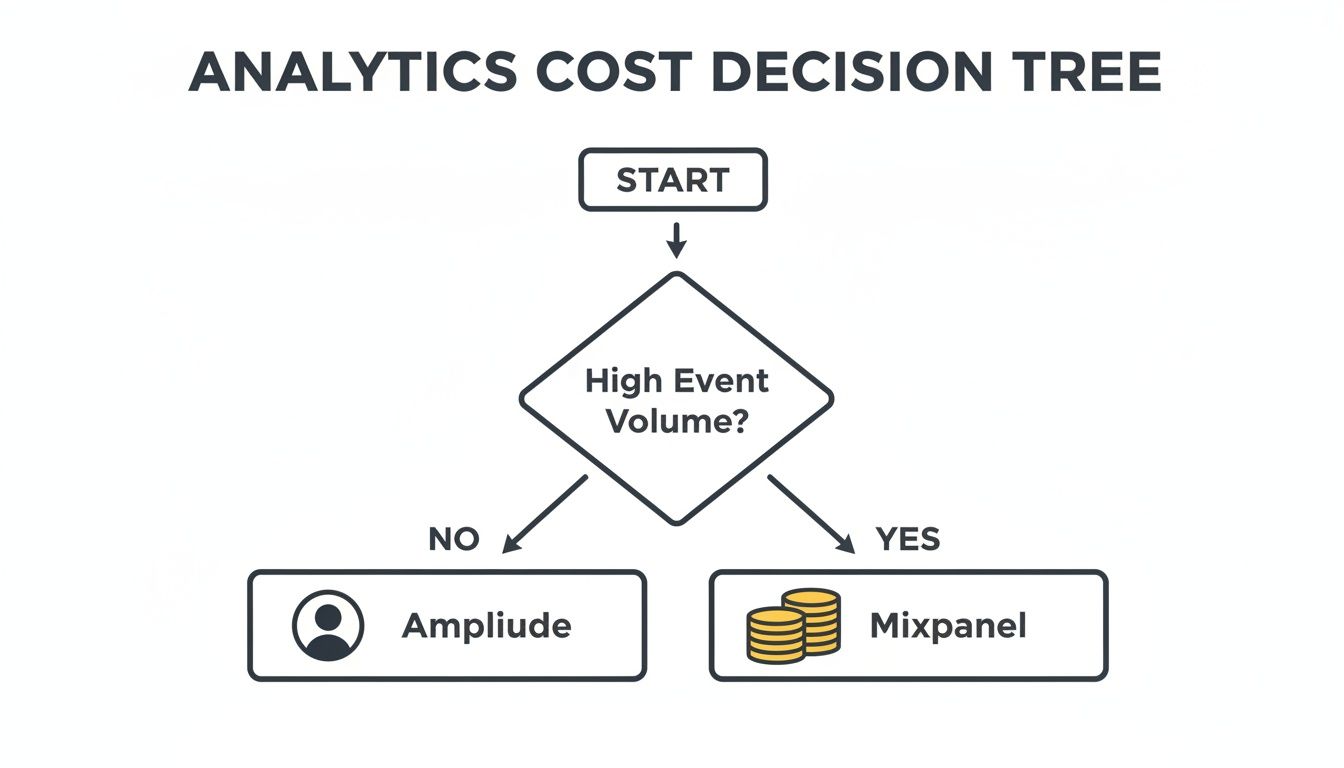
As you can see, Mixpanel's model generally works out to be more economical for high-volume products. In contrast, Amplitude’s user-based pricing is a better fit when you're doing deep analysis on a smaller set of high-value users.
3. The Mature Enterprise
For established B2B enterprises or companies with complex, layered digital products, Amplitude is the clear winner. At this scale, your goal isn't just tracking events anymore. It’s about understanding a customer's entire journey, predicting churn before it happens, and spotting expansion opportunities within your user base.
Amplitude’s powerful AI-driven features and its user-centric data model were built from the ground up to solve these exact challenges. Advanced capabilities, like finding the specific behaviors that lead to churn or creating predictive audiences for marketing campaigns, give you a strategic edge that easily justifies the higher price tag.
Your Final Decision Checklist
Use this checklist to do a quick audit of your own situation and make the final call. Be brutally honest about your team’s skills, budget, and what truly matters for your business right now.
- What is your core business model?
- B2C/Freemium/High-Volume SaaS: Lean towards Mixpanel.
- B2B/High LTV/Complex Products: Lean towards Amplitude.
- What is your primary analytical goal?
- Tracking conversions and campaign impact: Mixpanel excels here.
- Understanding long-term retention and user behavior: Amplitude is stronger.
- What is your team's data maturity?
- Need quick, self-serve insights with minimal training: Mixpanel is more accessible.
- Have data-savvy analysts ready for deep dives: Amplitude offers a higher ceiling.
- How do you project your growth?
- Expecting massive user growth with moderate engagement: Mixpanel’s pricing will be more predictable.
- Expecting steady user growth with a focus on deepening engagement: Amplitude’s MTU pricing aligns with this goal.
When choosing between powerful analytics platforms, it's also useful to think about your overall software strategy. For a deeper dive into making these kinds of decisions, check out this Custom Software vs Off The Shelf Software Guide.
By weighing these factors against the detailed comparisons we’ve covered, you can pick the platform that will not only answer today's questions but also grow with your ambitions. Your choice in the Amplitude vs Mixpanel showdown will shape how well you can listen to your users—and ultimately, build a better product.
Frequently Asked Questions
Alright, we've gone deep on data models, AI features, and pricing. But a few tricky, real-world questions always pop up when it's time to actually make a choice. Let's get straight to the answers for those final, nagging concerns.
Is It a Nightmare to Migrate from Amplitude to Mixpanel (or Vice Versa)?
Let's be clear: switching analytics tools is never a simple "lift and shift." It’s a genuine project that takes careful planning. The main hurdle isn't just the technical part; it's re-thinking your event tracking, validating all the new data, and getting your team comfortable with a new workflow.
How tough it is really depends on which way you're going:
- Moving from Mixpanel to Amplitude: This is a pretty common move for companies that are getting more serious about deep, user-level analysis. You’ll often find Amplitude's own team or their partners helping with this. The biggest piece of work is building a solid data governance plan from the start, defining your new event structure, and figuring out how to map historical data to Amplitude's user-first model.
- Moving from Amplitude to Mixpanel: This happens less often, but it's usually driven by a need to control costs, especially for B2C apps with millions of users. The move can feel a bit easier because Mixpanel’s event-based system is generally more forgiving. The tradeoff? You might lose some of the rich historical user properties that Amplitude tracks so well.
The big takeaway here is that migration is a strategic project, not a copy-paste job. You'll need a clear plan and dedicated engineering time for a few weeks to get it done right.
Which One Is Better for Mobile vs. Web Analytics?
Both tools have fantastic SDKs for mobile (iOS, Android) and web (JavaScript), so for basic tracking, you’re covered either way. The real differentiator in the Amplitude vs Mixpanel debate for mobile and web isn’t the technology itself, but the user journey you need to understand.
If your product is a self-contained mobile app—think a game or a social platform—where the main action is high-volume, in-app events, Mixpanel's event-focused model and pricing often make more sense.
On the other hand, if you're trying to track a user across different platforms—maybe they find you on the web, sign up, and then do most of their work on the mobile app—Amplitude's powerful identity resolution gives you a much clearer, single view of that entire user lifecycle.
How Should a B2B2C Business Choose?
The B2B2C model is a special kind of complicated. You’re serving a business client, but you also have to understand their end-users. The right tool really depends on which part of that equation is your main focus for product analytics.
- If you’re focused on the "C" (the end-user): You need to understand the behavior of thousands or millions of individual users. This looks a lot like a classic B2C scenario with high event volumes. Here, Mixpanel is often the more practical and cost-effective starting point.
- If you’re focused on the "B" (the business account): You need to see how your client companies are adopting the product, how their teams are using it, and what features drive account-level retention and expansion. This calls for deep, account-level analysis, which makes Amplitude the stronger choice.
A common path for B2B2C companies is to start with Mixpanel for its scale and simplicity. Later, as the need for sophisticated, account-level insights grows, they might add Amplitude or even run both tools to serve different internal teams.
Does One Have Better Data Governance Features?
Both platforms have gotten serious about data governance, because they know that messy data creates useless reports. But they come at it from different angles.
Amplitude has always been a bit more rigid and "governance-first." Their whole process pushes you to get your event naming and taxonomy right from day one. This builds great habits, but it can feel inflexible because changing historical data is intentionally difficult.
Mixpanel, especially with its Lexicon feature, gives you more wiggle room. It lets non-technical folks merge, hide, or rename events and properties right in the UI, no engineers needed. This is a lifesaver for cleaning up data on the fly as your product evolves. While Amplitude has features for this, Mixpanel’s are widely considered more user-friendly for the whole team.
At SigOS, we believe the best insights come from connecting user behavior directly to revenue impact. While Amplitude and Mixpanel tell you what users are doing, our AI-driven platform tells you why it matters to your bottom line. By analyzing support tickets, sales calls, and usage data, SigOS prioritizes the bugs and feature requests that have the biggest financial impact, turning customer feedback into a revenue-driving roadmap. Learn how SigOS quantifies the dollar value of your product decisions.
Keep Reading
More insights from our blog

Ready to find your hidden revenue leaks?
Start analyzing your customer feedback and discover insights that drive revenue.
Start Free Trial →