Analytics as a Service Explained How It Drives Revenue
Discover how analytics as a service (AaaS) turns complex data into clear actions that boost revenue and cut churn. Your guide to smarter business insights.
Analytics as a Service, or AaaS, is a framework where a third-party provider manages your entire analytics pipeline in the cloud. Think of it less as a tool you buy and more as an analytics-on-demand service you subscribe to. It handles everything from data ingestion and processing to AI-driven analysis and visualization.
You get all the powerful insights without the headache and overhead of building and maintaining your own data science infrastructure.
What Is Analytics as a Service, Really?
Imagine all your company's data is like a massive, disorganized library. The books are filled with priceless stories—customer feedback, usage patterns, support issues—but they're written in hundreds of different languages. You know the answers to your biggest business questions are in there, but hiring a full-time team of expert translators and researchers is a huge, costly undertaking.
Analytics as a Service is like having that expert team on speed dial. Instead of just handing you a library card and wishing you luck, an AaaS provider steps in, reads every book, translates the languages, and connects the dots for you. It pulls in data from all your scattered sources—Zendesk tickets, Gong calls, product logs, customer surveys—and does the heavy lifting to find the hidden narratives.
Beyond the Traditional Dashboard
This isn't just another way to build prettier charts. A genuine AaaS solution goes far beyond standard business intelligence (BI) by layering in artificial intelligence to get to the why behind the what. It’s smart enough to connect a sudden jump in support tickets to a newly shipped feature, automatically calculate the potential revenue impact, and surface that insight directly to the right product manager.
AaaS isn't a tool; it's an outcome. The goal is not to produce more reports but to generate clear, prioritized actions that directly influence key business metrics like revenue and customer retention.
This fundamental shift from passive data reporting to active, prescriptive intelligence is why the market is exploding. The global analytics as a service market is on a massive growth trajectory, projected to hit 126.48 billion by 2026, up from just 9.62 billion in 2018. The demand is clearly there.
Let's look at how AaaS stacks up against the old way of doing things.
Traditional Analytics vs Analytics as a Service
This table breaks down the core differences between building your own analytics stack from scratch and plugging into a ready-made AaaS solution.
| Aspect | Traditional In-House Analytics | Analytics as a Service (AaaS) |
|---|---|---|
| Setup & Maintenance | Requires significant upfront investment in hardware, software, and specialized staff. Ongoing maintenance is complex and costly. | Subscription-based model with minimal setup. The vendor handles all infrastructure, updates, and maintenance. |
| Time to Insight | Months or even years to build, integrate, and generate the first meaningful insights. | Can deliver actionable insights within days or weeks of implementation. |
| Core Focus | Teams spend most of their time on data engineering, infrastructure management, and tool configuration. | Teams focus on acting on insights and driving business outcomes, not managing technology. |
| Scalability | Scaling is slow, expensive, and requires careful capacity planning. | Elastic cloud infrastructure scales automatically to handle growing data volumes and user demand. |
| Required Expertise | Demands a dedicated team of data scientists, engineers, and analysts to build and operate. | Leverages the vendor's expertise, allowing leaner teams to access advanced AI and machine learning capabilities. |
As you can see, the AaaS model is designed to remove the friction between data and decisions, making sophisticated analytics accessible to a much broader range of companies.
A Strategic Partner for Growth
Ultimately, AaaS acts as a strategic partner. It empowers organizations to make smarter, faster decisions by turning a messy mix of qualitative feedback and hard quantitative data into a single, unified roadmap for growth. For large companies drowning in data, this is no longer a "nice-to-have." To see how this plays out in complex environments, check out our guide on how analytics for enterprise teams is evolving.
How AaaS Turns Raw Data Into Actionable Insights
So, what’s really going on under the hood with analytics as a service? The best analogy I’ve found is hiring a world-class chef versus building a professional kitchen from scratch. Sure, you could build your own, but that means sourcing the equipment, hiring specialized staff, and managing the day-to-day grind. With a chef, you just get the gourmet meal.
AaaS is that chef for your data. The provider handles all the complex culinary work—the data engineering, the machine learning models, the infrastructure—so you can focus on the results. It's about turning mountains of raw data into a clear, strategic menu of actions.
This journey from noise to signal isn't magic; it's a well-defined pipeline.
The AaaS Data-to-Action Pipeline
Everything kicks off by connecting your data streams. A good AaaS platform doesn't just look at one source. It pulls in information from every customer touchpoint you have—think support tickets from Zendesk, chat logs from Intercom, and even development tasks from Jira, alongside your core product usage data. This creates a single, unified view of what your customers are actually experiencing.
With all that data in one place, the AI and machine learning models get to work. Their job is to clean, process, and enrich the information, looking for patterns and connections a human analyst would almost certainly miss. For example, an AI might discover that customers who complain about a specific bug are 40% more likely to churn in the next 60 days. That’s a game-changer.
This simple diagram breaks down the flow: raw data comes in, AI finds the insights, and the platform turns them into concrete business actions.
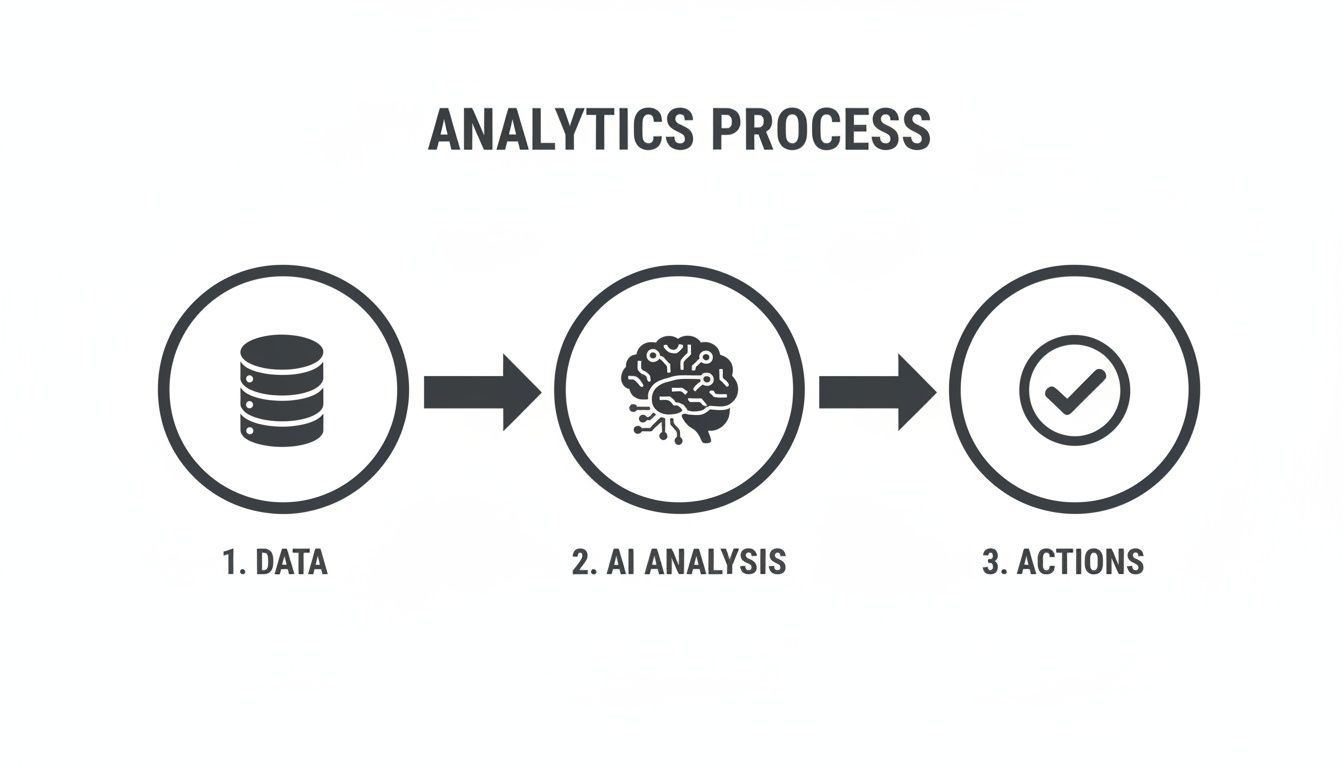
This process isn't just about finding interesting tidbits; it’s designed to make those insights immediately useful to the people who need them.
From Analysis to Automation
This is where the real value kicks in. The platform moves beyond just showing you dashboards and charts to delivering prescriptive insights—basically, a prioritized to-do list.
The core function of AaaS is to close the loop between data and decision. It translates complex findings into simple, revenue-centric tasks that product and growth teams can execute immediately.
Automation is the key. The system doesn't just tell you what's happening; it helps you do something about it.
- Automated Prioritization: Insights are automatically scored based on their estimated revenue impact. You instantly know which bug fixes will save the most customers or which feature requests are linked to your largest expansion deals.
- Workflow Integration: The findings are pushed directly into the tools your teams live in every day. An urgent customer issue can automatically create a ticket in Jira, prepopulated with all the necessary customer context and revenue data.
- Proactive Alerts: Your team gets real-time pings about important trends, like a sudden spike in negative feedback after a new feature release. This lets them jump on problems before they snowball.
Of course, the foundation for all of this is clean data. Garbage in, garbage out. Even the most powerful AI can't produce reliable insights from messy inputs. It's worth exploring the best data quality monitoring tools to ensure your data is solid from the start.
Ultimately, this is how analytics as a service stops being a reactive reporting tool and becomes a proactive engine for growth. It empowers your teams to make smarter, more profitable decisions without needing a Ph.D. in data science.
Key Capabilities That Deliver Real Business Value
It’s one thing to talk about how Analytics as a Service works, but what really matters is what it can do. The real magic is in the specific capabilities that don't just report on data but actually drive real-world business outcomes. These platforms are engineered to decode complex user behavior and turn it into a clear, revenue-focused roadmap for your teams.
This is all about shifting from a reactive stance to a proactive one. Instead of waiting for a customer to hit the cancel button, you can see the writing on the wall and act first. That’s where these core capabilities come in, turning your AaaS platform into a legitimate growth engine.
Predictive Churn Forecasting
One of the most powerful features is predictive analytics. This isn’t fortune-telling; it's smart technology using machine learning to spot the subtle red flags that show a customer is about to churn. Think of it as connecting the dots—the platform might notice a slight drop in feature usage, combined with a couple of support tickets and a negative comment in a chat log.
By catching these patterns early, your customer success team can step in with the right support long before the customer even thinks about leaving. It’s no surprise that the predictive analytics market is growing at a massive 44.3% CAGR from 2019-2026. Businesses are all-in on this because it gives them a real shot at forecasting trends and stopping churn in its tracks.
An AaaS platform transforms churn management from a reactive "save" effort into a proactive retention strategy, driven by data-backed indicators of customer health.
Automated Root Cause Analysis
Knowing what happened is good, but knowing why it happened is a game-changer. Automated root cause analysis goes way beyond a simple dashboard alert. When a key metric suddenly plummets, the system doesn’t just show you a red line on a graph; it automatically digs through all the related data to pinpoint the most likely reason.
Let's say you launch a new feature and the adoption rate is terrible. The platform could automatically link that dip to a spike in negative feedback from a specific user segment or a bug that just got flagged in Jira. This saves your product team from spending days digging through data manually, letting them get straight to fixing the actual problem. This is a core part of building a strong self-serve analytics culture, where teams can find their own answers.
Revenue Impact Scoring and Opportunity Sizing
Here’s a hard truth: not all insights carry the same weight. The best AaaS solutions put a dollar value on every finding, helping you focus your energy where it counts the most.
- Revenue at Risk: The system can calculate the exact monthly recurring revenue (MRR) tied to customers experiencing a specific bug. Suddenly, that "minor" issue has a clear price tag, making it much easier to justify an immediate fix.
- Expansion Opportunity: It can also identify feature requests or positive feedback coming from high-value accounts, essentially raising a flag that says, "Hey, this is a prime upsell opportunity!"
This turns your product backlog from a messy wish list into a revenue-driven priority queue. The most advanced platforms are even integrating technologies like Large Language Models (LLMs) to pull insights from unstructured data like support calls and survey responses. When you know which actions will protect existing revenue and which will drive new growth, you can allocate your resources with confidence, knowing your team is always focused on what moves the needle.
Integrating AaaS Into Your Existing Workflow
For any new technology to be worth the investment, it has to fit into how your team already works. An analytics as a service platform isn't just another dashboard to log into; it should feel like a natural part of your existing tools, actively feeding insights right where your team can act on them. This is where seamless integration and smart deployment really separate the good from the great.
The first thing to figure out is how the solution will be hosted. Most AaaS vendors are cloud-based, but the specific flavor of cloud you choose depends on your company's needs around security, control, and budget.
- Public Cloud: This is the most common setup. The vendor handles all the infrastructure on a shared environment like AWS or Azure, which keeps it scalable and cost-effective.
- Private Cloud: You get a dedicated environment just for your organization. This offers tighter control and isolation, which is often a must-have for enhanced security.
- Hybrid Cloud: A mix of both worlds. This model lets you keep sensitive data safely on-premises while still taking advantage of the public cloud's raw processing power.
Picking the right deployment model is the foundation, but the real magic happens with deep, two-way integrations.
Connecting Insights Directly to Action
A modern AaaS platform doesn't just pull data in—it has to push actionable intelligence back out to the tools your teams live in every day. This simple but powerful shift closes the gap between finding an insight and actually doing something about it.
Let’s walk through a real-world product development scenario. An AaaS platform like SigOS might sift through thousands of support tickets and spot an emerging bug that’s putting $50,000 in monthly recurring revenue on the line. Instead of just flagging this on a dashboard nobody checks, a proper integration kicks off an automated workflow.
The goal is to embed data-driven decision-making directly into your operational cadence. When an insight automatically creates a prioritized ticket in Jira or Linear, analytics stops being a separate activity and becomes part of the development process.
This completely changes the dynamic. A new ticket lands in the product team's queue, but it’s not just a vague bug report. It comes fully loaded with all the crucial context: direct customer quotes, relevant usage data, and—most importantly—the calculated revenue impact.
This allows product managers to make faster, smarter prioritization decisions without ever switching tabs. That's why connections to tools like Jira, Linear, and GitHub are absolutely essential for any effective analytics as a service setup.
6. Tracking the Metrics That Prove AaaS ROI
So, you’ve invested in an Analytics as a Service solution. How do you actually know if it's working? The proof isn't in how many people log into a dashboard; it’s about connecting the dots between user insights and your bottom line.
A good AaaS platform doesn't just throw data at you. It’s built to tie specific user behaviors directly to real business outcomes, helping you build a data-backed story that proves the ROI of your investment.
Key Metrics for Product Teams
For product managers and their teams, the mission is to build features people actually want and use—the kind that keep them from churning. An AaaS platform gives you the hard data to see if you're hitting the mark.
- Reduction in Customer Churn: When you can spot at-risk behaviors or prioritize bug fixes that are costing you the most revenue, you should see a tangible drop in both customer and revenue churn.
- Increased Feature Adoption: Are people using that new feature you shipped last quarter? Tracking adoption rates for features prioritized with AaaS insights confirms you’re building the right things.
- Faster Time-to-Insight: How long does it take your team to go from a question like, "Why did engagement drop last week?" to a confident, data-driven answer? Shortening this cycle is a massive operational win.
KPIs for Customer Success and Growth Teams
Your customer success and growth folks are on the front lines, fighting churn and finding expansion opportunities. Their metrics need to show a deeper, more proactive grasp of your customer base.
An effective AaaS implementation doesn't just report on the past; it equips your teams to change the future. Success is measured by their ability to act on predictive insights to save accounts and close expansion deals faster.
This is where you move from reactive problem-solving to proactive growth. For customer success, it might mean faster ticket resolution because they have immediate context on a user's issues. For growth teams, it’s about a measurable lift in expansion revenue because they’re acting on AI-surfaced upsell signals.
This table breaks down how different teams can measure the impact of an AaaS solution like SigOS.
Measuring AaaS Impact Across Your Organization
| Team | Key Performance Indicator (KPI) | Business Goal |
|---|---|---|
| Product | Feature Adoption Rate | Validate that new features meet user needs and drive engagement. |
| Product | Reduction in Time-to-Insight | Accelerate product decisions by getting answers from data faster. |
| Product | Customer Churn Rate | Decrease customer and revenue loss by prioritizing impactful fixes. |
| Customer Success | Proactive Outreach to At-Risk Accounts | Reduce churn by identifying and engaging struggling users early. |
| Customer Success | Ticket Resolution Time | Improve support efficiency with instant access to user behavior context. |
| Growth | Expansion MRR/ARR | Increase revenue by identifying and acting on upsell/cross-sell signals. |
| Growth | Lead-to-Opportunity Conversion Rate | Improve sales effectiveness by focusing on product-qualified leads (PQLs). |
Focusing on these kinds of outcomes is critical. You can dive deeper into this topic in our complete guide to metrics and reporting.
By setting up a clear framework to measure success across different departments, you stop talking about analytics as a cost. Instead, it becomes a core part of your company's growth engine, and you have the numbers to prove it.
Why Security and Privacy Are Non-Negotiable
Let's be blunt: when you hand over customer data to a third-party service, you're placing an immense amount of trust in them. With analytics as a service, you aren't just sharing numbers on a spreadsheet; you're sharing the voice of your customer. That makes security and privacy the absolute foundation of the relationship, not just another feature on a checklist.
A data breach isn't just a technical problem that results in regulatory fines. It's a catastrophic event that can shatter customer trust and permanently tarnish your brand's reputation. This is why digging deep into a potential vendor's security practices isn't just due diligence—it's essential.
Core Security Protocols to Demand
Any AaaS provider worth considering must have a few non-negotiable security measures in place. Think of these as the bare minimum for earning your trust.
- End-to-End Encryption: Your data needs to be locked down at all times. That means it must be encrypted while it's traveling from your systems to theirs (in transit) and while it's sitting on their servers (at rest). If it's encrypted everywhere, it's unreadable to anyone who shouldn't have access.
- Robust Data Anonymization: The goal is to analyze trends, not individuals. A good provider will systematically strip out or mask Personally Identifiable Information (PII), allowing their AI models to work their magic without ever exposing sensitive customer details.
- Strict Regulatory Compliance: The vendor must prove they play by the rules. Look for clear compliance with major data protection laws like GDPR for handling European customer data and CCPA for California residents.
But technical specs are only part of the story. You also need a partner with transparent and ironclad data governance policies.
Here’s a crucial question you must ask any AaaS vendor: "Is my data used to train your global AI models?" The answer has to be an unequivocal "no." Your customer data is your competitive edge, and it should never, ever be used to help your competitors.
Protecting Your Intellectual Property
This brings us to a critical concept: data isolation. It’s paramount. Your data needs to be kept in its own secure, walled-off environment.
Platforms like SigOS solve this by operating in a single-tenant environment. This architecture guarantees that your analytics models are trained only on your data. The insights are yours alone, unique to your business, and completely shielded from prying eyes.
Ultimately, choosing an analytics as a service partner is as much a security decision as it is a technology one. Verifying these protocols is the only way to unlock powerful insights without gambling with the trust your customers have placed in you.
Common Questions About Analytics as a Service
Diving into the world of analytics as a service usually brings up a handful of good questions. Let’s tackle some of the most common ones to clear up any confusion and help you see where this approach could fit.
How Is This Different from Our Current BI Tools?
This is probably the most frequent question we hear. While both traditional business intelligence (BI) and analytics as a service (AaaS) use data, they play very different roles.
Traditional BI is fantastic at descriptive analytics—it tells you what happened. Think of it as your rearview mirror, showing you historical performance through dashboards and reports. AaaS, on the other hand, is built for prescriptive and predictive insights. It doesn't just show you the past; it uses AI to tell you why something happened and what you should do next.
A good analogy is that BI gives you the rearview mirror, while AaaS acts like a GPS, providing a clear path forward with real-time traffic updates and recommended routes.
What Do We Need to Get Started?
Many people assume you need perfectly clean, structured data warehouses to even think about AaaS. The good news is, that's not the case. Modern platforms are designed to handle the messy, real-world data most companies actually have.
To get going, you just need to connect the systems where your customer interactions are happening. This usually includes:
- Support & Ticketing: Your Zendesk or Jira instances.
- Communication Logs: Conversation data from tools like Intercom or Gong.
- Product Usage Data: Behavioral analytics from platforms such as Mixpanel or Amplitude.
The AaaS provider does the heavy lifting—ingesting, cleaning, and connecting all this disparate data. It's far more accessible than most teams think.
The real prerequisite isn't perfect data. It's having a clear idea of the business problems you're trying to solve, like pinpointing the root cause of churn or finding your best expansion opportunities.
How Long Until We See Results?
Finally, every leader wants to know about time-to-value. Nobody wants to sign up for another massive data project that takes a year or more to pay off.
This is where AaaS really shines. Instead of a long, drawn-out implementation, you can start getting actionable findings within the first few weeks. While every company is unique, the goal is rapid and continuous value.
You should expect to see early wins quickly, like quantifying the revenue impact of a critical bug. From there, the platform gets smarter over time, building a deeper understanding of your user behavior to deliver the kind of predictive insights that truly shape your product and growth strategy.
Ready to turn your customer data into a clear, revenue-driven roadmap? SigOS uses AI-driven product intelligence to connect user behavior directly to business outcomes. Find out how we can help you prioritize with confidence.
Keep Reading
More insights from our blog
Ready to find your hidden revenue leaks?
Start analyzing your customer feedback and discover insights that drive revenue.
Start Free Trial →