Develop product roadmap: A guide to develop product roadmap-driven growth
Discover how to develop product roadmap strategies with customer input and AI insights to prioritize initiatives and align stakeholders.
Before you can build a product roadmap that actually works, you need a fundamental mind shift. A roadmap isn't just a list of features with deadlines attached. It’s a strategic communication tool that connects your product vision directly to business outcomes, prioritizing work based on real data like customer feedback and revenue impact.
Why Your Roadmap Is More Than Just a Feature List
So many product teams get stuck treating their roadmap like a static document. It becomes a backlog of requests, usually driven by the loudest person in the room. This reactive approach is exhausting and rudderless, leading to a product bloated with features that don't actually move the needle on key business metrics.
An effective roadmap is something else entirely: a dynamic, revenue-driving asset. It's built on a solid foundation of data that ties every development effort directly to a measurable business goal.
The Shift to a Revenue-Driven Mindset
Instead of just asking, "What should we build next?" a strategic roadmap forces you to answer, "Which initiative will have the biggest impact on our goals?" That simple change in framing makes all the difference. It moves your team from building on hunches to making data-backed decisions with a clear financial justification.
The real trick is turning all that qualitative noise from various channels into signals you can act on. Modern product intelligence tools are great for this, helping you analyze:
- Support Tickets: What recurring issues are frustrating customers and leading to churn?
- Sales Calls: Which missing features are consistently blocking high-value deals from closing?
- Usage Analytics: Where are users getting stuck, and which features drive the most engagement?
- Customer Feedback: Can we spot trends in requests that are tied to specific customer segments or revenue potential?
By putting a number on the impact of each bug, feature request, or friction point, you can start prioritizing work that directly reduces churn, unlocks new revenue, and keeps customers happy.
Connecting Strategy to Execution
This data-first approach ensures your roadmap is a direct reflection of your company's strategy. The link between a clear strategy and business success is undeniable. Research shows that organizations with well-defined strategies outperform their competitors by 2.5 times, and firms with a strong strategic focus are 4.5 times more likely to see superior financial performance.
Ultimately, your roadmap should tell the story of why you're building certain things, not just what. It gets engineering, marketing, sales, and leadership all aligned and rowing in the same direction. To really dig into the strategic side of this, understanding how to create a product roadmap that works is a crucial next step.
Setting the Stage: Your Roadmap's Foundation
A great product roadmap isn't just a laundry list of features. It's a strategic document, and like any good strategy, it needs a solid foundation. Before you even think about which feature to build next, you have to get a few fundamentals locked in place. This groundwork is what turns a simple to-do list into a powerful tool that actually drives business success.
First things first: you need a crystal-clear product vision and concrete strategic goals. This isn't about some fluffy mission statement you hang on the wall. This is your North Star. It answers the most important question for your team: "Where are we actually going?"
From that vision, you'll break things down into measurable goals. Many of the best teams use a framework like Objectives and Key Results (OKRs) to make this happen.
Align Everything to Measurable Goals
Your strategic goals are the "why" behind every single item on your roadmap. Seriously. If a new idea or feature request doesn't directly help you hit one of your key results, it has no business being on the roadmap. It's that simple. This is how you create focus and stop wasting time on things that don't move the needle.
Let's say one of your company's main Objectives this year is to "Increase Customer Retention." That's a great start, but you need to make it measurable. The Key Results might look something like this:
- Drop the monthly churn rate from 4% to 2% by the end of Q3.
- Boost the adoption of our "stickiest" features by 20%.
- Raise our Net Promoter Score (NPS) from 35 to 45.
Now, look what happens. Every feature idea gets filtered through these metrics. That bug fix that seems minor? If your data shows it's a major source of user frustration causing people to cancel, it's no longer just a technical task. It’s a strategic move that directly impacts a core business goal. This simple shift transforms prioritization from a subjective argument into an objective, data-driven discussion.
If you want to dig deeper into this, getting your product strategy right is the perfect place to start.
Your product roadmap is the direct expression of your strategy. It’s the playbook for making that strategy a reality. Without clear goals, you have no strategy to execute and no destination to guide your team toward.
Create a Central Hub for All Customer Feedback
Okay, with your strategic goals defined, it's time to gather the raw material for your roadmap: customer feedback. And let’s be honest, it’s coming from everywhere—support tickets in Zendesk, live chats in Intercom, call notes from sales, and random mentions on social media. Letting all that valuable insight stay locked away in different tools is a huge mistake.
The answer is to create a centralized feedback hub. This isn't just another spreadsheet that gets forgotten. It's a system built to pull in, organize, and make sense of all this feedback. Modern product intelligence platforms can even automate this, piping data from all your tools into one single source of truth.
This does more than just save you hundreds of hours of manual copy-pasting. It helps you see the patterns you'd otherwise miss entirely. All of a sudden, you can see that ten different customers complained about the same confusing workflow last week—and seven of them are from your highest-paying enterprise accounts. Now that is a signal you can't afford to ignore.
Map the Customer Journey to Spot the Real Opportunities
Finally, take all that centralized feedback and use it to map out your customer journey. A journey map is just a visual way of tracking every single interaction a person has with your product, from the moment they first hear about you to the day they become a raving fan.
When you start layering your collected feedback onto this map, the real magic happens. You can pinpoint the exact moments where users are getting frustrated, feeling confused, or just giving up and leaving.
- Awareness: Are your sales reps constantly hearing about a specific feature gap that’s killing deals?
- Onboarding: Do you see a flood of support tickets from new users who all get stuck at the same step?
- Adoption: Is your usage data showing that a really powerful feature is basically invisible to most users?
Each of these friction points is a potential home run for your roadmap. By understanding the complete journey, you stop thinking about isolated feature requests and start seeing the bigger picture. You'll spot the opportunities that don't just fix a single problem but dramatically improve the entire customer experience—and push you closer to your most important strategic goals.
Turning Customer Feedback Into Quantifiable Priorities
You've got your strategic goals locked in and a steady stream of feedback is finally flowing into one place. Now for the hard part: connecting the dots. This is where you wrangle that messy, qualitative river of opinions, complaints, and ideas into a clean, prioritized list of things that will actually move the needle for your business.
The old way of just counting votes on a feature request board? That's not going to cut it anymore if you want to build a winning roadmap.
Today’s most effective product teams are using a much smarter system. They're quantifying the real impact of each piece of feedback. It’s less about what customers are asking for and more about why they're asking—and what it costs you to ignore them.
This flow diagram shows how everything builds on itself, starting from your high-level vision and getting refined by the raw feedback that fuels your entire roadmap.
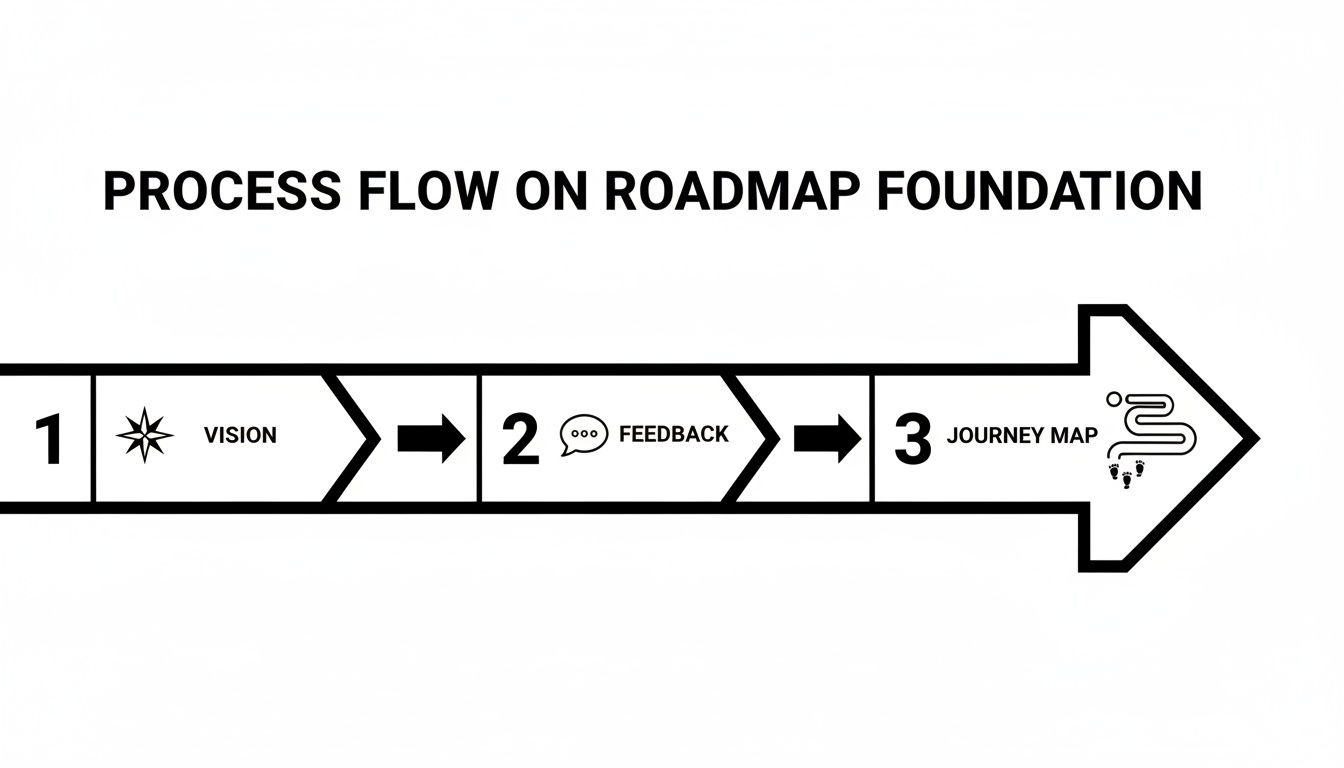
As you can see, a clear vision sets the course, but it’s the continuous loop of customer feedback and a solid grasp of their journey that gives you a rock-solid foundation for prioritization.
Scoring Feedback Beyond the Vote Count
First things first: stop treating all feedback as equal. It’s just not. A single feature request from an enterprise customer who’s about to churn is infinitely more valuable than a dozen ideas from free-tier users who don’t fit your long-term strategy. To make objective calls, you need a scoring system that weighs feedback against your actual business goals.
Here are a few factors you should be looking at when a piece of feedback comes in:
- Revenue Impact: How much monthly recurring revenue (MRR) is on the line if this bug isn't fixed? How much expansion revenue could a new feature unlock? Tying feedback directly to revenue data from your CRM is a game-changer.
- Strategic Alignment: Does this request move you closer to achieving one of your key results (OKRs)? If your quarterly goal is to reduce churn, then a bug fix affecting your highest-churn customer segment should jump to the top of the list.
- Customer Segment: Is this feedback coming from your ideal customer profile (ICP)? Prioritizing requests from the market you’re actually trying to win is just good business.
- Volume and Frequency: While it’s not the only metric that matters, a high volume of related requests is a strong signal of a widespread problem that needs a closer look.
By scoring feedback against these criteria, you shift the conversation from "who is shouting the loudest?" to "which initiatives deliver the most tangible value?" It’s a data-driven mindset that’s non-negotiable for modern product teams.
Uncovering Hidden Patterns with AI
Often, the most critical insights are the ones your customers never explicitly state. They might complain about a slow interface, but the root cause could be a sluggish database query that’s also degrading performance in three other areas of your product. This is where AI-powered analysis really shines.
Product intelligence tools can sift through thousands of unstructured support tickets, chat logs, and sales call notes to pinpoint root causes and spot emerging trends. They find correlations a human would almost certainly miss, like a specific error message that appears in 75% of tickets from customers who churned within 30 days. That’s not a hunch; that’s an actionable insight.
This isn’t just a theory. Modern platforms are achieving 87% accuracy in correlating customer-reported issues with real churn and revenue impact. Using an AI prioritization framework helps identify and sequence the most impactful work. If you want to dig deeper, our guide on how to analyse customer feedback provides even more techniques.
Choosing Your Prioritization Framework
Once you have a scored and analyzed list of potential projects, a prioritization framework gives you a repeatable structure for making the final cuts. There’s no single “best” one; the right choice really depends on your team's culture, maturity, and specific goals.
Choosing Your Prioritization Framework
This table breaks down some of the most common frameworks to help you find a good fit for your team.
| Framework | What It Measures | Best For | Potential Pitfall |
|---|---|---|---|
| RICE | Reach, Impact, Confidence, and Effort. It uses a formula to generate a clear score. | Data-driven teams that want an objective score for comparing dissimilar ideas. | Can be time-consuming to gather the data needed for an accurate score. |
| MoSCoW | Must-have, Should-have, Could-have, and Won't-have. It categorizes features by necessity. | Teams that need to define a Minimum Viable Product (MVP) with clear scope. | Can become a dumping ground for stakeholders to label everything a "Must-have." |
| Value vs. Effort | A simple matrix that plots initiatives based on their potential value and the effort required. | Quick, high-level prioritization and getting alignment early in the process. | "Value" and "Effort" can be highly subjective without supporting data. |
Ultimately, picking a framework isn't about finding a magic formula that spits out the perfect answer.
The real goal of a framework is to facilitate a structured, data-informed conversation. It forces everyone to justify their priorities with logic and evidence instead of just emotion or gut feelings.
By systematically scoring feedback, using AI to find the patterns hidden in the noise, and applying a consistent framework, you create a defensible and objective process. This is how you build a product roadmap that’s directly tied to the health and growth of your business.
Building and Communicating Your Visual Roadmap
Once you’ve scored your priorities and aligned them with company goals, it’s time to bring everything to life. A roadmap is, at its heart, a communication tool. Its real power comes from its ability to tell a clear, compelling story about where your product is headed and, more importantly, why.
The old way of doing things—a simple feature list with hard deadlines—is thankfully on its way out. Experienced teams know that a rigid, date-driven plan often creates more chaos than it solves. The focus now has shifted to more flexible, strategic formats that communicate intent and value, not just a list of tasks.
Choosing the Right Roadmap Format
The best roadmap format depends entirely on who you're talking to. What your engineering team needs is vastly different from what the board of directors cares about. Thinking about your audience first is the secret to getting the buy-in you need.
For modern product teams, two of the most effective formats are outcome-based and theme-based roadmaps.
- Outcome-Based Roadmaps: This approach ties every initiative directly to a measurable business outcome. Instead of saying, "Build a new dashboard," you frame it as, "Increase user engagement by 15% by improving data visibility." This is perfect for executives who are laser-focused on business impact.
- Theme-Based Roadmaps: Here, you group related initiatives under broad strategic umbrellas. For instance, a theme could be "Improve New User Onboarding" or "Reduce Technical Debt." This helps you communicate high-level priorities without getting bogged down in the nitty-gritty of specific features.
Both formats do an excellent job of shifting the conversation to the why behind the work, which is always more powerful than just the what.
A great roadmap doesn't just list features; it builds a narrative. It should clearly articulate the customer problem you’re solving, the business opportunity it creates, and how the proposed solution will deliver measurable value.
Tailoring Your Story for Different Audiences
A one-size-fits-all roadmap just doesn't cut it. One survey found that 40% of product managers see stakeholders as their primary audience, making clear communication absolutely non-negotiable. To make your roadmap resonate, you have to tailor the presentation for each group.
- For the Engineering Team: They need clarity on priorities and context. A "Now-Next-Later" format is fantastic for them. It clearly lays out what’s in the current sprint ("Now"), what’s being teed up for the near future ("Next"), and what’s on the horizon ("Later"). This gives them the context they need without the pressure of arbitrary deadlines.
- For the Executive Team: Leadership wants to see how your product plan fuels the company's strategic goals and financial targets. An outcome-based roadmap is your best friend here. Show them the high-level themes and connect each one directly to an OKR or a revenue goal.
- For Sales and Marketing: These teams need to understand the customer value you’re shipping so they can build their messaging around it. A theme-based roadmap highlighting key customer benefits and general timelines (like Q3 or Q4) gives them what they need to plan killer go-to-market strategies.
In every conversation, your job is to tell a story. For example, instead of just presenting a feature, try this: "We've identified that 30% of new users drop off during onboarding because of a confusing setup process. The 'Streamlined Onboarding' theme in Q3 is designed to fix this, and we project it will cut early-stage churn in half."
Maintaining a Single Source of Truth
One of the biggest headaches in roadmapping is keeping the document current and aligned with the actual work. There's nothing worse than presenting a roadmap that's completely out of sync with what the engineering team is actually building.
This is where your tool integrations become your lifeline. By connecting your roadmapping software to development tools like Jira or Linear, you create a seamless, two-way data flow.
This integration ensures your high-level roadmap always reflects the ground-level reality of development. When an epic in Jira is marked "In Progress," that status can automatically update on your visual roadmap.
This kind of automation is more than a convenience—it builds trust across the entire organization. Stakeholders learn they can trust the roadmap for an accurate, real-time view of progress without having to chase you down for an update. It solidifies the roadmap as the single, reliable source of truth for your product’s direction, which is essential for earning and keeping stakeholder buy-in.
Keeping Your Roadmap Agile with AI and Automation
Let's be honest: a great product roadmap is never really "done." If you treat it like a static document you create once a quarter and then forget about, it's going to become irrelevant—fast. The most effective roadmaps I've ever worked with are living, breathing guides. They have to be, because they need to adapt to new intel, shifting market dynamics, and what our customers are actually telling us.
This agility is what separates a roadmap that genuinely guides the business from one that just gathers dust.
Keeping a roadmap responsive used to be a mountain of manual work. It meant constantly sifting through feedback, trying to make sense of analytics, and chasing down stakeholders. Thankfully, AI and automation have completely changed the game. Now, you can build a dynamic feedback loop that keeps your roadmap both intelligent and current.
Instead of waiting for problems to boil over, modern tools allow you to keep a constant pulse on all your key feedback channels. This creates a proactive system that surfaces emerging trends and risks before they snowball into full-blown crises.
Creating a Dynamic Feedback Loop
The real goal here is to shift from periodic check-ins to a state of continuous listening. Automation is the key—it can tie together all those disparate data sources you're juggling. Think support tickets, usage analytics from tools like Mixpanel, and even transcripts from sales calls.
This kind of system doesn't just collect data; it actively analyzes it for patterns that actually matter.
For instance, AI can spot a subtle but growing number of support tickets all mentioning the same frustrating bug. On their own, each ticket might seem minor. But the system can flag the pattern, quantify the potential revenue tied to the affected customers, and alert you that a seemingly small issue is becoming a serious churn risk.
You've just created a powerful, real-time feedback loop. New data is constantly refining your roadmap priorities, meaning you're no longer reacting to last month's problems. You're responding to what's happening right now.
A static roadmap is a bet on the past. An agile, automated roadmap is an investment in the future, allowing you to adapt your strategy as soon as the market sends a new signal.
Leveraging AI for Proactive Alerts
This is where AI really becomes a product manager's best friend. Intelligent alerts can completely change how you develop a product roadmap, making it both strategic and incredibly responsive. Imagine getting a ping on Slack for things like this:
- High-Value Opportunities: An alert flags that three different enterprise prospects mentioned the exact same missing feature in sales calls this week, representing a potential $250,000 in new ARR.
- Emerging Churn Risk: The system correlates users experiencing a specific API error with a 40% higher likelihood of churning within 30 days.
- Feature Adoption Issues: You get notified that a feature you just launched has a completion rate below 10%, pointing to a major UX problem that needs immediate attention.
These alerts give you the power to make quick, data-backed adjustments. Instead of waiting for a quarterly review to even discuss that new opportunity, you can evaluate it on the spot and decide if it justifies a shift in your short-term priorities. If you want to see how this works in the real world, it's worth exploring the fundamentals of using AI for product development.
AI is fundamentally changing how we develop product roadmap priorities, turning messy qualitative feedback into clear, quantifiable actions. A PwC forecast predicts that by 2025, this approach can lead to 19% efficiency gains, a 17% faster time-to-market, and 13% cost reductions. For a platform like SigOS, which has an 87% accuracy in its churn-revenue correlations, this means roadmaps can stay laser-focused on the highest-impact work.
Scheduling and Communicating Roadmap Updates
While AI gives you the real-time signals, you still need a human-driven process to integrate these insights without causing total chaos. An agile roadmap doesn't mean you're changing direction every single day. It means having a structured cadence for review and adjustment.
A quarterly roadmap review is still a solid anchor for reassessing your high-level strategic themes. But you should absolutely supplement this with more frequent, smaller-scale syncs. Maybe it's a bi-weekly or monthly meeting where you review the automated alerts and decide on any tactical shifts.
And when you do make a change, communication is everything. Don't just quietly alter the roadmap and hope everyone notices. Announce the update and, most importantly, share the data that drove the decision. This kind of transparency builds trust with your stakeholders and reinforces the idea that the roadmap is a logical, evidence-based guide, not just a reflection of someone's opinion.
Answering Your Toughest Product Roadmap Questions
Even with the best frameworks, the day-to-day reality of product management is full of curveballs. Let's dig into some of the most common questions I hear from product managers trying to keep their roadmaps on track.
Getting these right is what separates a roadmap that just exists from one that truly drives your product forward.
How Often Should You Update a Product Roadmap?
Your roadmap should be a living document, not a stone tablet. For most agile teams, a quarterly review is a solid rhythm. It’s a natural time to zoom out, check your progress against bigger goals like OKRs, and make sure your major themes still make sense.
But don't get locked into a rigid schedule. The real trick is to stay responsive. A major competitor move, a shift in the market, or a wave of feedback flagging a critical churn risk are all valid reasons to revisit the plan right now.
The point isn't to create chaos with constant changes. It's to make sure your roadmap always reflects the smartest path forward based on what you know today.
How Do You Handle Conflicting Stakeholder Requests?
Ah, the classic tug-of-war. Sales needs a feature to close a big deal, marketing has a brilliant idea for a new campaign, and leadership just came back from a conference with a "must-have" request. It’s a situation every PM knows well.
The best way to navigate this isn't to argue opinions—it's to anchor the conversation in data. This is where your prioritization framework and product intelligence really shine. You become the voice of reason, backed by evidence.
Instead of just saying "no," you can frame it differently: "I understand why that feature is important. Right now, our data shows this other issue is directly costing us $50,000 in churn from our top customers. Let's plug that revenue leak first, then we can re-evaluate that new idea."
This shifts the dynamic from a battle of wills to a strategic discussion about business impact. It's much harder to argue with cold, hard numbers.
What Is the Difference Between a Roadmap and a Backlog?
This is a fundamental distinction that often gets muddled.
A product roadmap is your strategic, high-level guide. It's the "why." It communicates the major themes and outcomes you're aiming for over the next few quarters, getting everyone from engineering to the C-suite aligned on the destination.
The product backlog, in contrast, is the tactical "how." It's a detailed, granular to-do list for the development team, packed with specific user stories, bugs, and technical tasks. Think of it this way: the roadmap is the map showing the cities you'll visit, while the backlog is the turn-by-turn GPS directions to get to the first city.
Should a Product Roadmap Include Timelines and Dates?
This is a tricky one, and the answer really depends on who you're talking to.
For your internal teams, broad timeframes usually work best. Think in terms of quarters (Q1, Q2) or a simple "Now-Next-Later" structure. This keeps the focus on the priorities and gives your engineering team the flexibility they need, rather than chaining them to arbitrary deadlines.
When it comes to an external-facing roadmap for customers, be very careful with hard dates. Promising a feature by June 15th can easily backfire. It’s often much safer to communicate direction with terms like "In Progress" or "Coming Soon." You're managing expectations by sharing the vision without boxing your team in.
SigOS helps you answer these questions with confidence by turning messy customer feedback into clear, revenue-driven priorities. Stop guessing and start building a roadmap based on quantifiable data. Discover how SigOS can transform your product strategy.
Keep Reading
More insights from our blog
Ready to find your hidden revenue leaks?
Start analyzing your customer feedback and discover insights that drive revenue.
Start Free Trial →