Insight Into Action A SaaS Playbook for Driving Revenue
Transform customer feedback into your biggest growth driver. This insight into action guide gives SaaS teams a playbook for turning customer data into revenue.

So, what does it really mean to turn insight into action? It’s all about creating a system that methodically turns raw customer feedback into tangible business results. We're moving beyond just passively collecting data and getting into proactive, revenue-focused improvements. For any SaaS company, this isn't just a nice-to-have; it's a fundamental survival tactic. It closes the dangerous gap between what you think your customers want and what they actually need.
The Hidden Cost of Ignoring Customer Feedback

Here’s a hard truth: most SaaS companies are confident they're delivering a fantastic customer experience. Their customers? Not so much. This perception gap isn't a small misalignment—it's a silent killer of growth, driving churn in ways that never show up on a dashboard until it's too late.
The most expensive feedback isn't the angry support ticket or the one-star review. It's the deafening silence from unhappy customers who just leave. These are the people who hit a point of friction, get confused by a feature, or run into a bug and never say a word. They just cancel and find a competitor who solves their problem better. Their departure is a direct result of an insight that was never heard, prioritized, or acted on.
The Great Experience Disconnect
This disconnect between companies and their customers is alarmingly common. The problem is so widespread that it has a name: The Customer Experience Perception Gap. This is the critical blind spot where businesses believe they are excelling, while customers are quietly becoming frustrated and leaving.
| Metric | Business Perception | Customer Reality | Impact |
|---|---|---|---|
| Experience Quality | 80% of businesses believe they deliver a "superior" experience. | Only 8% of customers agree. | A massive 72-point gap that hides significant churn risk. |
| Customer Loyalty | We believe our product's value keeps customers loyal. | Over 50% of consumers leave after just one bad experience. | Product features alone cannot overcome poor user experiences. |
| Feedback Value | We listen to the customers who complain the loudest. | Most unhappy customers (91%) don't complain; they just leave. | Relying only on vocal feedback means missing the biggest threats. |
The numbers speak for themselves. This isn't just a communication issue; it's a direct threat to your bottom line. Without a systematic way to turn insight into action, you're essentially gambling with your engineering resources, building features nobody asked for while ignoring the tiny papercuts forcing your best customers out the door.
The real challenge isn't just collecting feedback. It's about translating vague complaints and subtle signals into a clear, prioritized roadmap that directly protects and grows your revenue.
Why Unstructured Feedback Fails
Even when you do manage to capture feedback, it often goes nowhere. A support agent might spot a recurring complaint, or a salesperson hears the same feature request over and over, but that goldmine of information rarely reaches the product team with the context needed to do anything about it.
Often, the problem isn't just ignoring feedback, but getting feedback that's too vague to be useful. For example, using a proven bug report template can make a world of difference by ensuring user submissions are clear and actionable from the start.
This playbook is designed to help you build a reliable system to find the real, high-impact signals hidden in your everyday customer conversations and turn them into your biggest competitive advantage.
Building Your Centralized Insight Engine
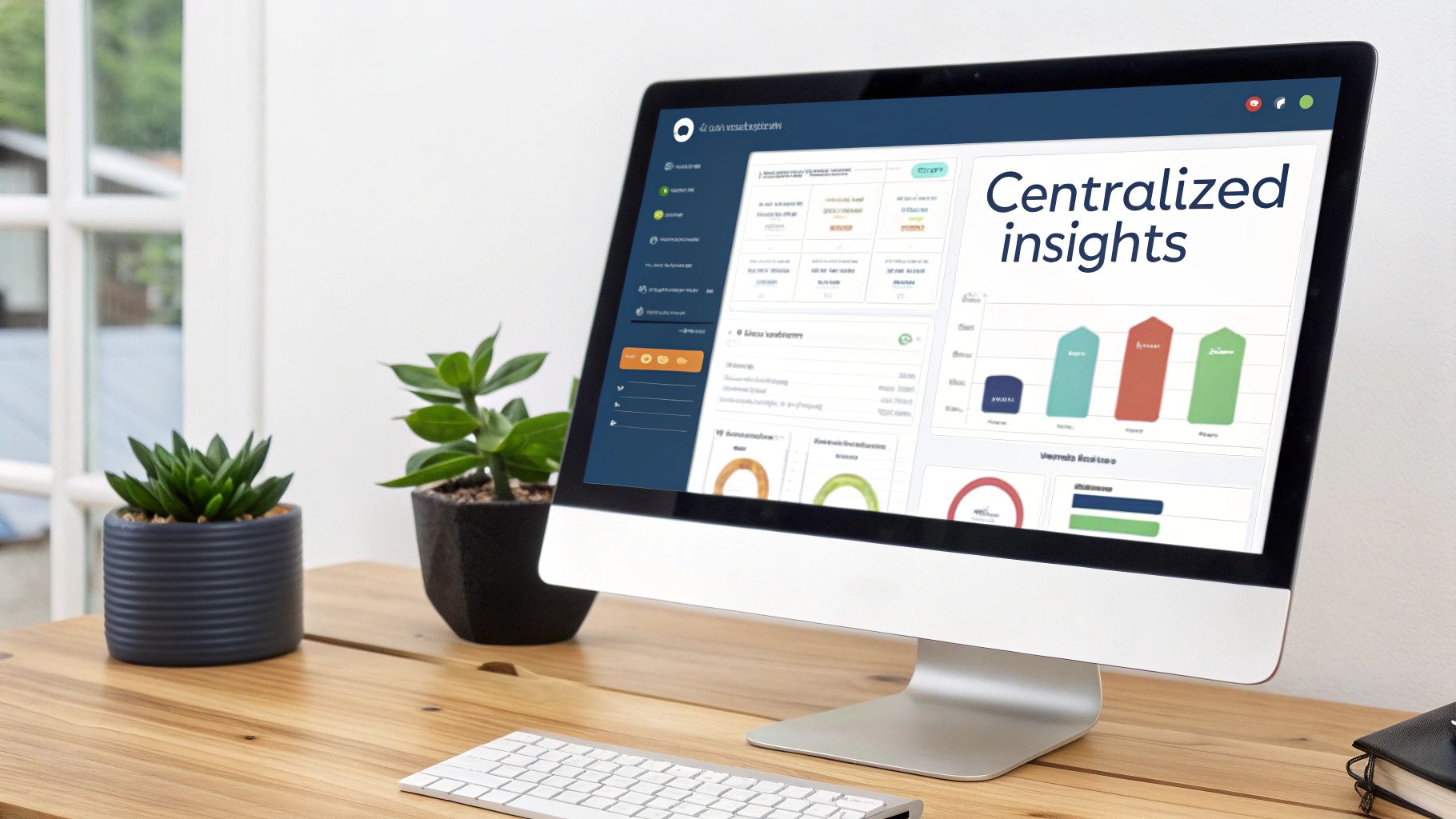
If you're serious about turning insight into action, the first thing you have to do is stop letting valuable feedback fall through the cracks. It's happening every day across your company in support tickets, sales calls, chat logs, surveys, and app store reviews. When those conversations stay siloed, you can't see the patterns that matter.
The first move is to build a single source of truth. This doesn't mean ripping and replacing the tools your teams already love. It’s about creating an automated pipeline that pulls all that scattered feedback into one central insight engine.
Connecting Your Data Streams
The idea is to get a constant flow of information moving from your front-line teams to your product and growth teams. You don't have to boil the ocean; start with the highest-volume channels. For most SaaS businesses, that’s going to be your core support and communication platforms.
Here are the key integrations to get in place first:
- Support Platforms: Automatically pull every ticket from tools like Zendesk or Intercom. This is your richest source of user friction.
- Sales & CRM Systems: Sync call transcripts and notes from Gong and Salesforce to capture what prospects are asking for (and why you’re losing deals).
- Communication Tools: Integrate internal chat logs from Slack. You'd be surprised how much unstructured feedback gets shared in channels like
#feedbackor#customer-love. - Product Analytics: Connect usage data to see if what users say matches what they actually do in your product.
Getting these pipes connected ensures that every customer touchpoint becomes a potential data point. To see how different platforms stack up, check out our guide on choosing the right customer feedback analysis tool.
The Power of Automated Analysis
Once the data is flowing in, trying to analyze it all by hand is a losing battle. Sifting through thousands of conversations is not only a massive time sink but also incredibly prone to human bias. This is where modern AI-powered platforms become a non-negotiable part of your strategy.
An insight engine should be working for you 24/7. It tirelessly analyzes unstructured text and audio to surface the subtle patterns your team would almost certainly miss, quantifying sentiment and flagging emerging issues before they turn into fires.
For instance, an AI might detect a 15% increase in support tickets mentioning a "confusing checkout process" over a 48-hour period. It can then correlate this spike with a dip in conversion rates from your analytics data, instantly flagging a revenue-impacting problem that needs attention.
This unified view is what powers everything that comes next—from validating an idea to prioritizing it and finally, shipping a solution.
Connecting Feedback to Financial Impact
So, you’ve got your insight engine up and running. The feedback is pouring in, and you’re seeing patterns, complaints, and a whole lot of feature requests. This is great, but it's also where things usually fall apart. The sheer volume can be paralyzing, leading to the chaotic, opinion-driven process of deciding what to do next.
To move from raw insight into action, there’s a critical step most teams miss: tying each piece of feedback directly to its financial impact.
Without this link, prioritization meetings turn into a battle of wills. The loudest customer gets the attention. The highest-paid person's opinion (HiPPO) dictates the roadmap. The most persistent salesperson wins the debate. This isn't a strategy; it's a recipe for building expensive features that nobody really needed, sending your development team down one low-impact rabbit hole after another.
The goal here is to shift the conversation from subjective debate to objective data. We stop asking, "What should we build?" and start asking, "Which of these issues is costing us the most, and which feature has the highest potential to bring in new revenue?"
Creating a Revenue-Driven Prioritization Model
A revenue-driven model is all about quantifying the financial stakes of each insight. You do this by connecting feedback themes directly to the metrics that matter most to the business: churn risk, expansion opportunities, and how fast you can close new deals.
Let's take a common example. Instead of just a note that says, "Users are confused by the new dashboard," you can go deeper. By connecting your support tickets to your CRM, you might discover something powerful. Maybe you find that the 15% of enterprise accounts that complained about the dashboard also have a 30% higher churn rate than the ones who didn't.
Just like that, a simple usability issue is reframed as a measurable, urgent revenue threat.
Here are the key metrics you should be linking to your feedback data:
- Customer Churn Risk: Tag feedback from customers your CSMs have flagged as "at-risk" or those with declining product usage.
- Expansion & Upsell Opportunities: Pinpoint feature requests coming from accounts with massive growth potential.
- Lost Deals: Dig into feedback from sales calls where a missing feature was the reason a deal died on the vine.
- Customer Lifetime Value (CLV): Prioritize fixing issues that disproportionately affect your most valuable customer segments.
Getting this granular is how you make truly smart decisions about where to put your resources. You can dive deeper into the best methods for this process in our guide on how to analyse customer feedback.
A simple comparison makes the value crystal clear. Most teams today are still stuck using older models that don't directly tie their work to business outcomes.
Insight Prioritization Framework
| Prioritization Method | Key Driver | Primary Metric | Business Outcome |
|---|---|---|---|
| Traditional (RICE/ICE) | Perceived user value, effort | Reach, Impact, Confidence | Vague "user delight" or feature velocity |
| Revenue-Driven | Financial gain or loss | MRR at risk, pipeline influence | Reduced churn, accelerated sales, higher CLV |
The difference is stark. While traditional methods have their place, a revenue-driven approach gives you a direct line of sight from a customer comment to a number on the balance sheet.
The Insight Impact Score
To make this practical and scalable, you need to distill all these financial connections into a single, straightforward metric: the Insight Impact Score. Think of it as a calculated value that represents the potential revenue gain or loss attached to a specific piece of feedback.
The Impact Score isn't just a number; it's a compelling business case. It transforms a developer ticket from a simple task into a strategic action with a clear, quantifiable justification.
For instance, a minor bug affecting a single small account might get a low score. It’s an issue, but not a fire. On the other hand, a feature request repeatedly mentioned by three high-value enterprise prospects stuck in your sales pipeline? That gets a massive score. This system instantly clarifies where your team’s limited engineering hours will deliver the biggest financial punch.
Sadly, this isn't common practice. Research from Zendesk shows that only 22% of B2B companies consistently measure and act on their customers' experience metrics, and that data rarely makes it into sales and account planning.
The same research found that organizations that do successfully bridge this gap are 29% more likely to get the budget they need for customer experience initiatives. Why? Because they can prove the financial stakes. The mandate from leadership is clear: prove the ROI, and you'll get the resources.
Putting Actionable Insights Into Motion
Alright, you’ve done the hard work. You’ve collected the feedback, validated the insight, and even put a dollar figure on its importance. Now what? This is where the magic happens—turning that potential into actual change.
An insight without a clear owner or a defined next step is just noise. It's a forgotten data point gathering dust in a spreadsheet. The goal is to build a seamless bridge from your insight engine straight into the tools your product, growth, and support teams live in every day.
This simple flow is how you connect the dots from customer feedback all the way to business impact.
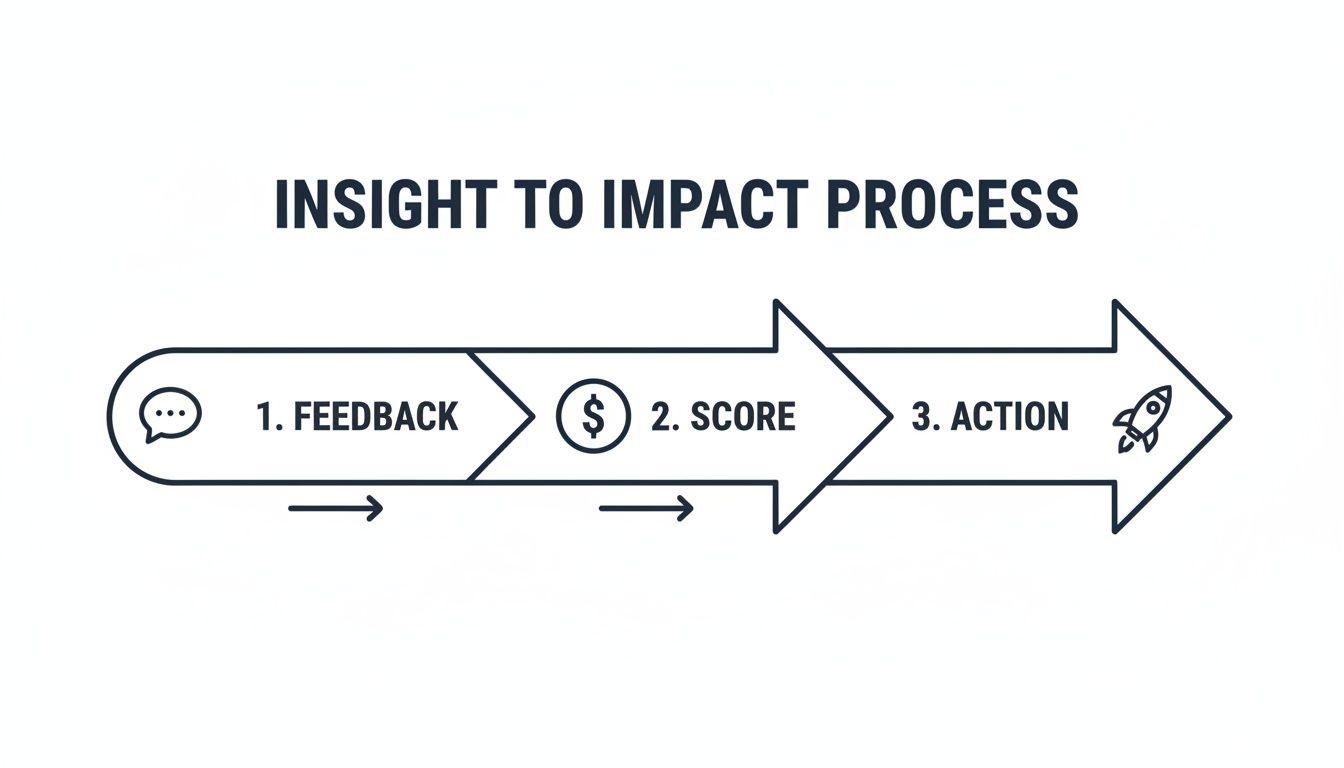
As you can see, every piece of feedback gets scored for its financial weight before anyone is tasked with taking action. This creates a direct, undeniable link between what customers are asking for and what's good for the business.
Workflows for Product Teams
For product managers and engineers, action means creating a development ticket that can't be ignored. A well-oiled workflow lets a PM convert a validated insight into a Jira or Linear ticket with a single click.
This isn't just another vague feature request. It's a ticket packed with everything a developer needs to understand the why behind the what.
- The raw customer feedback: Actual quotes from support chats, call transcripts, or survey answers.
- The Insight Impact Score: The hard numbers—MRR at risk or potential expansion revenue.
- A list of affected customers: Every single user and account that has run into this problem.
This changes the entire conversation. Instead of a ticket that just says, "Fix dashboard bug," the developer sees something far more powerful: "Fix dashboard bug that is impacting three enterprise accounts worth 120,000 ARR and is a known blocker for a ****50,000 new business deal." Now that's a ticket that gets attention.
Driving Growth Experiments
For growth teams, action is all about experimentation. Let's say your insight engine flags a huge drop-off rate during onboarding. The right move isn't to immediately tear down and rebuild the entire flow. It's to design a small, targeted experiment.
You might discover that users consistently get confused by one specific step in your sign-up form. The 'action' for your growth team is to spin up a quick A/B test with clearer copy or a simpler UI for just that one step. Then, you measure the impact on conversion rates.
This approach lets you validate potential fixes quickly and cheaply before you pour a ton of engineering resources into a big project. It's a much smarter way to tackle user friction and directly bump up your key growth metrics.
Empowering Proactive Support
Your support team is usually on the receiving end of problems, but with the right insights, they can get ahead of them. When your system flags a new, emerging bug, that insight shouldn't just go to the product team. It should also fire off an immediate alert to your support organization.
This gives them the heads-up they need to:
- Prep their responses: They can arm agents with clear explanations and workarounds before the tickets start flooding in.
- Update the help docs: A simple banner on relevant support articles acknowledging the issue can save everyone a lot of time.
- Reach out proactively: They can contact high-value customers who might be affected and let them know a fix is already in the works.
This is the kind of service that builds real loyalty. After all, research shows that 90% of buyers consider an immediate response crucial for support questions. And a third of them will walk away from a brand they love after just one bad experience. By feeding your support team real-time insights, you give them the power to deliver the fast, intelligent service customers expect. You can learn more about how to elevate your service by checking out these customer experience statistics.
Measuring ROI and Closing the Loop
Putting an insight into action is a huge win, but the job isn't done until you measure the results and—just as importantly—tell people about them. This is the step that proves the value of your entire program. It turns a one-off product fix or a new feature launch into a repeatable, revenue-driving machine.
If you skip this final feedback loop, you’re basically just shipping changes into a void and hoping for the best.
Tracking the outcome is all about connecting the action you took back to the financial metrics that got it approved in the first place. Did that bug fix actually reduce churn for the customers it was affecting? Did that new feature you shipped really drive the expansion revenue you forecasted? You have to answer these questions with data, not just gut feelings.
Defining Your Success Metrics
You can't measure success if you haven't defined it. Vague goals like "improve user satisfaction" are a great starting point, but they won't cut it for showing real business impact. You need specific key performance indicators (KPIs) that tie your work directly to the bottom line.
Think in terms of concrete, measurable outcomes:
- Churn Reduction from a Fix: Let's say you fix a critical bug. You should be tracking the churn rate of the specific customer cohort that was impacted by it and comparing it to a control group. Seeing a 5% reduction in churn for that segment is a massive, tangible win.
- Expansion Revenue from a Feature Request: When customers who asked for a new feature actually upgrade their plan to get it, you've drawn a straight line from their feedback to new revenue.
- Lower Support Ticket Volume: If you ship a usability improvement that leads to a 20% drop in support tickets for that specific workflow, you've just saved the company real money in operational costs.
The principles behind measuring marketing campaign effectiveness apply perfectly here. Just like a marketing campaign, every product change needs clear attribution to prove its worth.
The most powerful part of this entire process is "closing the loop"—personally telling customers that you built something because of their feedback. This single gesture validates their effort, proves you're listening, and builds incredible, long-term loyalty.
The Power of Closing the Loop
When you close the loop, you turn customers from passive users into active partners. It's a simple act with a profound impact. So, when you ship that fix or launch that new feature, don't just bury it in the release notes. Reach out to the actual people who asked for it.
A simple, personal email makes all the difference.
Something like, "Hi Jane, a few weeks ago you mentioned how frustrating our reporting dashboard was. We heard you. Based on your feedback, we've just shipped a complete overhaul. Would love to know what you think!"
This does so much more than just announce a feature. It tells your customers they have a voice and that you genuinely value their input.
For a deeper dive into quantifying these efforts, our detailed return on investment template can help you structure your internal reporting. By consistently measuring outcomes and closing the loop, you create a virtuous cycle: valuable feedback leads to profitable action, which in turn encourages even more high-quality feedback.
Got Questions? Let's Talk Through the Common Hurdles
Even the best playbook can feel a little intimidating when you're starting from scratch. Rolling out a new process for turning customer insights into action always brings up a few common roadblocks. Let's tackle some of the questions I hear most often from teams just getting started.
"Our Feedback is Everywhere. Where Do We Even Begin?"
This is probably the biggest one. Your customer feedback is scattered across support tickets, sales call notes, chat logs, maybe even a few rogue surveys. The goal isn't to replace all those tools, but to pipe the valuable insights into one central place.
My advice? Don't try to connect everything on day one. Start small. Take a quick look at where most of your feedback comes from—for many, that’s a support platform like Zendesk or Intercom. Focus on integrating just that one source first.
This gives you a manageable, high-signal stream of data to work with. You can prove the value of this approach with a small win, which builds the momentum you'll need to connect everything else later.
Think of it this way: you're not trying to boil the ocean. You're just turning on one faucet to show everyone how clean the water is. Once you prove the value, getting buy-in to connect the other sources becomes a much easier conversation.
"How Can We Ask Our Already-Swamped Dev Team to Do More?"
Your engineering team's backlog is already a mile long. So, how do you convince them to take on more work based on customer feedback? Here's the key: this isn't about creating more work; it's about making sure they're focused on the right work.
When you can tie a revenue or churn risk number to every bug fix or feature request, you completely change the conversation. It's no longer a subjective debate about what seems important. It becomes an objective, data-backed decision.
Imagine walking into a planning meeting with a ticket that says:
- "This bug is putting 5% of our enterprise segment at risk of churning."
- "We have three deals in the pipeline, worth a combined $75k in new ARR, that are blocked until we ship this feature."
Suddenly, it’s not just another request. It’s a direct play to protect revenue or unlock new growth. That kind of work naturally shoots to the top of any priority list because you've aligned the engineering effort directly with the company's financial goals.
Ready to turn your customer feedback into your biggest revenue driver? SigOS uses AI to connect support tickets, sales calls, and usage data to financial impact, showing you exactly what to build next. Prioritize your roadmap with SigOS today.
Keep Reading
More insights from our blog
Ready to find your hidden revenue leaks?
Start analyzing your customer feedback and discover insights that drive revenue.
Start Free Trial →