Census Reverse ETL: How Warehouse Data Powers Growth
Learn how Census Reverse ETL syncs warehouse data to business tools, driving growth with real-time insights in 2026.

Your warehouse contains a carefully modeled view of customer health, product usage, renewal timing, and buying behavior. Yet a sales representative opens Salesforce and sees an outdated account record, a marketer builds an audience from a spreadsheet, and a customer success manager learns about risk only after a renewal conversation goes badly. The business has data, but the people responsible for acting on it can't reach it where their work happens.
That gap is what Census reverse ETL is designed to close. Census takes trusted, modeled warehouse data and activates it in operational tools such as Salesforce, HubSpot, Google Ads, and Marketo. Neutral coverage has described Census as supporting more than 200 destinations while helping establish reverse ETL as a major data movement pattern (industry coverage of Census's category positioning).
The important distinction is that Census isn't just another connector. It acts as a warehouse truth activation layer. That layer creates operational benefit when your models are accurate, current, and governed. It creates operational sprawl when stale or poorly defined signals are pushed into more systems at higher frequency.
This guide explains the mechanics in plain language, from the difference between traditional ETL and reverse ETL to Census models, segments, syncs, incremental updates, use cases, implementation risks, alternatives, and a practical readiness test. If your organization is also trying to make trusted data more accessible without turning every request into an analyst ticket, the principles behind self-serve analytics provide useful context.
Introduction Why Your Best Data Never Reaches Your Team
A product team sees a customer stop using a critical feature. The warehouse can combine that change with support tickets, contract dates, payment history, and account ownership, then turn the inputs into a health signal.
The account manager may still need to open a dashboard, interpret the result, copy a note into Salesforce, and remember to check again next week. Manual steps delay the insight and make follow-up inconsistent.
Marketing faces the same gap. A data team builds a reliable customer segment, while campaign managers work with the narrower attributes available in their marketing platform. They export a CSV, upload it, discover mismatched fields, and repeat the process as the audience changes. Product teams encounter it when behavioral signals remain in warehouse tables instead of reaching in-app messaging or experimentation tools.
Reverse ETL changes the direction of travel. Traditional pipelines bring information into the warehouse for analysis. Census sends modeled warehouse output into the operational systems where sales, marketing, support, success, and product teams make decisions.
Analytics becomes useful only when it changes a workflow. A dashboard can show that an account is at risk. A synced health score in Salesforce can place that signal beside the account owner's next action. A warehouse-defined audience can become a usable segment in HubSpot or Google Ads instead of an analyst-maintained spreadsheet.
Census works as a warehouse truth activation layer. It carries the right governed attributes into the right tools, at a freshness level that fits the decision. Accurate, well-defined models create value by reducing manual handoffs. Stale or poorly governed data spreads confusion across every connected system.
Teams evaluating this approach should also consider whether trusted data is accessible to non-analysts. Guidance on self-serve analytics practices offers useful context. The practical question is not whether to sync everything, but whether each sync has a clear owner, destination, and action attached to it.
How Reverse ETL Works and How It Differs From Traditional ETL
Traditional ETL or ELT moves data toward a central analytical environment. Applications, billing systems, support platforms, and event streams supply raw inputs. The warehouse stores them while data teams clean, join, and model the records for reporting and analysis.
Reverse ETL begins after that work. It selects a curated warehouse model and delivers chosen fields to an operational destination, such as a CRM, marketing platform, ad network, or customer support system. The two patterns form a loop: source data enters the warehouse, gains business meaning, then returns to the tools where teams act on it.
The warehouse holds the broad, governed view. Operational tools receive a focused working set. Salesforce may need account health and renewal signals, while HubSpot may need audience membership and lifecycle attributes. Sending every warehouse column would create clutter, mapping risk, and unclear ownership.
The direction explains the value
The practical flow has three stages:
- Ingest and prepare data. Source systems send information into a cloud warehouse.
- Model business meaning. Data teams produce clean views, metrics, and entity-level records.
- Activate selected outputs. Reverse ETL maps those records into operational tools.
Census operates in the third stage. It does not replace ingestion, transformation, data quality work, or analytical modeling. It makes the output of those layers available beyond SQL and dashboards.
That dependency shapes where Census creates value. A trusted model can place a useful signal beside a seller's next action or keep a marketing audience current. An inaccurate model spreads the same error across every connected destination. Census therefore works as a warehouse truth activation layer, amplifying governed data while also making weak upstream definitions more visible and operationally costly.
The warehouse requirement also affects project planning. Independent reviews describe Census as a warehouse-first activation product that requires an existing cloud warehouse such as Snowflake, BigQuery, Redshift, or Databricks (review of Census limitations and prerequisites). If reliable models and ownership are missing, the first task may be data readiness rather than sync configuration.
Freshness comes from the sync path
A warehouse table can update frequently while its destination remains stale. Operational latency depends on sync cadence, destination API behavior, batching, throttling, and retry handling, not only on warehouse update speed. Census workflows can run on a schedule or continuously, so frequency should match the decision being supported (Databricks explanation of Census and operational analytics).
A renewal warning may need frequent delivery. A broad demographic attribute may not. The right sync delivers sufficiently fresh data without unnecessary warehouse reads, API pressure, or downstream noise. A clear owner, destination, and action should exist before the connection is enabled.
Inside Census How Models Segments and Syncs Move Data
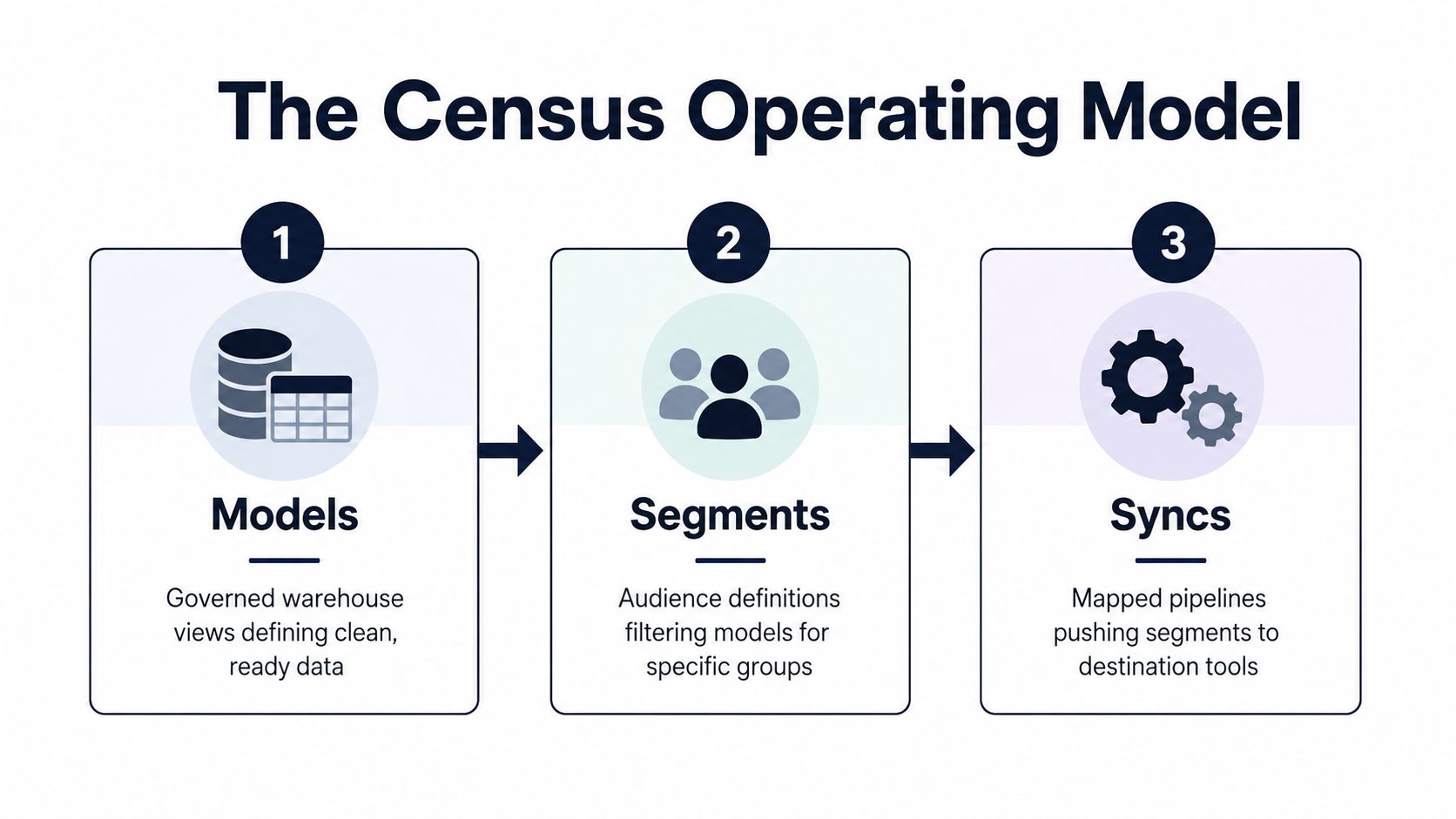
Three warehouse objects drive Census: models define records, segments narrow audiences, and syncs deliver fields to destinations. Together, they turn warehouse logic into operational updates without mixing business definitions with delivery settings.
A model answers, “Which records should exist, and what do they mean?” A segment selects the records relevant to a decision. A sync maps those records to destination fields, identifies how they should match, and controls how changes are sent.
Models define the warehouse truth
Suppose a team wants sales representatives to prioritize accounts. Its model could contain one row per account, an account identifier, a health score, recent product activity, open ticket status, renewal date, and expansion signals. That model needs clear definitions and ownership before anyone connects it to Salesforce.
The model's grain determines what each row represents. One row per account is different from one row per user, event, subscription, or opportunity. If Salesforce expects account records but the model contains several rows per account, the sync may overwrite values unpredictably or create ambiguous updates.
A well-defined model gives downstream teams a shared starting point. A poorly defined model spreads uncertainty into every connected destination, turning a sync into a faster way to distribute conflicting logic.
Segments make activation intentional
A segment limits which records from a model reach a destination. A marketing team might start with a model containing all customers, then select accounts eligible for an expansion campaign. Customer success could filter for accounts with an approaching renewal and a declining health signal.
The filter should represent a business decision. It should not repair an unclear model. If each destination needs its own interpretation of the same raw table, the warehouse needs clearer models before more syncs are added.
Syncs handle mapping and movement
A sync connects a model or segment to a destination. It maps source fields to destination fields, sets the record key, and determines whether updates run on a schedule or continuously. This model, segment, and sync pattern lets Census move prepared warehouse data into SaaS systems without recreating the logic in every tool.
Stable unique keys keep the match reliable. A Salesforce account ID, CRM contact ID, or another durable identifier connects a warehouse record with its destination counterpart. Change timestamps can also help identify which records require attention.
The operating model is easier to review when teams document the source grain, destination key, field transformations, null behavior, update rules, and failure response. Data architecture diagrams can make ownership, dependencies, and movement between systems visible before a sync reaches production.
Incremental updates reduce unnecessary work
An incremental sync sends records that changed instead of resending the full table. This can reduce warehouse reads, outbound API calls, and duplicate writes. It still requires state management, because batching, API limits, retries, and upserts affect the final result.
The practical test is simple: can the team explain which record changed, how Census identifies it, what happens when a field becomes null, and how a failed update is retried? Clear answers reduce operational surprises. They also reveal when activation would amplify bad upstream data or add another destination that nobody owns.
For a visual introduction to the workflow, this video offers another explanation of Census-style activation:
Census Reverse ETL Use Cases That Drive Revenue
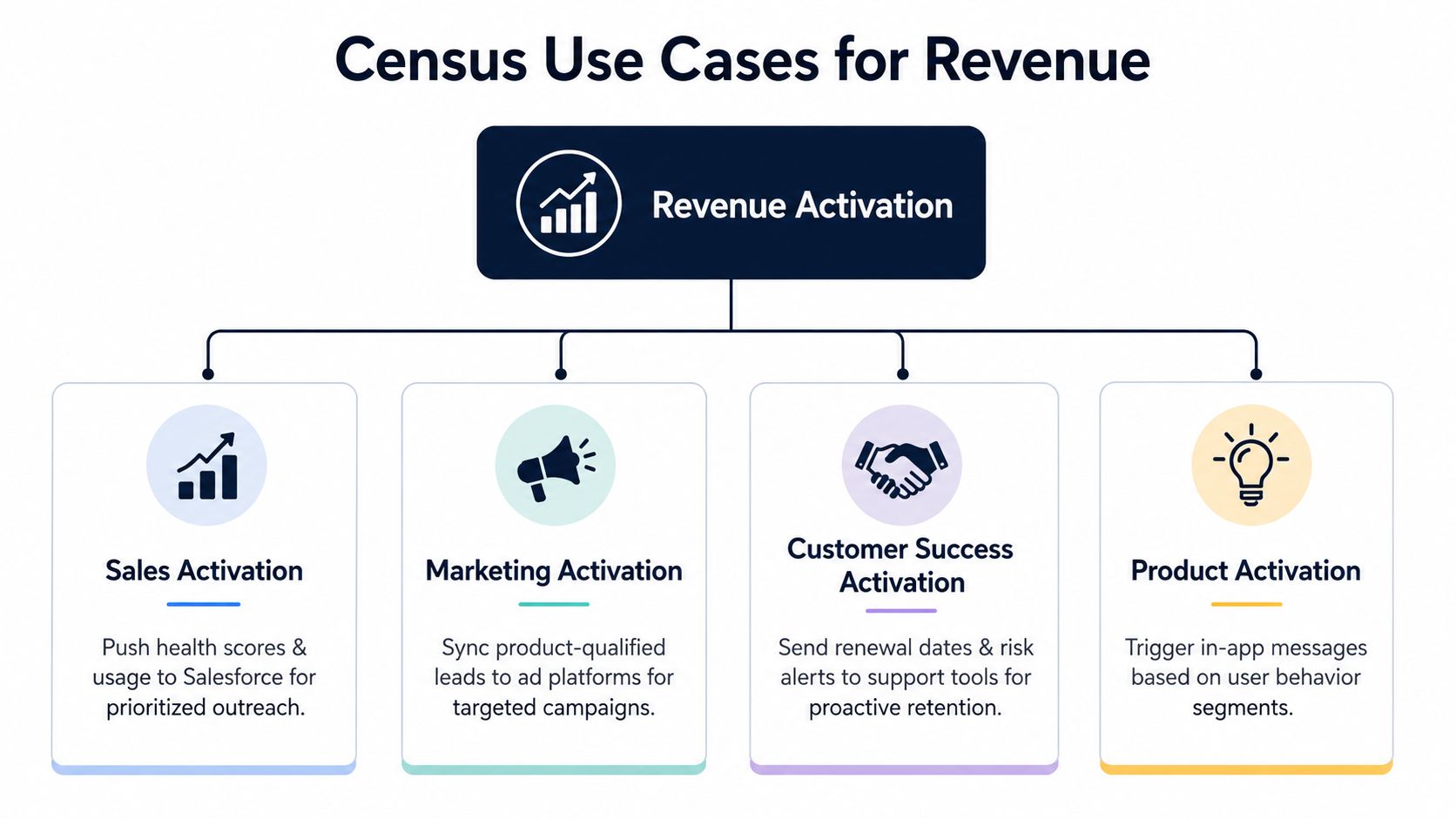
The strongest Census projects begin with a decision that someone already makes manually. The warehouse supplies better evidence, and the sync places that evidence into the decision-maker's normal workflow.
Sales activation
A revenue operations team builds an account model from product usage, support activity, subscription details, and renewal dates. It sends health and engagement fields to Salesforce, where account owners can see which customers need attention before a scheduled renewal conversation.
The value isn't the presence of another field in the CRM. The value comes from replacing an inconsistent interpretation with a shared signal. A seller can use the account's recent usage pattern to prepare a relevant conversation, while leadership can define the prioritization logic in the warehouse rather than in disconnected spreadsheets.
Marketing activation
A growth team defines a product-qualified audience from modeled behavior. It may include users who reached a meaningful product milestone but haven't converted, or existing customers whose usage suggests expansion potential. Census can deliver those audience attributes to tools such as HubSpot and Google Ads, allowing marketers to build campaigns around warehouse-defined segments.
Census's reported destination coverage includes Salesforce, HubSpot, Google Ads, and Marketo, with neutral coverage describing more than 200 destinations (coverage of Census destination and category positioning). Teams evaluating broader revenue workflows may also find this guide to how platforms power prospecting useful when deciding where activated signals should influence outreach.
Customer success activation
A customer success model combines renewal timing, product adoption, unresolved support issues, and account health. Instead of asking a success manager to inspect several dashboards, the organization syncs a risk attribute and supporting context to its customer platform.
That workflow can help a manager prioritize a review, investigate a drop in usage, or coordinate with support. The model still doesn't make the decision for the manager. It puts relevant, governed context beside the account record so the manager doesn't have to reconstruct it.
Product activation
Product teams can use behavioral segments to trigger more relevant in-app communication or route signals into operational tools. A segment might identify users who repeatedly encounter a workflow barrier, accounts that haven't adopted a valuable feature, or customers showing a change in usage pattern.
The important design question is what action follows the sync. If the destination receives a signal but no one owns the response, the pipeline creates data volume without business value. Define the recipient, action, and feedback loop before adding another destination.
Implementation Essentials From Schema Mapping to Security
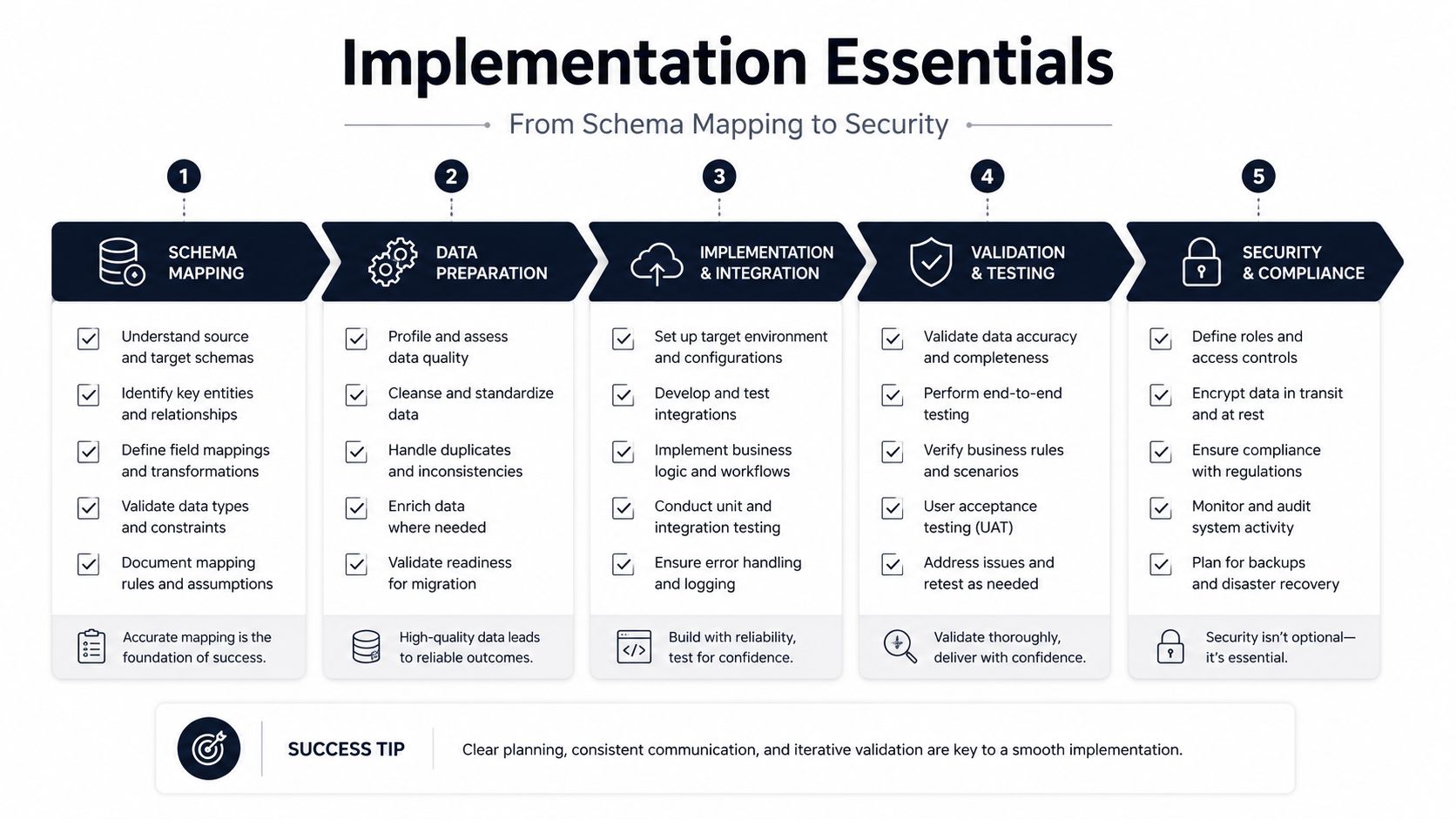
A Census rollout can look successful in a demo and still fail in daily operations. The difference usually appears before the first connector is configured: the warehouse must contain trustworthy models, the destination must have a clear schema, and the team must decide which information may leave the analytical environment. Census works as a warehouse truth activation layer. It gives reliable models a path into operational tools, while sending flawed models outward can multiply confusion across those tools.
Start with warehouse readiness
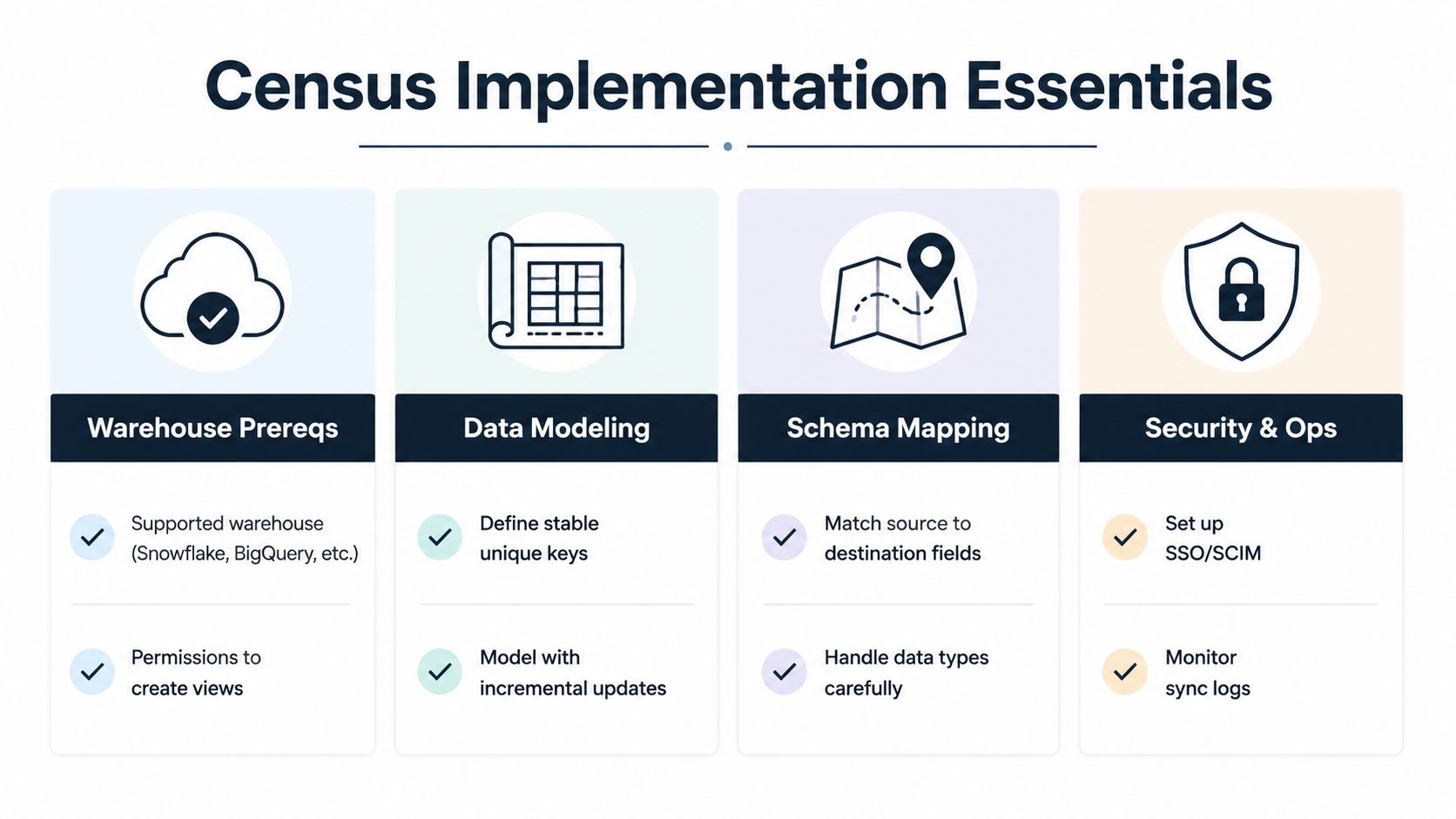
Begin by identifying the warehouse that holds authoritative records, the owners of relevant models, and the refresh schedule for each model. Snowflake, BigQuery, Redshift, and Databricks are examples of cloud warehouse environments commonly associated with Census prerequisites, as noted in the Census limitations review.
A sync should not conceal unresolved upstream problems. If account ownership is inconsistent, customer IDs change, or status fields carry different meanings across teams, the destination will inherit those ambiguities. Check the source logic first, then decide whether the model is ready for activation.
Protect record identity
Incremental syncs require reliable identity. Assign each exported entity a stable unique key and retain a meaningful change timestamp. Without both controls, Census may miss updates, write to the wrong destination record, or repeatedly process unchanged data.
Incremental delivery can avoid resending full tables, reducing duplicate writes, warehouse reads, and outbound API calls, according to reverse ETL incremental sync guidance. Efficiency does not correct flawed modeling. A bad key makes a fast sync wrong at scale.
Treat schema mapping as product work
Destination fields often enforce stricter rules than warehouse columns. Dates, Booleans, currency values, identifiers, and free-text attributes may need different formats. Map each field deliberately, define null behavior, and specify what happens when a destination field disappears or changes type.
Use representative records before production testing. Include missing values, duplicate candidates, unusually long text, changed ownership, deleted records, and records entering or leaving a segment. Reviewing common data quality issues helps the team find upstream conditions that could spread through every connected destination.
Match frequency to consequence
Use continuous syncs when a delay could change the next operational decision. Scheduled syncs fit destinations that do not need constant updates or sources that change slowly. Each increase in frequency should account for warehouse workload, destination API limits, retries, and the cost of transmitting noisy changes.
Build governance into activation
Reverse ETL can place standardized customer and account attributes in operational tools, improving consistency across teams. It can also expand compliance exposure when sensitive fields move into more systems. Market research identifies governance and compliance as use cases, while citing security, privacy, integration complexity, and skills shortages as restraints (reverse ETL market research).
Create a field allowlist, assign owners, restrict access, monitor sync logs, and document each destination's purpose. These controls determine whether added movement creates useful action or operational sprawl.
Census Strengths Limitations and Top Alternatives
A revenue team opens Salesforce, sees stale account signals, and acts on yesterday's customer reality. Census addresses that gap by moving governed warehouse models into the tools where teams work. Its value depends on the warehouse beneath it: accurate models create useful action, while weak upstream data spreads bad decisions across more destinations.
Census became one of the earliest widely recognized reverse ETL vendors after its founding in 2018. By 2022, it had raised 80.3 million in venture funding, including a ****60 million Series B announced in February 2022. The round was led by Tiger Global, with participation from Sequoia Capital and Insight Partners. In May 2025, Fivetran acquired Census as part of its push toward an end-to-end data movement platform. Census's earlier $630 million valuation was the last publicly reported benchmark (Census company and funding history).
Those milestones provide context, not a buying recommendation. Census fits teams that want the warehouse to act as an activation layer, with modeled data separated from the delivery process. Its main limitation follows the same design: teams need a functioning cloud warehouse, reliable models, and clear ownership before syncing can create value.
| Approach | Best For | Warehouse Requirement | Governance Tradeoff |
|---|---|---|---|
| Census | Warehouse-first activation across revenue and operational tools | Existing cloud warehouse and modeled data | Centralized logic can improve consistency, but each destination expands data exposure |
| Hightouch | Teams comparing a similar warehouse-to-tool activation pattern | Existing warehouse and usable models | Flexible activation requires disciplined ownership and field controls |
| Custom integrations | A narrow set of stable, specialized workflows | Usually required, with engineering-managed delivery | Maximum architectural control, with maintenance and change-management burden |
| iPaaS workflows | Simple application-to-application automations | Not necessarily central | Convenient for point-to-point logic, but warehouse governance may be less direct |
| Native warehouse features | Organizations consolidating activation around their existing data platform | Required | Fewer moving parts can simplify oversight, though destination coverage and workflow depth may vary |
The category grew from a niche warehouse activation approach into a recognized data infrastructure segment during the early 2020s. Coverage identified Census, Hightouch, and Rivery as early groundwork builders by 2018, while G2 called Census the category leader by August 2022 (category history and Census positioning).
Choose Census when the warehouse is already the organization's analytical source of truth and operational teams need those signals in existing tools. Choose Hightouch for a comparable activation pattern, custom integrations for a small set of specialized workflows, iPaaS for simpler application-to-application logic, or native warehouse features when reducing platform layers matters more than destination breadth. In every case, the deciding question is whether the sync activates trusted data or multiplies upstream confusion.
Getting Started With Census A Practical Path Forward
A team opens Salesforce before a renewal call and finds an outdated health score. The warehouse already contains the latest usage and support data, yet the useful signal stayed behind. Census can close that gap, but only if the underlying model is trustworthy and someone owns the action it triggers.
Start with readiness. Confirm that the warehouse has a maintained model for one business entity, a stable key, clear field definitions, and an owner who can explain how each value is produced. Assign one operational team a specific response when the data arrives. Without those conditions, a sync spreads uncertainty faster than it creates value.
Choose one high-value workflow for the first test. A customer health signal in Salesforce, a defined product-qualified segment in HubSpot, or a renewal-risk attribute for customer success can each work. Keep the model narrow enough for the team to check every field and destination record. A small, visible pilot acts like a control panel: it shows whether the warehouse signal is ready for operational use.
Measure the workflow's effect, not just its successful run status:
- Freshness: How long does an approved warehouse change take to reach the destination?
- Reliability: Which records fail, what causes the failures, and how are retries handled?
- Data quality: Do destination values match the model and the source-of-truth rules?
- Adoption: Do intended users see and use the signal in their existing workflow?
- Business response: Does it change prioritization, outreach, support, or product action?
Scale after the first workflow has an owner, documented field definitions, access controls, and a process for failures. Cloud deployment is common in the reverse ETL market, while governance, security, privacy, integration complexity, and skills can still limit implementation. A warehouse provides the reference point, not the operating discipline. Teams still need clear ownership, review routines, and rules for changing models.
Decision rule: If your warehouse produces trusted, entity-level models, pilot Census with one owned workflow. If it does not, improve modeling and data quality first. Activation magnifies the truth already present, including inconvenient parts.
SigOS can complement this approach by analyzing support tickets, chat transcripts, sales calls, and usage metrics for patterns related to churn, expansion, and revenue impact. Visit SigOS to assess which product signals should become operational data before syncing them into downstream tools.
Keep Reading
More insights from our blog

Ready to find your hidden revenue leaks?
Start analyzing your customer feedback and discover insights that drive revenue.
Start Free Trial →