Cold Starting Problem: A Practical Guide for Product Teams
Understand the cold starting problem, its impact on retention and revenue, and proven mitigation strategies for SaaS product and growth teams.

Your launch day dashboard is open, the feature is live, and the numbers are flat. No clicks, no ratings, no useful patterns, just a row of empty charts and a team staring at each other while the product manager asks the only question that matters, “Do we keep this on or kill it?”
That's the cold starting problem in real life. It shows up before teams name it, and it hits hardest when you need signal the most, right after launch, right after onboarding, right after you've spent real time and budget getting people into the product.
The mistake often made is treating that emptiness like a model problem first. It usually isn't. It's a sequencing problem, a market-design problem, and an instrumentation problem, with the algorithm sitting at the end of the chain. If you want the mental model people use in the field, keep the early adopter marketing playbook nearby, and make sure your dashboard itself is built to surface early-stage signal instead of burying it in vanity metrics, like the reporting patterns covered in this dashboard metrics guide.
The Empty Dashboard on Launch Day
The bad moment isn't when the code ships. It's when the first few users arrive and your system can't tell you what they wanted, what they skipped, or whether the experience made sense. The team has a feature, but not a clue. That gap feels bigger than a bug because it leaves you making product calls on instinct while the product is still learning how to exist.
In SaaS, this happens all the time. A new recommendation module has no interaction history, a personalized onboarding flow has no preference data, and a brand-new product has no behavioral baseline at all. The dashboard looks precise, but the inputs behind it are too thin to support confidence.
What the anxiety is really about
The fear is not “the model is wrong.” The fear is “we don't know what's important yet.” If the first users don't click, support doesn't complain, and sales doesn't surface objections, leaders start guessing, and that guesswork gets baked into the next release cycle.
Practical rule: treat the first launch cohort like a learning system, not a representative average. Early behavior is biased, but it's still the best signal you've got.
The right response is to narrow the problem before you widen the launch. Ask what you need to learn, who can tell you fastest, and which interaction will give you usable signal with the least friction. If you do that well, the cold starting problem stops being a panic and starts looking like a launch constraint you can manage.
What Cold Start Actually Means in Practice
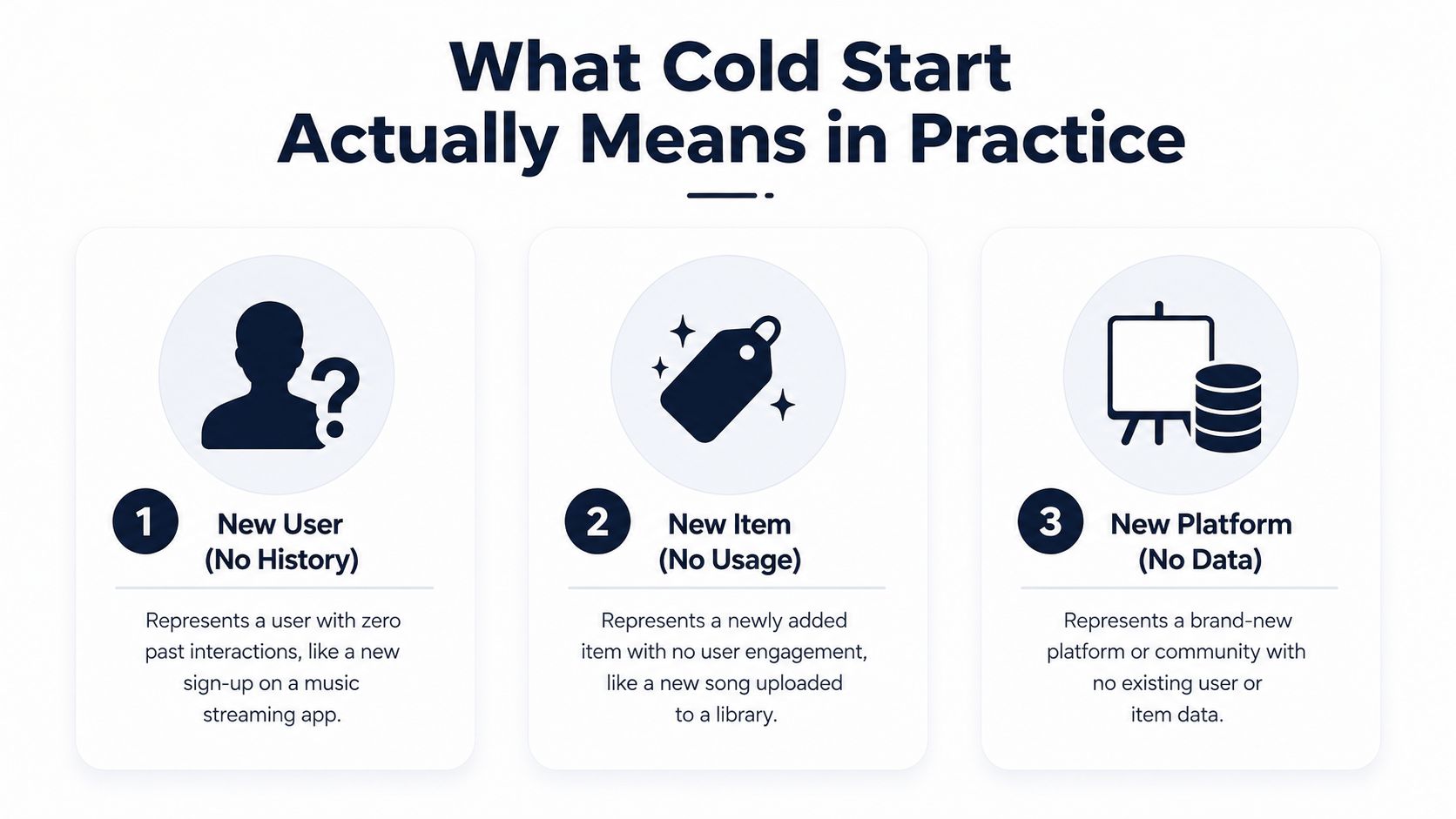
A new user cold start is the easiest to recognize. A new signup lands in your product, but the system knows nothing about them yet, so personalization has no history to lean on. Think of a music app asking a first-time listener what they like, or a SaaS tool trying to rank features for a user who hasn't clicked anything.
A new item cold start is different. The user base exists, but the thing you're trying to surface is brand new, so it has no usage trail. That's the new song in a library, the new template in a design tool, or the new workflow in a CRM, all sitting there with zero engagement and no clue which segment should see it first.
A new platform cold start is the hardest case. There's no meaningful historical data anywhere, which means every recommendation, ranking, or prioritization call is mostly guesswork until the system collects enough evidence. That's the first week tenant in a new apartment building, nobody knows the neighbors, the building has no reputation, and every assumption is borrowed from somewhere else.
The three cases aren't interchangeable
Teams mix these up and then pick the wrong fix. A new user problem can often be improved with onboarding and preference capture. A new item problem usually needs better seeding, default placement, or controlled exposure. A new platform problem needs disciplined sequencing because there's no stable past to infer from.
The commercial-sense version is simple. If your product has users but no item history, don't rebuild the whole model first. If your product has neither users nor history, don't pretend collaborative filtering will save you on day one. And if your team is launching AI-driven prioritization, remember the core issue is still lack of signal, just dressed in newer language.
“No history means no trust.” That's the simplest way to explain cold start to a stakeholder who doesn't want the jargon.
How Much Cold Start Actually Costs You
Cold start is not a technical inconvenience. It leaks activation, retention, and expansion before you've had time to notice. In mobile transportation, the same basic pattern shows up in emissions, where the early phase is disproportionately costly, and research from the University of Texas/TRB notes that cold starts can account for 10% to 30% of total mobile-source emissions in most cases, with some pollutants around 10% to 20% of combined starting-and-running emissions, which is a useful parallel for how the first few minutes can dominate the whole outcome UT/TRB study.
The business damage compounds
Product teams feel the same compounding effect. A weak first session lowers activation. Lower activation means fewer people generate the behaviors your system needs. Fewer behaviors mean weaker recommendations, and weaker recommendations make the next cohort even harder to convert. That loop is why cold start hurts more than a one-time drop.
The operational damage usually shows up in a few places first, even when leaders aren't measuring it cleanly yet. Support tickets rise because users don't understand the first experience. Expansion conversion slows because the product never demonstrates value early enough. Week-one retention falls because the initial journey feels generic or irrelevant.
The right way to estimate exposure is boring and effective. Track activation rate, week-one retention, expansion conversion, and support volume tied to first-use confusion. If one of those is bad, don't immediately blame the model. Check whether the launch sequence itself is starving the system of signal.
Practical rule: if the first cohort is thin, every bad interaction matters more than people think. Early behavior shapes later behavior.
The strongest teams don't wait for a full quarter to admit the launch is underperforming. They instrument the cold window separately, watch the first signals in real time, and decide whether the problem is user understanding, market size, or model quality. That's the difference between diagnosing a launch and rationalizing a missed one.
Fixing Cold Start Before You Touch the Algorithm
Reach for algorithmic fixes too early? That's backward. The fastest wins usually come from onboarding design, preference capture, and launch sequencing, because those changes create signal before the model needs to be clever.
Start with onboarding and explicit preference capture
If users can tell you what they care about in the first minute, do it. Guided onboarding, interest pickers, category selection, and lightweight preference prompts all help the system learn faster. They work when users are motivated enough to answer and when the choices are simple enough that people don't bounce.
They backfire when the form becomes a tax. If you ask for too much too early, users give random answers or abandon the flow entirely. The fix is not more fields, it's fewer decisions with clearer payoff.
Seed the experience with defaults and curated sets
Default content is not a crutch. It's a starting hypothesis. New products need starter sets, curated examples, and strong defaults so users can react to something instead of facing a blank screen.
Many teams overcorrect and hide behind “personalization.” There's nothing personalized about a feature that has no data. Give it an intelligent default first, then let behavior replace the guesswork.
Use incentives and staged rollout to create early signal
Referral loops, early access programs, and targeted incentives can help when your user base is thin. They work best when the first users are highly engaged, not just numerous. That's the difference between a cohort that teaches you something and a crowd that muddies the signal.
If you want a practical way to collect feedback without turning launch into a survey carnival, use the discipline in this customer feedback collection guide as a model for asking for signal at the right moment, not all the time.
A staged rollout is not timid. It's how you avoid learning the wrong lesson from the wrong audience.
Choosing the Right Algorithm for Cold Start
Once the product and rollout decisions are doing their job, the algorithm question becomes worth solving. The mistake here is treating every cold-start case like a recommender-system problem, because the best technique depends on what data you have, not what sounds impressive in a deck.
| Approach | Best cold-start case solved | Main weakness | Team profile that fits |
|---|---|---|---|
| Content-based filtering | New item | Needs strong item metadata, can ignore collaborative patterns | Teams with rich catalog attributes |
| Collaborative filtering with side information | New user or new item | Still needs enough interaction density to work well | Teams with meaningful usage history and profile data |
| Hybrid models | Mixed cold-start cases | More complex to operate and debug | Mature product teams with data and MLOps support |
| Zero- or few-shot methods, including transfer learning | New platform or early AI rollout | Can look confident before it's actually reliable | Teams with a parent product, pretrained models, or strong domain transfer |
Use the simplest model that matches your data shape
If you have strong metadata on items, content-based methods are the cleanest first move. If you have real interaction history plus user or item side information, collaborative or hybrid methods make more sense. If you're launching from near zero, zero- or few-shot approaches can help, but only if you're honest about how little the model really knows.
That honesty matters. A hybrid model can still fail at launch if it's trained to overtrust sparse early signals. A transfer-learning setup can also fail if the source domain is too different from the new one. The point is not to chase model sophistication. The point is to match the technique to the data maturity of the product.
Match the method to the team, not the trend
A brand-new product usually needs content structure, explicit onboarding, and controlled seeding more than fancy collaboration logic. A team with one successful product and a similar second product can often transfer useful patterns faster than building from scratch. A platform with richer behavioral history can justify more complex ranking logic, but only after the instrumentation is trustworthy.
If you're deciding between approaches in a meeting, ask three blunt questions. What data exists today. What cold-start case hurts us most. What failure mode are we willing to tolerate while the system warms up.
Instrumentation and Active Data Collection
A cold-start system cannot improve if it can't see. Passive telemetry is the baseline, but passive logs alone usually move too slowly when the product has no history. Active collection, where the system asks for ratings or preferences on purpose, gets you signal sooner, but it also increases friction.
The practical trade-off is simple. Passive data is cheap and low-friction, but noisy and slow. Explicit elicitation is cleaner, but users have to stop and answer. Active learning sits between the two, because the system chooses strategically what to ask, which can improve both coverage and speed.
Build a separate cold-window dashboard
Don't hide early metrics inside your normal engagement report. Create a dedicated view for time to first meaningful signal, coverage of the catalog or feature set, and confidence around recommendations or prioritization outputs. If the team can't see the cold window clearly, they'll keep arguing from anecdote.
The most dangerous failure is a silent cold start in AI features. The model returns confident-looking outputs, the UI looks polished, and nobody notices that the underlying signal is too weak to trust. That kind of failure doesn't announce itself. It just trains the team to believe the wrong thing.
For teams wiring event collection into the stack, a practical tracking setup matters more than perfect taxonomy on day one. The implementation pattern in this GTM walkthrough is useful because it forces you to think about event capture as a system, not a guess.
Separate signal quality from traffic volume
More events do not automatically mean better data. A flood of meaningless clicks is still meaningless. The central question is whether the events you capture predict later behavior, not whether they make the dashboard look busy.
If you're using product analytics, tie the earliest events to downstream outcomes and keep an eye on where the signal breaks. That's also why a clean usage-tracking setup matters, and why the workflow in this app usage tracking guide belongs in the hands of whoever owns launch instrumentation.
Practical rule: if the system can't explain why a recommendation is strong, assume it's weak until proven otherwise.
A Week One Rollout Playbook for Growth Teams
A growth team launches a personalization feature behind a flag on Monday morning. They expose it to a small slice of traffic, not the whole base, because they want signal, not chaos. By Tuesday, the team sees that engagement is uneven, but they don't panic, because low engagement in the first hours is often a data problem, not a product verdict.
On Wednesday, they check the early cohort manually. The users they selected are too broad, so the signal is muddy. The team narrows the rollout to a more engaged segment, and the quality of the interactions improves almost immediately.
What the team watches during the first seven days
They track whether first-time users produce meaningful actions, whether those actions differ from baseline traffic, and whether the feature creates more support confusion than value. They do not optimize for total traffic in the first 48 hours. That's the wrong metric, and it leads teams to widen too soon.
By Friday, they know whether the launch deserves more exposure or more work. If the cohort is generating useful behavior, they widen gradually. If the signal is still thin, they keep the flag on and fix the onboarding or data collection path first.
The cleanest part of the playbook is the discipline around rollback. If the feature creates noise without learning, they pull it back and keep instrumenting. That is not a failure. It's a better use of the launch window than pretending broad release will somehow manufacture clarity.
For teams trying to keep launches converting after the first burst of attention, launch campaigns that keep converting is a useful reminder that rollout design and campaign design have to work together, not compete.
Don't confuse exposure with learning. A thousand passive users can teach you less than fifty engaged ones.
Start Narrow, Not Broad
The contrarian lesson is the one start narrow, not broad. A small, high-engagement cohort gives you better signal than a wide, shallow launch, and better signal beats bigger volume every time when the system is still cold.
That's why the durable fix is not “more data” in the abstract. It's better onboarding, cleaner instrumentation, and a launch sequence that respects how little the system knows on day one. Treat the first cohort like a strategic asset, not a sample size, and the cold starting problem gets much easier to manage.
SigOS helps product and growth teams find the signal in early feedback, usage data, and support noise, which is exactly what cold-start launches need. If you're trying to understand which issues matter first, and you want a dashboard that connects customer behavior to revenue impact, visit SigOS and see how it turns scattered inputs into clearer launch decisions.
Keep Reading
More insights from our blog

Ready to find your hidden revenue leaks?
Start analyzing your customer feedback and discover insights that drive revenue.
Start Free Trial →