Conversation Intelligence Platform: Maximize Revenue
Unlock customer insights with a conversation intelligence platform. Discover how it drives revenue and empowers SaaS teams for product & growth.
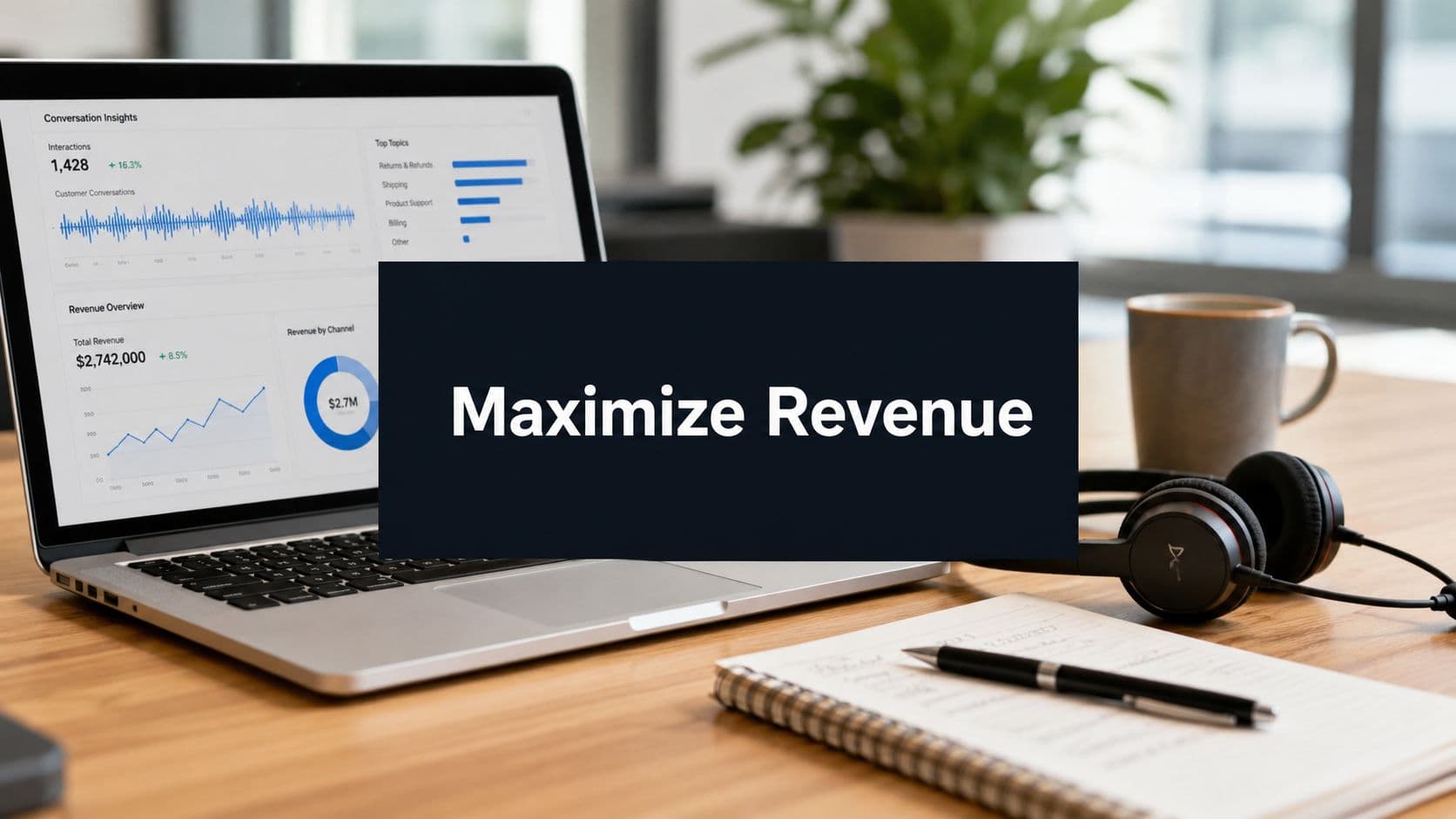
Most advice about a conversation intelligence platform starts too low in the stack. It treats the category as a better call recorder, a faster note taker, or a coaching tool for sales managers. That's useful, but it misses the bigger operational change.
A strong platform gives product, growth, support, success, and revenue teams a shared way to convert raw customer language into decisions. Without that system, companies end up prioritizing roadmaps based on the loudest customer, coaching reps from isolated anecdotes, and reacting to churn signals after the account is already gone.
Beyond Sales Coaching What Is Conversation Intelligence
A conversation intelligence platform captures customer interactions across calls, meetings, chats, and support exchanges, then turns that unstructured input into searchable, structured signals. The important word is not conversation. It's intelligence.
Teams that don't have this layer usually rely on secondhand summaries. A salesperson says enterprise buyers keep asking for a security feature. Support says the underlying problem is onboarding confusion. Product hears three scattered requests and struggles to tell whether they represent roadmap noise or a pattern tied to expansion, churn, or deal velocity.

That's why the category has moved beyond a niche sales workflow. The global Conversation Intelligence Software market is projected to grow from USD 25.3 billion in 2025 to USD 60.3 billion by 2036, at a CAGR of 8.20%, according to Future Market Insights research on conversation intelligence software. That projection matters because it reflects how companies are treating these systems as core revenue infrastructure, not optional enablement software.
What changes when you use it well
A mature team uses conversation data to answer business questions like these:
- Product prioritization: Which requests show up most often in deals with meaningful expansion potential?
- Growth diagnosis: Which onboarding objections repeat before trial drop-off or stalled adoption?
- Support risk detection: Which issue clusters are showing up across accounts before escalations reach leadership?
Practical rule: If your platform only summarizes calls and never connects recurring topics to business outcomes, you bought transcription, not intelligence.
If you want a useful baseline on the broader benefits of conversational AI, that context helps. But the operational leap happens when you connect conversation analysis to pipeline quality, product gaps, and retention signals. That's much closer to what teams mean when they talk about revenue intelligence.
How a Platform Turns Talk Into Actionable Insights
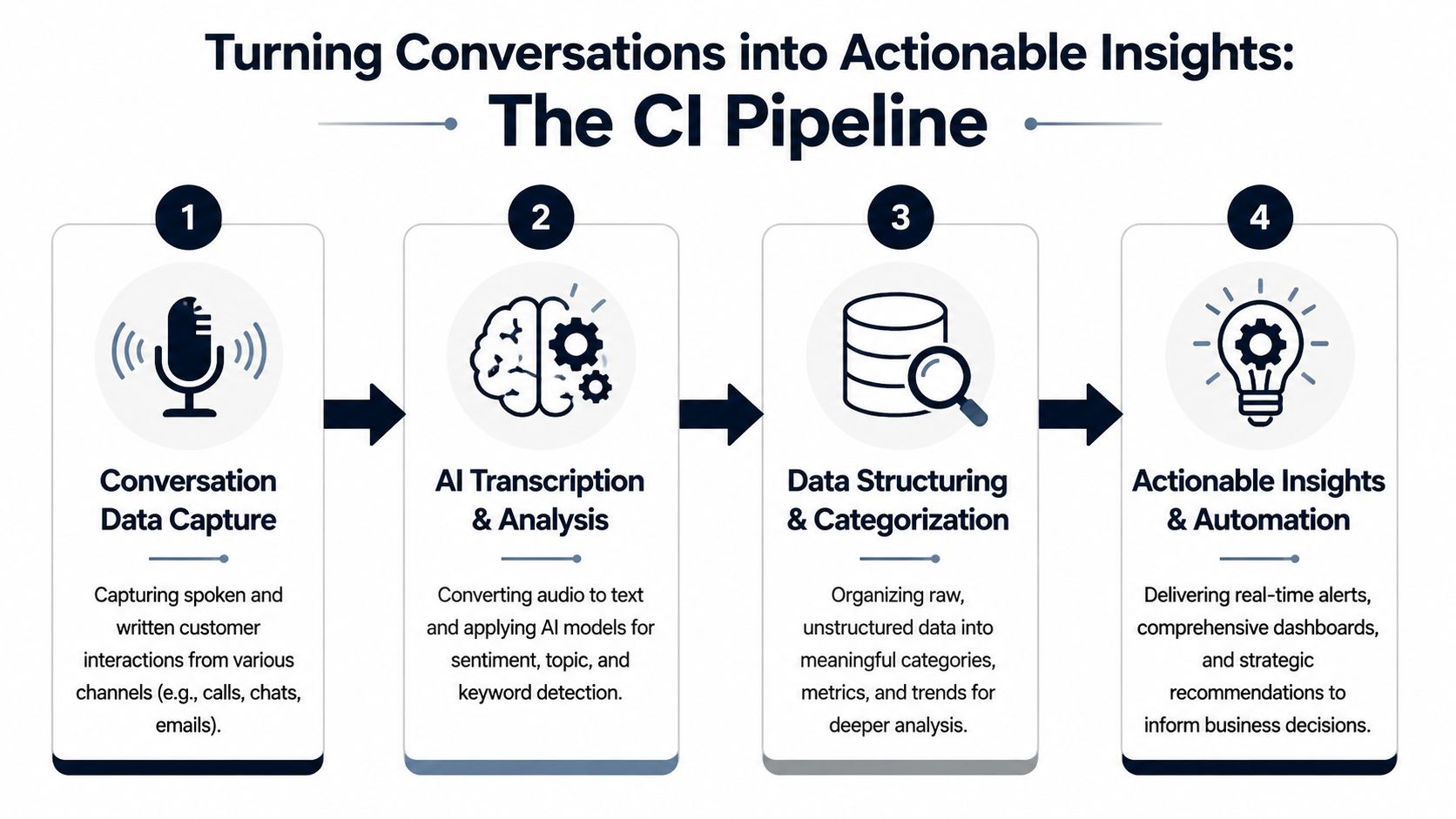
The easiest way to understand a conversation intelligence platform is to think of it as a relay team. One system listens. Another interprets. A third decides which patterns matter.
The handoff between those stages is what separates a usable platform from a noisy transcript archive.
Stage one captures what was actually said
The first job is high-fidelity speech-to-text conversion. The platform records the interaction, converts speech into text, and tags speakers so the team knows who said what. That speaker separation matters more than many buyers expect. A transcript that mixes rep language, customer objections, and stakeholder comments into one block is hard to operationalize.
According to CloudTalk's explanation of conversation intelligence software architecture, the technical flow starts with speech-to-text, then moves into NLP analysis and machine learning correlation. The same source notes that this pipeline can automate administrative work by up to 40% when it handles note-taking and CRM updates.
Stage two interprets meaning, not just words
Raw text isn't enough. The second layer uses NLP models to identify topics, sentiment, keywords, and intent signals. At this stage, the platform begins distinguishing a feature request from a pricing objection, or a mild complaint from a churn warning.
In practical terms, this layer helps teams answer questions such as:
- What topics recur most often in renewal calls versus expansion calls
- Where sentiment drops during demos, onboarding sessions, or escalations
- Which competitor mentions appear before a deal stalls
- How often pricing enters the conversation before procurement slows things down
A lot of teams get stuck here because topic tagging feels like the finish line. It isn't. It's the foundation.
For teams working on messaging design and bot flows alongside human conversation analysis, these Hyperleap AI chatbot best practices are useful because they reinforce the same discipline. Good systems don't just capture interactions. They categorize intent in a way people can act on.
Here's a simple visual walkthrough of the pipeline in action:
Stage three extracts business signals
This is the layer most vendors underplay and most operators should care about most. The platform correlates conversation metrics with downstream outcomes. That means talk-to-listen ratios, objection patterns, sentiment shifts, or repeated product mentions get mapped against closed-won, churned, renewed, expanded, or escalated accounts.
The transcript tells you what happened. The signal layer tells you whether it mattered.
That difference is what lets a product team ask, “Which request appears in high-value opportunities?” instead of “What are customers asking for in general?” It also lets growth and support teams stop treating all feedback as equal.
What works and what doesn't
What works:
- Consistent taxonomy: Teams define categories clearly. “Security concern,” “missing integration,” and “implementation friction” cannot overlap too loosely.
- Closed-loop outcomes: Conversation data gets linked back to CRM, billing, support, and product systems.
- Human review on edge cases: AI can cluster and flag patterns, but teams still need operators to validate ambiguous signals.
What doesn't work:
- Dumping every transcript into one search tool and calling it insight
- Measuring platform success by transcript volume
- Ignoring channel context, especially when support chats and sales calls use the same words differently
Core Platform Features and Key Performance Indicators
Most buyers compare features at the UI level. That's a mistake. The better way to evaluate a conversation intelligence platform is to ask what decision each feature supports and which KPI it improves.
Foundational features
These features make the system usable, but they don't create strategic advantage on their own.
- Automated transcription and summaries: Useful for recordkeeping, handoffs, and follow-up hygiene.
- Speaker identification: Necessary when you want to separate buyer language from rep talk tracks.
- Keyword and topic detection: Helpful for finding mentions of pricing, competitors, objections, or product gaps.
- Search and filtering: Essential when product, support, and revenue leaders need to inspect patterns quickly.
The KPIs here tend to be operational. Teams look at follow-up consistency, CRM completeness, handoff quality, and manager review efficiency. For a practical framework on tracking these kinds of outcomes, this guide to metrics and reporting is a solid reference.
Strategic features
These are the capabilities that push the platform beyond note-taking.
| Feature | Best use | KPI to watch |
|---|---|---|
| Competitor tracking | Identify where rival products enter the deal or renewal conversation | Frequency of competitor mentions in stalled or lost opportunities |
| Sentiment analysis | Detect shifts in confidence, frustration, or hesitation | Trend of negative sentiment across onboarding, support, or renewal conversations |
| Topic clustering | Group repeated issues across teams and channels | Volume of recurring product gaps tied to churn or expansion themes |
| Coaching recommendations | Flag weak discovery, missed objections, or inconsistent talk tracks | Conversion quality, rep consistency, and manager intervention quality |
| Revenue signal mapping | Connect talk patterns to business outcomes | Share of conversation themes linked to churn risk, expansion, or deal progression |
A practical filter
A feature matters if it helps a team make a better decision faster. If it doesn't change prioritization, forecasting, triage, or execution, it's probably dashboard decoration.
That's why vanity metrics often disappoint. “Calls analyzed” sounds impressive, but it rarely changes behavior. “Accounts with repeated implementation friction before downgrade risk review” does.
Real Use Cases for Product Growth and Support Teams
The most useful deployments don't stop at rep coaching. They give different teams a way to use the same customer language for different decisions.
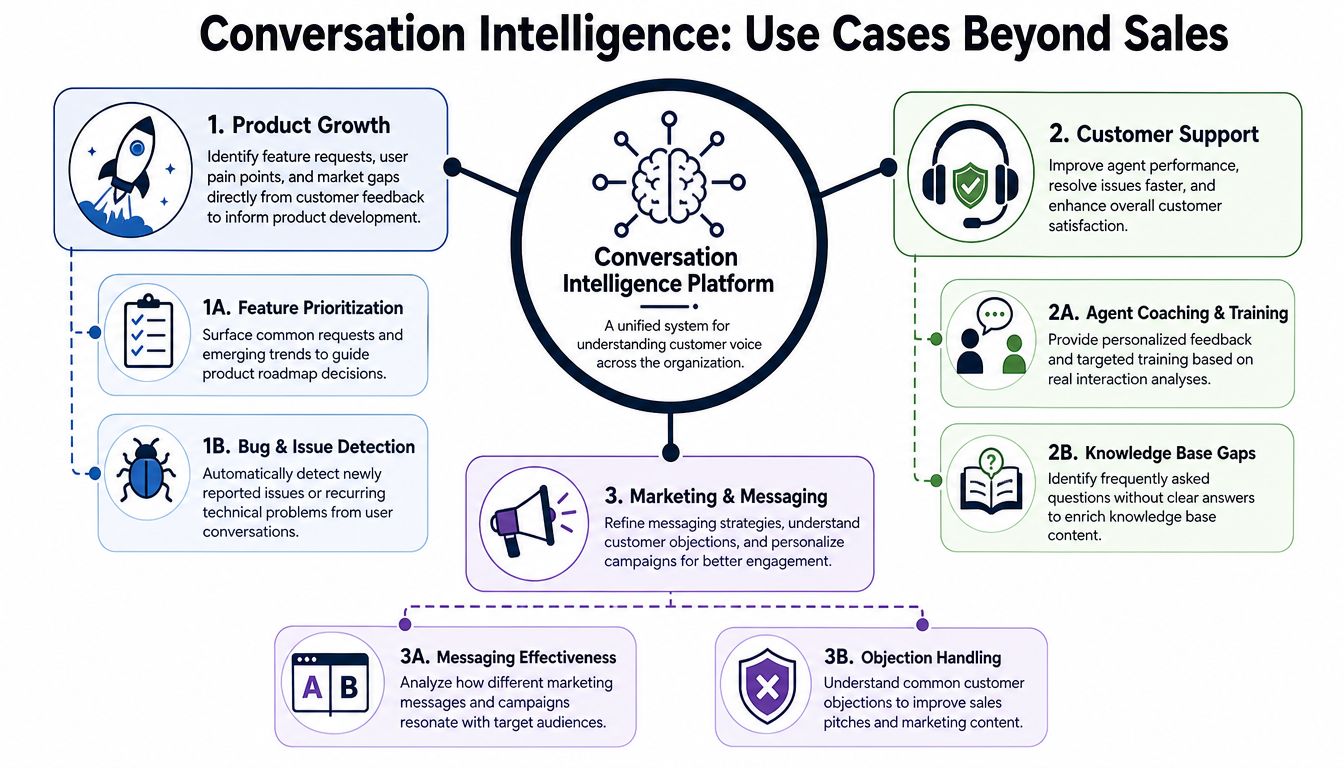
One reason this matters is that the key gap in the market isn't more call summaries. It's linking conversation data to product and growth outcomes. Gong's discussion of conversation intelligence highlights that missing link, including the need to connect conversation patterns to roadmap prioritization, churn, and large deal movement.
Product teams can validate roadmap demand
A product manager usually hears the same complaint in a fragmented way. Sales flags it as a blocker. Success calls it a renewal risk. Support tags it as a workaround issue. Without a unifying layer, each team sounds anecdotal.
A conversation intelligence platform changes that by clustering similar mentions across channels. The better implementations then compare those themes against account tier, deal stage, or renewal status. That lets product ask harder questions:
- Which feature requests appear in strategic accounts?
- Which gaps show up before churn concerns?
- Which complaints are loud but isolated?
This shifts roadmap prioritization from volume alone to revenue-weighted evidence. If your team already works through dispersed inputs, a process for analyzing customer feedback helps frame the operational side of that work.
Product teams shouldn't treat every request as equal. They should treat every request as a signal to be weighted.
Growth teams can find friction before the funnel breaks
Growth leaders often measure drop-off after the fact. Trial conversion stalls. Activation slips. Expansion motion underperforms. The dashboard shows the result but not the language behind it.
Conversation analysis fills that gap. It can reveal repeated objections like “setup seems heavy,” “I'm not sure this integrates with our stack,” or “the reporting isn't clear enough for leadership.” Those aren't just comments. They're friction points that shape adoption and expansion.
The teams that get value here usually do three things well:
- They isolate repeated objections by segment, not across the whole base.
- They compare pre-sale and post-sale language to catch expectation gaps.
- They route themes into messaging, onboarding, and lifecycle work, not just a dashboard.
Support and success teams can spot churn risk sooner
Support leaders often know a pattern is serious before leadership sees it in a weekly report. The problem is proving it quickly enough. A conversation intelligence platform helps by surfacing repeated issue clusters and sentiment changes across tickets, chats, and calls.
The operational value can be material. Industry research summarized by AssemblyAI's review of conversation intelligence software reports that more than 70% of companies using conversation intelligence reported measurable increases in customer satisfaction, and over 80% expect real-time conversation intelligence to be highly impactful between 2026 and 2028. The same source cites observed outcomes including 15% higher win rates, a 90% reduction in manual review time for compliance and coaching, and a doubling of the customer base for conversation intelligence solutions.
Those numbers matter, but the workflow matters more. Support teams get the most value when they use the platform to route emerging issues to engineering, update knowledge content, and trigger proactive outreach for at-risk accounts.
Integration and Security Considerations for Your Tech Stack
A conversation intelligence platform becomes expensive shelfware when it sits beside the stack instead of inside it. Native integration matters because teams need conversation signals to move into the systems where work already happens.
For revenue teams, that usually means Salesforce. For meetings, Zoom and Microsoft Teams are common. For service operations, the destination might be a help desk, issue tracker, or workflow layer. The point isn't to centralize transcripts in one more dashboard. It's to push useful signals into account records, escalation queues, and prioritization workflows.
Integration quality matters more than feature count
Platforms with strong integration design tend to do a few things well:
- They sync context automatically: call metadata, topics, sentiment shifts, and action items move without manual copying.
- They preserve timing: teams can trace when an objection, escalation, or bug mention first appeared.
- They support workflows: alerts and tags feed into the systems where product, success, and revenue teams already operate.
When those connections are weak, adoption drops fast. Reps won't update two systems. Support leads won't monitor a separate analytics layer all day. Product managers won't trust data that never ties back to account context.
Security isn't a procurement checkbox
Security is one of the most underestimated buying criteria in this category. Teams often focus on AI features first, then realize late in the process that conversation data contains pricing discussions, customer complaints, roadmap references, legal risk, and regulated information.
According to ZoomInfo's benchmarks on conversation intelligence platforms, top-tier systems reach 92%+ transcription accuracy, integrate natively with Salesforce, Zoom, and Microsoft Teams, and enterprise-ready platforms with SOC 2 Type II certification enforce encryption in transit and at rest while maintaining audit trails to support GDPR and CCPA requirements.
If a vendor talks a lot about AI but says very little about encryption, audit logs, and access controls, treat that as a warning sign.
What technical leaders should push on
A CTO or security lead should ask practical questions, not abstract ones:
- How is data encrypted at rest and in transit?
- What access events are logged?
- How does the platform handle deletion requests and retention policies?
- Can teams isolate data by workspace, region, or business unit?
- Which integrations are native, and which require custom middleware?
A flashy interface won't compensate for weak governance. In regulated environments, it won't survive procurement anyway.
How to Evaluate and Choose the Right Platform
The cleanest vendor demos often hide the hardest operational questions. Every platform can show a transcript, a summary, and a sentiment graph. That doesn't tell you whether it will hold up in enterprise use or help product and growth teams make better calls.
The biggest blind spot is still data handling. According to RingCentral's discussion of AI conversation expert requirements, 83% of CTOs cite non-retraining on customer data as a top-three purchase requirement, while only 12% of buyer guides explicitly address it. That gap explains why many evaluations feel incomplete. Buyers are being shown AI outcomes without getting clear answers on model isolation and privacy.
Vendor Evaluation Checklist
| Evaluation Area | Key Question to Ask | Why It Matters |
|---|---|---|
| Transcription quality | How does the platform perform with accents, overlapping speakers, and noisy calls? | Weak transcripts corrupt every downstream insight |
| Real-time capability | Which insights appear during the interaction versus after it ends? | Timing changes whether teams can intervene live or only review later |
| Cross-functional usability | Can product, growth, support, and revenue teams use the same signal layer differently? | A sales-only tool creates another silo |
| Revenue linkage | How are conversation patterns tied to churn, expansion, renewals, or deal outcomes? | Without outcome mapping, the platform stays descriptive instead of operational |
| Integration depth | Which systems connect natively, and what data syncs automatically? | Manual handoffs break trust and reduce adoption |
| Governance | What controls exist for permissions, audit logs, retention, and deletion? | Conversation data often contains sensitive business context |
| Model training policy | Do you retrain models on my customer data, and if not, how is isolation enforced? | This is a core trust question for technical buyers |
| Security posture | Which certifications, encryption practices, and compliance controls are in place? | Enterprise adoption depends on it |
| Workflow support | Can alerts and tagged themes route into CRM, support, and engineering tools? | Insight only matters if it changes execution |
| Reporting quality | Can teams inspect why a signal was surfaced, not just that it was surfaced? | Black-box scoring is hard to trust |
What usually separates good from bad fits
Bad fits tend to over-index on sales coaching and under-deliver on shared intelligence. They can tell a manager a rep talked too much, but they can't tell product which objections correlate with lost expansion or tell support which issue clusters are spreading.
Good fits make three things clear early:
- How signal extraction works
- How data is protected
- How insights move into the systems your teams already use
Ask vendors to show one workflow from raw conversation to business action. If they can only show dashboards, keep looking.
The question buyers should ask directly
Ask this in plain language: Will your models retrain on our customer data?
Don't accept vague phrasing like “we use customer interactions to improve performance” unless they explain exactly what that means operationally and contractually. If the answer is hard to pin down, trust gets harder to build later.
Your First Steps to Unlock Conversation Insights
Many teams don't need a massive rollout first. They need a narrow business question and a workable pilot.
Start by auditing where customer language already lives. Pull together sales calls, support tickets, chat transcripts, onboarding recordings, and success notes. Many companies already have the raw material. They just haven't normalized it into one decision layer.
Then choose one question with real business weight. Good examples include: which requests appear most often in strategic deals, which onboarding complaints show up before weak activation, or which support issues cluster before churn reviews. A focused question keeps the pilot from collapsing into generic transcript analysis.
Use the pilot to prove workflow value, not just model output. The test isn't whether the platform can detect topics. The test is whether a product manager, growth lead, or support leader changes a decision because the signal was clearer than what they had before.
A conversation intelligence platform earns its place when it becomes the operating layer between customer language and revenue action. That's when it stops being a sales accessory and starts functioning like core infrastructure.
If your team wants to move from scattered feedback to quantified product and revenue signals, SigOS is built for that job. It helps SaaS teams connect support tickets, chats, sales calls, and usage data to churn risk, expansion potential, and roadmap priority, while keeping a security-first approach and avoiding retraining on customer data.
Keep Reading
More insights from our blog

Ready to find your hidden revenue leaks?
Start analyzing your customer feedback and discover insights that drive revenue.
Start Free Trial →