Customer Feedback Integration: Boost Revenue in 2026
Implement a customer feedback integration strategy to connect tickets, calls, & usage data to revenue & churn. Essential for product managers in 2026.
Customer feedback is often treated like a collection problem. It isn't. It's a prioritization and revenue attribution problem.
The strongest proof is growth. Companies that use customer feedback directly in product development grow 3x faster, and SaaS companies grow 2.5x faster when they actively solicit and embed that input into their roadmaps, according to feedback culture statistics. The lesson isn't “collect more.” It's “connect feedback to decisions that affect retention, expansion, and roadmap sequencing.”
As a Head of Product, I've found that the turning point comes when feedback stops living in decks, survey summaries, and weekly triage meetings. It starts driving the same operating rhythm as pipeline reviews and churn reviews. That requires architecture, scoring, workflows, and discipline. It also requires a different question.
Don't ask, “What are customers saying?” Ask, “Which customer signals put revenue at risk, and which ones enable growth?”
From Voice of Customer to Signal From Revenue
Typical B2B survey response rates now sit in the single digits to low teens, which is why product teams that still anchor on surveys miss the signals that predict renewals and expansion, as SurveyMonkey notes in its guidance on survey response rates. The useful evidence is already spread across support tickets, call transcripts, CRM notes, and product usage. The job is to connect those inputs to account economics.
Why volume misleads product teams
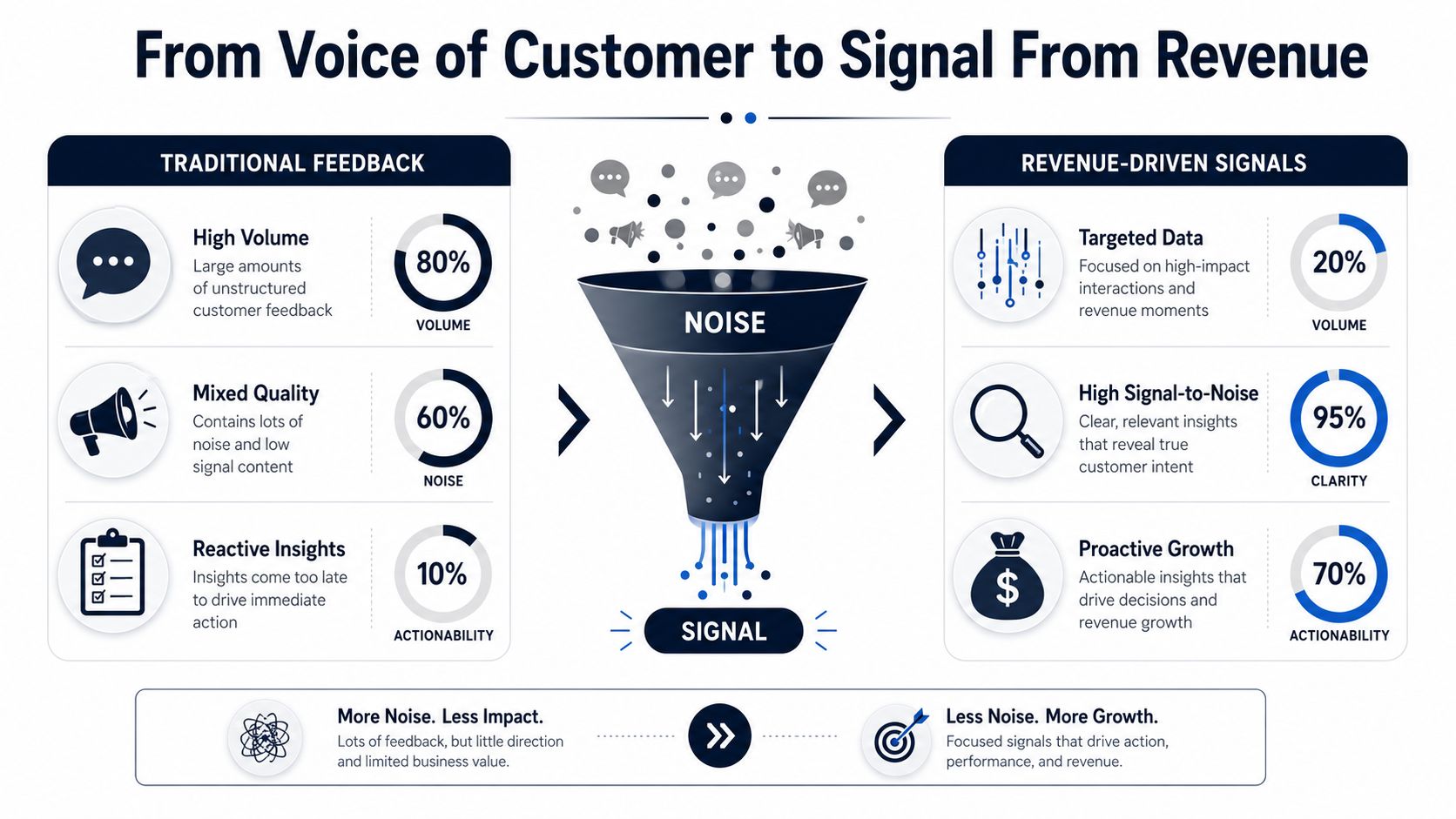
In practice, a feedback queue blends three very different signals. Some comments are loud but low value. Some describe recurring friction that pushes teams toward downgrade or churn. Others reveal the conditions required for broader rollout, seat expansion, or an upsell.
The expensive mistake is treating all three the same.
At my company, we stopped asking which requests appeared most often and started asking which patterns showed up inside at-risk accounts, stalled deals, and high-potential expansions. That shift changed roadmap debates immediately. A complaint mentioned five times by small accounts stopped outranking a workflow blocker mentioned twice by enterprise customers with six-figure renewals attached.
That is the difference between voice of customer and signal from revenue.
What a revenue lens changes
A useful feedback system does more than collect comments. It links each item to an account, a segment, a stage in the customer lifecycle, and a financial outcome you can inspect later. Without that chain, teams can claim they heard customers without proving what changed in retention, expansion, or support cost.
Practical rule: If a feedback item cannot be tied to an owner, a decision, and an account-level outcome, it is not product intelligence yet.
Here is how the operating model changes:
| Old habit | Better operating model |
|---|---|
| Count requests | Measure affected ARR, renewal exposure, or expansion potential |
| Review feedback in batches | Monitor patterns continuously |
| Prioritize by loudest theme | Prioritize by financial risk and commercial upside |
| Close tickets | Verify whether the product change reduced churn risk or increased adoption |
Teams often start evaluating systems designed for unlocking growth with CI platforms, because storage is not the hard part. Correlating support language, feature usage, contract value, and pipeline movement is the hard part.
A practical starting point is to treat every source as partial evidence. Support tickets show where workflows fail. Sales calls show what blocks a new team, region, or use case from buying. Usage data shows whether the issue is isolated, segment-specific, or broad enough to affect net revenue retention. Combined, those inputs produce a far more reliable operating signal than sentiment scores alone. If your team needs a framework for the mechanics, analyze customer feedback systematically before layering on automation.
Architecting Your Unified Feedback Pipeline
The architecture matters more than is often realized. If ingestion is weak, everything downstream becomes manual, delayed, and political.
The biggest structural problem is fragmentation. 60% of feedback is lost in fragmented silos like Intercom, Zendesk, and GitHub because teams lack automated integrations that create issues with revenue scores instantly, according to this roadmap feedback research. That number feels believable to anyone who has watched support, product, and success teams argue over whose spreadsheet is current.
The pipeline we actually need
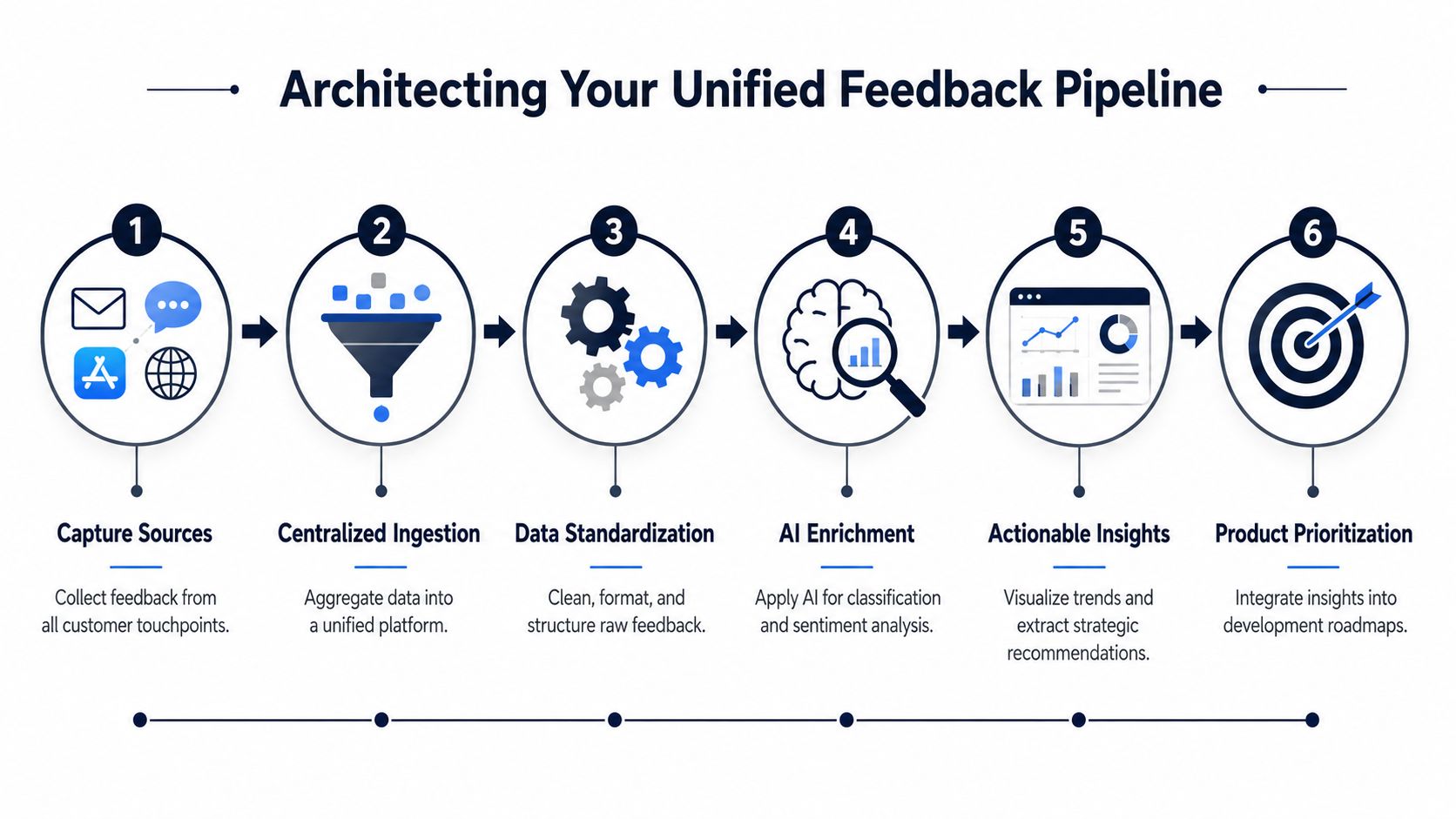
A useful feedback pipeline has five layers.
- Source connectorsPull data from Zendesk, Intercom, Gong, HubSpot, Salesforce, app store reviews, CRM notes, and product telemetry. The point isn't to centralize every field. It's to capture enough structured and unstructured context to interpret the feedback later.
- Ingestion layerUse APIs and webhooks to bring events into one stream. This layer should timestamp everything, assign a source, preserve the raw text, and maintain an account or user identifier wherever possible.
- Normalization layer Standardize fields. “Customer,” “account,” and “company” should resolve into one entity model. Ticket priority scales, plan names, and owner fields also need mapping. At this point, many projects often go awry.
- Enrichment layerJoin raw feedback with account metadata such as contract status, segment, product area, owner, open opportunities, and recent usage trends.
- Activation layerPush enriched outputs into the systems where teams work, such as Jira, Linear, Slack, CRM tasks, and planning dashboards.
What breaks in real implementations
The failure modes are rarely exotic. They're operational.
- Missing identifiers: Support data and product telemetry can't be joined reliably.
- Loose taxonomy: Every team tags the same issue differently.
- No replay path: If an integration fails, events disappear instead of reprocessing.
- No monitoring: Pipelines drift unnoticed until someone notices a dashboard looks wrong.
That's why it helps to borrow patterns from teams already evaluating pipeline monitoring software. Feedback data isn't special from a reliability standpoint. It still needs observability, field validation, alerting, and ownership.
A good reference point for this design work is a set of data architecture diagrams that force you to define systems, flows, and dependencies before building connectors ad hoc.
Later in the implementation, I like to show teams this walkthrough because it makes the ingestion-to-action chain easier to visualize:
The fastest way to lose trust in a feedback program is to centralize data without centralizing accountability.
A simple ownership model
Keep ownership brutally clear.
- Product operations owns taxonomy, routing logic, and dashboard definitions.
- Data engineering owns connector reliability, schema controls, and monitoring.
- Support and success leadership own source quality and escalation standards.
- Product managers own decisions taken from the signal, not the pipeline itself.
That split prevents a common failure mode where “customer feedback integration” becomes everybody's side project and nobody's system.
Enriching Raw Data into Actionable Intelligence
Raw feedback is cheap to collect and expensive to interpret. The interpretation cost is what AI has changed.
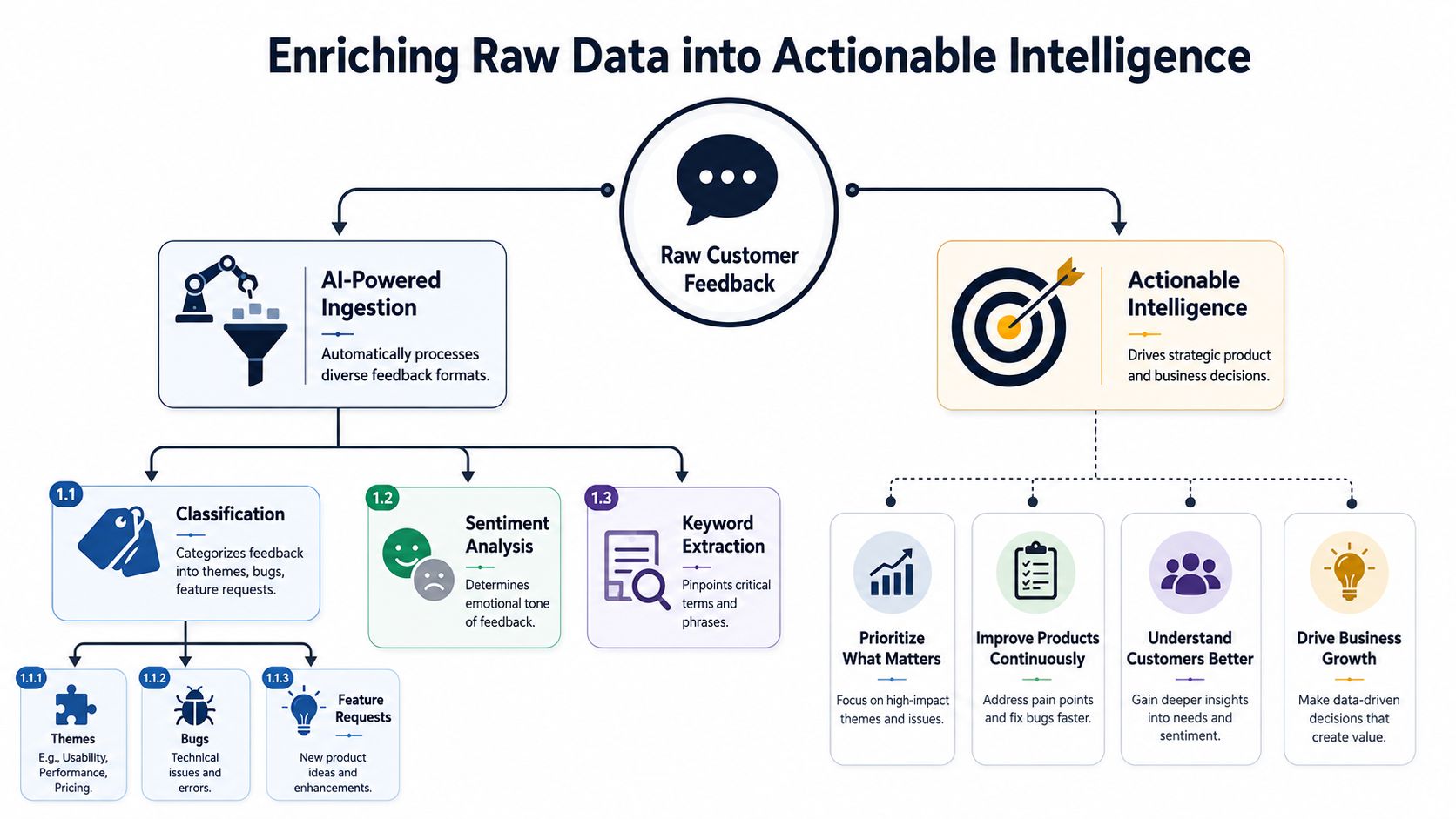
AI-driven sentiment classification now reaches 87–92% accuracy and can reduce feedback processing time by up to 70%, according to AI customer feedback analysis statistics. That matters, but only as a first layer. Sentiment alone won't tell you whether a complaint came from a free user who churned already or a strategic account heading into renewal.
Classification is table stakes
A modern enrichment flow should classify incoming feedback into categories such as:
- Bug reports
- Feature requests
- Usability friction
- Pricing or packaging friction
- Service complaints
- Competitive pressure
That initial pass helps with routing, but it shouldn't decide priority. A low-sentiment ticket about a confusing setting may matter less than a calm message from an enterprise admin saying a workflow blocks rollout to additional teams.
The joins that create business meaning
Value comes from attaching business context to each item. For every feedback record, I want the system to answer questions like these:
| Enrichment field | Why it matters |
|---|---|
| Account segment | Enterprise friction and SMB friction shouldn't enter the same queue |
| Contract stage | Renewal timing changes urgency |
| Product usage pattern | Active usage tells you whether this issue affects a core workflow |
| Open opportunity context | Some requests are expansion blockers, not retention risks |
| Ownership | Routing fails when nobody can act on the signal |
Once that context exists, a ticket stops being “customer is unhappy with exports” and becomes “account owner has an active expansion conversation, the admin is blocked in a core workflow, and multiple similar accounts reported the same friction.”
Raw text becomes useful when you can answer who is affected, what workflow is breaking, and what commercial event is nearby.
Where human review still matters
AI improves throughput. It doesn't remove judgment.
Use automation for first-pass classification, deduplication, and clustering. Keep people involved in three places:
- Taxonomy review: Product teams need to refine categories as the product changes.
- High-impact exceptions: Strategic accounts deserve human validation before escalation.
- Root cause separation: Several complaints may look similar but stem from different product defects or onboarding gaps.
For teams building this layer, a strong grounding in qualitative data analysis methods helps avoid the trap of treating text classification as understanding.
A practical enrichment standard
I recommend one rule above all others. Never let a feedback item travel alone.
Every item that enters your system should carry:
- source context
- cleaned text
- account or user mapping
- product area
- commercial context
- status history
If one of those is missing, the signal gets weaker and the resulting prioritization gets easier to dispute.
The Revenue-Driven Prioritization Playbook
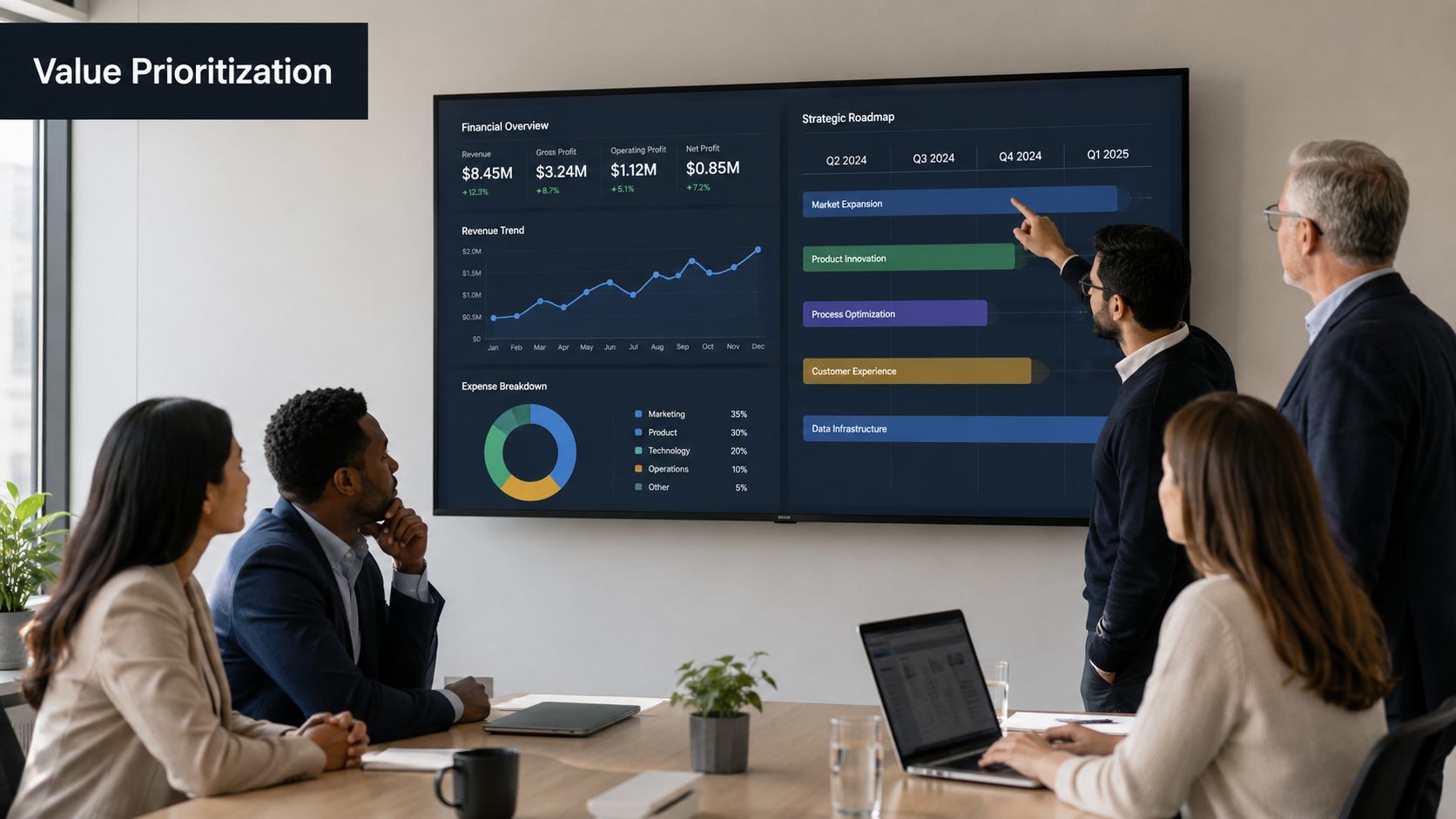
Most product teams say they prioritize based on impact. In reality, they often prioritize based on visibility, pressure, or how easy it is to explain the request in a planning meeting.
That gap is bigger than many leaders admit. 87% of product leaders say they struggle to prioritize feedback based on business value, and less than 15% of standard guides explain how to connect support tickets or chat transcripts to revenue loss metrics like churn probability or deal size, according to this analysis of customer feedback as a growth lever.
Why frequency fails
The “most requested” model sounds fair. It usually isn't.
Ten requests from low-usage accounts can outrank one blocker affecting a strategic renewal. A highly vocal customer can distort the roadmap. Support teams can over-escalate issues that generate ticket load but have limited commercial effect. Frequency is useful as one input, but it's a weak final decision rule.
I prefer a Revenue Impact Score that forces product, success, and finance to work from the same logic.
The score we use in practice
I don't recommend pretending the score is mathematically perfect. I do recommend making it explicit.
A useful model combines signals such as:
- Account valueHigher-value accounts deserve more attention, but not automatically. Value matters when paired with actual product dependency and credible risk.
- Churn or contraction riskIf the feedback appears alongside declining engagement, escalations, or renewal friction, its urgency changes.
- Pattern breadth among valuable accountsA bug affecting several strategically important accounts outranks an isolated complaint, even if the absolute volume is lower than a consumer-facing annoyance.
- Expansion dependencySome requests don't save existing revenue. They unblock wider rollout, larger seats, or movement into a new team or use case.
- Time sensitivityRenewal windows, executive reviews, and active procurement cycles should influence sequencing.
- ConfidenceNot every revenue story is equally reliable. If the signal comes from one ambiguous conversation, score it lower than a pattern confirmed across tickets, calls, and behavior.
A simple decision matrix
Here's the framing I use with leadership:
| Scenario | Product action |
|---|---|
| High revenue risk, high confidence | Pull forward immediately |
| High revenue opportunity, medium confidence | Validate quickly, then decide |
| High volume, low commercial impact | Batch or defer |
| Low volume, strategic account blocker | Escalate for direct review |
This changes the roadmap conversation. Instead of asking, “How many customers asked for this?” the room asks, “What revenue event is attached to this issue, and how confident are we?”
Operator's note: The goal isn't to turn product management into finance. The goal is to stop separating roadmap choices from commercial consequences.
What works and what doesn't
What works:
- Tie every major roadmap item to a retention, expansion, or activation hypothesis
- Review scored feedback with product, success, and sales in the same meeting
- Separate strategic exceptions from broad roadmap investments
- Store evidence with the score so anyone can audit the reasoning
What doesn't:
- Letting sentiment drive priority by itself
- Treating all ARR the same without checking product dependency
- Using static quarterly lists that ignore new risk signals
- Confusing executive anecdotes with validated patterns
This is also the one place where tooling can materially change the speed of decision-making. Platforms such as SigOS can ingest support tickets, chat transcripts, sales calls, and usage data, then surface issues with revenue impact scores inside existing product workflows. That's useful when your internal team doesn't want to build custom enrichment and scoring logic from scratch.
The meeting cadence that keeps this honest
The operating rhythm matters almost as much as the score.
Run two different forums:
- Weekly signal reviewReview newly surfaced high-risk or high-opportunity items. Keep it tactical.
- Monthly roadmap value reviewRe-rank major themes based on updated evidence. Invite product, customer success, and revenue leadership.
That cadence prevents two bad outcomes. Product doesn't overreact to every fresh complaint, and revenue teams don't wait a quarter to raise meaningful blockers.
Activating Intelligence with Workflows and Alerts
A dashboard is not an operating system. Teams need the signal to appear where they already work.
That means customer feedback integration has to trigger action automatically. When a pattern reaches a threshold your team cares about, the system should create a Jira or Linear issue, notify the owner in Slack, and attach the evidence package needed to make a decision. If someone has to copy and paste context from one system into another, the loop is still broken.
Build workflows around moments, not reports
The most useful automations are event-based.
- Renewal risk alertWhen a customer with an upcoming renewal reports friction in a core workflow and similar signals cluster around the same feature area, notify the account owner and product manager together.
- Expansion blocker escalationWhen sales call notes and product feedback point to the same missing capability, route it into the roadmap review queue with the related account context.
- Bug amplification triggerWhen multiple accounts hit the same failure pattern across support and telemetry, create an engineering issue with supporting evidence already attached.
The issue payload should include:
- the underlying feedback excerpts
- affected product area
- account list
- owner
- current status
- the commercial explanation for why this matters now
Keep routing rules narrow at first
Many teams over-automate too early. They create broad triggers, flood Slack channels, and train everyone to ignore alerts.
Start with a few high-trust workflows. Enterprise renewal risk is usually a good first candidate because the stakeholders, timing, and value are clear. Expansion blockers are another strong candidate because sales and product both feel the urgency. General product complaints are a poor place to start because the noise floor is too high.
The quality of your alerting determines whether people see the system as intelligence or spam.
Security and privacy have to be designed in
This data is sensitive. Support tickets, call transcripts, and CRM notes often contain commercial, operational, and personal information.
A practical baseline includes:
- Access controls by role so support, product, and executives see what they need and no more
- Encryption in transit and at rest across ingestion, storage, and activation layers
- Redaction or anonymization for fields that don't need to be exposed downstream
- Retention policies that prevent qualitative data from living forever without purpose
- Audit logs so you can trace who accessed what and when
The simplest rule is this: don't distribute raw customer detail more widely than necessary just because the workflow makes it easy. Route context with intent.
What good activation looks like
When this is working, product managers don't chase updates across Slack, Zendesk, Salesforce, and planning docs. They receive a routed issue with context attached. Customer success doesn't need to lobby for attention because the evidence already includes account stakes. Engineering gets a cleaner problem statement and fewer vague escalations.
That's when feedback stops being commentary and starts becoming operational input.
Closing the Loop to Measure and Prove ROI
If you can't prove the business effect of this system, it will eventually get treated like tooling overhead.
The strongest measurement model tracks the full chain: signal detected, action taken, product response, customer outcome, and business result. A closed-loop program should show not just that feedback was collected, but that it changed prioritization and produced a measurable commercial outcome.
The dashboard leadership actually needs
I don't recommend building an executive dashboard around activity metrics alone. Counts of tickets tagged or themes detected are operational metrics, not value metrics.
A better dashboard answers questions like:
| Question | Evidence to show |
|---|---|
| What revenue risks were surfaced early? | List of high-impact issues identified before renewal or escalation |
| What roadmap decisions changed because of feedback? | Prioritization changes with linked evidence |
| Which fixes or launches resolved repeat complaints? | Before-and-after issue trend by theme |
| Where is expansion demand becoming clearer? | Clustered requests tied to account conversations and adoption patterns |
This is also where a “you said, we did” discipline matters. Teams should record what was heard, what decision was made, what shipped or changed, and what happened afterward. Without that record, feedback programs look busy but not accountable.
Measure outcomes at three levels
I've had the best results when ROI is reviewed in layers.
- Operational efficiencyDid the team reduce manual review, speed up routing, and improve issue clarity?
- Product decision qualityDid roadmap choices become more consistent and easier to justify across product, finance, and go-to-market teams?
- Business effectDid the team reduce feature-related churn risk, unblock expansion conversations, or resolve commercially important defects faster?
Not every outcome will tie cleanly to one feature or one ticket cluster. That's normal. The job is not to create false precision. The job is to show credible linkage between the signal, the decision, and the business result.
A feedback program earns budget when leadership can trace product choices back to retained or expanded revenue.
The proof pattern that wins support
The most convincing report is usually a short narrative backed by evidence:
- a recurring problem was detected across important accounts
- the issue was scored and prioritized
- the team shipped a fix or workflow change
- customer-facing teams closed the loop
- the affected accounts stabilized, expanded, or re-engaged
That pattern is easier for executives to trust than a pile of charts with no operating story behind them.
The broader point is simple. Customer feedback integration should not sit under “voice of customer” as a soft initiative. It belongs inside the company's decision system. When the pipeline is unified, the enrichment is credible, the prioritization model is revenue-aware, and the activation workflows are tight, feedback becomes one of the cleanest inputs product teams have.
If your team wants to move from manual tagging and anecdotal prioritization to a system that connects feedback with churn risk, expansion signals, and product decisions, SigOS is built for that workflow. It ingests support, sales, and behavioral inputs into one product intelligence layer so teams can route, score, and act on feedback with clearer commercial context.
Keep Reading
More insights from our blog

Ready to find your hidden revenue leaks?
Start analyzing your customer feedback and discover insights that drive revenue.
Start Free Trial →