SaaS Customer Retention Programs: Boost Revenue 2026
Build effective SaaS customer retention programs. Our 2026 playbook covers KPIs, segmentation & product intelligence to reduce churn & boost revenue.
Customer retention programs deserve a bigger budget than they usually get. The reason is simple. Keeping customers is far cheaper than replacing them, with acquisition costs averaging 5 times higher than retention costs, and even a 5% increase in retention can lift profits by 25% to 95% according to Flowlu's customer retention statistics roundup.
In B2B SaaS, that changes how you should think about retention. It isn't a support initiative. It isn't a loyalty email calendar. It isn't a last-minute save motion before renewal. It's a revenue system that starts in the product, gets operationalized by growth and customer success, and gets validated with disciplined measurement.
Many organizations still run retention as a communications problem. They send more reminders, launch a webinar, add a renewal sequence, and hope usage recovers. Sometimes it does. Often, the customer was either fine already or frustrated for a product reason no email could fix.
The stronger approach is to treat customer retention programs as a product function. Support tickets, onboarding friction, bug patterns, stalled integrations, and feature request clusters tell you where retention is won or lost long before a cancellation form does. When product, growth, and customer success use those signals together, retention stops being reactive.
Laying the Foundation for Retention Success
Customer retention work gets funded faster when it is tied to revenue mechanics, not brand language. Bain & Company found that increasing customer retention rates by 5% can increase profits by 25% to 95%, and that principle matters even more in SaaS where recurring revenue compounds over time, as reported in Bain's research on retention and profitability.
That changes how the foundation should be built.
If the operating model starts with “loyalty” or “customer experience,” teams usually default to campaigns, reminders, and save tactics. If it starts with retained ARR, expansion capacity, and the product behaviors that predict both, decisions get sharper. Product, growth, support, and customer success can then work from the same objective instead of running separate programs with separate definitions of success.
The trade-off is real. Revenue goals create discipline, but they can also push teams toward short-term saves that never fix the product issue behind churn. The better approach is to treat retention as a product function with commercial accountability. Qualitative feedback is part of that foundation, not a side channel. Ticket themes, onboarding friction, stalled integrations, and repeated feature complaints often explain churn risk earlier than usage volume alone. Teams that already analyze churn signals with a structured feedback model usually make better roadmap decisions because they can separate random complaints from recurring blockers tied to revenue loss.
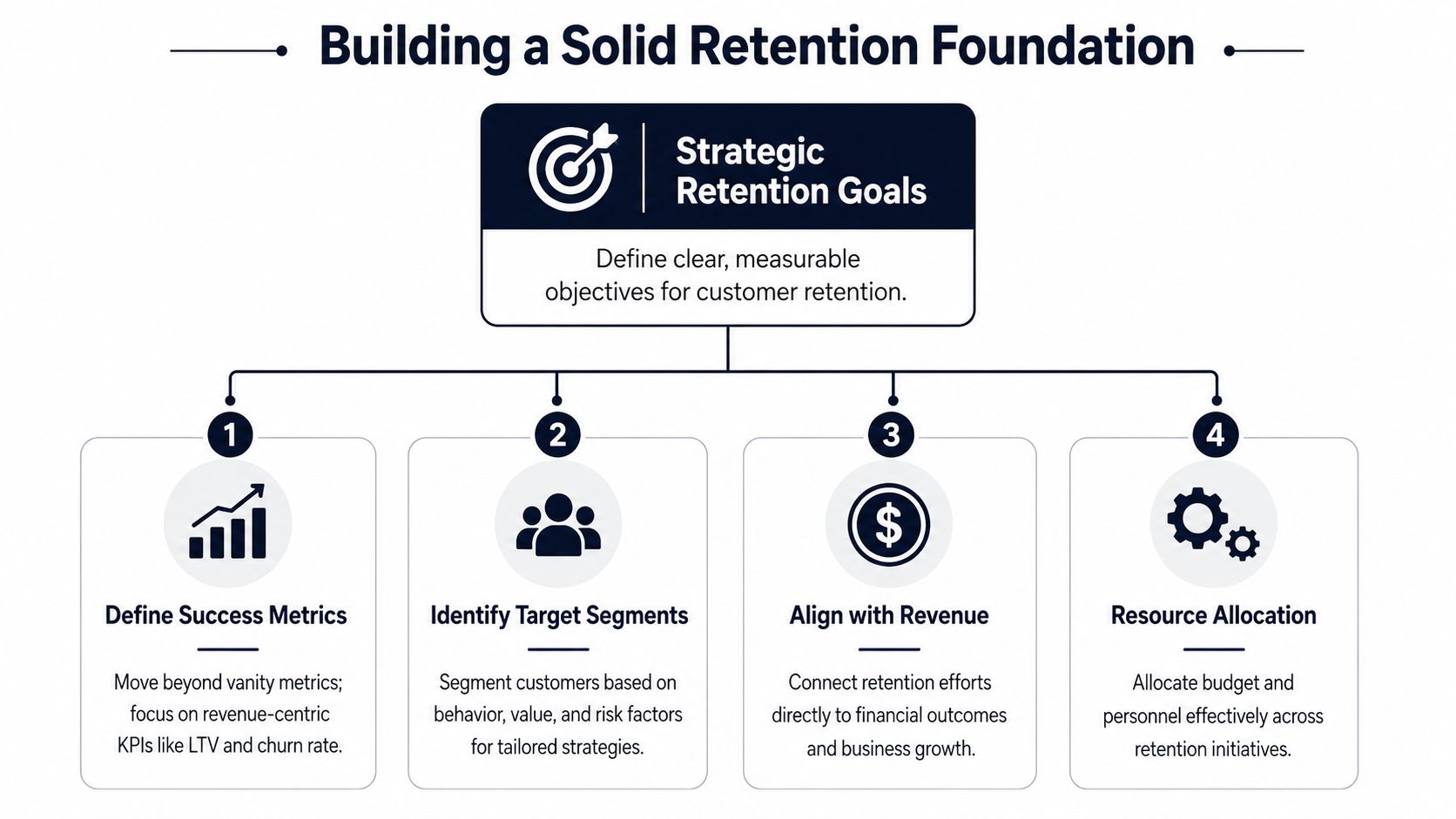
Set goals that finance will care about
A retention goal should answer a simple question. What changes in the P&L if this works?
Good goals tie directly to lower logo churn, lower revenue churn, stronger gross retention, higher expansion from retained accounts, faster time-to-value, or less involuntary churn from billing failures. Weak goals measure activity. More emails sent, more QBRs booked, and more surveys collected can support retention, but none of them proves retained revenue.
Practical rule: If the CFO cannot trace the metric to retained or expanded ARR, it is an operating metric, not a retention KPI.
A useful scorecard stays short:
- Net Revenue Retention shows whether the customer base is expanding after churn and contraction.
- Gross Revenue Retention shows how well the business holds revenue before expansion masks underlying loss.
- Logo churn and revenue churn should be tracked separately because small-account loss and large-account contraction create different operating problems.
- Time-to-value shows whether new customers are reaching the milestone that justifies renewal.
- Health scores only matter if they reflect progress toward customer outcomes, product adoption depth, and friction patterns from support or feedback.
Build one operating model across teams
Retention programs fail at the handoffs.
Customer success may call an account healthy because no one is complaining. Product may see repeated setup errors in the same account. Support may see a cluster of tickets tied to one broken workflow. Growth may keep sending adoption emails because the contact still opens messages. Each team is acting on partial truth, and the customer experiences that fragmentation.
A workable operating model gives each function a clear lane and a shared view of risk:
| Team | What they should own |
|---|---|
| Product | Activation milestones, friction removal, roadmap response to recurring blockers, adoption paths tied to stickiness |
| Customer Success | Account context, renewal strategy, stakeholder mapping, intervention plans for high-value accounts |
| Support | Ticket tagging quality, issue severity, escalation patterns, root-cause visibility for recurring problems |
| Growth or Lifecycle | In-app prompts, lifecycle messaging, reactivation plays, experiment design for scalable interventions |
The missing piece in many SaaS companies is product accountability. If recurring friction never makes it into prioritization, retention stays stuck in rescue mode. Tools that aggregate qualitative signals, including platforms like SigOS, help teams connect what customers say, where they stall, and which product issues correlate with churn or stalled expansion.
Avoid the setup mistakes that drain budget
The first mistake is building dashboards around easy signals instead of durable ones. Email opens, webinar attendance, and NPS response rates can be useful context. They are weak foundations for retention if they are disconnected from activation, usage depth, support friction, and renewal outcomes.
The second mistake is splitting ownership by channel instead of by customer problem. A product defect should not become a lifecycle email problem because marketing can act faster than engineering.
The third mistake is overbuilding before the team has signal quality. Start with a small set of triggers you trust, validate them against churn or contraction, then add complexity. A simple model with credible inputs beats a detailed model built on noise.
The fourth mistake is leaving executives out of the operating cadence. If leadership still treats churn as a customer success metric, product work that would reduce churn never gets the same priority as net-new features.
Strong retention foundations are usually quiet. Shared definitions, finance-linked goals, clear ownership, and a steady flow of qualitative feedback into product decisions do not look flashy. They do create the conditions for lower churn, stronger renewals, and a product that gets stickier with each feedback cycle.
Identifying At-Risk Customers with Predictive Signals
The biggest mistake in retention is trying to save everyone who looks inactive.
That sounds counterintuitive until you look closely at behavior. Some customers use a product less because they've already achieved their goal. Others use it less because they're blocked, confused, or disappointed. Those are not the same customer, yet many teams route both into the same “re-engagement” play.
That blind spot is costly. 34% of at-risk interventions target customers who are done with the product, not customers needing rescue, according to Outreach's analysis of retention strategy blind spots.
Start with static segmentation, then move fast
Static segmentation still matters. Firmographics, contract size, plan tier, use case, admin count, and industry give useful context. They help you decide where human intervention belongs and where automation is enough.
But static fields don't predict churn well on their own. They tell you who the customer is, not whether the account is drifting.
A stronger signal model layers behavior on top:
- Activation progressHas the customer completed the milestones that prove initial value?
- Feature depthAre they using only one narrow workflow, or have they adopted the features tied to stickiness?
- Support frictionAre tickets random and routine, or do they cluster around one broken journey?
- Integration healthHas a key integration degraded, failed, or stopped syncing?
- Champion behaviorIs the main user still active, or has ownership gone quiet?
Distinguish healthy low usage from risky low usage
Most health scores break because they overweight logins and underweight outcomes.
A finance team might use a product intensely during implementation, then less frequently once reporting is automated. Usage declines, but the customer is successful. A product team dealing with broken workflows may still log in every day while trying to make the product work. Usage looks fine, but churn risk is climbing.
Healthy low usage follows value achievement. Risky low usage follows friction.
That means your scoring model should include milestone completion, failed actions, support volume by issue type, and signs of blocked workflows. If a customer stopped logging in because the product did its job, leave them alone. If they stopped because a key feature keeps erroring, intervene fast.
A useful primer on this kind of signal design is predicting customer churn from behavioral patterns.
Build a health score your teams can act on
Health scores don't need to be mathematically impressive. They need to be operational.
Use a model your CSM, product manager, and lifecycle owner can all understand. “High risk because admin activity dropped after repeated setup failures and support escalation” is actionable. “Health score fell from 72 to 61” is not, unless everyone knows why.
A practical score usually combines:
- Value realization indicators such as onboarding milestones and core workflow completion
- Negative signals like repeated errors, ticket recurrence, and stalled setup
- Relationship signals including stakeholder responsiveness and champion stability
- Commercial context such as contract timing, expansion potential, and account importance
Watch for pattern clusters, not isolated events
One support ticket rarely predicts churn. A cluster does.
Three tickets from the same account about one broken integration matter more than ten unrelated questions. A sudden drop in activity from one casual user isn't urgent. A drop from the admin who drove implementation is. The goal isn't to build a perfect churn model. It's to identify the patterns that deserve intervention before the customer makes a renewal decision.
Designing Proactive Retention Workflows and Plays
The best retention workflows feel like service, not surveillance.
If an account hits friction and immediately receives a generic “We miss you” email, you've told the customer two things. First, you noticed a change. Second, you don't understand it. That's why strong customer retention programs map plays to the underlying risk, not just the symptom.
Here's the shape of a practical workflow system.
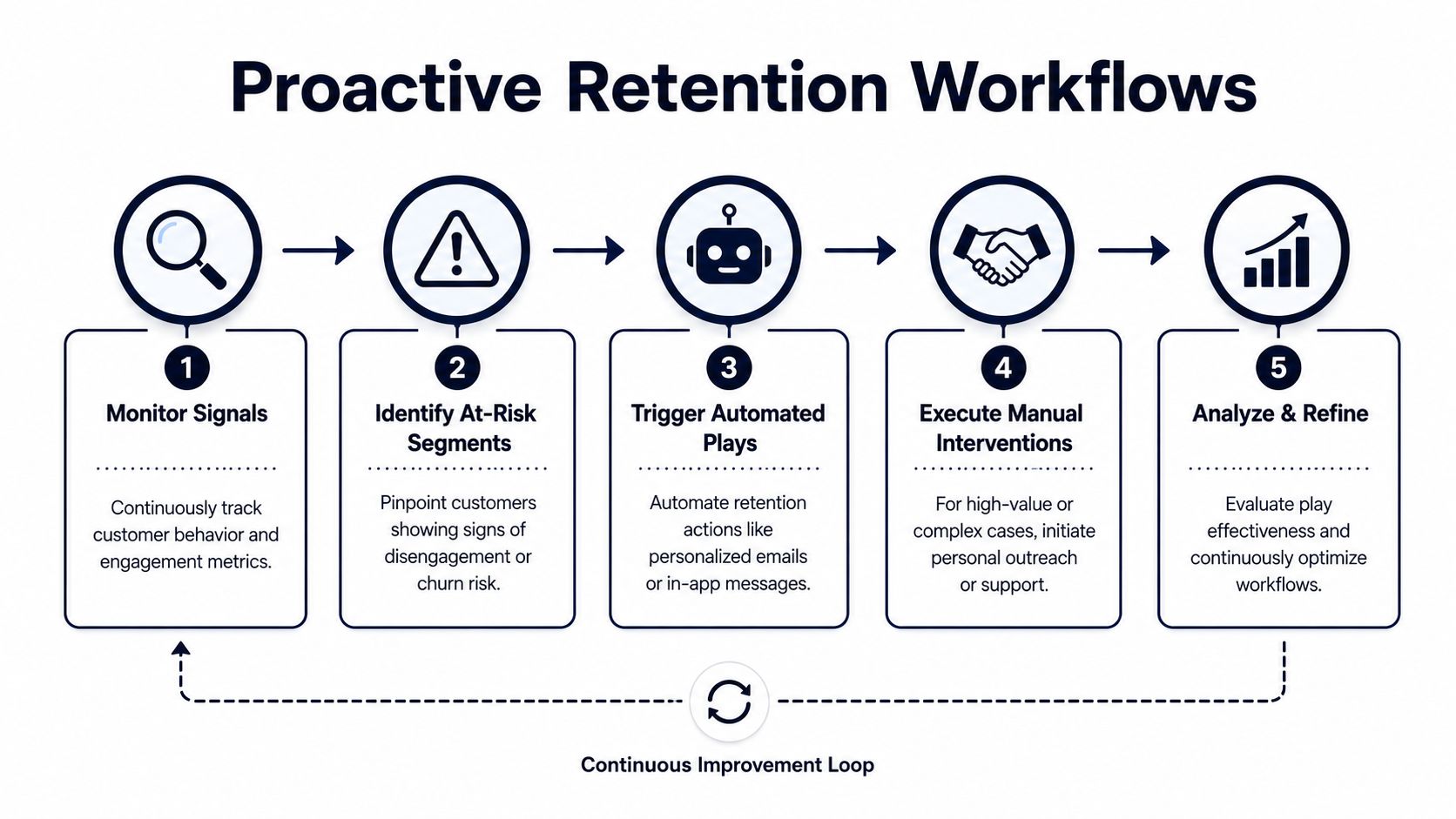
Consider this section a useful visual companion:
A stalled onboarding play
Take a common SaaS scenario. A mid-market account signs, completes kickoff, invites users, then stalls before integrating the product into production workflow. The account hasn't churned. But it's entering a zone where time-to-value slips, internal momentum fades, and executive sponsors stop paying attention.
A weak response is a generic onboarding reminder.
A stronger play is sequenced:
- First trigger comes from a missed activation milestone, not merely fewer logins.
- Automated response sends a concise message focused on the blocked step, with a relevant help asset or setup checklist.
- In-app guidance appears only when the user returns to the product and reaches the stalled area.
- CSM task creation happens if the account is high-value, the stall persists, or support interactions suggest deeper implementation friction.
- Product escalation starts when multiple accounts hit the same blocker.
This structure matters because it keeps automation in the lane where automation works, while reserving human effort for accounts and issues that warrant it.
Match the play to the risk type
Not all churn is behavioral churn. Some of it is operational. Some of it is commercial. Some of it is product-led frustration that only looks like disengagement from the outside.
A mature playbook usually includes different workflows for different triggers:
| Trigger | Best first move | When to escalate |
|---|---|---|
| Failed payment | Automated billing retry and payment update prompt | Escalate when account value is high or failure persists |
| Usage drop after activation | In-app nudge tied to core value workflow | Escalate if key stakeholders also disengage |
| Repeated support issues | Targeted resolution update and workaround guidance | Escalate when issue repeats across the same workflow |
| Onboarding stall | Step-specific email plus CSM checkpoint | Escalate if implementation owner goes dark |
| Renewal risk from low product adoption | Executive review, success plan, adoption workshop | Escalate to product if friction themes repeat across accounts |
Benchmark data supports this segmentation-first approach. Companies using advanced lifecycle segmentation and automation achieve 20% to 30% lower churn, and proactive recovery of payment failures reduces involuntary churn by 25% to 40%, according to Marketing LTB's retention benchmark summary.
A deeper operating model for these workflows is covered in this guide to reducing churn rate.
The workflow should answer the customer's likely problem before the customer asks the renewal question.
Write interventions that sound informed
The copy matters more than is commonly appreciated.
Good retention messaging names the context, offers one clear next step, and avoids fake urgency. Bad messaging sounds like marketing automation trying to impersonate account management.
Use language like:
- Specific context such as a setup step, integration issue, or workflow milestone
- One recommendation rather than three competing asks
- A real owner when escalation is human-led
- A time-sensitive reason only when one exists, such as billing interruption or renewal planning
The play should never feel like punishment for reduced activity. It should feel like competent assistance delivered at the right time.
Closing the Feedback-to-Product Loop
Most retention programs stop at outreach. That's too late in the cycle and too narrow in scope.
If the same bug, missing workflow, or confusing setup path keeps appearing across support tickets, call transcripts, and user behavior, the retention answer isn't another save campaign. It's a product decision, marking a shift in retention from lifecycle marketing into product operating cadence.
The gap is real. 87% of product leaders struggle to prioritize feedback based on revenue impact, and most frameworks still don't show teams how to connect support tickets and usage signals to churn probability before customers explicitly say they're unhappy, according to this analysis on feedback prioritization and retention.
Feedback becomes useful when it's connected
A single feature request rarely deserves roadmap priority by itself. A single complaint about onboarding copy probably doesn't either. What matters is correlation.
If support tickets on a certain integration rise, usage of a downstream workflow drops, and expansion conversations stall in the same account segment, that's no longer anecdotal feedback. It's retention intelligence.
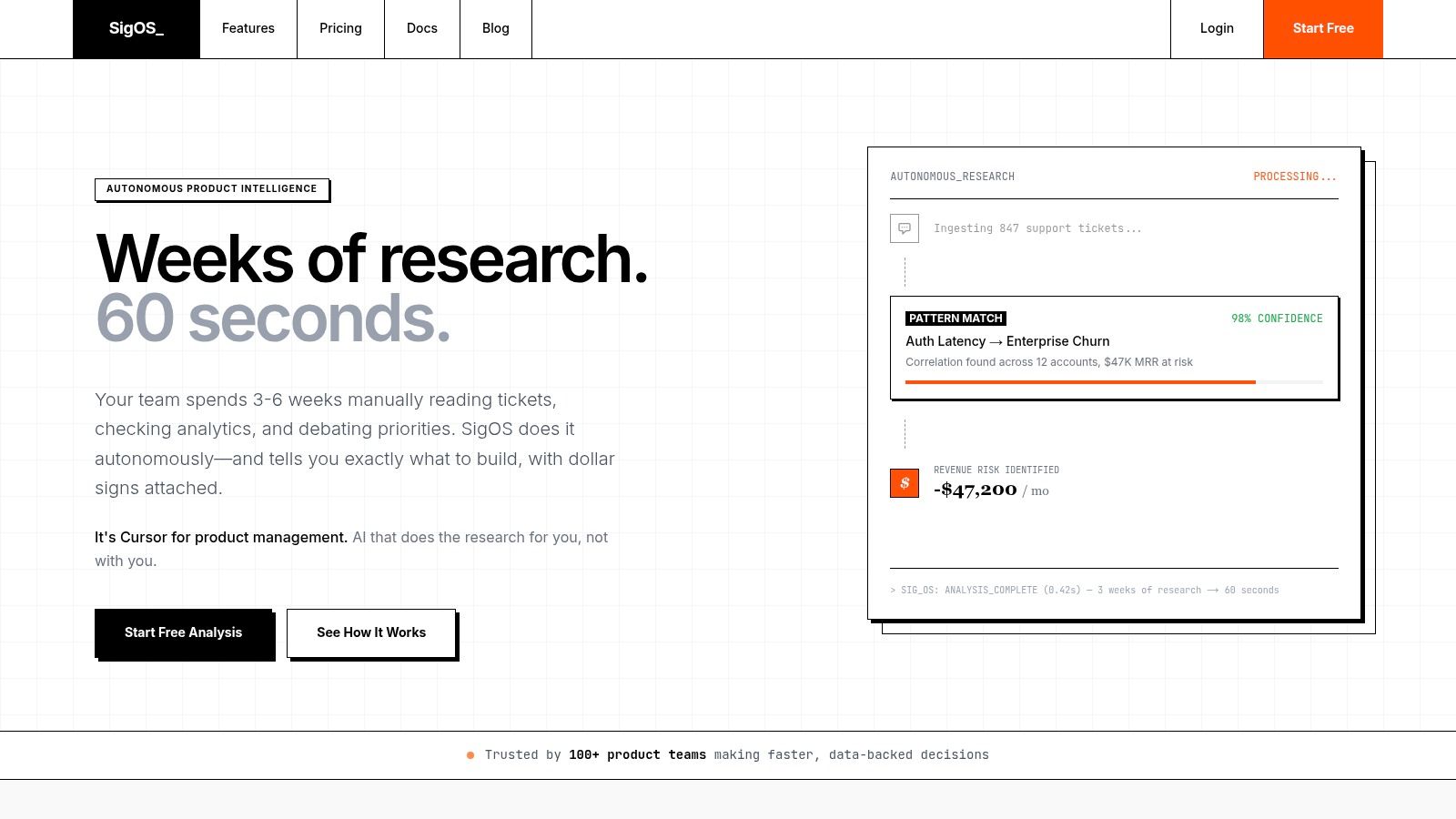
The best teams pull signals from multiple systems at once:
- Support systems like Zendesk and Intercom reveal recurring friction themes
- Product analytics show where workflows break, stall, or get abandoned
- Sales and success calls expose objections, missing capabilities, and stakeholder concerns
- Engineering tools like Jira, Linear, and GitHub connect customer pain to delivery status
Build a revenue-weighted product loop
Many SaaS companies often get stuck. They collect feedback well, but prioritize it poorly. Everything sounds important when customer language is fresh and emotional.
A better operating loop looks like this:
- Capture signals continuously from support, chat, calls, and in-product behavior.
- Cluster related issues into themes such as activation blockers, integration failures, reporting gaps, or admin workflow pain.
- Map themes to customer outcomes like churn risk, stalled onboarding, contraction risk, or blocked expansion.
- Push the highest-impact themes into the backlog with clear business context, not just anecdotal summaries.
- Close the loop with customer-facing teams so success and support know what changed and which accounts are affected.
Product teams shouldn't ask, “How many customers requested this?” They should ask, “Which customers, what revenue, and what retention risk?”
A useful framework for this operating model is analyze customer feedback in a way that connects signals to decisions.
Treat retention as an output of product quality
This is the strategic shift most guides miss.
Loyalty perks, nurture sequences, and save offers can help around the edges. But if customers repeatedly hit avoidable friction, your retention ceiling is set by product quality, not campaign quality. The companies that outperform on retention usually don't just communicate better. They identify the recurring sources of friction earlier and route them into product changes faster.
That's what makes the product stickier over time. Not delight theater. Fewer reasons to leave.
Measuring True Impact with Experiments and Control Groups
It is often claimed that a retention program worked because top-line churn improved after launch.
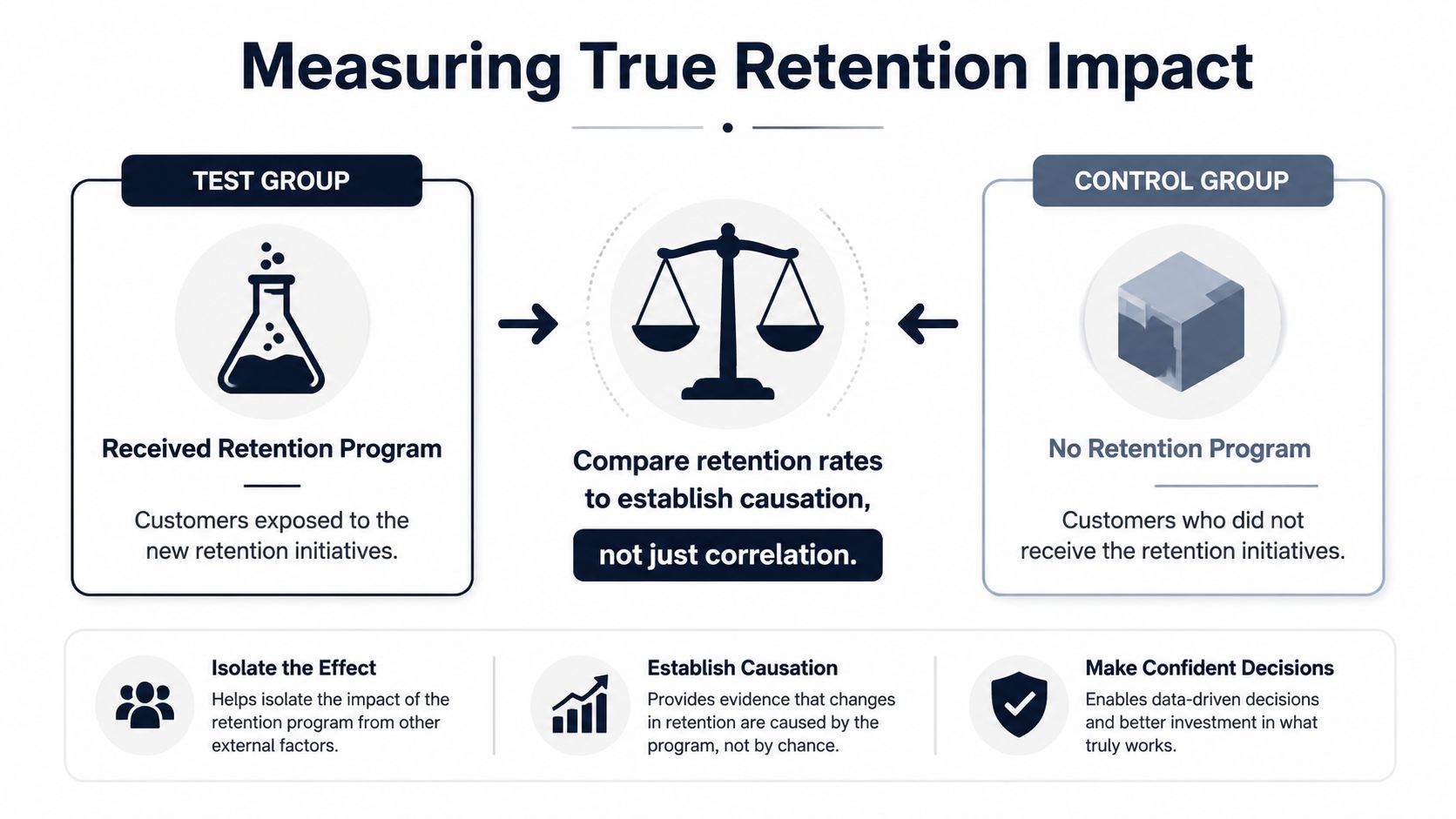
That isn't enough. Some of those customers would have stayed anyway. Some might have renewed because a champion changed jobs, a budget was restored, or a product fix landed at the same time. If you don't separate intervention effects from natural retention, you'll keep funding programs that look helpful and aren't.
Why aggregate reporting misleads
A sequence can show high engagement and still do little for retention. A customer success outreach motion can coincide with healthier renewals without causing them. This is common in retention because the audience is already selected for complexity. Accounts recover for many reasons.
That's why a rigorous methodology requires a randomly selected control group. It allows direct calculation of rescue rate, defined as the percentage of would-be churners successfully retained by a campaign, and it's essential for assessing true efficacy and profitability according to Harvard Business School research on retention campaign measurement.
A simple test design that works
You don't need a data science org to run disciplined retention experiments.
Split a qualifying at-risk segment into two groups. One gets the intervention. One does not. Keep the holdout random and small enough that the business is comfortable, but large enough to produce a credible comparison over time.
Then compare outcomes such as:
- Renewal behavior across test and control
- Contraction patterns if the product allows seat or usage reductions
- Expansion conversion if the play is meant to deepen adoption
- Support burden created by the intervention itself
- **Gross and **net revenue retention trends at the cohort level, so you're not evaluating save motions in isolation from broader account economics
If you don't hold out a control group, you're measuring motion, not impact.
What to test first
The best early experiments focus on interventions with clear triggers and manageable variables.
- Billing recovery plays are often straightforward because the trigger is explicit.
- Onboarding rescue sequences can work well if milestone definitions are tight.
- Feature adoption nudges are testable when tied to a specific workflow and audience.
- CSM escalation thresholds are worth testing because human time is expensive and often over-assigned.
The important part is discipline. Keep eligibility rules stable during the test window. Avoid changing the message, trigger, and target segment all at once. Document what the team expects to happen before launch.
Many retention teams are surprised by results. The polished sequence underperforms. The plain billing prompt works. The CSM call helps only for certain account types. That's a feature, not a failure. It's how you turn customer retention programs into a capital-efficient system instead of a belief system.
Building Your SaaS Retention Tech Stack
A retention stack shouldn't be a pile of disconnected tools.
It should function like a decision system. One layer stores customer truth. Another executes outreach. Another manages humans in the loop. Another translates raw behavior and feedback into usable signals. If one layer is missing, teams improvise with spreadsheets and tribal knowledge. That works for a while, then breaks under scale.
The core systems and their jobs
Most SaaS companies need four categories working together.
First is the CRM, usually something like Salesforce or HubSpot. This is the commercial source of record. It holds account structure, contract dates, ownership, and renewal context. Without that layer, retention actions don't tie cleanly back to revenue and account strategy.
Second is the customer success platform, such as ChurnZero, Catalyst, or Gainsight, which often includes health scoring, playbooks, book-of-business workflows, and renewal risk management. It gives CSMs a working environment rather than just a database.
Third is the communications layer, with tools like Intercom, Customer.io, Braze, or Outreach depending on your motion. These tools handle in-app prompts, email sequences, product messages, and triggered lifecycle communications. They're effective only if the upstream signals are good.
Fourth is the product intelligence and analytics layer. Within this layer, behavioral data, support themes, issue recurrence, and product friction become interpretable. Without this layer, organizations overreact to loud feedback and miss quieter patterns that predict churn.
Integration matters more than feature lists
Teams often buy for features and regret the workflow gaps later.
The useful question isn't whether a tool can send an email or calculate a score. Most can. The useful question is whether the signal can move from support ticket to product insight to lifecycle trigger to CSM task without manual stitching.
A healthy architecture usually supports flows like these:
- Support tool to issue tracker so recurring problems become visible to product
- Product analytics to customer success platform so health reflects actual usage patterns
- CRM to lifecycle tool so messaging respects account value, contract stage, and ownership
- Engineering system back to success and support so teams know when a customer-affecting issue is fixed
One operational area people overlook is documentation quality. Retention suffers when onboarding guides, implementation docs, and support references drift out of date. This resource on preventing doc rot in SaaS documentation is useful because stale documentation contributes to friction across the lifecycle.
Choose tools based on your retention model
A low-touch PLG company and a high-ACV enterprise SaaS business shouldn't buy the same way.
If your motion is mostly self-serve, prioritize real-time product signals, in-app messaging, and automated lifecycle orchestration. If your model depends on CSM relationships and multithreaded stakeholders, prioritize account intelligence, escalation workflow, and executive visibility.
In both cases, keep one rule in mind. Don't let the tool define the strategy. Define the retention model first, then select systems that support it. Customer retention programs work when the stack helps teams detect risk early, respond in context, and route repeat friction back into product decisions.
If your team wants to connect support tickets, chat transcripts, usage data, and product signals to real retention risk, SigOS is built for that job. It helps product, growth, and success teams find the issues driving churn, prioritize feedback by revenue impact, and turn qualitative noise into actions that make the product harder to leave.
Keep Reading
More insights from our blog
Ready to find your hidden revenue leaks?
Start analyzing your customer feedback and discover insights that drive revenue.
Start Free Trial →