Data quality concerns: Identify, Prioritize, and Fix for Revenue
Uncover data quality concerns and learn a practical framework to fix bad data and protect revenue.
Data quality concerns are any issues in your data that make it less reliable or useful for making decisions. These problems show up in a few key ways—like accuracy, completeness, and timeliness—and they can lead to flawed strategies and a total loss of trust in your business intelligence.
Make no mistake: this isn't just some technical problem. Ignoring data quality is a direct threat to your revenue and growth.
The Real Cost of Overlooking Data Quality
Ever launch a new feature based on what looked like solid user data, only to watch it completely flop? The launch fails, and months of engineering and marketing dollars go down the drain. That’s not a strategy failure; it’s a data quality failure. These hidden problems quietly sabotage even the best-laid plans.
This guide isn’t about treating data quality as a boring chore for engineers. It's about seeing it for what it is: a core business function that directly impacts your bottom line. It’s about shifting from guesswork to certainty in every decision you make. When you can trust your data, you build products customers actually want, find revenue opportunities faster, and get ahead of churn before it hurts you.
Why Data Quality Is a Business Imperative
Running a business on poor data is like building a skyscraper on a foundation of sand. It’s only a matter of time before things start to crumble. In a business, those cracks show up as expensive mistakes and missed opportunities.
For product and growth teams, the stakes are especially high. Bad data can lead to:
- Wasted Resources: Teams sink time and money into building features for the wrong problems because customer feedback was incomplete or misinterpreted.
- Increased Customer Churn: Inaccurate user data can hide critical bugs, leaving customers frustrated until they eventually leave. One study found that companies lose up to 25% of their revenue because of poor data quality.
- Missed Opportunities: When data is inconsistent or old, you might completely miss high-value feature requests from enterprise clients, leaving massive expansion revenue on the table.
Data isn't just a byproduct of your business; it's the raw material for growth. Treating it as an afterthought is one of the most expensive mistakes a modern company can make.
Understanding the Core of the Problem
To fix data quality, you first have to understand what can go wrong. The problem isn't just one thing; it's a family of related issues that pop up in different ways. We’re going to look at the six main dimensions of data quality that are the foundation for reliable decision-making.
These dimensions are:
- Accuracy: Is the data correct?
- Completeness: Are there critical gaps in the information?
- Timeliness: Is the data fresh enough to be relevant?
- Consistency: Does the data mean the same thing across different systems?
- Lineage: Do we know where the data came from and how it has changed?
- Bias: Does the data systematically favor certain outcomes?
Ignoring these dimensions is a recipe for disaster. But if you master them, every strategic move you make will be built on a foundation of truth. That makes clean, trustworthy data your most valuable asset for sustainable growth.
The Six Data Quality Dimensions You Must Master
To get a real handle on data quality, you need a framework for what "good" data actually looks like. Think of it like a car inspection. A mechanic doesn't just glance at a car and say it’s “bad.” They have a checklist: they inspect the brakes, pop the hood to check the engine, and kick the tires.
We need to do the same with our data. We can diagnose its health by examining six core dimensions. Getting these right gives everyone a shared language to pinpoint exactly where problems are coming from and how they’re quietly hurting the business.
1. Accuracy
Accuracy is the most fundamental dimension. It’s a simple question: does the data reflect reality? Inaccurate data is like a faulty GPS that insists on sending you down a dead-end street. Following its lead wastes time, burns fuel, and gets you nowhere.
For a SaaS company, a classic accuracy fumble is when a customer’s annual recurring revenue (ARR) is logged as 50,000 in your CRM when it’s actually ****5,000. That single typo can cause a sales leader to blow up their forecast, misallocate resources, and build a growth strategy on a foundation of sand. It’s a tiny error with massive downstream consequences.
2. Completeness
Completeness asks if you have all the data you need to make a sound judgment. Imagine trying to assemble a 1,000-piece puzzle with only 500 of the pieces. You might see a corner of the picture, but you'll never grasp the full scene. That's exactly what incomplete data does to your business insights.
A common example for product teams is a support ticket that's missing crucial context, like the customer's subscription tier or the product version they're using. Without that information, you can't tell if a nasty bug is hitting your high-value enterprise clients or only a handful of free-tier users. Critical patterns stay hidden in the gaps, making it impossible to prioritize fixes that matter.
Incomplete data doesn't just give you a partial view; it actively creates a distorted one. The insights you derive from it are often dangerously misleading because you're making decisions based on what you can see, not what’s actually there.
3. Timeliness
Timeliness is all about freshness. Is your data available and relevant right now, when you need to make a decision? Relying on outdated information is like using last week's weather forecast to decide if you need an umbrella today. The facts were probably correct then, but they’re useless for what’s happening at this moment.
Consider a churn prediction model that only gets refreshed with user engagement data once a month. By the time the model finally flags a customer as "at-risk," that customer might have already bailed on your product weeks ago. The insight arrives too late to be actionable, turning a preventable problem into another lost account.
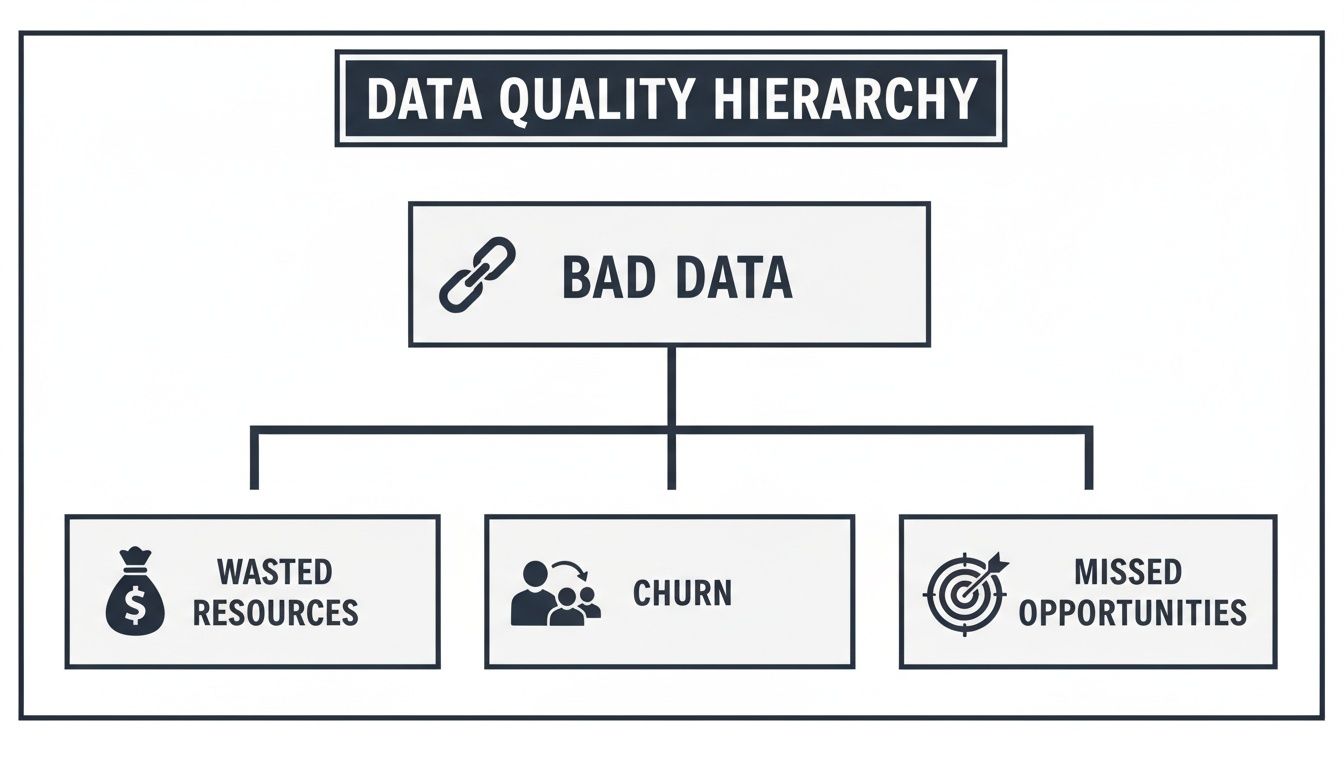
When data is inaccurate, incomplete, or out-of-date, the problems cascade. They inevitably lead to wasted engineering cycles, higher customer churn, and missed revenue opportunities.
4. Consistency
Consistency ensures that data about the same thing is identical across all your systems. Think of it like two architects working from different sets of blueprints for the same building. They might both be working hard, but their efforts are going to clash, leading to chaos, confusion, and a whole lot of expensive rework.
This is an everyday headache in SaaS. Your CRM might list a customer as an "Enterprise" account, but your support tool, like Zendesk, has them tagged as "SMB." This seemingly small discrepancy creates immediate operational friction:
- Does this customer get white-glove support or standard service?
- Should they be targeted in an upsell campaign for enterprise-only features?
- Which system is the source of truth?
This conflict paralyzes automated workflows, forces your team into time-consuming manual checks, and ultimately creates a disjointed and frustrating experience for the customer.
5. Lineage
Data lineage is all about knowing your data's life story. Where did it come from? What changes were made to it along the way? Where is it being used now? Without clear lineage, your data is like a mysterious package that shows up on your doorstep—you have no idea who sent it, what’s inside, or if you can trust it.
Understanding the origin and journey of your data is fundamental to building trust in it. For instance, if a dashboard shows a sudden spike in user sign-ups, lineage lets you trace it back to the source. You can quickly see if it came from a brilliant new marketing campaign (a win!) or a bot attack (a fire drill!). That distinction completely changes how you react.
6. Bias
Finally, we have bias. This is the most subtle and often the most dangerous data quality issue. Bias means your data systematically and unfairly favors certain outcomes over others. It’s like a loaded die—it might look perfectly normal, but it's been engineered to produce a specific result, leading you to completely false conclusions.
For example, if you primarily collect customer feedback through post-support surveys, your data will be heavily skewed toward users who recently had a problem. This creates a "survivorship bias," where you're only hearing from the loudest and often most frustrated voices. You end up missing crucial insights from the quiet, happy majority of your users. Building a product roadmap on this skewed data can lead you to over-invest in fixing niche complaints while completely ignoring huge opportunities for innovation.
The Six Dimensions of Data Quality and Their Business Impact
To pull it all together, here’s a quick summary of each dimension, the core question it answers, and what it looks like in the real world of a SaaS business.
| Dimension | Core Question | SaaS Example | Potential Business Impact |
|---|---|---|---|
| Accuracy | Is the data correct and true to reality? | A customer's ARR is listed as 50,000 instead of ****5,000 in the CRM. | Inaccurate revenue forecasting and flawed growth strategy. |
| Completeness | Do we have all the essential data we need? | Support tickets are missing the user's subscription tier, obscuring which customers a bug affects. | Inability to prioritize critical bug fixes for top accounts. |
| Timeliness | Is the data fresh enough to be useful now? | A churn prediction model uses engagement data that is a month old. | Insights arrive too late to prevent customer churn. |
| Consistency | Is the same data identical across all systems? | The CRM says a customer is "Enterprise" while the support tool says "SMB." | Operational confusion and poor customer experience. |
| Lineage | Do we know where the data came from and its journey? | A sudden spike in sign-ups appears on a dashboard, but its source (marketing vs. bots) is unknown. | Lack of trust in data and misguided strategic reactions. |
| Bias | Does the data unfairly represent a specific group? | Product feedback comes only from users who have recently contacted support. | A skewed product roadmap that ignores the silent majority. |
Keeping these six dimensions in mind gives you a powerful diagnostic toolkit. It helps you move from the vague feeling that "the data is wrong" to a precise understanding of what's broken, why it matters, and how to start fixing it.
Why Data Quality Became an Executive Priority
For a long time, data quality was the kind of thing you only heard about in IT closets and data engineering stand-ups. It was considered operational plumbing—important, sure, but handled deep in the org chart. That era is over. Data quality has officially crashed the boardroom party and is now a top-tier concern for the C-suite.
What changed? In a word: AI. The explosion of artificial intelligence and automated decision-making has completely flipped the script. AI isn't some black box that spits out magic; it’s an engine, and data is its fuel. The old saying "garbage in, garbage out" has been supercharged with new, high-stakes meaning. When you feed an AI model bad data, it doesn't just create a faulty report—it automates bad decisions at a terrifying speed and scale.
The AI-Fueled Awakening
Think about an AI system built to predict customer churn. If the data it’s trained on is missing key context from support tickets or has jumbled customer lifecycle stages, the model will be flying blind. It might start flagging perfectly happy customers as churn risks while completely missing the ones who are one foot out the door. This isn't just a technical glitch; it's a direct shot to your revenue, all because of poor data.
This new reality is forcing a major shift in how executives think. Investing in data quality is no longer just about cleaning up a few messy spreadsheets. It’s about building a smarter, more resilient organization that can actually use AI to get ahead. The growing consensus on Why Data Quality Is The Real Competitive Edge In AI shows just how critical this has become for business success.
Investing in AI without first investing in data quality is like buying a Formula 1 race car and filling the tank with dirty water. You've made a massive investment that is guaranteed to fail, and the breakdown will be catastrophic.
From Afterthought to Top Priority
The strategic importance of clean, reliable data isn't just an opinion anymore—it's a clear trend backed by hard numbers. Leaders across industries now get it: without a solid data foundation, their ambitious AI and analytics projects are set up for failure from the start.
A recent global survey of industry professionals confirms just how dramatic this shift has been. According to BARC's Data, BI and Analytics Trend Monitor, data quality management has reclaimed the top position in organizational priorities, scoring an importance rating of 7.9 out of 10. That's a huge deal. It means data quality now ranks above the very AI and advanced analytics initiatives that used to dominate the conversation. You can dive into the full research on these data and analytics trends.
This chart from the BARC report really tells the story.
What this shows us is that the market is growing up. The initial hype around AI is settling, and in its place is the practical, hard-won wisdom that an AI's success lives or dies by the quality of its data.
The New Competitive Landscape
In this new environment, companies that treat data quality as a core strategic asset are pulling away from the pack. Their AI models are more accurate, their product decisions are sharper, and their ability to pivot in the market is faster. They can trust their automated systems because they’ve built that trust from the ground up, starting with the data itself.
On the other hand, organizations that continue to treat data quality as an afterthought are getting stuck in a vicious cycle:
- Failed AI Projects: They pour money and time into models that never produce reliable outcomes.
- Wasted Engineering Time: Their developers are constantly sent on wild goose chases, trying to fix problems rooted in bad data.
- Eroding Customer Trust: They make poor product and service decisions that ultimately drive users away.
At the end of the day, making data quality a priority is about building a company that lasts. Executives now see that it's not a cost center to be minimized, but a core enabler of the intelligent, automated future they're all racing to build.
How Bad Data Breaks AI and Derails Product Strategy

Making the jump from human-led analysis to AI-driven insights brings an incredibly powerful—but brutally unforgiving—new element into your strategy. Think of AI as a massive amplifier. It takes those tiny, seemingly harmless data quality issues and blows them up into systemic business risks at machine speed.
What was once a minor annoyance in a spreadsheet can suddenly become the root cause of a major product failure.
Imagine your AI is supposed to spot emerging customer needs by sifting through thousands of support tickets. If your data is a mess of inconsistent terms—"login issue," "can't sign in," and "access problem"—the AI sees three separate, low-priority problems. It completely misses the single, massive trend: a huge chunk of your user base is locked out of your product.
This isn’t just a hypothetical. When an AI model is fed bad data, it can’t build an accurate picture of reality. It’s like trying to navigate a city with a map that’s missing half the streets. You’re going to get lost.
When AI Hallucinates from Bad Data
One of the scariest outcomes of poor data quality is what’s often called an AI “hallucination.” This is when an AI generates confident but completely fabricated outputs because its training data was flawed. It’s not just getting something wrong; it’s inventing a false reality and presenting it as stone-cold fact.
Consider these all-too-common scenarios where data quality issues directly sabotage AI:
- Incomplete Feedback Blinds Churn Models: Your churn prediction AI is analyzing support transcripts, but 30% of them are missing the customer’s subscription tier. The model never learns that a specific bug is overwhelmingly hitting your highest-value enterprise clients, leaving you blind to a massive—and preventable—revenue loss. You can learn more about how to get this right by predicting customer churn with better data.
- Inconsistent Naming Derails Prioritization: An AI trying to identify top feature requests sees "dark mode," "night theme," and "dark UI" as three distinct requests, each with low volume. It fails to connect the dots, burying what is actually your single most-requested feature deep in the backlog.
- Biased Data Creates a Skewed Roadmap: If your AI only analyzes feedback from customers who bother to fill out a post-support survey, it builds a product strategy based on the voices of the most frustrated. It might recommend "fixing" features that the silent, happy majority loves, actively degrading the experience for most of your customers.
The most dangerous thing about AI is that it executes on flawed data with incredible efficiency and without a moment of hesitation. There is no human safety net to question a bad assumption; the system just runs, scaling the mistake across your entire user base.
From Supporting Role to Foundational Requirement
The direct line between data quality and AI performance is now impossible to ignore. Industry analysis from Forrester has confirmed it: data quality has moved from a "nice-to-have" to a foundational requirement for any serious AI initiative. As companies push deeper into AI, they’re learning a hard truth: when data quality fails, AI systems fail, and the consequences are amplified at machine speed.
This is especially true for autonomous systems that make decisions with zero human oversight. There is no one there to catch an error or notice data drift after the fact. For any organization serious about using AI for product intelligence, getting your data integrity right before you build is the only path forward.
Your Playbook for Fixing Data Quality Issues
Pinpointing data quality problems is a huge first step, but it's really only half the battle. To make a real difference, you need a repeatable process that takes you from spotting a problem to actually solving it. This playbook is a practical, step-by-step guide for product and growth teams to systematically shore up their data quality and build a culture of trust in their numbers.
Don't think of this as a one-off project. It’s more like building a fitness routine for your data. You start with a check-up to find the weak spots, create a targeted workout plan to build strength, and finally, lock in the habits that keep your data healthy for the long run.
Phase 1: Define and Detect
Before you can fix anything, you have to know exactly what’s broken and how you'll measure success. This phase is all about setting a baseline and shining a bright light on those hidden issues. It's the diagnostic step where you graduate from a vague feeling that "the data is off" to a concrete list of problems.
Your first move is to identify the critical data assets for your team. This isn't about every single table in your data warehouse; it’s about the specific information you rely on to make your most important decisions. For a product team, that might mean support tickets, product usage logs, and notes from user feedback calls.
Once you know what matters most, you need to define what "good" actually looks like by setting up some key metrics.
- Error Rate: What percentage of records have known errors, like an invalid email format or a customer ID that doesn't exist?
- Completion Rate: Are all the essential fields filled out? For example, what's the completion rate for the "customer tier" field in your support tickets?
- Timeliness Lag: How long does it take for data to be usable after an event happens? A lag of a few days can make your insights totally useless.
With these metrics in hand, the next step is data profiling. This is where you run analyses to get a real, unfiltered look at the state of your data. Profiling can uncover weird patterns, outliers, and inconsistencies you didn't even know to look for. Diagnosing the problem is a crucial skill; learning how to find and fix Google Analytics problems, for instance, can help sharpen your diagnostic abilities.
Phase 2: Prioritize and Plan
After you've uncovered a list of data quality issues, the natural impulse is to try and fix everything at once. That's a surefire way to get overwhelmed and accomplish nothing. Smart remediation is all about ruthless prioritization based on business impact.
Let's be real: not all data errors are created equal. A typo in an internal comment is an annoyance. An incorrect ARR value in your CRM is a five-alarm fire.
Use a simple impact/effort matrix to get your priorities straight:
- High-Impact, Low-Effort (Quick Wins): Tackle these first. A great example is fixing a broken integration that’s causing customer statuses to be inconsistent between your CRM and support tool.
- High-Impact, High-Effort (Major Projects): These are often deep, systemic problems that demand a proper root cause analysis. If you find that 40% of support tickets aren't categorized correctly, you might need to retrain the support team and add required fields to your ticketing system.
- Low-Impact, Low-Effort (Fill-in Tasks): These are minor cleanup jobs you can chip away at when you have downtime.
- Low-Impact, High-Effort (Re-evaluate Later): Put these on the back burner. The return on your time just isn't there.
The goal of prioritization isn't to achieve data perfection. It's to fix the problems that are actively costing you money or hiding major opportunities. Always connect your cleanup efforts back to a specific business outcome, like cutting down churn or spotting new expansion revenue.
Phase 3: Remediate and Monitor
With a prioritized plan locked in, you can finally start fixing things. This usually involves a mix of activities, from one-off manual data cleansing to engineering projects that attack the root cause of recurring problems.
For example, say you found out your system lets users enter phone numbers in a dozen different formats. The remediation plan should have two parts:
- Short-Term: Run a script to standardize all the phone numbers already in your database.
- Long-Term: Add an input mask to the user entry form so new numbers are always entered in a consistent format from now on.
That long-term fix is what really matters. Real data quality management isn't just about cleaning up yesterday's messes; it's about preventing tomorrow's. You have to build quality checks and validation rules right into your systems. Understanding and tackling the full range of data quality issues is a continuous process, not a one-time event.
Finally, set up continuous monitoring. Create automated alerts that ping you when your key data quality metrics drop below an acceptable level. This shifts data quality from a reactive, fire-fighting mode into a proactive, managed process. And that ensures your biggest strategic bets are always built on a solid foundation of data you can trust.
How to Operationalize Your Data Quality Strategy

Fixing data quality problems one by one is a good starting point, but it's not a long-term solution. The real goal is to weave data quality into the very fabric of your daily operations. It’s about shifting from occasional data cleanup projects to a continuous, automated system that keeps data trustworthy from the moment it enters your world. For product and growth teams, this is where the strategy really pays off.
A modern product intelligence platform like SigOS is built for this. It takes in messy, unstructured data from all over—think support tickets, sales call transcripts, and live chats—and gets to work. Its AI engine automatically cleans, structures, and makes sense of it all, turning a chaotic flood of information into a clear signal.
From Messy Data to Actionable Insights
This automated approach isn't just about tidying up your data. It’s about building a rock-solid foundation for finding patterns that directly tie to revenue. By structuring all that raw customer feedback, the system can put a number on specific issues and connect them to real business outcomes, like churn risk or upsell opportunities.
This solves two huge problems at the same time:
- It surfaces powerful insights by pinpointing the most critical customer pain points.
- It ensures those insights are reliable because the analysis is built on validated, trustworthy data from the ground up.
Operationalizing data quality means your team can stop second-guessing their reports. They can move straight from analysis to action, confident that the underlying data is sound. This is a huge leap from reactive fire-fighting to proactive, data-informed strategy.
The Strategic Imperative of Data Quality Tools
The market has caught on to how important this is. The data quality tools market is booming, valued at USD 3.27 billion and projected to hit USD 7.39 billion by 2031. That's a compound annual growth rate of 17.7%, which tells you this isn't just a passing trend—it's a major business shift. Discover more insights about this growing market.
This explosive growth highlights a simple truth: fixing your underlying data quality is no longer optional. It's a strategic necessity for any company that wants to stay competitive.
By embedding automated quality checks and analysis directly into your workflows, you create a resilient system that fuels growth. A well-designed system, like the one we detail in our guide on the data architecture diagram, is the key to making this happen. In the end, operationalizing your strategy ensures every decision is built on a foundation of truth.
Frequently Asked Questions
Even with a solid playbook, actually getting your arms around data quality can feel like a huge undertaking. We've seen product and growth teams run into the same kinds of questions when they try to put these ideas into practice. Let's tackle some of the most common ones about getting started, proving value, and figuring out who owns what.
What’s the First Step Our Product Team Should Take?
Don't try to boil the ocean. The best way to start is with a small, focused data quality assessment on one of your most important data sources—something like your customer support tickets.
First, define what "good" looks like for that specific dataset across the six quality dimensions we talked about. Then, hunt for the single most painful issue you can find. Maybe you discover that 30% of support tickets are missing the customer segment data needed for proper routing. Pour all your initial energy into fixing that one thing. This approach shows real value, fast, and builds the momentum you need for a bigger data quality push.
How Can We Measure the ROI of Investing in Data Quality?
To make a case for the investment, you first have to calculate the cost of doing nothing. Before you kick off any project, start tracking the metrics that bad data is already tanking.
Think about things like:
- Wasted engineering hours spent building features based on flawed assumptions.
- Customer churn happening because critical bugs get lost in a sea of noisy feedback.
- Big expansion opportunities missed because you couldn't spot high-value feature requests.
The ROI isn't just a fuzzy concept; it's a measurable drop in those costs and a clear lift in revenue from making smarter, data-backed decisions. Success might mean a 15% reduction in churn or landing new six-figure deals because you finally uncovered insights that were there all along.
The strongest business case for data quality isn't about getting to some mythical "perfect data." It's about preventing the incredibly expensive mistakes that bad data causes. The ROI is in the disasters you dodge and the opportunities you actually grab.
Should Our Data Team Handle All Data Quality Issues?
It's tempting to think so, but no. While your central data team is crucial for the heavy lifting on infrastructure, product and growth teams are the ones with the most context. They live and breathe the data that shapes their decisions, which means data quality has to be a shared responsibility.
Your data warehouse team can make sure the data is available and the pipes are working. But only the product team can truly validate if the content of that data—like the sentiment in customer feedback or the specifics in a feature request—is accurate and complete enough for their needs. Modern tools are built to bridge this gap, giving product teams the power to analyze their own data streams and flag the quality problems that directly mess with their work and results.
Ready to stop guessing and start building with data you can actually trust? SigOS is the AI-driven product intelligence platform that automatically finds the signal in your customer feedback noise. We connect bugs and feature requests to real revenue impact so you can build what truly matters. See how SigOS works.
Keep Reading
More insights from our blog

Ready to find your hidden revenue leaks?
Start analyzing your customer feedback and discover insights that drive revenue.
Start Free Trial →