A Modern Growth Plan Strategy for Your SaaS
Build a smarter growth plan strategy for your SaaS. This guide shows you how to turn customer feedback into revenue by prioritizing what truly matters.
A solid growth plan strategy isn't about guesswork. It’s about systematically figuring out which product improvements will actually cut churn, drive expansion, and close new deals. It means taking the chaotic mess of customer feedback—from support tickets, sales calls, and CSM notes—and turning it into a clear, data-driven framework where every decision is tied to its potential impact on revenue.
Why Your Current Growth Plan Is Probably Broken

Let’s be honest. A lot of SaaS growth plans are built on shaky ground. They often feel like a shot in the dark, driven by gut feelings, the loudest person in the room, or whatever the competition just launched. You're swimming in qualitative feedback, but connecting all that noise to actual revenue feels next to impossible.
This is how you end up in a "feature factory." Engineering teams work tirelessly shipping new stuff, but when you look at the numbers, key metrics like churn and expansion barely budge. It's a frustrating cycle where good resources are spent on projects that just don't move the needle.
Shifting From Gut-Feel to Data-Backed
The modern approach flips the script entirely. Instead of relying on opinions, you build a revenue-driven feedback loop that translates every qualitative comment into a hard number. The core idea is simple but powerful: systematically quantify the business impact of every piece of feedback, whether it’s a tiny bug report or a massive feature request.
This data-first mindset forces product decisions to align with real business outcomes. For a deep dive into building a system like this, check out this guide on creating a modern growth strategy framework.
Once you make this shift, you can start answering critical questions with confidence:
- Which specific bug is costing us the most in customer churn right now?
- What single feature request is holding up our three largest enterprise deals?
- How much potential expansion revenue is locked behind this one integration request?
The Goal: Turn your product roadmap from a wish list into a strategic asset. Every single item on it should have a clear, justifiable link to revenue growth, retention, or acquisition.
The Power of a Revenue-Driven Framework
Thinking about growth this way isn’t just a theoretical exercise; it’s a practical framework for turning your product organization into a legitimate growth engine. When you start attaching dollar values to customer feedback, you create a common language that finally gets product, engineering, sales, and success teams on the same page.
To see the difference, let’s compare the old way of thinking with this new, revenue-focused strategy.
Traditional vs Revenue-Driven Growth Planning
| Aspect | Traditional Approach | Revenue-Driven Strategy |
|---|---|---|
| Prioritization | Gut feel, loudest customer, competitor features | Quantified revenue impact (churn risk, expansion opportunity) |
| Data Source | Anecdotal feedback, siloed notes | Centralized feedback linked directly to customer accounts and MRR |
| Decision-Making | Subjective, based on opinion or "HiPPO" | Objective, based on financial data and strategic alignment |
| Team Alignment | Disconnected; "feature factory" mentality | Unified around shared revenue goals and priorities |
| Roadmap | A list of features and projects | A strategic plan where each item has a business case |
| Success Metric | "Features shipped," velocity | Measurable impact on churn, expansion, and new revenue |
This table really highlights the core shift: moving from building stuff to building what demonstrably grows the business.
When a Jira ticket is created in this new world, it’s no longer just a technical task. It now includes the potential revenue at risk or up for grabs, direct customer quotes for context, and a clear priority score based on its financial impact. This gives your development team the "why" behind their work, boosting morale and ensuring everyone is pulling in the same direction.
Platforms like SigOS are designed to automate this entire process, using AI to surface the most critical insights from your customer conversations. To see how this fits into a broader reporting structure, you might find our guide on metrics and reporting helpful.
Setting Goals That Actually Move the Needle
A growth plan without real, measurable goals is just a wish list. I've seen it a hundred times: teams rally around fuzzy targets like "increase user engagement" or "improve customer satisfaction." While they sound productive, these goals lack the teeth needed to drive real business outcomes. They don't connect your team's day-to-day work to the company's financial health.
The best growth strategies I’ve ever been a part of always start with the end in mind. They focus on the big-picture results you want to achieve, like revenue and churn—what we call lagging indicators—and then work backward to pinpoint the specific actions that will actually influence them. This approach creates a straight line between the team's effort and its impact.
From Vague Ideas to Revenue-Tied Objectives
Let's get practical. Imagine your product team sets a goal to "enhance the user experience." It sounds great in a meeting, but what does it actually mean? How do you know when you’ve succeeded?
A revenue-driven approach flips this on its head. That same goal becomes something like: "Reduce churn in our SMB segment by 15% in Q3 by fixing the top three revenue-impacting bugs."
See the difference? This version is powerful because:
- It’s Specific: It names the exact customer segment (SMB) and the problem (churn from bugs).
- It’s Measurable: The target is a crystal-clear 15% reduction.
- It’s Time-Bound: There's a hard deadline: the end of Q3.
- It’s Actionable: It points the team toward a prioritized list of tasks (the top three bugs).
This kind of clarity ensures everyone on the team understands what success looks like and, more importantly, how their work directly protects or grows the bottom line. It immediately shifts the conversation from subjective opinions to objective, data-backed priorities.
Identifying Your Leading and Lagging Indicators
To set goals this sharp, you have to get comfortable with the relationship between leading and lagging indicators. Lagging indicators are the results—the outputs you want. Leading indicators are the inputs—the actions that drive those results.
Key Takeaway: A great growth plan doesn't just track results; it identifies and measures the activities that produce those results. This is where you actually have control.
Think of it like trying to lose weight. The number on the scale is a lagging indicator; it just tells you the result of your past actions. The real levers you can pull—your leading indicators—are the calories you eat and the minutes you exercise each day.
In a SaaS business, it breaks down like this:
| Lagging Indicator (The Result) | Leading Indicator (The Driver) |
|---|---|
| Monthly Recurring Revenue (MRR) | Number of new trial sign-ups, lead-to-customer conversion rate |
| Customer Churn Rate | Number of unresolved critical support tickets, feature usage frequency |
| Customer Lifetime Value (LTV) | Product adoption rate, number of expansion MRR opportunities |
| Net Revenue Retention (NRR) | CSM health scores, usage of "sticky" features |
When you focus your team's energy on improving these leading indicators, you create a much more predictable path to hitting your big-picture goals. This is the core of a proactive, results-oriented growth strategy.
Setting Practical, Impactful Goals
When you're building out your growth plan, resist the urge to create a laundry list of disconnected goals. Instead, zero in on one or two primary objectives that will have the biggest financial impact on the business for the upcoming quarter. This forces ruthless prioritization and keeps your team from spreading itself too thin.
For example, a team could decide to focus entirely on reducing churn for a quarter. This singular focus lets them go deep, analyze the root causes, and ship fixes that have a real, compounding effect.
Maybe they discover that customers who don't adopt a key integration within 30 days are 50% more likely to churn. Suddenly, they have a powerful insight. With this knowledge, they can set a highly specific leading indicator goal: "Increase new user adoption of our primary integration to 75% within their first 30 days." Hitting that goal directly impacts the ultimate lagging indicator—reducing churn and protecting revenue.
Finding Revenue Signals in Your Customer Feedback
Your customer feedback is an absolute goldmine for your growth plan strategy, but you have to know what you're looking for. The real answers—the reasons customers stick around, upgrade, or walk away—are buried in your Zendesk tickets, Gong transcripts, product analytics, and CSM notes.
The key is to move past just tallying up feature requests.
Instead, you need to spot the patterns that signal genuine risk or opportunity. The loudest customers often soak up all the attention, but they aren't always your biggest revenue drivers. A smart growth strategy tunes into all feedback channels and connects the dots between what users say and what they actually do.
Unifying Disparate Data Sources
The first hurdle is almost always breaking down data silos. Your support team lives in Zendesk, sales is glued to Salesforce and Gong, and product operates out of Jira. Each system holds a piece of the puzzle, but without a unified view, you’re flying blind.
Modern platforms are built to pull in and make sense of data from all these sources at once. This consolidation is where you start uncovering powerful connections. For example, you might discover that a recent spike in support tickets about a specific integration is directly tied to a 10% higher churn rate for that customer segment. Now that's an insight. It turns a qualitative complaint into a prioritized, revenue-driving action.
The global artificial intelligence market has exploded, with its value estimated to be between **371.71 billion and **390.91 billion in 2025. This isn't just a trend; it's a reflection that AI-driven analysis is now essential. For SaaS companies, using this tech is no longer a "nice-to-have." It’s how you turn mountains of raw data into clear business directives. With some projections estimating the market could hit $3.5 trillion by 2033, its role in business intelligence is undeniable. You can get more details about the projected AI market expansion and its implications.
From Feedback to Financial Impact
Once your data is in one place, the next move is to attach a dollar value to each piece of feedback. This is how you transform a chaotic sea of comments into a clear, actionable roadmap. Instead of a long, jumbled list of feature requests, you get a prioritized backlog where every single item is tied to revenue.
Here’s a practical way to start assigning value:
- Churn Risk: Tag feedback from customers your CSMs have flagged as "at-risk." Sum the total MRR of every account mentioning a specific bug or missing feature to calculate its "churn risk value."
- Expansion Opportunity: When a customer on a starter plan requests a feature only available in your enterprise tier, tag that feedback with the potential expansion MRR.
- Blocked Sales: Connect feedback from Gong calls or Salesforce notes directly to deals in your pipeline. If a prospect says, "We'll sign if you add this integration," you now have a hard number for that feature's "new revenue value."
The Key Insight: Every piece of customer feedback is a signal. By connecting that signal to a real dollar amount—whether it's revenue at risk or revenue you could win—you give your product and engineering teams the context they need to make smart, financially-sound decisions.
This is exactly where an AI-driven platform shines, analyzing customer conversations to surface the most urgent issues automatically.
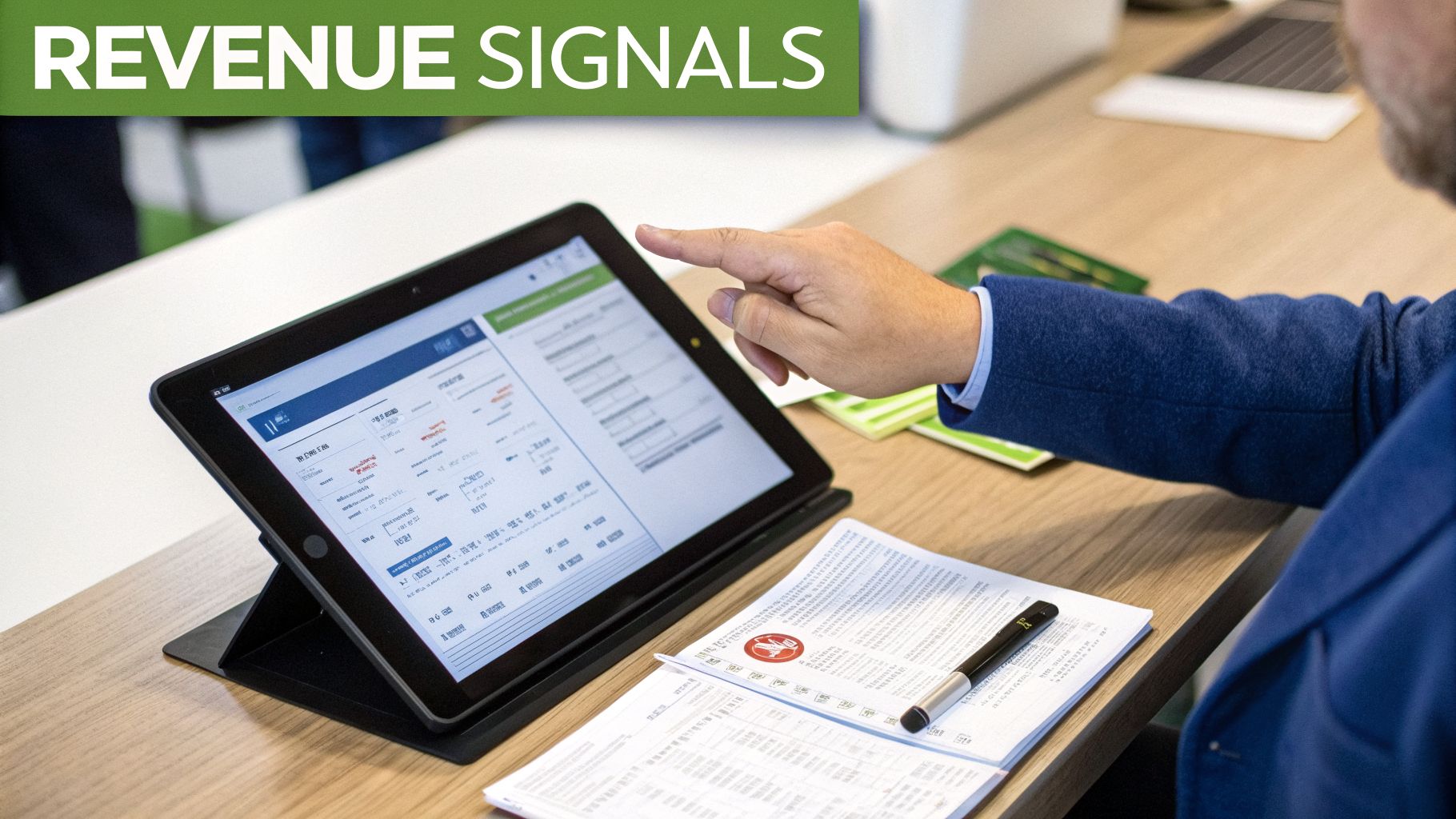
This kind of dashboard instantly shows you which problems are costing you the most money. It allows teams to prioritize fixes based on financial data, not just the volume of complaints. For a deeper look at different methods, you might be interested in our guide on how to analyze customer feedback.
Practical Application: A Real-World Scenario
Let's make this real. Imagine you're a product manager at a B2B SaaS company, and your team is trying to decide what to tackle next sprint. Two major issues are on the table:
- Issue A: A UI bug that’s a minor annoyance. It has generated 50 support tickets this month.
- Issue B: A faulty API endpoint for a key integration. It has only generated 5 support tickets.
On the surface, Issue A seems like the obvious priority. More tickets, right? But when you dig into the revenue data, a completely different picture emerges.
The 50 tickets for Issue A come from small accounts that, all together, represent 1,500 in MRR. The 5 tickets for Issue B, however, are from three massive enterprise customers totaling ****45,000 in MRR. Worse, your CSM team has already flagged two of them as being "at-risk."
With that financial context, the decision is a no-brainer. Fixing Issue B is exponentially more valuable to the business. This is the power of finding revenue signals in your feedback—it aligns your development efforts directly with your most important business goals.
How to Prioritize Your Roadmap for Revenue Impact
Once you’ve unearthed all these powerful, revenue-tied insights, the real work begins. You’re now looking at a list of bugs, feature gaps, and integration requests, each with a dollar value attached. But what do you build first? This is where a real growth plan strategy moves past simple frameworks like RICE scoring and into true, ruthless prioritization.
The goal isn't just to pick the "best" ideas. It's about making objective trade-offs that maximize financial impact. Do you tackle a small UI tweak requested by dozens of low-MRR users, or do you build a complex integration demanded by three enterprise prospects representing $250k in potential new ARR? The answer lies in a smarter model that weighs development effort against direct revenue.
Building Your Revenue Impact Score
To make these calls without getting bogged down in opinions, you need a "revenue impact score." This isn't just some fuzzy label; it's a hard metric you can calculate by combining the different types of financial value tied to any given task.
This score lets you compare seemingly different initiatives on an even playing field.
- Churn Protection Value: What’s the total MRR of at-risk customers who have reported a specific bug or issue?
- Expansion Opportunity Value: How much potential MRR uplift could you get from existing customers who need a feature to upgrade?
- New Revenue Value: What’s the total ARR of sales-blocked deals that are completely dependent on a new feature or integration?
By adding these values together, every item on your backlog gets a clear, quantifiable score. Suddenly, a bug that’s jeopardizing 50,000 in current MRR is obviously a higher priority than a new feature request tied to ****10,000 in potential expansion MRR. This data-driven approach pulls emotion and internal politics right out of your roadmap decisions.
To get this right, you might consider leveraging AI tools that help prioritize product features based on user data, which can turn subjective feedback into actionable numbers.
This shift toward quantifiable value is only getting more important. A recent UN Trade and Development (UNCTAD) report forecasts the global AI market will absolutely explode, rocketing from **189 billion in 2023 to **4.8 trillion by 2033. As this happens, enterprise customers will demand AI solutions with proven business outcomes, making a clear ROI your sharpest competitive edge. You can see the full findings on AI's market dominance and growth for yourself.
Balancing Quick Wins and Strategic Bets
A revenue-first roadmap isn't just about chasing the biggest numbers, though. You have to build a balanced portfolio of initiatives that includes both short-term wins and long-term strategic investments. The best way to visualize this is with a simple matrix that plots financial impact against the level of effort required.
Think of it in four quadrants:
- High Impact, Low Effort (Quick Wins): These are your no-brainers and top priorities. A simple bug fix that unblocks a major enterprise customer is a perfect example. These wins build momentum and deliver immediate value.
- High Impact, High Effort (Strategic Initiatives): These are the big rocks—your major projects, like building a new product module or cracking a new market segment. They take a lot of resources but promise huge long-term returns.
- Low Impact, Low Effort (Fill-in Tasks): These are minor improvements and small tweaks that can be tackled when engineering has some downtime. They’re nice to have, but they should never derail more important work.
- Low Impact, High Effort (Time Sinks): Avoid these at all costs. These are the projects that eat up a ton of resources for very little financial return and can completely derail a focused growth strategy.
Key Insight: A well-prioritized roadmap isn't just a list; it's a strategic allocation of your most precious resource—engineering time. Balancing quick wins with larger bets ensures you’re delivering value today while building the foundation for tomorrow.
This balanced approach prevents your team from getting stuck only on massive, long-term projects or, just as bad, only shipping minor fixes that never lead to significant growth.
Ultimately, this methodical approach ensures your product roadmap becomes the most powerful tool in your growth arsenal. For more guidance, check out our in-depth article on product roadmap development to refine your process. It transforms your plan from a static document into a dynamic, revenue-generating machine.
Putting Your Revenue-Driven Growth Plan Into Action
A brilliant strategy is just a document until you execute. You’ve done the hard work of building a prioritized list of revenue-driving initiatives, and now it’s time to bring that plan to life. This is where the rubber meets the road—where you connect insights to action and build a system for continuous, sustainable growth.
The goal here isn't to create a static roadmap that collects dust. It's about building a living, breathing growth engine. We're talking about a workflow where customer insights automatically spark action, those actions produce real-world results, and the results feed right back into refining your strategy.
Setting Clear KPIs For Every Initiative
Before a single line of code gets written, every single initiative needs a clear Key Performance Indicator (KPI). I can't stress this enough. We're not just tracking whether a task gets done; we're measuring the actual business impact we predicted it would have.
Define what success looks like upfront for every item on your list.
- Fixing a bug? The goal isn't just to "close the ticket." A strong KPI would be something like, "Decrease churn by 5% for our enterprise accounts within 60 days of the fix."
- Launching a new feature? Shipping it is just the start. The real measure of success is adoption and revenue impact: "40% of target users adopt the new dashboard within 30 days, leading to a 10% increase in expansion MRR from that cohort."
This simple habit shifts the team’s focus from just shipping stuff to delivering real business outcomes. It forces everyone to ask, "Did this actually move the needle?"
Get Your Workflow Flowing with Integrations
The real magic of a modern growth plan strategy happens when you get information flowing automatically between your teams. We’ve all seen how much time is wasted on manual handoffs, copy-pasting customer feedback, and hunting down context in different systems. The goal is to build a seamless bridge from insight to action.
Picture this: your product intelligence platform, like SigOS, flags a critical bug affecting three of your biggest customers, putting $120,000 in ARR at risk. Instead of a product manager having to manually create a ticket and explain the situation, the system can do the heavy lifting.
A smart integration can automatically fire off a Jira ticket, pre-loaded with its revenue score, the specific customer accounts affected, and even direct quotes from their support calls. Suddenly, your engineering team has the full story—the why behind their work—which fuels both speed and motivation.
This kind of connected workflow keeps revenue impact front and center, from the initial idea all the way through to deployment.
This diagram shows a straightforward way to think about turning a mountain of ideas into a prioritized action plan.
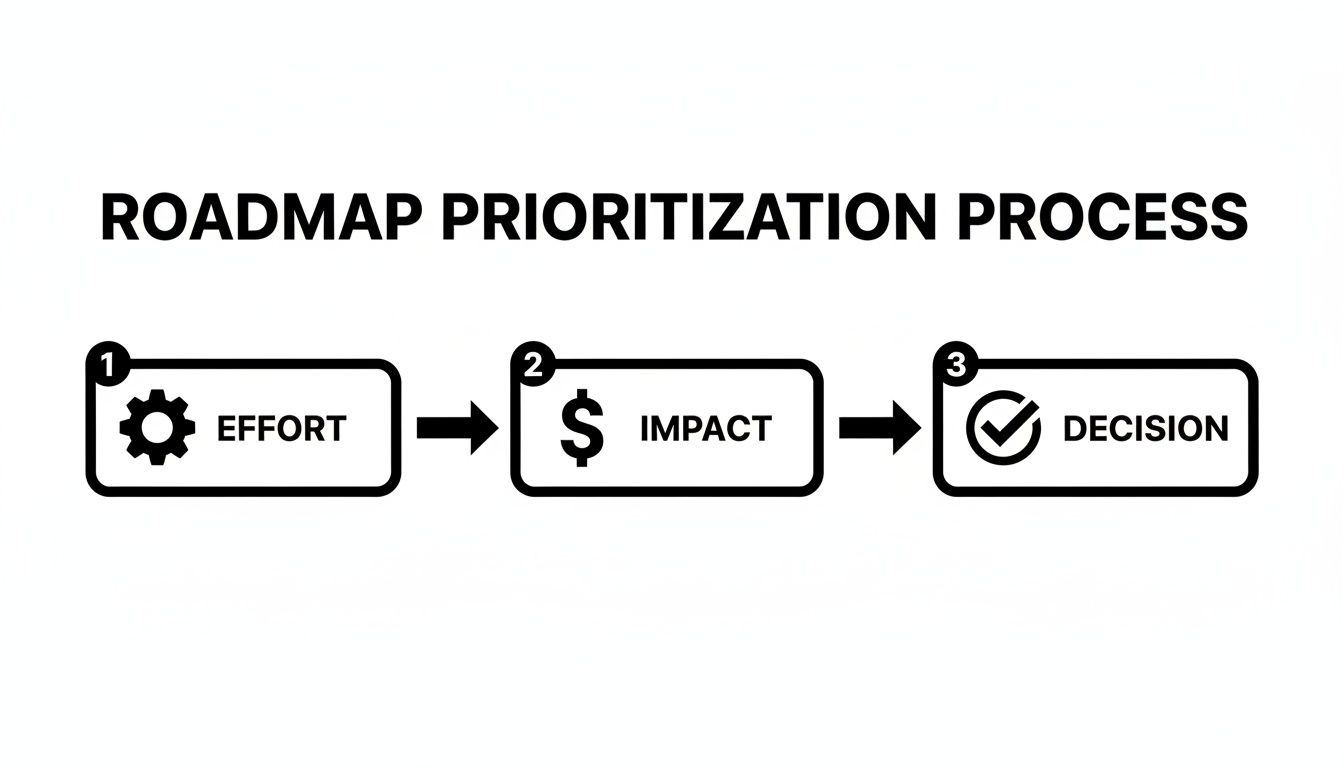
It’s all about making sure your most valuable resources—your team’s time and energy—are always pointed at the tasks that will deliver the biggest financial return.
Create a Continuous Feedback Loop
Your growth plan can't be set in stone. The market shifts, customer needs change, and new opportunities pop up unexpectedly. To stay on top of it all, you need a system for constant feedback and adjustment. Think real-time alerts that tell you when something important is happening, whether it's a new opportunity or a churn risk.
This is where AI becomes an invaluable partner. It's no secret that AI adoption is on the rise; recent data shows that 65% of businesses are already using it to improve workflows and automate tasks. You can dig into more stats about AI's growing role in business operations on procurri.com. This isn't just a trend—it's a sign that your customers expect solutions that help them make smarter, data-backed decisions.
With an AI-driven platform, you can set up automated alerts for key business triggers:
- Churn Risk Alert: Ping the Head of Customer Success on Slack the moment negative sentiment from a high-value account hits a critical level.
- Expansion Opportunity Alert: Shoot an email to the sales team when a customer on a lower-tier plan repeatedly asks about a feature in your enterprise package.
- New Trend Alert: Notify the product team when a specific feature request suddenly gains traction with a key user segment.
These kinds of alerts help you build a proactive culture, not a reactive one. You stop waiting for quarterly business reviews to spot trends and start acting on them in real-time. This is what a truly operationalized growth plan looks like—a closed-loop system that consistently delivers measurable results.
Common Questions About SaaS Growth Plans
Even the best framework for building a growth plan can leave you with a few nagging questions. That's perfectly normal. Let's tackle some of the most common hurdles SaaS leaders face when putting these ideas into practice.
My goal here is to give you the confidence to move forward, even when things aren't perfectly clear.
How Often Should We Revisit Our Growth Plan?
Think of your growth plan as a living document, not something you carve in stone once a year. The best rhythm I've found is a major strategic review each quarter. This lines up nicely with most business planning cycles and gives you enough time to react to market shifts without constantly changing direction.
But that doesn't mean you ignore it for three months. You need a multi-layered approach to keep things on track.
Here’s how that looks in practice:
- Quarterly: This is your high-level strategy session. Are our big-picture goals still the right ones? Has a new competitor or market trend changed the game? This is when you might adjust your core objectives.
- Monthly: This is a tactical check-in. How are we pacing against our quarterly targets? Are any key initiatives blocked or falling behind? It's about course correction.
- Weekly: This is all about execution. Your team should be huddling to sync up on the immediate tasks and experiments that are pushing you toward those monthly and quarterly goals.
This cadence keeps your strategy agile while ensuring the team stays focused on what needs to get done this week.
The Bottom Line: Your growth plan is a map. You set the destination quarterly, but you check your compass weekly to navigate the real-world terrain you encounter along the way.
What If We Have Limited Data to Start With?
This is probably the most common worry, especially for early-stage companies. Don't let a lack of "big data" paralyze you. The core principle is simple: use the best information you have to make better-informed bets.
When you're short on quantitative data, you have to get scrappy with your qualitative insights. But "scrappy" doesn't mean "messy."
Start with these steps:
- Talk to People (Systematically): Set up a recurring process for structured interviews with new customers, recently churned users, and your most active fans. Your goal is to deeply understand their problems and what they're trying to accomplish.
- Become a Fly on the Wall: Have your product and growth folks listen in on sales calls and customer success check-ins. This is where you hear the unfiltered voice of the customer—it’s an absolute goldmine of raw data.
- Manual Triage: You don't need a sophisticated AI platform from day one. Manually tag and categorize feedback from support tickets in a simple spreadsheet. Look for recurring themes and see if they correlate with specific customer types or plan sizes.
You're trying to move from scattered anecdotes to recognizable patterns. Even just five in-depth conversations can often reveal a critical insight that points your entire strategy in a more profitable direction. As you scale, you can bring in tools to automate this work.
How Do We Get Buy-In From Other Teams?
Getting everyone from engineering to sales aligned around a new growth strategy can feel like herding cats. The secret is to stop talking about your plan and start talking about their goals. You have to connect the dots for them.
When you present your roadmap, frame everything in terms of business outcomes, not product features.
- For Engineering: Frame priorities by their impact. Don't say, "We need to fix this bug." Instead, try: "Fixing this bug will cut support tickets by 15% and protect $50,000 in at-risk revenue. That's two weeks of engineering time we'll get back for new projects."
- For Sales: Draw a straight line from your roadmap to their quota. Point out the exact features you're building to unblock deals they're struggling with or to open up new expansion revenue from existing accounts.
- For Marketing: Give them new stories to tell. A new feature isn't just a widget; it's a powerful new message that can attract a specific buyer or create a clear advantage over a competitor.
When every decision is tied back to a quantifiable impact on revenue, churn, or acquisition, it stops being "product's plan." It becomes the entire company's plan for hitting its most important numbers.
Ready to stop guessing and start building a growth plan strategy backed by data? SigOS is the AI-powered platform that transforms your chaotic customer feedback into a clear, revenue-driven roadmap. We help you automatically identify and prioritize the product improvements that will actually move the needle.
Discover how to connect your roadmap directly to revenue by visiting sigos.io.
Keep Reading
More insights from our blog
Ready to find your hidden revenue leaks?
Start analyzing your customer feedback and discover insights that drive revenue.
Start Free Trial →