Expanded Opportunity Set: A Practical Guide
Learn how an expanded opportunity set helps product teams identify, prioritize, and capture new growth with practical frameworks.

Collecting more feature requests won't make your product strategy better. It'll usually make it noisier, because the customers who write long requests aren't a random sample of revenue at risk. An expanded opportunity set isn't a bigger inbox. It's a disciplined portfolio of credible moves you could make, each staged so you learn cheaply before you commit engineering time you can't get back.
Why More Requests Are Not More Opportunity
Most backlog advice starts with a category error. It treats request volume as demand, then asks you to rank the pile more cleverly. That fails in practice because feedback is structurally biased. Power users and high-touch accounts request often, while users who quietly stop adopting rarely explain themselves before renewal.
I've rebuilt SaaS backlogs where the loudest items were interface preferences from a small group of experienced users. The expensive problems sat elsewhere, in repeated workarounds, stalled onboarding, declining usage, and support conversations that never became feature votes. Counting tickets amplified what was easy to articulate and buried what affected retention.
What Request Counts Miss
A request tells you a customer can name a preferred solution. It doesn't tell you whether the underlying problem repeats across cohorts, blocks a core workflow, or changes a buying decision. It also doesn't reveal latent opportunities, the packaging changes, automations, and adjacent use cases customers won't request because they've normalized the friction or built a workaround outside your product.
That's why a shallow tally needs replacing with evidence about actual needs and behavior. If your team is small and you're still formalizing that discovery work, this customer needs assessment playbook for small teams is a useful starting point for separating stated wants from underlying jobs. Use it to frame better questions, then test the answers against usage and revenue data.
More input gives you more material to misread. It doesn't give you more opportunity until you can connect a pattern to a cohort, an outcome, and a next test.
Treat each validated problem as the start of a decision tree, not as a ticket to build. One problem might justify a retention fix, an expansion module, a different package, or nothing at all after a cheap test. Another might only matter for one enterprise segment and should stay quarantined there until you find repeatability.
The Portfolio Standard
Your expanded opportunity set should answer three direct questions for every candidate:
- Who repeats this problem: Which cohorts show the behavior without being prompted?
- What changes commercially: Does it protect retention, increase usage, enable a cross-sell, or open a segment?
- What's the cheapest proof: What small test would reduce uncertainty before a build?
If you can't answer those, you don't have an opportunity yet. You have an anecdote with a title.
What an Expanded Opportunity Set Actually Means
Start with a shopkeeper who can only buy from nearby suppliers and sell at one local market. Then new shipping routes open, trade restrictions fall, and distant fairs become reachable. She hasn't automatically become wealthier, but her opportunity set has expanded because she can now choose among more suppliers, customers, prices, and places to invest.
That distinction matters. Expansion describes the range of credible choices available before commitment, not the number of choices you exercise. A business with more reachable options can still make bad picks, but it isn't trapped by the limits of its original market.
The Historical Pattern
This isn't a modern software invention. During the first wave of globalization beginning around 1870, trade's share of global GDP rose from about 1% to 8% between 1800 and 1913, and after World War II, trade in goods and services rose from 42.1% of world GDP in 1980 to 62.1% in 2007, while foreign direct investment stock rose from 6.5% to 31.8% of GDP between 1980 and 2006 and foreign workers grew from 78 million in 1965 to 191 million in 2005, according to IMF historical globalization figures. Markets, capital, labor, and production networks became reachable across borders.
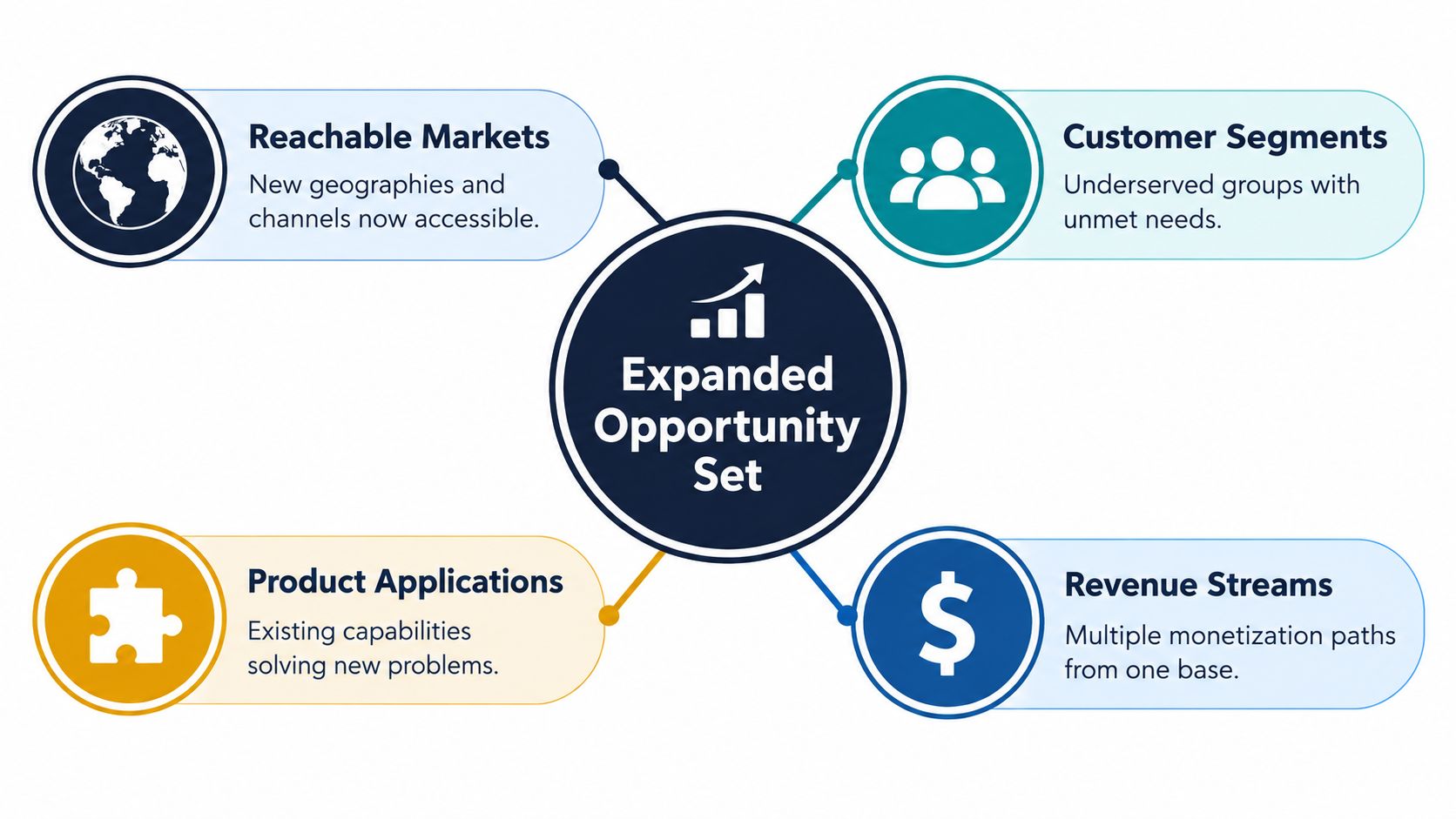
Translate that to SaaS. Your original set might be one buyer, one workflow, and one geography. It expands when the same underlying capability can credibly reach another team inside the account, another industry with the same job, a partner channel, or a new monetization path.
The Four Components in Product Terms
Define your expanded opportunity set as the union of four categories. Retention fixes remove friction that's suppressing adoption. Seat and usage expansion helps existing accounts get more value across more people or volume. Cross-sell paths attach a related capability to an installed workflow. New-segment discovery tests whether an underserved group has the same problem in a form you can serve.
Don't collapse those into one generic growth list. They carry different evidence, sales motions, and downside. A retention fix with clear behavioral proof deserves faster funding than a speculative segment bet with attractive language and no repeatable signal.
New distribution methods can also enlarge the set. Reviewing current AI agent deployment scenarios, for example, can show product teams where an existing capability might serve an automated workflow rather than only a human-operated interface. That's an expanded use case, not proof of demand, and it still needs cohort evidence before you build.
Working definition: An expanded opportunity set is every credible, evidence-backed move your current capability could support, organized by outcome before you choose which few to fund.
Opportunity Expansion as a Real-Options Portfolio
Stop scoring ideas as if you will build the full thing now or reject it forever. That binary habit forces fake forecasts and punishes ideas whose main value is what they open up next. A real-options portfolio gives you a better model.
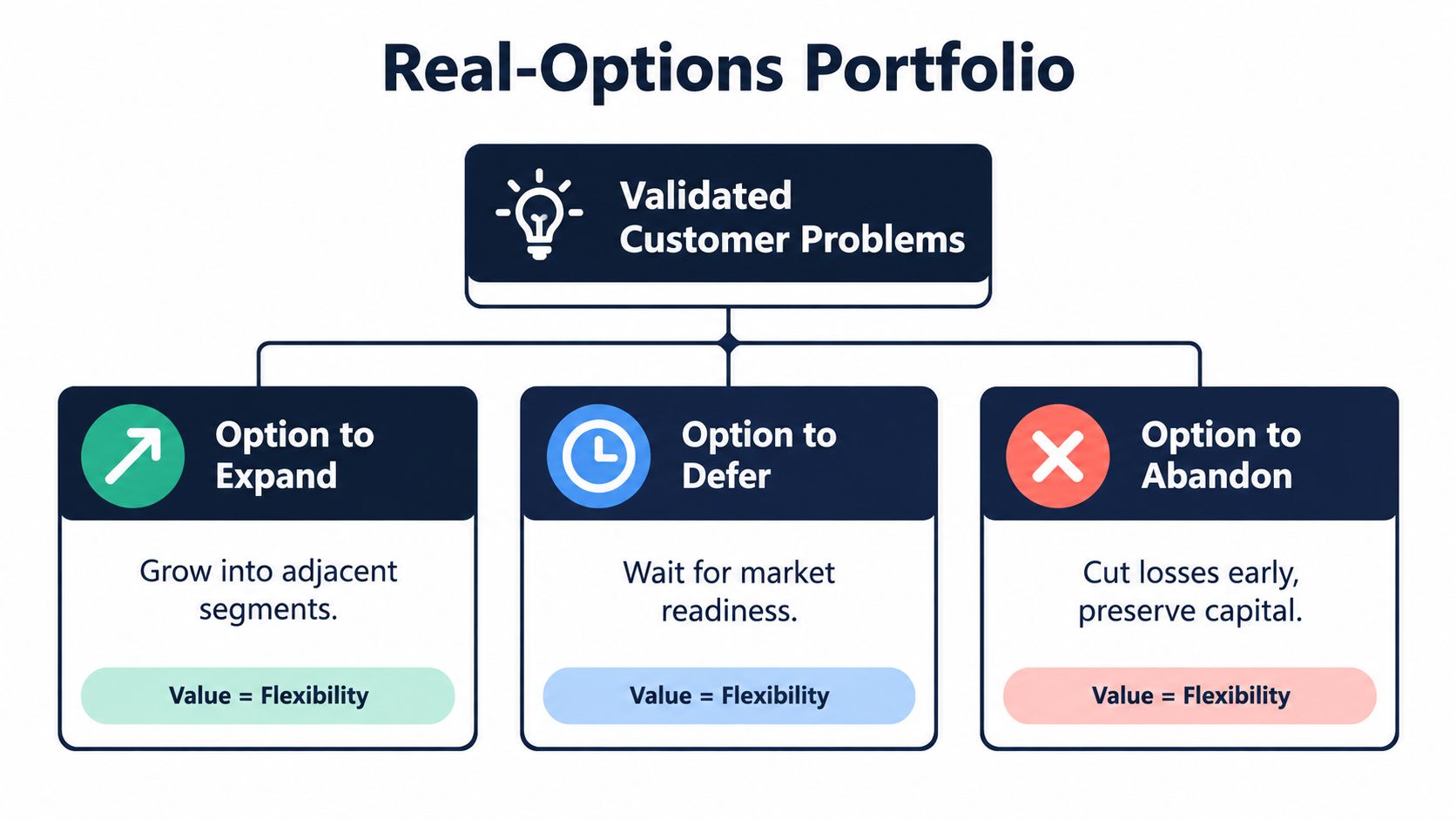
An investment creates the right, but not the obligation, to take a later action. You can enter an adjacent market, scale a capability, switch direction, delay commitment, or abandon the work. Research on real-options investments under uncertainty characterizes these as sequential and partially irreversible decisions, which is exactly why small early spending should buy information before larger commitments lock you in.
The Five Option Moves
Map each move to a product decision you already make:
- Expand: A validated workflow performs well, so you fund integrations and distribution for adjacent teams.
- Scale: Usage grows inside accounts, so you invest in automation, permissions, and reporting depth.
- Switch: Buyers value the capability but not the original surface, so you move it into an API or embedded flow.
- Defer: The problem is real but willingness to pay is unclear, so you wait for a trigger event.
- Abandon: A prototype or concierge test disproves repeat demand, so you stop and keep the learning.
Stage the money accordingly. First prove a recurring problem exists. Then test willingness to pay or change behavior. Fund the heavier build only when evidence improves and uncertainty falls.
Why Reversibility Beats a Big Forecast
A single revenue estimate hides option value. A modest capability might look weak on immediate return but give you access to a new buyer, workflow, industry, or platform ecosystem. Conversely, a feature with a confident forecast from one large account may create no reusable path beyond that contract.
Fund incrementally, keep early commitments reversible where you can, and shift resources toward options with falling uncertainty and rising expected payoff. Evidence linking real-options reasoning to innovation portfolio outcomes supports that discipline, and it fits how teams should run structured product portfolio management when several bets compete for the same engineers. You're not buying features in stages. You're buying the right to make a better decision later.
From Feedback Noise to an Option Map
Take a familiar mess. Support sees repeated complaints about manual status updates, success hears the same issue on renewal calls, sales loses deals where prospects ask about automation, and usage data shows accounts exporting data to finish the job elsewhere. In a request-led system, that becomes one ticket called "add automation" with a vote count.
Don't ship that ticket yet. The pattern is more valuable than the proposed solution because it may point to several different opportunities with different economics. Your first job is to establish whether the behavior repeats across cohorts and whether it correlates with adoption, churn risk, expansion, or lost deals.
One Pattern, Four Branches
Draw the option map before you estimate the build:
- Retention branch: Removing manual updates may stop a measurable drop in weekly active use before renewal.
- Expansion branch: Automated updates could make the product useful to operations teams who don't sit in it daily.
- Vertical branch: One industry may treat the update as a compliance record, creating a narrower but higher-value workflow.
- Platform branch: Partners may need the same event through an API rather than another screen in your interface.
Each branch gets its own next test. Interview the cohort showing exports, prototype the notification, test packaging with accounts that have unused seats, and ask partners whether an event feed would change integration plans. Kill branches quickly when the test fails instead of letting them ride along inside one oversized release.
Product intelligence tooling earns its place. SigOS reports 87% correlation accuracy between identified feedback patterns and revenue outcomes, with sub-minute analysis times, turning overnight behavioral patterns into quantified opportunity options, per SigOS reporting on its correlation accuracy. Used properly, that kind of system helps you apply signal to noise thinking to feedback analysis, so dollar-valued bugs and revenue-linked patterns surface before subjective request volume sets the roadmap.
Practical rule: Never convert a recurring complaint into a feature specification until you've named at least two other ways the same problem could create or protect revenue.
Four Types of Opportunities in Your Set
Route every candidate into one primary category before you score it. If you skip routing, you'll compare a churn fix with a speculative new segment as if they carry the same burden of proof. They don't.
Retention protection should start with behavior, not sentiment. Look for declining usage, abandoned core workflows, repeated workarounds, and support contact patterns tied to accounts approaching renewal. The revenue mechanism is preserved gross retention, and the common failure is shipping cosmetic relief while the adoption blocker stays intact.
Seat and usage expansion is different. You're looking for accounts where a team gets value but nearby users can't join, volumes hit manual limits, or a successful workflow isn't spreading. Expansion ARR accounted for 40% of total new ARR in 2024, up five percentage points year over year, according to Orb reporting on annual recurring revenue statistics. That makes expansion worth hunting, but only where behavior shows unmet demand inside accounts that already succeed.
Route Before You Rank
| Opportunity Type | Dominant Signal | Revenue Mechanism | Common Failure |
|---|---|---|---|
| Retention protection | Falling usage, workarounds, stalled adoption | Preserved renewals and gross retention | Fixing surface complaints, not the blocker |
| Seat or usage expansion | Power-team saturation, manual volume limits | More seats, usage, or higher tiers | Selling expansion into weak adoption |
| Cross-sell potential | Adjacent job handled in another tool | New module or add-on revenue | Building a bundle nobody asked to buy together |
| New-segment discovery | Same job appearing in an unserved cohort | New logos from a new segment | Mistaking one enterprise request for a market |
Cross-sell candidates need proof that customers already move between your workflow and the adjacent job. Exports, integrations, partner referrals, and sales-call language can reveal that seam. If customers don't experience the two jobs as connected, your cross-sell is just a second product wearing your logo.
New-segment discovery carries the highest uncertainty and should receive the smallest first check. A new industry or company size may share the vocabulary of your current buyers while differing on procurement, compliance, integrations, and time to value. Validate the job in that cohort directly, and don't let one high-touch prospect define the segment.
Use the matrix as a routing screen, then ask what evidence would move the item forward. Retention work needs cohort outcomes. Expansion work needs evidence of constrained use. Cross-sell work needs an observed adjacent job. Segment work needs repeatability beyond the account that suggested it.
The Case for Narrowing Your Backlog
Broadening feels safe because nobody has to say no. It's not safe. It spreads engineers across speculative adjacencies while core adoption problems keep taxing every renewal.
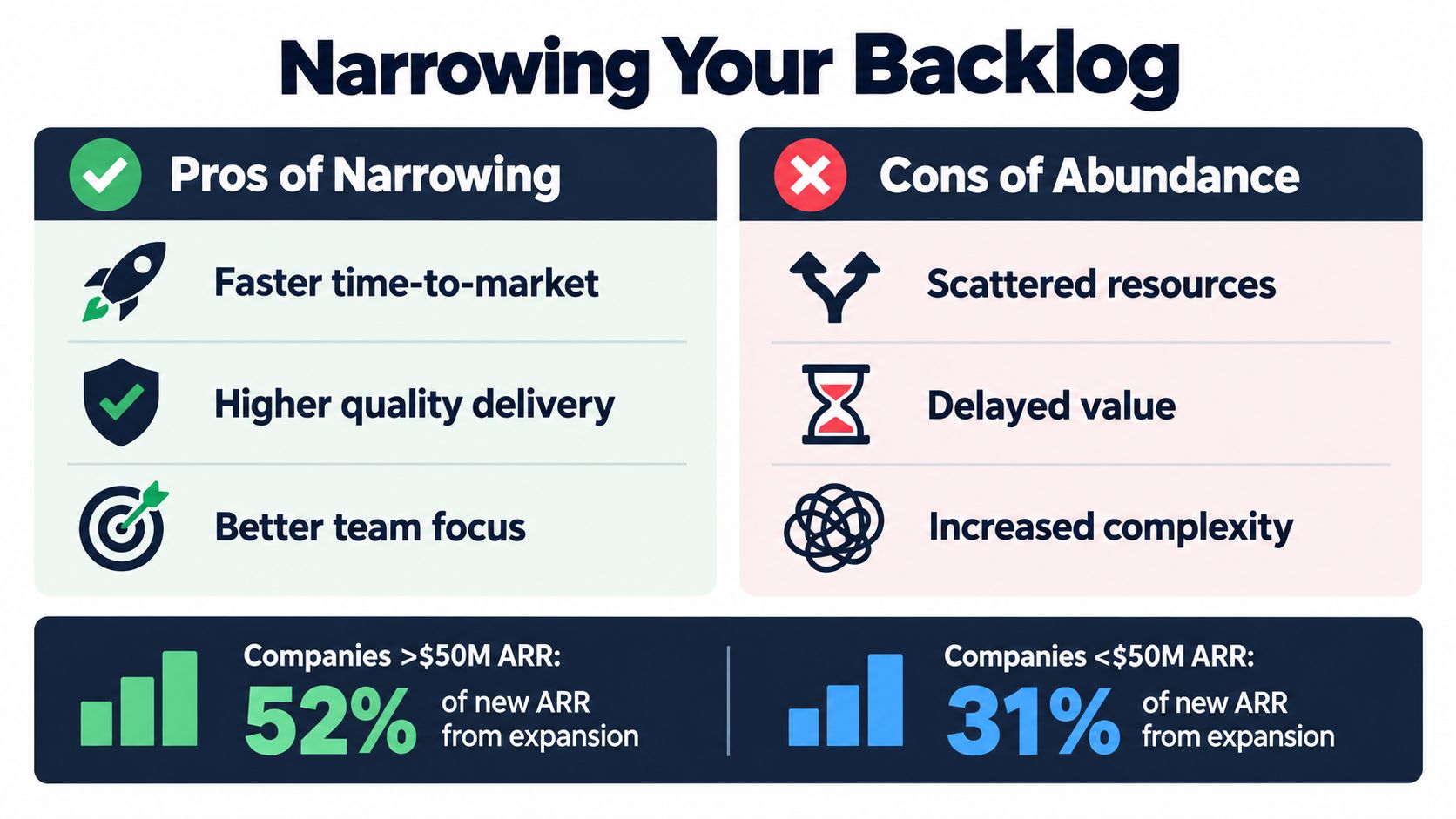
Expansion contributes more than half of new ARR for companies above $50 million in ARR, while overall median net revenue retention remains near 101%, a pattern discussed in analysis of SaaS prioritization from customer feedback. Read those together. Expansion can be powerful at scale, but it barely outweighs churn and contraction for the median business, so it can't indefinitely compensate for weak retention.
Use Negative Criteria
Cut candidates that fail any of these tests:
- No repeatable demand: The problem doesn't recur across a defined cohort.
- No measurable friction: You can't observe stalled adoption, workaround behavior, or lost usage.
- No credible revenue path: Nobody can explain how it protects or grows revenue without hand-waving.
Also test whether the effect holds across regions, company sizes, and contract values. Benchmarks can hide selection bias, and one segment with heavy success coverage can make demand look broader than it is. The same allocation discipline shows up outside SaaS, which is why retail and finance resource allocation tips can be a useful cross-check when you're deciding where scarce capacity should stop going.
Narrow to fewer opportunities that can reduce churn and increase usage at the same time. Treat standalone expansion ideas as experiments until behavioral and commercial evidence says they can scale.
A Prioritization Rubric That Scores Option Value
Score each routed opportunity on six factors. Keep the sheet simple enough that product, success, and revenue leaders will argue with the inputs.
- Incremental revenue: What retained or expanded revenue is credibly at stake for the affected cohort?
- Affected cohort: How many comparable accounts show the pattern, not just how many people voted?
- Evidence strength: Does behavior confirm the words across more than one source?
- Time to value: How quickly can customers experience the improvement after release?
- Architecture reuse: Does the work reuse existing capability and create credible follow-on use cases?
- Cost of next learning milestone: What's the cheapest test that meaningfully reduces uncertainty?
Weight retention evidence and cohort repeatability heavily, then use a weighted scoring model for product decisions to make trade-offs explicit. For example, a small automation with strong cross-cohort workaround evidence, high reuse, and a cheap prototype should outrank a larger module backed by one account and a long build. Pilot the rubric on your current backlog, review score changes after each test, and promote only options whose uncertainty is falling.
Stop treating your backlog as a voting contest and start funding it like a portfolio of staged options tied to retention, expansion, and revenue impact. SigOS helps product teams connect feedback patterns and product behavior to commercial outcomes, so you can identify which opportunities deserve the next test and which should be cut. Visit SigOS to turn last night's feedback and usage patterns into a ranked opportunity set your team can act on today.
Keep Reading
More insights from our blog



Ready to find your hidden revenue leaks?
Start analyzing your customer feedback and discover insights that drive revenue.
Start Free Trial →