8 Product Management Project Ideas and Examples
Explore 8 practical product management project ideas with objectives, scope, deliverables, metrics, case studies, and implementation tips for PMs and students.
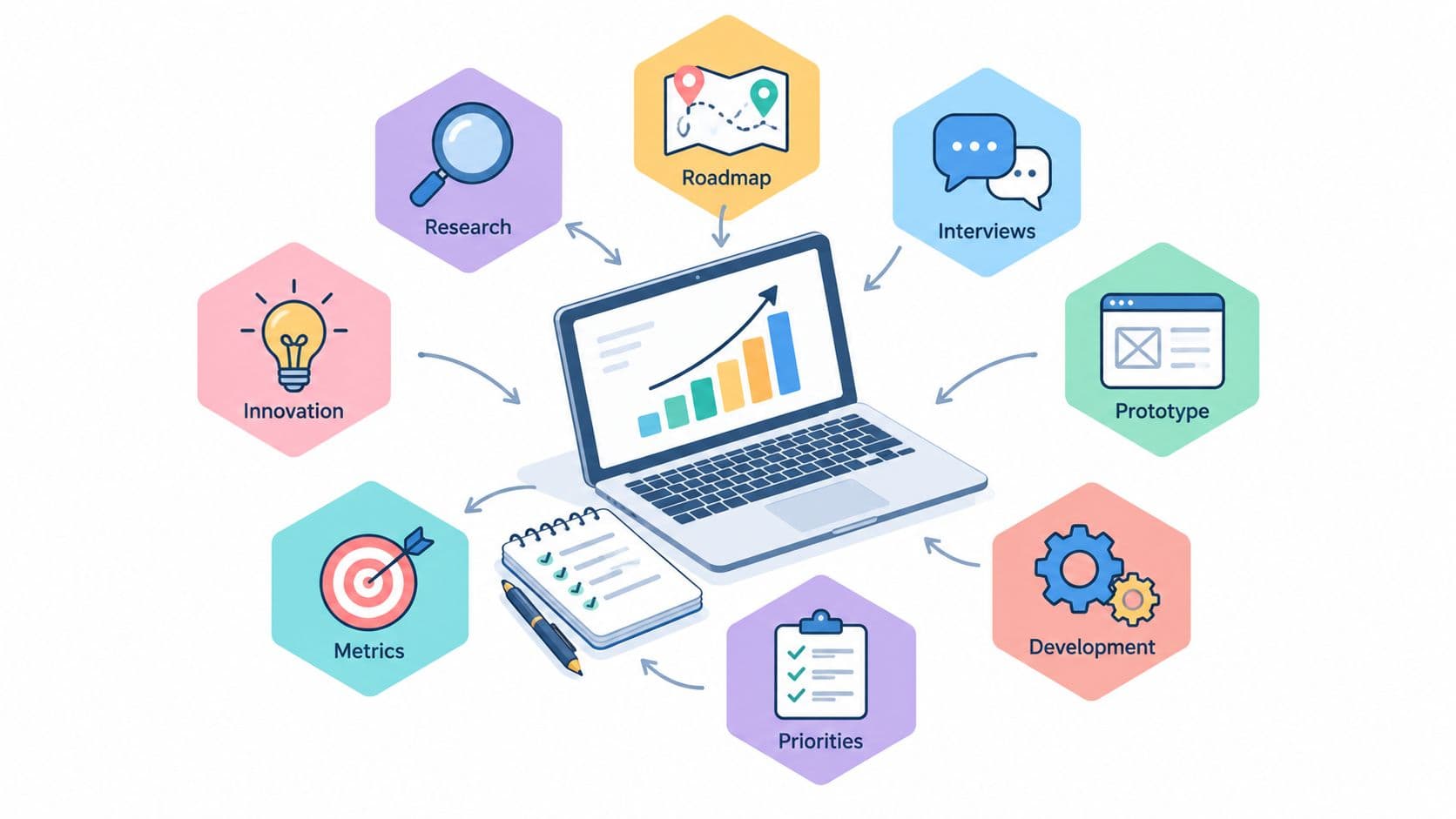
Only 48% of projects qualified as successful under the value-centered definition used in PMI's 2024 project-success research. Finishing the work isn't the same as delivering value. A team can ship every planned feature without making customers more successful or improving the business.
The best product projects turn feedback into decisions. A strong product management project starts with a measurable problem, a deliberate scope, a clear decision owner, and evidence the team can use. The framework matters less than whether you can explain why you selected an opportunity, what you chose not to build, and how you'll evaluate the result.
These eight project ideas cover the practical work between customer signals and product outcomes: collecting evidence, interpreting needs, testing solutions, prioritizing investments, negotiating scope, and measuring adoption. Each can produce something useful for a portfolio, a class assignment, or an actual SaaS roadmap.
Students can work with interviews, public product reviews, and prototype tests, provided they distinguish observed evidence from assumptions. Practicing PMs can add account revenue, support history, behavioral analytics, and engineering estimates. For interview preparation, the playbook for startup founders is a useful starting point.
Choose a project around a decision someone needs to make, not a framework you want to demonstrate. A defensible recommendation to stop an initiative can show more product judgment than a polished proposal to build it.
1. RICE Prioritization Framework
A backlog ranking project is useful when support wants usability fixes, sales wants enterprise capabilities, and engineering wants reliability work. The objective isn't to generate a definitive score. It's to make competing assumptions visible enough that stakeholders can agree on the next investment.
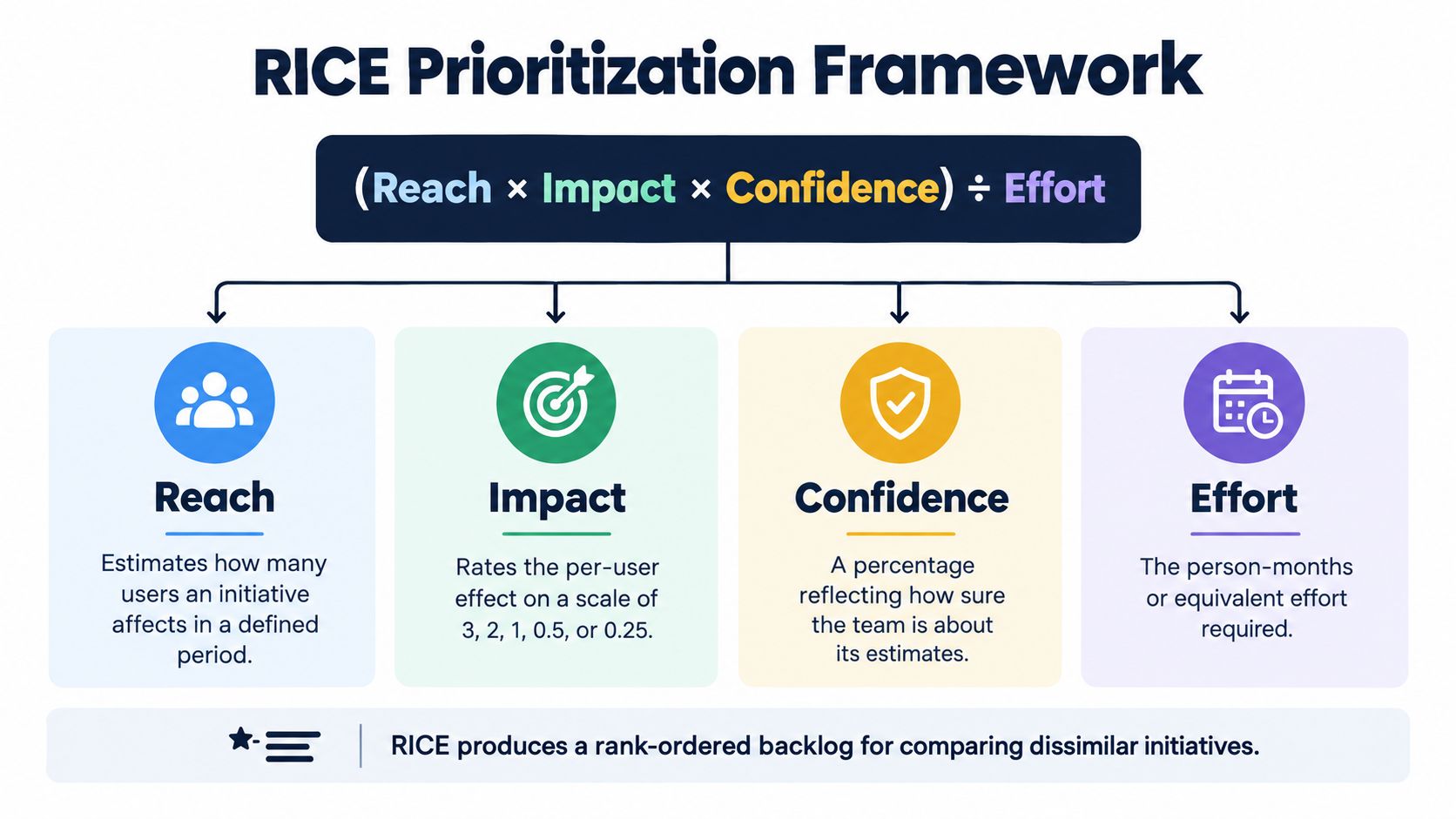
RICE compares Reach, Impact, Confidence, and Effort:
Working rule: Calculate (Reach × Impact × Confidence) ÷ Effort, then inspect the assumptions before accepting the ranking.
Scope the project to a related set of initiatives, such as onboarding improvements. Define Reach using eligible accounts or users within a consistent period, Impact against the same outcome, Confidence from evidence quality, and Effort in an agreed engineering unit. The RICE prioritization framework guide provides a reference for structuring the assessment.
- Deliverables: Create a scored backlog, an evidence register, an assumption log, and a recommendation explaining important exceptions.
- Metrics: Track the customer outcome behind each initiative, such as activation or task completion, alongside estimated versus actual effort.
- Implementation: Deduplicate requests by account, ask engineering to estimate independently, and send weakly supported initiatives back to discovery.
Compare reach without hiding commercial context
For an illustrative SaaS scenario, compare a confusing import workflow with a permissions request from a strategic account. The import problem may reach more customers, while permissions may block an expansion conversation.
Keep affected revenue beside the RICE score rather than changing Reach into a revenue-weighted measure. If you modify the formula, label the adaptation so stakeholders understand what they're comparing.
RICE works well when initiatives share an objective and the estimates are traceable. It works poorly when teams assign precise-looking scores to guesses or use low effort as a reason to prioritize work with little customer value.
2. Opportunity Solution Tree (OST)
An onboarding complaint isn't necessarily a request for a better tooltip. Customers might misunderstand the workflow, lack permission to complete it, or struggle to prepare their data. An Opportunity Solution Tree helps separate those unmet needs from proposed solutions.
The objective is to improve a defined outcome, such as successful onboarding. Limit scope to a target segment and workflow, then connect the outcome to customer opportunities, candidate solutions, and experiments.
Keep the distinction between discovery and ranking explicit. This RICE illustration shows the scoring mechanics you can apply after identifying candidate initiatives.
Build branches from evidence
Deliverables should include the tree, linked customer observations, experiment briefs, and a decision log. Cluster support conversations by the underlying difficulty before brainstorming features, and distinguish observed problems from interpretations.
For an illustrative onboarding project, place difficulty preparing import files on the opportunity layer. Candidate solutions could include a template, an import preview, or assisted setup. Test the riskiest assumption before commissioning a complete workflow redesign.
Measure time from question to evidence, assumptions invalidated, and changes to the proposed roadmap, alongside onboarding outcomes. In a documented discovery project, research time fell from two-to-four weeks to one week, and the team changed its positioning after user feedback, according to the AI-assisted discovery case study.
Use the video as a supplementary explanation of opportunity mapping.
Review branches when new evidence arrives. A beautiful tree doesn't justify investment if nobody has tested whether its opportunities connect to the intended outcome.
3. Kano Model
Customer satisfaction and request volume aren't interchangeable. A missing capability can make a product unacceptable even when customers rarely request it, while an appealing enhancement might attract attention without changing purchasing or retention decisions.
A Kano analysis project examines how customers respond to a capability being present or absent. Its objective is to distinguish baseline expectations from performance improvements, attractive additions, indifferent features, and features some customers actively dislike.
Scope the work to a specific segment and product decision. The Kano model analysis guide can support the classification process, but the customer responses should determine your conclusions.
- Deliverables: Produce a survey, response-classification sheet, segment comparison, and recommendation linked to supporting interviews.
- Metrics: Assess satisfaction responses, unresolved baseline needs, and behavioral or cancellation evidence associated with those needs.
- Implementation: Test survey wording before distribution and retain contradictory responses instead of averaging them away.
Classify features in context
In an illustrative B2B software scenario, enterprise administrators might treat single sign-on as a baseline requirement, while occasional users care more about setup simplicity. An AI-generated summary might appeal to some users but concern others who need exact, reviewable records.
Don't label AI automation an excitement feature merely because it's new. Ask whether customers value the output, trust it, and can correct it.
That stakeholder dimension matters: 35% of product professionals identified influencing stakeholders as their main obstacle in the product-professional priorities survey.
Kano works best as an interpretation tool, not a complete investment model. Reassess classifications when customer expectations change, and combine satisfaction evidence with usage, commercial context, and implementation costs before committing to the roadmap.
4. Jobs-to-be-Done (JTBD)
A customer asks for another export format. Building it might solve the problem, but the request alone doesn't explain the decision. The customer may need to reconcile records, prepare an executive review, or transfer evidence into a mandated system.
A Jobs-to-be-Done project identifies the progress customers want to make in a particular situation. Its objective is to understand the trigger, desired result, current workaround, and constraints before selecting a solution.
Scope interviews around a recent task or switching decision rather than broad preferences. Ask customers to reconstruct what happened, what they tried, and where they struggled. Capture emotional and organizational concerns alongside functional requirements.
The project should show the steps between a customer's situation and the progress they need.

Turn requests into testable job statements
Deliverables include interview notes, a task timeline, job statements, desired outcomes, and a prototype or experiment addressing a recurring obstacle. Write the job without embedding your preferred feature, then place it in an Opportunity Solution Tree if discovery needs further structure.
For an illustrative reporting-product scenario, a customer-success manager requests a dashboard export because they must assemble a renewal review from scattered account information. The underlying opportunity may be producing a trustworthy account narrative, not downloading another spreadsheet.
A feature request describes a proposed answer. Reconstruct the customer's situation before deciding whether it's the right answer.
Measure task completion, preparation effort, errors, and reliance on workarounds. In a portfolio, report what interviewees demonstrated or described, and clearly label untested commercial implications.
JTBD is less useful when job statements become so broad that almost any feature fits. Keep the circumstances specific enough to guide a real decision.
5. Cost of Delay and WSJF (Weighted Shortest Job First)
A renewal-blocking defect and a reporting enhancement can both be valuable, but they may have very different deadlines. Cost of Delay asks what the business stands to lose by waiting. Weighted Shortest Job First compares that delay cost with job size to support sequencing.
The objective is to order work according to economic urgency, not stakeholder persistence. Scope the project to initiatives with identifiable timing constraints, dependencies, or commercial consequences.
A documented portfolio program reported €1.9 million in incremental annual revenue by its second year while rejecting two of four proposed investments before development spending began, according to Sequent Learning's product-management success stories. The relevant lesson is investment discipline; the case doesn't establish WSJF as the cause.
Separate value, urgency, and effort
- Deliverables: Prepare delay-cost assumptions, a sequencing recommendation, dependency notes, and a commercial validation record.
- Metrics: Track validated revenue exposure, resolution before relevant milestones, and whether expected customer outcomes materialize.
- Implementation: Ask revenue stakeholders to validate commercial consequences and engineering to assess job size independently.
For an illustrative renewal scenario, a permissions defect prevents a customer from completing an operational review. Establish whether the defect threatens renewal, whether a workaround exists, and when the customer needs a resolution before assigning high urgency.
Don't treat all affected annual recurring revenue as revenue that will certainly disappear. Separate account value from the evidence that delay changes the customer's decision.
WSJF is a sequencing aid, not a replacement for judgment. Uncertain estimates, foundational engineering work, and linked dependencies can justify departing from the calculated order. Record the exception and its rationale so the next review doesn't restart the same debate.
6. MoSCoW Prioritization
Release planning can fail even when everyone agrees that the proposed work is useful. The disagreement is often about what must ship now, what can wait, and which compromise still produces a viable customer experience.
MoSCoW creates a shared vocabulary: Must have, Should have, Could have, and Won't have this time. A practical product management project uses those categories to negotiate a bounded release rather than describe a wish list.
Set the objective around a complete customer task, such as enabling administrators to invite colleagues securely. Scope should specify the release constraints, supported segment, and workflow boundaries.
Deliverables include categorized requirements, acceptance criteria, dependency notes, and a deferred-work register. Measure successful task completion, launch readiness, escaped defects, and scope changes rather than treating the number of completed requirements as the outcome.
Make every Must defensible
A global PMI survey reported that 26% of projects failed to meet their stated business goals, as covered in Workplace Insight's report on project outcomes. A scoped release still needs a clear connection to its business goal.
For an illustrative team-invitation release, secure access and correct role assignment may be Must requirements. Custom invitation styling could be deferred if customers can complete the intended workflow without it.
Scope test: If removing a requirement still leaves a safe, usable release that achieves the stated objective, challenge its Must classification.
Ask stakeholders to explain the consequence of omission. Use RICE or WSJF to rank work within categories when the release still exceeds capacity.
Record Won't items with a reason, owner, and revisit condition. MoSCoW works poorly when leaders classify every promise as mandatory or when teams defer necessary operational work because customers won't see it directly.
7. Voice of the Customer (VoC) Program
Only 2% of surveyed organizations reported fully automated feedback analysis, while 7% said they were very efficient at identifying trends in unstructured feedback, according to Unwrap's customer-feedback analysis research. Collecting more comments won't automatically improve product decisions.
A Voice of the Customer project establishes a repeatable process for capturing, interpreting, routing, and acting on customer evidence. Its objective is to make important signals discoverable and accountable, not merely consolidate them in a dashboard.
Start with a bounded workflow, such as recurring onboarding friction, and a manageable set of feedback sources. The Voice of Customer guide supports program design, while these 10 UX research methods offer ways to investigate themes beyond support conversations.
Build a feedback-to-decision workflow
- Deliverables: Create a shared taxonomy, account-linked evidence repository, theme briefs, routing rules, and customer follow-up process.
- Metrics: Track unresolved themes, time to a validated decision, duplicate requests, and outcomes after the team acts.
- Implementation: Retain source excerpts, deduplicate by account, and review AI-generated classifications against the original material.
In an illustrative SaaS scenario, support receives repeated navigation complaints from smaller accounts while sales reports a blocker at a strategic prospect. Compare frequency, affected usage, commercial exposure, confidence, and customer concentration without reducing everything to account value.
Revenue context matters, but it shouldn't erase usability problems affecting an emerging segment. Include behavioral evidence from customers who aren't submitting tickets.
Assign a human owner to consequential recommendations. Review multilingual feedback in context, restrict access to sensitive conversations, and escalate ambiguous themes rather than allowing automated summaries to become unexamined roadmap priorities.
8. Product Analytics and Feature Adoption Tracking
Shipping a requested feature doesn't establish that customers can find it, use it successfully, or gain value from it. A product analytics project investigates actual behavior and tests whether the intended change occurred.
The objective might be improving repeated use of a collaboration workflow. Scope the analysis to eligible users, a defined customer segment, and the events needed to distinguish exposure, trial, successful completion, and repeat use.
An adoption dashboard should make these stages visible rather than combine them into a single engagement total.
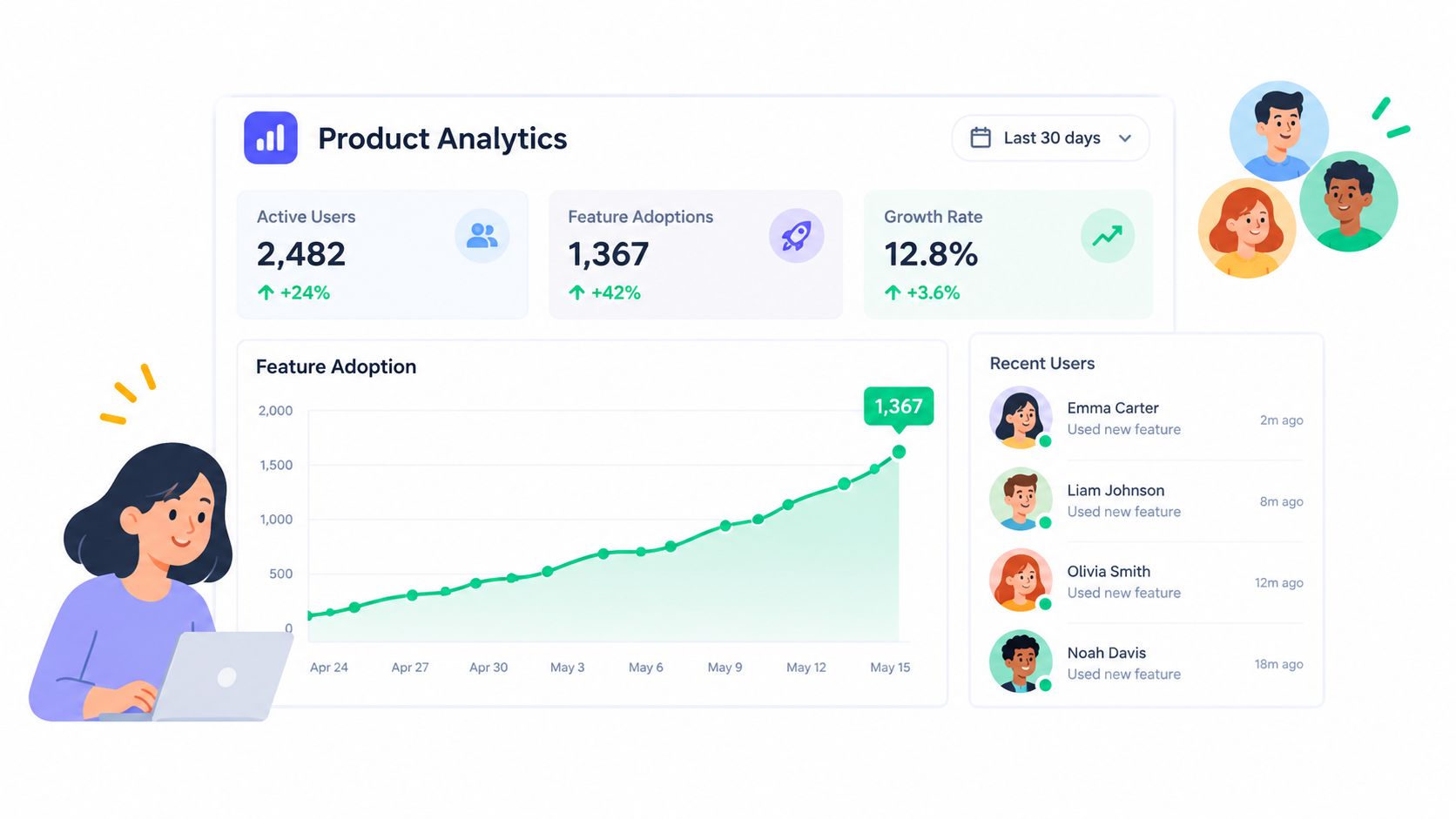
Define meaningful adoption before launch
Deliverables include an event specification, tracking-quality report, cohort dashboard, launch measurement plan, and follow-up recommendation. If you're using Amplitude, Mixpanel, or Pendo, document the event properties and eligibility rules needed for your analysis rather than relying on a default chart.
Define adoption as behavior that reflects the feature's intended value. A page view may show discovery, but it doesn't demonstrate successful use.
For an illustrative collaboration feature, distinguish opening the invitation dialog from sending an invitation and having a colleague complete the shared task. Compare accounts that requested the feature with those that use it, then interview customers whose behavior contradicts the expected demand.
- Outcome metrics: Track successful use, repeat use, task completion, and relevant retention or expansion indicators.
- Guardrails: Inspect errors, support contacts, permission failures, and unintended effects on adjacent workflows.
- Implementation: Validate instrumentation before interpreting results and compare similar customer cohorts.
Usage associated with retention doesn't prove that the feature caused retention. More engaged customers may already be more likely to stay.
A student project can use a prototype and observed task behavior. Present those findings clearly rather than describing prototype engagement as production adoption.
Product Management Frameworks: 8-Point Comparison Guide
| Framework | 🔄 Complexity & Resources | 📊 Expected Outcome | ⭐ Key Advantage | 💡 Ideal Use Case |
|---|---|---|---|---|
| RICE Prioritization Framework | Moderate; needs estimates for reach, impact, confidence, and effort | Ranked backlog using (Reach × Impact × Confidence) ÷ Effort | ⚡ Creates comparable, auditable scores across initiatives | Ranking a high volume of features, fixes, or requests |
| Opportunity Solution Tree (OST) | High; requires ongoing customer research and regular tree maintenance | Connects a business outcome to opportunities, solutions, and tests | ⭐ Encourages teams to test alternatives before committing | Exploring customer needs tied to a specific measurable outcome |
| Kano Model | Moderate; requires well-designed customer surveys and periodic refreshes | Classifies features by their effect on customer satisfaction | 💡 Distinguishes essential features from performance and delight opportunities | Balancing core product improvements with differentiation |
| Jobs-to-be-Done (JTBD) | Moderate to high; relies on qualitative interviews and analysis | Reveals customer goals, context, and unmet needs | ⭐ Groups feature requests around the progress customers seek | Understanding switching, churn, or needs behind feature requests |
| Cost of Delay and WSJF | Moderate to high; needs value, urgency, and job-size estimates | Ranks work by the cost of delay relative to job size | 📊 Makes time sensitivity and economic impact explicit | Sequencing work with revenue risk, deadlines, or renewal urgency |
| MoSCoW Prioritization | Low; workshop-based, with limited data requirements | Groups scope into Must, Should, Could, and Won't | ⚡ Provides a fast, accessible way to negotiate scope | Release or sprint planning when detailed scoring is impractical |
| Voice of the Customer (VoC) Program | High; combines multiple feedback sources, analysis, and follow-up | Produces organized customer insights linked to business metrics | ⭐ Reduces reliance on isolated anecdotes | Building a continuous, cross-channel feedback process |
| Product Analytics and Feature Adoption Tracking | High; requires instrumentation, analytics tools, and data governance | Measures feature usage by segment and its relationship to retention or expansion | 📊 Reveals observed behavior and post-launch impact | Validating adoption, identifying friction, and monitoring usage changes |
Build a Product Management Project You Can Defend
These approaches are complementary. VoC and product analytics gather signals. JTBD and Kano interpret them. An Opportunity Solution Tree organizes discovery. RICE, Cost of Delay, WSJF, and MoSCoW support prioritization, sequencing, and scope decisions.
You don't need to use every framework in every project. Choose the method that addresses the decision's uncertainty: unclear customer needs call for discovery, competing investments call for prioritization, and an overloaded release calls for scope negotiation.
A project brief should establish what the team intends to change and how it will decide whether to continue. Keep it concise enough for stakeholders to use, but detailed enough that another PM can trace your recommendation back to evidence.
A repeatable project brief
- Business objective: State the customer or business outcome, its baseline if available, and why changing it matters.
- Target user: Specify the segment, role, situation, and eligibility boundaries.
- Evidence sources: Identify interviews, support conversations, usage events, account context, and known gaps.
- Scope boundaries: Describe the workflow under investigation and what the project explicitly excludes.
- Deliverables: Name the artifacts needed to make the decision, such as a validated opportunity, prototype, ranked backlog, or measurement plan.
- Success metrics: Define the primary outcome, supporting indicators, guardrails, and measurement limitations.
- Decision owner: Identify who approves investment, resolves disagreement, and accepts remaining uncertainty.
- Review cadence: Set evidence-review points and conditions that trigger reprioritization, further discovery, or cancellation.
Start with a bounded problem you can investigate properly. Preserve source evidence, label assumptions, and explain why plausible alternatives didn't make the recommendation. Students should separate prototype findings from projected business effects; working PMs should separate revenue exposure from confirmed revenue impact.
A defensible project can change direction. If interviews contradict your initial hypothesis or adoption fails to follow expressed demand, update the recommendation. Treat the change as evidence of learning rather than a failure to follow the plan.
AI-assisted analysis needs the same discipline. Specify human approval points, retain an audit trail, and review uncertain or commercially sensitive findings before they influence engineering commitments. Faster classification is useful only when the team can still inspect the evidence and take responsibility for the decision.
Where continuous behavioral analysis and revenue-linked feedback are relevant, SigOS offers a way to connect customer signals with churn, expansion, and roadmap decisions. Keep the intended outcome and decision ownership explicit regardless of the tool you choose.
The strongest portfolio story isn't that you applied a framework. It's that you identified a meaningful problem, tested the important assumptions, made a reasoned trade-off, and established how to evaluate the result.
SigOS analyzes customer feedback, product-usage signals, and revenue context to help teams prioritize issues and feature requests. Visit SigOS to explore how you can connect your next product management project to churn risk, expansion opportunities, and evidence-based roadmap decisions.



Ready to find your hidden revenue leaks?
Start analyzing your customer feedback and discover insights that drive revenue.
Start Free Trial →