Explain product differentiation in SaaS: Find your unique advantage
explain product differentiation with practical steps to identify your unique advantage and stand out in the SaaS market.

Let's break down what product differentiation really is. Put simply, it’s what makes your product or service stand out from the competition in a way that truly matters to your ideal customer. This isn't about cramming in more features; it’s about carving out a unique space in your customer's mind and giving them a compelling reason to choose you, every single time.
What Product Differentiation Really Means

Think about a street packed with coffee shops. They all sell coffee, right? But one spot always has a line snaking out the door. Why is that? Maybe it’s their ethically sourced, single-origin beans. It could be the baristas who remember your name and your order. Or maybe it’s just the cozy, welcoming vibe that makes you want to stay all day. Whatever that special “something” is, that’s differentiation at work.
In a crowded market—especially in the world of SaaS—if you don't stand out, you're forced to compete on price. That’s a race to the bottom that destroys your profit margins and cheapens the value of your hard work. A smart differentiation strategy is your way out of that trap. It elevates your product from being just another expense to an essential tool your customers can't imagine working without.
For a quick reference, here's a breakdown of the core ideas.
Product Differentiation At a Glance
| Component | Description | Key Objective |
|---|---|---|
| Unique Identity | The specific quality or perception that sets your product apart. | To create a memorable and distinct brand in the customer's mind. |
| Target Audience | The specific group of customers who will value your unique identity. | To focus efforts on the people most likely to become loyal advocates. |
| Competitive Edge | The advantage you have because your unique identity is hard to copy. | To build a sustainable, long-term market position. |
This table shows how these pieces fit together to create a powerful, defensible market position.
The Core Goal Beyond Being Different
The real goal isn't just being different for the sake of it. It’s about being meaningfully different in a way that solves a problem or fulfills a desire for a specific group of people. This is how you build a real competitive advantage—one that’s tough for anyone else to copy. It's the reason people stick with a brand, even when a cheaper or flashier alternative comes along.
This isn’t just a nice-to-have; it's a fundamental part of building a business that lasts. It's what fuels your brand's strength and helps you capture more of the market. In fact, studies from places like RISU Marketing Journals have shown that companies with a clear differentiation strategy often see their revenue growth rates more than double those of their generic competitors.
A differentiation strategy is an approach to make your business unique and distinct from the rest. Its main objective is to increase your competitive advantage by standing out from the noise and giving people a reason to choose your brand over others.
Why It's More Than Just Features
Relying on features alone to set you apart is a dangerous game. Sooner or later, a competitor will copy your best idea. Real, lasting differentiation is much deeper—it's woven into the very DNA of your company. It can come from anywhere:
- A Superior User Experience (UX): Is your product incredibly intuitive, fast, and just plain enjoyable to use?
- Exceptional Customer Service: Do you provide support that makes customers feel genuinely heard and valued?
- A Strong Brand Community: Have you built a tribe of users who feel connected to your brand and to each other?
- A Specialized Focus: Do you solve one specific problem for a niche audience better than anyone else on the planet?
Getting this right is a cornerstone of any solid product strategy. To see how this applies in a specialized field, this guide on What Is Product Differentiation in B2B SaaS? offers some great insights. It’s all about creating a clear, defensible position in the market—and in your customer’s mind.
Exploring Different Ways to Stand Out

Product differentiation isn't a one-size-fits-all strategy. It's really a spectrum of choices you can make to carve out a unique space in the market. Knowing what those choices are is the first step to figuring out which one best fits your product, your team's strengths, and the customers you want to attract.
These paths boil down to two main categories: vertical differentiation and horizontal differentiation. Think of them as two different lenses customers use to evaluate their options. One is all about a clear hierarchy of "better" or "worse," while the other is purely about personal preference.
Let’s dig into what these ideas actually mean for your business and how they apply to more than just a list of features.
Vertical Differentiation: Quality and Price
Vertical differentiation is what happens when customers can objectively rank products from best to worst based on a measurable quality—like speed, power, or sheer effectiveness. More often than not, price is the key indicator here.
Imagine two project management tools. One is a simple, free version with basic task tracking. The other is an enterprise-level platform that goes for $50 per user per month but comes loaded with advanced Gantt charts, resource allocation, and in-depth reporting. A large construction company would almost certainly agree the enterprise tool is "better" for what they need. Their choice is based on a clear pecking order of capability and value.
This type of differentiation usually revolves around:
- Performance: Your tool crunches data faster or handles more complex workloads.
- Durability: Your product is simply built to last longer or withstand heavy use.
- Features: One product just plain does more than its lower-priced competition.
With vertical differentiation, the goal is to position your product as the superior choice on a specific, important metric that customers are happy to pay more for. It’s a direct claim of being quantifiably better.
Horizontal Differentiation: Taste and Preference
On the flip side, horizontal differentiation comes into play when products have similar quality and price but appeal to different customer tastes. There isn't an objectively "better" option—just a better fit for a certain person or team.
Think about two competing CRMs. Both are priced similarly and handle core sales tracking just fine. But one is celebrated for its sleek, minimalist design that works beautifully with Apple products, making it a hit with design-focused teams. The other boasts powerful customization and deep integrations with financial software, which is exactly what data-driven sales ops professionals are looking for.
Neither CRM is definitively better than the other; they are simply different. The decision to buy is based purely on personal preference, workflow, and aesthetic taste.
This is a fantastic way to stand out in a crowded market where core features have become table stakes. Instead of trying to be the "best" for everyone, you focus on being the perfect fit for a specific group.
Moving Beyond Product Features
While features are the most obvious place to differentiate, the most durable advantages are often built on something more. Many of the strongest competitive moats have little to do with the product's core functionality.
Here are other critical areas where you can create some real distance from your competitors:
- Customer Service: Zappos famously built an empire not just by selling shoes, but by delivering legendary customer service that no one could easily copy. That became their main differentiator.
- User Experience (UX): Is your product incredibly simple and intuitive to use? A smooth, enjoyable experience can be a huge advantage, especially when the alternative is clunky and frustrating.
- Brand and Community: Building a strong brand identity and a passionate user community fosters an emotional bond. Customers don't just use your product; they feel like they’re part of something bigger.
- Specialization: Focusing on a narrow niche can make you the undisputed leader in that space. A project management tool built specifically for architectural firms will always have an edge over a generic tool when selling to that audience.
When you look beyond just features, you can build a multi-layered differentiation strategy that is much, much harder for competitors to replicate. This is how you build a lasting moat around your business and secure your place in the market for the long haul.
How to Discover Your Unique Advantage

Often, your most compelling differentiators aren't hiding in a secret product roadmap. They’re scattered in plain sight across customer conversations, support tickets, and usage data. To find them, you need to switch hats—from builder to market detective. It’s not about asking customers for a feature list; it's about uncovering the unspoken needs and recurring frustrations that point to a real market opportunity.
This isn’t a guessing game. It's a systematic investigation. By digging into the right places, you can find that sweet spot where your customers' biggest needs, your competitors' blind spots, and your team's core strengths all intersect.
Analyze Competitors to Spot Market Gaps
Every good detective story starts by surveying the scene. For a product team, that means taking a deep, honest look at the competition. The idea isn't to copy what they're doing, but to find the strategic gaps they've left wide open. A thorough SaaS competitive analysis is essential for carving out your unique position.
Start by looking for patterns in their customer reviews. Are people constantly complaining about a clunky workflow, slow customer support, or a missing integration? These complaints are basically breadcrumbs leading you straight to an underserved need.
Then, dissect their marketing. What benefits are they shouting from the rooftops? If every competitor is claiming "ease of use," you won't gain any ground by saying the same thing. Look for the value they aren't talking about. That’s your opening.
Sift Through User Feedback for Pain Points
Your own customer feedback is a goldmine for differentiation ideas. It's the most direct line you have into your users' world. The only problem? It's often messy, unstructured, and overwhelming.
The key is to move beyond individual feature requests and look for the underlying pain. A user asking for a specific button might really be saying, "This task takes too many clicks, and it's slowing me down."
This is where you shift from just listening to actively interpreting. You need a system for gathering and tagging feedback from every channel:
- Support Tickets: What problems are so frustrating that users have to stop what they're doing and ask for help?
- Sales Calls: What objections or hesitations keep coming up during demos? What "must-have" features do prospects bring up?
- Churn Surveys: Why are customers really leaving? Dig past generic answers like "it was too expensive" to find the root cause.
By pulling all this qualitative data together, you can spot the recurring themes that point to high-value problems—the ones that are truly worth solving. This is the raw material for a differentiation strategy that works because it’s built on real-world frustrations.
Quantify Feedback with Product Intelligence
Once you’ve identified some potential differentiators, you have to connect them to business outcomes. A hunch is not a strategy. This is where modern product intelligence platforms like SigOS come in, helping you turn all that messy qualitative feedback into hard, quantifiable data.
These systems use AI to analyze all of your customer communications—from support chats to sales calls—around the clock. They can automatically surface patterns, connecting a specific bug report or feature request to churn risk or potential expansion revenue. The result is a prioritized list of what actually matters to your bottom line.
This data-driven approach mirrors the market segmentation strategies used by global giants. Think about how Apple has long dominated by tailoring its iPhones to specific groups, from high-end premium users to the more accessible iPhone SE. Platforms like SigOS let you apply that same principle internally. They can help you quantify the dollar value of bugs and predict feature ROI with up to 87% accuracy. This data empowers product teams to move past subjective arguments and focus on what will genuinely win more deals and reduce churn.
Validating Your Differentiation Strategy
Having a great idea for a differentiator is just the start. It's a hypothesis, an educated guess. Believing your product is better because of some unique feature is one thing, but having customers prove you right with their wallets is another entirely.
This is where validation steps in. It’s the make-or-break process of testing your brilliant assumptions against cold, hard reality. Without it, you're flying blind, risking months—or even years—building something nobody actually wants or is willing to pay a premium for. The whole point is to connect your strategy to real business outcomes, turning that unique edge into measurable results like higher conversion rates, lower churn, or a faster sales cycle.
From Hypothesis to Hard Data
Every idea about what makes you different should begin as a testable hypothesis. Don't just say, "Our new AI assistant will make us stand out." That's too vague.
Instead, frame it like an experiment: "We believe that by introducing an AI assistant that automates report generation, we can slash user time-on-task by 30%. We predict this will lead to a 15% increase in upgrades to our premium tier." This structured approach, which you can read more about in our guide on how to do hypothesis testing, forces you to define what success looks like before you sink resources into development.
So, how do you actually test these ideas? The best approaches usually blend qualitative and quantitative methods.
Methods for Validating Product Differentiation
You need a mix of tools to get the full picture—some to understand the "why" behind customer behavior and others to measure the "what" at scale. Here’s a quick breakdown of common methods:
| Validation Method | What It Measures | Best For | Example Metric |
|---|---|---|---|
| Customer Interviews | Qualitative emotional and rational feedback. | Early-stage ideas, exploring pain points, and getting initial reactions to prototypes. | "The majority of interviewees described the new feature as a 'must-have'." |
| A/B Testing | Quantitative user behavior changes. | Validating the impact of a new feature on key user actions within the product. | "The user group with the new feature had a 20% higher conversion rate." |
| Surveys | Perceived value and willingness to pay. | Gauging price sensitivity and market positioning for a new differentiator. | "Customers indicated they would pay 15% more for the plan including Feature X." |
| Beta Programs | Real-world usage and feedback at scale. | Fine-tuning a feature with a dedicated group of early adopters before a full launch. | "Beta users logged in 25% more frequently than the average user." |
Each method gives you a different piece of the puzzle. Interviews might give you the confidence to build, while A/B tests provide the hard data to justify a full rollout.
Measuring the Business Impact
At the end of the day, a differentiator is only valuable if it drives business growth. You have to draw a clear, undeniable line from your unique feature to your key performance indicators (KPIs). This is where you move beyond gut feelings and into data-backed decisions.
Platforms like SigOS are built for this. By constantly analyzing signals from customer interactions—from support tickets to sales calls—they can directly link specific feature requests, bug reports, and pain points to churn risk and expansion revenue. This transforms your validation process into a precise, data-driven engine.
Imagine discovering that bug fixes for a specific integration are consistently tied to at-risk enterprise accounts. Suddenly, prioritizing that work isn't just about "improving quality"—it's a measurable differentiation strategy focused on reliability for your most valuable user segment.
This isn't just a SaaS concept. Take the hyper-competitive wine industry. One detailed study on sectoral brands found that 27.3% of brands that successfully used a dual differentiation strategy boosted their market share by up to 15%. They validated their unique selling points—like a specific flavor profile or brand story—by meticulously tracking sales data and customer feedback.
For product teams using SigOS, the principle is the same, just faster and more precise. The platform quantifies customer signals to prove which efforts will actually reduce churn or drive new revenue, achieving 87% accuracy in its predictions.
By validating your strategy with both human feedback and hard financial metrics, you ensure that every move you make to stand out is a calculated step toward building a stronger, more profitable business.
Common Differentiation Pitfalls To Avoid
Even the smartest product ideas can stumble if they miss the mark in execution. You might end up back at square one, blending in instead of standing out.
To truly shine, you need more than a fresh feature—you need one that speaks directly to your user’s biggest headaches. Below are the most frequent missteps and how to steer clear of them.
Building The “Brilliant” Feature Nobody Wanted
It all starts with a burst of creativity in the war room. The team dreams up a “game-changing” feature, pours months into development, then hears…crickets.
In almost every case, the feature solves a problem that isn’t there. It’s built on hunches rather than hard data. A SaaS vendor might invest in a heavy-duty analytics engine, assuming customers crave complex dashboards. In reality, those same users often just need to export simple reports more quickly.
“The most expensive features are the ones that nobody uses.” They eat up dev time, clutter your interface, and distract from what really matters.
To avoid this trap:
- Ground every roadmap decision in real user data
- Use a platform like SigOS to turn support tickets and feedback into quantitative signals
- Run quick validation tests before committing major resources
Choosing A Differentiator Competitors Can Easily Copy
A flashy feature might give you a momentary edge. But if rivals can replicate it in a weekend, you’ll be back in a feature race by Monday.
Imagine a project management app that rolls out “AI task summarization.” Competitors with access to the same models will mimic it before you know it. Your one-time edge becomes just another checkbox on a comparison grid.
Build defenses into your differentiation by leaning on:
- Exceptional Customer Service: Requires culture, training, and dedication
- A Thriving Community: Takes years to cultivate passionate advocates
- Deep Niche Expertise: Makes you the obvious choice in a specific vertical
Failing To Communicate Your Unique Value
Even a breakthrough product won’t sell itself if your messaging muddles the benefit. Generic lines like “easy to use” or “powerful features” leave prospects guessing.
When your positioning is vague, you force potential customers to do extra work—and they rarely will. If you’ve crafted a CRM designed exclusively for fast-growing e-commerce brands, shout it from the rooftops instead of hiding behind bland claims about “managing relationships.”
To sharpen your message:
- Spell out the specific outcome users gain
- Include real metrics or examples (“cuts onboarding time by 40%”)
- Lead with your differentiator in headlines and calls to action
Building Your Differentiation Action Plan
Okay, so you understand what differentiation is. Now for the hard part: turning that theory into a real-world market advantage. This requires a clear, actionable plan—not just more brainstorming, but a focused roadmap for execution. Let's walk through the steps to take your differentiation idea from a slide deck to a measurable impact that creates a more valuable, defensible product.
First things first, you need to become a market detective. This means conducting a deep competitive audit, but not the kind where you just list out their features in a spreadsheet. You're looking for their strategic weaknesses. Dig into their customer reviews, scour social media threads, and lurk in community forums. What are the same complaints you see over and over? Those are your opportunities.
From Signals to Strategy
While you're investigating the competition, you also need to get your own house in order. Start setting up systems to capture and analyze customer signals from your own users. Think of all the gold hidden in support tickets, sales call notes, or churn surveys. Don’t let that valuable feedback die in a silo. The goal is to bring it all together and find the patterns.
Once you have this raw intelligence, you can start forming a differentiation hypothesis. This can't be some vague aspiration like "be more user-friendly." It needs to be specific and measurable. For example: "We believe that by building a direct integration with popular accounting software, we can eliminate manual data entry for our users. We predict this will lead to a 10% drop in churn for our customers in finance roles within six months."
Of course, even the best plans can go sideways. This is where you have to be careful.
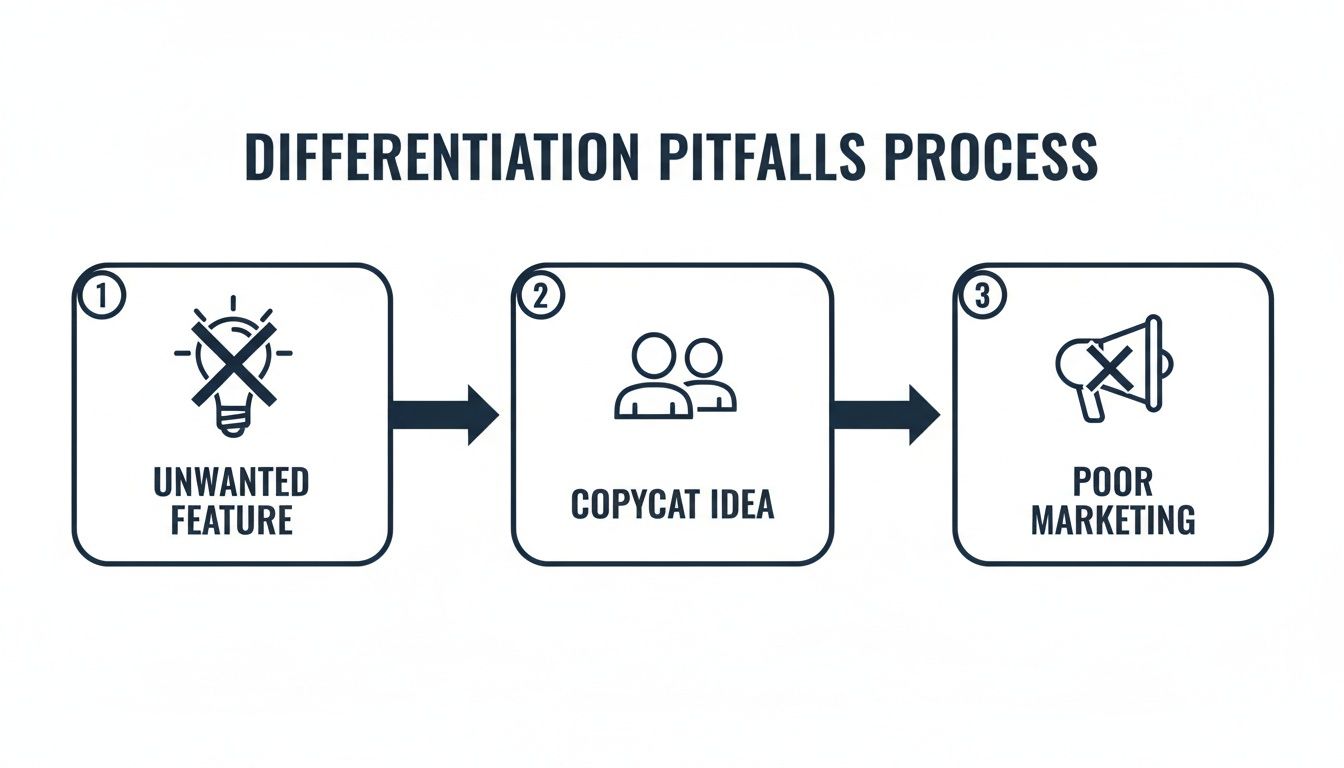
As you can see, a few common traps can completely derail your efforts. Building features nobody asked for, chasing an idea your competitors can copy overnight, or simply failing to communicate your unique value are surefire ways to fail.
Embedding and Executing Your Plan
With a solid hypothesis in hand, it’s time to make it real. The next step is to embed this new differentiator directly into your product roadmap. Prioritizing this work is everything. If you need help figuring out how to weigh it against other initiatives, our guide on using a feature prioritization matrix is a great resource.
Finally, you have to align your entire go-to-market motion around your new differentiator. Your marketing, sales, and customer success teams all need to be singing from the same song sheet, equipped to articulate precisely what makes you special.
A differentiator is only powerful if the market understands and values it. Your product can’t do the talking on its own; your messaging must amplify what makes you the best choice for your ideal customer.
Following this plan transforms differentiation from an abstract concept into a concrete process, giving your team a clear path to building something truly distinct in the market.
Frequently Asked Questions
Even with the best-laid plans, a few questions always seem to surface when you start putting a product differentiation strategy into practice. Let's dig into some of the most common ones to clear up any lingering confusion and help you move forward with confidence.
What's The Difference Between Being Unique And Being Differentiated?
This is a fantastic question because it gets right to the heart of what matters. Being "unique" simply means having a feature or quality that nobody else has. But being "meaningfully differentiated" means that unique quality is something customers actually care about and are willing to open their wallets for.
A unique feature that doesn’t solve a real-world problem is just a gimmick.
Imagine a project management tool that changes its color scheme based on the local weather. Sure, it's unique. But does it help anyone finish a project on time or under budget? Not really. True differentiation would be a unique workflow that cuts project reporting time in half—something a project manager would happily pay for.
The key difference is customer value. Uniqueness is about what your product has, while differentiation is about what your product does for the customer that others can't.
How Can Startups Differentiate Against Big Competitors?
It can feel like a classic David vs. Goliath story, right? The big players have brand recognition, massive budgets, and a feature list that scrolls for days. Trying to beat them at their own game is a losing battle. Instead, you need to change the rules of the game.
Here’s how you can do it:
- Specialize in a Niche: Don’t try to build a CRM for every business on the planet. Instead, build the absolute best CRM for independent real estate agents. By focusing on a narrow market, you can solve their specific problems in a way a one-size-fits-all tool never could.
- Deliver a Superior Customer Experience: Large companies are notoriously slow and impersonal when it comes to support. You can turn this into your secret weapon. Make exceptional, white-glove service your core differentiator and build a loyal tribe of users who feel seen and heard.
- Move Faster: Your small size is an advantage. You can listen to customer feedback on Monday and ship a fix by Friday. Use that agility to consistently solve user pain points faster than a big company's bureaucracy ever could.
How Do I Evolve My Differentiation Strategy?
Your differentiation isn't a one-and-done task. The market is a living, breathing thing—competitors pop up, customer needs change, and technology advances. The feature that makes you a standout today could be table stakes tomorrow.
This means you need to treat your strategy like a product, not a project. It requires continuous attention.
Regularly check what your competitors are saying. Dive into your customer feedback to spot emerging pain points. Track which features are actually driving engagement and revenue. The goal is to see where the market is headed and adjust your unique value proposition before you become just another commodity.
Ready to turn messy customer feedback into a clear, revenue-driving differentiation strategy? SigOS uses AI to analyze all your customer conversations, quantifying the dollar value of bugs and feature requests to show you exactly what to build next. Prioritize your roadmap with confidence.
Keep Reading
More insights from our blog
Ready to find your hidden revenue leaks?
Start analyzing your customer feedback and discover insights that drive revenue.
Start Free Trial →