10 Growth Hacking Tools for Smarter Growth
Compare 10 growth hacking tools for acquisition, activation, retention, and product intelligence, with features, trade-offs, pricing, and stacks.
Collecting more tools doesn't automatically create growth. It often creates more event definitions, duplicated audiences, conflicting attribution, and dashboards no one trusts. The strongest growth hacking tools form a decision loop that connects acquisition data, product behavior, experimentation, lifecycle messaging, and customer feedback.
This list evaluates ten tools as parts of that system, not as isolated products. For each one, the focus is its job in the funnel, the capability it adds, what it can replace, the operational trade-offs it introduces, pricing uncertainty, and the workflow where it earns a place. The historical case for this approach is clear. Dropbox's referral program increased referral sign-ups by 60% and helped users send more than 2.8 million invitations per month by early 2010, according to this history of Sean Ellis's growth-hacking model. The lesson wasn't “buy a referral tool.” It was to connect a product behavior with a measurable acquisition loop.
The list starts with SigOS, a product-intelligence layer for turning qualitative feedback, usage metrics, revenue context, and shipping workflows into revenue-prioritized action. Acquisition tools bring people in, analytics explain behavior, experiments test changes, and messaging moves users forward. SigOS helps teams decide which problem deserves attention first.
1. SigOS
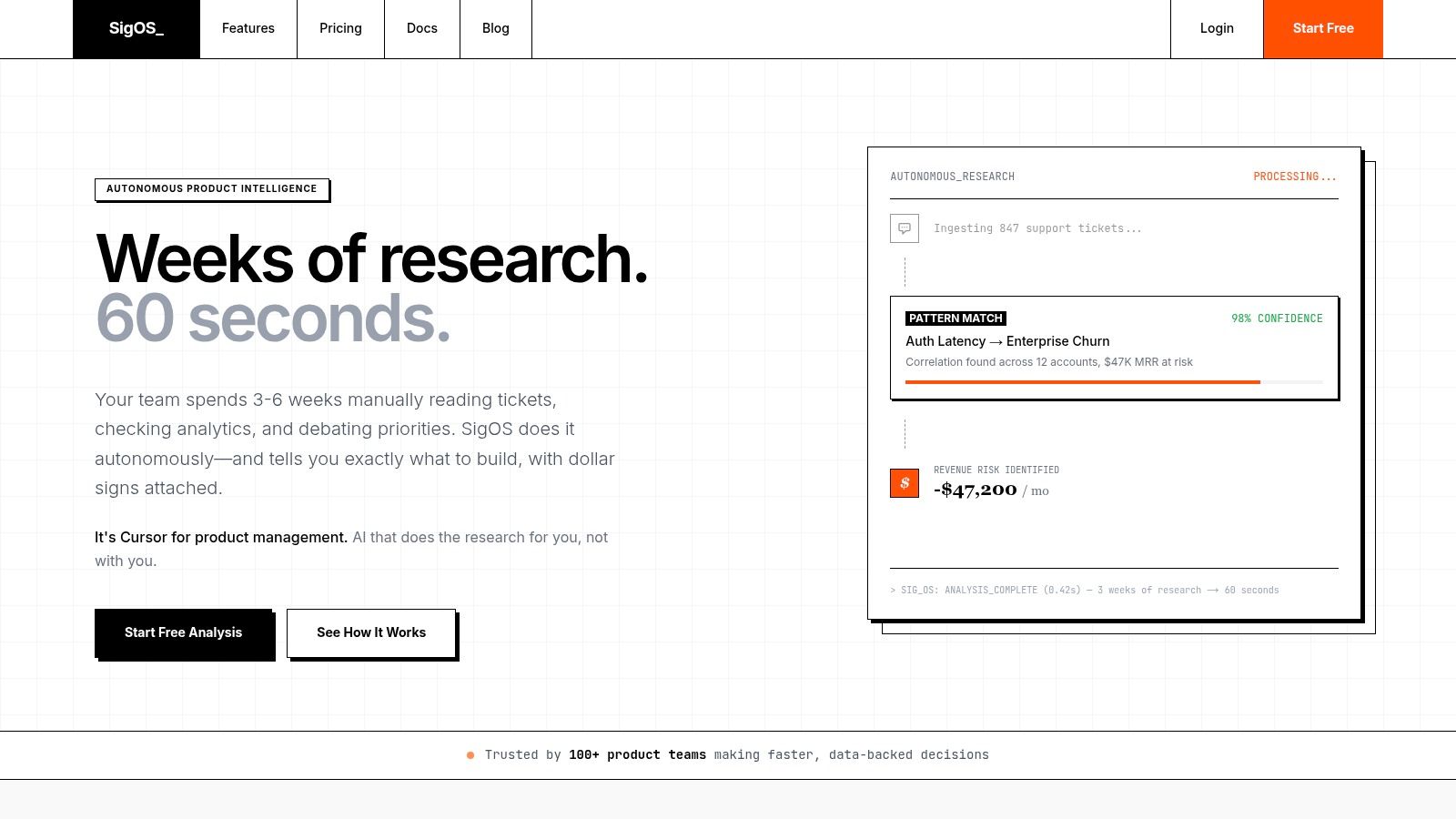
Growth teams rarely need another dashboard. They need a reliable way to turn scattered customer signals into work that someone can validate and ship. SigOS serves that role as a product-intelligence layer, connecting support tickets, chat transcripts, sales calls, product usage, revenue records, and shipping history.
Its practical advantage appears when the signal is distributed across teams. For example, if support tickets about SSO failures spike among $50k+ ACV accounts, SigOS can identify the affected customers and create a Linear issue with a revenue-at-risk score. Product and engineering can then check the underlying cases before committing capacity. That workflow is more useful than another chart showing ticket volume.
SigOS can also connect a reported feature request with account expansion potential, identify the users affected by a bug, and route validated work to Jira, GitHub, or Linear. The product describes sub-minute analysis, including a site example of 0.42 seconds, and reports 87% correlation accuracy for churn-related signals. Teams should test those claims against their own event quality, identity resolution, and customer records, as described by the SigOS product-intelligence platform.
Practical rule: Use revenue impact to rank work, not to approve it automatically. Teams still need to verify causality, scope, customer context, and engineering effort.
Where SigOS replaces manual work
SigOS can reduce recurring spreadsheet reviews, manually tagged feedback repositories, support-to-product meetings, and searches across CRM, analytics, and issue trackers. It fits best when customer feedback is plentiful but account identity, product behavior, and commercial context remain disconnected.
A workable setup starts by ingesting feedback, matching it to accounts and usage, and sending a short list of reviewed priorities into the shipping system. After release, teams can monitor adoption, retention, expansion, or support volume to assess whether the change had the intended effect. This makes SigOS part of the product loop, while analytics, experimentation, and lifecycle tools handle their own jobs.
Trade-offs and evaluation
Data quality determines the output. Incomplete event definitions, inconsistent account identifiers, missing revenue records, and outdated issue histories can produce weak or misleading priorities. SigOS does not publish list pricing, so budget owners should use the free first analysis advertised by the company to assess fit before considering a wider rollout.
Security review also matters. SigOS states that it uses security-first encryption and does not use customer data to retrain models. Security teams should verify retention, access controls, permissions, data residency, and connector behavior before approving production access.
2. Twilio Segment
Twilio Segment is the data-pipeline choice for teams that need one governed way to collect, standardize, and route first-party events. It supports connections to more than 700 destinations, according to the company's product information, making it useful when growth teams need to change analytics, CRM, experimentation, or messaging tools without rebuilding instrumentation each time.
Segment belongs at the foundation of the stack. Engineering defines the event taxonomy, Segment collects and forwards the events, analytics tools interpret behavior, and activation platforms use audiences for campaigns or in-product experiences. Its identity-resolution and warehouse capabilities can also help connect anonymous visits, product users, accounts, and CRM records, although identity design remains a business problem rather than a toggle.
For a B2B SaaS team, Segment can replace a collection of point-to-point tracking scripts and brittle custom integrations. It won't replace a product analytics platform, a CRM, or a customer-feedback system. It makes those systems more consistent by giving them a shared data layer.
What works and what doesn't
Segment works well when the company treats tracking as a governed product rather than a series of requests. Define event names, properties, ownership, validation rules, and deprecation procedures before adding destinations. Otherwise, Segment can distribute bad data faster and make inconsistent definitions look authoritative.
The cost trade-off appears as the stack matures. Basic connections may be straightforward, while advanced customer data platform capabilities are sales-led and can become more expensive with event volume, destinations, and warehouse requirements. Audit the data flow before expanding the contract.
Read this guide to customer data platforms alongside the implementation plan. The important question isn't how many destinations you can connect. It's whether every downstream tool receives the identity, consent, and event context it needs to support a decision.
3. Clearbit
Clearbit supports B2B acquisition by enriching company and person records and identifying organizations visiting a website. Its Reveal capability can give sales and marketing teams account-level context for pricing pages, demo pages, and account-based campaigns, even when a visitor doesn't complete a form.
The best fit is a B2B SaaS motion with a defined ideal customer profile, enough account volume to justify enrichment, and a clear handoff between marketing and sales. Clearbit can shorten forms, improve lead routing, enrich CRM records, and support personalization based on company attributes. It replaces some manual research and reduces the temptation to ask every visitor for extensive information before offering value.
The tool doesn't replace product analytics or intent validation. A company visit is a signal, not proof that a buying committee is active or that an account is qualified. Teams should combine enrichment with page behavior, product activity, campaign source, account ownership, and customer fit.
The operational cost of enrichment
Clearbit's credit-based usage model gives teams granular consumption, but it also requires discipline. Set rules for which records receive enrichment, which fields matter, how often records refresh, and what happens when a credit budget is reached. The free platform has been sunset, so it is wise to model the paid plan against the value of routed or influenced opportunities rather than against the number of enriched records.
Privacy and accuracy deserve careful review. De-anonymization can create compliance and trust concerns, while firmographic data can be incomplete or stale. Use Clearbit to prioritize research and routing, not to make irreversible decisions without human review.
This comparison of customer-data integration tools is useful when deciding whether Clearbit belongs in the same data flow as Segment, your CRM, and SigOS. The workflow should end with an accountable action, such as routing an account, tailoring a message, or creating a research task.
4. Amplitude Analytics
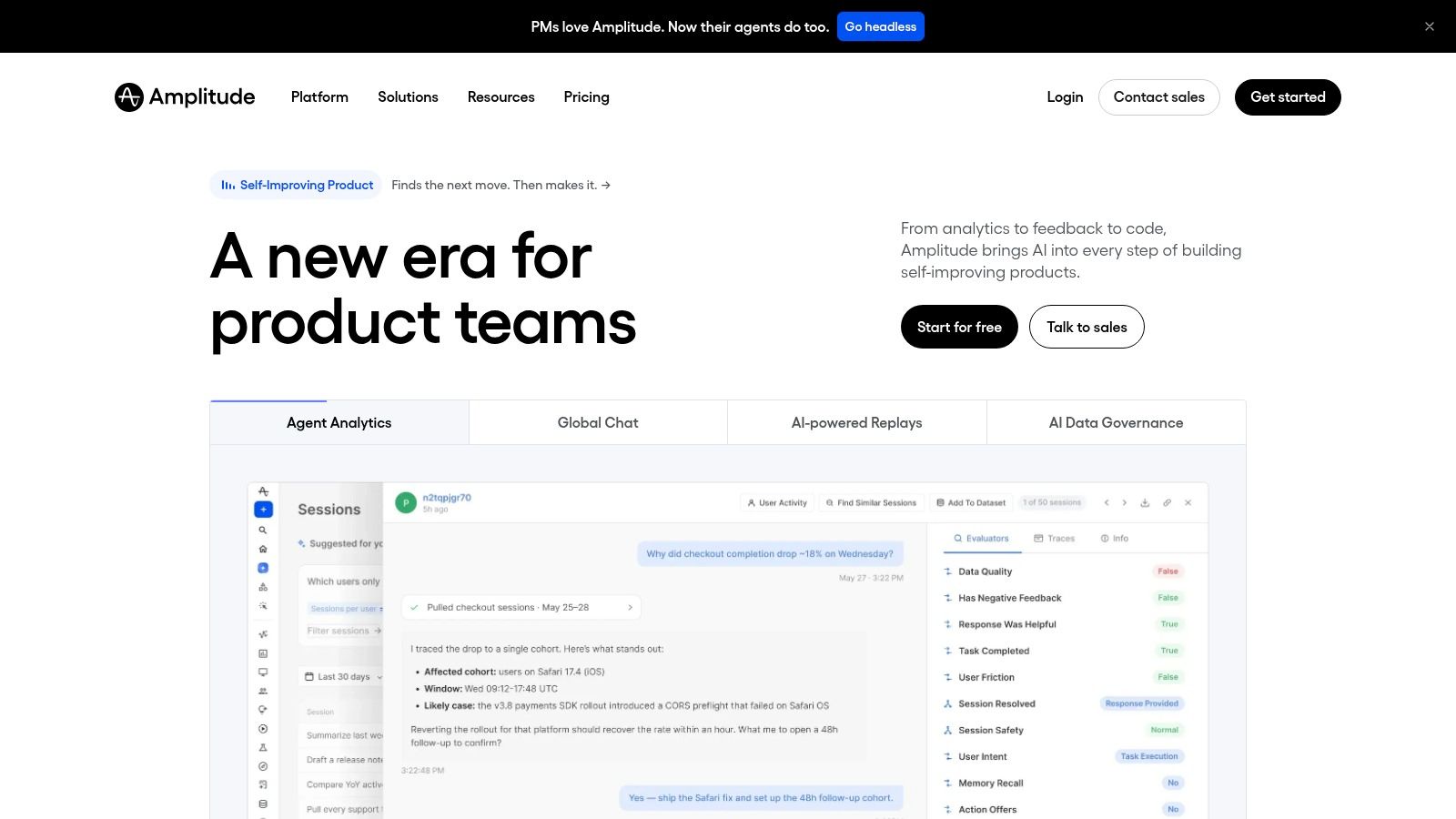
Amplitude is a product-growth platform for teams that want analytics, experimentation, feature flags, session replay, in-product guides, and surveys connected in one environment. Its practical advantage is consolidation. A product manager can trace a funnel drop-off to a cohort, inspect relevant sessions, define an experiment, and activate a segment without maintaining as many separate integrations.
That makes Amplitude a strong product-intelligence and activation layer for product-led growth. Use it to define activation events, compare retention cohorts, examine conversion paths, and connect experiments to product metrics. Client-side and server-side testing support changes beyond landing pages, while feature flags provide a controlled path from hypothesis to release.
Consolidation versus depth
Fewer systems can reduce integration work and reporting overhead. The trade-off is operational ownership. Teams still need clear rules for event quality, experiment design, replay privacy, guide maintenance, and permission management. Without them, adding modules can spread inconsistent data and unfinished workflows across the stack.
Amplitude describes generous early-stage limits, including 2 million events per month and unlimited seats, for its free offering. Verify those terms on the current Amplitude pricing page, since packaging and add-ons can change. Larger data volumes, longer replay retention, advanced activation, and enterprise governance may require sales-led tiers.
Compare evaluation criteria in this guide to choosing a product analytics platform before consolidating modules.
Evidence standard: Treat a funnel chart as a diagnostic, not proof of lift. Revenue decisions should combine product analytics with treatment-control comparisons, revenue-quality checks, and documented tracking limitations.
Amplitude can replace lighter analytics and activation tools, but it does not prioritize customer problems by revenue impact. SigOS can connect behavioral signals with customer feedback, helping teams move from “where do users drop?” to “which problem should we address first?” That link turns product intelligence into a prioritized action across acquisition, activation, experimentation, and retention.
5. Mixpanel
Mixpanel is a practical choice for product managers and growth analysts who want fast, self-serve analysis of funnels, retention, cohorts, flows, and alerts. Its strength is time to insight. A team can investigate a new onboarding path, compare users who adopted a feature with those who didn't, and create a behavioral segment without waiting for a specialized analyst.
Mixpanel also includes experiments, feature flags, and session replay, which gives it more reach than a pure analytics product. Those capabilities work best when the team maintains a clear distinction between discovery and proof. A replay can reveal confusion, while a controlled experiment can test whether a change caused a measurable outcome.
Where it fits
Mixpanel fits the product intelligence part of the stack. It can replace a basic event dashboard and some separate analysis workflows, especially for self-serve teams that need product managers to answer questions independently. It won't replace a customer data pipeline, account-level revenue model, or qualitative synthesis process.
The commercial trade-off is relatively clear online purchasing for smaller teams versus more flexible, quote-based enterprise packaging. Mixpanel also promotes a startup program with a first year free for eligible companies, but eligibility and plan details should be verified before forecasting savings. Event volume, replay retention, permissions, and advanced capabilities can change the total cost.
Use Mixpanel to identify the behavior associated with activation or retention. Use SigOS or a similar intelligence layer to connect that behavior with support themes, account value, churn risk, and the issues already sitting in engineering's backlog. The combination prevents the team from optimizing a convenient metric while missing the commercial problem behind it.
6. Hotjar
Hotjar provides visual behavior evidence through heatmaps, session recordings, funnels, surveys, and feedback widgets. It belongs close to the website and onboarding experience, where teams need to understand whether visitors notice a call to action, abandon a form, misunderstand navigation, or encounter friction that aggregate analytics can't explain.
Hotjar's practical advantage is accessibility. Designers, marketers, product managers, and support leaders can often learn from a heatmap or recording without writing a query. That makes it useful for a rapid qualitative investigation after a conversion drop, a redesign, or a new onboarding flow.
The right use for visual evidence
Hotjar should generate hypotheses, not serve as a standalone success metric. A recording can show that users hesitate, but it can't by itself establish how common the problem is, whether the behavior affects qualified users, or whether fixing it improves revenue. Pair recordings with event analytics, customer feedback, and a defined experiment.
The implementation burden is lighter than a full product analytics rollout, but recording volume and site performance need monitoring. Pricing can rise with higher daily session-recording needs, and privacy controls require careful configuration for sensitive fields and regulated experiences.
Hotjar can replace scattered screen recordings and informal design critiques. It won't replace Amplitude or Mixpanel for cohort analysis, and it won't identify which customer problem has the highest commercial impact. Feed recurring friction themes into the same prioritization process that handles support and sales feedback. Otherwise, the team may fix the most visually interesting session instead of the most consequential one.
7. VWO
VWO is a mature conversion-rate optimization suite for teams that need web experimentation, personalization, funnels, recordings, heatmaps, form analytics, and surveys in one environment. It fits acquisition and activation teams that run repeated website tests and need more governance than a lightweight visual editor provides.
The platform supports visual and code-based testing, which matters because serious experiments often move beyond headlines and button colors. Teams may need to test form logic, pricing presentation, audience-specific experiences, or changes that require engineering control. VWO's broader CRO workflow can reduce the number of separate tools used by marketing, design, and optimization teams.
Where VWO earns its cost
VWO works when the team has enough qualified traffic, a meaningful backlog of hypotheses, and people who can design tests correctly. It won't rescue a weak value proposition or compensate for poor instrumentation. It can also add process overhead compared with a small testing tool, especially when governance, privacy, approvals, and experiment QA are important.
Pricing is commonly quote-based, so buyers should request a scenario tied to traffic, environments, experiment volume, and required modules. Security and compliance claims may matter to regulated teams, but they should be verified against the specific contract and deployment.
A useful VWO workflow begins with a quantitative anomaly, adds Hotjar or survey evidence to explain it, and then runs a controlled test. If the result affects a high-value account segment, send the outcome into the revenue-prioritization layer rather than filing it as an isolated marketing win. This keeps conversion gains connected to activation quality, retention, and expansion.
8. LaunchDarkly
LaunchDarkly is a release-control and feature-flagging platform for teams that need to ship experiments safely. It gives engineering and growth teams targeted rollouts, kill switches, progressive delivery, and the ability to separate deployment from exposure.
That separation changes the risk profile of experimentation. A team can deploy code, expose it to a selected audience, monitor behavior, and reverse the change without a full redeploy when the result is harmful. For SaaS products with complex dependencies or high-value customers, that operational control can matter more than another visual testing feature.
The flag lifecycle matters
LaunchDarkly doesn't create a growth hypothesis or define a success metric. It provides the control plane that lets teams execute one. Before adoption, agree on flag ownership, naming, expiry, access permissions, audit trails, and removal responsibility. An abandoned flag creates branching logic and makes future behavior harder to understand.
Pricing is generally quote-based and can be expensive for smaller teams. The return depends on disciplined release practices, not on the number of flags created. Ask for a model based on environments, seats, service connections, flag evaluations, support needs, and compliance requirements.
Connect LaunchDarkly exposure data to your analytics platform, then connect experiment outcomes and customer feedback to the roadmap. SigOS is complementary here. LaunchDarkly controls what ships and to whom, while SigOS can help identify which bug, feature request, or customer pattern deserves the next controlled release.
9. Appcues
Appcues gives non-technical teams a way to create in-product onboarding and adoption experiences. Tooltips, checklists, modals, announcements, surveys, segmentation, and scheduling let product marketing and growth teams guide users without waiting for an engineering sprint.
Its best use is a clearly defined activation or feature-adoption bottleneck. For example, if analytics shows that users who complete a setup action are more likely to continue, Appcues can create an in-product path that makes that action easier to discover. The team should then measure completion, downstream usage, support contact, and retention rather than stopping at flow views or clicks.
Speed without message overload
Appcues can replace one-off engineering work for simple guidance and reduce dependence on custom UI components. It doesn't replace product usability, documentation, product analytics, or a well-designed onboarding experience. Too many prompts can also train users to dismiss every message, so each flow needs an owner, audience, expiry condition, and success metric.
The platform's pricing scales with monthly active users, and enterprise packaging is sales-led. Published experience tiers and a free trial can help teams test the workflow, but growth in active users can change the economics quickly. Include message governance, localization, mobile requirements, analytics destinations, and permission controls in the evaluation.
A strong workflow uses Segment or a product analytics platform for trusted behavioral events, Appcues for the intervention, and SigOS for recurring feedback that explains why users still fail to reach value. That combination distinguishes a discoverability problem from a missing capability or a product defect.
10. Customer.io
Customer.io is a behavior-driven messaging platform for email, push, in-app messages, and lifecycle workflows. It fits SaaS teams that want activation, re-engagement, expansion, and retention campaigns to respond to product events rather than calendar dates or static lists.
The visual workflow builder helps teams combine events, attributes, segments, delays, branches, and suppression rules. A practical sequence might respond to incomplete setup, repeated use of a high-value feature, an inactive account, or a billing-related event. The message should reflect the user's context and lead to a product action that the team can measure.
Messaging is only as good as the trigger
Customer.io can replace basic newsletter automation and manual lifecycle follow-ups. It won't fix a broken event taxonomy, weak identity resolution, or an unclear activation definition. If the same user appears under multiple identifiers, campaigns can duplicate messages or miss the behavior that should have triggered them.
The company publishes plan matrices, billing details, and a startup program that can provide 12 months free for eligible early-stage companies, according to its current product materials. Eligibility, included volume, premium features, and HIPAA support should be confirmed before purchase. Higher tiers may be difficult for very small teams, particularly when message volume and data complexity grow.
Keep Customer.io downstream of a trustworthy event layer and upstream of a measurement loop. When messages are failing because users repeatedly report the same missing capability, don't keep rewriting the copy. Send that pattern to product intelligence, connect it to account and revenue context, and decide whether the right intervention is messaging, onboarding, experimentation, or product work.
Top 10 Growth Hacking Tools: Features & Use Cases
| Product | Core capability | Unique selling point ✨ | Target audience 👥 | Quality / Impact ★ | Pricing / Value 💰 |
|---|---|---|---|---|---|
| SigOS 🏆 | Autonomous product intelligence: ingests tickets, calls, usage to surface revenue-impacting issues | ✨ Dollar-impact scoring + continuous, sub-minute pattern detection; native Zendesk/Intercom/Jira/GitHub integrations | 👥 SaaS PMs, CS, growth & product intelligence teams | ★★★★★ 87% churn correlation; proven MRR recoveries | 💰 Free first analysis; enterprise / sales-led |
| Twilio Segment | CDP / customer data pipeline: unify events & identity across stack | ✨ 700+ destinations & warehouse sync / reverse ETL | 👥 Data engineers, analytics & growth teams | ★★★★ Real-time audiences; strong attribution | 💰 Usage-based; can scale costs |
| Clearbit | B2B data enrichment & Reveal (visitor de-anonymization) | ✨ Company/person enrichment + Reveal for ABM & retargeting | 👥 Sales, SDRs, ABM & marketing teams | ★★★ Good B2B fit for ICP & routing | 💰 Paid, credit-based usage |
| Amplitude Analytics | Product analytics + experimentation + feature flags + replay | ✨ Consolidated analytics → experiments → activation in one platform | 👥 PLG PMs, growth analysts, experimenters | ★★★★ No-sampling analytics; generous free limits | 💰 Free tier; advanced features often sales-led |
| Mixpanel | Fast, self-serve product analytics with experiments & replay | ✨ Quick funnels, templates & online purchasing for fast time-to-value | 👥 PMs, growth analysts, startups | ★★★★ Fast ad-hoc analysis; strong templates | 💰 Clear pricing; startup program / paid tiers |
| Hotjar | Behavior analytics: heatmaps, recordings & feedback widgets | ✨ Visual UX insights and in-product feedback for rapid iteration | 👥 UX, product & growth teams focused on conversion | ★★★ Visual, quick insights; potential perf impacts at scale | 💰 Free + paid; recording volume drives cost |
| VWO (Visual Website Optimizer) | CRO & experimentation: A/B/n, personalization, recordings | ✨ All-in-one CRO with compliance for regulated teams | 👥 CRO teams, conversion-focused marketers | ★★★ Proven CRO outcomes; needs traffic for ROI | 💰 Quote-based / sales-led |
| LaunchDarkly | Feature flags & progressive delivery for safer releases | ✨ Enterprise-grade flags, governance and rollback controls | 👥 Engineering, SRE, enterprise product teams | ★★★★ Strong governance & risk mitigation | 💰 Quote-based (enterprise pricing) |
| Appcues | No-code in-product experiences: onboarding, flows, NPS | ✨ Build flows without engineering; clear MAU packaging | 👥 PMM, growth & non-technical product teams | ★★★★ Easy to adopt for non-dev teams | 💰 MAU-based pricing; scales with usage |
| Customer.io | Data-driven lifecycle messaging (email, push, in-app) | ✨ Visual workflows triggered by product events & segments | 👥 Growth, retention & lifecycle teams | ★★★★ Strong PLG lifecycle orchestration | 💰 Transparent tiers; startup program available |
Build the Smallest Stack That Closes the Loop
The best growth hacking tools aren't the ones with the longest feature lists. They're the ones that help a specific team move from a trustworthy signal to a controlled action and then back to a measurable outcome. Start by identifying the current bottleneck. Acquisition problems call for audience and enrichment workflows. Activation problems call for product analytics and in-product guidance. Retention problems often require lifecycle messaging, feedback analysis, and a clearer link between behavior and customer value.
Build the foundation before adding orchestration. Establish event definitions, identity rules, consent handling, account relationships, revenue fields, and ownership for every important data source. Segment can help route governed first-party events, while Amplitude or Mixpanel can provide the primary behavioral analysis layer. Don't choose both as default. Select one as the main product analytics system unless a specific separation of use cases justifies the added complexity.
Next, add qualitative evidence where quantitative data leaves unanswered questions. Hotjar can explain web friction visually. Customer.io can act on known behavioral states. Appcues can guide users through an activation path. VWO can test a conversion hypothesis, and LaunchDarkly can control a risky product rollout. These tools solve different problems, even when their feature pages overlap. Choose the one that closes the bottleneck you can name today.
Attribution requires extra skepticism. The Drivers of Growth 2026 report says that 52% of surveyed marketers identified incomplete customer journeys as their top attribution challenge in 2026, while 41% of marketers at large companies identified data accuracy as a primary concern. Those figures are a warning against treating a multi-touch dashboard as causal evidence. When channels, devices, consent states, and dark-social interactions fragment the journey, use holdouts, treatment-control comparisons, incrementality tests, or marketing-mix approaches where appropriate.
Gartner reports that organizations use only 33% of their available marketing-technology stack capabilities, and that 76% of marketing-technology leaders audit tool usage at least twice yearly, as described in its marketing technology research. Before buying another platform, review weekly active users, feature adoption, integration coverage, data freshness, and revenue-linked outcomes. License count is not operational maturity.
The Intuit benchmark offers a related implementation lesson. Among 460 accounting professionals, high-growth firms reported adoption of workflow automation at 43%, AI tools for data extraction and summarization at 41%, data analytics and reporting tools at 41%, and CRM systems at 37%. The same benchmark reported that 61% of high-growth firms viewed their technology stack as a competitive advantage, compared with 37% of moderate-growth firms and 12% of conservative-growth firms, according to this Intuit growth and marketing maturity benchmark. The useful takeaway for SaaS teams isn't to copy those tools. It's to embed each one in a repeatable process with a named owner and an outcome.
Document five things before adopting anything new:
- Decision owner: Identify who can act on the signal and who approves the change.
- Event contract: Define names, properties, identities, consent rules, and deprecation steps.
- Integration dependency: Record what breaks when a connector, API, warehouse sync, or destination changes.
- Pricing threshold: Model usage, seats, monthly active users, events, records, and premium modules before renewal.
- Success metric: Tie the tool to activation, retention, qualified pipeline, expansion, experiment quality, time to insight, or revenue protection.
SigOS is complementary to this stack. It can ingest the feedback and usage evidence that other tools produce, connect recurring patterns to churn or expansion context, and prioritize issues by commercial impact. Its workflow integrations can then create work in Jira, GitHub, or Linear, turning product intelligence into execution. Teams investing in SaaS SEO services should apply the same principle to content and acquisition: measure whether traffic reaches qualified users and product value, not just whether a page attracts visits.
The smallest useful stack is usually the one that makes the next decision easier. Add a tool only when it removes a known bottleneck, strengthens evidence, or shortens the path from insight to action.
SigOS connects support conversations, sales feedback, product usage, revenue context, and shipping workflows to surface the growth problems that deserve attention first. Visit SigOS to run a first analysis, identify revenue-linked customer signals, and turn the strongest priorities into actionable work for your product and growth teams.
Keep Reading
More insights from our blog


Ready to find your hidden revenue leaks?
Start analyzing your customer feedback and discover insights that drive revenue.
Start Free Trial →