How to Make and Sell a Product: SaaS Playbook 2026
Learn how to make and sell a product with our step-by-step SaaS playbook. Go from idea to revenue: validation, MVP, GTM, sales enablement.

Product failure rates stay high, and in SaaS the root cause is usually commercial, not technical. Teams ship features that interview well but do not change buying behavior, shorten sales cycles, or improve retention. If the signal does not show up in pipeline movement, onboarding success, expansion, or churn, it should not carry much roadmap weight.
A common early mistake is treating feedback as proof. A prospect asks for a feature. A customer success manager escalates a request from a large account. An executive wants to match a competitor. Those inputs matter, but they are weak on their own. The stronger inputs come from places tied to revenue: call recordings where the same objection blocks deals, support tickets that reveal repeated workflow failures, product usage that separates retained accounts from stalled ones, and win-loss notes that show what buyers will fund.
The teams that make and sell products well run product development as one operating loop. They use discovery to identify expensive problems, validation to test willingness to pay, product decisions to improve adoption, and go-to-market execution to confirm whether the message holds up in live deals. That is how product, sales, and customer success stop arguing from anecdotes and start working from shared evidence.
After enough launches, the pattern is consistent. Build less than the feature request list suggests. Instrument earlier than feels comfortable. Put commercial weight behind the signals that correlate with conversion, activation, retention, and expansion.
If you're early in the process and need a broader frame for mobile and software delivery, this guide to understanding the app development journey for founders is useful because it lays out the execution path founders often underestimate once an idea leaves the whiteboard.
Introduction From Idea to Impact
A product idea becomes a business only when a buyer changes behavior. In SaaS, that means they book the demo, involve the economic owner, sign the contract, onboard the team, and keep paying because the product solved something that mattered.
That sounds obvious. Teams still miss it because they overvalue expressed demand and undervalue operational evidence. A prospect says a feature would be nice. A customer success manager forwards a request from a strategic account. An executive likes a category trend. None of that is useless, but none of it deserves roadmap priority on its own.
The strongest product teams work from a narrower definition of truth. They look for signals with commercial weight: recurring pain in call transcripts, repeated workarounds in support tickets, stalled deals tied to one missing workflow, and adoption patterns that show which capabilities change retention or expansion behavior.
Build around buying behavior, not applause. Praise in interviews doesn't close deals or stop churn.
There's also a practical reality many teams avoid. The product lifecycle is not one handoff from product to engineering and another from engineering to sales. It's one continuous loop. Discovery informs packaging. Packaging shapes demos. Demos surface objections. Objections reveal onboarding friction. Onboarding exposes missing product value. Then the cycle starts again.
That loop is where most of the value resides. When teams treat sales notes, support conversations, and usage events as one system instead of three separate reporting lanes, roadmap decisions stop being political. They become commercial.
Find High-Value Problems with Customer Discovery
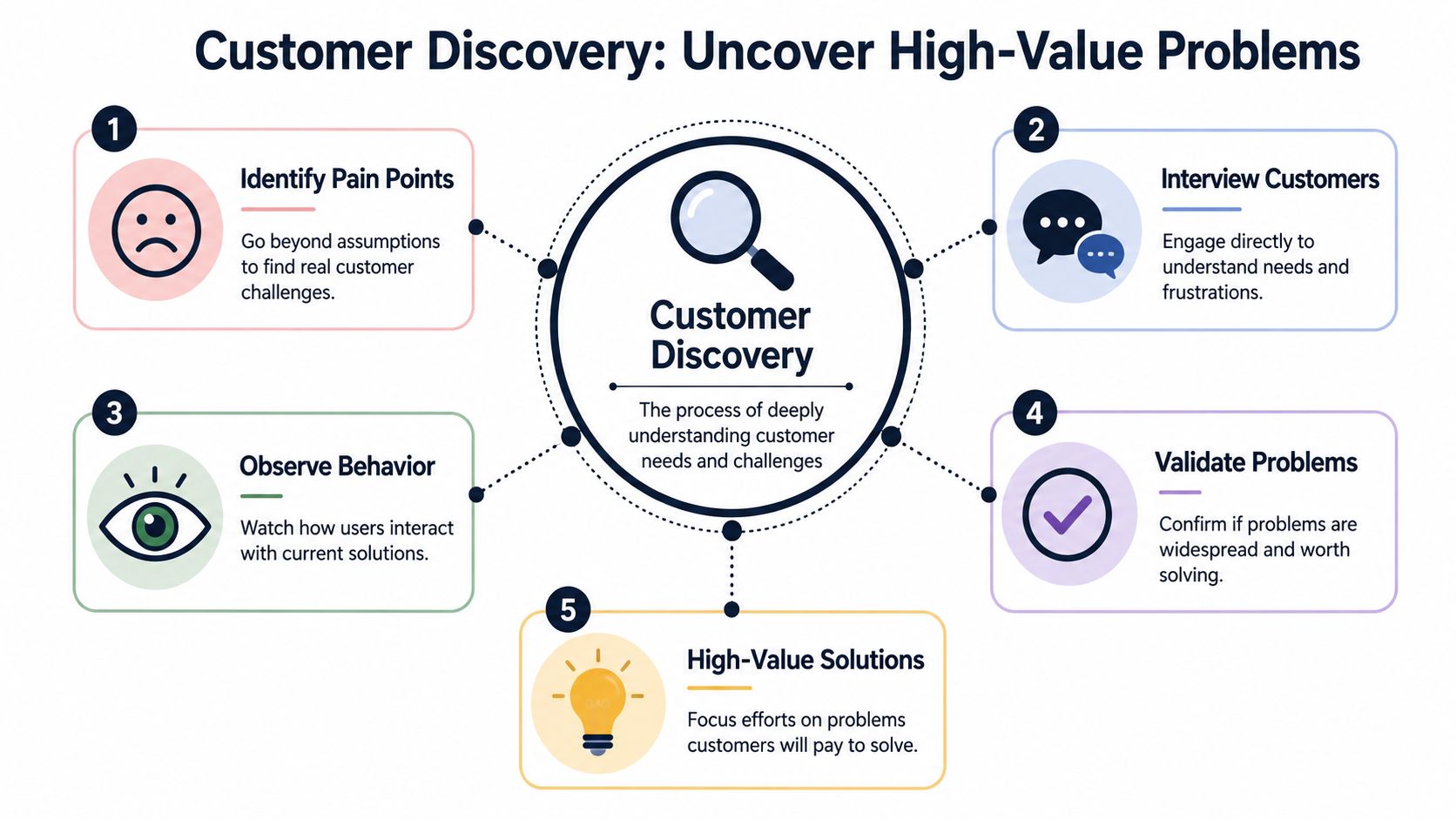
The best product ideas usually don't start as ideas. They start as a repeated struggle that customers have already tried to fix with spreadsheets, workarounds, extra headcount, or the wrong tool. That's where high-value discovery lives.
The cleanest lens for this is Jobs to Be Done. Successful entrants often follow a 5-step process: find the smallest category, obsess over an underserved segment, give a compelling reason to switch, utilize word-of-mouth from early adopters, and dominate the market. That approach is tied to the Jobs to Be Done view that customers choose products to complete a specific job, not to collect features, as described in this piece on finding underserved segments and product angles.
A simple way to operationalize that in SaaS is to stop asking, “What should we build?” and start asking, “What outcome is this person trying to secure, and what fails before they get there?”
Start with the smallest painful segment
Broad markets create weak products. “Sales teams” is too broad. “Series B SaaS sales managers running outbound with lean revops support” is useful. “Support leaders at multi-product SaaS companies dealing with duplicate ticket taxonomies across Zendesk and Slack” is even better.
The smallest category gives you sharper language, cleaner distribution, and fewer false positives in research. It also helps you avoid the common trap of hearing the same surface complaint from very different buyers with very different economics.
Use a few sources together:
- Sales call recordings to hear where evaluation friction repeats
- Support tickets to spot broken expectations and workaround patterns
- Live chat and email threads to catch language customers use without prompting
- Win-loss notes to understand why change happens or stalls
- A structured prompt list like this customer research template to keep interviews consistent enough to compare
Ask for history, not opinions
Most discovery interviews go off track because the interviewer asks for hypotheticals. Buyers are polite. They'll tell you they'd “probably use” something. That answer has almost no roadmap value.
Ask for facts anchored in time:
- What triggered the search? Look for a moment, not a general frustration.
- What did they try before? Existing tools, internal workarounds, consultants, manual processes.
- Who felt the pain first? The user, the manager, finance, compliance, leadership.
- What breaks if this stays unsolved? Delays, missed revenue, reporting gaps, churn risk, team burnout.
- Why now? Budget windows and organizational urgency matter more than abstract need.
A feature request is often a compressed story. Expand it until you hear the failed workflow behind it.
After a few interviews, don't summarize by feature. Summarize by job, obstacle, and consequence. That gives product, design, and GTM one language to work from.
Here's a practical example:
| Signal source | What teams often record | What actually matters |
|---|---|---|
| Sales calls | “Needs better reporting” | Buyer can't prove ROI internally |
| Support tickets | “Import is confusing” | Time-to-value is too slow during onboarding |
| Usage logs | “Low adoption of advanced filters” | Core workflow may not require them |
| Churn notes | “Switched to competitor” | Incumbent solved one must-have use case |
A lot of founders also benefit from hearing this process explained verbally before they run it themselves:
Turn noise into a problem thesis
At the end of discovery, you should be able to write a tight problem statement in plain language:
- Who has the problem
- What they are trying to get done
- What fails in the current process
- Why existing tools don't fully solve it
- Why solving it changes buying or renewal behavior
If you can't write that without buzzwords, you're still too early. Discovery isn't complete when you have many notes. It's complete when the team can point to one painful job, one underserved segment, and one reason a buyer would switch now.
Validate Demand Before You Write a Line of Code
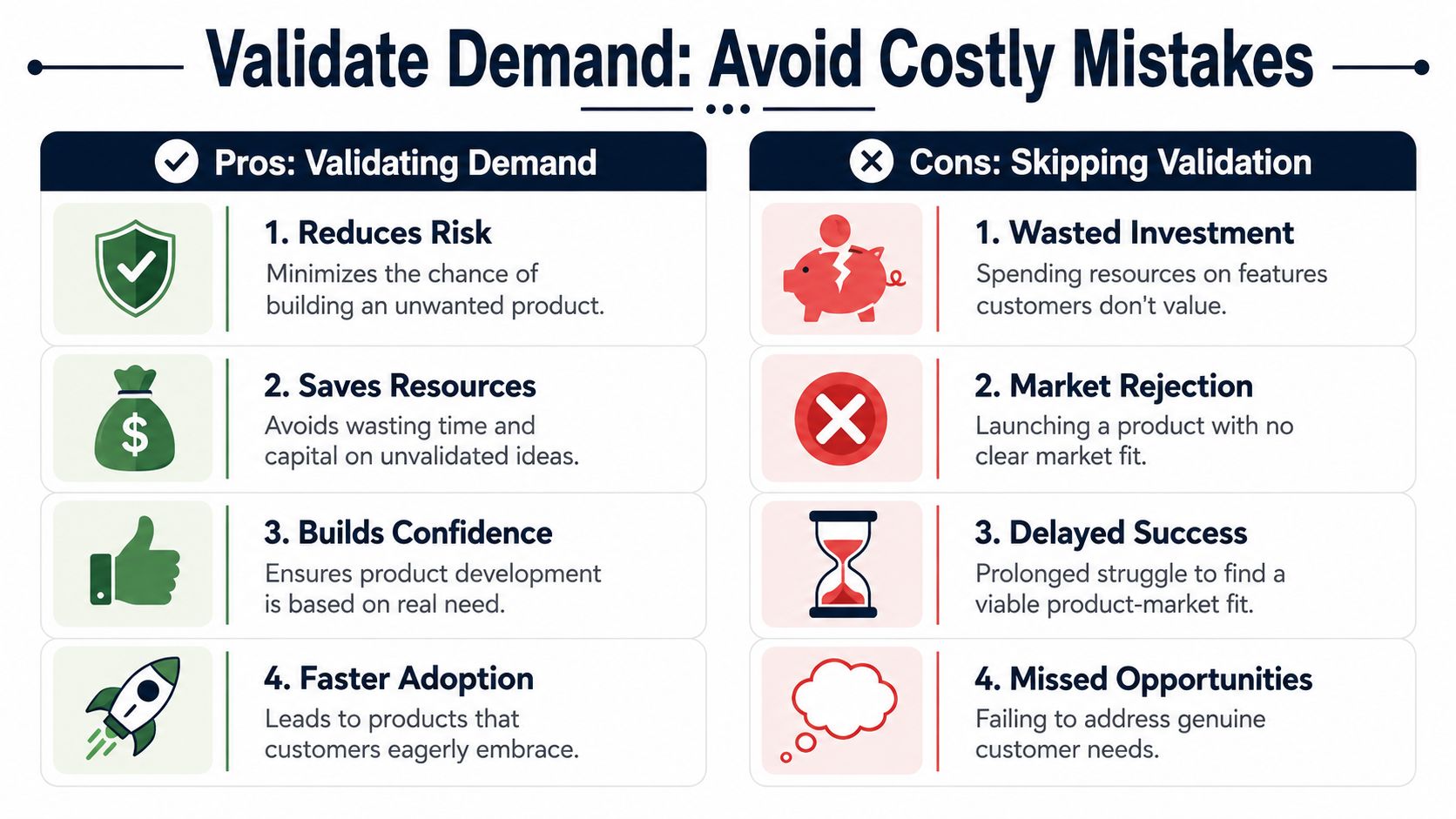
The most expensive feature is the one you built before you proved anyone would pay for it. SaaS teams hide from this by calling internal conviction “vision.” That usually means they skipped the market test because building felt more productive than selling.
Validation should create a forcing function. Put the offer in front of real buyers, ask for an action that has cost or commitment, and watch what happens. Interest is cheap. Action is signal.
Run a smoke test with a real offer
Data shared by entrepreneurs suggests that add-to-cart actions, email registrations, and direct messages are 30% more indicative of genuine purchasing interest than page views, and that a 7 to 14 day preorder or landing page test can confirm willingness to pay before committing capital, as discussed in this Reddit entrepreneur thread on underserved niches and validation.
In SaaS, that translates well into a lean test structure:
- A focused landing page with one job, one buyer, one promised outcome
- A clear CTA such as book demo, join pilot, request early access, or reserve implementation slot
- A price anchor or package framing so buyers react to the economic proposition, not just the idea
- A short follow-up flow that asks why they clicked, what they currently use, and what would block purchase
Page views aren't useless, but they're weak on their own. A buyer who submits a work email, asks about implementation, or requests procurement details is telling you far more.
What to measure and what to ignore
Teams validating demand often over-measure traffic and under-measure intent. That creates false optimism. A decent headline can attract clicks from the wrong people.
Use a simple filter:
| Weak signal | Stronger signal |
|---|---|
| Page view | Demo request |
| Session duration | Reply to outreach |
| Social engagement | Direct pricing question |
| Generic newsletter signup | Pilot or waitlist signup tied to use case |
If you want a structured way to frame these experiments before launch, this guide on how to do hypothesis testing is a practical model for turning assumptions into testable statements.
Practical rule: If the validation step doesn't ask the buyer to risk time, reputation, or money, it probably isn't strong enough.
Don't validate the whole product
You don't need to prove an entire roadmap. You need to prove the first commercial wedge. The test should answer one question: is this problem urgent enough that the target buyer will take a meaningful next step?
That means narrowing the pitch. Don't promise platform breadth. Don't mention every future integration. Don't bury the buyer in architecture. Present the painful before-and-after in terms they already use internally.
A few patterns tend to work:
- Fake door tests for capabilities you haven't built yet
- Concierge delivery where a human does manually what software would later automate
- Pilot commitments with a clear use case and decision owner
- Pre-sales demos using prototype screens, not full production code
What doesn't work is hiding from the market until the product feels polished. Buyers don't reward secrecy. They reward relevance.
If the test falls flat, that's a gift. It means the team still has capital, time, and attention left to redirect. If buyers lean in, now you have permission to build with much more confidence and much less waste.
Build a Metrics-Driven MVP by Prioritizing Revenue
Most MVPs fail because teams confuse “small” with “strategic.” They strip scope, launch quickly, and still miss because the reduced feature set doesn't resolve the commercial bottleneck. A better definition is this: the MVP is the smallest product that removes a buying blocker or retention blocker for a specific segment.
That requires a different prioritization model. Not “what did customers ask for most?” Not “what did leadership promise?” Not “what's easiest to ship this sprint?” The right question is, which product change moves revenue fastest with acceptable effort and risk?
In practice, that means pulling together signals that usually live in separate systems: product analytics, support ticket themes, sales call objections, implementation delays, and churn reasons. The point isn't to centralize data for its own sake. The point is to make roadmap trade-offs with commercial context.
Score opportunities by business consequence
A useful prioritization pass starts with a scorecard. Not every item needs a perfect formula, but each one should be judged through the same lens.
For each request, bug, or workflow gap, ask:
- Does it block new revenue? Sales hears this in demos and security reviews.
- Does it protect existing revenue? Support and success see this in renewal friction.
- Does it accelerate time-to-value? Activation issues often look like usability issues but behave like churn drivers.
- Does usage data confirm importance? Some loud requests come from low-value edges.
- What's the implementation cost and dependency load? A strong revenue case still has to survive engineering reality.
Many teams get sharper once they stop relying on anecdote. In the automotive and industrial sectors, 41% of companies now use data analytics and AI in product development to accelerate decision-making and reduce inefficiencies, according to StudioRed's product development statistics. SaaS teams can apply the same discipline, especially when they already sit on richer behavioral data.
Build the first release around one monetizable workflow
The strongest early SaaS products usually win on a narrow workflow, not a broad category promise. They solve one job all the way through. Buyers can then justify purchase because they can explain the outcome in one sentence.
A weak MVP says, “We help revenue teams collaborate better.”
A stronger one says, “We surface the support issues tied to churn risk so product can prioritize fixes before renewal.”
That difference matters because monetization follows clarity. A focused workflow improves demos, onboarding, and pricing because everyone knows what the product does.
If you need a practical structure for ranking roadmap choices, this feature prioritization matrix is a solid reference point. Use it only after you've attached each item to a revenue consequence. The matrix itself won't save a team that is still scoring based on politics.
Avoid three roadmap traps
Teams that know how to make and sell a product in SaaS usually protect themselves from the same traps:
- The loudest customer trapOne strategic account asks for a custom edge case. The request feels urgent because the relationship is visible. Unless that workflow repeats across the target segment, it belongs in careful review, not automatic priority.
- The usability-only trapUI polish matters, but not every rough edge deserves front-of-roadmap status. Prioritize the friction that delays activation, blocks champion creation, or weakens renewal confidence.
- The platform fantasy trapTeams love building abstractions before they've proved demand. The first release rarely needs a generalized framework. It needs a reliable path from problem to outcome.
The roadmap should read like a revenue thesis, not a feature inventory.
A commercially sound MVP often feels narrower than stakeholders want. That's normal. Breadth impresses internally. Precision sells externally.
Design Your Pricing and Go-to-Market Strategy
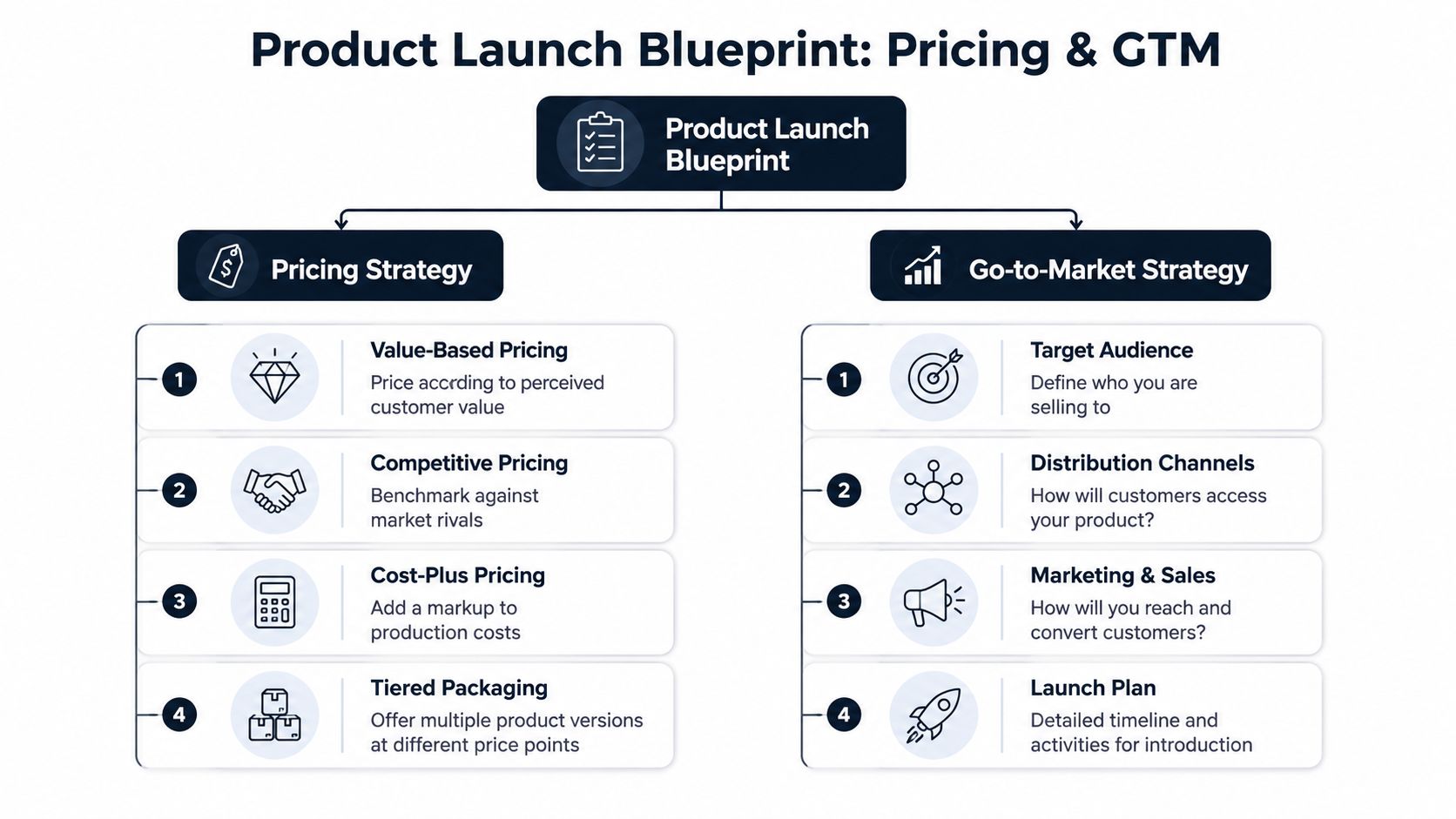
A product can solve a real problem and still struggle because the pricing is vague, the packaging is messy, or the message doesn't give buyers a reason to switch. Go-to-market isn't the layer you add after product. It's how the product becomes purchasable.
The first rule is to price the value created, not the effort it took to build. Buyers don't care that a workflow took six months of engineering time. They care whether it saves manual work, speeds decisions, reduces risk, or enables revenue they can defend internally.
Start with the value metric
Every SaaS product has a natural unit that ties price to customer benefit. It might be seats, usage volume, managed entities, active projects, tickets processed, or revenue under management. Pick the one that scales with customer success, not just with system load.
That choice shapes everything:
- Sales motion becomes easier because buyers understand the bill
- Expansion path becomes cleaner because growth follows usage or value
- Packaging gets more rational because features can support segment differentiation rather than random bundling
If you're comparing how specialized service companies communicate value through their plans, this page on Pricing for GEO services is a useful example of packaging clarity. The specific service differs, but the lesson applies. Buyers respond better when plans map to outcomes and operating context.
Use positioning before discounting
Too many teams reach for discounts when what they really lack is positioning. If the product doesn't have a sharp reason to switch, lower pricing only speeds low-quality demand.
A stronger GTM spine has four parts:
| GTM element | What good looks like |
|---|---|
| ICP | Narrow enough that sales can qualify quickly |
| Problem statement | Specific pain with operational consequence |
| Reason to switch | Clear improvement over status quo or incumbent |
| Proof path | Demo, pilot, onboarding, and success criteria line up |
The “reason to switch” matters most. New products don't win because they exist. They win because the buyer can justify the disruption of change.
Premium can be the right starting point
Cheap is not the default answer for a new product. Eighty-one percent of new products introduced to the market are premium products priced above the category average, according to the same StudioRed dataset cited earlier. That pattern supports what many SaaS teams already learn in market. Early buyers often want confidence, specialization, and clear value more than the lowest possible price.
That doesn't mean pricing high without substance. It means packaging the product around meaningful outcomes and selling to the segment that feels the pain acutely enough to pay for relief.
A practical launch setup often includes:
- One core package that solves the main workflow without feature clutter
- One expansion tier tied to advanced controls, integrations, or scale
- A clear implementation promise so buyers know how fast they'll realize value
- Messaging for one champion and economic language for one budget owner
Premium pricing works when the buyer can repeat your value story in their own internal meeting.
What usually fails is the middle ground. Too many tiers. Too many caveats. Too many “contact sales” pages with no value framing. Buyers don't need infinite options. They need confidence that the product fits their problem and that the commercial model won't become painful later.
Enable Sales and Ensure Customer Onboarding Success
A launch becomes real when the first rep has to sell the product without the founder in the room, and when the first customer has to get value without a custom rescue project. That's where many otherwise promising SaaS products wobble.
The handoff works best when product, sales, and customer success share one operating story. The story is simple: who the product is for, what painful job it solves, what proof convinces a buyer, and what first outcome the customer should achieve after purchase.
Give sales a process, not just a deck
A strong sales motion follows five stages: Research, Making Contact, Discovery or Demos, Closing, and Continued Support, and methods like MEDDIC help reps quantify impact and identify internal champions, as outlined in this guide to building a step-by-step sales process.
That matters because many product launches fail in discovery, not in demo quality. Reps jump into the product before they've established pain, urgency, decision process, and economic logic. Then the call ends with “send me more info,” which usually means the buyer has no internal case to advance.
A practical sales playbook should include:
- Ideal customer profile notes with disqualifiers, not just target traits
- Discovery questions that surface current workflow, pain, and urgency
- Objection handling for budget, migration effort, security, and inertia
- Demo paths specific to role, so operators and executives don't see the same flow
- Champion language that helps an internal advocate explain the value upward
Design onboarding around the first win
Good onboarding doesn't teach everything. It gets the customer to one undeniable result. In B2B SaaS, that often means importing data, connecting one integration, inviting one team member, and producing one useful output quickly.
A common mistake is to mirror the product architecture in onboarding. Customers don't care how modules are organized internally. They care what they need to do first.
A better sequence looks like this:
- Confirm the use case at kickoffRe-state what the customer bought and how success will be recognized.
- Remove setup friction earlyCredentials, imports, permissions, and integrations should happen before training depth.
- Guide to one outcomeShow one report, one alert, one workflow completion, or one collaboration moment that proves the purchase was justified.
- Expand after confidenceSecondary features land better once the core value is visible.
A customer who reaches one clear win forgives a lot. A customer who sees no win notices every rough edge.
Tighten the loop between sales promises and product reality
Disciplined teams outperform. Sales should log the promises that consistently help close. Success should log where customers stumble in the first few sessions. Product should compare both against actual usage.
If sales keeps promising an outcome that onboarding can't deliver quickly, the issue isn't just enablement. It may be packaging, sequencing, or product design. If onboarding repeatedly has to explain one concept manually, that concept probably belongs inside the product itself.
Teams that know how to make and sell a product don't treat post-sale friction as someone else's problem. They treat it as evidence. Every lost champion, delayed launch, and support-heavy onboarding is telling you something precise about the product's readiness to scale.
Measure Revenue Impact and Iterate with Intelligence
Launch reporting often creates false confidence. A dashboard can show signups, activated accounts, and feature clicks while revenue quality is getting worse underneath. I have seen products post healthy engagement numbers at the same time support costs rose, renewals got harder, and sales had to discount around product gaps.
The useful question after launch is narrower and more commercial: which behaviors predict retained revenue, expansion, and efficient delivery?
That changes how teams measure performance. Product usage matters, but only when paired with support volume, onboarding friction, renewal risk, win-loss notes, and the objections sales hears in active deals. A feature matters when it helps a customer complete a recurring job, brings more seats or teams into the workflow, or gives an executive buyer enough confidence to renew at full price.
Track commercial patterns across systems
Strong post-launch reviews connect signals that usually sit in different tools. Product teams should review them together, account by account, segment by segment.
Questions worth answering include:
- Which actions appear consistently in retained and expanded accounts?
- Which onboarding milestones shorten time-to-value for paying customers?
- Which support issues show up 30 to 90 days before churn or downgrade?
- Which missing capabilities force sales into discounting or stall expansion?
- Which workflows create internal champions who bring additional teams into the product?
Product intelligence is the discipline of tying those signals to revenue decisions. Analysts, product managers, sales leaders, and customer success managers all have part of the picture. The job is to combine it before roadmap decisions get made.
For teams building that muscle, it helps to understand SaaS retention metrics in the context of account behavior, contract value, and renewal outcomes. Retention improves when customers repeat a valuable workflow often enough that replacing the product becomes inconvenient and risky.
Prioritize iteration by revenue effect
Post-launch roadmaps get noisy fast. A single prospect request, a frustrated support ticket, and a loud internal opinion can all look urgent if there is no scoring model behind prioritization.
Use a simple decision table instead:
| Signal | Question to ask | Action |
|---|---|---|
| Usage drop in a core workflow | Did the job lose importance, or did the workflow become harder to complete? | Simplify the flow, remove friction, or revisit the use case |
| Support spike from new customers | Is this a defect, a packaging issue, or an onboarding gap? | Fix the root cause in product or onboarding, not just the queue |
| Expansion stall in healthy accounts | What proof is missing for broader rollout? | Add reporting, admin controls, permissions, or integrations |
| Churn warning from CS or sales | Which unresolved issue repeats across at-risk accounts? | Prioritize the issue tied to renewal risk |
Many teams stumble at this stage. They collect feedback well, then rank it badly.
The better filter is simple. Prioritize changes that improve time-to-value, increase adoption of the workflow tied to renewal, or strengthen the buyer's case to expand. Everything else can wait, get packaged differently, or stay off the roadmap.
One more trade-off matters. Local optimization can hurt company performance. A feature that raises click-through inside the product but increases implementation time, confuses packaging, or creates more support dependency may be a net loss. Revenue impact has to include margin, sales efficiency, and retention quality, not just product engagement.
Products improve faster when teams keep closing the loop between user behavior, customer outcomes, and commercial performance.
If your team is sitting on support tickets, chat logs, sales calls, and product usage data but still struggling to decide what deserves roadmap priority, SigOS is worth a look. It helps product and growth teams identify which issues are tied to churn risk, expansion opportunity, and real revenue impact so the roadmap reflects commercial signal instead of feature noise.
Keep Reading
More insights from our blog
Ready to find your hidden revenue leaks?
Start analyzing your customer feedback and discover insights that drive revenue.
Start Free Trial →