Build Your Marketing Technology Stack
Build a powerful marketing technology stack. This guide covers core components, selection, KPIs, & integrating product intelligence for business impact.

You already know the feeling. Campaign data lives in one dashboard, product usage lives somewhere else, sales notes sit in CRM fields nobody trusts, and support conversations never make it back into marketing planning. Every week, someone asks which tools are worth keeping, and the honest answer is usually, “It depends which team you ask.”
That's why a marketing technology stack matters. Not as a list of software categories, but as the operating system behind how marketing turns customer activity into pipeline, expansion, and retention. The problem isn't tool count by itself. It's disconnection. When systems don't share context, teams end up measuring activity instead of business impact.
Beyond the Chaos of Disconnected Tools
Organizations don't need more software. They need fewer blind spots.
A messy stack usually looks functional from a distance. The CRM is live. The email platform is sending. Analytics is collecting events. Paid media is running. But when leadership asks which campaigns influenced revenue, which product behaviors predict conversion, or which customer issues are blocking expansion, the answers fall apart fast.
That's because the industry moved beyond isolated campaign tools. Current architecture guidance has shifted toward data unification and activation, and one framework argues that if a company could only adopt two technologies for its martech stack, they should be data collection and data activation according to Hightouch's martech stack guidance. That's the right lens. A stack earns its keep when it captures customer signals, routes them into systems people use, and triggers action at the right time.
What the stack is really for
A healthy marketing technology stack does three things well:
- Collects signals: Website behavior, form fills, product events, sales conversations, support interactions.
- Creates usable context: It makes those signals visible in the CRM, analytics, and campaign tools without manual reconciliation.
- Drives action: It helps teams route leads, segment accounts, prioritize campaigns, and follow up based on behavior instead of guesswork.
That's why platform comparisons should start with workflow fit, not feature grids. If you're evaluating automation platforms, a practical resource is this Marketo and HubSpot review, especially if you're deciding how much operational complexity your team can support.
Don't ask whether a tool is powerful. Ask whether your team can connect it to the systems that influence revenue.
The old buying habit was simple. Add a tool for each channel. The better approach now is different. Build around shared data, shared ownership, and clear handoffs between marketing, sales, customer success, and product.
The Anatomy of a Modern MarTech Stack
A strong stack works like a business nervous system. Data comes in from many places. Core systems interpret it. Engagement tools act on it. Analytics tells you whether the response worked. If one part is disconnected, the whole system gets slower and less reliable.
Industry guidance consistently defines a marketing technology stack as an integrated system, not a random collection of tools, with value coming from how well the tools work together. Modern stacks usually span data collection, data management, campaign execution, analytics, and integration according to BlueConic's martech stack overview.
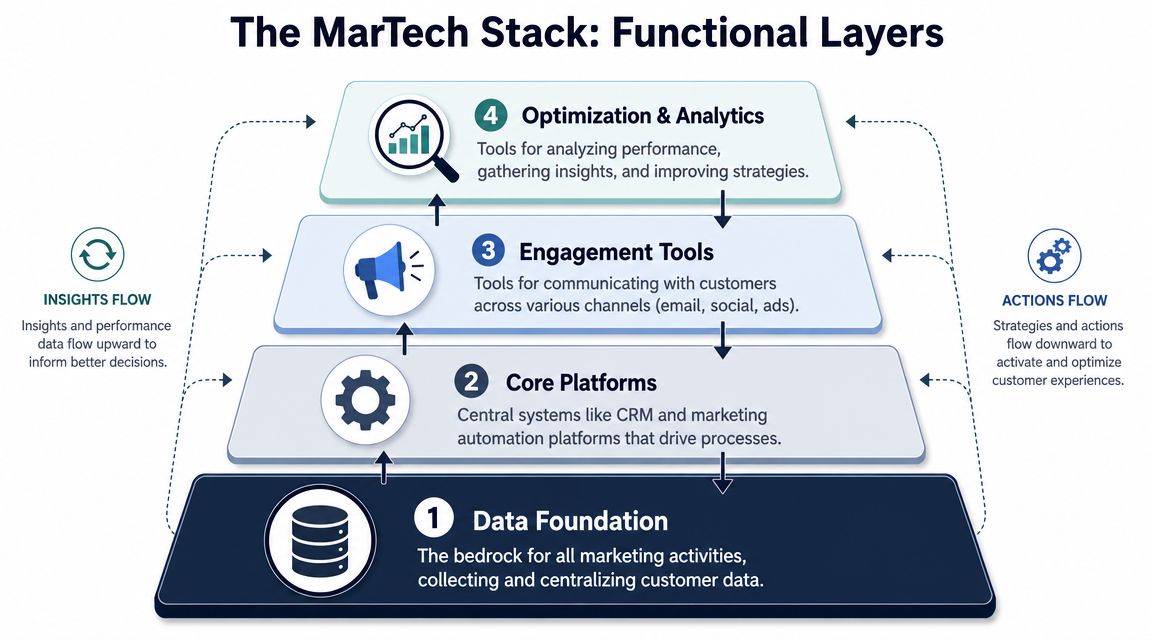
Data foundation
This is the bedrock. It includes event tracking, customer records, warehouse layers, and whatever system creates a stable view of accounts and users.
Without this layer, every downstream tool invents its own version of the customer. Marketing sees one lifecycle stage. Sales sees another. Product analytics sees activity but can't tie it to pipeline. If you need a simple way to think through the structure, this data architecture diagram guide is useful because it frames how information should move between systems instead of treating tools as isolated purchases.
Core platforms
At this stage, process starts to become operational. In many B2B teams, that means a CRM plus a marketing automation platform. For some companies, that also includes a CDP or warehouse activation layer.
The mistake here is letting the CRM become a storage bin. A core platform should do more than hold data. It should govern lifecycle stages, ownership, handoff logic, and reporting definitions.
Engagement tools
These are the visible parts of the stack. Email platforms, ad systems, landing page tools, webinar software, chat, social scheduling, and outbound sequencing. They matter, but they should sit downstream of a clear data model.
If an engagement tool can't take in meaningful signals and send useful outcomes back, it becomes another disconnected execution surface.
- Email and lifecycle tools work best when they use behavioral and account data, not just static lists.
- Paid media tools become more valuable when audience definitions reflect CRM and product signals.
- Web and chat tools should capture intent and push it into sales and analytics systems quickly.
Optimization and analytics
This layer tells you what happened, but it shouldn't be limited to campaign reporting. It should connect campaign activity to opportunity creation, sales progression, retention signals, and customer value.
A stack is healthy when an account's behavior can move from website event to CRM context to campaign response without someone exporting CSVs.
For teams still mapping options, directories can help if you use them carefully. Browse to discover marketing products, then narrow choices based on integration depth and workflow role rather than shiny feature lists.
How to Select and Govern Your MarTech Stack
The expensive part of martech usually isn't the invoice. It's the tool nobody adopts, the workflow duplicated in three places, and the reporting logic that changes depending on who pulls the dashboard.
Gartner reported that 58% of marketing budgets in 2023 were spent on channels, people, and tech, yet stack effectiveness is often limited by fragmentation and underuse, which is why the more useful question is where redundant spend is creating operational drag according to SalesMotion's marketing technology stack analysis.

Governance matters more than shopping
A lot of stack decisions fail before procurement starts. Teams buy for isolated use cases. Nobody defines system ownership. Integrations get configured once and forgotten. Six months later, campaign operations depend on one power user and a handful of manual workarounds.
Good governance is boring on purpose. It answers:
- Who owns the tool
- Which workflows belong in it
- Which data it should receive
- Which data it must send back
- How success gets measured
- When the tool should be reviewed
If those answers aren't clear, don't buy the platform yet.
What to evaluate before you add anything
Feature comparisons come last. Start with decision criteria that expose hidden cost.
- Integration reality: Native integration claims are cheap. Test the actual objects, fields, event timing, and failure handling.
- Operational fit: A powerful platform can still be the wrong choice if your team can't maintain it without outside help.
- Adoption path: If campaign managers, sales ops, or customer success won't use it in daily work, the tool won't produce consistent data.
- Workflow overlap: If another system already handles the same trigger, audience, or reporting logic, adding a second one creates confusion.
- Business role: Every tool should support acquisition, conversion, expansion, retention, or governance. If it supports none of those clearly, it's noise.
Practical rule: Audit workflow ownership before you audit software. Redundant tools usually exist because redundant processes already exist.
One useful habit is to map a single journey end to end. For example, take a demo request from first touch through qualification, meeting held, opportunity creation, onboarding, and expansion. Then document which tool handles each step. You'll usually find duplicate automation, broken attribution, and fields that never sync back upstream.
A walkthrough like this is a solid reset point:
A simple governance cadence
You don't need a massive steering committee. You need discipline.
- Review quarterly: Check active users, workflow volume, integration health, and output quality.
- Document changes: Track field mapping, automation edits, and ownership changes.
- Retire aggressively: If a tool duplicates a core function, consolidate.
- Tie renewals to outcomes: Renew systems that create usable data and visible business movement, not just internal enthusiasm.
That's how stacks stay lean enough to operate and strong enough to scale.
Sample MarTech Stacks for Every Company Stage
The right stack at a startup would be too thin for an enterprise. The right stack at an enterprise would crush a startup with overhead. Tool selection should reflect operating maturity, not vendor ambition.
Here's a practical comparison.
Sample MarTech Stacks by Company Stage
| Category | Startup (Lean & Agile) | Growth Stage (Scaling & Integrating) | Enterprise (Complex & Governed) |
|---|---|---|---|
| CRM | HubSpot CRM or Salesforce with minimal customization | Salesforce or HubSpot with stricter lifecycle design | Salesforce with formal admin governance and cross-team object strategy |
| Marketing automation | HubSpot or Customer.io for fast setup | Marketo, HubSpot, or Braze depending on buying model and channel mix | Marketo, Braze, Adobe, or equivalent with dedicated ops support |
| Analytics | GA4 plus product analytics such as Mixpanel or Amplitude | Product analytics plus BI reporting and cleaner event taxonomy | Product analytics, BI, warehouse reporting, and formal attribution governance |
| CMS and web | Webflow or WordPress | CMS tied more tightly to CRM and lifecycle workflows | Enterprise CMS with governance, permissions, localization, and DAM alignment |
| Data layer | Basic event tracking and reliable UTM discipline | Warehouse or CDP layer for customer unification and activation | Warehouse, reverse ETL, strict identity resolution, and governed data access |
| Engagement tools | Email, forms, light chat, webinar tool | Paid media sync, lifecycle nurture, chat, sales engagement, customer messaging | Cross-channel orchestration, permissions, regional workflows, stronger compliance controls |
| Support and feedback inputs | Help desk and chat with manual review loops | Structured sync from support themes into CRM and planning | Formal voice-of-customer pipelines tied to account and product systems |
| Reporting focus | Lead quality and fast feedback loops | Pipeline movement, segmentation quality, handoff performance | Revenue influence, lifecycle consistency, retention signals, and regional accountability |
Startup
The goal is speed with just enough structure. A startup stack should avoid heavy customization and keep data definitions simple. If one person can't explain how leads move through the funnel in a few minutes, the setup is already too complicated.
Startup teams often benefit more from cleaner naming conventions and tighter CRM hygiene than from adding another specialist tool.
Growth stage
Integration begins to matter significantly more. More channels come online. More people touch the data. Sales wants better routing. Customer success wants lifecycle context. Product wants clearer insight into what converts and what expands.
At this stage, a company usually needs stronger customer unification and better operational visibility. If you're evaluating what belongs in that middle layer, this overview of customer insights platforms is helpful because it focuses on how insights become usable across teams.
Enterprise
Enterprise stacks don't fail because they lack tools. They fail because every business unit builds its own logic.
- Governance becomes essential: Shared field definitions, permission models, and ownership structures matter more than adding another point solution.
- Integration design gets deeper: Sync direction, timing, and source-of-truth rules have to be explicit.
- Change management becomes part of stack strategy: Training, release processes, and documentation are part of the stack whether people admit it or not.
The best enterprise stacks aren't the most crowded. They're the ones where teams know which platform owns which decision.
Integrating Product Intelligence The Missing Link
Most marketing stacks still treat product data as an optional enrichment layer. That's a mistake.
If you only connect CRM activity, campaign engagement, and web analytics, you can explain marketing performance. You still can't explain customer value well enough. Revenue decisions improve when marketing can see what users do in the product, what they complain about in support, what sales hears during evaluations, and which patterns show up before expansion or churn.
Why CRM and campaign data aren't enough
A CRM tells you account stage. It doesn't always tell you whether users adopted the feature that made the deal attractive. Marketing automation can tell you who clicked. It usually can't tell you whether the customer hit repeated friction after onboarding. Support tickets show pain, but they often sit in a separate queue with no link to revenue context.
That gap creates predictable problems:
- Marketing promotes features customers don't use.
- Product teams prioritize loud requests instead of commercially meaningful ones.
- Sales repeats promises that onboarding and support can't validate.
- Customer success spots churn risk too late because the signal is fragmented.
What integrated product intelligence changes
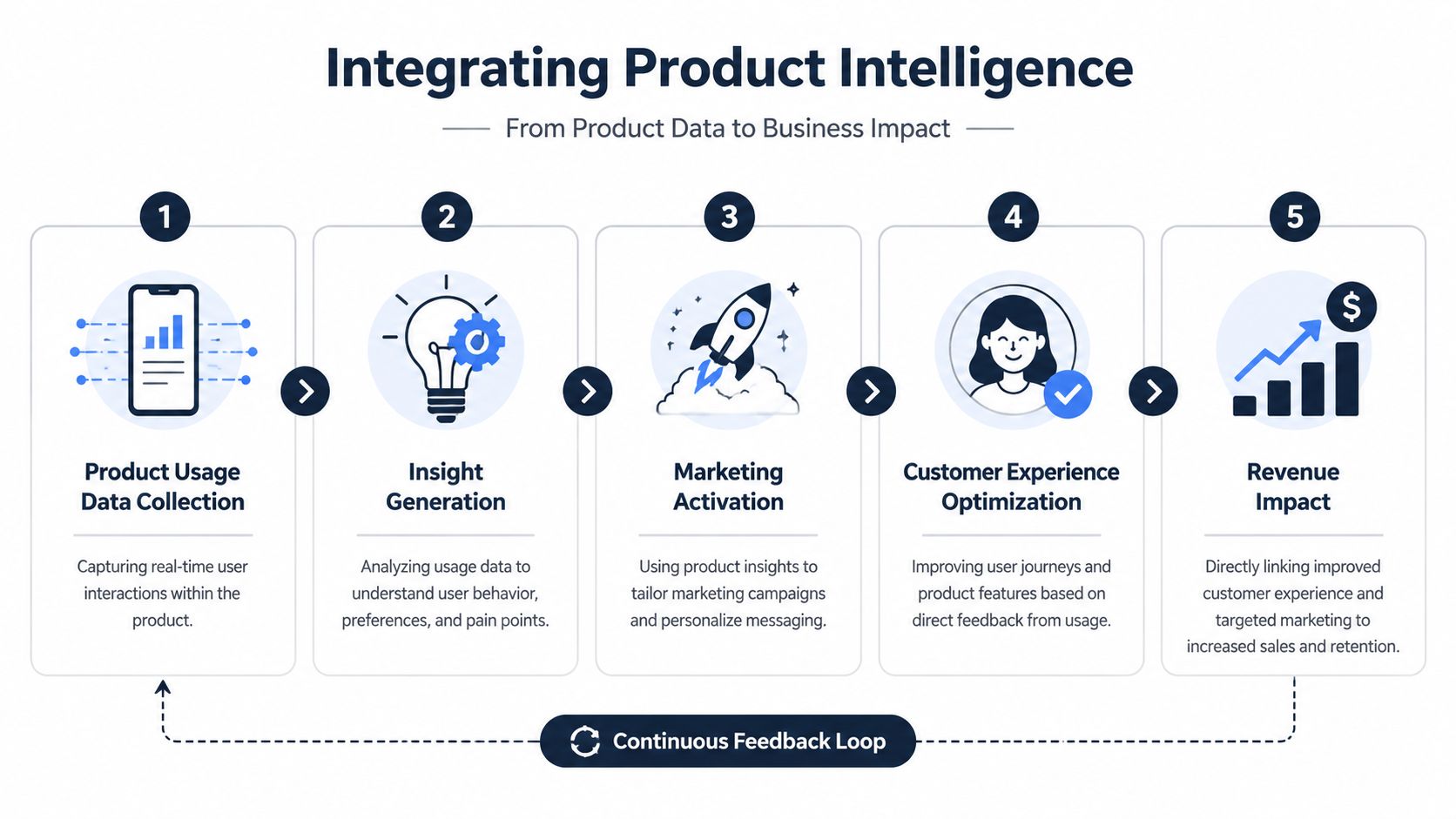
When product intelligence is connected to the marketing technology stack, qualitative and quantitative inputs start reinforcing each other.
A better model looks like this:
- Collect behavior and feedback togetherProduct usage, support conversations, sales calls, chat transcripts, and account metadata all contribute signal.
- Turn raw inputs into account-level contextInstead of reading isolated comments, teams can see themes attached to segments, stages, products, or customer types.
- Push insights into systems of actionCRM records update with risk or opportunity context. Marketing platforms suppress or accelerate certain journeys. Product systems receive better-prioritized issues. Customer success gets earlier warnings.
- Measure downstream business movementTeams can then review whether those actions improved conversion quality, onboarding health, expansion readiness, or retention outcomes.
When product intelligence is missing, marketing optimizes for response. When it's connected, marketing can optimize for customer value.
A practical workflow
Here's what that looks like in day-to-day operations:
- Sales call themes inform segmentation and follow-up messaging.
- Support ticket clusters shape lifecycle education and onboarding campaigns.
- Feature adoption signals influence upsell timing and account prioritization.
- Repeated friction points get routed into product planning with commercial context attached.
- Account health changes trigger cross-functional action instead of sitting inside one dashboard.
At this point, the stack stops being a marketing-only construct. It becomes a revenue coordination system.
What works and what usually fails
What works is narrow, disciplined integration. Start with a few signals that matter operationally. Route them into the systems where teams already make decisions. Build shared definitions for risk, adoption, friction, and opportunity.
What fails is dumping raw product data into the warehouse and assuming teams will figure it out later. They won't. Data without workflow ownership becomes dashboard clutter.
A good test is simple. If support identifies a recurring issue among high-value accounts, can marketing adjust messaging, can customer success intervene, can product prioritize the fix, and can leadership see the revenue implications without waiting for manual synthesis? If the answer is no, the missing problem isn't another channel tool. It's the absence of connected intelligence.
Measuring Your Stack's True Business Impact
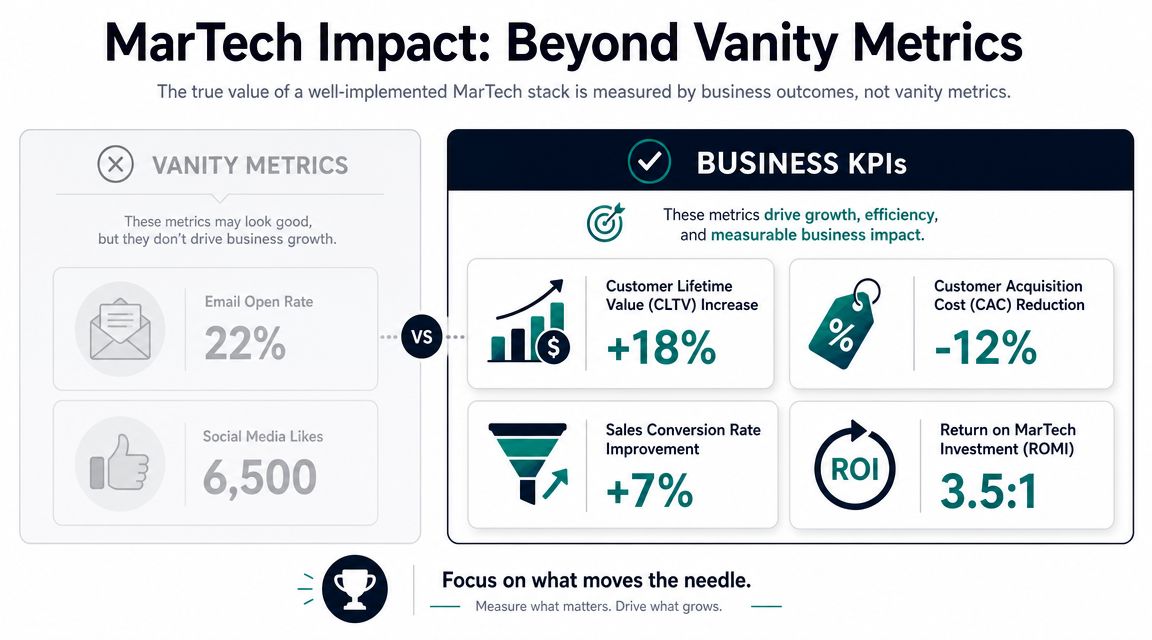
Most martech reporting still overweights what's easy to count. Opens, clicks, impressions, form fills, MQL volume. Those can be useful operational signals, but they don't justify a stack.
The better question is whether the stack helps your company acquire the right customers, convert them faster, retain them longer, and expand them more reliably. If your reporting can't connect activity to those outcomes, leadership will see software cost before they see system value.
Metrics that deserve boardroom attention
A practical measurement model usually includes:
- Customer acquisition cost: Are cleaner routing, better targeting, and tighter audience logic improving acquisition efficiency?
- Customer lifetime value: Are better onboarding, adoption, and lifecycle campaigns helping the business keep and grow stronger customers?
- Pipeline velocity: Are leads moving from response to qualified pipeline without avoidable delays or data loss?
- Conversion quality: Are campaigns generating accounts that fit, activate, and progress, or just filling dashboards?
- Retention and churn signals: Does the stack help teams identify risk early enough to act?
If your team needs a framework for tying those questions together, this guide on what is revenue attribution is a useful reference point.
How to connect stack activity to outcomes
Start with one workflow, not every report at once. Pick a motion that matters, such as demo request to opportunity, free trial to paid conversion, or onboarding to expansion. Then identify the systems involved, the fields passed between them, and the point where data quality breaks.
From there, review impact through a few lenses:
| View | What to ask |
|---|---|
| Process | Did integration reduce manual handoffs and reporting inconsistency? |
| Commercial | Did the workflow improve deal progression, retention, or expansion readiness? |
| Operational | Did teams act faster because context reached the right system in time? |
A stack proves value when teams can explain why revenue moved, not just which campaigns generated activity.
The teams that get this right don't obsess over perfect attribution on day one. They build reliable signal flow first. Then they tighten measurement around the moments that change revenue outcomes.
The Future of Your Stack Is Integrated Intelligence
The next phase of martech won't reward companies for collecting more point solutions. It will reward companies that know which systems deserve deep integration, strong governance, and durable trust.
That matters even more with AI. In 2025, MarTech reported that AI is commoditizing tools built on convenience, while systems that manage workflow risk and connect complex data sources remain harder to replace. That shifts procurement strategy away from endlessly adding AI wrappers and toward strengthening core infrastructure, as summarized in this martech stack perspective from StackAdapt.
Where smart teams will invest
The stack categories won't disappear. CRM, automation, analytics, CMS, data infrastructure, and engagement tools still matter. What changes is the buying logic.
- Commodity layers will multiply: Many AI features will be easy for vendors to replicate.
- Trusted systems will matter more: Teams will protect platforms that control data quality, workflow accountability, and cross-functional coordination.
- Connected intelligence will become the differentiator: The advantage won't come from AI-generated output alone. It will come from how well teams tie intelligence to decisions and outcomes.
That same shift is changing search and discovery strategy too. If you're thinking about how AI is reshaping visibility, this guide to AI search optimization is worth reading because it pushes beyond old channel-specific tactics.
A good marketing technology stack doesn't just support campaigns. It connects customer behavior, product reality, operational accountability, and revenue decisions. That's the standard now.
Stop building a software collection. Build a system your teams can trust.
If you want to connect customer feedback, support signals, sales conversations, and product usage to real revenue impact, SigOS helps teams turn scattered signals into prioritized action. It gives product, growth, and support teams a clearer view of what's driving churn risk, expansion opportunities, and development priorities so the stack you already have can work like a revenue system instead of a reporting maze.
Keep Reading
More insights from our blog

Ready to find your hidden revenue leaks?
Start analyzing your customer feedback and discover insights that drive revenue.
Start Free Trial →