Mastering Model Validation Techniques
Explore essential model validation techniques for robust, fair, and reliable AI models. Learn methods, metrics, and best practices for implementation and
Your team shipped the model, the dashboard looked fine, and then customer complaints started creeping in. The numbers still seemed respectable in the aggregate, but the behavior your users cared about had changed, and no one noticed until support, sales, or product felt the pain.
That's the hidden cost of weak model validation techniques. It's not just a technical miss, it can distort roadmaps, erode trust, and send teams chasing the wrong problem for weeks.
Why Model Validation Techniques Matter
A product team can do everything “right” on paper and still end up with a brittle model in production. The usual story is familiar, the model passed an internal check, the release went out, and then real users arrived with messier inputs, shifting behavior, and edge cases the team never sampled. When that happens, validation stops being a formality and becomes the difference between a reliable feature and a noisy liability.
The damage shows up in more than one place. Users lose confidence when the model behaves inconsistently, engineers spend time on emergency fixes, and roadmap discussions get hijacked by triage instead of progress. Good validation is a shield because it catches the mismatch between controlled evaluation and real-world use before the mismatch becomes visible to customers.
Practical rule: if the evaluation setup doesn't resemble the way the model will be used, the result is mostly a rehearsal, not proof.
That's why validation belongs in product planning, not just in the final QA pass. It helps teams decide whether a model is ready, where it will likely fail, and what kinds of guardrails need to exist before launch. In a cross-functional team, that means product, data science, engineering, and operations all need a shared view of what “good enough” means.
The strongest teams treat validation as a business control, not an academic exercise. They use it to protect user trust, preserve team time, and keep the roadmap from being derailed by avoidable surprises.
Understanding Fundamentals of Model Validation Techniques
Think of model validation like taste-testing a dish before you serve it at a dinner party. You wouldn't wait until guests are seated to discover the soup is oversalted, and you shouldn't wait until production to find out a model only works on the data it memorized.
Why separation matters
The core idea is simple, the model should be judged on data it hasn't already seen. If you test on the same examples you trained on, you're checking memory, not judgment. That's how data leakage sneaks in, and it's why teams can end up with inflated performance that falls apart in deployment.
For product teams, this usually means separating in-sample evaluation from out-of-sample evaluation. In-sample results tell you how well the model fit the historical data, while out-of-sample results tell you how it may behave on the next wave of users, requests, or transactions. The second view is the one that matters when you're making launch decisions.
A comprehensive validation workflow should combine a holdout test set with cross-validation, plus checks for fairness, stability, and drift, because single splits can be unstable on small or imbalanced datasets (Domino). That matters whenever one segment dominates the data, because a model can look strong overall while failing badly on the cases your team cares about.
Bias and variance in plain language
Validation also helps you balance two common failure modes. A model with too much bias is too simple and misses real patterns. A model with too much variance is too sensitive to quirks in the training set and behaves unpredictably when conditions change.
Consider a recipe. A recipe that ignores all spice levels is bland no matter how carefully you follow it. A recipe that changes wildly every time you cook it is unstable, even if one batch happens to taste great. Validation tells you whether your recipe is reliable enough to serve again.
For teams that want a sharper testing mindset, the logic lines up well with hypothesis testing in product analysis, because both disciplines are about separating signal from noise before you commit to a decision.
Core Model Validation Methods
Different validation methods answer different questions, so the right choice depends on the data shape, the business risk, and how expensive it is to be wrong. A churn model, for example, can sometimes tolerate a simpler workflow than a forecasting model that drives inventory decisions, but both still need a disciplined evaluation setup.
Train/test split, cross-validation, and bootstrapping
A train/test split is the simplest option. You hold out one chunk of data for evaluation, train on the rest, and get a quick read on generalization. It's useful early in a project, but one split can be noisy, especially when the dataset is small or imbalanced.
K-fold cross-validation gives a steadier estimate by rotating through multiple folds, then averaging the results. That makes it easier to compare model choices without overreacting to one lucky or unlucky split. If you want a practical walkthrough, the prevent overfitting with K-Fold resource is a helpful companion when teams are deciding how to structure folds and compare candidates.
Stratified cross-validation is the version you reach for when class imbalance is severe. It preserves the target distribution in each fold, which helps avoid a situation where a majority class makes performance look better than it really is. That's especially relevant in churn prediction, fraud screening, and other cases where the positive class is rare.
Bootstrapping is useful when you want to estimate how sensitive results are to sampling variation. Instead of splitting once, you repeatedly resample the data with replacement and re-evaluate. It's not always the first tool people learn, but it's valuable when leaders want a sense of how much confidence to place in a score.
A churn-specific example helps here. If your team is working on a churn prediction model, a single split may say the model is fine, while cross-validation reveals that performance swings across customer segments. That's the kind of detail that changes how product and lifecycle teams prioritize follow-up work.
Comparison of core validation methods
| Method | Use case | Pros | Cons |
|---|---|---|---|
| Train/test split | Fast baseline evaluation | Simple, cheap, easy to explain | Can be unstable on small or imbalanced data |
| K-fold cross-validation | General model comparison | More reliable estimate, lower variance | More compute, slower iteration |
| Stratified cross-validation | Imbalanced classification | Preserves class distribution in each fold | Still needs enough examples per class |
| Bootstrapping | Estimating uncertainty | Shows variability across resamples | Can be harder to explain to non-technical teams |
For many teams, the right answer isn't one method. It's a sequence. Start simple, then graduate to cross-validation when the result matters, and add stratification or bootstrapping when the dataset or business context makes the first pass too fragile.
The method matters less than the discipline of matching it to the risk.
Advanced Validation for Time Series Models
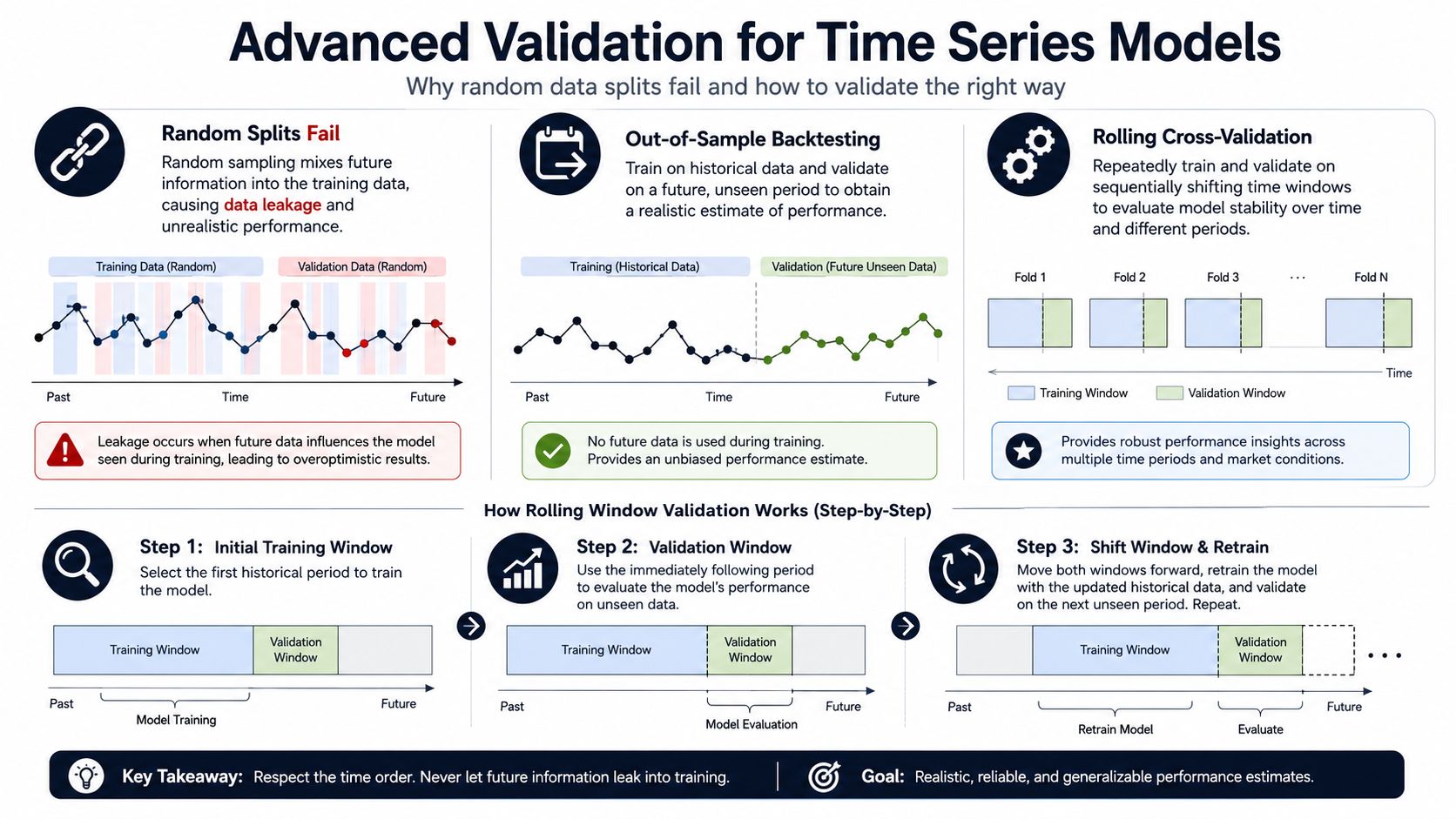
Random splits are a trap for time-dependent data. If next quarter's demand leaks into the training set for this quarter's forecast, the model looks better than it should, because it learned from information that wouldn't have been available at decision time. For time-dependent models, validation should use out-of-sample backtesting or rolling cross-validation rather than random splits to avoid leaking future information and inflating performance (Towards Data Science).
A rolling setup fits how forecasting really works. Start with an initial historical window, train the model, and validate on the next unseen period. Then shift the window forward, retrain on the expanded history, and test again. That repeated process gives you a more realistic picture of how the model behaves when the calendar moves.
For a sales forecast, the workflow often looks like this. The first training window covers older months, the next window checks how well the model predicts the following period, and later windows test whether the model remains stable as seasonality, promotions, or product mix change. Hyperparameters should be tuned on the earlier windows, while the final test set stays untouched until the end.
A single backtest is helpful when stakeholders want a quick deployment-like read. Rolling cross-validation is better when the team needs to understand performance across several historical conditions, not just one moment in time. That matters in retail, subscription revenue, logistics, and any environment where the future is shaped by the past in a visible sequence.
The key mental shift is this. Time series validation isn't about getting a random sample of the data, it's about reproducing the order in which the model will learn and fail.
Ensuring Fairness and Robustness in Validation
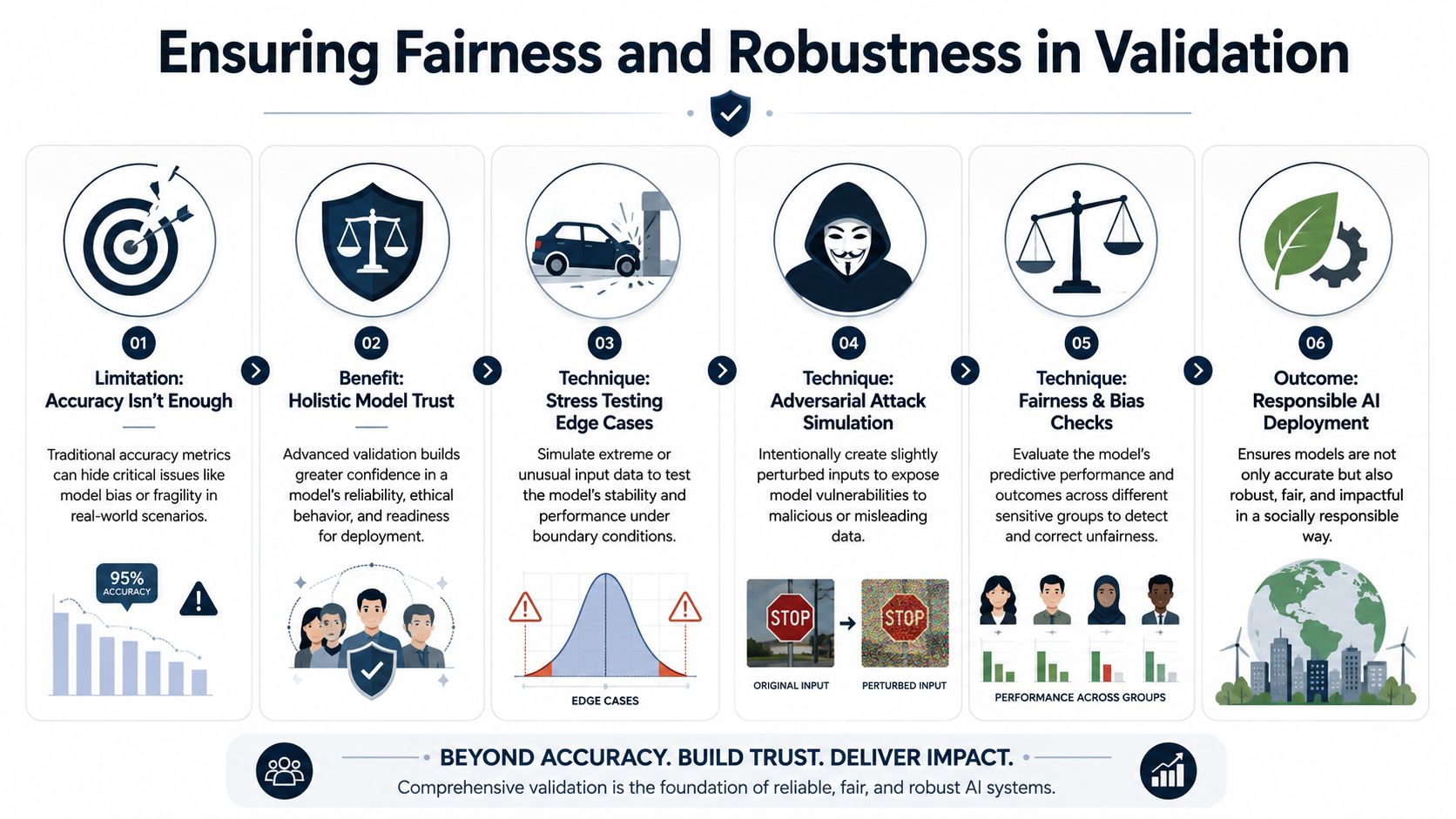
Accuracy alone can hide serious problems. A model can score well overall and still behave badly on edge cases, vulnerable inputs, or specific user groups. That's why validation has to expand beyond predictive correctness and into the shape of the failure modes themselves.
Stress tests and edge cases
Stress testing asks a simple question, what happens when inputs get weird. That could mean incomplete records, unusually long text, extreme numerical values, or prompts that are deliberately misleading. These tests matter because real users don't always behave like the training set, and bad actors often behave even less predictably.
Fairness checks add another layer. They compare behavior across groups so the team can see whether performance shifts in a way that would be hard to detect in a single overall score. The point isn't to force every segment to look identical, the point is to detect uneven failure that could create harm or bias in production.
Modern validation for LLM and agentic systems
The picture changes further with LLMs and agentic systems. Traditional accuracy-based validation isn't enough on its own, because these systems can follow instructions badly, ignore context, misuse tools, or produce harmful output even when they look fine on benchmark-style tests. Newer guidance emphasizes behavioral metrics, adversarial tests, and continuous production-aware validation across the lifecycle (Galileo).
That's where a resource like understanding AI agent drift becomes useful for product and engineering teams. It helps frame why a system that looked stable during release can still drift in live usage when prompts, tools, or workflows evolve.
Strong validation doesn't just ask whether the model is right. It asks whether the model is safe, stable, and still doing the job you intended.
The practical takeaway is to treat resilience as a product requirement, not a research bonus. If a feature touches customer trust, policy compliance, or automated action, validation has to include failure mode testing, not just scorekeeping.
Choosing Metrics and Aligning Validation with Use Cases
The right metric depends on what the business is trying to optimize. If the model is helping support teams triage tickets, the main question might be whether it routes the right cases to the right queue. If the model is forecasting revenue, the question shifts to whether the predictions are trustworthy enough to guide planning.
A good starting point is to map the use case to the risk. Accuracy can work for balanced classification problems, but it can mislead on rare-event tasks because the majority class dominates the score. In those cases, precision, recall, and precision-recall style evaluation usually tell a clearer story.
For pricing, risk, or resource allocation, calibration matters because the confidence score has to mean something operationally. If the model says an event is likely, leaders need to know that the probability is meaningful enough to support a decision. A prediction that is directionally right but poorly calibrated can still lead teams to overreact or underreact.
Use case to metric mapping
- Customer support triage: focus on class-level correctness, routing quality, and misclassification cost, because a wrong queue can create delays.
- Churn prevention: use recall for at-risk customers and segment-level checks, because missing a high-value account hurts more than a false alarm.
- Revenue forecasting: emphasize backtesting behavior and calibration, because planning teams need confidence in the forecast range.
- Risk scoring: prioritize calibration and threshold behavior, because the score often drives downstream action.
- Imbalanced detection tasks: use precision-recall thinking rather than relying on a single average score.
The right metric set also depends on how the result will be consumed. A support manager wants actionable categorization. A finance lead wants stability. A product lead wants to know whether the model improves the workflow without creating hidden bias in the tail.
For teams comparing tooling and evaluation methods, an unbiased AI detector review is a useful reminder that metric choice shapes what a test can and can't prove.
Implementing Continuous Monitoring and Validations
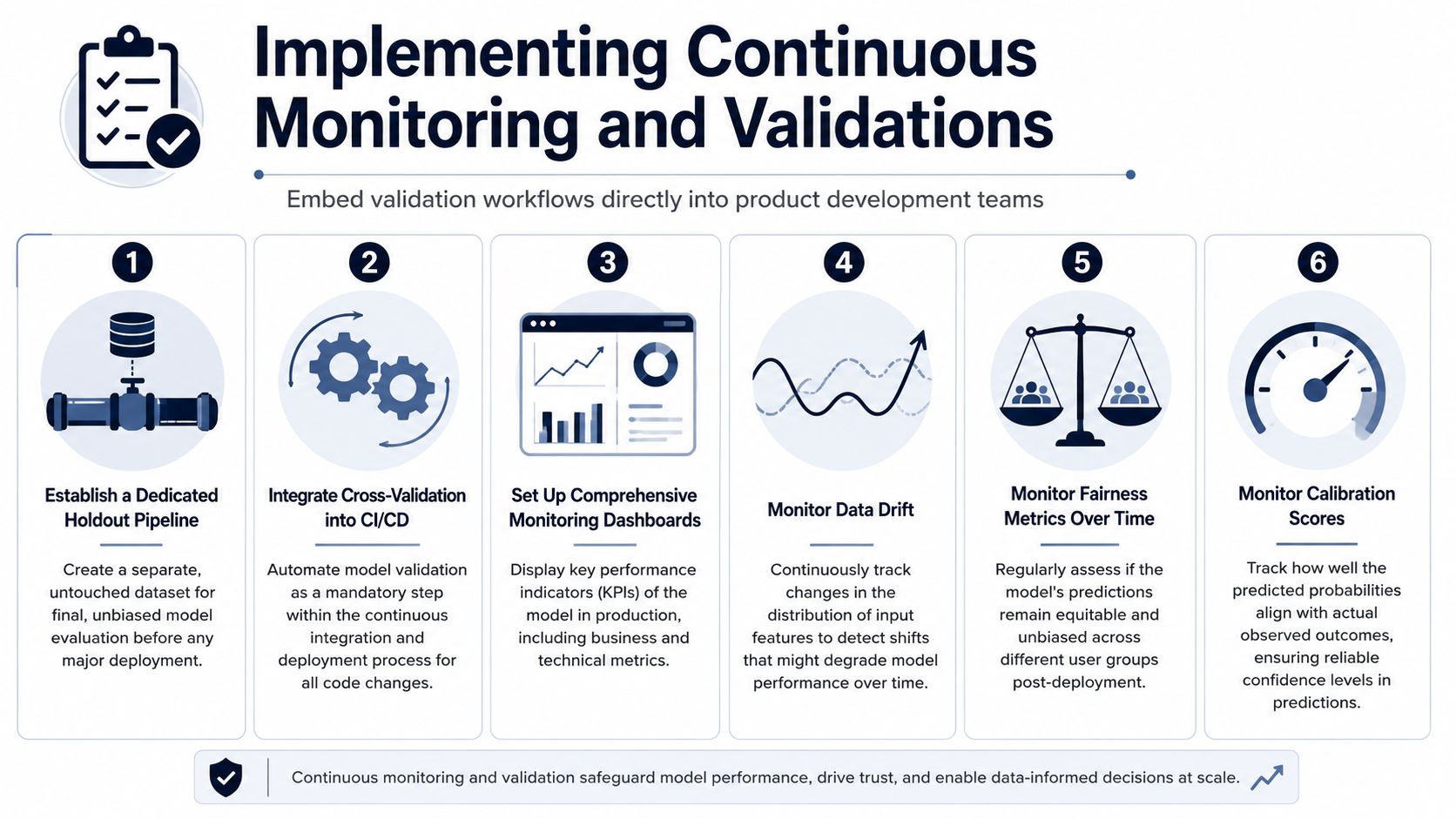
Validation gets much stronger when it becomes part of the delivery system instead of a one-time review. Product teams need a pipeline that keeps testing alive after launch, because the model, the data, and the business context keep changing too.
Build validation into the workflow
Start with a dedicated holdout pipeline that stays untouched until the final review. That keeps the last check honest and prevents accidental tuning against the same data you plan to use for sign-off.
Then put cross-validation into CI, so model changes get checked automatically before they reach production. Such integration makes the work cultural, as the team stops treating validation as a special event and starts treating it like every other mandatory test.
A monitoring dashboard should track more than one kind of signal. Business metrics show whether the model still helps users or revenue. Technical metrics show whether the predictions are drifting, becoming less calibrated, or behaving differently across groups. The earlier section on fairness matters here, because post-launch monitoring has to keep those checks alive, not just perform them once.
What to watch after launch
A practical operating checklist usually includes:
- Drift tracking: watch for changes in input distribution that may degrade behavior.
- Fairness tracking: compare outcomes across user groups over time.
- Calibration tracking: check whether predicted probabilities still line up with observed results.
- Retraining triggers: define clear rules for when the model needs to be refreshed.
- Governance sign-off: make sure important changes are reviewed before release.
Teams that work with live behavioral streams often pair these checks with real-time data analytics, because alerts are only useful when they arrive fast enough for someone to act on them.
The best monitoring setups don't just collect signals, they assign owners. Someone needs to know when to investigate, who approves retraining, and what happens if the model crosses a threshold. Without that operating rhythm, dashboards become background noise.
A dashboard is only useful when it changes a decision.
Conclusion and Next Steps for Validation Culture
Strong model validation techniques don't end at launch, and they don't begin with a dashboard. They start with a shared understanding of how the model will be used, then expand into evaluation methods that mirror production, stress tests that reveal brittle behavior, and monitoring that keeps the system honest after release.
The pattern is straightforward. Use methods that match the data, use metrics that match the business, and use monitoring that matches the pace of change. If the system is time-dependent, validate it like time matters. If the model affects people unevenly, test it for fairness. If it acts autonomously, measure behavior, not just accuracy.
The next step is to formalize that thinking inside the team. Write a validation policy, define review checkpoints, and schedule recurring audits with product, data science, engineering, and governance in the same room. That creates a validation culture instead of a one-off checklist, and it keeps the team from relearning the same lesson every time the model or the market shifts.
If you want a clearer way to turn model validation into an always-on product habit, explore SigOS.
Keep Reading
More insights from our blog
Ready to find your hidden revenue leaks?
Start analyzing your customer feedback and discover insights that drive revenue.
Start Free Trial →