Structure of Teams: A Playbook for High Performance
Learn how the structure of teams drives high performance in SaaS. This playbook offers actionable strategies for building cohesive groups.
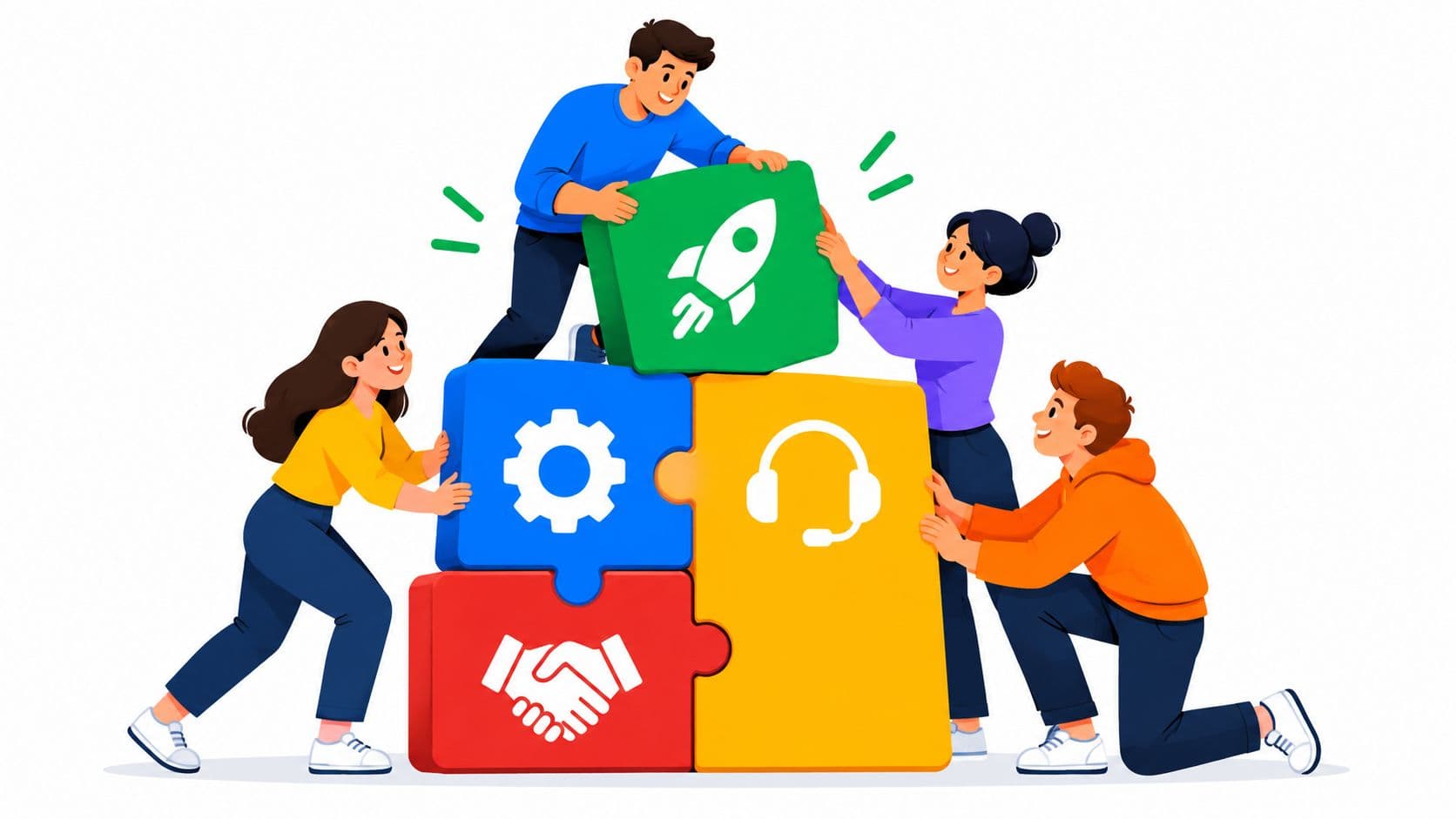
Teams of approximately 4 to 6 people are commonly recommended for software delivery, while teams of 10 members in a large study achieved 300% greater average success than solo participants, provided ownership and coordination were strong. The most common SaaS mistake is building cross-functional teams without clear ownership boundaries, and the best structure depends on product complexity and customer lifecycle stage.
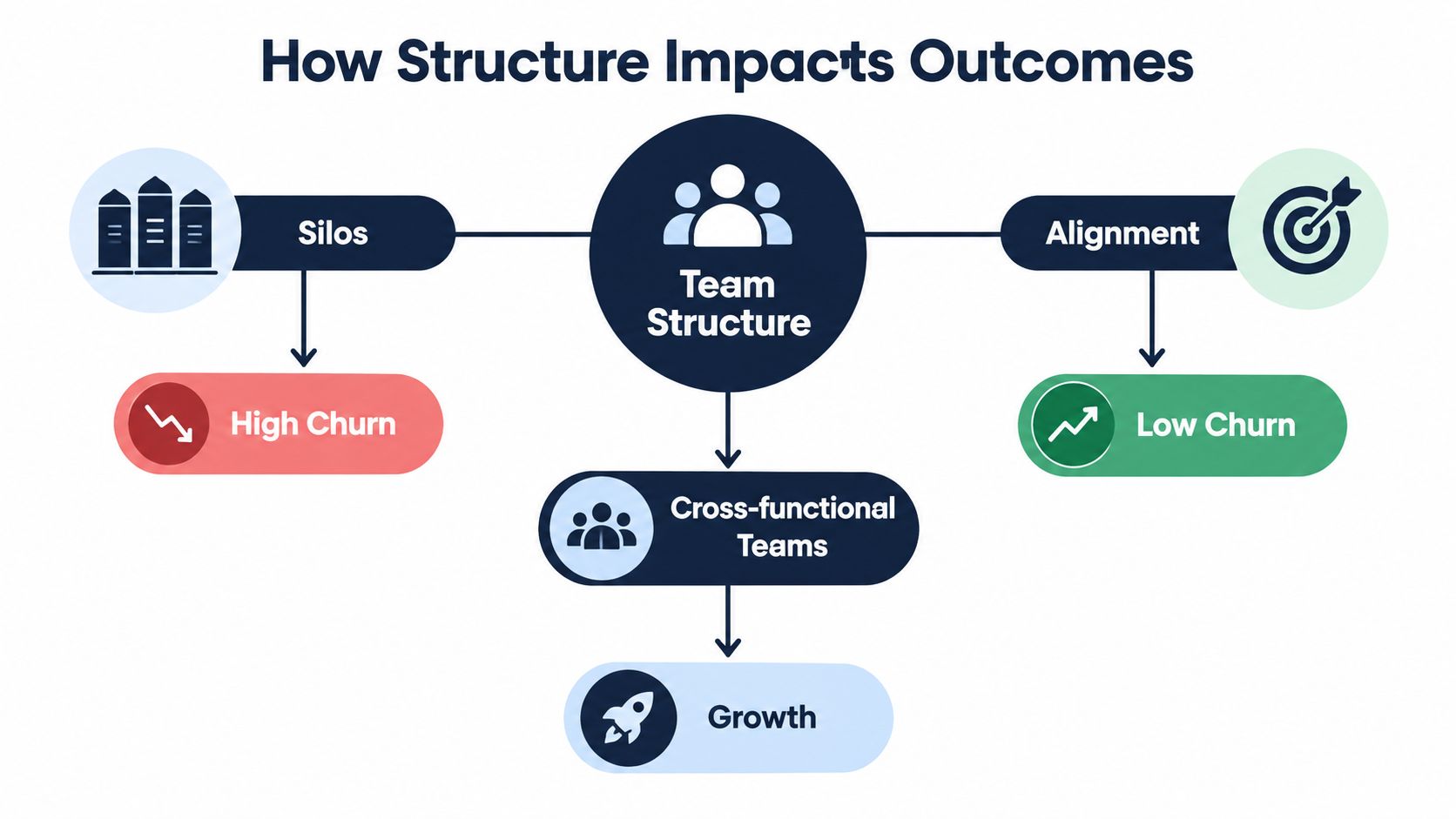
You've probably seen the failure pattern. A SaaS company adds product managers, engineers, designers, growth specialists, support leads, and customer success managers to one cross-functional group. Everyone attends the same meetings. Everyone has access to the same dashboards. Yet support tickets still sit between teams, product priorities collide with growth experiments, and nobody owns the customer journey from first use to renewal.
That isn't primarily a people problem. It's a structure of teams problem. The org chart may look collaborative while decision rights remain ambiguous, handoffs multiply, and accountability dissolves exactly where customers need a fast answer.
Why Team Structure Determines SaaS Success
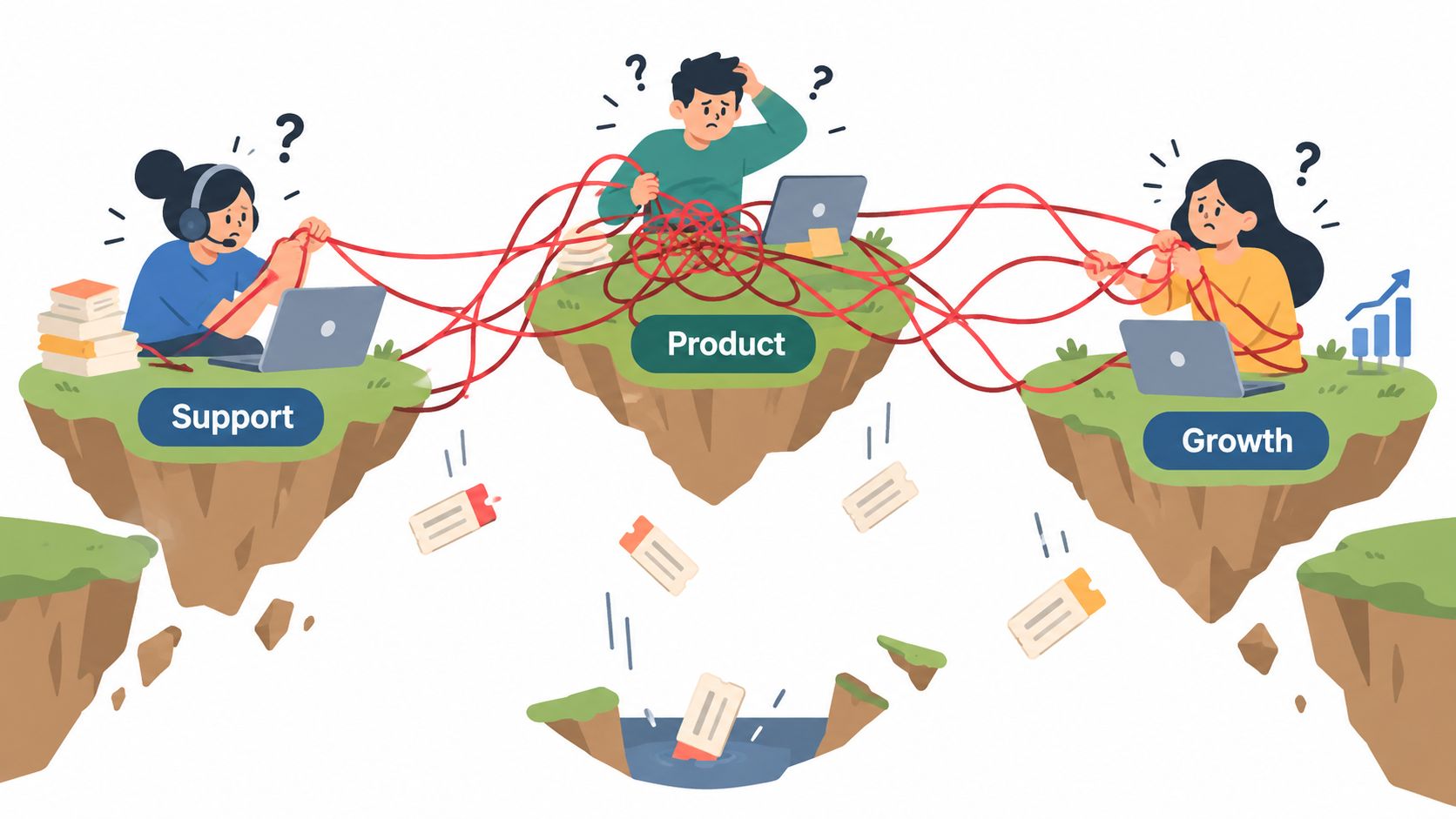
A SaaS company can lose expansion opportunities without losing a single employee. A customer reports repeated friction in support. Support tags the issue, but Product sees no revenue context. Customer Success notices declining adoption, but the signal never reaches the roadmap. Growth continues promoting a workflow that customers struggle to complete. Each function performs its assigned task, yet the business fails to solve the customer's actual problem.
The cost appears in delayed ticket resolution, an aging feature-request backlog, weaker adoption, and renewal conversations that start after the customer has already disengaged. A defined customer success structure connects roles to retention, expansion, and revenue outcomes, as outlined in Gainsight's guide to customer success team structure.
Structure is a commercial system
Think of team design as the operating architecture behind the customer lifecycle. It determines who sees a signal, who interprets it, who can act, and who remains accountable when the first response doesn't work.
A functional structure can protect specialist quality, but it often pushes customer problems across handoffs. A cross-functional structure can reduce those handoffs, but only if the team has a bounded domain and explicit authority. A customer-segment structure can improve relevance, but it can also duplicate expertise across segments.
The practical question isn't whether your teams collaborate. Teams generally collaborate constantly. The question is whether collaboration produces a named owner and a timely decision.
Operating rule: Every important customer outcome needs one accountable owner, even when several teams contribute.
That principle also protects employee capacity. Unclear ownership creates duplicate work, escalation anxiety, and meeting overload. Leaders assessing team design should consider employee wellbeing alongside delivery metrics. Guidance on salute mentale in ufficio is useful context because chronic ambiguity often turns ordinary coordination into avoidable workplace strain.
Design around the customer journey
Map the journey from acquisition to activation, adoption, renewal, and expansion. For every stage, identify the team that owns the outcome, the teams that provide inputs, and the person who makes the final decision.
A practical cross-functional alignment framework can help expose gaps, but the framework only matters if leaders use it to change operating behavior. If no team owns the transition from support insight to product decision, the map is documentation, not structure.
Three Dominant Team Structures for SaaS Organizations
SaaS leaders usually choose among three broad designs, then combine them as the product and customer base evolve. The right choice depends on whether your main constraint is specialist depth, coordination speed, or customer-context complexity.
| Structure Type | Best For | Key Trade-off | Coordination Cost |
|---|---|---|---|
| Functional teams | Deep expertise, stable disciplines, early product development | Handoffs can slow customer-response and delivery work | Lower inside functions, higher across functions |
| Cross-functional squads or pods | Bounded product domains with end-to-end ownership | Requires strong decision rights and shared operating standards | Moderate inside the pod, potentially high between pods |
| Product-led or customer-segment teams | Distinct products, markets, or lifecycle motions | Can duplicate capabilities and create inconsistent practices | Higher across product lines or segments |
Functional teams
Functional teams group engineers with engineers, designers with designers, marketers with marketers, and support specialists with support specialists. This structure works well when the company needs consistent craft standards, coaching, and a clear professional home.
Its weakness appears at the edges. A support issue may require a technical investigation, a product decision, a communication plan, and a success intervention. If each step belongs to a different manager, the customer experiences the organization's internal boundaries.
Functional design still makes sense for an early product with limited complexity. Don't replace a clear engineering team with a squad structure just because squads are fashionable.
Cross-functional squads
A squad combines the capabilities required to own one bounded product area or customer workflow. Product management, engineering, design, and relevant data or customer expertise work against one outcome rather than a list of functional outputs.
This structure improves accountability when the squad can prioritize, implement, and operate within its domain. It fails when every decision still requires approval from separate functional leaders. In that case, the company has created a new meeting layer without removing the old bottlenecks.
Commercial teams also need deliberate boundaries. If you're building an outbound motion, specialist resources such as HireSDRs.com may support execution, but the ownership of qualification quality, segment strategy, and revenue handoff must remain explicit.
Product-led and segment-aligned teams
These teams organize around a product line, customer segment, or lifecycle stage. They're useful when enterprise and self-serve customers need different motions, or when separate product areas have distinct value propositions.
The risk is duplication. Multiple segment teams may create their own enablement, analytics, feedback practices, and prioritization rituals. Leaders should centralize shared standards and data while leaving customer-specific decisions close to the segment.
How Team Structure Impacts Customer Outcomes
Structure changes what information reaches decision-makers. A support team organized by issue type may resolve tickets efficiently, while a product-area team may recognize that several seemingly different issues point to one adoption barrier. Neither design is automatically superior. The correct choice depends on whether speed, context, or technical specialization is the binding constraint.
Follow the signal through the organization
A useful test is to trace one customer signal from origin to action. Start with a support conversation, product event, sales call, or renewal-risk alert. Then ask:
- Visibility: Which team receives the signal first?
- Interpretation: Who combines it with usage, account, and commercial context?
- Decision: Who can prioritize a response?
- Execution: Which team changes the product, workflow, or customer communication?
- Verification: Who confirms that the intervention improved the customer outcome?
If you can't answer each question with a named role, your structure has an accountability gap.
A team's autonomy helps when it improves task and relationship functioning. A meta-analysis covering 415 effect sizes, 69 studies, and approximately 6,035 teams found that autonomy was positively related to those forms of team functioning, with indirect improvements in performance and attitudes (research on team autonomy). Autonomy doesn't mean isolation. It means authority inside a clear domain.
Measure friction, not meeting activity
Track cycle time from insight to action, cross-team wait time, escaped defects, decision latency, and the number of handoffs attached to high-value customer issues. These measures reveal structural friction more reliably than meeting counts or headcount ratios.
Distributed agile research also links task interdependence with role clarity across teams. That supports a practical design rule: document what each team provides, what it expects, and how escalation works. Aligning team boundaries with architecture matters too, because empirical software research reports slower development and more defects when one component is maintained across multiple teams (software team size and coordination research).
Choosing the Right Structure for Your SaaS Stage
Don't choose a structure from a template. Choose it from the complexity your teams must absorb.
Start with three variables:
- Product complexity: Count the meaningful product modules, workflows, and technical boundaries that require distinct ownership.
- Customer diversity: Identify how differently your segments buy, implement, use, and renew the product.
- Revenue complexity: Map the number of motions involved in acquisition, expansion, services, usage-based billing, or renewals.
A simple product with one dominant customer motion usually benefits from functional clarity. As modules and customer segments diverge, cross-functional or segment-aligned ownership becomes more valuable. If several product areas share one technical component, don't create independent teams that must constantly negotiate over it. Give the component a clear owner or redesign the boundary.
Use red flags instead of org fashion
Your current structure is probably wrong when:
- Support crosses too many boundaries: A routine issue requires repeated escalation between support, engineering, product, and success.
- Priorities conflict repeatedly: Product, growth, and customer success bring different definitions of urgency to the same decision.
- Ownership stops at launch: A team ships a feature but no one owns adoption, customer education, or post-release measurement.
- Managers arbitrate ordinary work: Teams need leadership approval for decisions that should sit inside their domain.
- Customers repeat themselves: Different functions collect the same information because they don't share a usable customer context.
Make the change proportional
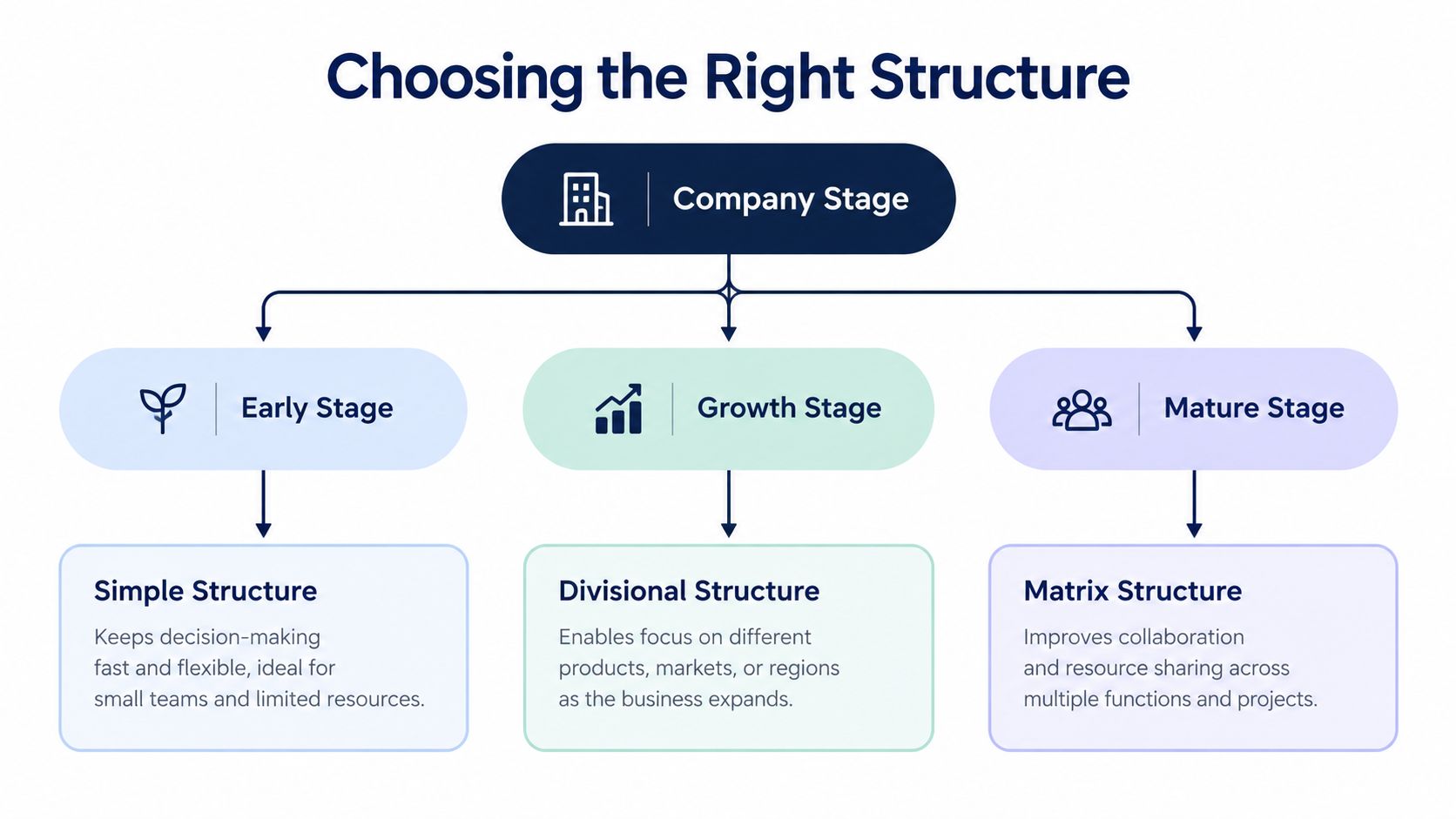
Early-stage companies should avoid premature specialization. Keep teams close enough to the customer that product, support, and commercial feedback travel quickly. Growth-stage organizations often need stable squads or segment ownership because a single functional leader can no longer coordinate every dependency directly.
Mature organizations may need a hybrid. Centralize governance, architecture standards, data definitions, and career development. Distribute customer and product decisions to teams that own bounded outcomes.
Team Structure in the Age of AI Agents
A renewal-risk agent flags falling usage, drafts a customer message, and recommends a product change. Three teams now touch the same signal. Unless decision rights are explicit, the workflow has activity but no accountable owner.
AI agents turn team design into an accountability problem as well as a capacity question. An agent can classify feature requests, draft support responses, or propose code changes. It can perform work inside the workflow, but a named human must own the resulting customer or product decision.
A 2025 survey of 250 AI and product leaders across 27 industries reported that 77% of organizations used blended teams combining employees with specialized freelance talent. Those organizations were reported to be twice as likely to have deployed AI to production or reached scaled usage than organizations using only traditional structures (2025 AI research). The recommendation is practical: build a deliberate hybrid operating model, rather than adding contractors or agents without clear boundaries.

Define the team API
Give every human team and agent four operating fields:
- Owned outcome: The business or customer result for which a named owner is accountable.
- Decision rights: The actions the team or agent may take without approval.
- Escalation rule: The conditions that require human review or another team's involvement.
- Audit trail: The evidence required to reconstruct how a recommendation or action was produced.
Apply the model to the renewal-risk example. The agent ranks signals and drafts a recommendation. Customer Success owns the customer intervention. Product owns any product change. A named human decides whether to contact the customer, alter the roadmap, or escalate to an executive.
Centralized governance and distributed specialist responsibility give AI-heavy organizations a workable balance. Keep policy, risk ownership, and executive accountability centralized. Assign implementation decisions to the business units and specialist roles closest to the work. Do not create a central AI team that becomes a queue for every domain decision.
Preserve attribution
AI can reduce functional silos while increasing role ambiguity. Microsoft's 2025 Work Trend Index, based on 31,000 workers across 31 countries, describes teams made up of humans and AI agents and examines AI-enabled collaboration across R&D and business functions (Microsoft Work Trend Index).
Record which agent produced an insight, which human validated it, and which owner accepted the consequence. AI workflow automation works when automation routes work into an accountable process, with approvals and evidence visible to the people responsible for outcomes.
Evolving Team Structure as You Scale
Static teams accumulate invisible debt. A product boundary that worked when the company had one core workflow may become a source of delays once several modules, customer segments, and technical dependencies share it.
A large-scale study of approximately 150,000 self-organized online team projects found a statistically significant positive relationship between team size and project success, with ρ = 0.0845 and p < 10^-10. Teams with 10 members achieved 300% greater average success than solo participants, but activity was unevenly distributed, with a small number of members typically doing most of the work (large-scale team project study). More people can increase capacity. They don't automatically improve ownership.
Use a staged maturity model
Functional alignment comes first. Establish specialist standards, basic ownership, and a shared customer vocabulary.
Cross-functional squads become appropriate when a product area has enough complexity to justify stable end-to-end ownership. Keep the domain narrow and give the squad real authority.
Product-led domain ownership follows when modules or customer segments behave like distinct value streams. Centralize platform standards, but let domain teams make local decisions.
Hybrid human and AI orchestration becomes necessary when agents, contractors, and employees jointly produce customer or product outcomes. Extend the same accountability model to every contributor.
A team diversity study of 911 sales teams found that 71% consisted of members from one specialization, while 9% included members from more than three areas. It also found significant relationships between performance and nationality diversity, specialization diversity, team size, management tenure, and first-language diversity, with nationality and specialization diversity identified as the strongest positive drivers among the examined factors (team diversity research). Composition matters, but only when teams can turn varied perspectives into coordinated decisions.
Build a structural health dashboard
Review cycle time, cross-team wait time, decision latency, escaped defects, recurring handoffs, and the number of active domains per team. A spike in one metric is a signal. A persistent pattern across several metrics is a restructuring case.
Resource planning also belongs in this review. Leaders responsible for forecasting for fast-growing engineering teams should connect hiring forecasts to ownership boundaries, not just projected workload. Before moving people, document the current interfaces, preserve critical context, and run a retrospective after the change.
For resource allocation decisions, SigOS resource allocation guidance offers a useful lens: route effort toward customer and revenue signals rather than distributing capacity evenly across teams.
Real-World Examples of Structural Choices
Consider a mid-market SaaS company that formed cross-functional squads before its product boundaries were stable. Each squad included product, design, engineering, and customer-facing contributors, but several squads depended on the same technical components. Priorities collided, architecture decisions waited for multiple approvals, and delivery dates slipped.
The leadership team didn't abandon squads permanently. It first restored functional boundaries around shared engineering capabilities, clarified component ownership, and limited the next pilot to one product area. Only after the interfaces stabilized did it reintroduce a squad with a narrower mandate.
A different high-growth company aligned growth and customer success around customer segments. The teams gained sharper context about buying behavior, onboarding friction, and expansion needs. The trade-off appeared later: each segment recreated analytics, enablement, and campaign practices. Leadership centralized shared capabilities while keeping segment teams accountable for customer outcomes.
Five principles emerge from both choices:
- Pilot the structure: Test a new design in one bounded product area before changing the entire company.
- Name the decision owner: Contributors can be many, but final accountability must be singular.
- Separate standards from decisions: Centralize governance and reusable capabilities, while distributing domain choices.
- Measure interfaces: Track waiting, handoffs, reversals, and defects instead of relying on meeting volume.
- Run structural retrospectives: Review team design after major product, customer, or operating milestones.
The structure of teams should change when the work changes. If your teams can't explain who owns a customer signal, a roadmap decision, an AI recommendation, or a production outcome, don't add another meeting. Redraw the boundary.
SigOS helps SaaS teams connect support tickets, sales conversations, and usage signals to the people responsible for action, with role-based dashboards and smart routing for product-intelligence insights. Visit SigOS to see how a clearer evidence flow can support better team boundaries and faster accountability.
Keep Reading
More insights from our blog
Ready to find your hidden revenue leaks?
Start analyzing your customer feedback and discover insights that drive revenue.
Start Free Trial →