Roadmap in Business: roadmap in business to align teams and accelerate growth
Learn how a roadmap in business can align your team, prioritize initiatives, and accelerate growth with practical steps and proven frameworks.
A roadmap in business is your company's strategic story, told visually. Think of it as a high-level map for a long journey—it doesn't show every single turn, but it clearly marks the destination, the key cities you'll pass through, and the general route you'll take to get there. It’s all about the big picture.
What Is a Business Roadmap and Why Is It Essential for Growth?
Imagine you’re about to lead an expedition into uncharted territory. You wouldn't just tell your team to "start walking west." That's a recipe for disaster. Instead, you'd roll out a map showing the ultimate destination (the vision), pointing out major landmarks along the way (milestones), and explaining the path you plan to take.
A business roadmap does exactly that for your company.
It’s a powerful communication tool that translates an ambitious vision into a concrete, digestible plan. A roadmap avoids getting bogged down in the tiny details. For example, instead of listing out a task like "redesign the login button," a good roadmap focuses on the strategic outcome, such as "Improve User Onboarding Experience in Q3." This simple shift keeps everyone focused on the why behind their work.
Without that shared guide, teams inevitably start drifting. You get departments working in silos, chasing conflicting goals, and wasting time and money on efforts that don't move the needle. It's a surefire way to feel busy but achieve very little.
Aligning Teams and Stakeholders
At its core, a business roadmap is an alignment machine. It gets everyone—from engineering and marketing to sales and customer support—rowing in the same direction. When the entire company understands the strategic priorities, individuals can make smarter, more autonomous decisions in their daily work.
This clarity extends beyond your internal teams, too. For investors, a well-crafted roadmap provides confidence that you have a thoughtful plan for using their capital. For potential partners, it signals that you're a serious organization with a clear vision for growth and innovation.
A business roadmap is the bridge between your high-level vision and the daily execution that makes it a reality. It transforms abstract goals into a shared, actionable plan that motivates and aligns your entire organization.
And this concept isn't just for big corporate projects. A solid management development plan, for instance, is essentially an actionable roadmap for building leadership skills and guiding an individual’s career growth.
The Core Components of a Roadmap
So, what actually goes into one of these? While the look and feel can change, every effective roadmap needs a few key ingredients to answer the fundamental questions: what are we doing, why are we doing it, and when will it happen?
Here’s a breakdown of the essential elements you'll find in a strong business roadmap.
Core Components of an Effective Business Roadmap
| Component | Description | Primary Purpose |
|---|---|---|
| Vision & Goals | The high-level strategic objectives the roadmap aims to achieve. | To provide context and connect initiatives to business outcomes. |
| Themes | Broad areas of focus, such as "Market Expansion" or "Enhance Mobile Experience." | To group related initiatives and communicate strategic priorities. |
| Initiatives | Specific projects or epics that fall under each theme. | To outline the key efforts required to achieve the goals. |
| Timeline | A broad timeframe (e.g., quarters or Now/Next/Later) for initiatives. | To set expectations and show the sequence of work. |
| Status & KPIs | Indicators showing the progress of initiatives and the metrics used to measure success. | To track progress and ensure accountability for results. |
By including these components, your roadmap becomes more than just a document—it becomes a dynamic guide for strategic execution, keeping everyone informed, aligned, and focused on what truly matters.
How to Build Your Business Roadmap from Scratch
Building a roadmap in business isn't an abstract art project. It's a disciplined process, more like architecture than painting. It’s about turning your company’s biggest ambitions into a concrete plan that everyone can follow. But where do you even start?
The journey begins with a single, foundational question: What's our destination?
Trying to build a roadmap without a clear vision is like hopping in a car for a road trip with no destination in mind. You'll burn a lot of fuel but won't get anywhere meaningful. Your first job is to define that "why." What does winning look like in one, three, or five years? This vision should be a compelling statement that becomes your company's North Star.
From that big-picture vision, you can work backward to set your strategic objectives. These aren't fuzzy wishes; they are the high-level, measurable goals that pave the way. So, instead of "get better at sales," a real objective is something like, "Increase market share by 15% in the next 24 months" or "Achieve a 95% customer satisfaction score."
Define Your Strategic Themes
Once your objectives are clear, you can start grouping your work into strategic themes. Think of these themes as the major chapters in your roadmap's story. They are the broad areas of focus that connect your team's day-to-day work back to the company's high-level goals.
For example, your themes might look something like this:
- Perfect the Customer Onboarding Experience: A theme focused squarely on crushing churn and making sure new users find value fast.
- Win the EMEA Market: A theme dedicated to geographic expansion and targeted growth initiatives.
- Modernize Our Internal Tech Stack: A theme aimed at boosting efficiency and cutting down on operational drag.
These themes give every project a clear purpose. It’s how you ensure that no effort is wasted and everything contributes to a larger business outcome. If you're looking for a structured way to think about this, seeing how to build a 12-month IT roadmap can offer a helpful framework, even if your roadmap isn't purely technical.
This simple diagram shows how everything flows from the top down, from your vision to the actual work.
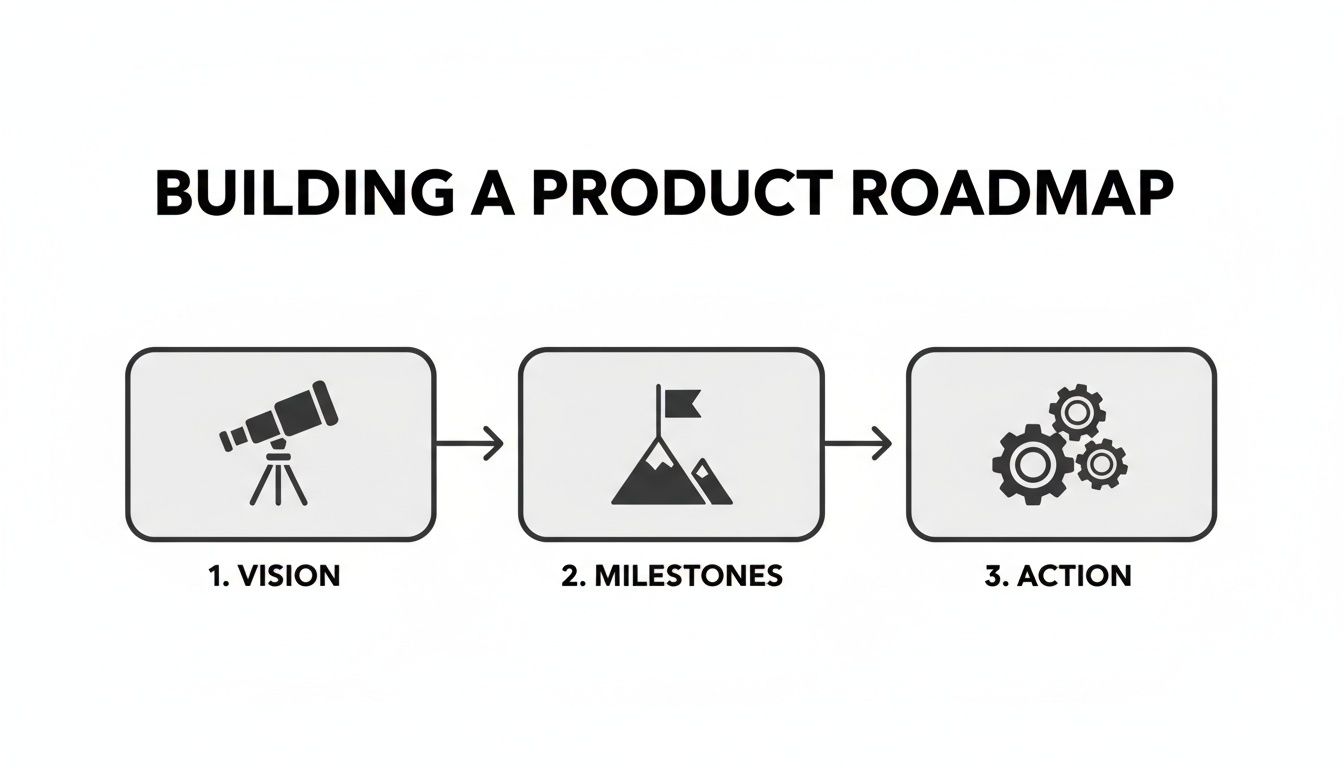
This structure makes it possible to trace any single task all the way back to a strategic milestone and, ultimately, to the core vision.
Gather Inputs and Surface Signals
A roadmap built in an echo chamber is doomed to fail. To make it truly effective, you need to pull in information from all corners of the business and—most importantly—from your customers. This is where you swap out internal assumptions for real-world evidence.
Gathering good intel is a multi-pronged effort:
- Market and Competitor Analysis: What's happening in your industry? What are your competitors shipping, and where are their blind spots you can exploit?
- Stakeholder Collaboration: Talk to your leaders in sales, marketing, customer support, and engineering. What insights do they have? What are their biggest pain points and priorities?
- The Voice of the Customer: This is your most valuable source of truth. What are customers telling you through their words and, just as critically, through their actions?
This is where product intelligence platforms like SigOS can be a game-changer. These tools automatically analyze unstructured feedback from thousands of support tickets, sales call transcripts, and survey responses.
Instead of relying on gut feelings, you can instantly see which feature requests are tied to your biggest deals or which bugs are causing the most customer churn. The anecdotal "noise" of customer feedback becomes a powerful signal you can use to build your roadmap.
For instance, the platform might highlight that a specific integration request is holding up three enterprise deals worth over $500,000 in ARR. Just like that, an item that was a "nice-to-have" becomes a top priority with a rock-solid business case.
Prioritize, Assign Ownership, and Set Timelines
With a backlog full of great ideas, you now face the hardest part: prioritization. You can't do everything at once. This is where you have to make tough, strategic trade-offs. Frameworks like RICE (Reach, Impact, Confidence, Effort) are great for this because they give you an objective model for making these calls. If you need help organizing this, our guide on creating a technology roadmap template has some useful structures.
Next, assign clear ownership. Every single initiative on that roadmap needs one person who is responsible for seeing it through. Without an owner, even the most brilliant ideas wither on the vine.
Finally, set realistic timelines. Many of the best roadmaps today have moved away from rigid, specific due dates. Instead, they use broader time horizons like Now, Next, and Later. This approach gives your teams clear direction while also providing the flexibility to adapt and respond to new information as it comes in.
Prioritizing Initiatives with Data-Driven Frameworks
Once your backlog is brimming with ideas, you’ve hit a crucial crossroads in building a roadmap in business. This is the moment where strategy either gains serious momentum or fizzles out. The difference almost always comes down to how you decide what to build next.
Prioritization isn't just about picking the coolest-sounding ideas. It’s a disciplined process of allocating finite resources. When decisions are driven by gut feelings, the loudest person in the room, or a single urgent customer complaint, your strategy can get derailed fast. To prevent this, smart teams rely on structured frameworks to replace subjective arguments with objective data.
These frameworks give everyone a common language and a transparent way to evaluate every idea on a level playing field. Instead of getting stuck in debates over opinions, teams can have a real strategic discussion, confident that the most valuable projects are the ones getting the green light.
Understanding the RICE Scoring Model
One of the most popular and practical frameworks out there is RICE. It’s not just a passing trend; the latest surveys on PM practices show that in 2026, RICE is the clear leader, with a 38% adoption rate among product teams. Its three-year reign at the top signals a major shift away from intuition and toward more structured, analytical thinking.
The beauty of the RICE model is how it forces you to think critically about the potential of an idea by breaking it down into four key parts. The score comes from a straightforward formula: (Reach x Impact x Confidence) / Effort.
Let's unpack what each of those really means:
- Reach: How many people will this actually touch in a given timeframe? A tweak to your main checkout flow might reach 10,000 users a month, while a niche tool for power users may only reach 500. This number grounds your plans in the real-world scale of your user base.
- Impact: When a user encounters this, how much will it actually help them? This is usually graded on a simple scale (e.g., 3 for massive, 2 for high, 1 for medium, 0.5 for low). A bug fix that unblocks a core task has a massive impact; a minor UI change has a low one.
- Confidence: How sure are you about your Reach and Impact numbers? This is your gut-check, expressed as a percentage (100% for high confidence, 80% for medium, 50% for low). If you have hard data, your confidence will be high. If it's more of a strategic guess, your confidence will be lower, which rightfully brings the overall score down.
- Effort: What's the total cost in team time (product, design, engineering)? We usually measure this in "person-months." A quick fix might take 0.5 person-months, whereas a major new feature could easily take 5 or more.
By putting a number to these four factors, RICE gives you a single, comparable score for every item on your list. For teams who want to explore this further, looking into different types of a feature prioritization matrix can add even more clarity.
Automating Data for Better Decisions
The biggest hurdle with frameworks like RICE isn't the math; it's getting the reliable data to feed into the formula. Manually estimating reach and impact is a huge time sink and can still be riddled with personal bias. This is exactly where modern AI-powered tools come in.
Product intelligence platforms like SigOS can automatically sift through customer conversations, support tickets, and usage data to give you the hard numbers for your RICE scores. The platform can tell you, for instance, exactly how many customers have asked for a certain feature or how many of your highest-value accounts are running into a specific bug.
This kind of automation completely changes the game. It frees your team from the drudgery of spreadsheets and guesswork. Instead, you can spend your valuable time on the high-level strategic debates, weighing objectively scored initiatives and building a roadmap in business that’s directly tied to what customers actually want and what will drive revenue.
Connecting Your Roadmap to Customer Voice and Revenue
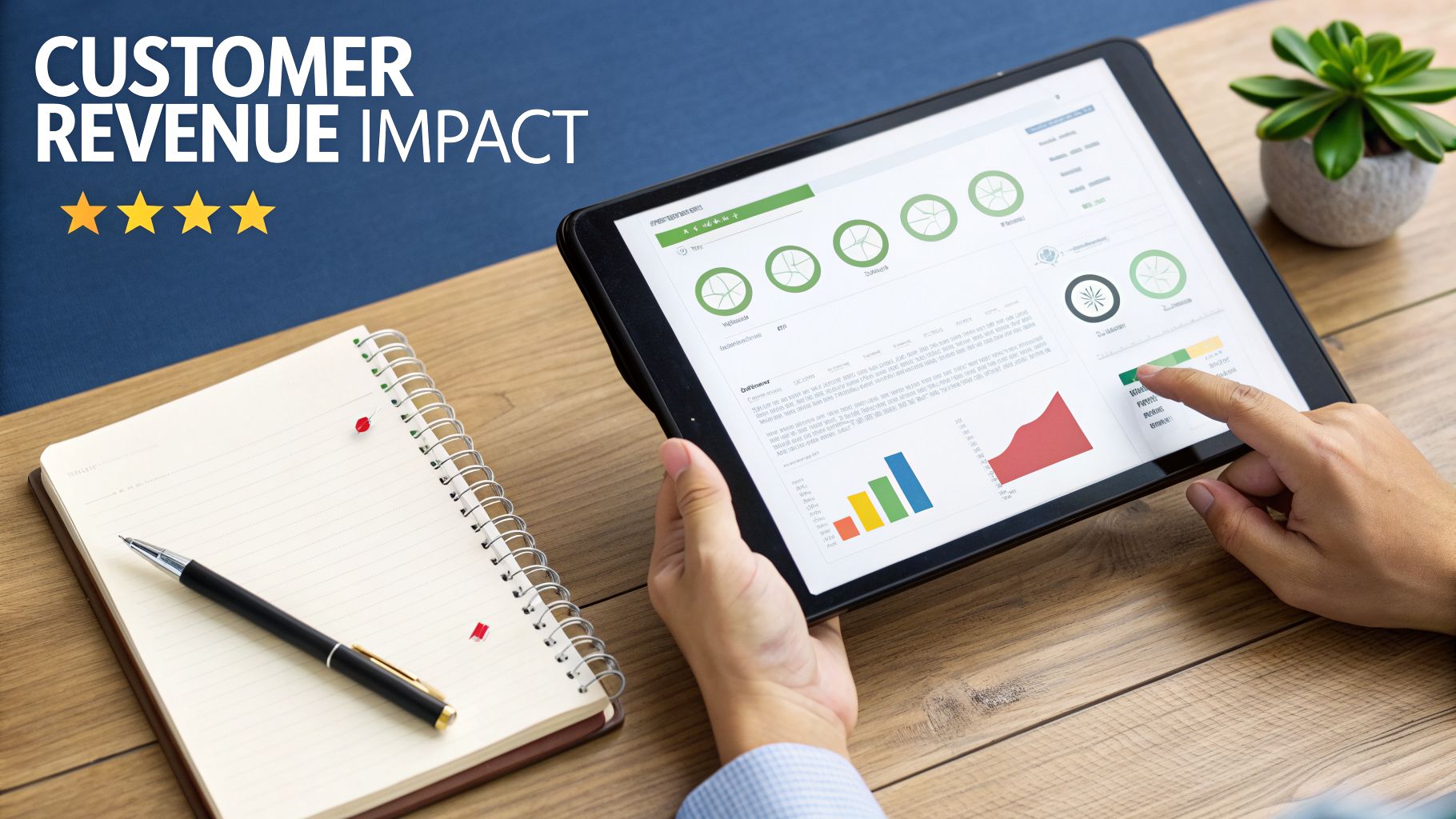
A roadmap in business built entirely on internal discussions is a dangerous echo chamber. When your priorities come only from what you think customers want, you aren't really building a strategy—you're just making a list of educated guesses. The most successful companies I've seen flip this model on its head. They create roadmaps from the outside-in, tying every development effort directly to what customers are saying and, ultimately, to revenue.
This customer-driven approach means going beyond the occasional survey or anecdote. It’s about tapping into the raw, unstructured data your business is already collecting every single day. We’re talking about support tickets, sales call transcripts, online reviews, and chat logs. This shift turns your roadmap from a simple document of intentions into a powerful engine for real business growth.
Turning Customer Noise into Revenue Signals
Of course, the big challenge has always been the sheer volume and messiness of all that customer feedback. No single product manager can realistically listen to every sales call or read thousands of support tickets. This is where modern product intelligence platforms are changing the game for strategic planning.
Imagine a product manager starting their day not with a confusing backlog of feature ideas, but with a clean, AI-powered dashboard. This system has already sifted through every customer interaction from the past 24 hours. Instead of a mountain of qualitative "noise," it serves up a prioritized list of actionable signals.
For example, the dashboard might instantly highlight two critical insights:
- A Recurring Bug: A specific error in your checkout flow has been mentioned in 78 support tickets this month. More importantly, the system connects this bug to 15% of recent customer churn, showing you its exact financial damage.
- A High-Value Feature Request: An API integration, once considered a low priority, keeps coming up in sales calls with three major enterprise prospects. The platform flags this as a blocker for deals totaling over $250,000 in annual recurring revenue.
This is the real power of building a business roadmap from the outside-in. To go deeper on this, you can learn more about how to analyse customer feedback effectively in our detailed guide.
Quantifying the Dollar Value of Development
Armed with these kinds of insights, the whole conversation around priorities changes. The debate is no longer about which feature sounds cooler or which executive argues most convincingly. It becomes a straightforward business decision based on tangible financial outcomes.
The roadmap stops being a subjective wish list and becomes a direct tool for impacting revenue and retention. It empowers product teams to build an undeniable business case for their priorities by tying development effort directly to a dollar value.
This approach gives product leaders the concrete evidence they need to secure resources and get stakeholders on board. When you can walk into a meeting and say, "Fixing this bug will directly protect $50,000 in ARR from at-risk accounts," you're speaking the language of the business. You’re not just requesting resources; you’re presenting a clear return on investment.
From Cost Center to Revenue Driver
This data-driven method completely reframes the role of product and engineering teams. Suddenly, they're no longer seen as a "cost center"—just another expense on the budget. Instead, they become a provable "revenue driver," directly contributing to the company's bottom line.
This has a profound effect on team morale and alignment. When developers know the code they’re writing is directly responsible for saving a major account or unlocking a new market segment, their work takes on a deeper sense of purpose. It connects their daily tasks to the company’s biggest goals.
Ultimately, a roadmap in business that’s deeply connected to the customer voice does more than just guide development. It builds a stronger, more resilient organization by ensuring that every bit of effort is focused on solving real problems and delivering measurable value.
Keeping Your Roadmap Relevant and Adaptive
It’s tempting to frame your new roadmap, hang it on the wall, and treat it like a finished masterpiece. But that’s a huge mistake. A roadmap you create in January and follow blindly all year isn't a strategy—it's a liability.
The most dangerous thing you can do is treat your roadmap in business like a static document, set in stone. The reality is that your roadmap needs to be a living, breathing guide. It has to adapt right along with your market, your customers, and your own performance data. Sticking to an old plan just because it's written down is like following a paper map that leads you straight into a collapsed bridge. The point isn't to follow it blindly; it's to have a direction that you can intelligently adjust along the way.
Establish a Regular Review Cadence
To stop your roadmap from gathering dust, you need to build a formal review process right into your calendar. For most teams, a quarterly check-in hits the sweet spot. It's often enough to react to new information without causing constant whiplash from shifting priorities.
Think of these reviews as dedicated pit stops to ask the hard questions:
- Are the assumptions we made last quarter still holding up?
- What are our key business metrics telling us?
- What new themes are popping up in customer feedback?
- Did a competitor just make a move that changes the game?
This regular rhythm ensures your strategy never strays too far from reality. It creates a predictable space to reassess what’s important based on fresh data, not just old plans.
Shift from Outputs to Outcomes
Here’s one of the most powerful changes you can make: move from a roadmap focused on outputs to one focused on outcomes. It's the difference between making a list of features to build and defining the goals you need to hit.
An output-focused roadmap says, "We will build a new dashboard, a reporting feature, and a user permissions system." An outcome-focused roadmap says, "We will reduce new user churn by 15%."
That simple-sounding switch changes everything. When you define the desired outcome, you empower your team to be problem-solvers. Instead of just cranking out a pre-approved feature, they're challenged to find the best way to hit the goal. This approach sparks creativity, builds ownership, and gives their work real business context. You end up solving a problem, not just shipping a feature.
This is a massive advantage, especially since so many companies struggle with long-range planning. Shockingly, only 13% of companies maintain a detailed product roadmap that looks out more than a year. The full analysis of product development trends highlights how this short-sightedness leads to constant misalignments and wasted effort for more than half of large product teams.
Embrace Flexibility as a Strategy
Building wiggle room into your roadmap isn’t a sign of weakness or indecision. It’s a sign of a smart, resilient strategy. Markets shift, customer needs change, and unexpected opportunities pop up. A rigid plan locks you out of capitalizing on those moments.
A truly adaptive roadmap acknowledges that the future is fuzzy. Here’s how it works in practice:
- Near-Term (This Quarter): These initiatives are well-defined and committed. The team knows what they’re building.
- Mid-Term (Next 2-3 Quarters): These items are more flexible. The problems are defined, but the solutions are still up for debate.
- Long-Term (A Year or More): Think of these as directional goals. They are placeholders that will almost certainly change as you learn more.
This structure gives you stability for today while preserving your agility for tomorrow. It makes sure your roadmap in business stays a useful guide, not an outdated artifact, and keeps everyone focused on what truly matters now.
Frequently Asked Questions About Business Roadmaps
Even the most seasoned product leaders run into the same questions time and again when it comes to roadmapping. It’s a process filled with tough trade-offs and competing priorities. Let’s clear up some of the most common points of confusion with practical answers you can actually use.
What Is the Difference Between a Business Roadmap and a Project Plan?
It’s easy to mix these two up, but the distinction is crucial. Think of your business roadmap as the high-level travel itinerary for your company. It shows the major destinations you’re aiming for—like "Improve Customer Retention"—and explains why you’re going there. It's your strategic 'why' and 'what'.
A project plan, on the other hand, is the granular, turn-by-turn set of directions for just one part of that trip. It’s the tactical guide for getting that "Improve Customer Retention" initiative done, breaking it down into every specific task, deadline, and resource assignment for engineering, marketing, and design.
The roadmap sets the vision; the project plan handles the execution.
How Often Should We Update Our Business Roadmap?
Your roadmap should be a living guide, not a stone tablet. For most agile teams, a formal review on a quarterly basis hits the sweet spot. This rhythm is just right for reacting to fresh market data or business results without causing constant disruption and team whiplash.
Alongside those quarterly check-ins, a thorough annual review is essential to make sure you’re still aligned with the big-picture company vision and financial targets. A smart way to manage this is to build your roadmap with different levels of certainty:
- Near-Term (Current Quarter): These are your committed items. They should be well-defined and locked in.
- Mid-Term (Next 2-3 Quarters): These initiatives are firm, but you should have flexibility in how you'll solve them.
- Long-Term (1+ Year): Think of these as directional placeholders. They represent strategic goals that will almost certainly evolve as you learn more.
This tiered approach keeps your roadmap both reliable and adaptable, refined by data instead of being derailed by every new idea.
Who Is Responsible for the Business Roadmap?
While building a great roadmap is a team sport, ultimate ownership typically rests with product leadership—usually a Chief Product Officer (CPO) or VP of Product. This person is the final decision-maker, ensuring the roadmap truly reflects the business strategy and balances the needs of every department.
That said, ownership is not the same as accountability. The work doesn't get done without shared responsibility. Heads of Engineering, Sales, and Marketing are all accountable for providing critical input, aligning their teams to the roadmap’s priorities, and ultimately, making it a success.
In short, ownership is centralized to create a single source of truth. But accountability for executing it is distributed across the entire leadership team. This is the key to creating both clear direction and genuine buy-in.
How Do I Get Stakeholder Buy In for My Roadmap?
Getting everyone on board comes down to two things: transparency and data. Don't just spring the finished roadmap on your stakeholders. Involve them early in the process to gather their insights and concerns. When they feel heard, they feel like partners.
When it's time to present, don't just walk through a list of features. Tell a story. Connect every initiative back to a tangible business outcome, whether it's growing revenue, reducing churn, or expanding into a new market. This is where you use hard numbers to make your case impossible to ignore.
Instead of saying, "A lot of users want this," try this: "This feature is requested by 40% of our at-risk accounts, which represent $1.2M in annual recurring revenue." That kind of data-driven storytelling shifts the conversation from subjective opinions to a defensible strategic plan. Using an objective framework like RICE also helps show that your priorities are based on logic, not politics.
Ready to build a business roadmap driven by real revenue impact? SigOS is an AI-driven product intelligence platform that automatically analyzes support tickets, sales calls, and usage data to show you which bugs are costing you money and which features will unlock your next big deal. Transform your qualitative feedback into quantifiable, revenue-driving priorities. See how SigOS can connect your roadmap to your bottom line.
Keep Reading
More insights from our blog
Ready to find your hidden revenue leaks?
Start analyzing your customer feedback and discover insights that drive revenue.
Start Free Trial →