SaaS Growth Strategy: A Data-Driven Framework for 2026
Build a repeatable SaaS growth strategy with our 2026 framework. Learn to set goals, master the AARRR funnel, and use product intelligence to drive revenue.

Most advice on SaaS growth strategy is still trapped in a channel-first mindset. Publish more content. Launch more ads. Add outbound. Build a referral loop. Those tactics matter, but they stop working as a primary growth engine once the easy wins are gone.
The problem isn't that acquisition is bad. The problem is that a lot of teams treat growth like a bag of tricks instead of an operating system. They look at top-line conversion data, push harder on traffic, and miss the actual constraint. In many SaaS businesses, the bottleneck sits deeper in the system: weak activation, confusing packaging, preventable churn, or a product experience that users tolerate but don't adopt.
That shift matters even more in a market this large. A 2026 SaaS market compilation reports the global SaaS market at 408.21 billion in 2025 and projects ****465.03 billion in 2026, with a projected 13.32% CAGR from 2025 to 2034. In a category at that scale, growth doesn't come from cloud novelty anymore. It comes from repeatable expansion, monetization discipline, and retention systems that compound over time.
The strongest growth teams I've seen don't separate metrics from customer understanding. They connect both. They study what users do in the funnel, then pair it with what users say in tickets, sales calls, onboarding notes, and cancellation reasons. That's where better strategy comes from. Numbers tell you where performance broke. Feedback tells you why.
Beyond Growth Hacks Your Real SaaS Growth Strategy
Why the default playbook stalls
A lot of growth advice assumes every company has the same problem. If pipeline is light, buy more traffic. If trials aren't converting, redesign the landing page. If signups slow down, add incentives. That can work for a quarter. It usually doesn't survive contact with a maturing product, a more selective buyer, or a larger installed base.
What fails is the idea that one tactic can carry the business indefinitely. SEO compounds, until the traffic is broad and low intent. Paid acquisition scales, until the unit economics tighten. Product-led onboarding helps, until users hit a confusing setup step that nobody on the team noticed because the dashboard only showed drop-off, not the reason behind it.
Growth stalls when teams optimize the visible metric and ignore the hidden cause.
The better mental model is simple. Treat growth as a system with dependencies. Acquisition only matters if the right users arrive. Activation only matters if users reach value fast enough. Retention only improves if the product solves a durable job and keeps solving it as the account matures. Revenue expands when packaging, timing, and customer outcomes line up.
What a real growth system looks like
A durable SaaS growth strategy has four traits:
- It starts with constraints: The team asks what is limiting growth right now, not which tactic is trending.
- It uses a closed loop: Marketing, product, sales, and customer success share evidence instead of defending local metrics.
- It values retention as much as acquisition: Growth from existing customers is usually cleaner, faster, and easier to defend.
- It combines quantitative and qualitative inputs: Funnel metrics identify the leak. Customer language identifies the repair.
Many teams often get stuck at this point. They have dashboards, but they don't have interpretation. They can tell you trial-to-paid dropped. They can't tell you whether the root issue is poor onboarding, wrong-fit leads, missing integrations, weak implementation support, or packaging friction.
That's why "growth hacking" is the wrong frame for most B2B SaaS companies. You don't need more hacks. You need a repeatable system for finding the next constraint, validating the cause, and shipping the most impactful fix.
Defining Your Growth Foundation and Unit Economics

A SaaS growth strategy breaks down fast if the business can't tell the difference between growth and expensive activity. Before running experiments, get clear on the foundation: who you're trying to grow, what behavior signals value, and whether your acquisition and monetization model can support scale.
Start with one operating question
The cleanest way to align a growth team is to define one question that matters now. Not ten. One.
Examples include:
- Are we acquiring the right accounts?
- Are new users reaching first value fast enough?
- Are we losing expansion because packaging doesn't match usage?
- Are churn reasons concentrated in a few product gaps?
That question becomes the filter for everything else. It shapes what you instrument, what feedback you collect, and which experiments deserve engineering time.
Think of unit economics like an engine
I explain unit economics to non-finance teams this way. Acquisition is the fuel cost. Lifetime value is the distance you get from each customer before the engine stops. If fuel gets more expensive and distance gets shorter, adding more fuel doesn't solve the problem.
You don't need finance jargon to use this well. You need a few habits:
- Track acquisition cost by segment: Not all leads cost the same to win or support.
- Review lifetime value alongside retention signals: If accounts leave early, the problem may be product fit, onboarding, or expectation setting.
- Separate revenue quality from revenue volume: A new customer isn't equally valuable if they churn before meaningful adoption.
For teams that want a practical walkthrough, this guide on calculating lifetime value in SaaS is a useful reference point because it connects the metric to operating decisions rather than treating it as a spreadsheet exercise.
Pricing is part of growth, not a finance side task
Many growth teams wait too long to touch pricing. That's a mistake. Packaging and pricing influence acquisition quality, conversion, expansion, and retention all at once. A cheap plan can flood onboarding with poor-fit users. A confusing enterprise tier can block qualified buyers. A usage limit in the wrong place can create frustration instead of healthy expansion.
A useful resource here is RetentionCheck's guide to SaaS pricing, especially if you're rethinking tiers, value metrics, or where to place feature gates.
Practical rule: If you can't explain why a customer chooses each plan, your pricing model is hiding growth problems instead of solving them.
What to define before experimentation
Use this checklist before opening an experiment backlog:
| Item | What good looks like |
|---|---|
| Primary growth constraint | One clearly named bottleneck |
| Core user segment | A specific buyer and use case, not the whole market |
| Value moment | The action that signals meaningful product value |
| Economic lens | A shared view of how acquisition, retention, and pricing affect payback |
| Decision owner | One person who decides whether to ship, test, or stop |
Without this foundation, teams confuse movement with progress. With it, every growth initiative can be judged against the same question: does this improve durable revenue, or does it just create more activity?
The AARRR Framework Your Growth Playbook
The AARRR framework is still the most useful way to organize a SaaS growth strategy because it forces teams to think in sequence. Customers don't appear fully monetized. They move through stages. Each stage has a different job, a different failure mode, and different evidence.
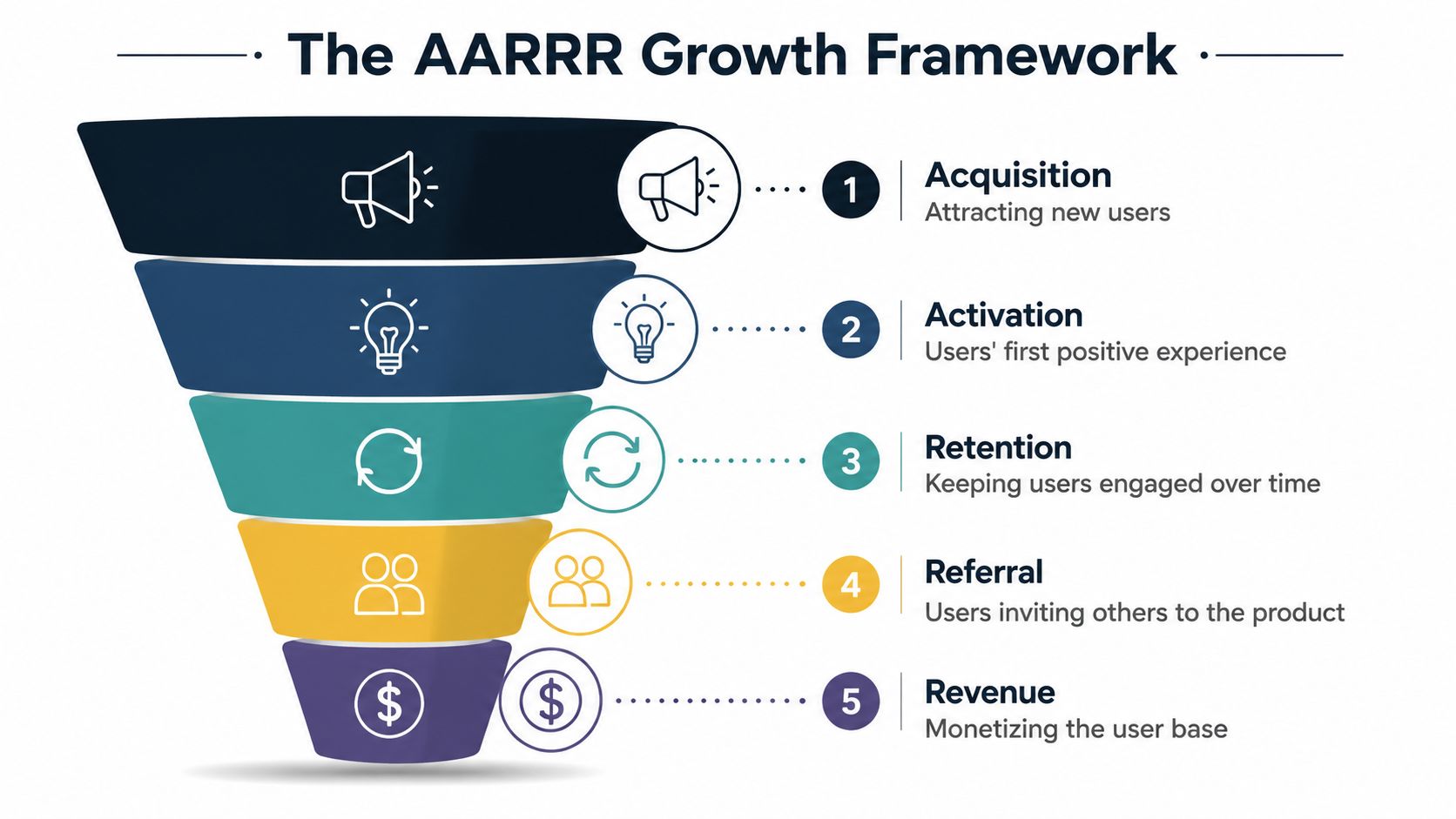
If you need a broader operating model around this, this growth strategy framework overview is a good companion because it helps map funnel stages to business priorities.
Acquisition means fit before volume
Acquisition answers one question. Are the right users entering the funnel?
Too many teams evaluate acquisition by lead count alone. That creates a hidden tax for the rest of the business. Marketing celebrates volume, sales qualifies harder, onboarding slows down, and product gets blamed for weak downstream conversion.
A better acquisition lens includes:
- Lead quality: Are inbound users close to your ideal customer profile?
- Channel-source fit: Which channels consistently bring users who activate well?
- Message match: Does the promise on the landing page align with the in-product experience?
Good acquisition work doesn't try to attract everyone. It filters aggressively so later stages perform better.
Activation is the first proof of value
Activation is the moment a user reaches meaningful value, not the moment they complete setup. That distinction matters. A user can create an account, invite teammates, and still fail to understand why the product belongs in their workflow.
Look for activation signals such as:
- Completion of a key workflow
- Use of a core feature linked to repeat usage
- Successful setup of the integration or data source that makes the product useful
The best activation metric is behavioral and product-specific. It should reflect real value, not administrative progress.
A lot of onboarding redesigns fail because teams optimize for speed instead of clarity. Fast setup is useful. Fast confusion is not.
The framework becomes easier to internalize when you see it applied in context:
Retention is where SaaS economics become real
Retention tells you whether the product keeps earning its place after the first win. At this point, many growth programs either mature or collapse.
Industry guidance summarized in Prospeo's SaaS growth strategy article notes median Net Revenue Retention is 101%, and that each point of NRR recovered adds roughly 5% growth without equivalent acquisition spend. That's why retention-first thinking is usually the most impactful move once acquisition is reasonably healthy.
Watch retention through multiple lenses:
| Metric | What it tells you |
|---|---|
| Logo retention | Whether accounts stay at all |
| Usage retention | Whether product engagement holds over time |
| Net Revenue Retention | Whether existing revenue base expands or contracts |
Teams often overreact to top-of-funnel softness and underreact to retention decay. That's usually backward.
Revenue is more than closing the first deal
In SaaS, revenue isn't a one-time event. It's the full monetization system. That includes initial conversion, pricing structure, plan progression, contract design, renewal conditions, and expansion timing.
Useful revenue metrics often include:
- Trial-to-paid conversion
- Expansion by segment
- Plan mix and upgrade path health
When revenue stalls, don't assume you need more leads. You may need cleaner packaging, better qualification, or a stronger handoff from sales to onboarding.
Referral works best after value is obvious
Referral is usually over-romanticized in B2B SaaS. Most products don't grow because users are eager to "share with friends." They grow because teams invite colleagues, agencies recommend tools to clients, or champions bring software into a new department.
Track referral through behaviors, not vanity:
- Invites sent within active accounts
- Partner-driven introductions
- Champion-led expansions to adjacent teams
Referral usually strengthens after activation and retention are already healthy. If users aren't getting value, they won't advocate for you. If they are, referral often shows up as a byproduct of adoption rather than a separate campaign.
Stage-Specific Growth Plays and Examples
Frameworks help with diagnosis. Growth happens when a team turns diagnosis into specific plays. The easiest way to make AARRR operational is to build a backlog of focused moves at each stage, tied to one constraint and one audience.
Independent SaaS guidance in Paddle's growth strategies resource puts churn management, pricing iteration, and monetization ahead of only adding more top-of-funnel activity. It also recommends planning for churn from day zero and testing pricing and packaging quarterly. That's the right instinct. Most stalled growth systems don't need more random motion. They need sharper intervention where value leaks.
Acquisition play for a niche workflow
A hypothetical compliance SaaS company notices that broad search traffic signs up but rarely activates. Instead of publishing more general content, the team builds a focused landing page and webinar series for one segment: multi-location operators with audit-heavy workflows.
The move works because it narrows the promise. Sales gets better context. Product demos feel more relevant. Onboarding starts with the specific workflow buyers care about. Acquisition improves not because traffic exploded, but because fit improved.
Activation play for time-to-value friction
A project management SaaS sees plenty of signups, but new accounts stall during setup. User interviews and support tickets show the same issue repeatedly: admins don't know what to configure first, and individual contributors don't see value until a template is already live.
The growth team responds with a role-based onboarding flow:
- Admins get a guided setup checklist with one recommended starting template.
- Managers see examples of completed workflows.
- Contributors land directly in an assigned task view instead of an empty workspace.
Nothing fancy happened. The team removed ambiguity. Activation tends to improve when users have fewer choices and clearer defaults.
Retention play for recurring churn reasons
A customer success platform keeps losing mid-market accounts after initial rollout. The churn notes aren't random. Accounts struggle when they reach a specific stage of maturity and need better reporting flexibility.
Instead of launching a broad re-engagement campaign, the company creates a retention play around the known risk moment. Customer success flags accounts approaching that stage, product adds guided reporting presets, and lifecycle messaging points users to the reports most tied to executive reviews.
Operator view: Retention work gets cheaper when you target recurring failure points instead of treating every churned account as a unique mystery.
Revenue play for packaging friction
A developer tool gets strong usage in smaller teams but weak expansion into larger accounts. The issue isn't demand. Procurement and finance teams don't understand the pricing logic, and product limits don't align with how bigger teams adopt the tool.
The team runs a packaging review. They simplify plan boundaries, align pricing with the value metric customers already discuss internally, and update the pricing page to explain when each plan fits. Sales enablement gets refreshed at the same time so reps don't improvise the story.
This is a classic growth move because it affects conversion and expansion together.
Referral play through champion behavior
An analytics SaaS wants more word-of-mouth growth but doesn't force a referral program. Instead, it studies accounts that naturally spread. The common pattern is simple: one internal champion builds a dashboard that other teams want.
So the company creates reusable dashboard templates, an easier sharing flow, and a short enablement sequence that helps champions present wins internally. Referral rises from useful artifacts, not incentives alone.
The lesson across all five plays is consistent. Effective growth work is rarely about adding more tactics. It's about identifying the narrowest change that fixes the biggest leak.
Building Your Growth Machine Experimentation and Prioritization
Good ideas are everywhere. Reliable growth teams are rare. The difference is operating rhythm.
A working SaaS growth strategy needs a disciplined loop that turns observations into decisions. Without that loop, teams jump from brainstorm to brainstorm, experiments overlap, and nobody can explain why a result mattered or what should happen next.
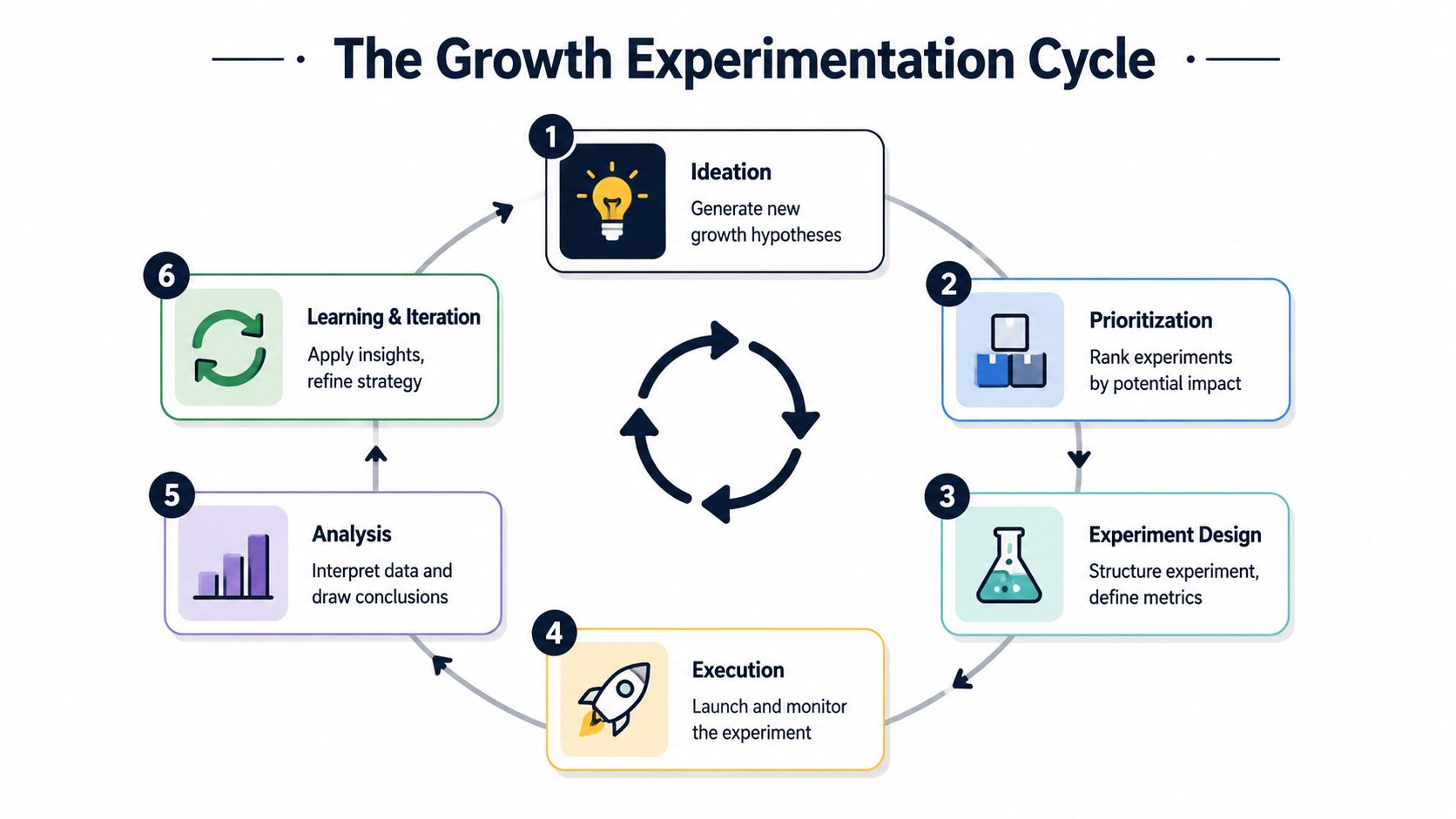
Use one repeatable loop
The simplest version is enough:
- Hypothesize based on observed friction or opportunity.
- Implement the smallest reasonable test.
- Measure against the metric that actually matters.
- Learn whether to scale, revise, or stop.
That loop sounds obvious. However, teams frequently skip steps. They launch without a clear hypothesis, measure too many things, then call the result "mixed" and move on.
A stronger hypothesis has three parts:
- Observation: What behavior or feedback suggests a problem?
- Change: What exactly are you altering?
- Expected effect: Which user behavior should change if you're right?
For creative-heavy acquisition tests, teams often benefit from faster production cycles. If you're iterating on ad concepts or short-form video variants, tools like ShortGenius AI ad creative tool can help generate and test creative directions more efficiently without turning the process into pure guesswork.
Prioritize with discipline, not excitement
A backlog gets noisy fast. The loudest idea in the room usually isn't the best one. That's why I like simple scoring models such as RICE. It forces the team to debate four things:
| Factor | What to ask |
|---|---|
| Reach | How many users or accounts could this affect? |
| Impact | If it works, does it change a meaningful business outcome? |
| Confidence | Do we have real evidence, or is this mostly opinion? |
| Effort | What will this cost in design, engineering, data, and enablement? |
You don't need perfect scoring. You need consistent scoring. The point isn't mathematical purity. The point is to stop treating every request as equally urgent.
Build a weekly decision cadence
A useful growth meeting is short and evidence-led. Mine usually follows this order:
- Review active experiments: What's running, what changed, what's blocked.
- Look at fresh signals: Funnel movement, support themes, sales objections, onboarding friction.
- Decide backlog order: Which one or two experiments move forward next.
- Assign ownership: One owner, one metric, one review date.
The fastest way to slow a growth team is to let five experiments launch with unclear owners and overlapping goals.
What not to do
Some patterns waste months:
- Running broad redesigns without diagnosis
- Changing onboarding, pricing, and lifecycle messaging at the same time
- Picking ideas because a competitor did something similar
- Letting engineering work start before success criteria are agreed
Experimentation should reduce uncertainty. If a test creates more ambiguity than it resolves, the design was probably too broad.
The strongest teams don't just collect ideas. They create a machine that converts signal into action, and action into a documented learning loop the whole company can use.
Unlocking Growth with Customer Feedback and Intelligence
Metrics tell you where users dropped, converted, expanded, or churned. They don't tell you why. That's the blind spot in a lot of SaaS growth strategy work.
A team sees a trial-to-paid decline and assumes the pricing page is weak. Maybe it is. But the actual issue could be poor onboarding for one persona, a missing integration that blocks setup, a sales promise that product doesn't meet, or a reliability issue showing up in support conversations long before churn hits the dashboard.
That's why growth teams need customer intelligence, not just analytics.
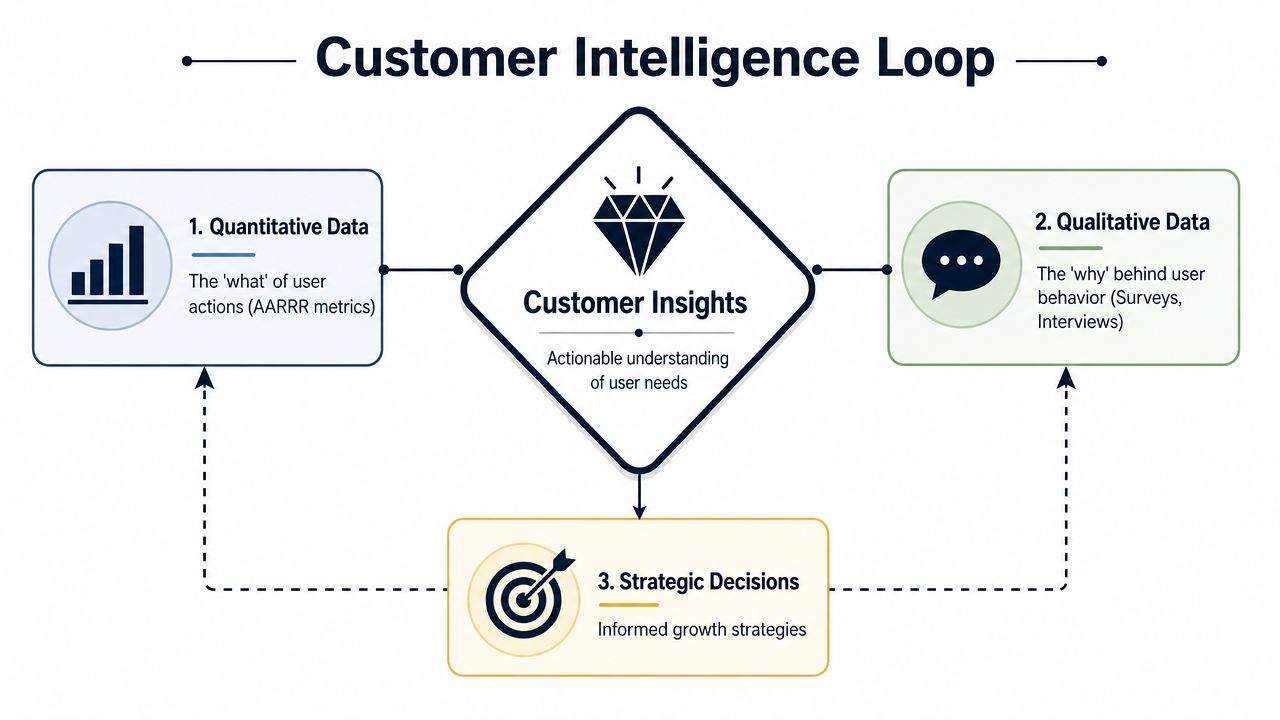
The real advantage is connecting behavior to language
The useful question isn't "what are customers saying?" in the abstract. It's "what are customers saying that correlates with conversion, churn, expansion, or stalled adoption?"
That means pulling evidence from places growth teams often underuse:
- Support tickets for repeated friction and unresolved bugs
- Sales call notes for buying objections and missing capabilities
- Onboarding conversations for setup confusion and expectation gaps
- Cancellation reasons for the moments value broke down
For teams building a formal process around this, a guide to analyzing customer feedback can help structure inputs so they become decision material instead of anecdotal noise.
Why AI matters here
The case for AI in this workflow isn't hype. It's throughput. A 2026 SaaS statistics roundup reports that spending on AI-native SaaS applications increased 108% year over year, and cites a projection for the global AI SaaS market to grow from **71.54 billion in 2023 to **775.44 billion by 2031, a projected 38.28% CAGR. The practical takeaway is straightforward: teams are using AI to process signals faster, personalize experiences sooner, and spot revenue-impacting patterns before manual review catches them.
That changes how growth teams operate. Instead of manually tagging a sample of tickets once a quarter, they can continuously cluster themes, tie them to behavioral cohorts, and identify which issues are associated with poor activation or increased churn risk.
A lightweight version of this can start with transcripts. If your team records discovery calls, onboarding sessions, or customer interviews, a comparison of WhisperAI's transcription service review is a useful starting point for choosing tooling that makes those conversations searchable and reviewable.
Turning feedback into experiments
The important step is not collecting more feedback. It's translating feedback into action. One practical workflow looks like this:
- Cluster recurring themes from support, calls, and surveys.
- Map themes to funnel stages such as activation drop-off or expansion hesitation.
- Check behavioral correlation by account type, plan, use case, or lifecycle stage.
- Write experiments from the pattern, not from a single loud anecdote.
This is also where a product intelligence platform such as SigOS can fit. It analyzes support conversations, sales calls, chat transcripts, and usage data to surface patterns linked to churn and expansion so product and growth teams can prioritize issues by revenue impact.
If you want cleaner experiments, stop asking only what users did. Ask what they were trying to do, what blocked them, and whether that pattern repeats in revenue outcomes.
Teams that combine quantitative funnel analysis with qualitative feedback usually find better opportunities than teams that rely on dashboards alone. They don't just optimize pages or emails. They fix the product and monetization issues that caused the numbers to move in the first place.
Your Path to Compounding Growth
A strong SaaS growth strategy isn't a campaign calendar. It's a system for making better decisions, faster, with less wasted effort.
That system starts with foundations. You need clear economics, a defined user segment, and a shared understanding of where value appears in the product. From there, AARRR gives the team a usable map. It helps separate acquisition problems from activation problems, retention problems from monetization problems.
The difference-maker is what happens next. Teams that compound growth don't stop at metrics. They build an experimentation rhythm, prioritize ruthlessly, and keep feeding the system with customer evidence. They know that a churn spike, a pricing objection, a drop in onboarding completion, and a cluster of support complaints may all be versions of the same problem.
The companies that keep growing aren't the ones chasing every new tactic. They're the ones building a loop between user behavior, customer language, product decisions, and revenue outcomes.
That's what makes growth durable. Each fix improves the next cohort. Each insight sharpens the next experiment. Each retained customer increases the value of every future acquisition effort.
If your current playbook feels stuck, don't ask which channel to add next. Ask where the system is leaking, what customers are telling you about that leak, and which change will improve compounding revenue rather than temporary activity.
If your team wants to connect customer feedback, product usage, and revenue signals in one place, SigOS is worth a look. It helps product and growth teams identify which issues and requests correlate with churn risk, expansion potential, and lost revenue so prioritization decisions aren't based on volume alone.
Keep Reading
More insights from our blog
Ready to find your hidden revenue leaks?
Start analyzing your customer feedback and discover insights that drive revenue.
Start Free Trial →