10 SaaS Retention Strategies That Drive Growth
Explore 10 saas retention strategies for onboarding, engagement, analytics, support, pricing, and product decisions that reduce churn.

Retention starts before the renewal conversation. The popular advice says SaaS retention is mainly a customer-success problem, solved through check-ins, discounts, or a last-minute rescue call. That view is too narrow. Customers usually reveal risk earlier through slow activation, declining usage, unresolved support issues, payment friction, weak product adoption, or a changing business need.
A stronger retention program treats every signal as part of a revenue-prioritization system. Teams rank interventions by two questions: how likely is this account to leave, and how much revenue or expansion potential is at stake? That changes how product, support, success, growth, and finance work together.
The timing matters. One benchmark reports that 60–70% of total annual churn occurs in the first 90 days, making onboarding, activation, and early value delivery especially important (SaaS Ultra's churn benchmarks). The same source reports average B2B SaaS monthly churn of 3.5%, including 2.6% voluntary churn and 0.8–0.9% involuntary churn, so retention work must address both perceived product value and payment reliability.
The ten strategies below connect behavior, customer health, feedback, product decisions, support operations, segmentation, and recovery workflows to measurable outcomes. Track retention rate, churn rate, net revenue retention, time-to-value, feature adoption, engagement, support resolution time, and expansion. Those metrics turn retention from a collection of campaigns into an operating discipline.
1. Behavioral Analytics and Usage Monitoring
Customer behavior often changes before a customer announces dissatisfaction. A team that monitors login frequency, workflow completion, feature interaction, and account-level engagement can identify weakening adoption while there's still time to respond. The signal isn't “the customer logged in less.” The useful question is whether the change affects the workflow that creates value.
A product analytics layer should connect usage patterns to customer outcomes and revenue. For example, a decline in a core reporting workflow may indicate implementation friction, while lower activity in an optional feature may mean very little. Tools such as Amplitude and Mixpanel can help product teams examine behavioral paths, and teams can use behavior analytics to identify retention signals across product activity and customer context.
Build signals that trigger action
Start with a baseline for healthy accounts, then compare customers with similar use cases, plans, and maturity. Avoid treating one universal engagement threshold as a churn prediction. A low-frequency workflow may be perfectly healthy for one segment and dangerous for another.
Useful monitoring practices include:
- Define meaningful events: Track actions tied to customer outcomes, not superficial clicks or raw sessions.
- Create behavioral segments: Separate new accounts, established accounts, power users, and dormant users so outreach reflects context.
- Alert on meaningful change: Notify teams when usage drops, key workflows stop, or adoption stalls after implementation.
- Connect behavior to value: Compare usage patterns with renewal, expansion, support, and churn outcomes.
- Validate predictions: Review whether flagged accounts experience the predicted risk, then refine the model.
A real-world scenario makes the distinction clear. If a project-management customer still logs in but stops creating shared workflows, a generic “active user” score could miss the risk. A workflow-based signal would prompt success or product teams to investigate whether collaboration has broken down.
Practical rule: Measure behavior against the customer's job to be done, not against activity for its own sake.
2. Proactive Customer Success Management
Proactive customer success turns retention into a revenue-prioritization system. Teams combine product behavior, support history, account value, and stated goals to decide which customers need attention before frustration becomes a cancellation decision. The right account gets the right intervention at the right moment, while healthy accounts avoid unnecessary outreach.
A useful health score reflects several signals rather than one activity measure. Usage can remain strong while unresolved tickets accumulate. A high-value customer may lack a documented success milestone, while new activity could indicate expansion potential instead of churn risk. Gainsight, HubSpot's Customer Platform, and Totango can organize health scoring and success workflows, but the operating rules determine whether those systems improve retention.
Design decisions around customer risk
Success criteria should be set during onboarding and revisited as the customer's business changes. A strategic account may require implementation planning, executive alignment, and integration support. A self-serve account may respond better to an in-app prompt, billing assistance, or targeted education. Prioritize interventions by likely revenue impact and the customer's specific obstacle, not by account volume alone.
A practical playbook records five decisions:
- Trigger: Which behavior, ticket pattern, or milestone activates the response?
- Owner: Which person or team handles it?
- Message: What customer problem does the outreach address?
- Next step: What action should the customer take?
- Outcome: Which retention or expansion measure indicates progress?
Consider an analytics customer that has stopped inviting colleagues. A discount addresses price, but the signal points first to an adoption or ownership problem. The CSM could ask whether reporting responsibilities changed, demonstrate collaboration workflows, and reconnect those workflows to the customer's original success criteria.
Measure the intervention as an operating investment. Track changes in adoption, support resolution, renewal confidence, and expansion activity after outreach. Meetings alone are an insufficient result. If a playbook creates conversations without improving customer outcomes, the team should revise its trigger, message, or next step rather than count internal activity as retention value.
3. Product Feedback Integration and Prioritization
Retention improves when feedback changes product decisions, not when requests accumulate in a backlog. Rank each problem through five questions:
- Revenue exposure: Which renewals, expansions, or sales opportunities could it affect?
- Customer prevalence: How many accounts report the same underlying problem?
- Retention relevance: Does it block activation, adoption, or a core customer outcome?
- Strategic fit: Does solving it support the product's intended direction?
- Evidence quality: Do usage and support data confirm the customer's description?
This framework turns feedback into a revenue-prioritization system. A repeated workflow failure may deserve attention before a popular feature request, while a request from a high-value account may take priority if it blocks expansion or threatens renewal. Teams should record the reasoning behind each decision, including the expected customer and revenue effect, so product, support, sales, and customer success teams use the same criteria.
Source quality still matters. Intercom can surface themes from customer conversations, Productboard can organize requests across segments and product areas, and teams can use Claude Artifacts for rapid synthesis of customer feedback to turn unstructured conversations into reviewable themes and decisions. These tools organize evidence. They do not determine whether a problem deserves product capacity.
Consider enterprise users requesting a complex integration while smaller customers ask for interface improvements. The decision depends on segment strategy, implementation constraints, evidence of adoption barriers, and revenue exposure. A product leader should document why one problem wins, identify what would change that decision, and communicate the outcome to affected customers even when the answer is no.
Close the loop with an outcome test. Tell customers when the underlying issue is addressed, explain how the change supports their workflow, and monitor adoption among affected accounts. Compare that behavior with the original retention signal, such as stalled usage or an unmet product outcome. Shipping without measuring the response leaves the retention hypothesis untested and makes future prioritization less reliable.
4. Revenue-Focused Churn Analysis and Prediction
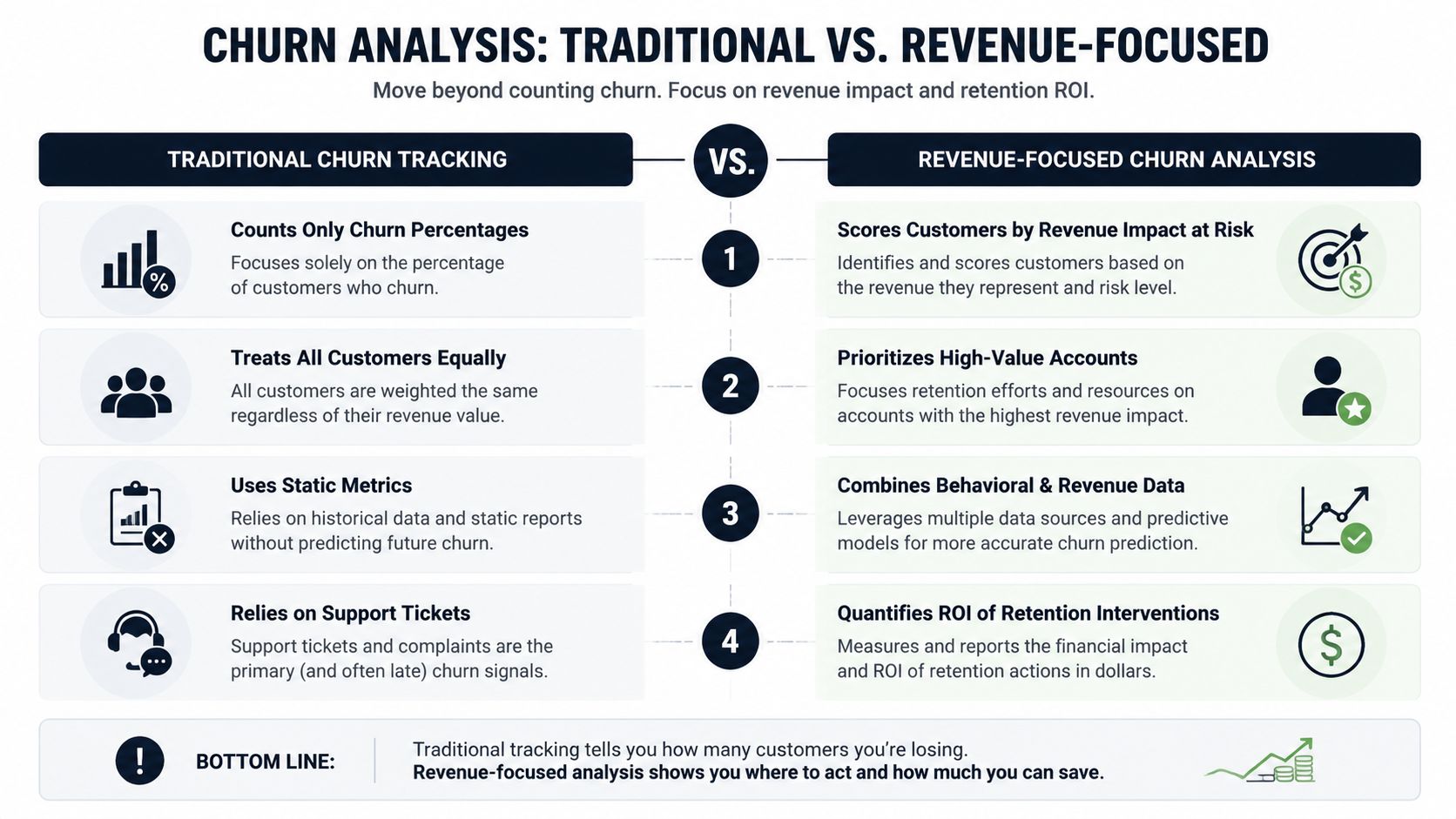
Logo churn counts departures but misses which ones cost the business most, which accounts remain recoverable, and where retention capacity can produce the greatest return. A revenue-focused analysis combines account value, expansion potential, contract context, product usage, churn probability, and intervention cost.
Prioritization should follow expected value rather than risk score alone. A low-ACV account may need an automated billing or onboarding correction, while a strategic account may justify coordinated executive and technical attention. Planhat and ChartMogul support revenue-cohort analysis, while predictive churn modeling can connect account signals with churn risk and potential revenue impact.
Rank risk by expected value
Use five questions to turn risk detection into an operating decision:
- How credible is the churn signal? Confirm the pattern with multiple indicators instead of treating one score as proof.
- What revenue is exposed? Include current recurring revenue and realistic expansion opportunity.
- What is driving the risk? Distinguish product dissatisfaction, implementation failure, service problems, and payment issues.
- What will intervention cost? Match human effort to the value that could plausibly be preserved.
- What can the team learn? Favor actions that test a repeatable retention hypothesis.
This framework directs senior attention toward accounts where intervention has both financial value and a reasonable chance of success. It also separates gross retention from expansion. An account that renews after materially contracting has a different commercial outcome from one that renews and grows.
Retention prioritization should combine likelihood, value, cause, and cost. A risk score without revenue context is an alert, not a decision.
Review the assessment whenever customer conditions change. Successful implementation can reduce exposure, while the departure of a key champion can increase it. A monthly review creates a baseline, but event-driven updates should follow major product, billing, or account changes. That cadence connects onboarding results, usage behavior, support events, and recovery actions to the revenue at risk, giving teams a consistent basis for deciding where to intervene.
5. Onboarding Excellence and Time-to-Value Acceleration
Onboarding is a revenue decision, not a welcome sequence. Its job is to move customers to a meaningful outcome before doubt, competing priorities, or implementation fatigue weaken adoption.
The first milestone should be specific to the product and tied to later usage. A collaboration product might define value as a team completing a shared workflow. A billing platform might use the first successful automated reconciliation. A developer tool might require a working integration in the customer's environment. Customers do not need to explore every feature before reaching these outcomes.
Use onboarding data to locate stalled steps, then route customers according to complexity and likely value:
- Fast track: A focused setup path for experienced users who want immediate progress.
- Guided implementation: Milestones, owners, and technical support for complex accounts.
- Role-based education: Separate instructions for administrators, operators, and executives.
- High-value assistance: Dedicated support where implementation failure could put substantial revenue at risk.
- Milestone measurement: Track value events and compare their completion with later retention behavior.
A short onboarding path risks stripping configuration that drives long-term adoption. Target time to meaningful value, not time to finish a checklist. That distinction helps teams prioritize setup work that changes customer outcomes instead of optimizing activity that may have little revenue impact.
Measure onboarding by what customers accomplish, not by how many screens they view. A completed value event can trigger the next product prompt, support check-in, or success review. Accounts that stall at a high-risk implementation step may warrant human intervention, while successful self-serve users can continue without added service cost. This connects onboarding effort to customer value and makes time-to-value a practical input for retention prioritization.
A product walkthrough can reinforce this principle:
6. Customer Segmentation and Personalized Engagement
Retention is a revenue-prioritization problem, so customer segments should determine where human effort, product guidance, and recovery actions go first. Customer economics, workflows, support expectations, and switching barriers vary substantially. Benchmark coverage reports monthly logo churn around 4.2% for SMB customers versus 0.7% for enterprise customers, with annual churn ranging from 40.3% in SMB to 8.1% in enterprise (Optif's analysis by ACV).
The operational implication is clear. SMB retention generally benefits from scalable activation, explicit value communication, and fewer billing obstacles. Enterprise retention more often requires implementation depth, integrations, stakeholder alignment, and credible expansion paths. Applying an enterprise QBR model to every small account can waste service capacity. Treating an enterprise customer like a self-serve user can leave high-value churn risk unaddressed.

Build segments that change decisions
Start with a limited set of operational groups defined by revenue tier, use case, industry, implementation complexity, and observed behavior. Looker and Segment can organize these dimensions, but a segment has value only when it changes the next action, owner, or level of service.
Record five decisions for each group:
- Primary value event: What must happen before the customer can recognize credible value?
- Common risk signal: Which behavior or unresolved issue indicates weakening adoption?
- Best intervention: What action addresses the risk without over-serving the account?
- Expansion path: Which workflow or capability could increase durable usage?
- Owner and cadence: Who acts, and when is the segment reviewed?
Personalization should follow risk and value, not demographic labels alone. A low-revenue account showing strong adoption may need automated education, while a larger account with stalled implementation may justify immediate success support. Review segments as account conditions change. A growing SMB account can become operationally complex, and an enterprise reorganization can reduce usage. Behavioral refinement keeps retention playbooks aligned with changing churn exposure.
7. Data-Driven Feature Prioritization Tied to Retention
A roadmap can be busy while retention risk remains untouched. Prioritization should therefore connect each proposed product change to customer value, revenue exposure, and the behavior associated with renewal.
Feature usage alone cannot establish that connection. A frequently used capability may frustrate customers, while an infrequently opened integration may support a workflow they cannot replace. Pendo and Mixpanel can help teams trace adoption and usage paths. A feature prioritization matrix gives product and revenue teams a shared way to compare customer value, account exposure, implementation effort, and retention evidence.
Start with a testable retention hypothesis. “Customers who complete this workflow are more likely to renew” can be measured. “This feature will improve engagement” needs a defined behavior and a demonstrated link to customer outcomes.
Use a short scorecard:
- Adoption velocity: How quickly do target users begin using the capability?
- Meaningful use: Do they complete the workflow tied to their goal?
- Segment impact: Does the relationship differ across SMB, mid-market, and enterprise accounts?
- Retention movement: Do exposed cohorts renew more often or contract less?
- Expansion behavior: Does adoption precede additional seats, workflows, or plan growth?
Prioritize changes that reduce churn exposure, even when they produce little launch attention. A reliability improvement may matter more than a popular discovery feature if it removes a recurring reason customers leave. The reverse can also occur: a well-liked feature may attract trials without becoming part of a repeatable workflow, limiting its revenue effect.
After release, compare the forecast with observed results. Review adoption among intended accounts, support volume, renewal outcomes, and whether the original problem was resolved. Product decisions then become part of a retention operating system, linking customer evidence to roadmap investment rather than rewarding visibility alone.
8. Transparent Communication and Roadmap Alignment
Roadmap transparency does not retain customers by itself. It reduces churn risk when communication helps an account judge whether the product will keep supporting its operating priorities. Customers assess the vendor's direction, decision quality, and reliability alongside the current feature set.
Notion's public roadmap, Slack's release communication, and GitHub's visible development direction represent different transparency models. Their shared lesson is consistency. Customers need to know what changed, why it matters, and how it connects to work they already perform.
Make roadmap communication a retention control
Release notes create awareness. Retention-oriented communication supports a decision: which workflow improves, which customers benefit, what action users should take, and whether existing configurations are affected.
Use five checks for every significant update:
- Connect releases to themes: State the customer problem behind the work.
- Set boundaries: Separate committed work from exploration.
- Show practical impact: Describe workflows and outcomes, not only features.
- Route customers to adoption help: Provide documentation, training, or success support.
- Close the loop: Tell contributors when their feedback influenced a decision.
The roadmap also needs confidence levels. Publishing every possibility can create expectations the product team cannot meet. A narrower plan with clear boundaries may build more trust than an expansive list of ambitions, especially for accounts making renewal decisions around unresolved requirements.
Communication should reflect account value and churn exposure. If renewal depends on data export, a generic newsletter is unlikely to address the risk. Product and success teams can send a targeted update covering release status, a temporary workflow, and the customer's operational requirements. If delivery is not immediate, the account still receives a usable plan and a clear basis for evaluating continued engagement.
Track whether this communication changes behavior. Useful measures include responses from at-risk accounts, adoption of interim workflows, support escalation, and renewal outcomes. Roadmap alignment therefore becomes part of revenue prioritization: teams spend communication effort where uncertainty threatens customer value, rather than treating transparency as a broadcast activity.
9. Automated Issue Detection and Rapid Resolution
Technical failures can create retention risk before a customer submits a ticket. A broken integration, degraded performance, or recurring workflow error reduces usage and weakens confidence. Automation detects these signals earlier, but an alert matters only when it identifies the customer impact and directs an appropriate response.
New Relic and Datadog can flag application and infrastructure anomalies. Support and product intelligence systems add account context by linking incidents to affected workflows, contract value, and churn signals. Teams can then distinguish a minor error with limited customer effect from a serious failure affecting a strategically important account.
Prioritize incidents by customer consequence
Engineering teams may rank incidents by error volume, severity codes, or system-wide metrics. Retention operations need a second view: which customers are blocked, how long the disruption has continued, and whether the affected workflow supports daily adoption or renewal value.
A practical incident process should connect detection to action:
- Impact-based alerts: Escalate failures in customer-critical workflows, not only spikes in total errors.
- Account mapping: List affected customers and their success owners.
- Revenue context: Include contract and expansion information when setting response priority.
- Resolution playbooks: Define steps for recurring incidents and known failure modes.
- Customer updates: Explain the effect, provide a temporary option when available, and share progress.
- Outcome measurement: Track time to detect, acknowledge, and restore the workflow.
Consider a CRM integration that stops syncing for several accounts. The technical alert identifies the failure. A retention-focused process also shows which customers depend on that connection for daily operations, allowing success teams to warn them before missing data becomes a surprise. Engineering can prioritize restoration according to the affected workflows and account consequences.
This process creates a direct link between product reliability and revenue protection. Rapid resolution preserves adoption, limits avoidable escalations, and gives customer-facing teams evidence that the vendor responds responsibly when the product fails. Teams should review incident patterns alongside churn and usage changes, then fix recurring causes rather than treating every alert as an isolated support event.
10. Win-Back Campaigns and Churn Recovery
Win-back campaigns are a revenue-prioritization system, not a final email sequence. Cancellation data can show whether lost value came from price sensitivity, missing functionality, weak implementation, organizational change, payment failure, or temporary inactivity. That diagnosis determines whether recovery is commercially sensible.
One benchmark separates B2B SaaS churn into 2.6% voluntary churn and 0.8–0.9% involuntary churn (Data-Mania's B2B SaaS benchmark summary). The distinction changes the workflow. A failed card requires payment recovery. A customer who could not implement the product needs a different intervention, and a discount alone may leave the underlying risk unchanged.
Start with account value and recoverability. Rank recent churners by revenue, expansion potential, stated reason for leaving, and evidence that the original problem can be addressed. High-value accounts deserve attention, but not automatically a discount. Price relief can help a price-sensitive customer while reducing value perception for someone who needs onboarding or an integration.
Use reason-specific recovery paths:
- Payment recovery: Retry failed charges, update payment details, and provide a clear route back to an active subscription.
- Product friction: Address the workflow that blocked value, with practical implementation support.
- Feature gap: Explain available alternatives, product direction, or a realistic workaround.
- Timing problem: Offer a pause or future reactivation path when the need is temporary.
- Competitive replacement: Identify what the alternative solved better before making an offer.
Spotify, Adobe, and Netflix illustrate re-engagement and return offers, but SaaS teams should apply the diagnostic principle rather than copy consumer mechanics. Use email warmup tools for responsible outreach operations, not to compensate for irrelevant messages.
Measure recovery beyond the reactivated invoice. Compare return rates, product usage, support needs, and renewed cancellations across recovery cohorts. A customer who returns and cancels again quickly may signal campaign success but retention failure. Sustained product value is the outcome that protects revenue.
10-Point Comparison of SaaS Retention Strategies
| Approach | 🔄 Implementation complexity | ⚡ Resource requirements & scalability | 📊 Expected outcomes | 💡 Ideal use cases | ⭐ Key advantages |
|---|---|---|---|---|---|
| Behavioral Analytics & Usage Monitoring | High, instrumentation, event modeling | High, analytics engineers, data pipeline, privacy controls | Early churn detection; feature adoption metrics; prioritized product fixes | Product-led SaaS with rich telemetry; teams needing proactive signals | Predictive churn detection; objective usage-driven decisions |
| Proactive Customer Success Management | Medium–High, processes, scorecards, playbooks | High, dedicated CS headcount, tooling, training | Reduced churn via outreach; higher expansion and customer health | Enterprise or strategic accounts requiring high-touch engagement | Deep relationship-building; targeted pre-emptive interventions |
| Product Feedback Integration & Prioritization | Medium, centralization and analysis workflows | Medium, feedback tooling, analysts, roadmap process | Better PMF; higher adoption of customer-requested features | Companies with high feedback volume wanting data-driven roadmaps | Aligns development to customer demand; closes feedback loop |
| Revenue-Focused Churn Analysis & Prediction | High, revenue attribution and modeling complexity | Medium–High, finance integration, analytics resources | Prioritized retention by dollar value; clear ROI of efforts | Businesses with diverse ARR and variable account value | Maximizes retained revenue; efficient allocation of retention spend |
| Onboarding Excellence & Time-to-Value Acceleration | Medium, workflow design and cross-team coordination | Medium, onboarding managers, content, in-app guidance | Faster time-to-value; reduced early churn; improved activation | New customers in first 30–90 days; high CAC products | Highest ROI period for retention; establishes long-term adoption habits |
| Customer Segmentation & Personalized Engagement | Medium, segmentation logic and maintenance | Medium, marketing/CS tooling, dynamic updates | More relevant messaging; targeted interventions; better resource use | Heterogeneous customer base needing tailored experiences | Improves relevance and conversion of retention programs |
| Data-Driven Feature Prioritization Tied to Retention | Medium, correlation analysis and experimentation | Medium, product analytics, stakeholder alignment | More impactful roadmap; reduced dev waste; improved retention | Product teams focused on linking features to CLTV | Focuses engineering on retention-critical capabilities |
| Transparent Communication & Roadmap Alignment | Low–Medium, cadence and content discipline | Low–Medium, comms, product marketing time | Increased trust; smoother renewals; clearer expectations | Companies aiming to strengthen customer trust and advocacy | Reinforces purchase decision; enables early customer feedback |
| Automated Issue Detection & Rapid Resolution | High, monitoring, integrations, alert tuning | Medium–High, SRE/engineering, observability tools | Reduced tech-driven churn; faster MTTR; proactive incident comms | SaaS with complex infra or high availability requirements | Prevents customer-impacting incidents; speeds resolution |
| Win-Back Campaigns & Churn Recovery | Low–Medium, campaign design and segmentation | Medium, marketing resources, incentives, analytics | Recovered revenue from lapsed users; learnings on churn reasons | Recent or high-value churners; periodic reactivation efforts | Cost-effective recovery vs. new acquisition; insights into churn drivers |
Turn the List Into a Retention Operating System
Ten tactics can still produce a fragmented program if each team optimizes its own queue. Product monitors adoption, support closes tickets, finance recovers payments, customer success schedules meetings, and growth sends win-back emails. Customers experience all of those activities as one relationship, so the company needs a shared prioritization system.
Start with the earliest and most consequential failure points. Fix onboarding friction and high-impact product issues before adding more lifecycle campaigns. If customers can't reach a meaningful outcome, additional messaging may increase contact without improving retention. If a recurring bug blocks a core workflow, a roadmap change or engineering fix may preserve more value than another QBR.
Then build the monitoring layer. Define leading churn signals for each customer segment, connect them to revenue context, and create intervention playbooks that specify ownership and next actions. Enterprise accounts may require integration depth, implementation support, and expansion planning. SMB-heavy businesses may benefit more from fast activation, self-service guidance, billing reliability, and automated recovery. Benchmark coverage places enterprise monthly logo churn around 0.5–1.5%, growth-stage mid-market around 1.5–3%, and Series A or SMB-heavy businesses around 3–5%, reinforcing the need for a segmented operating model (RetentionCheck's 2026 benchmark coverage).
After the signal and intervention system is working, use customer feedback to improve the roadmap. Treat feature requests, support themes, usage shifts, and churn reasons as connected evidence. Win-back programs come later, once the team can explain why customers leave and whether a recovered customer is likely to find durable value.
Rank every initiative using four dimensions:
- Customer impact: How directly does the work improve a customer's ability to achieve an outcome?
- Revenue at risk: Which current or potential revenue does it protect?
- Implementation effort: What product, engineering, data, or operational work is required?
- Time to learning: How quickly can the team observe whether the intervention worked?
A billing recovery workflow may offer faster learning than a major product redesign. A high-value integration may require more effort but protect a strategic customer motion. The decision should reflect both realities rather than reducing everything to a generic churn score.
Use the first 30 days to establish discipline. Define retention cohorts and baseline metrics. Identify the leading behavior, support, product, or payment signals associated with churn. Select one intervention for one segment. Instrument its outcome across usage, time-to-value, support resolution, renewal risk, or expansion. Review the results before scaling, changing the playbook when the evidence doesn't support the original assumption.
SigOS can fit into this operating model by connecting support tickets, chat transcripts, sales calls, and usage metrics to patterns associated with churn and expansion. Its product intelligence workflows can help teams surface issues, investigate churn signals, and prioritize customer feedback with revenue context. The platform should support a defined retention process, not become a replacement for customer judgment or clear ownership.
Retention becomes a growth system when the company knows which customers need help, why they need it, what the intervention costs, and whether the outcome improved. That is more durable than a renewal-season rescue effort.
SigOS connects customer feedback, support conversations, sales calls, and usage data to signals associated with churn and expansion, helping teams prioritize the issues most relevant to revenue retention. Visit SigOS to see how product intelligence can support a more focused SaaS retention strategy.
Keep Reading
More insights from our blog
Ready to find your hidden revenue leaks?
Start analyzing your customer feedback and discover insights that drive revenue.
Start Free Trial →