What is customer intelligence: Uncover insights that drive growth
Discover what is customer intelligence and how it turns raw data into actionable insights for smarter growth.

Picture your business for a moment. You’re likely swimming in customer feedback—support tickets, survey responses, call transcripts, and chat logs are pouring in every single day. It feels like a constant hum of noise. Customer intelligence is the system that cuts through that noise, acting like an advanced radar to pinpoint the clear, actionable signals that guide you toward growth and away from hidden risks.
From Data Noise to Revenue Signals
So many companies today are what you might call "data-rich but wisdom-poor." They collect mountains of information but can't seem to connect the dots in a way that actually helps the business. This is the exact problem customer intelligence was built to solve. It’s not just another software tool; it's a complete business strategy that weaves disconnected data into a single, unified view of your customer relationships.
Traditional analytics might tell you what happened. For example, your dashboard might show that the support team handled 100 tickets about a specific bug. That's good to know, but it’s missing crucial context. You know there’s a fire, but you have no idea how big it is or if it’s more important than the other fires happening at the same time.
The Power of Context
This is where customer intelligence changes the game entirely. It goes beyond the what to answer the far more important question: why does it matter?
Instead of just flagging those 100 tickets, a true CI system pulls in other critical pieces of information to create a complete picture:
- Financial Data: It reveals that those 100 users are tied to $2 million in annual recurring revenue (ARR).
- Behavioral Data: It shows that product usage among these customers has plummeted by 40% in the last month.
- Sentiment Data: It analyzes the language in the tickets, automatically flagging the tone as highly frustrated and at-risk.
All of a sudden, what looked like a minor bug is exposed for what it really is: a major churn risk threatening a huge chunk of your revenue. This is the fundamental shift—moving from simply reacting to problems to making proactive, revenue-aware decisions.
By unifying qualitative feedback with quantitative business metrics, customer intelligence gives every piece of data a dollar value. This allows your teams to stop guessing and start prioritizing the work that will have the biggest impact on the bottom line.
Customer Intelligence vs Traditional Analytics
To make this distinction crystal clear, here’s a breakdown of how these two approaches differ. Traditional analytics provides a rearview mirror, while customer intelligence offers a forward-looking GPS.
| Aspect | Traditional Analytics | Customer Intelligence |
|---|---|---|
| Primary Goal | Reports on past performance (the what) | Uncovers the why behind the numbers to predict future outcomes |
| Data Sources | Primarily quantitative (e.g., web traffic, sales numbers) | Unifies quantitative and qualitative data (e.g., tickets, surveys, call logs) |
| Focus | Departmental silos (marketing, sales, support) | A single, unified view of the entire customer journey |
| Output | Dashboards and historical reports | Actionable signals, revenue impact, and prioritized issues |
| Business Value | Identifies trends and measures KPIs | Drives strategic decisions, reduces churn, and finds expansion opportunities |
This unified approach creates the foundation for a business that’s truly built for growth. It empowers your product, success, and support teams to operate from a single source of truth, aligning everyone’s efforts on the things that actually move the needle. Instead of getting lost in the noise, you can finally focus on the signals that predict churn, highlight expansion opportunities, and drive real, sustainable growth.
To dig deeper into the specific tools that make this possible, you can learn more about how customer insights platforms operate in our detailed guide.
The Engine Behind Powerful Customer Intelligence
Think of a modern customer intelligence platform as a high-performance engine. Its fuel isn't just one thing; it's a blend of different data streams. You have the hard numbers—quantitative metrics like product usage and behavioral trends—but you also need the rich, qualitative context that's usually trapped inside your support and communication tools.
This combination is what gives customer intelligence its real power. It finally connects what your customers do with what they say. For instance, a platform might pull in behavioral data from your app, support tickets from Zendesk, chat logs from Intercom, and even engineering tasks from Jira or GitHub. On their own, these are just disconnected, noisy signals.
From Data to Actionable Signals
But here's where it gets interesting. The real work happens in the processing layer, where AI and machine learning step in to connect those dots in ways a human analyst simply can't. This engine is built to cut through the chaotic flood of information and spot the patterns hidden beneath the surface. It can analyze sentiment across thousands of conversations to find widespread frustration that might otherwise fly under the radar.
This concept map shows how that raw data gets refined into sharp insights and, eventually, confident action.
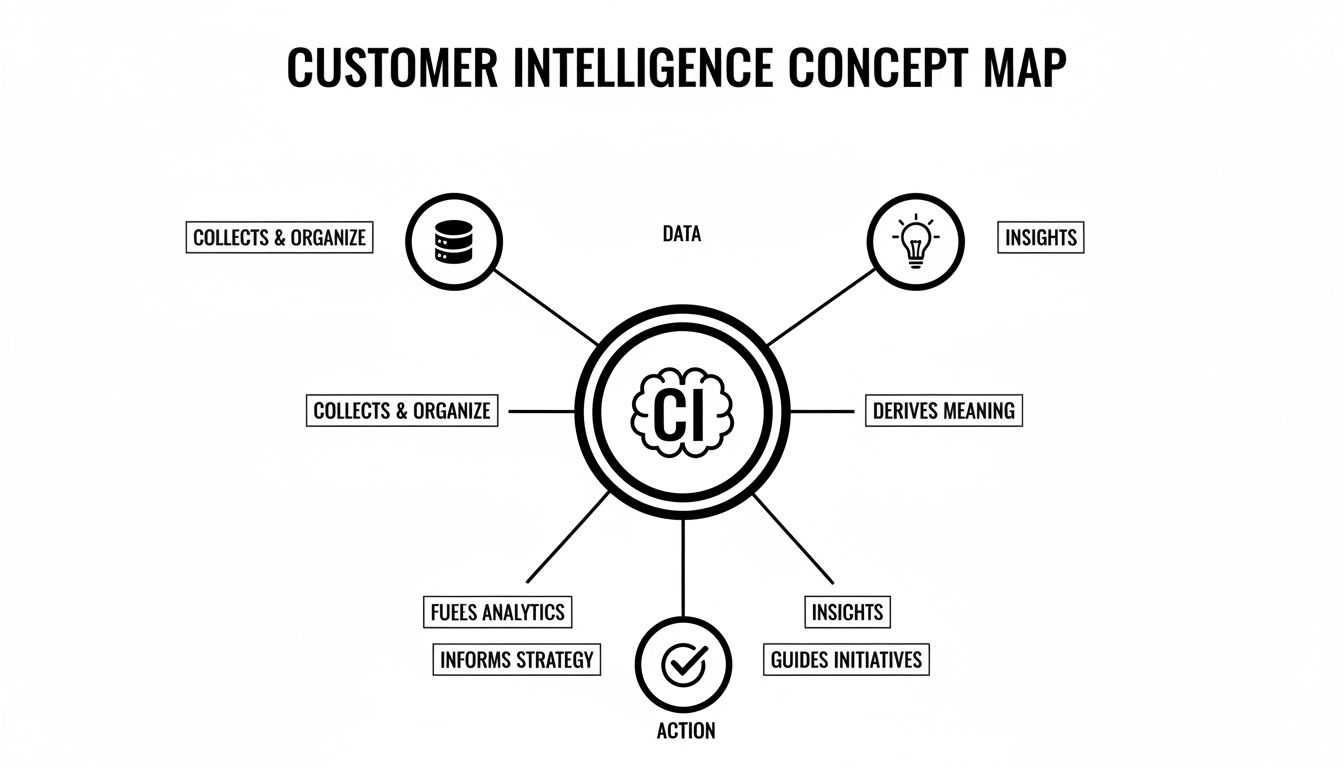
As you can see, there’s a clear flow: data comes in, the intelligence engine turns it into insights, and those insights empower your teams to make smart business moves.
A platform like SigOS acts as the central hub for this whole operation. It doesn't just gather data; it pulls it all together into a single, prioritized view that tells your team exactly what needs attention. Imagine seeing a dashboard that highlights a bug not by how many tickets it generated, but by the $50,000 in monthly recurring revenue it’s putting at risk. This is the engine turning noise into intelligence.
By connecting qualitative feedback with quantitative business metrics, a customer intelligence engine transforms vague complaints into clear, revenue-based priorities. It answers the crucial question: "Of all the things we could work on, what should we work on right now?"
The Importance of High-Quality Fuel
Of course, the performance of this engine depends entirely on the quality of the fuel you put in it. To get the most out of your customer intelligence efforts, you have to collect customer feedback effectively. This is about more than just sending out surveys; it's about creating channels where customers can give you honest, unfiltered input.
Here’s a look at how the engine uses different types of "fuel" to produce valuable insights:
- Support Tickets: Pinpoints recurring bugs and friction points that frustrate customers and drain your support team's time.
- Behavioral Data: Flags declining product usage, often the earliest warning sign of churn, long before a customer ever complains.
- Sales Calls: Surfaces common feature requests or objections from high-value prospects, revealing untapped market opportunities.
- CRM Data: Ties every piece of feedback and behavior back to a specific account, letting you see the dollar value attached to every single issue.
By bringing all these sources together, the engine gives you a complete, 360-degree picture. It shifts your teams from a reactive posture—constantly putting out fires—to a proactive one, where you can anticipate customer needs and make strategic decisions that protect revenue and drive growth.
Turning Customer Insights Into Tangible Business Value

It’s one thing to understand what customer intelligence is, but the real question everyone asks is: how does it actually make the business money? A solid CI strategy does more than just generate interesting reports; it creates a direct line between what your customers are saying and your company's bottom line.
Ultimately, it empowers your teams to make smart decisions that protect and grow revenue. This impact is felt most strongly in three key areas: stamping out churn before it happens, finding new expansion opportunities, and taking the guesswork out of product roadmapping.
Proactively Reducing Customer Churn
Think of customer intelligence as an early-warning system for at-risk accounts. Instead of getting blindsided by a cancellation notice, you can spot the subtle signs of trouble long before a customer decides to leave.
For instance, a good CI platform might notice that a high-value account has filed a few frustrated support tickets and, at the same time, their product usage has started to drop off. That's a huge red flag. This gives your customer success team a crucial heads-up, allowing them to step in with the right context, solve the problem, and save the relationship.
Uncovering Hidden Expansion Opportunities
Some of your biggest growth opportunities are hiding in plain sight within your existing customer base. The trick is knowing where to look. Customer intelligence sifts through all the feedback coming from your healthiest, most successful accounts to find these gold nuggets.
Imagine your platform flags that three of your fastest-growing clients have all requested the same specific feature. That’s not just a feature request anymore—it's a clear, data-backed signal for a potential upsell or a new product tier. Following up on that insight could easily unlock six-figure deals that you would have otherwise completely missed.
By assigning a dollar value to every feature request and bug report, customer intelligence ends the guesswork. It transforms product development from a subjective art into a revenue-driven science.
Prioritizing Your Roadmap with Revenue Data
For any product team, deciding what to build next is a constant battle of competing priorities. Customer intelligence cuts through the noise by tying every potential project directly to revenue.
Instead of debating which bug fix is more important, a product manager can see that one issue is impacting accounts worth $500,000 in annual revenue, while another only affects a few smaller users. The right decision becomes instantly obvious.
This data-driven clarity is quickly becoming a must-have. The customer intelligence market is expected to balloon from USD 3.72 billion in 2026 to USD 11.27 billion by 2032 as more businesses catch on. It’s a massive shift, and for good reason—some companies are already seeing churn reductions of 15-20% by using this kind of multi-source analysis.
To dig deeper into how this works in the real world, check out our guide on key metrics and reporting for customer success.
Customer Intelligence in the Real World
All the theory is great, but what does customer intelligence actually do? It's one thing to talk about data and analytics, but it’s another to see how it can save a critical account or shape a product roadmap.
Let's walk through a few real-world scenarios. We'll look at how CI helps teams move from guessing about problems to solving them with confidence.
Use Case 1: Spotting the Silent Churn Risk
Picture one of your best customers. They’ve been quiet lately—no new support tickets, no complaints. On the surface, everything seems fine. But what your customer success team can't see is that their product engagement has quietly plummeted by 60%.
This is where a customer intelligence platform acts as a lookout. It flags the sharp drop in activity and, more importantly, connects it to a seemingly minor support ticket that was closed two weeks ago without a real resolution. The combination of these two signals triggers an urgent, context-rich alert for the account's customer success manager.
Instead of a generic check-in, the CSM can now have a specific, helpful conversation. They address the root cause of the user’s frustration, not only preventing a potential cancellation but also uncovering a friction point that was likely affecting other customers, too.
Customer intelligence is your early warning system. It detects the subtle signs of customer dissatisfaction that precede churn, giving you the chance to intervene before it’s too late.
Use Case 2: Finding the Hidden Expansion Play
The product team is stuck in a familiar debate: which major feature should they build next? The head of engineering has one idea, the VP of Product has another, and the decision feels like it’s being driven by opinions, not evidence.
Instead of guessing, the team uses their CI platform to analyze recent sales call transcripts and demo notes. A powerful pattern emerges. Three separate enterprise prospects—each representing a potential six-figure deal—have all asked for the exact same unbuilt capability.
Suddenly, the debate is over. The team now has a data-backed business case. They can confidently prioritize the new feature, knowing it directly addresses a need from a high-value market segment and has a clear path to generating new revenue.
Use Case 3: Calculating the True Cost of a Bug
Every engineering team has a backlog that feels a mile long. A bug that seems minor keeps getting reported, but it’s constantly pushed down the priority list in Jira in favor of more "exciting" feature work. It’s just an annoyance, right?
A customer intelligence platform can show you what that "annoyance" is actually costing you. By connecting every user who reported the issue to their account data, it reveals that this “minor” bug is actively frustrating a group of users who contribute $150,000 in monthly recurring revenue.
The bug is immediately escalated from a low-priority task to a critical fix. What seemed insignificant is now correctly identified as a major revenue risk, justifying the immediate allocation of engineering resources to solve it.
This shift toward data-driven decisions is why the global customer intelligence platform market is growing so rapidly. Valued at USD 3,092.7 million in 2024, it's projected to hit USD 13,812.8 million by 2030. For businesses using platforms like SigOS, this means getting daily, actionable alerts that tie customer behaviors directly to revenue outcomes. You can discover more insights about these market trends and their impact on Grandviewresearch.com.
How to Build Your Customer Intelligence Strategy

Ready to get serious about customer intelligence? The key is to see it as a new way of operating, not just another piece of software you have to buy. It's about building a practical process that turns scattered customer feedback into a clear, revenue-focused plan.
This might sound like a huge undertaking, but it doesn't have to be. Let's break it down into manageable steps that get you to the good stuff—the results—faster.
Map Your Data Universe
First things first: you can't connect your data until you know where it all is. Right now, your customer insights are likely scattered across a dozen different apps, a whole universe of disconnected information. Your first job is to draw a map.
Start by auditing every tool and system that holds a piece of the customer story. You’ll probably find data in more places than you expect, but they generally fall into a few key categories:
- Feedback & Support: Think about all the places customers talk to you directly. This includes support tickets in Zendesk, live chats in Intercom, and any survey tools you use.
- Behavioral Data: This is all about what customers do. Look at your product analytics tools like Mixpanel or Amplitude that track user engagement and specific actions.
- CRM & Sales Data: Your commercial data holds critical financial context. Systems like Salesforce contain everything from account size and contract value to notes from sales calls.
Once you have this map, you’ll finally have a clear view of what you're working with. This step is absolutely essential for understanding the true scope of your project.
Define Your North Star
All that data is worthless without a clear target. A customer intelligence initiative needs a specific business goal, or you'll just be collecting information for the sake of it. You need to decide what success actually looks like in real, measurable terms.
Your “North Star” goal needs to be a concrete business outcome, not a fluffy aspiration. Forget "improve customer satisfaction." Instead, aim for something like, “reduce customer churn among enterprise accounts by 15% in the next six months.”
Having this kind of clarity forces everyone to focus on what matters and makes it incredibly easy to prove the ROI of your work. For teams just starting out, learning how to implement self-serve analytics can provide a great framework for setting and hitting these kinds of goals.
Select the Right Technology
Now that you know what data you have and what you want to achieve, it’s time to find the right platform to act as your central hub. A good tool doesn't just collect data—it connects it, analyzes it, and makes it genuinely useful for your teams.
When you're looking at different CI platforms, focus on the features that will directly help you hit your North Star goal. I'd prioritize these capabilities:
- Automated Integrations: Can the platform connect to your existing stack (Zendesk, Salesforce, Jira, etc.) without a massive engineering project?
- Revenue Impact Scoring: Does the system automatically tie a dollar value to customer feedback, bugs, and feature requests? This is what separates insights from noise.
- Proactive Alerts: Will the platform notify your team about emerging churn risks or high-value opportunities before it's too late?
Choosing a platform like SigOS, which is built from the ground up to deliver these revenue-focused insights, ensures your technology is a business tool, not just a data repository. From there, the final piece of the puzzle is weaving these insights into your team’s daily work, making data-driven decisions the default, not the exception.
Frequently Asked Questions About Customer Intelligence
Any time you explore a new way of looking at your business, questions are bound to pop up. Getting straight answers is the best way to cut through the noise and figure out if an approach like customer intelligence is right for you.
Let's tackle a few of the most common questions we hear from teams who are just starting to connect their customer data to actual revenue. This should help clarify how it all works, no matter the size or technical know-how of your company.
Is This Just Business Analytics With a New Name?
It’s easy to see why people ask this, but thinking of customer intelligence (CI) as a simple rebrand of business analytics misses the most critical distinction. Traditional analytics is fantastic at telling you what happened. For instance, it might show that your team handled 500 new support tickets last week. That's a fact.
But customer intelligence is designed to tell you why it happened and, more importantly, why it matters. It doesn't just see 500 tickets; it connects them to other data points. It might reveal that those tickets came from a handful of high-value accounts whose product usage has been steadily dropping. Suddenly, that number isn't just a metric—it's a massive churn risk.
Analytics gives you the numbers; intelligence gives you the story behind them. It turns raw data into a clear, prioritized action plan so you can get ahead of problems instead of just reacting to them.
How Much Technical Expertise Do I Need?
This is probably the biggest concern we hear, but the good news is that modern CI platforms are built for business users, not data scientists. The entire point is to get these insights into the hands of the people who can act on them—like product managers, customer success leads, and support teams.
Thanks to no-code integrations and user-friendly dashboards, you don't need to write a single line of code. Your team can connect the tools they already use and start seeing a unified view of the customer almost immediately. The heavy lifting, like sifting through data and finding patterns, is handled by AI behind the scenes. This breaks down the data silos that so often become bottlenecks.
The demand for this kind of accessibility is fueling incredible growth in the market. The customer intelligence platform market was valued at US****3.26 billion in 2024 and is on track to hit US****16.62 billion by 2032. This boom is happening because leaders need AI-driven tools that can make sense of all the feedback coming from places like Zendesk and Intercom, connect it to usage data, and predict churn with up to 87% accuracy. You can read more about the industry's growth trajectory on OpenPR.com.
Can CI Really Work for a Small Business?
Absolutely. There's a persistent myth that customer intelligence is only for giant corporations with endless budgets and dedicated data science departments. While enterprise companies certainly have more data to manage, the core problem is universal: customer feedback is scattered, making it nearly impossible to spot major risks and opportunities.
For a small or mid-sized business (SMB), the impact of these insights can be even more profound. Think about it:
- Preventing Churn: Losing even one key customer can throw off an entire quarter for an SMB. CI helps you see the warning signs before it's too late.
- Prioritizing Development: What if you could identify the one feature that would unlock an entirely new customer segment? For a small company, that's a game-changer.
- Improving Efficiency: With a smaller team, you can't afford to waste time. CI points you directly to the accounts and issues that need your attention most.
Ultimately, customer intelligence helps you make smarter, higher-impact decisions with the resources you already have. That makes it an incredibly powerful strategy for a business of any size.
Ready to stop guessing and start prioritizing with revenue-driven insights? SigOS is the AI-driven platform that connects customer feedback to real business outcomes. See how SigOS can help you build a smarter product strategy today.
Keep Reading
More insights from our blog
Ready to find your hidden revenue leaks?
Start analyzing your customer feedback and discover insights that drive revenue.
Start Free Trial →